

|
Opera Limited (OPRA): PESTLE Analysis [Apr-2026 Updated] |
Fully Editable: Tailor To Your Needs In Excel Or Sheets
Professional Design: Trusted, Industry-Standard Templates
Investor-Approved Valuation Models
MAC/PC Compatible, Fully Unlocked
No Expertise Is Needed; Easy To Follow
Opera Limited (OPRA) Bundle
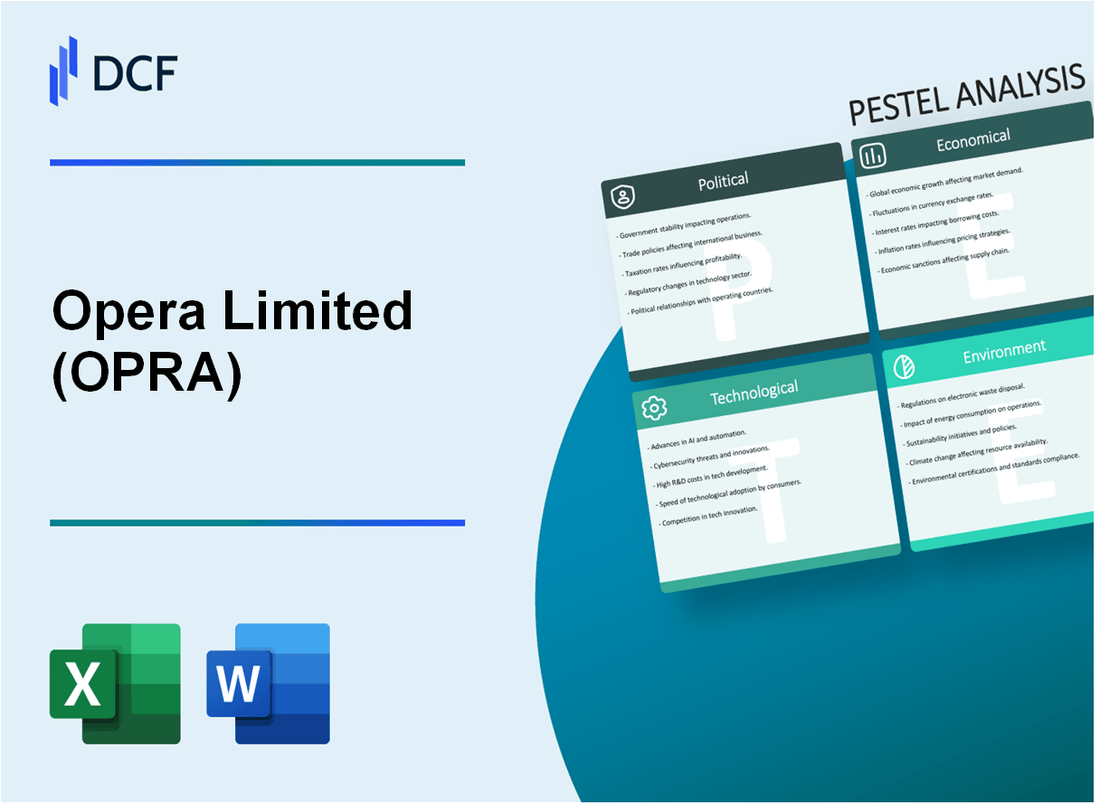
You need to know if Opera Limited (OPRA) is a smart bet, and right now, the answer is complex: the company is sitting on a massive, high-growth user base-projected to hit 320 million Monthly Active Users-but it's also walking a tightrope between US-China geopolitical tension and stricter EU data laws. While the global digital advertising market is a clear tailwind, expected to grow by 9.5% in 2025, the real differentiator is their rapid integration of generative AI like Aria, which is defintely a necessary move to counter platform control by rivals. We've broken down the Political, Economic, Sociological, Technological, Legal, and Environmental factors to show you exactly where the risks are highest and where the near-term revenue opportunities lie.
Opera Limited (OPRA) - PESTLE Analysis: Political factors
You're looking at Opera Limited's strong financial growth-revenue guidance of up to $597 million for fiscal year 2025 is defintely impressive-but you can't ignore the political headwinds. The company's majority Chinese ownership is the single biggest political risk factor, creating a permanent cloud of regulatory and geopolitical scrutiny over its US-listed shares and global data practices.
US-China geopolitical tension creates delisting risk for US-listed, Chinese-owned firms.
The core political risk for Opera Limited stems from its ownership structure. As of July 2025, Kunlun Tech Co., Ltd., a public company, holds a controlling stake of approximately 69% of the shares outstanding. This majority Chinese ownership keeps the company squarely in the crosshairs of US-China geopolitical tensions, particularly regarding data security and market access.
The persistent concern is that the US government, or a regulatory body like the Securities and Exchange Commission (SEC), could eventually mandate stricter audit requirements or even delisting for US-listed companies controlled by entities in jurisdictions deemed non-cooperative. Here's the quick math on the market impact: despite projecting a robust Adjusted EBITDA between $138 million and $141 million for FY 2025, the stock often trades at a lower valuation than peers, a discount largely attributed to this ownership risk and the associated data-privacy concerns.
This risk is not abstract; it's a tangible threat that impacts investor sentiment and capital raising. One clean one-liner: Geopolitics is the ultimate valuation headwind.
Data localization laws in key markets like India and the EU increase operational costs.
Governments worldwide are tightening their grip on where their citizens' data is stored and processed, a trend called data sovereignty or data localization. For a global browser company with 289 million average monthly active users (MAUs) as of Q2 2025, this means higher compliance costs and a more complex infrastructure footprint.
In the European Union, the General Data Protection Regulation (GDPR) already allows for massive fines, up to €20 million or 4% of global turnover, for non-compliance with cross-border data transfer rules. In key growth markets like India, the Digital Personal Data Protection Act introduces penalties that can reach up to INR 2.5 billion (approximately €27.5 million) for significant breaches. To be fair, this forces Opera to invest in regional data centers and compliance teams, which increases operating expenses-Q2 2025 operating expenses were already up 40% year-over-year to $124.9 million, partly reflecting the cost of scaling and compliance across different legal regimes.
| Region/Legislation | Compliance Impact | Maximum Financial Penalty (2025) |
|---|---|---|
| European Union (GDPR/Data Act) | Requires local data storage, strict consent, and reduced dependency on foreign cloud providers. | Up to €20 million or 4% of global turnover. |
| India (Digital Personal Data Protection Act) | Mandates local data processing/storage for certain data types, increasing infrastructure costs. | Up to INR 2.5 billion (~€27.5 million). |
| China (Regulations on Network Data Security Management) | Stricter compliance requirements for data security, potentially impacting data flow for its Chinese ownership. | Varies by severity, focused on comprehensive compliance. |
Government pressure on app stores (Apple, Google) affects distribution channels and terms.
Governmental antitrust action against the major app store gatekeepers, Apple and Google, presents both a risk and a significant opportunity for Opera. In June 2025, the bipartisan Open App Markets Act was reintroduced in the US Senate, aiming to curb the monopolistic control of these platforms. Similarly, the EU's digital competition laws are forcing Apple to make changes to its App Store payment rules in Europe.
If this regulatory pressure succeeds, it could force Apple and Google to allow third-party app stores or alternative payment systems. This would help Opera by lowering the cost of user acquisition and in-app monetization, potentially freeing up capital. But, still, any regulatory change that forces a platform to alter its entire ecosystem is a risk, as it could unintentionally disrupt Opera's current distribution model, which is heavily reliant on those same app stores for its mobile browser growth.
- Opportunity: New US/EU laws could reduce the 15-30% commission fees paid to app stores.
- Risk: Any sudden, forced change to platform rules could disrupt user acquisition flows.
- Action: Regulatory bodies, like the German government, are already asking Apple and Google to remove apps with data transfer concerns, which sets a precedent for foreign-owned tech companies like Opera.
Increased scrutiny on data collection practices by foreign-owned tech companies.
The political climate of distrust toward foreign-owned technology, especially from China, translates directly into intense scrutiny of Opera's data collection and transfer practices. Opera's business model relies heavily on advertising revenue, which grew 44% year-over-year in Q2 2025 and accounted for a significant portion of its total revenue of $143.0 million. This advertising is fueled by user data.
What this estimate hides is the potential cost of a privacy investigation. Opera itself acknowledges the risk that concerns about data collection, even if unfounded, could damage its reputation and cause user loss. Furthermore, the company's new AI chatbot, Aria, utilizes third-party AI services like OpenAI and Google, adding another layer of complexity to data processing and cross-border data transfer, which is a magnet for regulatory bodies in the US and EU. The political environment essentially weaponizes any data-handling misstep against companies with significant foreign ownership.
Opera Limited (OPRA) - PESTLE Analysis: Economic factors
You're looking for a clear picture of the economic forces shaping Opera Limited's (OPRA) 2025 performance, and the takeaway is simple: strong tailwinds from global digital advertising growth are battling significant currency and emerging market inflation risks. The company's core monetization strategy, Opera Ads, is thriving, but the geographic mix of its revenue exposes it to volatile macroeconomic pressures.
Here's the quick math: Opera Limited raised its full-year 2025 revenue guidance to a range of $567 million to $582 million, largely fueled by advertising growth that hit 63% year-over-year in Q1 2025 to reach $95.6 million. That growth is tied directly to the global digital ad market's expansion.
Global Digital Advertising Spend is a Strong Tailwind
The overall market environment for Opera Limited's primary revenue stream-advertising-remains highly favorable. Digital ad spend globally is forecast to grow by a robust 7.9% in 2025, reaching an estimated total of $678.7 billion. This secular trend, driven by programmatic advertising and the shift to mobile, directly supports the company's Opera Ads platform.
The expansion is concentrated in performance-based advertising, which is Opera Limited's sweet spot. Programmatic advertising is projected to grow by 8.4% in 2025, and search spending, a key component of their revenue, is expected to grow by 8.3%. This means the engine powering their revenue is running hot. You simply cannot ignore that kind of market momentum.
High Inflation Rates in Emerging Markets Pressure Consumer Spending
Opera Limited has a significant user base and revenue concentration in high-growth emerging markets, which are currently grappling with high inflation. This is a real headwind because it directly impacts the consumer's disposable income and, consequently, their willingness to spend on premium digital services or react to advertising.
Consider the divergence in key markets:
- Nigeria: The annual inflation rate was a staggering 16.05% in October 2025, with forecasts projecting it to ease slightly to 14.70% by the end of Q4 2025.
- Indonesia: In contrast, Indonesia's year-on-year headline inflation was much lower, at just 0.76% in January 2025.
This massive gap shows that while some emerging markets are stabilizing, others like Nigeria are experiencing cost-of-living crises that will defintely constrain the average revenue per user (ARPU) growth, especially for non-essential services.
Currency Fluctuations Reduce International Revenue
Currency risk, specifically a strong US Dollar, is a constant threat to any company with significant international revenue, and Opera Limited is no exception. A sustained strengthening of the US Dollar Index, which saw a key technical breakout above the 100 level in November 2025, acts as a foreign exchange (FX) headwind.
Here's how it works: revenue generated in local currencies (like the Nigerian Naira or the Euro) converts into fewer US Dollars when repatriated. This directly reduces the reported USD revenue and Adjusted EBITDA. Opera Limited's revenue is heavily international, so a strong dollar can shave millions off the top line, regardless of local business performance.
Economic Slowdowns in Core European Markets Dampen Ad Revenue
While the overall Eurozone is not in a deep recession, its growth is modest, and advertiser sentiment is cautious. Eurozone GDP growth is projected at a moderate 1.3% for 2025. This slow growth is already translating into tighter ad budgets.
The risk is concentrated in desktop advertising, which is a key part of the browser business model. A Nielsen survey indicated that 60% of European marketers were likely or very likely to reduce ad spend in 2025, a higher percentage than the global average of 54%. The broader EMEA (Europe, Middle East, and Africa) region's total ad spend growth is forecast at a relatively muted 5.0% for 2025, which is notably lower than the growth seen in the Americas or Asia-Pacific regions.
| Metric | 2025 Value / Forecast | Implication for Opera Limited (OPRA) |
|---|---|---|
| Global Digital Ad Spend Growth | 7.9% | Strong tailwind for Opera Ads and overall revenue growth. |
| Eurozone GDP Growth | 1.3% | Modest growth signals cautious corporate ad spending in core European desktop markets. |
| Nigeria Inflation Rate (Oct 2025) | 16.05% | High pressure on consumer disposable income, constraining ARPU growth in a key market. |
| US Dollar Index Trend (Nov 2025) | Breakout above 100 level | FX headwind; reduces value of international revenue when converted to USD. |
| FY 2025 Revenue Guidance (Raised) | $567M to $582M | Despite risks, the company's internal expectation is for significant growth. |
Next Step: Portfolio Managers should assess Opera Limited's currency hedging strategy and model a scenario where a 5% further appreciation of the US Dollar impacts their full-year 2025 revenue guidance.
Opera Limited (OPRA) - PESTLE Analysis: Social factors
Strong user base growth in emerging markets, driving Monthly Active Users (MAU) toward 320 million.
You can't talk about Opera Limited's social footprint without starting with its dominance in emerging markets. That is the engine. As of the third quarter of 2025 (Q3 2025), Opera reported 284 million average Monthly Active Users (MAUs), a figure that shows solid momentum toward the aspirational 320 million mark.
This growth is not just about volume; it's about monetization, with Annualized Average Revenue Per User (ARPU) increasing by an outstanding 28% year-over-year to $2.13 in Q3 2025. The core of this strategy is the Opera Mini browser, which remains a data lifeline in regions like Africa, where it has nearly 70 million monthly active users. This is a high-volume, high-growth demographic that values the product's core utility: saving money.
Here's the quick math on the emerging market financial push:
| Metric | Q3 2025 Value | Significance |
|---|---|---|
| Average Monthly Active Users (MAUs) | 284 million | Core user base for advertising and services. |
| Annualized ARPU (Q3 2025) | $2.13 | Shows successful monetization, up 28% YoY. |
| MiniPay Wallets Activated | Over 10.5 million | Direct measure of financial inclusion success. |
| MiniPay Transactions | Almost 310 million | Indicates high engagement and real-world utility. |
Increasing user demand for built-in privacy tools and ad-blocking features.
Users are defintely more privacy-conscious in 2025, and Opera's long-standing focus on built-in tools gives it a clear social advantage. The company has maintained its native Ad Blocker, a feature it pioneered, which allows web pages to load up to 90% faster by removing clutter. This is a massive utility for users on slower networks or limited data plans.
Also, Opera is one of the few browsers that continues to support the older Manifest V2 extension framework, which means popular, powerful ad-blocking and privacy extensions like uBlock Origin still work without the restrictions imposed by competitors. This commitment to user control is a major social differentiator.
The new generation of AI-powered features also addresses privacy concerns directly:
- The 'Browser Operator' AI agent processes tasks locally on the device, ensuring sensitive data is not sent to the cloud.
- The browser includes a free, built-in Virtual Private Network (VPN) which is an encrypted proxy server, cloaking the user's IP address and protecting traffic from ISPs.
- Web3 integration features include built-in crypto wallets and decentralized identity tools, catering to users who prioritize self-custody and enhanced digital privacy.
Shift to mobile-first internet access, especially critical for Opera's focus on Opera Mini.
The global shift to mobile-first is not a trend anymore; it is the reality, especially in the markets Opera targets. In emerging economies, mobile usage often exceeds 80% of all internet traffic. Opera Mini is specifically engineered for this environment, using server-side compression to dramatically cut load times and save users up to 90% of their mobile data in 'Extreme' mode.
This focus positions Opera not just as a browser, but as a crucial tool for digital inclusion. The browser is a gateway to the internet for millions who are budget-conscious and rely on slow or expensive mobile data. The MiniPay wallet, integrated into the Opera Mini experience, further solidifies this mobile-first ecosystem by turning the browser into a financial hub.
Growing need for financial literacy tools integrated into the browser experience.
The social need for financial inclusion and literacy is acute in emerging markets, and Opera is addressing this by embedding financial services directly into the browser experience via MiniPay. While not a traditional 'literacy course,' the product itself is a tool for financial empowerment, simplifying complex financial concepts.
MiniPay is a non-custodial stablecoin wallet, which means users control their own funds, designed with a simple, mobile-first interface to minimize the complexity typically associated with decentralized finance (DeFi). This design choice fosters financial inclusion by making stable, dollar-based digital payments accessible to a mobile-first generation.
- Simplification: MiniPay removes the need to manage private keys or worry about complex gas fees, lowering the barrier to entry for digital finance.
- Real-World Utility: It enables users to use stablecoins (like USDT, USDC, and cUSD) for everyday needs such as sending money, saving securely, topping up airtime, and paying bills.
- Global Access: The recent launch of virtual ACH and SEPA accounts allows global freelancers to receive USD and EUR payments directly in MiniPay, instantly converting funds to stablecoins and cashing out locally to services like M-Pesa or Pix. This is a clear action to address the global need for fast, affordable international payouts.
Finance: draft a 13-week cash view by Friday incorporating the ARPU growth and MiniPay transaction volume forecasts.
Opera Limited (OPRA) - PESTLE Analysis: Technological factors
You're looking at Opera Limited (OPRA) and seeing a company that is defintely punching above its weight class, especially in technology. The core story here is that Opera cannot win the market share war against the platform giants, so it's strategically dominating the feature war. This focus on AI, Web3, and niche features is the only way to justify its raised full-year 2025 revenue guidance of between $600 million and $603 million, which represents a robust 25% growth at the midpoint.
Rapid integration of generative AI (like Aria AI) is a key differentiator against entrenched rivals.
Opera's aggressive push into generative Artificial Intelligence (AI) is its primary technological defense and growth engine. Aria, the built-in browser AI, is a crucial feature that moves the browsing experience beyond simple navigation. It's not just a chatbot; it's an integrated tool that uses Opera's proprietary Composer infrastructure, which connects to multiple large language models (LLMs) from companies like OpenAI and Google.
This AI-first approach is directly feeding the top line. The company's AI-driven intent-based advertising and search algorithms were a major factor in Q2 2025 advertising revenue increasing by a massive 44% year-over-year. It's a smart move: embed the AI, make the browsing experience stickier, and boost the Average Revenue Per User (ARPU), which grew 35% year-over-year to $1.97 in Q2 2025.
Here's the quick math: Aria is now available to over 100 million users of the Opera Mini browser alone, especially in data-constrained emerging markets, offering features like content summarization and image generation without high data costs. That's a massive, addressable user base for a differentiating technology.
- Aria AI Capabilities: Summarize content, generate text/code, create images (via Google's Imagen3).
- AI Engine: Opera's Composer infrastructure, utilizing multiple LLMs.
- User Reach: Available to 100M+ Opera Mini users, often without extra data costs.
Intense competition from default browsers (Apple Safari, Google Chrome) that benefit from platform control.
The biggest technological headwind is the sheer dominance of default, platform-controlled browsers. You are competing with companies that own the operating system. Google Chrome and Apple Safari benefit from being pre-installed on billions of devices, and the 2025 market share data clearly illustrates this challenge. Opera's global market share remains in the low single digits, which forces it to be an innovation-first niche player.
To be fair, Opera is fighting back by securing distribution deals, such as becoming the default browser on 12 million new devices in 2025 through partnerships with smaller Original Equipment Manufacturers (OEMs). But still, the scale difference is brutal. The table below shows the competitive reality you must navigate.
| Browser | Global Market Share (2025) | Core Technological Advantage |
|---|---|---|
| Google Chrome | 68.38% | Default on Android, deep integration with Google services, vast extension ecosystem. |
| Apple Safari | 17.09% | Default on iOS and macOS, mandatory engine on iOS, strong privacy marketing. |
| Opera | 2.01% | First-mover in native AI (Aria), built-in VPN Pro, Web3/Crypto wallet integration. |
Continued investment in Web3 and blockchain features to attract a niche, high-value user segment.
The Web3 push is a key part of Opera's strategy to attract a digitally-savvy, high-value user segment that is underserved by mainstream browsers. The company has integrated a non-custodial crypto wallet and Web3 support directly into its main browsers, supporting major blockchain ecosystems like Bitcoin, Solana, Ethereum, and Polygon.
The most concrete evidence of success here is the rapid adoption of MiniPay, the stablecoin wallet integrated into the Opera Mini browser. As of September 2025, MiniPay reached 10 million activated wallets, showing a 500% year-over-year growth. This isn't just a niche feature; it's a functioning financial ecosystem. Users have completed over 271 million transactions, moving more than $270 million on-chain, with transactions finalizing in about one second and costing around $0.001. This level of low-cost, high-speed utility in emerging markets is a powerful technological moat.
Need for constant security updates against increasingly sophisticated cyber threats.
The cost of maintaining a competitive technological edge, especially in security, is significant and non-negotiable. The browser is the front door to a user's digital life, so security and privacy are paramount. The dependence on the Chromium engine (like Chrome and Edge) means Opera benefits from Google's core security updates, but must still invest heavily in its unique features like the built-in Virtual Private Network (VPN) and ad-blocker.
In Q2 2025, Opera announced a revamp of its VPN Pro service, focusing on faster speeds and reinforced privacy/security, which is a direct response to the escalating sophistication of cyber threats. While the specific R&D expenditure is often buried in financials, the overall operational commitment is clear: Q2 2025 operating expenses jumped 40% to $124.9 million, a large portion of which fuels the engineering and security teams necessary to support this innovation and defend against platform vulnerabilities. If onboarding takes 14+ days, churn risk rises, so keeping the core product fast and secure is a daily, expensive necessity.
Opera Limited (OPRA) - PESTLE Analysis: Legal factors
Stricter enforcement of data protection laws like GDPR and CCPA requires constant compliance updates.
You can't ignore the global shift toward data sovereignty; it's a permanent cost of doing business, especially for a browser company. Stricter data protection laws like the European Union's General Data Protection Regulation (GDPR) and the California Consumer Privacy Act (CCPA) force Opera Limited to dedicate significant resources to ongoing compliance. This isn't a one-time fix.
The core issue is that user consent mechanisms must be transparent and easily managed, which directly impacts how Opera monetizes its user base of over 289 million average Monthly Active Users (MAUs) as of Q2 2025. While Opera hasn't faced a major fine recently, the potential penalty for a GDPR breach can reach 4% of annual worldwide turnover. For a company projecting full-year 2025 revenue of up to $603 million, that risk is substantial. Maintaining a built-in, no-log Virtual Private Network (VPN) and ad-blocker helps with user trust, but the legal overhead remains.
Antitrust investigations in the EU targeting larger tech rivals could create market openings for Opera.
Honestly, the biggest legal opportunity for Opera is the regulatory heat on its 'gatekeeper' rivals, particularly Alphabet (Google) and Apple, under the EU's Digital Markets Act (DMA). The goal of the DMA is to ensure a level playing field, which directly benefits smaller browser and ad-tech players like Opera.
The European Commission is actively using its powers. For example, in September 2025, the Commission fined Google €2.95 billion for abusing its dominant position in the ad-tech industry by favoring its own services. This action forces Google to change its practices, creating immediate openings in the ad-tech supply chain where Opera Ads operates. The DMA also mandates browser choice screens on devices, which can drive new user adoption for non-default browsers. This is a clear, near-term catalyst. It's a classic case of regulatory risk for the giants translating into a growth opportunity for the challenger.
| Regulatory Action | Target | Legal/Financial Impact (2025) | Opportunity for Opera Limited |
|---|---|---|---|
| DMA Non-Compliance Investigations | Alphabet (Google), Apple, Meta | Fines up to 10% of global revenue; mandated changes to platform operations (e.g., choice screens). | Increased market contestability; potential for higher user acquisition as default browser barriers fall. |
| EU Ad-Tech Antitrust Fine | €2.95 billion fine (Sept 2025) for self-preferencing practices. | Direct market opening in the ad-tech supply chain, supporting Opera's 44% year-over-year Q2 2025 advertising revenue growth. | |
| CCPA/GDPR Compliance | All global tech firms | Constant legal and engineering costs; risk of fines up to 4% of global turnover. | Competitive advantage through privacy-first features (built-in VPN, ad-blocker) that appeal to privacy-conscious users. |
Intellectual Property (IP) disputes over new AI and browser technology features are a rising risk.
The pivot to AI is a great growth story-Opera launched its AI-native browser, Opera Neon, in May 2025-but it's also a legal liability magnet. The entire generative AI sector is currently embroiled in high-stakes intellectual property (IP) litigation, primarily over the use of copyrighted material to train large language models (LLMs).
While Opera may not be the direct target, its reliance on third-party AI models and its own proprietary AI features expose it to secondary risks. The legal landscape is being shaped right now by cases like The New York Times v. Microsoft & OpenAI over copyright infringement in training data. This means the licensing costs for the underlying AI technology Opera uses could rise dramatically, or the company could face injunctions against certain AI-powered features if the courts rule broadly against commercial use of copyrighted training data. The IP risk is a direct threat to the cost structure of their new AI strategy.
New regulations on digital content and misinformation could impact news feed monetization.
Opera News, a key part of the company's content discovery and monetization strategy, is increasingly under the microscope of global content regulation. The trend is moving toward holding platforms accountable for the content they host or recommend, especially regarding misinformation.
Plus, several countries are adopting laws that require platforms to pay publishers for using their content. This is already happening in places like Australia and Indonesia. The European Union's Copyright Directive (EU 2019/790) also gives publishers more control over content re-use. These regulations directly threaten the profitability of Opera's news feed, which is a significant component of its advertising revenue, which hit $95.9 million in Q3 2025. You have to anticipate a rise in content licensing fees and moderation costs.
Here's the quick math: managing this risk means higher operating expenses, which increased 29% to $129.7 million in Q3 2025, partly driven by professional services and technology costs. A portion of that growth is defintely tied to managing these complex, fragmented legal requirements across numerous jurisdictions.
- Anticipate rising content licensing fees in key markets.
- Increase legal budget for content moderation compliance.
- Monitor EU's investigation into Google's search policies that impact news publishers' ad revenue.
Opera Limited (OPRA) - PESTLE Analysis: Environmental factors
You need to see the Environmental factors for Opera Limited not as a direct operational headache today, but as a rapidly escalating risk in your supply chain and a major factor in investor perception. Your direct carbon footprint is small, but your reliance on third-party data centers for AI and browser services puts you squarely in the crosshairs of the massive data center energy debate. This is a Scope 3 problem that requires immediate supplier engagement.
Indirect pressure from investors to report on the carbon footprint of data centers used by their services.
The pressure from institutional investors, like BlackRock, on data center carbon is intense and growing exponentially, driven by the AI boom. Global investment in data centers is now valued at around $550 billion, and their energy consumption is projected to more than double by 2030, reaching 945 TWh globally.
For a software company like Opera Limited, this translates directly into a Scope 3 emissions risk (indirect emissions from the value chain). Your latest available data shows that your Scope 3 emissions stand at 57.21 tCO2eq, representing over 98% of your total reported emissions of 58.16 tCO2eq (2024 reporting period).
Here's the quick math: that 57.21 tCO2eq is largely tied to purchased goods and services, which includes the cloud infrastructure powering products like the Opera Neon AI agent. As AI usage continues to surge-AI-related servers alone jumped from 2 TWh in 2017 to 40 TWh in 2023-your Scope 3 footprint will climb unless your cloud providers commit to verifiable 24/7 renewable energy.
Your action is clear: you must align at least 80% of your supply chain to a high standard, including published carbon reporting and a net-zero plan, to meet your own goal of a 42% Scope 3 reduction by 2030.
| Emissions Scope | 2024 Total (tCO2eq) | Primary Source of Emissions | 2030 Target |
|---|---|---|---|
| Scope 1 (Direct) | 0.53 | Fugitive Emissions, On-site Fuel | Zero emissions |
| Scope 2 (Purchased Energy) | 2.47 (Location-based) | Purchased Electricity/Heat | Zero emissions |
| Scope 3 (Value Chain) | 57.21 | Purchased Services (Cloud/Data Centers), Business Travel | 42% reduction |
| Total Emissions | 58.16 | Net-Zero aligned by 2050 |
Consumer preference for 'green' technology brands, though browser choice is less directly impacted than hardware.
To be fair, a user isn't going to switch browsers just because of your data center's power source, but brand perception matters hugely for attracting and keeping users. The market is shifting: 75% of consumers consider sustainability important in their purchasing decisions, and 70% are open to buying sustainable, energy-efficient products at a reasonable price.
While this trend initially targets hardware, consumers are increasingly aware of the environmental cost of digital services. For example, 34% of consumers rate the data centers powering artificial intelligence tools as having a 'great impact' on the environment.
Since Opera Limited is heavily marketing its AI agent, Opera Neon, which uses compute-intensive models, transparency about the energy efficiency of this feature is a potential competitive differentiator. You need to communicate your commitment to low-carbon electricity sources for your Scope 2 emissions, and your efforts to align your supply chain for Scope 3, to capture the growing segment of eco-conscious users.
E-waste regulations in the EU and US, indirectly affecting the lifecycle of devices Opera's software runs on.
New regulations on electronic waste (e-waste) are tightening globally, which indirectly creates a more sustainable ecosystem for your product. The Basel Convention's E-waste Amendments, effective January 1, 2025, now control international shipments of both hazardous and non-hazardous e-waste, requiring Prior Informed Consent (PIC) documentation.
This means device manufacturers-your primary partners-face stricter Extended Producer Responsibility (EPR) laws and higher recycling quotas.
- Stricter EPR laws push manufacturers toward modular, durable devices.
- Longer device lifecycles mean a larger, more stable potential user base for Opera Limited.
- The focus on 'Right to Repair' in the EU and US states supports devices running your software for longer.
What this estimate hides is the potential for a slower device upgrade cycle, which could slightly temper the growth of your average revenue per user (ARPU) in regions where new device sales are a key driver of new user acquisition. Still, a more sustainable device ecosystem is a net positive for your long-term user retention.
Operational focus remains low on direct environmental impact, but this will change over the next five years.
Currently, your direct operational impact (Scope 1 and 2) is negligible, totaling only 3.00 tCO2eq in the last reported period.
However, the shift toward AI-centric products like Opera Neon will force a change. The sheer energy demand of AI is the single biggest environmental trend in tech for the next five years. The US data center energy consumption is projected to range from 325 to 580 TWh by 2028.
Your commitment to making Scope 1 and Scope 2 emissions zero by 2030 is defintely achievable, primarily by minimizing fossil fuel use for heating and ensuring a supply of low-carbon electricity. The real challenge is managing the Scope 3 impact of your AI infrastructure partners, which is where the market will apply pressure first. You must treat supplier decarbonization as a core part of your technology procurement strategy now, not later.
Finance: Track Q4 2025 ad-spend growth rates in the US and Europe by Friday.
Disclaimer
All information, articles, and product details provided on this website are for general informational and educational purposes only. We do not claim any ownership over, nor do we intend to infringe upon, any trademarks, copyrights, logos, brand names, or other intellectual property mentioned or depicted on this site. Such intellectual property remains the property of its respective owners, and any references here are made solely for identification or informational purposes, without implying any affiliation, endorsement, or partnership.
We make no representations or warranties, express or implied, regarding the accuracy, completeness, or suitability of any content or products presented. Nothing on this website should be construed as legal, tax, investment, financial, medical, or other professional advice. In addition, no part of this site—including articles or product references—constitutes a solicitation, recommendation, endorsement, advertisement, or offer to buy or sell any securities, franchises, or other financial instruments, particularly in jurisdictions where such activity would be unlawful.
All content is of a general nature and may not address the specific circumstances of any individual or entity. It is not a substitute for professional advice or services. Any actions you take based on the information provided here are strictly at your own risk. You accept full responsibility for any decisions or outcomes arising from your use of this website and agree to release us from any liability in connection with your use of, or reliance upon, the content or products found herein.