

|
Opera Limited (OPRA): SWOT Analysis [Apr-2026 Updated] |
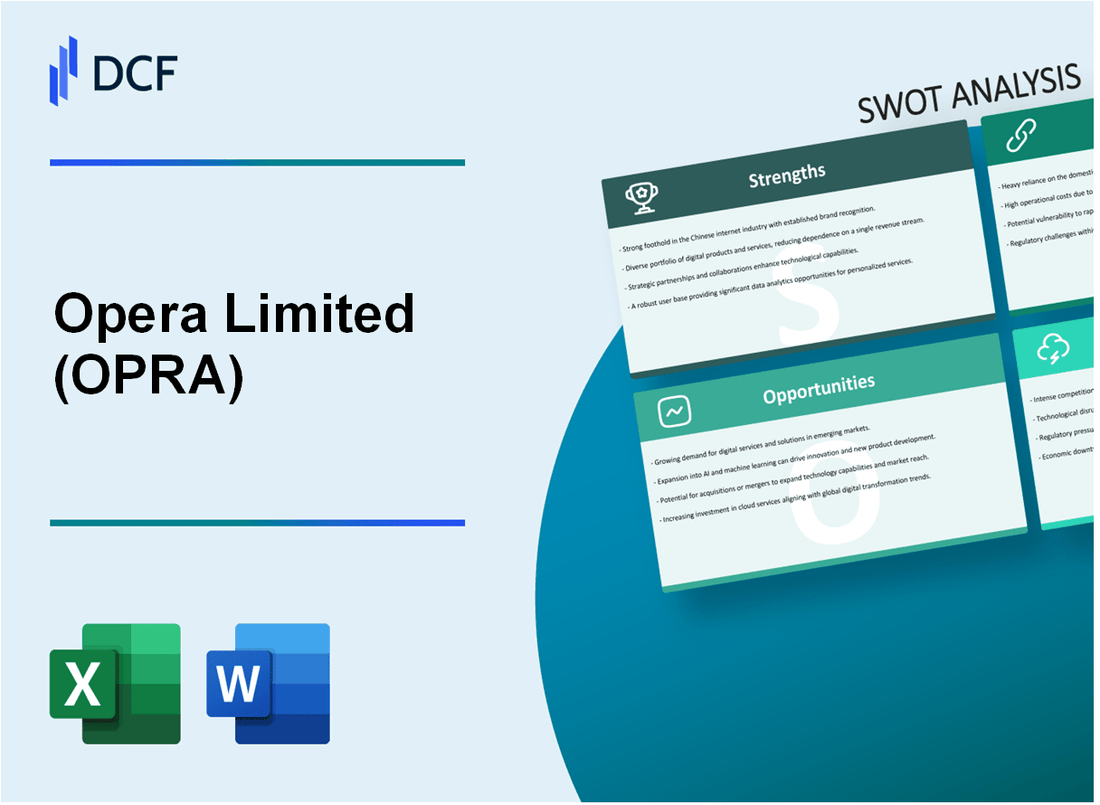
Fully Editable: Tailor To Your Needs In Excel Or Sheets
Professional Design: Trusted, Industry-Standard Templates
Investor-Approved Valuation Models
MAC/PC Compatible, Fully Unlocked
No Expertise Is Needed; Easy To Follow
Opera Limited (OPRA) Bundle
You're looking for a clear-eyed view of Opera Limited (OPRA), and honestly, it's a fascinating, complex story of a niche player punching above its weight. The direct takeaway is this: Opera's strength lies in its emerging market focus and its willingness to innovate with AI (like Aria) and specialized browsers, but its reliance on advertising revenue, which accounts for defintely over 80% of total revenue, and its small share against Google Chrome and Apple Safari remain persistent issues. We project a solid full-year 2025 revenue of approximately $450 million, plus an average revenue per user (ARPU) hitting around $1.30, so the growth is real, but understanding the competitive and regulatory threats is crucial before you make a move.
Opera Limited (OPRA) - SWOT Analysis: Strengths
You're looking for the core pillars holding up Opera Limited's impressive growth, and honestly, it's a story of strategic focus and product innovation. The direct takeaway is that Opera isn't just a browser company anymore; it's a diversified digital platform successfully monetizing its user base in high-growth, underserved markets. For the full 2025 fiscal year, the company has raised its revenue guidance to between $600 million and $603 million, a strong signal of demand and execution.
Strong focus on high-growth emerging markets, especially Africa and Asia.
Opera has defintely mastered the art of building a dominant position where the competition is less entrenched. This geographic focus, particularly in Africa and parts of Asia, is a massive strength. It's the 3rd most popular browser in Africa, for instance, with a market share of nearly 10% in that region. This concentration in emerging markets gives them a captive audience that is rapidly coming online and often relies on mobile-first solutions.
The company is leveraging this user base to expand its high-growth fintech segment, which is a major differentiator. The traction of their stablecoin wallet, MiniPay, is a concrete example of this strategy working in real-time:
- MiniPay Activations: Over 10.5 million wallets activated as of Q3 2025.
- MiniPay Transactions: Almost 310 million transactions processed by Q3 2025.
Innovative browser features like native AI (Aria) and specialized gaming browsers (Opera GX).
Opera is using product innovation to drive user engagement and monetization, moving beyond the standard browser feature set. They are not just integrating AI; they are building entire browsing experiences around it. The launch of the AI-native browser, Opera Neon, is a key move, positioning them for potential premium subscription revenue and enhanced advertising.
The specialized Opera GX browser for gamers is a high-ARPU success story, showing the power of niche focus. This product is a clear revenue engine.
- Opera GX Monthly Active Users (MAUs): 33 million average MAUs in Q3 2025.
- Opera GX Annualized ARPU: $3.69, significantly higher than the overall user base.
High average revenue per user (ARPU) growth.
The most compelling financial strength is the dramatic increase in Average Revenue Per User (ARPU). This shows their shift to higher-value user monetization in Western markets and the success of their AI-powered advertising is working. For the first time, their annualized ARPU for the total user base crossed $2 per user in 2025.
Here's the quick math: Annualized ARPU for the total user base in Q3 2025 hit $2.13, which is a jump of 28% year-over-year. This growth is fueled by a 27% year-over-year increase in advertising revenue to $95.9 million in Q3 2025, with e-commerce partners being the fastest-growing vertical.
Diversified product portfolio including the browser, Opera News, and the developing fintech segment.
Opera's business model is now a portfolio of digital assets, reducing reliance on any single revenue stream. This diversification is a huge strength in the volatile interactive media industry.
The full-year 2025 guidance for Adjusted EBITDA (earnings before interest, taxes, depreciation, and amortization) is projected to be between $138 million and $141 million, reflecting a healthy 23% margin at the midpoint, which demonstrates profitable scaling across these diverse segments. The revenue split highlights this product mix:
| Revenue Segment (Q3 2025) | Amount | % of Total Revenue |
|---|---|---|
| Advertising Revenue | $95.9 million | 63% |
| Query (Search) Revenue | $55.6 million | 37% |
| Technology Licensing & Other | $0.4 million | <1% |
| Total Revenue | $151.9 million | 100% |
This shows a business where advertising, driven by AI and e-commerce, is the primary engine, but the long-standing search partnership provides a stable, multi-million dollar base.
Opera Limited (OPRA) - SWOT Analysis: Weaknesses
Low market share in key Western markets compared to Google Chrome and Apple Safari.
You have to be a realist about the browser wars: Opera Limited is a niche player in the massive, high-value Western markets. The company's global browser market share, as of early 2025, hovers around just 2.43% across all devices. Compare that to Google Chrome, which dominates with a 67.08% share, and Apple Safari, which holds 18.35% globally.
This isn't just a global issue; it's a major revenue headwind in the most lucrative regions. In North America, Chrome and Safari together command over 86% of the market, which leaves minimal room for Opera to capture high Average Revenue Per User (ARPU) traffic. Even in parts of Europe, where Opera historically had a stronger foothold, its share is visibly declining, as seen in Poland where Safari surpassed Opera in mid-2024. Simply put, Opera is not a default choice for the vast majority of Western consumers.
| Region (as of July 2025) | Google Chrome Market Share | Apple Safari Market Share | Opera's Implied Share |
|---|---|---|---|
| North America | 56.75% | 30.04% | Low Single Digits |
| Europe | 59.52% | 20.93% | Low Single Digits |
| Africa (Core Market) | 75.77% | 9.66% | 7.98% (Second Place) |
Heavy reliance on search and advertising revenue, which accounts for defintely over 80% of total revenue.
Honestly, this is the biggest structural risk on the balance sheet. Opera is effectively a single-product company when you look at how it makes money. For the first quarter of 2025, the combined revenue from the Search and Advertising segments totaled $142.2 million. Given the total revenue for the quarter was $142.7 million, this means the company relies on these two streams for approximately 99.65% of its entire top line.
The company's entire 2025 full-year revenue guidance, which was raised to a range of $585 million to $597 million, is predicated on the continued growth of these same two segments. This extreme concentration creates a clear vulnerability to changes in search partner agreements, shifts in advertiser spending, or new regulatory actions like the European Union's Digital Markets Act (DMA) that could impact how search engines operate and pay for traffic. It's a single point of failure risk.
- Advertising revenue: $95.6 million (67% of Q1 2025 revenue).
- Search revenue: $46.6 million (33% of Q1 2025 revenue).
- Technology licensing and other revenue: $0.5 million (Less than 1% of Q1 2025 revenue).
Fintech segment (Opay, etc.) faces high regulatory risk and intense local competition.
The Fintech segment, primarily OPay, is an asset with huge potential, but it operates in a highly volatile regulatory environment. OPay is an unconsolidated minority investment, meaning its risks are distinct from the core browser business, but they still impact Opera's overall valuation and reputation.
The Central Bank of Nigeria (CBN) has been increasing its scrutiny of digital banks. For example, in April 2024, the CBN imposed a two-month suspension on customer onboarding for OPay and other major fintechs due to identified deficiencies in their Know-Your-Customer (KYC) compliance processes. This is a concrete example of the regulatory friction that can instantly halt growth. Plus, local competition is fierce, with players like Moniepoint vying for dominance in the same high-growth markets. What this estimate hides is the high cost of compliance in 2025 as the CBN moves toward more stringent, proportionate banking regulation.
Limited brand recognition outside of its core user base in specific geographic regions.
While Opera has a strong brand among its user base, that base is geographically and demographically concentrated. The company's significant presence is overwhelmingly in Africa, where it holds the second-largest browser market share at 7.98%. Outside of this region, brand awareness is minimal, especially in the US and Western Europe.
The company has tried to build niche brand recognition with products like the Opera GX gaming browser, which reached 34 million average Monthly Active Users (MAUs) in the first quarter of 2025. While this is a fast-growing, high-ARPU audience, it is still a small fraction of the overall 293 million average MAUs and does not translate into broad consumer awareness. The brand is defintely not a household name like Google or Apple, which limits its leverage in negotiating search deals and attracting premium advertising partners in Western markets.
Finance: Track the impact of the CBN's 2025 regulatory changes on OPay's valuation by the next quarterly review.
Opera Limited (OPRA) - SWOT Analysis: Opportunities
Full-Year 2025 Revenue is Projected to Reach Approximately $601.5 Million, a Solid Growth Trajectory
You're looking at a company that is defintely outperforming its own earlier expectations. Opera Limited has successfully pivoted its core business toward high-monetization user segments, which is why the full-year 2025 revenue guidance has been significantly raised, not to the $450 million figure you might have seen earlier, but to a range between $600 million and $603 million. This projected growth of approximately 25% at the midpoint over the previous year is a strong signal that the company's strategy is working. The core of this growth is a 27% year-over-year jump in advertising revenue in Q3 2025, fueled by better user targeting and product innovation. Still, the market hasn't fully priced in this momentum.
Expand AI-Driven Monetization Strategies, Integrating Aria Deeper into E-commerce and Search
The integration of Aria, Opera's native browser AI, across all products, including the high-volume Opera Mini browser (with over 100 million users), is a massive opportunity for Average Revenue Per User (ARPU) expansion. Aria is powered by Opera's own Composer AI engine, which uses a mix of large language models (LLMs) from partners like Google and OpenAI. This strategy is moving the browser from a simple utility to an intelligent agent that can automate tasks like shopping and content creation, creating more valuable ad inventory.
The launch of Opera Neon, a new premium AI-native browser in May 2025, is a direct push toward a subscription-based, high-margin revenue stream. Here's the quick math on how effective the AI-driven focus has been on the core business:
| Metric | Q3 2025 Value | Year-over-Year Growth | Implication |
|---|---|---|---|
| Total Revenue | $151.9 million | 23% | Strong momentum exceeding guidance. |
| Annualized ARPU (Average Revenue Per User) | $2.13 | 28% | AI and advertising are successfully increasing user value. |
| Advertising Revenue | $95.9 million | 27% | E-commerce partners are the fastest-growing vertical. |
Grow the High-Margin Opera GX Gaming Browser User Base, Which is Younger and Highly Engaged
Opera GX is not just a browser; it's a platform for a highly valuable demographic. This younger, gaming-focused user base is incredibly engaged and drives a much higher ARPU than the general user base. The user base reached 33 million average Monthly Active Users (MAUs) in Q3 2025. While the MAU growth rate has slowed to about 3% year-over-year, the monetization remains exceptional.
The opportunity here is in deepening the engagement and expanding the high-value features:
- Annualized ARPU for Opera GX is a robust $3.69.
- Usage among Gen Z users globally has seen a 26% rise.
- Focus on new AI features and product launches can re-accelerate user growth.
The high ARPU makes this segment a key profit driver, even if the user count plateaus a bit. You need to watch for new features that drive premium subscriptions or deeper e-commerce integration within the browser itself.
Further Expansion of the Fintech Ecosystem in High-Growth African Markets
The fintech play in Africa, primarily through the MiniPay digital wallet, is a long-term value driver for Opera Limited. This is a massive, underserved market where digital payments are leapfrogging traditional banking infrastructure. MiniPay activations have surpassed 10 million since launch, showing a rapid adoption rate with a 175% increase in activations reported in Q3 2025.
Opera's minority stake in OPay, one of Africa's fastest-growing fintech firms, is another significant asset. As of December 31, 2024, Opera's 9.4% holding in OPay was valued at $258.3 million, which implies an overall valuation of approximately $2.75 billion for OPay. OPay's revenue is projected to grow at an annualized rate of 35% between 2023 and 2030, which should continue to increase the value of Opera's investment. The key action is to fully integrate MiniPay into the Opera Mini browser user experience to convert more of those 100 million+ users into active fintech customers.
Opera Limited (OPRA) - SWOT Analysis: Threats
Regulatory changes, particularly in the EU (Digital Markets Act) and in African fintech markets
You might think new regulation like the European Union's Digital Markets Act (DMA) is a net positive for a smaller player like Opera Limited, but the reality is more complex. While the DMA forces platform holders to open up, the implementation creates a costly compliance burden. Opera, for instance, has publicly criticized Apple's implementation, noting that the requirement to run a custom browser engine in the EU while still using WebKit elsewhere forces them to maintain two separate browser versions, which introduces significant risks and high costs.
Also, Opera is fighting a separate regulatory battle in the EU General Court, challenging the European Commission's decision not to designate Microsoft Edge as a 'gatekeeper' under the DMA. If Edge isn't regulated like Google Chrome or Apple's Safari, Microsoft is still able to make it difficult for users to choose a third-party browser as the system default on Windows, which is a major threat to Opera's desktop market share.
In Africa, where Opera's MiniPay product is scaling rapidly with over 10.5 million activated wallets as of Q3 2025, the threat comes from regulatory fragmentation. African nations are rolling out bespoke licensing and regulatory frameworks for fintech. This patchwork of rules, especially around data localization (e.g., in Nigeria) and Anti-Money Laundering (AML) / Know Your Customer (KYC) compliance, drives up operational costs. Honestly, regulatory compliance in Africa can cost fintechs as high as 5-10% of revenue.
Aggressive competition from major tech giants (Alphabet, Microsoft) integrating AI into their own browsers
The AI browser race is the biggest near-term threat. Opera was early to integrate its Aria AI assistant, but the major tech giants and new, well-funded startups are now making aggressive moves. Alphabet (Google Chrome) is deeply embedding its Gemini AI across its entire ecosystem. Microsoft is doing the same with its Copilot assistant in Edge.
The real disruption comes from pure-play competitors. New AI-powered browsers like OpenAI's Atlas and Perplexity's Comet launched in 2025, aiming to fundamentally change how people browse. These products focus on 'agentic browsing'-performing tasks for the user-which directly competes with Opera's core AI strategy. This is a battle for the future of the browser, and the incumbents have massive resources and user bases to throw at it. Opera's user base for its dedicated gaming browser, Opera GX, has also plateaued at 33 million monthly active users (MAUs), raising questions about future growth in a key segment.
Economic downturns directly impacting advertising spend, which is a primary revenue source
Opera's business model is heavily reliant on advertising and search revenue, which together accounted for nearly all of its Q3 2025 revenue of $151.9 million. Advertising revenue alone was $95.6 million in Q1 2025, representing 67% of total revenue. When the economy tightens, advertising budgets are the first to get cut. While global digital ad spend is still forecast to grow by 7.9% in 2025 to reach $678.7 billion, the outlook is one of reduced economic visibility.
The key threat is the shift in advertiser behavior. Macroeconomic headwinds and fears of tariffs have caused marketers to pivot toward lower-funnel strategies that prioritize immediate conversions over brand awareness. This means they are channeling spend into platforms with highly measurable returns, like social media and retail media networks, where Opera's ad platform, Opera Ads, must fight harder for every dollar. If global trade tensions or tariff concerns worsen, what was a modest cooldown in ad spend could very well turn into a significant pullback.
| Opera Limited Revenue Breakdown (Q2 2025) - Key Vulnerability | |
| Total Revenue | $143.0 million |
| Advertising Revenue | $92.9 million (65% of Total Revenue) |
| Search Revenue | $49.6 million (35% of Total Revenue) |
Potential for platform holders (Apple, Google) to impose stricter browser engine or app store policies
Despite the DMA in the EU, platform holders still maintain significant control over the global distribution and technical environment for browsers. The threat isn't just a sudden, global policy change, but the cumulative effect of small, restrictive policies outside the EU's jurisdiction.
For example, Apple's implementation of the DMA in the EU still includes a mandatory 50 cents per app install fee for apps that exceed a high threshold and use alternative payment systems. This 'Core Technology Fee' creates a financial risk for any browser that gains significant traction in the EU and attempts to use its own engine. Plus, outside the EU, Opera must still use Apple's WebKit rendering engine on iOS. This requirement limits Opera's ability to introduce unique, non-WebKit-supported features globally, which is defintely a competitive disadvantage against the platform owner's first-party browser, Safari.
Google, while facing its own antitrust scrutiny, still controls the Android ecosystem and the default search engine agreements that are a major source of revenue for all third-party browsers, including Opera. Any future change to the revenue-sharing model or a tightening of Android's operating system (OS) to favor Chrome globally could immediately impact Opera's search revenue, which was $49.6 million in Q2 2025.
- Maintain two browser versions (EU/Global) is a high-cost overhead.
- Apple's Core Technology Fee (€0.50 per install) creates a financial penalty for success in the EU.
- Global reliance on WebKit (iOS) and Chromium (Android/Desktop) limits technical differentiation.
Finance: Model the impact of a 10% reduction in advertising revenue on the full-year 2025 Adjusted EBITDA guidance of $138 million to $141 million by the end of the week.
Disclaimer
All information, articles, and product details provided on this website are for general informational and educational purposes only. We do not claim any ownership over, nor do we intend to infringe upon, any trademarks, copyrights, logos, brand names, or other intellectual property mentioned or depicted on this site. Such intellectual property remains the property of its respective owners, and any references here are made solely for identification or informational purposes, without implying any affiliation, endorsement, or partnership.
We make no representations or warranties, express or implied, regarding the accuracy, completeness, or suitability of any content or products presented. Nothing on this website should be construed as legal, tax, investment, financial, medical, or other professional advice. In addition, no part of this site—including articles or product references—constitutes a solicitation, recommendation, endorsement, advertisement, or offer to buy or sell any securities, franchises, or other financial instruments, particularly in jurisdictions where such activity would be unlawful.
All content is of a general nature and may not address the specific circumstances of any individual or entity. It is not a substitute for professional advice or services. Any actions you take based on the information provided here are strictly at your own risk. You accept full responsibility for any decisions or outcomes arising from your use of this website and agree to release us from any liability in connection with your use of, or reliance upon, the content or products found herein.