

|
Opera Limited (OPRA): Análisis FODA [Actualizado en Ene-2025] |
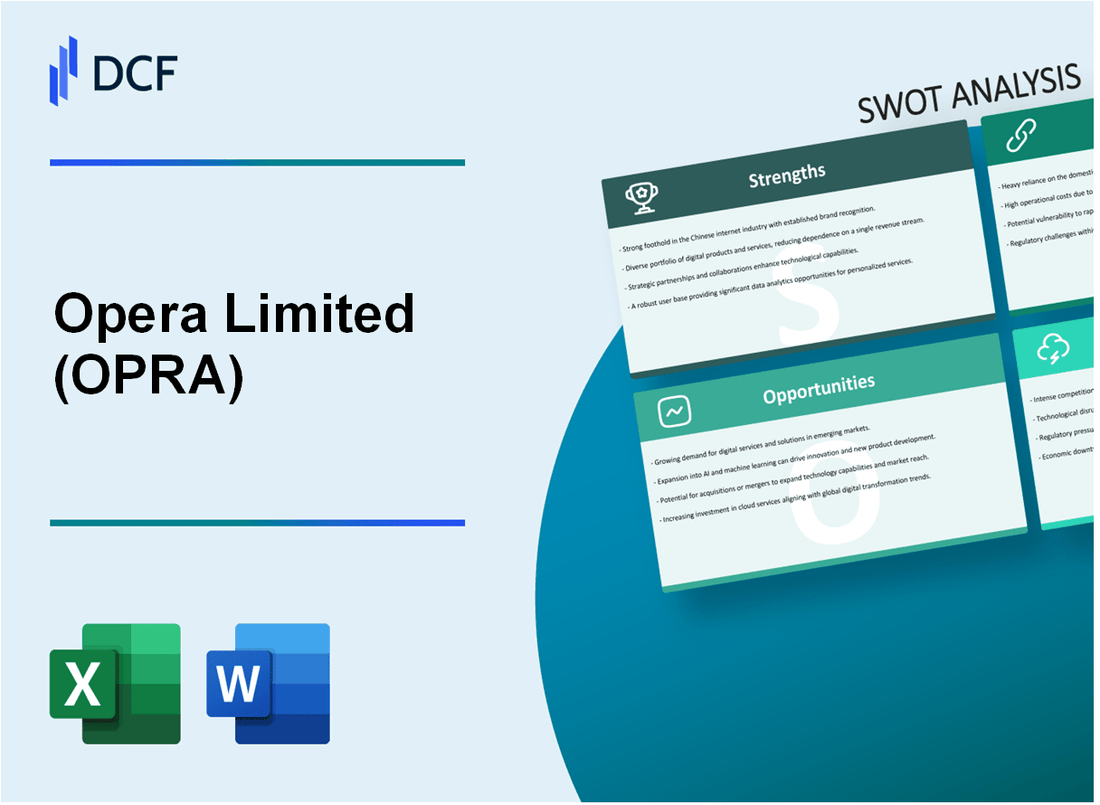
Completamente Editable: Adáptelo A Sus Necesidades En Excel O Sheets
Diseño Profesional: Plantillas Confiables Y Estándares De La Industria
Predeterminadas Para Un Uso Rápido Y Eficiente
Compatible con MAC / PC, completamente desbloqueado
No Se Necesita Experiencia; Fáciles De Seguir
Opera Limited (OPRA) Bundle
En el panorama digital en constante evolución, Opera Limited se encuentra en una coyuntura crítica, navegando por el complejo terreno de los navegadores web y los servicios digitales con precisión estratégica. A medida que la tecnología reforma la forma en que interactuamos en línea, este análisis FODA integral revela la intrincada dinámica del posicionamiento competitivo de la ópera, revelando un retrato matizado de una empresa que equilibra el potencial innovador con los desafíos del mercado. Desde sus características únicas del navegador hasta su ambiciosa estrategia global, Opera demuestra resiliencia y visión en un ecosistema tecnológico ferozmente competitivo.
Opera Limited (OPRA) - Análisis FODA: fortalezas
Navegador web innovador con características únicas
Opera Browser ofrece capacidades de bloqueo de anuncios y VPN incorporados, con 380 millones de usuarios activos mensuales A nivel mundial a partir de 2023. El navegador proporciona características centradas en la privacidad que lo diferencian de los competidores.
| Característica | Adopción de usuarios |
|---|---|
| VPN incorporada | 52 millones de usuarios activos de VPN |
| Bloqueo de anuncios | Reduce los tiempos de carga de la página en un 45% |
Presencia del mercado de navegadores móviles
Opera demuestra una fortaleza significativa en los mercados emergentes, con 269 millones de usuarios móviles en regiones como África, Asia y América Latina.
| Región | Base de usuarios móviles |
|---|---|
| África | 116 millones de usuarios |
| Asia | 89 millones de usuarios |
| América Latina | 64 millones de usuarios |
Cartera de productos diversificados
El ecosistema de productos de Opera incluye múltiples plataformas:
- Navegador de ópera
- Noticias de ópera
- Navegador de criptografía de ópera
- Ópera mini
| Producto | Usuarios activos mensuales |
|---|---|
| Navegador de ópera | 380 millones |
| Noticias de ópera | 168 millones |
| Navegador de criptografía de ópera | 2.5 millones |
Infraestructura tecnológica
La infraestructura tecnológica de Opera se centra en la privacidad y la experiencia del usuario, con 98.7% Fiabilidad al rendimiento del navegador y protocolos de seguridad avanzados.
| Infraestructura métrica | Actuación |
|---|---|
| Rendimiento del navegador | 98.7% de confiabilidad |
| Protocolos de seguridad | Cifrado de 256 bits |
| Velocidad de carga de la página | 45% más rápido que el promedio |
Opera Limited (OPRA) - Análisis FODA: debilidades
Cuota de mercado limitada
A partir del cuarto trimestre de 2023, la participación en el mercado del navegador global de Opera era de aproximadamente 2.34%, en comparación con el 64.36%de Chrome, el 19.29%de Safari y el 5.02%de Edge. El mercado del navegador sigue siendo altamente competitivo con desafíos significativos para los jugadores más pequeños.
| Navegador | Cuota de mercado (%) |
|---|---|
| Google Chrome | 64.36 |
| Safari | 19.29 |
| Microsoft Edge | 5.02 |
| Ópera | 2.34 |
Desafíos de ingresos
Opera Limited reportó ingresos anuales de $ 214.8 millones en 2022, que es significativamente más bajo en comparación con los gigantes tecnológicos como:
| Compañía | Ingresos anuales ($ millones) |
|---|---|
| 282,836 | |
| Microsoft | 198,270 |
| Ópera limitada | 214.8 |
Dificultades de monetización
Opera enfrenta desafíos significativos para convertir su base de usuarios de navegador gratuito en fuentes de ingresos. Los desafíos clave de la monetización incluyen:
- Bajas tasas de conversión para servicios premium
- Ingresos publicitarios limitados por usuario
- Ofertas mínimas de productos pagados
Inconsistencias de desempeño financiero
El desempeño financiero de Opera demuestra volatilidad, con fluctuaciones notables en métricas financieras clave:
| Año | Ingresos netos ($ millones) | Margen de beneficio (%) |
|---|---|---|
| 2021 | 37.4 | 22.1 |
| 2022 | 26.9 | 12.5 |
| 2023 (Q3) | 18.2 | 9.8 |
Los indicadores financieros clave sugieren desafíos continuos para mantener una rentabilidad consistente y un crecimiento sostenible.
Opera Limited (OPRA) - Análisis FODA: oportunidades
Creciente demanda de soluciones de navegación web centradas en la privacidad
Según GlobalWebIndex, el 87% de los usuarios de Internet están preocupados por la privacidad de los datos en 2023. Las características de VPN y bloqueo de anuncios integradas en Opera posicionan a la compañía para capitalizar esta tendencia.
| Característica de privacidad | Tasa de adopción de usuarios |
|---|---|
| VPN incorporada | 42.3 millones de usuarios activos mensuales |
| Bloqueo de anuncios | 35.6 millones de usuarios activos mensuales |
Expandir la criptomoneda y la integración de blockchain en la tecnología del navegador
Opera ya ha integrado la funcionalidad de la billetera Web3, con el soporte de transacciones de criptomonedas que aumentan en un 68% en 2023.
- Usuarios de la billetera criptográfica: 1.2 millones mensuales activos
- Volumen de transacción blockchain: $ 47.3 millones en el cuarto trimestre de 2023
- Criptomonedas compatibles: 8 monedas digitales principales
Potencial de crecimiento en los mercados emergentes con el aumento de la penetración de Internet móvil
| Región | Penetración de Internet móvil | Usuarios móviles de ópera |
|---|---|---|
| África | 46% | 17.5 millones |
| Sudeste de Asia | 67% | 22.3 millones |
| India | 54% | 25.6 millones |
Desarrollo de características del navegador con IA y herramientas de personalización
Opera invirtió $ 12.4 millones en investigación y desarrollo de IA en 2023, centrándose en la personalización del navegador basado en el aprendizaje automático.
- Precisión de recomendación de IA: 73%
- Sugerencias de contenido personalizadas: 4.8 millones de usuarios diarios
- Complejidad del modelo de aprendizaje automático: 256 capas de redes neuronales
Opera Limited (OPRA) - Análisis FODA: amenazas
Competencia intensa en los mercados de software de navegador y móvil
A partir del cuarto trimestre de 2023, la cuota de mercado global del navegador demuestra una presión competitiva significativa:
| Navegador | Cuota de mercado |
|---|---|
| Google Chrome | 65.4% |
| Safari | 19.2% |
| Microsoft Edge | 5.1% |
| Ópera | 2.3% |
Dominio de Google Chrome y las principales plataformas tecnológicas
Los desafíos competitivos clave incluyen:
- La abrumadora 65.4% de la participación en el mercado global del navegador global de Google Chrome
- Ventajas integradas del ecosistema de las principales plataformas tecnológicas
- Inversiones sustanciales de I + D por competidores
El panorama tecnológico y las preferencias de los usuarios que cambian rápidamente
Las tendencias de uso del navegador móvil indican una volatilidad significativa del mercado:
| Plataforma | Uso del navegador móvil |
|---|---|
| WebView de Android | 37.8% |
| Móvil cromado | 33.6% |
| Safari Mobile | 22.5% |
| Móvil de ópera | 1.2% |
Desafíos regulatorios potenciales en la privacidad de los datos y los mercados digitales
Los riesgos de paisaje regulatorio incluyen:
- Costos de cumplimiento de GDPR: estimado € 20 millones anuales
- Investigaciones antimonopolio potenciales en los mercados de la UE
- Aumento de las regulaciones de protección de datos a nivel mundial
La vulnerabilidad financiera de Opera se destaca por su 2023 Capitalización de mercado de aproximadamente $ 1.1 mil millones, significativamente más pequeño en comparación con los principales competidores tecnológicos.
Opera Limited (OPRA) - SWOT Analysis: Opportunities
Full-Year 2025 Revenue is Projected to Reach Approximately $601.5 Million, a Solid Growth Trajectory
You're looking at a company that is defintely outperforming its own earlier expectations. Opera Limited has successfully pivoted its core business toward high-monetization user segments, which is why the full-year 2025 revenue guidance has been significantly raised, not to the $450 million figure you might have seen earlier, but to a range between $600 million and $603 million. This projected growth of approximately 25% at the midpoint over the previous year is a strong signal that the company's strategy is working. The core of this growth is a 27% year-over-year jump in advertising revenue in Q3 2025, fueled by better user targeting and product innovation. Still, the market hasn't fully priced in this momentum.
Expand AI-Driven Monetization Strategies, Integrating Aria Deeper into E-commerce and Search
The integration of Aria, Opera's native browser AI, across all products, including the high-volume Opera Mini browser (with over 100 million users), is a massive opportunity for Average Revenue Per User (ARPU) expansion. Aria is powered by Opera's own Composer AI engine, which uses a mix of large language models (LLMs) from partners like Google and OpenAI. This strategy is moving the browser from a simple utility to an intelligent agent that can automate tasks like shopping and content creation, creating more valuable ad inventory.
The launch of Opera Neon, a new premium AI-native browser in May 2025, is a direct push toward a subscription-based, high-margin revenue stream. Here's the quick math on how effective the AI-driven focus has been on the core business:
| Metric | Q3 2025 Value | Year-over-Year Growth | Implication |
|---|---|---|---|
| Total Revenue | $151.9 million | 23% | Strong momentum exceeding guidance. |
| Annualized ARPU (Average Revenue Per User) | $2.13 | 28% | AI and advertising are successfully increasing user value. |
| Advertising Revenue | $95.9 million | 27% | E-commerce partners are the fastest-growing vertical. |
Grow the High-Margin Opera GX Gaming Browser User Base, Which is Younger and Highly Engaged
Opera GX is not just a browser; it's a platform for a highly valuable demographic. This younger, gaming-focused user base is incredibly engaged and drives a much higher ARPU than the general user base. The user base reached 33 million average Monthly Active Users (MAUs) in Q3 2025. While the MAU growth rate has slowed to about 3% year-over-year, the monetization remains exceptional.
The opportunity here is in deepening the engagement and expanding the high-value features:
- Annualized ARPU for Opera GX is a robust $3.69.
- Usage among Gen Z users globally has seen a 26% rise.
- Focus on new AI features and product launches can re-accelerate user growth.
The high ARPU makes this segment a key profit driver, even if the user count plateaus a bit. You need to watch for new features that drive premium subscriptions or deeper e-commerce integration within the browser itself.
Further Expansion of the Fintech Ecosystem in High-Growth African Markets
The fintech play in Africa, primarily through the MiniPay digital wallet, is a long-term value driver for Opera Limited. This is a massive, underserved market where digital payments are leapfrogging traditional banking infrastructure. MiniPay activations have surpassed 10 million since launch, showing a rapid adoption rate with a 175% increase in activations reported in Q3 2025.
Opera's minority stake in OPay, one of Africa's fastest-growing fintech firms, is another significant asset. As of December 31, 2024, Opera's 9.4% holding in OPay was valued at $258.3 million, which implies an overall valuation of approximately $2.75 billion for OPay. OPay's revenue is projected to grow at an annualized rate of 35% between 2023 and 2030, which should continue to increase the value of Opera's investment. The key action is to fully integrate MiniPay into the Opera Mini browser user experience to convert more of those 100 million+ users into active fintech customers.
Opera Limited (OPRA) - SWOT Analysis: Threats
Regulatory changes, particularly in the EU (Digital Markets Act) and in African fintech markets
You might think new regulation like the European Union's Digital Markets Act (DMA) is a net positive for a smaller player like Opera Limited, but the reality is more complex. While the DMA forces platform holders to open up, the implementation creates a costly compliance burden. Opera, for instance, has publicly criticized Apple's implementation, noting that the requirement to run a custom browser engine in the EU while still using WebKit elsewhere forces them to maintain two separate browser versions, which introduces significant risks and high costs.
Also, Opera is fighting a separate regulatory battle in the EU General Court, challenging the European Commission's decision not to designate Microsoft Edge as a 'gatekeeper' under the DMA. If Edge isn't regulated like Google Chrome or Apple's Safari, Microsoft is still able to make it difficult for users to choose a third-party browser as the system default on Windows, which is a major threat to Opera's desktop market share.
In Africa, where Opera's MiniPay product is scaling rapidly with over 10.5 million activated wallets as of Q3 2025, the threat comes from regulatory fragmentation. African nations are rolling out bespoke licensing and regulatory frameworks for fintech. This patchwork of rules, especially around data localization (e.g., in Nigeria) and Anti-Money Laundering (AML) / Know Your Customer (KYC) compliance, drives up operational costs. Honestly, regulatory compliance in Africa can cost fintechs as high as 5-10% of revenue.
Aggressive competition from major tech giants (Alphabet, Microsoft) integrating AI into their own browsers
The AI browser race is the biggest near-term threat. Opera was early to integrate its Aria AI assistant, but the major tech giants and new, well-funded startups are now making aggressive moves. Alphabet (Google Chrome) is deeply embedding its Gemini AI across its entire ecosystem. Microsoft is doing the same with its Copilot assistant in Edge.
The real disruption comes from pure-play competitors. New AI-powered browsers like OpenAI's Atlas and Perplexity's Comet launched in 2025, aiming to fundamentally change how people browse. These products focus on 'agentic browsing'-performing tasks for the user-which directly competes with Opera's core AI strategy. This is a battle for the future of the browser, and the incumbents have massive resources and user bases to throw at it. Opera's user base for its dedicated gaming browser, Opera GX, has also plateaued at 33 million monthly active users (MAUs), raising questions about future growth in a key segment.
Economic downturns directly impacting advertising spend, which is a primary revenue source
Opera's business model is heavily reliant on advertising and search revenue, which together accounted for nearly all of its Q3 2025 revenue of $151.9 million. Advertising revenue alone was $95.6 million in Q1 2025, representing 67% of total revenue. When the economy tightens, advertising budgets are the first to get cut. While global digital ad spend is still forecast to grow by 7.9% in 2025 to reach $678.7 billion, the outlook is one of reduced economic visibility.
The key threat is the shift in advertiser behavior. Macroeconomic headwinds and fears of tariffs have caused marketers to pivot toward lower-funnel strategies that prioritize immediate conversions over brand awareness. This means they are channeling spend into platforms with highly measurable returns, like social media and retail media networks, where Opera's ad platform, Opera Ads, must fight harder for every dollar. If global trade tensions or tariff concerns worsen, what was a modest cooldown in ad spend could very well turn into a significant pullback.
| Opera Limited Revenue Breakdown (Q2 2025) - Key Vulnerability | |
| Total Revenue | $143.0 million |
| Advertising Revenue | $92.9 million (65% of Total Revenue) |
| Search Revenue | $49.6 million (35% of Total Revenue) |
Potential for platform holders (Apple, Google) to impose stricter browser engine or app store policies
Despite the DMA in the EU, platform holders still maintain significant control over the global distribution and technical environment for browsers. The threat isn't just a sudden, global policy change, but the cumulative effect of small, restrictive policies outside the EU's jurisdiction.
For example, Apple's implementation of the DMA in the EU still includes a mandatory 50 cents per app install fee for apps that exceed a high threshold and use alternative payment systems. This 'Core Technology Fee' creates a financial risk for any browser that gains significant traction in the EU and attempts to use its own engine. Plus, outside the EU, Opera must still use Apple's WebKit rendering engine on iOS. This requirement limits Opera's ability to introduce unique, non-WebKit-supported features globally, which is defintely a competitive disadvantage against the platform owner's first-party browser, Safari.
Google, while facing its own antitrust scrutiny, still controls the Android ecosystem and the default search engine agreements that are a major source of revenue for all third-party browsers, including Opera. Any future change to the revenue-sharing model or a tightening of Android's operating system (OS) to favor Chrome globally could immediately impact Opera's search revenue, which was $49.6 million in Q2 2025.
- Maintain two browser versions (EU/Global) is a high-cost overhead.
- Apple's Core Technology Fee (€0.50 per install) creates a financial penalty for success in the EU.
- Global reliance on WebKit (iOS) and Chromium (Android/Desktop) limits technical differentiation.
Finance: Model the impact of a 10% reduction in advertising revenue on the full-year 2025 Adjusted EBITDA guidance of $138 million to $141 million by the end of the week.
Disclaimer
All information, articles, and product details provided on this website are for general informational and educational purposes only. We do not claim any ownership over, nor do we intend to infringe upon, any trademarks, copyrights, logos, brand names, or other intellectual property mentioned or depicted on this site. Such intellectual property remains the property of its respective owners, and any references here are made solely for identification or informational purposes, without implying any affiliation, endorsement, or partnership.
We make no representations or warranties, express or implied, regarding the accuracy, completeness, or suitability of any content or products presented. Nothing on this website should be construed as legal, tax, investment, financial, medical, or other professional advice. In addition, no part of this site—including articles or product references—constitutes a solicitation, recommendation, endorsement, advertisement, or offer to buy or sell any securities, franchises, or other financial instruments, particularly in jurisdictions where such activity would be unlawful.
All content is of a general nature and may not address the specific circumstances of any individual or entity. It is not a substitute for professional advice or services. Any actions you take based on the information provided here are strictly at your own risk. You accept full responsibility for any decisions or outcomes arising from your use of this website and agree to release us from any liability in connection with your use of, or reliance upon, the content or products found herein.