

|
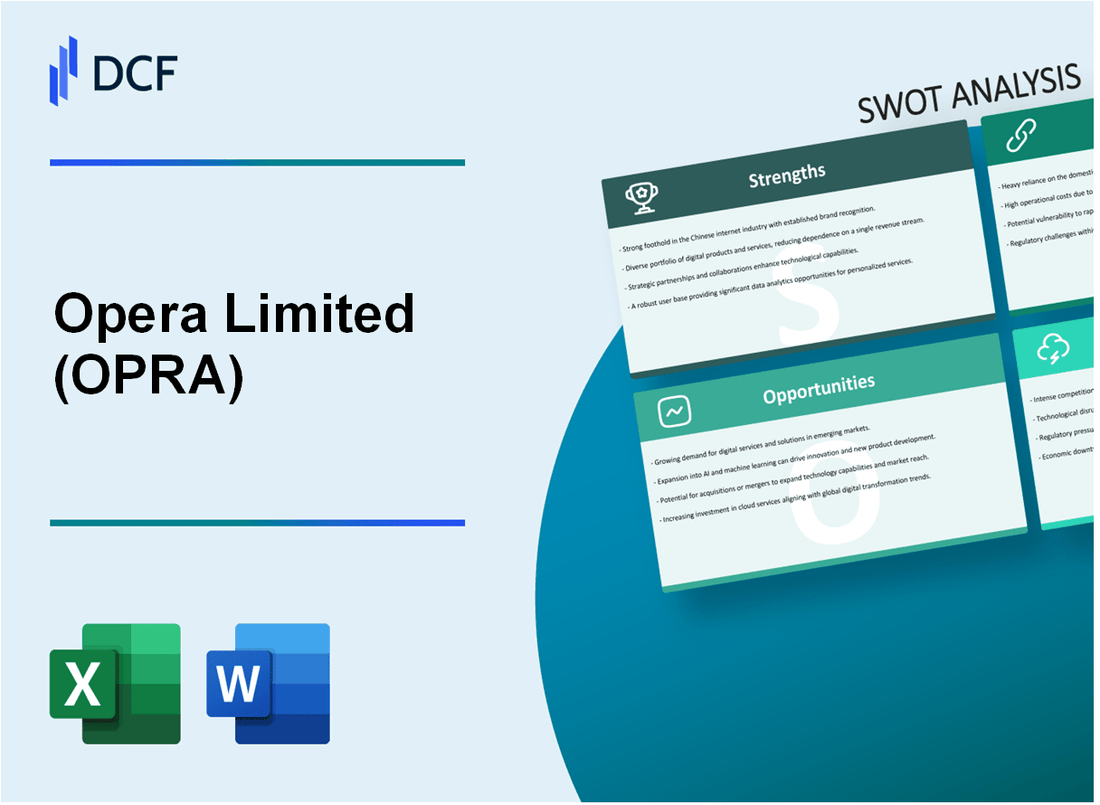
Opera Limited (OPRA): Analyse SWOT [Jan-2025 Mise à jour] |
Entièrement Modifiable: Adapté À Vos Besoins Dans Excel Ou Sheets
Conception Professionnelle: Modèles Fiables Et Conformes Aux Normes Du Secteur
Pré-Construits Pour Une Utilisation Rapide Et Efficace
Compatible MAC/PC, entièrement débloqué
Aucune Expertise N'Est Requise; Facile À Suivre
Opera Limited (OPRA) Bundle
Dans le paysage numérique en constante évolution, Opera Limited se tient à un moment critique, naviguant sur le terrain complexe des navigateurs Web et des services numériques avec une précision stratégique. Alors que la technologie rappelle la façon dont nous interagissons en ligne, cette analyse SWOT complète dévoile la dynamique complexe du positionnement concurrentiel de l'opéra, révélant un portrait nuancé d'une entreprise équilibrant le potentiel innovant avec les défis du marché. De ses caractéristiques de navigateur unique à sa stratégie mondiale ambitieuse, Opera démontre à la fois la résilience et la vision dans un écosystème technologique farouchement compétitif.
Opera Limited (OPRA) - Analyse SWOT: Forces
Navigateur Web innovant avec des fonctionnalités uniques
Opera Browser propose des capacités VPN et de blocage des publicités intégrées, avec 380 millions d'utilisateurs actifs mensuels Globalement à partir de 2023. Le navigateur fournit des fonctionnalités axées sur la confidentialité qui le différencient des concurrents.
| Fonctionnalité | Adoption des utilisateurs |
|---|---|
| VPN intégré | 52 millions d'utilisateurs de VPN actifs |
| Blocage publicitaire | Réduit les temps de chargement de la page de 45% |
Présence du marché du navigateur mobile
L'opéra démontre une force significative sur les marchés émergents, avec 269 millions d'utilisateurs mobiles Dans des régions comme l'Afrique, l'Asie et l'Amérique latine.
| Région | Base d'utilisateurs mobiles |
|---|---|
| Afrique | 116 millions d'utilisateurs |
| Asie | 89 millions d'utilisateurs |
| l'Amérique latine | 64 millions d'utilisateurs |
Portfolio de produits diversifié
L'écosystème des produits de l'opéra comprend plusieurs plateformes:
- Navigateur d'opéra
- Nouvelles d'opéra
- Navigateur de crypto d'opéra
- Opéra Mini
| Produit | Utilisateurs actifs mensuels |
|---|---|
| Navigateur d'opéra | 380 millions |
| Nouvelles d'opéra | 168 millions |
| Navigateur de crypto d'opéra | 2,5 millions |
Infrastructure technologique
L'infrastructure technologique de l'opéra se concentre sur la confidentialité et l'expérience utilisateur, avec 98,7% de fiabilité des performances du navigateur et protocoles de sécurité avancés.
| Métrique d'infrastructure | Performance |
|---|---|
| Performance du navigateur | 98,7% de fiabilité |
| Protocoles de sécurité | Cryptage 256 bits |
| Vitesse de chargement de la page | 45% plus rapide que la moyenne |
Opera Limited (OPRA) - Analyse SWOT: faiblesses
Part de marché limité
Au quatrième trimestre 2023, la part de marché mondiale du navigateur d'opéra était d'environ 2,34%, contre 64,36% de Chrome, 19,29% de Safari et 5,02% d'Edge. Le marché du navigateur reste très compétitif avec des défis importants pour les petits acteurs.
| Navigateur | Part de marché (%) |
|---|---|
| Google Chrome | 64.36 |
| Safari | 19.29 |
| Microsoft Edge | 5.02 |
| Opéra | 2.34 |
Défis de revenus
Opera Limited a déclaré un chiffre d'affaires annuel de 214,8 millions de dollars en 2022, ce qui est nettement inférieur à celle des géants de la technologie comme:
| Entreprise | Revenus annuels (millions de dollars) |
|---|---|
| 282,836 | |
| Microsoft | 198,270 |
| Opera Limited | 214.8 |
Difficultés de monétisation
Opera est confronté à des défis importants dans la conversion de sa base d'utilisateurs de navigateur libre en sources de revenus. Les principaux défis de monétisation comprennent:
- Faibles taux de conversion pour les services premium
- Revenu publicitaire limité par utilisateur
- Offres de produits rémunérés minimaux
Incohérences de performance financière
La performance financière de l'opéra démontre la volatilité, avec des fluctuations notables dans les principales mesures financières:
| Année | Revenu net (millions de dollars) | Marge bénéficiaire (%) |
|---|---|---|
| 2021 | 37.4 | 22.1 |
| 2022 | 26.9 | 12.5 |
| 2023 (Q3) | 18.2 | 9.8 |
Les indicateurs financiers clés suggèrent des défis continus pour maintenir une rentabilité cohérente et une croissance durable.
Opera Limited (OPRA) - Analyse SWOT: Opportunités
Demande croissante de solutions de navigation Web axées sur la confidentialité et sécurisées
Selon GlobalWebindex, 87% des internautes sont préoccupés par la confidentialité des données en 2023. Les fonctionnalités VPN intégrées de l'Opéra et le blocage des publicités positionnent la société pour capitaliser sur cette tendance.
| Fonctionnalité de confidentialité | Taux d'adoption des utilisateurs |
|---|---|
| VPN intégré | 42,3 millions d'utilisateurs actifs mensuels |
| Blocage publicitaire | 35,6 millions d'utilisateurs actifs mensuels |
Expansion de la crypto-monnaie et de l'intégration de la blockchain dans la technologie du navigateur
Opera a déjà intégré la fonctionnalité du portefeuille Web3, avec un support de transaction de crypto-monnaie augmentant de 68% en 2023.
- Utilisateurs de Crypto Wallet: 1,2 million
- Volume de transaction blockchain: 47,3 millions de dollars au quatrième trimestre 2023
- Crypto-monnaies prises en charge: 8 devises numériques majeures
Potentiel de croissance des marchés émergents avec une pénétration croissante d'Internet mobile
| Région | Pénétration de Internet mobile | Utilisateurs d'Opera Mobile |
|---|---|---|
| Afrique | 46% | 17,5 millions |
| Asie du Sud-Est | 67% | 22,3 millions |
| Inde | 54% | 25,6 millions |
Développer des fonctionnalités de navigateur et des outils de personnalisation alimentées
Opera a investi 12,4 millions de dollars dans la recherche et le développement de l'IA en 2023, en se concentrant sur la personnalisation du navigateur axé sur l'apprentissage automatique.
- Précision des recommandations de l'IA: 73%
- Suggestions de contenu personnalisées: 4,8 millions d'utilisateurs quotidiens
- Complexité du modèle d'apprentissage automatique: 256 couches de réseau neuronal
Opera Limited (OPRA) - Analyse SWOT: menaces
Concurrence intense sur les marchés du navigateur et des logiciels mobiles
Au quatrième trimestre 2023, la part de marché mondiale du navigateur démontre une pression concurrentielle importante:
| Navigateur | Part de marché |
|---|---|
| Google Chrome | 65.4% |
| Safari | 19.2% |
| Microsoft Edge | 5.1% |
| Opéra | 2.3% |
Dominance de Google Chrome et des principales plateformes technologiques
Les principaux défis compétitifs comprennent:
- La part écrasante de Google Chrome de 65,4% du marché mondial
- Avantages écosystémiques intégrés des principales plateformes technologiques
- Investissements substantiels de R&D par les concurrents
Paysage technologique en évolution rapide et préférences des utilisateurs
Les tendances d'utilisation du navigateur mobile indiquent une volatilité importante du marché:
| Plate-forme | Utilisation du navigateur mobile |
|---|---|
| Android WebView | 37.8% |
| Chrome Mobile | 33.6% |
| Safari mobile | 22.5% |
| Opera Mobile | 1.2% |
Défis réglementaires potentiels dans la confidentialité des données et les marchés numériques
Les risques de paysage réglementaire comprennent:
- Coûts de conformité du RGPD: 20 millions d'euros estimés par an
- Investigations potentielles antitrust sur les marchés de l'UE
- Augmentation des réglementations de protection des données dans le monde entier
La vulnérabilité financière de l'opéra est mise en évidence par son 2023 capitalisation boursière d'environ 1,1 milliard de dollars, significativement plus petit par rapport aux principaux concurrents technologiques.
Opera Limited (OPRA) - SWOT Analysis: Opportunities
Full-Year 2025 Revenue is Projected to Reach Approximately $601.5 Million, a Solid Growth Trajectory
You're looking at a company that is defintely outperforming its own earlier expectations. Opera Limited has successfully pivoted its core business toward high-monetization user segments, which is why the full-year 2025 revenue guidance has been significantly raised, not to the $450 million figure you might have seen earlier, but to a range between $600 million and $603 million. This projected growth of approximately 25% at the midpoint over the previous year is a strong signal that the company's strategy is working. The core of this growth is a 27% year-over-year jump in advertising revenue in Q3 2025, fueled by better user targeting and product innovation. Still, the market hasn't fully priced in this momentum.
Expand AI-Driven Monetization Strategies, Integrating Aria Deeper into E-commerce and Search
The integration of Aria, Opera's native browser AI, across all products, including the high-volume Opera Mini browser (with over 100 million users), is a massive opportunity for Average Revenue Per User (ARPU) expansion. Aria is powered by Opera's own Composer AI engine, which uses a mix of large language models (LLMs) from partners like Google and OpenAI. This strategy is moving the browser from a simple utility to an intelligent agent that can automate tasks like shopping and content creation, creating more valuable ad inventory.
The launch of Opera Neon, a new premium AI-native browser in May 2025, is a direct push toward a subscription-based, high-margin revenue stream. Here's the quick math on how effective the AI-driven focus has been on the core business:
| Metric | Q3 2025 Value | Year-over-Year Growth | Implication |
|---|---|---|---|
| Total Revenue | $151.9 million | 23% | Strong momentum exceeding guidance. |
| Annualized ARPU (Average Revenue Per User) | $2.13 | 28% | AI and advertising are successfully increasing user value. |
| Advertising Revenue | $95.9 million | 27% | E-commerce partners are the fastest-growing vertical. |
Grow the High-Margin Opera GX Gaming Browser User Base, Which is Younger and Highly Engaged
Opera GX is not just a browser; it's a platform for a highly valuable demographic. This younger, gaming-focused user base is incredibly engaged and drives a much higher ARPU than the general user base. The user base reached 33 million average Monthly Active Users (MAUs) in Q3 2025. While the MAU growth rate has slowed to about 3% year-over-year, the monetization remains exceptional.
The opportunity here is in deepening the engagement and expanding the high-value features:
- Annualized ARPU for Opera GX is a robust $3.69.
- Usage among Gen Z users globally has seen a 26% rise.
- Focus on new AI features and product launches can re-accelerate user growth.
The high ARPU makes this segment a key profit driver, even if the user count plateaus a bit. You need to watch for new features that drive premium subscriptions or deeper e-commerce integration within the browser itself.
Further Expansion of the Fintech Ecosystem in High-Growth African Markets
The fintech play in Africa, primarily through the MiniPay digital wallet, is a long-term value driver for Opera Limited. This is a massive, underserved market where digital payments are leapfrogging traditional banking infrastructure. MiniPay activations have surpassed 10 million since launch, showing a rapid adoption rate with a 175% increase in activations reported in Q3 2025.
Opera's minority stake in OPay, one of Africa's fastest-growing fintech firms, is another significant asset. As of December 31, 2024, Opera's 9.4% holding in OPay was valued at $258.3 million, which implies an overall valuation of approximately $2.75 billion for OPay. OPay's revenue is projected to grow at an annualized rate of 35% between 2023 and 2030, which should continue to increase the value of Opera's investment. The key action is to fully integrate MiniPay into the Opera Mini browser user experience to convert more of those 100 million+ users into active fintech customers.
Opera Limited (OPRA) - SWOT Analysis: Threats
Regulatory changes, particularly in the EU (Digital Markets Act) and in African fintech markets
You might think new regulation like the European Union's Digital Markets Act (DMA) is a net positive for a smaller player like Opera Limited, but the reality is more complex. While the DMA forces platform holders to open up, the implementation creates a costly compliance burden. Opera, for instance, has publicly criticized Apple's implementation, noting that the requirement to run a custom browser engine in the EU while still using WebKit elsewhere forces them to maintain two separate browser versions, which introduces significant risks and high costs.
Also, Opera is fighting a separate regulatory battle in the EU General Court, challenging the European Commission's decision not to designate Microsoft Edge as a 'gatekeeper' under the DMA. If Edge isn't regulated like Google Chrome or Apple's Safari, Microsoft is still able to make it difficult for users to choose a third-party browser as the system default on Windows, which is a major threat to Opera's desktop market share.
In Africa, where Opera's MiniPay product is scaling rapidly with over 10.5 million activated wallets as of Q3 2025, the threat comes from regulatory fragmentation. African nations are rolling out bespoke licensing and regulatory frameworks for fintech. This patchwork of rules, especially around data localization (e.g., in Nigeria) and Anti-Money Laundering (AML) / Know Your Customer (KYC) compliance, drives up operational costs. Honestly, regulatory compliance in Africa can cost fintechs as high as 5-10% of revenue.
Aggressive competition from major tech giants (Alphabet, Microsoft) integrating AI into their own browsers
The AI browser race is the biggest near-term threat. Opera was early to integrate its Aria AI assistant, but the major tech giants and new, well-funded startups are now making aggressive moves. Alphabet (Google Chrome) is deeply embedding its Gemini AI across its entire ecosystem. Microsoft is doing the same with its Copilot assistant in Edge.
The real disruption comes from pure-play competitors. New AI-powered browsers like OpenAI's Atlas and Perplexity's Comet launched in 2025, aiming to fundamentally change how people browse. These products focus on 'agentic browsing'-performing tasks for the user-which directly competes with Opera's core AI strategy. This is a battle for the future of the browser, and the incumbents have massive resources and user bases to throw at it. Opera's user base for its dedicated gaming browser, Opera GX, has also plateaued at 33 million monthly active users (MAUs), raising questions about future growth in a key segment.
Economic downturns directly impacting advertising spend, which is a primary revenue source
Opera's business model is heavily reliant on advertising and search revenue, which together accounted for nearly all of its Q3 2025 revenue of $151.9 million. Advertising revenue alone was $95.6 million in Q1 2025, representing 67% of total revenue. When the economy tightens, advertising budgets are the first to get cut. While global digital ad spend is still forecast to grow by 7.9% in 2025 to reach $678.7 billion, the outlook is one of reduced economic visibility.
The key threat is the shift in advertiser behavior. Macroeconomic headwinds and fears of tariffs have caused marketers to pivot toward lower-funnel strategies that prioritize immediate conversions over brand awareness. This means they are channeling spend into platforms with highly measurable returns, like social media and retail media networks, where Opera's ad platform, Opera Ads, must fight harder for every dollar. If global trade tensions or tariff concerns worsen, what was a modest cooldown in ad spend could very well turn into a significant pullback.
| Opera Limited Revenue Breakdown (Q2 2025) - Key Vulnerability | |
| Total Revenue | $143.0 million |
| Advertising Revenue | $92.9 million (65% of Total Revenue) |
| Search Revenue | $49.6 million (35% of Total Revenue) |
Potential for platform holders (Apple, Google) to impose stricter browser engine or app store policies
Despite the DMA in the EU, platform holders still maintain significant control over the global distribution and technical environment for browsers. The threat isn't just a sudden, global policy change, but the cumulative effect of small, restrictive policies outside the EU's jurisdiction.
For example, Apple's implementation of the DMA in the EU still includes a mandatory 50 cents per app install fee for apps that exceed a high threshold and use alternative payment systems. This 'Core Technology Fee' creates a financial risk for any browser that gains significant traction in the EU and attempts to use its own engine. Plus, outside the EU, Opera must still use Apple's WebKit rendering engine on iOS. This requirement limits Opera's ability to introduce unique, non-WebKit-supported features globally, which is defintely a competitive disadvantage against the platform owner's first-party browser, Safari.
Google, while facing its own antitrust scrutiny, still controls the Android ecosystem and the default search engine agreements that are a major source of revenue for all third-party browsers, including Opera. Any future change to the revenue-sharing model or a tightening of Android's operating system (OS) to favor Chrome globally could immediately impact Opera's search revenue, which was $49.6 million in Q2 2025.
- Maintain two browser versions (EU/Global) is a high-cost overhead.
- Apple's Core Technology Fee (€0.50 per install) creates a financial penalty for success in the EU.
- Global reliance on WebKit (iOS) and Chromium (Android/Desktop) limits technical differentiation.
Finance: Model the impact of a 10% reduction in advertising revenue on the full-year 2025 Adjusted EBITDA guidance of $138 million to $141 million by the end of the week.
Disclaimer
All information, articles, and product details provided on this website are for general informational and educational purposes only. We do not claim any ownership over, nor do we intend to infringe upon, any trademarks, copyrights, logos, brand names, or other intellectual property mentioned or depicted on this site. Such intellectual property remains the property of its respective owners, and any references here are made solely for identification or informational purposes, without implying any affiliation, endorsement, or partnership.
We make no representations or warranties, express or implied, regarding the accuracy, completeness, or suitability of any content or products presented. Nothing on this website should be construed as legal, tax, investment, financial, medical, or other professional advice. In addition, no part of this site—including articles or product references—constitutes a solicitation, recommendation, endorsement, advertisement, or offer to buy or sell any securities, franchises, or other financial instruments, particularly in jurisdictions where such activity would be unlawful.
All content is of a general nature and may not address the specific circumstances of any individual or entity. It is not a substitute for professional advice or services. Any actions you take based on the information provided here are strictly at your own risk. You accept full responsibility for any decisions or outcomes arising from your use of this website and agree to release us from any liability in connection with your use of, or reliance upon, the content or products found herein.