
|
Oramed Pharmaceuticals Inc. (ORMP): PESTLE Analysis [Nov-2025 Updated] |
Fully Editable: Tailor To Your Needs In Excel Or Sheets
Professional Design: Trusted, Industry-Standard Templates
Investor-Approved Valuation Models
MAC/PC Compatible, Fully Unlocked
No Expertise Is Needed; Easy To Follow
Oramed Pharmaceuticals Inc. (ORMP) Bundle
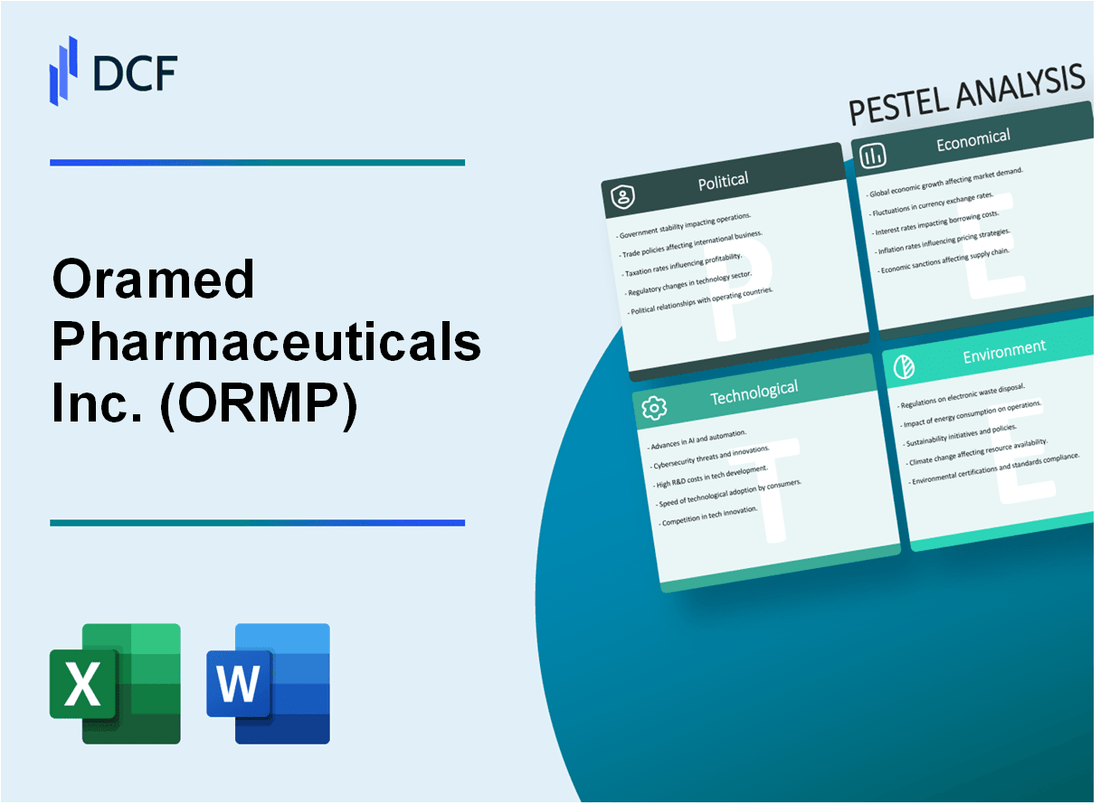
You're tracking Oramed Pharmaceuticals Inc. (ORMP) after the oral insulin Phase 3 setback, and the company you're analyzing today is fundamentally different: it's a cash-rich, post-pivot biotech. The failure of the oral insulin candidate in 2023 forced a strategic shift, making the performance of its vaccine subsidiary, Oravax Medical, the new primary driver, backed by an estimated $100 million in cash as of late 2025. This pivot changes everything, so let's look at the external forces-Political, Economic, Sociological, Technological, Legal, and Environmental-that now shape their path to market.
Political Factors: Funding and Geopolitical Risk
US government funding from agencies like the National Institutes of Health (NIH) or the Biomedical Advanced Research and Development Authority (BARDA) is defintely a key opportunity for Oravax Medical's vaccine R&D. Regulatory stability from the Food and Drug Administration (FDA) is crucial; any slowdown in new drug application (NDA) or Biologics License Application (BLA) reviews directly extends the time-to-market and burns cash. Still, we can't ignore the geopolitical tensions around Israel, Oramed Pharmaceuticals Inc.'s headquarters, which can complicate international R&D and supply chain logistics. The US-Israel bilateral agreements, however, often provide a buffer, supporting joint biomedical programs.
Oravax Medical needs to actively pursue BARDA grants to supplement its R&D budget.
Geopolitics is a silent line item on the R&D budget.
Economic Factors: Cash Runway and Cost of Capital
The good news is the cash position: Oramed Pharmaceuticals Inc.'s cash and cash equivalents are projected to be around $100 million as of late 2025. Here's the quick math: that gives them a crucial two-year R&D runway at current burn rates, which is a massive cushion after a Phase 3 failure. But, the stock price volatility remains high post-setback, so any future capital raises will be expensive, meaning dilution for current shareholders. Plus, high inflation and interest rates globally increase the cost of capital for everything from clinical trials to manufacturing scale-up. Global economic growth, or lack thereof, also influences overall healthcare spending, but the demand for chronic disease treatments like diabetes is relatively inelastic.
The core action is to manage the burn rate to maximize the $100 million runway.
Cash is king, but the cost of raising more is climbing.
Sociological Factors: Demand vs. Hesitancy
The market pull for Oramed Pharmaceuticals Inc.'s original focus remains powerful: the growing global prevalence of Type 2 diabetes drives massive demand for non-injectable treatments, even with the oral insulin setback. Patient preference for oral delivery systems (using Oramed's proprietary oral protein delivery or POD technology) over injections is a clear market advantage for any future POD-based drug. But, the pivot to Oravax Medical introduces a new, significant sociological risk: public acceptance and uptake of new vaccine technologies are heavily influenced by post-pandemic vaccine hesitancy and trust in pharmaceutical companies. Also, health equity movements increase pressure for affordable, accessible treatments globally.
Oravax Medical must invest heavily in transparent public communication and trust-building to mitigate vaccine hesitancy.
The oral pill demand is there, but vaccine trust is a different battle.
Technological Factors: Platform Value and Competition
Oramed Pharmaceuticals Inc.'s proprietary oral protein delivery (POD) technology is a valuable, de-risked platform for future drug candidates, despite the oral insulin failure; it proves the delivery mechanism works. The shift to Oravax Medical, however, means focusing on next-generation vaccine technology, which requires significant, ongoing R&D investment to stay competitive. What this estimate hides is the massive competitive pressure from other non-injectable diabetes treatments, specifically GLP-1 agonists, which set a high bar for any future oral diabetes drug market entry. Still, the company can accelerate pre-clinical work by using automation and artificial intelligence (AI) in drug discovery, potentially shortening R&D cycle times.
Prioritize R&D spend on the most advanced, differentiated vaccine platform at Oravax Medical.
The tech platform is sound, but the competition isn't standing still.
Legal Factors: Intellectual Property and Regulation
Securing and defending intellectual property (IP) for the POD technology is paramount; this is the core asset that protects future revenue streams from generic competition. Strict Food and Drug Administration (FDA) regulations for clinical trial design and execution, especially for novel delivery methods, increase time-to-market risk-every delay burns into that $100 million cash pile. Plus, product liability and litigation risks are inherent in the pharmaceutical sector, particularly with novel vaccine technologies like Oravax Medical, so legal due diligence is critical. Compliance with international data privacy laws, like the General Data Protection Regulation (GDPR), is also necessary for running global clinical trials.
The legal team must conduct a global IP audit on the POD platform immediately.
IP is the moat protecting the entire pivot strategy.
Environmental Factors: Sustainability and Waste Management
Institutional investors are increasingly applying pressure for sustainable supply chains and reduced carbon footprints in drug production. This means Oramed Pharmaceuticals Inc. must actively manage pharmaceutical waste and chemical byproducts from manufacturing processes, which is a growing regulatory and public concern. The company must also comply with increasingly stringent environmental regulations for lab operations and the disposal of biohazardous materials. Given the pivot, the energy consumption for large-scale vaccine manufacturing at Oravax Medical will require a proactive focus on energy-efficient production methods to keep operational costs down.
Operations: draft a sustainability compliance report for institutional investors by Q1 2026.
Environmental compliance is now a cost of doing business, not an option.
Oramed Pharmaceuticals Inc. (ORMP) - PESTLE Analysis: Political factors
The political landscape for Oramed Pharmaceuticals Inc. is a dual-edged sword, driven by US regulatory stability and the strategic, yet volatile, geopolitical position of its Israeli headquarters. The most defintely critical near-term factor is the shifting focus of US government R&D funding, which presents a clear opportunity for Oravax Medical's non-mRNA vaccine platform.
US government funding (NIH, BARDA) is key for vaccine R&D, impacting Oravax Medical's runway.
The direction of US government funding for medical countermeasures (MCMs) is a major swing factor for Oravax Medical, Oramed's majority-owned vaccine subsidiary. The Biomedical Advanced Research and Development Authority (BARDA) has signaled a significant shift in its investment priorities as of August 2025, winding down 22 existing mRNA vaccine development investments. This pivot is explicitly moving funding toward 'safer, broader vaccine platforms' like whole-virus and novel platforms, which could favor Oravax Medical's Virus-Like Particle (VLP) vaccine technology, as it is a non-mRNA approach.
While Oramed's core R&D expenses for the nine months ended September 30, 2025, were relatively low at $4.4 million, down from $4.9 million in the prior year, a major government contract could instantly change that. The National Institute of Allergy and Infectious Diseases (NIAID), part of the National Institutes of Health (NIH), has a substantial budget, with a total FY 2025 request of $6,581.3 million. They are actively soliciting proposals for new medical countermeasures, with one research area in the 2026 Omnibus Broad Agency Announcement (BAA) estimating up to $20 million in total contract costs for the base period across all awards. A VLP vaccine that targets emerging infectious diseases is a strong candidate for this redirected capital.
Regulatory stability from the Food and Drug Administration (FDA) is defintely critical for new drug applications (NDAs) and Biologics License Applications (BLAs).
For Oramed's oral insulin candidate (ORMD-0801) and Oravax's oral vaccine, the US Food and Drug Administration (FDA) review process is the ultimate gatekeeper. While the FDA's regulatory efficiency remains high, with a 94% Prescription Drug User Fee Act (PDUFA) goal date compliance rate in 2024, there are growing industry concerns about potential delays in considering New Drug Applications (NDAs) and Biologics License Applications (BLAs). This uncertainty is a risk, especially for a platform technology company like Oramed, where the entire valuation hinges on successful clinical translation and approval.
The FDA is also pushing for greater transparency. In July 2025, the agency released over 200 Complete Response Letters (CRLs) issued between 2020 and 2024 for approved products. This transparency helps, but it also increases scrutiny on a company's regulatory filings and public disclosures, which is a risk for companies like Oramed that have seen their stock performance highly sensitive to clinical trial results. The regulatory environment is stable, but the review process is getting more complex.
- Monitor FDA's new guidance agendas for 2025, especially those impacting BLA stability requirements.
- Factor in potential NDA/BLA review delays, despite the high 2024 PDUFA compliance rate.
- Prepare for enhanced public scrutiny due to the FDA's push for greater transparency on Complete Response Letters.
Geopolitical tensions around Israel, where Oramed is headquartered, can affect international collaborations and R&D operations.
Oramed is headquartered in Israel, which exposes its operations to regional geopolitical instability. While the company is listed on Nasdaq and its financial results for the nine months ended September 30, 2025, showed a strong net income of $65.0 million (driven by strategic investments, not product sales), the physical location of its R&D and clinical sites remains a risk factor. Geopolitical tensions in the Middle East have historically caused volatility in global energy markets, which can translate into higher operating costs for the pharmaceutical supply chain, including for energy-related utilities and CDMO (Contract Development and Manufacturing Organization) services. Honestly, regional stability is a non-financial factor that can still crush a balance sheet.
Furthermore, the US administration's trade policies, including new tariffs announced in July 2025 on imports from over 150 countries, could raise the cost of raw materials and Active Pharmaceutical Ingredients (APIs) sourced from overseas, even if Oramed's manufacturing is primarily conducted through partners. This tariff-driven increase in input costs affects the entire global pharmaceutical industry, but Oramed's international operational footprint makes it a direct concern.
US-Israel bilateral agreements often support joint biomedical research and development programs.
On the positive side, the strong bilateral relationship between the US and Israel provides a structural advantage. Several legislative efforts in 2025 aim to deepen this cooperation in health technology. The United States-Israel Bilateral Innovation for Research and Development in Health Act of 2025 (BIRD Health Act) and the Maximizing Israel-U.S. Research Advancement and Collaborative Leadership in Emerging Medical Technology Act of 2025 (MIRACLE Medical Technology Act of 2025) are examples.
The MIRACLE Act, for instance, foresees an appropriation of $8 million annually from 2026 to 2030 to fund joint initiatives in medical technology. This provides a clear, long-term funding channel for Oramed's platform technology. Plus, the existing U.S.-Israel Binational Science Foundation (BSF) has a November 15, 2025, submission deadline for research grants, offering up to $250,000 over four years for collaborative projects in life sciences and health sciences. These programs offer non-dilutive funding, which is always a win for a biotech with a strong cash position but limited product revenue.
Here's the quick math on the financial leverage from these political factors:
| Political/Regulatory Factor | Impact on Oramed/Oravax | Relevant 2025 Data Point |
|---|---|---|
| BARDA Funding Shift | Opportunity for non-mRNA VLP vaccine funding. | BARDA terminating 22 mRNA vaccine investments. |
| NIAID (NIH) R&D Funding | Potential for non-dilutive contract funding. | NIAID FY 2025 Budget Request: $6,581.3 million. |
| FDA Regulatory Efficiency | Predictability of review timelines. | FDA 2024 PDUFA goal date compliance rate: 94%. |
| US-Israel Bilateral R&D | Access to joint government grant funding. | BSF Research Grants up to $250,000 over four years. |
| MIRACLE Act (Proposed) | Long-term, dedicated funding for US-Israel medical tech. | Foresees $8 million annually from 2026-2030. |
Next Step: Oravax Medical: Prepare a targeted proposal for the NIAID BAA, emphasizing the VLP platform's safety and non-mRNA status, by January 15, 2026.
Oramed Pharmaceuticals Inc. (ORMP) - PESTLE Analysis: Economic factors
The economic outlook for Oramed Pharmaceuticals Inc. is a study in financial resilience against a challenging biotech market, largely due to smart balance sheet management following the Phase 3 failure of its oral insulin program, ORMD-0801. You're looking at a company that has successfully pivoted its financial focus, so its near-term risk is less about immediate cash burn and more about the high cost of future capital.
The company's cash and cash equivalents are projected to be around $100 million as of late 2025, providing a crucial two-year R&D runway.
Honestly, Oramed Pharmaceuticals Inc.'s balance sheet strength is a significant economic buffer. As of the unaudited results for the nine months ended September 30, 2025, the company reported total assets of $220.5 million, a 42% increase year-over-year. This growth was primarily driven by strategic investment returns, including the complete $100 million cash repayment from Scilex Holding Company. This cash position is critical. Here's the quick math on their runway:
| Financial Metric (Nine Months Ended Sept 30, 2025) | Amount (USD) |
|---|---|
| Total Assets | $220.5 million |
| Net Income (Pre-Tax) | $65.0 million |
| R&D Expenses (Nine Months) | $4.4 million |
| R&D Expenses (Annualized Estimate) | ~$5.9 million |
With annualized R&D expenses projected around $5.9 million, a significant portion of that $100 million cash gives them a long operational runway-defintely more than two years-to advance their oral drug delivery platform without immediate dilution. That's a luxury in the small-cap biotech space.
Post-Phase 3 failure, the stock price volatility remains high, making future capital raises more expensive.
The economic shadow of the Phase 3 failure for ORMD-0801 still affects Oramed Pharmaceuticals Inc.'s valuation, creating high stock price volatility. Biotech stocks are inherently sensitive to clinical trial outcomes, so a major setback makes investors demand a higher risk premium for new equity. The company's recent financial success is from its investment portfolio, not its core drug pipeline, which signals a fundamental shift in investor perception. This means any future capital raise (dilutive financing) to fund a new Phase 3 trial will likely come at a higher cost of equity, demanding a larger share of the company for the same cash amount.
High inflation and interest rates increase the cost of capital for clinical trials and manufacturing scale-up.
The broader macroeconomic environment is a serious headwind. Stubbornly persistent inflation and the US Federal Reserve's outlook for only two rate cuts in 2025 keep interest rates high. This is bad news for the entire biotech sector because it increases the cost of capital (borrowing) and lowers valuations for growth stocks like Oramed Pharmaceuticals Inc.
- Higher interest rates increase the cost of debt financing for large-scale clinical trials and manufacturing expansion.
- Investors are shifting capital to sectors with more predictable returns, reducing the overall pool of available venture capital for high-risk R&D.
- The high-cost environment forces companies to scale back R&D budgets or prioritize lower-risk projects, which could slow the advancement of Oramed Pharmaceuticals Inc.'s platform technology.
To be fair, the Inflation Reduction Act (IRA) also adds pressure, as it introduces drug price negotiation for Medicare, which reduces the potential future revenue of high-cost drugs and makes high-risk, high-reward R&D projects less attractive across the industry.
Global economic growth directly influences disposable income and healthcare spending on chronic diseases like diabetes.
Despite the capital market challenges, the target market for Oramed Pharmaceuticals Inc.'s oral delivery platform-chronic diseases, especially diabetes-shows immense and growing economic opportunity. The global economic burden of diabetes is projected to rise from $1.31 trillion in 2015 to an estimated $2.5 trillion by 2030. This massive cost ensures that governments and private payers will continue to prioritize spending on effective, and potentially more convenient, treatments.
The global diabetes care market is projected to climb from $26.79 billion in 2024 to $29.09 billion in 2025, an 8.6% compound annual growth rate (CAGR). This expansion is driven by the escalating global prevalence of diabetes, which the IDF Diabetes Atlas 2025 reports affects 11.1% (or 1 in 9) of the adult population (20-79 years). A successful oral delivery product, therefore, taps into a market with guaranteed, non-cyclical demand, largely insulated from short-term fluctuations in consumer disposable income because diabetes care is a medical necessity.
Oramed Pharmaceuticals Inc. (ORMP) - PESTLE Analysis: Social factors
You're looking at Oramed Pharmaceuticals Inc.'s social landscape, and the core takeaway is this: the massive, undeniable global demand for convenient diabetes care is a powerful tailwind, but it's running straight into the headwind of public skepticism toward new pharmaceutical products, especially vaccines.
Growing global prevalence of Type 2 diabetes drives massive demand for non-injectable treatments, despite the oral insulin setback.
The sheer scale of the diabetes epidemic creates a perpetual market opportunity for Oramed's oral delivery technology (POD™). The global Type 2 Diabetes (T2D) market size is projected to be valued at approximately $40.09 billion in the 2025 fiscal year, with a forecasted Compound Annual Growth Rate (CAGR) of 7.47% from 2025 to 2034. This growth is driven by a continually increasing patient pool. The International Diabetes Federation estimates that the total number of adults living with diabetes will rise to an astonishing 853 million by 2050, with T2D accounting for over 90% of these cases.
Here's the quick math: even after the Phase 3 trial failure of Oramed's oral insulin candidate, ORMD-0801, the underlying market need for a non-injectable solution remains colossal. The market is dynamic, and the oral route of administration already captured the largest market share by route in 2024, indicating a strong social and medical acceptance of pills over needles.
Public acceptance and uptake of new vaccine technologies (Oravax) are influenced by post-pandemic vaccine hesitancy and trust in pharmaceutical companies.
Oramed's vaccine subsidiary, Oravax Medical Inc., faces a complex social environment. While an oral vaccine offers clear logistical and convenience advantages, the post-COVID-19 era has left a significant portion of the global population defintely skeptical of new vaccine technologies and the pharmaceutical industry at large. This vaccine hesitancy is often fueled by social media misinformation.
The company has seen commercial interest, evidenced by a pre-order for 10 million doses of its oral COVID-19 vaccine from Tan Thanh Holdings in Vietnam. However, scaling up from a pre-order to widespread public uptake requires overcoming a significant trust deficit. The social factor here is not just about efficacy, but about the public's perception of safety and the pharmaceutical company's transparency. The development of Oravax's Virus-Like Particle (VLP) vaccine, which targets three structural proteins, is a scientific advantage, but the social challenge is convincing the public that a new, oral format is trustworthy.
Patient preference for oral delivery systems (like Oramed's POD technology) over injections remains a powerful market pull.
The strongest social factor favoring Oramed is the overwhelming patient preference for oral administration. This is a simple quality-of-life issue that drives compliance and, ultimately, better health outcomes. For patients with chronic conditions like T2D, avoiding daily or weekly injections is a massive incentive. One study of patients with T2D found that 82% of participants preferred a once-daily oral treatment over a once-daily injectable.
The route of administration was ranked as the most important factor driving this preference by 57.5% of those surveyed. Furthermore, in a clinical study evaluating an oral delivery system, 91% of participants indicated a preference for the oral route versus their current parenteral (injectable) route of drug administration. This social desire for convenience translates directly into a market pull for Oramed's POD™ technology, which is designed to deliver large therapeutic proteins like insulin orally.
| Patient Preference Factor | Preference for Oral vs. Injectable | Key Social Implication for Oramed |
|---|---|---|
| T2D Patients Preferring Once-Daily Oral over Injectable | 82% | High demand for any successful oral diabetes treatment. |
| Patients Preferring Oral Route over Current Injection Regimen | 91% | Strong compliance driver for POD™ technology. |
| Adults with Diabetes in Low- and Middle-Income Countries | 81% (4 in 5) | Affordability and ease of distribution are critical for global market entry. |
Health equity movements increase pressure for affordable, accessible treatments in both developed and emerging markets.
The global health equity movement is placing significant pressure on pharmaceutical companies to address the '3 As': availability, accessibility, and affordability of essential medicines, particularly for chronic diseases like diabetes. This is a major social and ethical consideration for Oramed, especially as it eyes global markets. Over 81% of adults with diabetes live in low- and middle-income countries, where financial constraints and inadequate healthcare infrastructure are major barriers to care.
An oral drug delivery system like Oramed's POD™ technology inherently addresses two of the '3 As'-it improves accessibility by simplifying administration (no needles, no special training) and potentially lowers distribution costs (no cold chain for the oral insulin capsule). However, the final price point will be the critical factor. Governments and advocacy groups are actively pushing for subsidies and price caps, making it a strategic imperative for Oramed to develop a pricing model that balances profitability with the social demand for equitable access to life-saving treatments.
- Focus on the '3 As' of health equity.
- Oral delivery simplifies distribution logistics.
- Pricing must meet affordability demands globally.
Oramed Pharmaceuticals Inc. (ORMP) - PESTLE Analysis: Technological factors
Oramed's proprietary oral protein delivery (POD) technology is a valuable, de-risked platform for future drug candidates, despite the oral insulin failure.
You need to look past the Phase 3 clinical trial failure of the oral insulin candidate, ORMD-0801, because the core Protein Oral Delivery (POD) technology itself remains a valuable, de-risked platform. The technology's ability to protect therapeutic proteins from degradation in the gastrointestinal tract and enable oral absorption is a major technical hurdle cleared. The market has validated this platform's potential through a major strategic move in February 2025: the spin-off of the POD technology into a new joint venture, OraTech Pharmaceuticals Inc.
This new entity, formed with Hefei Tianhui Biotech Co., Ltd. (HTIT), immediately secured a combined capital commitment of $75 million from the partners, with HTIT investing $60 million and Oramed investing $15 million. That is a clear financial signal that the technology, and its application to other molecules like the oral GLP-1 receptor agonist ORMD-0901, is still highly valued by strategic partners. The platform is now financially capitalized for a renewed, smaller Phase 3 trial for ORMD-0801 in the U.S. and continued development of other oral biologics.
The shift to Oravax Medical focuses on next-generation vaccine technology, requiring significant R&D investment.
The company's strategic pivot extends to its subsidiary, Oravax Medical Inc., which is focused on next-generation oral vaccines. Oravax leverages the POD technology from Oramed and the D-Crypt™ vaccine technology from Premas Biotech, aiming to create a needle-free, temperature-stable oral vaccine. The oral COVID-19 vaccine candidate, for example, is a Virus-Like Particle (VLP) that targets three structural proteins, which is a design intended to provide broad protection against emerging variants. This is a smart move into a high-growth, high-convenience market.
However, the R&D investment profile at Oramed itself has changed dramatically. For the nine months ended September 30, 2025, Oramed's direct Research and Development expenses actually decreased to $4.4 million from $4.9 million year-over-year. This reflects a strategic downsizing of internal drug development, shifting the heavy lifting of R&D for the POD platform to the new OraTech joint venture and managing the Oravax development tightly. The operational R&D spend is low, but the technological ambition remains high. You need to watch the capital burn at the joint ventures.
Competitor advancements in non-injectable diabetes treatments (e.g., GLP-1 agonists) create a high bar for market entry.
The competitive landscape for non-injectable diabetes and obesity treatments is exploding, setting a formidable bar for Oramed's oral GLP-1 candidate, ORMD-0901. The global Glucagon-like Peptide-1 (GLP-1) Analogues Market is projected to be valued at $66.48 billion in 2025, with a staggering CAGR of 33.24% expected through 2034. This market is dominated by injectable blockbusters, but the race for oral versions is intense.
Major competitors are already deep into development for next-generation oral GLP-1s:
- Eli Lilly is in Phase 3 trials for its oral GLP-1 drug, orforglipron.
- Novo Nordisk is expanding production with a $6.2 billion investment to meet surging demand.
- The market is moving toward dual and triple agonists, like Eli Lilly's tirzepatide (Mounjaro), a dual GLP-1/GIP receptor agonist, which are projected to capture nearly 25% of the market by 2027.
Oramed's POD technology must prove not just bioavailable, but competitive on efficacy and side-effect profile against these multi-billion-dollar programs. The convenience of an oral pill is a massive advantage, but the science has to be defintely superior to the current gold standard.
Automation and AI in drug discovery are being used to accelerate pre-clinical work, potentially reducing R&D cycle times.
The pharmaceutical industry is undergoing a massive technological transformation driven by Artificial Intelligence (AI) and automation, a trend Oramed must adopt to remain competitive. AI-driven drug discovery is expected to accelerate pre-clinical work, dramatically cutting R&D cycle times and costs across the industry.
Here's the quick math on the industry-wide opportunity:
- AI can potentially cut the time to develop new drugs by up to 50%, according to an Accenture report.
- McKinsey & Company suggests AI could lead to a 30% efficiency gain in pharma companies.
- Success rates for AI-discovered drugs are reported to be as high as 80% to 90%, significantly better than traditional methods.
This technological shift is now the baseline expectation for any innovative biotech. Oramed, through its joint ventures OraTech and Oravax, must integrate these AI and automation tools-for molecular modeling, target identification, and clinical trial optimization-to efficiently progress its pipeline and justify its platform valuation against the backdrop of its competitors' massive scale. This is a capital-efficient way to advance R&D.
| Technological Factor | Oramed's 2025 Strategic Position/Action | Key 2025 Financial/Statistical Data |
|---|---|---|
| Oral Delivery Platform (POD) Value | Spin-off into OraTech Pharmaceuticals Inc. to accelerate development of ORMD-0801 and oral GLP-1 (ORMD-0901). | OraTech joint venture secured $75 million in capital commitment (HTIT: $60M, Oramed: $15M). |
| Next-Gen Vaccine Technology | Oravax Medical Inc. developing oral VLP vaccine (POD + D-Crypt™) for ease of distribution and protection against variants. | Oramed's direct R&D expenses for nine months ended Sept 30, 2025, decreased to $4.4 million (reflecting strategic pivot). |
| Competitor Oral GLP-1 Advancements | Faces high market-entry bar from major pharma companies with advanced oral and multi-agonist candidates. | Global GLP-1 Analogues Market Size estimated at $66.48 billion in 2025, growing at 33.24% CAGR. |
| AI and Automation in R&D | Must adopt AI for target ID and pre-clinical work to match industry efficiency gains and accelerate pipeline. | AI adoption projected to yield up to 30% efficiency gain and cut drug development time by 50% in the industry. |
Oramed Pharmaceuticals Inc. (ORMP) - PESTLE Analysis: Legal factors
Securing and defending intellectual property (IP) for the POD technology is paramount to protect future revenue streams.
You can't build a revolutionary business on a weak foundation, and in pharma, that foundation is your intellectual property (IP). Oramed Pharmaceuticals Inc.'s core value is tied directly to its Protein Oral Delivery (POD™) technology, which is designed to enable the oral delivery of injectable drugs like insulin. Protecting this technology is a complex, global legal undertaking.
The company made a major strategic move in February 2025 by spinning off the POD™ technology and its oral insulin program into a new joint venture, OraTech Pharmaceuticals Inc., with Hefei Tianhui Biotech Co., Ltd. (HTIT). This transaction shifts the legal and financial burden of IP defense to the new entity, which received a combined $75 million in capital from the partners. The IP portfolio itself is substantial, having grown over the years to fortify its position.
Here's the quick math on their IP protection as of early 2025:
| IP Metric | Quantity | Implication |
|---|---|---|
| Granted Patents (as of Jan 2022) | 88 | Strong foundational protection in key markets (US, Europe, Japan). |
| Pending Patent Applications (as of Mar 2025) | 26 | Active, ongoing effort to expand protection for new compositions and methods. |
| Earliest Patent Expiration Date (for pending, if granted) | 2026 | The legal life of the core technology is secure for the near-term commercialization window. |
The new OraTech entity must now manage this portfolio, defending against potential infringement lawsuits, especially as the oral delivery market heats up. A single successful patent challenge could wipe out defintely years of R&D investment.
Strict FDA regulations for clinical trial design and execution, especially for novel delivery methods, increase time-to-market risk.
The U.S. Food and Drug Administration (FDA) is the ultimate gatekeeper, and for a novel drug delivery system like an oral insulin capsule, the regulatory path is inherently high-risk. The FDA's rigor, while necessary for patient safety, translates directly into increased time and cost for Oramed.
Following a deep analysis of prior Phase 2 and Phase 3 data, Oramed is now initiating a new, focused 60-patient, US-based trial for its oral insulin (ORMD-0801), with a protocol informed by discussions with the FDA. This is a direct action to mitigate past regulatory setbacks.
The company has already spent significant capital just on managing this regulatory process:
- Regulatory Compliance Investment: $12.4 million in regulatory compliance and FDA interaction processes (as of 2024).
- Average FDA Review Time: 12 to 18 months for innovative diabetes treatments, even after a successful Phase 3.
The new 60-patient trial is designed to maximize cost-efficiency and shorten the timeline, but any unexpected clinical hold or request for additional data will immediately push back the potential commercialization date, impacting the net present value of the entire program. It's a tightrope walk between speed and compliance.
Product liability and litigation risks are inherent in the pharmaceutical sector, especially with novel vaccine technologies like Oravax.
In the pharmaceutical world, product liability is a constant, material risk. When you introduce a novel drug or vaccine, you are accepting the risk of litigation from unforeseen side effects, manufacturing defects, or inadequate warnings. This risk extends beyond their flagship oral insulin to their joint venture, Oravax, which is developing an oral vaccine.
Oramed holds a 63% ownership stake in the Oravax joint venture. While Oravax is a separate entity, Oramed remains exposed to potential product liability claims related to the Oravax product, which could result in substantial liabilities, regardless of the claim's merit.
The cost of managing these legal and administrative risks is reflected in the company's operating expenses. For the nine-month period ended September 30, 2025, Oramed's General and Administrative (G&A) expenses, which include legal and professional fees, were $5.0 million, an increase from $4.3 million in the same period last year. This 16.3% increase in G&A costs shows the rising overhead of managing a complex, multi-asset legal and regulatory environment.
Compliance with international data privacy laws (e.g., GDPR) is necessary for global clinical trials and patient data management.
Oramed's clinical trials are not confined to the United States; past Phase 3 studies for ORMD-0801 recruited patients across the U.S., Europe, and Israel. This global reach immediately triggers the need for strict compliance with international data privacy regulations, most notably the European Union's General Data Protection Regulation (GDPR).
GDPR compliance is non-negotiable for any trial involving European patients. This means Oramed must ensure the highest standards for the collection, storage, and transfer of personally identifiable information (PII) and protected health information (PHI).
Key legal compliance actions for Oramed include:
- Implementing Standard Contractual Clauses (SCCs) for all data transfers of European patient data to the U.S. or Israel.
- Appointing a Data Protection Officer (DPO) to oversee compliance.
- Securing explicit, informed patient consent that meets GDPR's high standard.
Failure to comply with GDPR can lead to massive fines-up to 4% of annual global turnover or €20 million, whichever is higher-a catastrophic financial risk for a clinical-stage company. The new OraTech joint venture must inherit and immediately enforce these rigorous data governance standards across all its global trials.
Oramed Pharmaceuticals Inc. (ORMP) - PESTLE Analysis: Environmental factors
Managing pharmaceutical waste and chemical byproducts from manufacturing processes is a growing regulatory and public concern.
You must recognize that even as a clinical-stage company, the transition to commercial-scale manufacturing, particularly for the Oravax oral vaccine, brings immediate and intense scrutiny on waste management. The pharmaceutical sector is energy-intensive, and its waste stream includes complex chemical byproducts and biohazardous materials.
The industry standard for best practice in 2025 is moving toward a circular economy model, which includes adopting Zero-Liquid Discharge (ZLD) processes to eliminate liquid waste entirely by recycling all wastewater. Failure to implement such systems in future Good Manufacturing Practice (GMP) facilities will create a significant compliance and public relations risk. For context, major pharma companies are now spending an estimated $5.2 billion annually on environmental programs, representing a 300% increase from 2020, showing how serious this cost center has become.
The company must comply with increasingly stringent environmental regulations for lab operations and disposal of biohazardous materials.
Oramed's primary R&D operations in Israel face immediate and evolving regulatory hurdles that directly impact lab and disposal costs. The Israeli Ministry of Environmental Protection rolled out a comprehensive environmental management strategy in November 2024, mandating strict controls on per- and polyfluoroalkyl substances (PFAS).
This is a critical near-term compliance risk, as any use of PFAS in lab equipment, solvents, or fire-fighting foam requires immediate action. Plus, in July 2025, Israel published a draft of the Hazardous Substances Regulations to implement the UN's Stockholm Convention on Persistent Organic Pollutants (POPs), which will further restrict the production, trade, and use of highly toxic, persistent chemicals. This means a necessary, defintely costly, and immediate review of all lab chemicals and disposal protocols is required.
| Regulatory Change (Israel, 2025) | Direct Impact on Oramed (R&D/Lab) | Compliance Action Required |
|---|---|---|
| PFAS Controls (Nov 2024 Strategy) | Requires comprehensive data on PFAS usage, testing of products/processes, and a technical/economic evaluation of alternatives. | Immediate: Secure a toxic substances permit; establish procedures for managing PFAS leaks/wastewater within six months. |
| Draft Hazardous Substances Regulations (Stockholm Convention) (July 2025) | Restricts the use of 12 initial Persistent Organic Pollutants (POPs) and four PFAS compounds in R&D and manufacturing. | Near-Term: Conduct a comprehensive assessment to map all lab and production chemicals against the new POPs list to ensure compliance before ratification. |
Pressure for sustainable supply chains and reduced carbon footprints in drug production is increasing from institutional investors.
Institutional investors, including major asset managers, now view Environmental, Social, and Governance (ESG) performance as a material financial risk. They are pushing for lower Scope 3 emissions (indirect emissions from the supply chain), which account for approximately 50%-75% of total healthcare-related emissions. Oramed's oral drug delivery platform, however, offers a significant competitive advantage here.
The core proposition of an oral capsule over an injectable drug-like the Oravax oral vaccine-is a vastly simplified distribution chain. This eliminates the need for complex, energy-intensive cold-chain logistics, which are a major source of carbon emissions. For a comparable drug, one study found that the greenhouse gas (GHG) emissions of an oral tablet were up to 16 times less than those from an IV in a glass vial. This inherent environmental benefit is a powerful asset to highlight in investor relations.
Energy consumption for large-scale vaccine manufacturing (Oravax) will require a focus on energy-efficient production methods.
Scaling up the GMP manufacturing for the Oravax oral vaccine will demand substantial energy, bringing the company's energy footprint into focus. In a typical pharmaceutical plant, auxiliary services like heating, ventilation, and air conditioning (HVAC) and cooling systems account for roughly 40% of total energy consumption.
To mitigate this impact and meet investor expectations, Oramed must plan for energy-efficient production methods from the outset. The industry is rapidly adopting several key strategies:
- Implement Continuous Manufacturing to replace traditional batch processing, which reduces energy consumption and waste.
- Utilize Waste Heat Recovery Systems to repurpose excess thermal energy for heating, saving millions of kWh annually.
- Prioritize Green Chemistry approaches, such as using less toxic solvents and closed-loop solvent recovery systems.
Here's the quick math: if Oramed adopts these practices, it can achieve the industry average carbon emission reduction of 30% to 40% compared to traditional manufacturing, directly translating to lower long-term operating costs and a stronger ESG profile.
Disclaimer
All information, articles, and product details provided on this website are for general informational and educational purposes only. We do not claim any ownership over, nor do we intend to infringe upon, any trademarks, copyrights, logos, brand names, or other intellectual property mentioned or depicted on this site. Such intellectual property remains the property of its respective owners, and any references here are made solely for identification or informational purposes, without implying any affiliation, endorsement, or partnership.
We make no representations or warranties, express or implied, regarding the accuracy, completeness, or suitability of any content or products presented. Nothing on this website should be construed as legal, tax, investment, financial, medical, or other professional advice. In addition, no part of this site—including articles or product references—constitutes a solicitation, recommendation, endorsement, advertisement, or offer to buy or sell any securities, franchises, or other financial instruments, particularly in jurisdictions where such activity would be unlawful.
All content is of a general nature and may not address the specific circumstances of any individual or entity. It is not a substitute for professional advice or services. Any actions you take based on the information provided here are strictly at your own risk. You accept full responsibility for any decisions or outcomes arising from your use of this website and agree to release us from any liability in connection with your use of, or reliance upon, the content or products found herein.