
|
Pfizer Inc. (PFE): ANSOFF MATRIX [Dec-2025 Updated] |
Fully Editable: Tailor To Your Needs In Excel Or Sheets
Professional Design: Trusted, Industry-Standard Templates
Investor-Approved Valuation Models
MAC/PC Compatible, Fully Unlocked
No Expertise Is Needed; Easy To Follow
Pfizer Inc. (PFE) Bundle
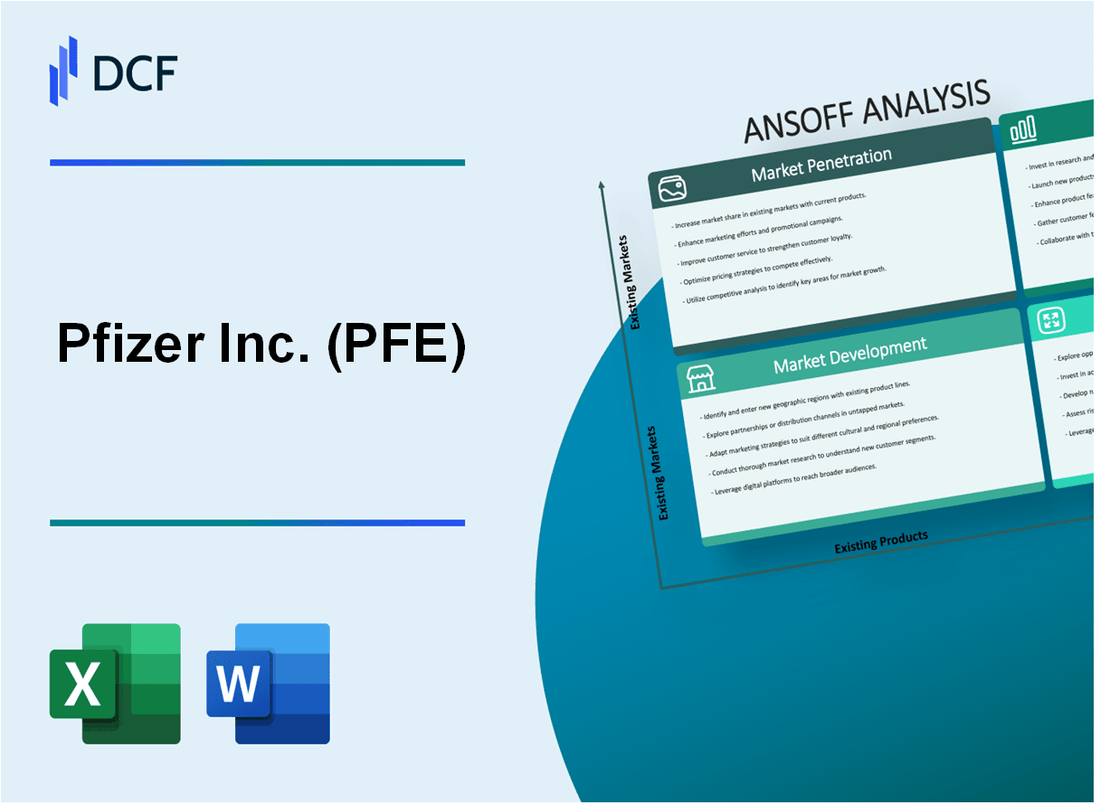
You're trying to map out Pfizer Inc.'s next move as they aim for that $61.0 billion to $64.0 billion revenue guidance in 2025, which is a real pivot after the pandemic peak. Honestly, the whole strategy is built on four clear growth engines: driving commercial excellence for blockbusters like Eliquis while defending against the IRA redesign, aggressively advancing the Seagen oncology pipeline, launching key new products like the mRNA flu/COVID vaccine, and making a defintely new bet on the obesity market and the Trumprx direct-to-consumer platform. It's a textbook balancing act between maximizing what you have and making calculated, high-stakes moves into new territory, so let's break down exactly where the capital and focus are going across the Ansoff Matrix below.
Pfizer Inc. (PFE) - Ansoff Matrix: Market Penetration
You're looking at how Pfizer Inc. (PFE) plans to squeeze more revenue out of its existing markets, which is the heart of Market Penetration. This means driving sales of current products to current customers, often through better marketing, pricing, or sales force efficiency. The numbers here show the direct impact of these efforts against headwinds.
For key brands, the commercial execution in 2025 is showing mixed but positive momentum in the non-COVID portfolio. For instance, in the third quarter of 2025, strengthened commercial execution drove 4% operational revenue growth for the non-COVID portfolio, which includes your focus products, Eliquis and the Vyndaqel family. Specifically, the Vyndaqel family globally saw an operational revenue increase in the second quarter of 2025. However, you should note that growth for Vyndaqel was expected to be tempered in 2025 due to the IRA Part D redesign and new competition.
The company is actively working to offset regulatory impacts. Pfizer anticipates a net unfavorable revenue impact of approximately $1 billion year-over-year in 2025 directly related to the Inflation Reduction Act (IRA) Part D Redesign changes. This is a direct challenge to market penetration that requires maximizing volume and price realization elsewhere.
To improve sales force effectiveness, Pfizer is leaning into technology. They have integrated AI into their sales force strategy, and leveraging AI-powered predictive analytics resulted in a reported 10% increase in conversion rates. Furthermore, Pfizer is deploying Agentforce, a tool supporting 20,000 employees in sales and engagement, to streamline clinical operations and improve customer interactions.
On the cost side, which frees up cash for market investment, Pfizer is realizing the final stages of its efficiency drive. The company anticipates realizing the final $500 million in net cost savings in 2025 from the ongoing Cost Realignment Program, which builds upon the $4.0 billion in net operating expense savings achieved through the end of 2024. Overall, these cost improvement initiatives are on track to deliver approximately $7.2 billion in anticipated net cost savings by the end of 2027.
Regarding the Prevnar family of vaccines, while global revenues for the family declined 2% to $1.8 billion in the third quarter of 2024, and the product faces generic competition, the focus remains on market defense and growth. Here's a quick look at the context for some key products and financial targets:
| Metric | Value/Range | Context/Period |
|---|---|---|
| 2025 Revenue Guidance Range | $61.0 to $64.0 Billion | Full-Year 2025 Forecast |
| IRA Part D Net Unfavorable Impact | $1 Billion | Anticipated 2025 Revenue Headwind |
| Final Cost Realignment Savings in 2025 | $500 Million | Anticipated Net Savings |
| AI Conversion Rate Increase | 10% | Reported increase from AI-powered predictive analytics |
| Vyndaqel Family Operational Growth (Q1 2025) | 33% | Global Operational Revenue Growth |
The strategy for Prevnar involves targeted public health campaigns to increase market share, which is critical given the competitive pressures. You can see the focus on operational efficiency supporting the core business in the overall 2025 Adjusted Diluted EPS guidance range of $3.00 to $3.15 as of the third quarter update.
- Drive commercial excellence for Eliquis and Vyndaqel.
- Mitigate the $1.0 billion net unfavorable revenue impact from IRA Part D.
- Leverage AI for a reported 10% increase in sales conversion rates.
- Realize the final $500 million in 2025 cost savings.
- Increase market share for Prevnar family against generic competition.
The deployment of Agentforce is supporting 20,000 sales and engagement employees. This focus on existing markets is designed to deliver operational growth, as seen in the 4% operational revenue growth for the non-COVID portfolio in Q3 2025.
Finance: draft 13-week cash view by Friday.
Pfizer Inc. (PFE) - Ansoff Matrix: Market Development
Market Development for Pfizer Inc. centers on taking existing, successful products into new international territories or finding new patient segments within established markets. This strategy relies heavily on regulatory approvals and tailoring commercial execution to local economic realities.
Expand the geographic footprint of key non-COVID products like Padcev into emerging markets (Asia, Africa)
Pfizer Inc.'s revenue breakdown in fiscal year 2024 showed that Emerging Markets accounted for 13.95% of total revenue, which amounted to $8.88 billion.
For 2025, Pfizer reaffirmed its full-year revenue guidance in the range of $61.0 to $64.0 billion.
In the second quarter of 2025, Pfizer's International revenues grew 6% on an operational basis, reaching $5.76 billion.
The performance of key non-COVID products like Padcev shows strong momentum that supports geographic expansion efforts:
| Metric | Value/Period | Source/Context |
| Padcev Sales (First Half 2025) | $967 million | Rose by 31.6 percent |
| Padcev Sales (First Nine Months 2025) | $1.43 billion | 25% growth (Pfizer books Americas sales) |
| Padcev Sales (Q2 2025) | $542 million | Rose 38% |
| Padcev Peak Sales Expectation (Astellas) | Raised from $2.7 billion to $3.4 billion | On promise of extended use |
Pursue label expansions for existing approved drugs, such as Padcev, to treat new patient populations in current countries
Label expansion is a critical driver for increasing the addressable patient pool for established assets. The focus here is on securing approvals for new indications in markets where the drug is already sold.
Pfizer expects 4 regulatory decisions in 2025 as part of its R&D focus.
A significant recent label expansion for Padcev occurred in the U.S. market:
- FDA approved PADCEV combined with pembrolizumab as a perioperative treatment for adult patients with muscle-invasive bladder cancer ineligible for cisplatin-containing chemotherapy on November 21, 2025.
- Globally, MIBC (muscle-invasive bladder cancer) represents approximately 30% of all bladder cancer cases.
- A decision on this new MIBC indication is anticipated in the EU before the end of 2026.
Other products also saw price adjustments at the start of 2025, reflecting market dynamics post-approval/negotiation:
- Pfizer's Paxlovid list price increased by 3% in early 2025.
- Migraine treatment Nurtec and cancer drugs Adcetris, Ibrance, and Xeljanz saw list price increases between 3% and 5% at the start of 2025.
Establish localized production and distribution infrastructure in new regions to improve supply chain resilience
Pfizer Inc. has made specific investments to build out localized manufacturing, particularly in the Middle East, to enhance supply chain agility and meet regional growth.
In Saudi Arabia, Pfizer invested $50 million to establish an 11,000 square-meter facility for manufacturing 16 pharmaceutical items.
This aligns with the Saudi National Industrial Development and Logistics Program goal to localize 40% of the Saudi pharmaceutical industry's value by 2030.
The Egyptian pharmaceutical market demonstrated robust demand, with sales reaching 62 billion Egyptian pounds in the first two months of 2025.
Pfizer's overall global infrastructure includes over 30 manufacturing sites and reaches 200 countries.
Adapt pricing and access strategies for established products to align with local healthcare systems in developing economies
While much of the recent public data focuses on U.S. pricing agreements, these strategies illustrate adapting to specific market access demands, which is a precursor to developing localized pricing for emerging markets.
Pfizer entered an agreement in late 2025 to implement Most-Favored Nation (MFN) pricing in the U.S., matching U.S. prices to the lowest offered in comparable developed nations.
For certain U.S. products on the TrumpRx.gov platform, Pfizer offered discounts that ranged as high as 85%, with an average reduction of around 50%.
Specific examples of U.S. discounts secured via this agreement include:
- Eucrisa: 80% discount.
- Xeljanz: 40% discount.
- Zavzpret: 50% discount.
The company reaffirmed its full-year 2025 Adjusted diluted EPS guidance range of $3.00 to $3.15, which absorbs the impact of currently imposed tariffs from China, Canada, and Mexico.
Pfizer also committed to investing an additional $70 billion dedicated to U.S. R&D and capital projects over the next few years in exchange for pricing certainty.
Pfizer Inc. (PFE) - Ansoff Matrix: Product Development
You're looking at Pfizer Inc.'s (PFE) aggressive push for new products, which is the core of the Product Development strategy in the Ansoff Matrix. This is where the company bets on its internal engine to deliver the next wave of revenue streams, moving beyond existing market penetration.
The R&D focus for 2025 is clearly defined by specific targets. Pfizer expects a total of 13 Phase 3 program starts planned for 2025, alongside 8 late-stage readouts and 4 regulatory decisions. These initiatives are weighted toward high-potential areas like oncology and vaccines.
The oncology pipeline advancement shows both progress and necessary pivots. Here's a look at the status of key assets like vepdegestrant and atirmociclib, which were central to the 2025 plans:
| Pipeline Asset | Trial/Decision Status | Key Data Point/Update |
| Vepdegestrant (ARV-471) | Phase 3 VERITAC-2 Monotherapy | Showed PFS benefit in ESR1m population; did not reach statistical significance in the ITT population |
| Vepdegestrant + Atirmociclib | Planned Phase 3 First-line Combo Trial | Abandoned in May 2025 |
| Atirmociclib (PF-07220060) | Phase 3 Second-line Trial | Downgraded from Phase 3 to Phase 2, with a decreased recruitment target |
| Overall Oncology Pipeline | Regulatory Decisions Expected | 4 regulatory decisions expected in 2025 |
The mRNA combination vaccine program against influenza and COVID-19 has moved through clinical stages. The lead formulations from the Phase 1/2 study demonstrated robust immune responses to influenza A, influenza B, and SARS-CoV-2 strains. The subsequent pivotal Phase 3 trial, which enrolled more than 8,000 adults aged 18 through 64, met one of its two primary immunogenicity objectives. However, the trial did not meet the non-inferiority objective against the influenza B strain.
To fuel this pipeline advancement, Pfizer is channeling significant capital. The company committed an additional $70 billion to U.S. research, development, and capital projects in the coming years. This investment builds upon the more than $83 billion committed to American biotech innovation between 2018 and 2024. Pfizer's U.S. footprint supporting this includes 31,000 colleagues, 13 manufacturing and distribution facilities, and seven major R&D centers.
The focus on commercial excellence in 2025 is concentrated across key categories:
- Oncology
- Vaccines
- Cardiovascular
- Migraine
- Inflammation and Immunology
Pfizer Inc. (PFE) - Ansoff Matrix: Diversification
You're looking at how Pfizer Inc. is aggressively moving into new business areas and markets, which is the essence of the Diversification quadrant in the Ansoff Matrix. This isn't just about tweaking existing products; it's about major strategic shifts, often involving significant capital deployment.
The integration of the Seagen acquisition is a prime example of product-focused diversification within the oncology space. Pfizer completed this buyout for a total enterprise value of approximately $43 billion. This move immediately doubled Pfizer's early-stage oncology clinical pipeline to 60 programs. Seagen brought four FDA-approved cancer drugs, including three Antibody-Drug Conjugates (ADCs), which is the core technology Pfizer is leveraging to establish a leading position. Pfizer anticipates products gained from this buyout will contribute more than $10 billion in risk-adjusted revenues by 2030.
Next, consider the entry into a new business model with the direct-to-consumer (DTC) market via the Trumprx platform. This represents a new way of selling, bypassing traditional channels for certain transactions. As part of this agreement, Pfizer committed to offering medications at discounts ranging from 50% to 85%. Specifically, you see concrete examples like the menopause treatment Duavee offered at $30, an 85% reduction, and the migraine treatment Zavzpret at a 50% discount. Furthermore, Pfizer agreed to bring the price of its drugs sold to state Medicaid programs in line with most-favored-nation prices, and announced a $70 billion investment in domestic manufacturing and R&D as part of the concessions. The platform itself is expected to launch in early 2026.
Pfizer is also aggressively pursuing a defintely new market: obesity therapeutics, following the Metsera deal. This acquisition propels Pfizer into the fast-growing weight-loss drug space, which analysts project will exceed $150 billion within a decade. The initial enterprise value for Metsera is set at $4.9 billion in cash, with an additional contingent value right (CVR) that could bring the total payout up to $7.3 billion. This deal secures four clinical-stage programs for Pfizer, including a monthly GLP-1 injectable candidate in Phase IIb development.
Looking forward, Pfizer has signaled its intent to continue this diversification through strategic M&A. The company has stated it has approximately $10 billion to $15 billion available for deals in 2025, focusing on earlier-stage assets to enhance the pipeline rather than near-term revenue plays. This capital is earmarked for entering new, high-growth therapeutic areas, and Pfizer is actively engaged in 'very fruitful discussions' regarding potential deals in regions like China.
Here is a quick look at the financial scale of these diversification efforts:
| Diversification Initiative | Financial/Statistical Metric | Value/Amount |
| Seagen Acquisition (Oncology ADC) | Total Enterprise Value | $43 billion |
| Seagen Integration | Oncology Pipeline Programs (Post-Deal) | 60 |
| Metsera Acquisition (Obesity) | Initial Cash Enterprise Value | $4.9 billion |
| Metsera Acquisition (Obesity) | Maximum Potential Total Value | $7.3 billion |
| Trumprx Platform (DTC Model) | Maximum Discount Offered | 85% |
| Trumprx Platform (DTC Model) | Investment in Domestic Manufacturing/R&D | $70 billion |
| Future M&A Strategy | Available Capital for Deals in 2025 | $10 billion to $15 billion |
These moves illustrate a clear strategy to diversify risk and capture growth in new modalities and markets:
- Securing leadership in Antibody-Drug Conjugates (ADCs) technology.
- Establishing a new direct-to-consumer sales channel with steep price concessions.
- Gaining immediate access to four clinical-stage assets in the obesity space.
- Allocating up to $15 billion for pipeline-enhancing acquisitions in 2025.
The commitment to the obesity area is significant, as Pfizer previously discontinued its own oral GLP-1 candidate, danuglipron. The Metsera pipeline includes candidates designed for monthly dosing, aiming for better patient convenience.
Disclaimer
All information, articles, and product details provided on this website are for general informational and educational purposes only. We do not claim any ownership over, nor do we intend to infringe upon, any trademarks, copyrights, logos, brand names, or other intellectual property mentioned or depicted on this site. Such intellectual property remains the property of its respective owners, and any references here are made solely for identification or informational purposes, without implying any affiliation, endorsement, or partnership.
We make no representations or warranties, express or implied, regarding the accuracy, completeness, or suitability of any content or products presented. Nothing on this website should be construed as legal, tax, investment, financial, medical, or other professional advice. In addition, no part of this site—including articles or product references—constitutes a solicitation, recommendation, endorsement, advertisement, or offer to buy or sell any securities, franchises, or other financial instruments, particularly in jurisdictions where such activity would be unlawful.
All content is of a general nature and may not address the specific circumstances of any individual or entity. It is not a substitute for professional advice or services. Any actions you take based on the information provided here are strictly at your own risk. You accept full responsibility for any decisions or outcomes arising from your use of this website and agree to release us from any liability in connection with your use of, or reliance upon, the content or products found herein.