

|
Safehold Inc. (SAFE): ANSOFF MATRIX [Dec-2025 Updated] |
Fully Editable: Tailor To Your Needs In Excel Or Sheets
Professional Design: Trusted, Industry-Standard Templates
Investor-Approved Valuation Models
MAC/PC Compatible, Fully Unlocked
No Expertise Is Needed; Easy To Follow
Safehold Inc. (SAFE) Bundle
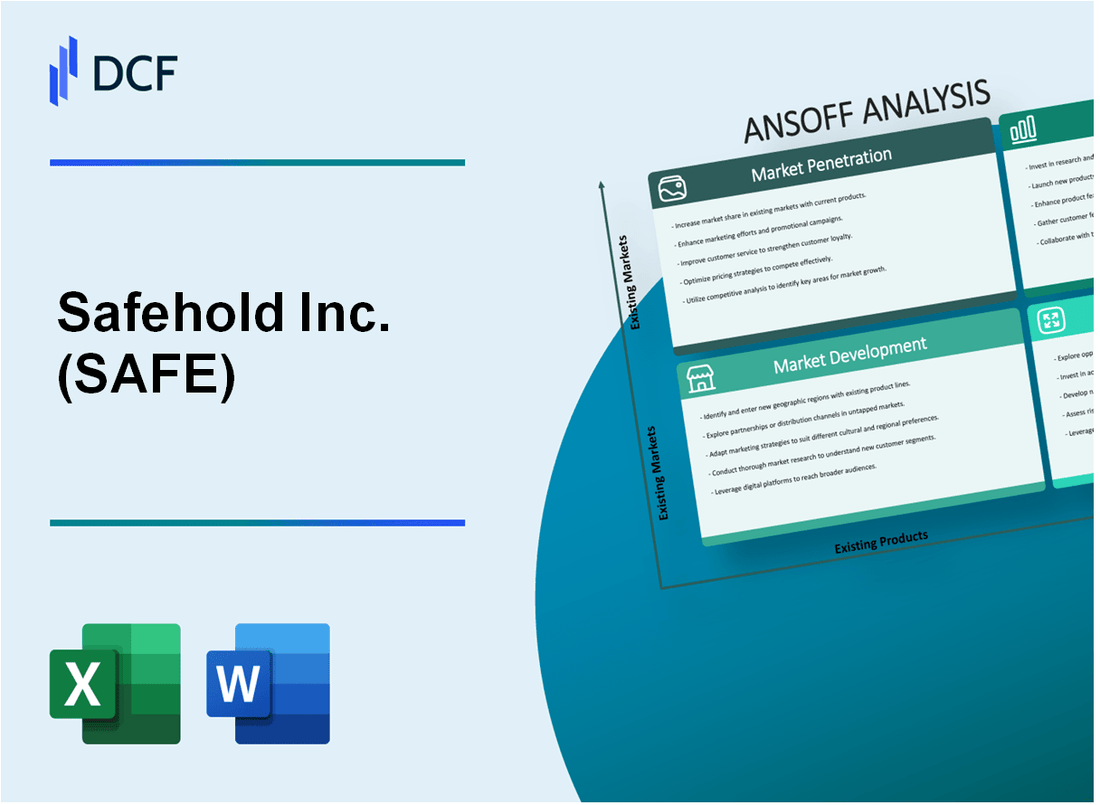
As someone who has spent two decades mapping growth for large asset managers, I see Safehold Inc.'s 2025 plan not as a wish list, but as a precise, four-pronged attack using the Ansoff Matrix. They are clearly focused on immediate wins: leveraging their A- rating and $1.1 billion in liquidity to double affordable housing ground lease volume and capture more share in core markets. But the real strategic depth is in their expansion; they are actively developing the Caret program to monetize an estimated $9.1 billion in unrealized appreciation while simultaneously planning entry into at least two new states and new asset classes like cell towers. This is a textbook case of balancing safe, high-conviction execution with calculated, future-facing bets, and I've broken down the concrete actions for you below.
Safehold Inc. (SAFE) - Ansoff Matrix: Market Penetration
You're looking to drive growth by selling more of your existing ground lease products into the customer base you already serve, which is exactly what Market Penetration is all about for Safehold Inc. The focus here is deepening relationships and maximizing penetration within the current top US markets.
Target repeat customers to drive consistent deal flow, as seen in Q3 2025 originations. The Chief Executive Officer noted satisfaction with the repeat customer business growing consistently. You closed $42 million of ground lease originations in Q3 2025 alone. This momentum carried into the next period, with $34 million of ground lease originations closed to date in Q4 2025. Furthermore, the forward pipeline shows over 15 deals and $300 million in transactions under Letter of Intent (LOI) expected to close in the coming quarters. The Pacific Companies, a prolific developer, is a good example of a repeat customer involved in recent Affordable Housing closings in July and October 2025.
Leverage the S&P A- credit rating to offer the most competitive cost of capital in existing markets. On November 24, 2025, S&P Global Ratings upgraded Safehold's credit rating to A- from BBB+. Management expects this upgrade to translate directly into better capital access and a lower cost of funds for customers. For instance, a recent unsecured term loan carried a borrowing rate of SOFR plus 90 basis points, supported by the company's current ratings profile.
Double affordable housing ground lease volume in 2025, building on the recent $76 million in Q3/Q4 originations. Safehold established a dedicated Affordable Housing team in 2025 to drive this focus. This sector is seeing tangible results, with eight ground leases closed for Low-Income Tax Credit (LIHTC) developments in California to date, providing over 1,600 units in total. Separately, six new LIHTC projects closed in Los Angeles in November 2025 are set to provide more than 400 total units upon completion in 2027.
Increase market share in core asset classes like multifamily and industrial within the current top 30 US markets. The portfolio has clearly shifted its concentration toward multifamily assets, which now represent 59% of the total asset count, a significant increase from just 8% at the initial public offering. The overall portfolio stands at 155 total assets spanning 37.2 million square feet, which includes 21,500 multifamily units and 5,300 hotel keys. Geographic concentration in the top markets remains high, with Manhattan at 21% of Gross Book Value (GBV), followed by Washington D.C. at 10%, Boston at 8%, and Los Angeles at 7%.
Here's a quick look at the current asset class and geographic mix:
| Portfolio Metric | Value/Percentage |
| Multifamily Asset Count Percentage | 59% |
| Total Assets | 155 |
| Total Square Feet | 37.2 million |
| Manhattan Concentration (of GBV) | 21% |
| Washington D.C. Concentration (of GBV) | 10% |
Utilize the $1.1 billion in liquidity to fund larger, more complex transactions with existing sponsors. As of September 30, 2025, Safehold had $1.1 billion of availability on its unsecured revolver, against $226 million of unfunded commitments. This robust liquidity position, which one report noted reached $1.3 billion following a recent term loan, helps position Safehold to deploy capital efficiently for its existing, trusted partners.
The company is using several tools to deepen engagement:
- One Stop Capital Solutions for speed.
- Custom pricing solutions for flexibility.
- Focus on providing speed, certainty, and flexibility.
- Expanding ground lease market for new relationships.
Finance: draft 13-week cash view by Friday.
Safehold Inc. (SAFE) - Ansoff Matrix: Market Development
You're looking at how Safehold Inc. plans to grow by taking its existing ground lease product into new geographic areas and new customer types. This is Market Development for Safehold Inc., and the numbers show where they are placing their bets for 2025.
The stated plan for geographic expansion is clear: Safehold Inc. plans to enter at least two new states in 2025. This follows a strategy that has historically focused on the top 30 MSAs (Metropolitan Statistical Areas) in the country. To support this, Safehold Inc. established a dedicated Affordable Housing team in 2025, signaling a targeted market development effort within that sector, with a goal to double its affordable housing volume from 2024.
Systematically targeting secondary US markets adjacent to the current top 30 is the logical next step to capture new land value. While the specific secondary markets aren't detailed, the company's Q3 2025 results show a portfolio aggregate gross book value (GBV) reaching $7.0 billion. This scale provides the foundation for expansion efforts. The company is also actively managing its capital structure to fund growth, authorizing a $50 million share buyback in 2025, funded through capital recycling strategies like asset sales or joint ventures.
Introducing the modern ground lease model to new customer segments, such as large corporate owner-occupiers, is an area where Safehold Inc. is building on existing success in other property types. Safehold Inc. currently helps owners of multifamily, office, industrial, hospitality, student housing, life science, and mixed-use properties. The company reported closing $42 million of ground lease originations in Q3 2025, with an additional $34 million closed to date in Q4 2025. This transaction activity demonstrates the ongoing market acceptance of their model.
Focusing on specialized property types like data centers or cold storage requires long-term, stable land financing, which the ground lease model is designed to provide. While the broader market sees investment in cold storage and data centers, Safehold Inc.'s stated focus for 2025 is heavily weighted toward doubling its affordable housing volume. The company's core portfolio rent coverage stood at 3.4 times as of Q3 2025, indicating a stable base to underwrite new, potentially specialized, asset classes. The potential value accretion is significant, with estimated unrealized capital appreciation (UCA) at $9.1 billion against the $7.0 billion GBV.
Here are some key financial metrics from the 2025 reporting period that underpin this market development strategy:
| Metric | Value (Q3 2025 or YTD) | Context |
| Q3 2025 GAAP Revenue | $96.2 million | Quarterly performance. |
| Nine Months 2025 Revenue | $287.7 million | Year-to-date performance. |
| Q3 2025 Net Income (GAAP) | $29.3 million | Quarterly profitability. |
| Nine Months 2025 Net Income (GAAP) | $86.6 million | Year-to-date profitability. |
| Total Portfolio Aggregate GBV | $7.0 billion | Portfolio size at quarter-end. |
| Estimated Unrealized Capital Appreciation (UCA) | $9.1 billion | Potential value upside. |
| Q3 2025 Ground Lease Originations | $42 million | New ground lease deployment. |
| Portfolio GLTV (Ground Lease to Value) | 52% | Leverage metric for the portfolio. |
| Portfolio Annualized Cash Yield | 3.8% | Core yield metric. |
The execution of the Market Development plan relies on converting pipeline activity into funded deals. Safehold Inc. had $62 million in forward commitments for new ground leases as of June 30, 2025. The company's overall portfolio rent coverage is 3.4 times, and the portfolio's weighted average lease term is 91 years including extensions.
To support the expansion into new markets and customer types, Safehold Inc. is also focused on capital structure management. The effective interest rate on permanent debt was 4.2%, with a cash interest rate of 3.8%. The company reported a leverage ratio of 1.98x.
The Market Development strategy is supported by the following operational focuses:
- Execute entry into at least two new states in 2025.
- Double affordable housing volume from 2024 levels.
- Continue working within the existing top 30 MSAs as a base.
- Leverage ground leases for property types including multifamily, office, and industrial.
Finance: review Q4 2025 pipeline conversion rate against the $34 million in Q4 to date originations by end of year.
Safehold Inc. (SAFE) - Ansoff Matrix: Product Development
You're looking at how Safehold Inc. can grow by evolving its core product, the modern ground lease. This is about taking what works-the separation of land and building ownership-and engineering new financial instruments from it. The goal is to capture more value and serve a wider range of capital needs for developers.
Marketing the Caret Program to Third-Party Investors
The Caret program, which captures ownership interests in future capital appreciation, is tied to a substantial pool of value. As of September 30, 2025, Safehold Inc. estimated the Unrealized Capital Appreciation (UCA) in its owned residual portfolio to be \$9,069 million. This UCA is the excess of the Combined Property Value of \$15,634 million over the Aggregate Ground Lease cost of \$6,565 million. The strategy here is to monetize a portion of this embedded upside by selling interests to external capital. As of September 30, 2025, Safehold Inc. had sold 122,500 Caret units to third-party investors. This mirrors the structure where Safehold's share was approximately 84% of the most recent third-party Caret valuation of \$2.0 billion.
The Product Development focus involves structuring the offering to appeal externally, which can be seen in the allocation of capital resources:
- The revolver balance allocation for STHO term loan, GL Plus, and Leasehold Loan funds was \$227 million of the total \$966 million revolver balance as of 9/30/2025.
- Safehold Inc. secured a \$400 million unsecured term loan with a potential maturity of November 15, 2030, hedged with a SOFR swap at a 3.0% strike rate through April 2028.
Expanding Ground Lease Plus with Structured Finance
To expand the Ground Lease Plus offering, you're looking to combine the ground lease with a leasehold loan, creating a more comprehensive capital solution. This moves beyond just the land lease to offer integrated debt financing on the underlying asset. The core portfolio itself is substantial, with the Core Ground Lease Portfolio Gross Book Value (GBV) at \$6.9 billion as of Q3'25, and the total portfolio GBV reaching \$7.0 billion. The portfolio delivers a 5.9% economic yield, which rises to 6.0% when adjusted for inflation. The illustrative yield, including the potential value of Caret, reaches 7.5%.
Developing a Shorter-Term, High-Yield Bridge Capital Product
A new product line would target developers needing capital that bridges the gap before securing permanent financing. This requires structuring a ground lease with a shorter duration or a different yield profile than the typical 99-year lease. The current portfolio has a weighted average lease term of 91 years including extensions. New Q3'25 originations carried an economic yield of 7.3%. This new product would need to price its yield relative to this, perhaps targeting a higher yield for the reduced term commitment.
Enhancing GL Structure for Flexible Rent Resets
The current structure has rent escalations that capture inflation, with the prompt suggesting 81% of the portfolio has a certain inflation capture mechanism. To enhance this, Safehold Inc. needs to design resets that capture inflation beyond that baseline. For example, the Economic Yield calculation assumes a Federal Reserve long-term 2.0% CPI target for variable escalators. The goal of product development here is to move more of the portfolio toward resets that capture actual market-rate increases, perhaps through more frequent fair market value resets or percentage rent provisions, which some existing structures explicitly lack.
Here's a snapshot of key portfolio metrics as of September 30, 2025:
| Metric | Amount / Value | Source Period |
| Estimated Unrealized Capital Appreciation (UCA) | \$9,069 million | Q3 2025 |
| Combined Property Value (CPV) | \$15,634 million | Q3 2025 |
| Aggregate Ground Lease Cost Basis | \$6,565 million | Q3 2025 |
| Core Ground Lease Portfolio GBV | \$6.9 billion | Q3 2025 |
| Total Portfolio GBV | \$7.0 billion | Q3 2025 |
| Portfolio Economic Yield | 5.9% | Q3 2025 |
| Portfolio Inflation-Adjusted Yield | 6.0% | Q3 2025 |
| Caret Illustrative Yield | 7.5% | Q3 2025 |
| Caret Units Sold to Third-Party Investors | 122,500 units | Q3 2025 |
The recent Q3'25 origination activity included four new ground leases totaling \$42 million, with an average Ground Lease-to-Value (GLTV) ratio of 34% and rent coverage of 2.4x. Finance: draft 13-week cash view by Friday.
Safehold Inc. (SAFE) - Ansoff Matrix: Diversification
You're looking at how Safehold Inc. (SAFE) is moving beyond its core single-asset ground lease model into new areas. Diversification for Safehold Inc. is currently showing up in a clear pivot toward specific sub-sectors and a general expansion of the portfolio's composition, rather than immediate entry into entirely new asset types like cell towers or international ground leases based on the latest public filings.
The most concrete evidence of a new sub-sector focus is the push into Affordable Housing, which Safehold established a dedicated team for in 2025. This capital solution functions as a low-cost 'gap filler' for Low-Income Tax Credit (LIHTC) projects. For instance, Safehold closed on ground leases for six Affordable Housing communities in Los Angeles with HVN Development, expected to deliver more than 400 total units by 2027.
Furthermore, the company has expanded its relationship with The Pacific Companies, closing a deal for a 227-unit Affordable Housing community in San Diego (delivery by 2028) and another 275-unit project in the San Fernando Valley (delivery by 2029). This focus on a new property sub-sector is a clear diversification play within real estate.
Regarding launching a dedicated fund for essential infrastructure assets like cell towers, or partnering with institutional investors for non-real estate assets with bond-like cash flows, the public data from the Q3 2025 reports does not detail these specific initiatives. However, the company is actively managing its capital structure to support growth, having recently closed a $400 million unsecured term loan with a potential maturity date of November 15, 2030, with a borrowing rate of SOFR plus 90 basis points. This move boosts liquidity, which stood at ~$1.1 billion as of Q3 2025.
The existing portfolio itself shows diversification by asset class concentration. Multifamily assets now represent 59% of the total asset count, a significant increase from just 8% at the time of its IPO. The total portfolio aggregate Gross Book Value (GBV) reached $7.0 billion, with an estimated Unrealized Capital Appreciation (UCA) of $9.1 billion as of Q3 2025.
Here's a quick look at the Q3 2025 performance metrics that underpin this strategy:
| Metric | Value | Context/Period |
| GAAP Revenue | $96.2 million | Q3 2025 |
| GAAP Net Income | $29.3 million | Q3 2025 |
| GAAP EPS | $0.41 | Q3 2025 |
| Aggregate GBV | $7.0 billion | Q3 2025 |
| Total Assets | 155 | Q3 2025 |
| Q3 Originations | $42 million | 4 multifamily ground leases |
| Q4 to Date Originations | $34 million | 4 ground leases (Affordable Housing) |
| Economic Yield on New Deals | ~7.3% | Q3/Q4 Originations |
The focus on expanding the US model through new sub-sectors is clear, but there are no reported figures on acquiring existing, traditional ground leases in new international markets yet. The company's overall credit profile has strengthened, evidenced by S&P Global Ratings upgrading Safehold to A- from BBB+.
The recent Affordable Housing originations highlight the sub-sector expansion:
- Six LIHTC projects closed in Los Angeles with HVN Development, providing over 400 units by 2027.
- One LIHTC development in San Diego with The Pacific Companies, providing 227 units by 2028.
- One LIHTC development in San Fernando Valley with The Pacific Companies, providing 275 units by 2029.
- Safehold has closed eight ground leases for LIHTC developments in California to date, totaling over 1,600 units.
Finance: draft 13-week cash view by Friday.
Disclaimer
All information, articles, and product details provided on this website are for general informational and educational purposes only. We do not claim any ownership over, nor do we intend to infringe upon, any trademarks, copyrights, logos, brand names, or other intellectual property mentioned or depicted on this site. Such intellectual property remains the property of its respective owners, and any references here are made solely for identification or informational purposes, without implying any affiliation, endorsement, or partnership.
We make no representations or warranties, express or implied, regarding the accuracy, completeness, or suitability of any content or products presented. Nothing on this website should be construed as legal, tax, investment, financial, medical, or other professional advice. In addition, no part of this site—including articles or product references—constitutes a solicitation, recommendation, endorsement, advertisement, or offer to buy or sell any securities, franchises, or other financial instruments, particularly in jurisdictions where such activity would be unlawful.
All content is of a general nature and may not address the specific circumstances of any individual or entity. It is not a substitute for professional advice or services. Any actions you take based on the information provided here are strictly at your own risk. You accept full responsibility for any decisions or outcomes arising from your use of this website and agree to release us from any liability in connection with your use of, or reliance upon, the content or products found herein.