

|
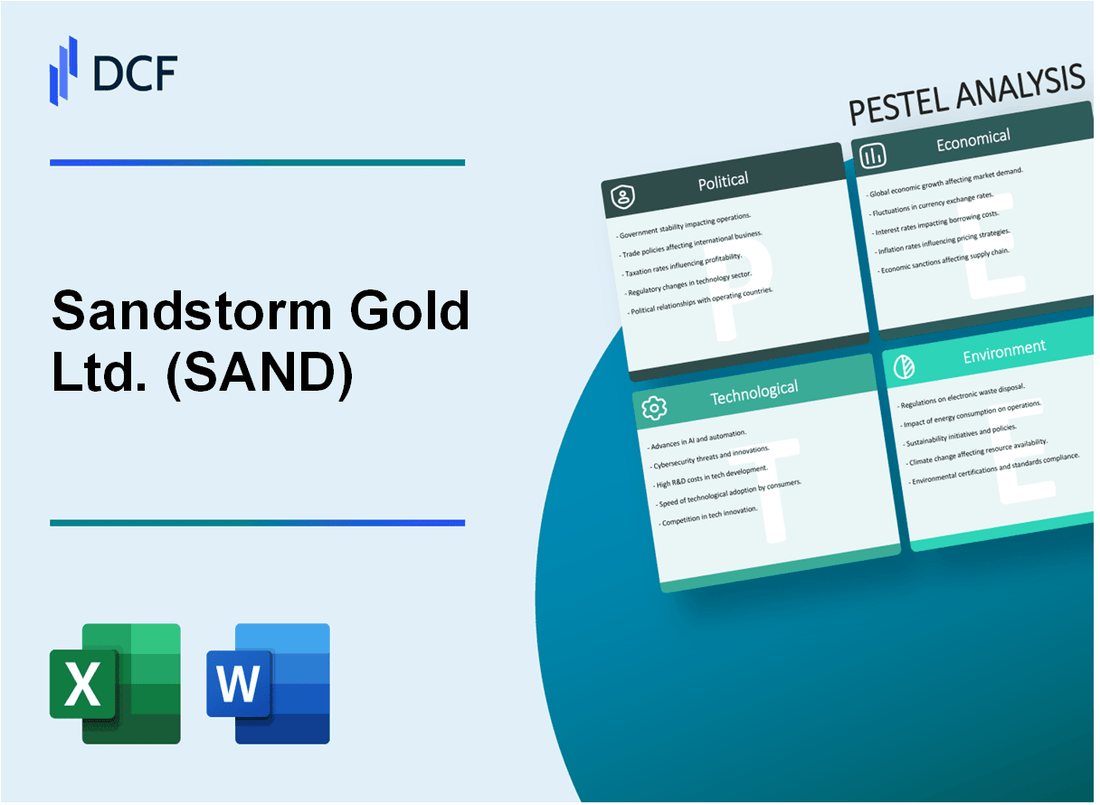
Sandstorm Gold Ltd. (SAND): PESTLE Analysis [Nov-2025 Updated] |
Fully Editable: Tailor To Your Needs In Excel Or Sheets
Professional Design: Trusted, Industry-Standard Templates
Investor-Approved Valuation Models
MAC/PC Compatible, Fully Unlocked
No Expertise Is Needed; Easy To Follow
Sandstorm Gold Ltd. (SAND) Bundle
You're looking for a clear, actionable breakdown of Sandstorm Gold Ltd. (SAND)'s operating environment as we head into late 2025. The royalty and streaming model insulates them from some risks, but it doesn't eliminate the geopolitical and economic headwinds affecting their underlying assets. Here is the PESTLE analysis, cutting straight to the core risks and opportunities.
The core takeaway is this: Sandstorm Gold is a high-margin, growth-focused royalty company, but its near-term performance is tied to volatile jurisdictions and the gold price, which drove record Q2 2025 revenue of $51.4 million. Your focus should be on how the company's development pipeline, now valued at a $3.5 billion implied acquisition price by Royal Gold, Inc., can weather the political and environmental risks in Latin America and Turkey.
Political Landscape: The Geopolitical Royalty Tax
Resource Nationalism is the biggest political headwind. We're seeing increased risk of royalty and tax hikes, especially in Latin American jurisdictions like Peru and Chile, where Sandstorm Gold has significant underlying assets. These governments are looking to capture more value from rising commodity prices, and your royalty contracts are a clear target. Permitting Delays are also slowing down expansion at key partner mines, which directly impacts long-term cash flow projections. If a partner's expansion is delayed by six months, that's six months of deferred revenue for you.
Still, the company's Jurisdictional Diversification helps. Sandstorm Gold holds a portfolio of approximately 230 royalties. This broad exposure mitigates the risk of a single-country political upheaval wiping out your returns. It's a classic portfolio hedge. The pending acquisition by Royal Gold, Inc. also signals confidence in the long-term stability of these assets under a larger, more diversified umbrella.
Economic Factors: Gold Price is Everything
Your revenue is directly tied to Gold Price Volatility. The streaming model means Sandstorm Gold has low operating costs, so most of the gold price upside flows straight to the bottom line. For example, the company's cash operating margins hit a record $2,981 per attributable gold equivalent ounce in Q2 2025. That's defintely a high margin business.
Here's the quick math: Sandstorm Gold's 2025 production guidance sits between 65,000 and 80,000 attributable gold equivalent ounces. A $100 move in the average realized gold price can shift your annual revenue by $6.5 million to $8.0 million. Also, the higher Interest Rate Environment increases the cost of capital for mining partners, potentially delaying new project development like the MARA project in Argentina, which is key to the long-term production forecast of 150,000 ounces by 2030.
Sociological Trends: The License to Operate
Social license to operate is critical; local opposition can halt partner mine operations instantly. Community Relations and Indigenous Rights are not abstract concepts-they are operational risks. A labor dispute or a community protest at a major operating mine in South America can stop the gold flow overnight. This risk is particularly acute in regions where Sandstorm Gold's partners operate, like the Fruta del Norte mine in Ecuador, which has seen strong royalty revenues.
The broader mining sector faces challenges in Talent Acquisition, which affects the quality of management and operations at partner sites. You need to monitor the Environmental, Social, and Governance (ESG) performance of your partners closely; poor performance by them becomes your reputational risk.
Technological Developments: Efficiency and Discovery
Technology is mainly an opportunity here. New seismic and AI-driven Exploration Efficiency techniques could lead to discoveries at partner properties, boosting reserves without Sandstorm Gold having to spend exploration dollars. Increased Automation in Mining at partner sites drives down their long-term operating costs, which improves the margin on your streams and makes the underlying asset more robust against commodity price dips.
Data Analytics is your internal tool. You can use advanced data to monitor partner performance and flag operational risks before they become critical. It's about being a smart money partner, not just a passive investor. Cybersecurity is the one near-term risk: protecting sensitive geological and financial data shared across a large network of mining partners is non-negotiable.
Legal and Regulatory Environment: Contract Sanctity
The biggest Legal risk is Royalty Contract Enforceability across diverse legal systems. Your entire business model rests on the sanctity of those stream and royalty agreements. Any legal challenge to an agreement, especially in a developing nation, could be costly and time-consuming. Tax Regime Changes, particularly new mining-specific taxes in key operating countries, directly cut into your partners' profitability and their ability to sustain production.
Permitting Litigation-legal challenges to environmental or operating permits for partner mines-can cause significant delays, impacting the timing of cash flows from development projects like Hod Maden in Turkey. You must ensure strict adherence to international Anti-Corruption Laws (e.g., FCPA) for all global dealings to protect the company from massive fines and reputational damage.
Environmental Concerns: Water and Waste
The 'E' in ESG is getting more teeth from investors. Growing pressure to meet stringent ESG Reporting Standards means your partners must disclose more, and you need to track it. Water Scarcity is a major operational risk, especially in arid mining regions like Chile. Regulatory and social focus on water use can force operational shutdowns.
Climate Change Policy, such as new carbon pricing or emission reduction mandates, will increase operating costs for partner mines, indirectly pressuring their margins. Finally, Tailings Management-the storage of mine waste-is under heightened scrutiny and regulation globally following recent incidents. A failure here is a catastrophic financial and reputational event for the partner, and a total loss of revenue for Sandstorm Gold.
Next Step: Portfolio Management: Conduct a sensitivity analysis on 2025 cash flow projections using a 10% increase in the average royalty/tax rate in the top three Latin American jurisdictions by Friday.
Sandstorm Gold Ltd. (SAND) - PESTLE Analysis: Political factors
You're looking at Sandstorm Gold Ltd. (SAND) in 2025, and the political landscape is the biggest non-geological risk on the map. The core takeaway is this: rising resource nationalism in Latin America is a clear and present danger to cash flow stability, but the company's strategic merger with Royal Gold, Inc. in October 2025 is a powerful move to diversify away from single-country political upheaval.
The royalty and streaming model is insulated from direct operating costs, but it can't defintely escape a government's decision to hike taxes or stall a permit. Your key focus should be on the political stability of the 40 producing mines and the development timelines for major growth assets like MARA and Hod Maden.
Resource Nationalism: Increased risk of royalty/tax hikes in Latin American jurisdictions like Peru and Chile.
Resource nationalism-the move by governments to assert greater control over natural resources, often through higher taxes or royalties-is now a baseline risk, not an outlier. We see this most clearly in Latin America, a region that contributed to Sandstorm Gold Ltd.'s record Q1 2025 revenue of $50.1 million. But, that revenue stream is under pressure.
In Peru, social protests are a constant headache, capable of causing temporary shutdowns at mines like Antamina, where the combined company holds a Net Profits Interest (NPI). To be fair, Peru is still forecasting $4.8 billion in new mining investment for 2025, but the political license to operate is fragile. Chile is also evaluating new royalty structures, which could directly impact the economics of any future deals or expansions in that country. These actions essentially put a bull's-eye on the mining sector's healthy profit margins.
Permitting Delays: Slowed approval processes for expansion at key partner mines, impacting long-term cash flow projections.
Permitting delays are the silent killer of Net Present Value (NPV). When a government or local authority slows down an approval, it pushes back the date you start receiving cash flow, which hits your valuation hard. For Sandstorm Gold Ltd., two major development assets highlight this risk:
- MARA Project (Argentina): Operator Glencore plc is expected to make a Formal Investment Decision (FID) as late as 2027, a timeline heavily dependent on securing various regulatory approvals, including the RIGI (a major investment stability regime).
- Hod Maden Project (Turkey): The joint venture partners approved early-works capital investments of approximately $60-$100 million (on a 100% basis) for 2025. This critical path work is moving, but any political friction in Turkey could easily stall the project and delay its anticipated production start.
The good news is the Robertson project in Nevada, a key North American asset, received its last major Federal environmental permit in late 2024, keeping its anticipated full-scale production in 2027 on track. That's one less regulatory hurdle to worry about.
Trade Policy Stability: Reliance on stable trade relations for global gold movement and equipment procurement.
While Sandstorm Gold Ltd. does not physically mine, its partners rely on stable global trade for everything from heavy equipment imports to the final sale of the gold and copper concentrate. Geopolitical tensions, like those driving trade controls, can introduce supply chain vulnerabilities that increase operating costs (OpEx) for the underlying mines.
Increased protectionism or the weaponization of trade controls could impact the timely delivery of specialized mining equipment, which in turn could delay production ramp-ups, thereby reducing the attributable gold equivalent ounces (GEOs) the company is forecasted to receive. For 2025, the company is forecasting attributable GEOs between 65,000 and 80,000 ounces, a number sensitive to any production hiccups at the mine level.
Jurisdictional Diversification: The company's broad portfolio mitigates single-country political upheaval risk.
The single most powerful political risk mitigation strategy for Sandstorm Gold Ltd. in 2025 was its acquisition by Royal Gold, Inc., which closed in October 2025. This transaction immediately enhanced the combined entity's jurisdictional diversification, a crucial buffer against the escalating resource nationalism we just discussed.
The combined company now boasts a global portfolio of precious metals interests that is significantly more diversified than Sandstorm Gold Ltd.'s standalone portfolio of approximately 230 royalties (with 40 producing mines). This move reduces the relative concentration of development-stage assets and insulates the company's cash flow from a single adverse political event, such as a retroactive tax hike in one country. You're trading a higher-risk, high-growth profile for a more mature, politically de-risked one.
| Political Risk Factor | Impact on Sandstorm Gold Ltd. (2025) | Mitigation Strategy |
|---|---|---|
| Resource Nationalism (Latin America) | Risk of royalty/tax hikes impacting partner mine economics (e.g., Peru, Chile). | Portfolio diversification; Royalty/Stream contracts are legally binding, though still subject to sovereign risk. |
| Permitting Delays | Potential delay of MARA (Argentina) FID past 2027; Hod Maden (Turkey) critical path delays. | Focus on North American assets like Robertson (Nevada), which received final major permit in late 2024. |
| Trade Policy Instability | Increased OpEx and potential production delays for partners due to equipment supply chain issues. | Royalty model insulates from direct OpEx, but revenue is still tied to ounces produced. |
| Single-Country Upheaval | High risk due to exposure in developing nations. | Strategic acquisition by Royal Gold, Inc. in October 2025, creating a more diversified, larger-scale entity. |
Sandstorm Gold Ltd. (SAND) - PESTLE Analysis: Economic factors
The economic landscape in 2025 has been a double-edged sword for Sandstorm Gold Ltd. (SAND), driving record revenue on one side but presenting persistent cost and capital risks on the other. Your revenue is directly tied to a gold price that is in a new, structurally higher regime, but your partners are fighting inflation and high financing costs to deliver that production.
Gold Price Volatility: Revenue is directly tied to the spot price of gold, which is sensitive to US Federal Reserve rate decisions.
The biggest factor driving your top line is the spot price of gold, and 2025 has been a wild ride. Gold is no longer just an inflation hedge; it's a strategic asset, which is why it broke through the $4,000/oz barrier in October 2025, briefly pushing beyond $4,200/oz. This surge is a direct benefit to your streaming model, where a low fixed cost of purchasing the metal locks in a huge margin.
Here's the quick math: Sandstorm Gold's cash operating margin hit a record $2,980 per gold equivalent ounce (GEO) in Q2 2025, up significantly from Q1's $2,509 per GEO. This margin expansion is almost entirely due to the rising gold price, which helped deliver record quarterly revenues of $51.4 million in Q2 2025, despite a slight drop in GEOs sold. J.P. Morgan Research projects prices to average $3,675/oz by the final quarter of 2025, which sets a very high bar for your expected full-year production of 65,000 to 80,000 GEOs.
Inflationary Pressure: While a streaming model has low operating costs, inflation affects partner mine costs, potentially slowing production ramp-ups.
While your direct operating costs are low-a key advantage of the streaming model-your business relies entirely on the health of your mining partners. And honestly, they are getting squeezed. Global mining input costs rose by an average of 3.6% year-on-year in Q1 2025, with the gold sector specifically recording the highest average increase in input cost inflation in March.
This inflationary pressure, particularly from high labor costs, directly impacts your partners' ability to execute. For instance, production ramp-ups at key assets like the Greenstone mine, where Sandstorm received and sold approximately 1,200 ounces in Q2 2025, are sensitive to these rising costs. If a partner's all-in-sustaining costs (AISC) rise too much, it can delay optimization efforts or even halt development, which means your expected GEOs don't materialize on time. You need to watch those capital expenditure (CapEx) budgets at your partner mines defintely.
US Dollar Strength: A strong dollar can pressure gold prices and affect the purchasing power of international royalty payments.
The US Dollar's (USD) trajectory is a major headwind or tailwind for gold. Historically, a weaker dollar makes gold, which is priced in USD, cheaper for international buyers, boosting demand and price. In Q1 2025, a period of perceived USD weakness was cited as a factor fueling the gold price rise.
However, the dollar's strength remains volatile, closely tied to the Federal Reserve's (Fed) outlook. As of late November 2025, the dollar index (DXY) dropped to 99.72 on expectations of a December Fed rate cut, which is a positive for gold. But remember, Sandstorm Gold has significant production from South America (around 48% of Q1 2025 GEOs). A strong USD can reduce the local currency purchasing power of operating cash flows for those partners, even if the gold price in USD is high, creating financial stress for them that could lead to operational issues down the line.
Interest Rate Environment: Higher rates increase the cost of capital for mining partners, potentially delaying new project development.
The cost of capital for your partners-the money they need to finance new mines or expansions-is directly linked to the US Federal Reserve's interest rate. The good news is that the Fed has started easing, lowering the target range for the federal funds rate by 25 basis points in both September and October 2025, bringing the current target range to 3.75% to 4.00%.
This easing is a positive for the industry, as it lowers the hurdle rate for new projects. However, the current rate is still elevated compared to the ultra-low rates of the past decade. This means financing costs remain a burden. For a massive development like Platreef in South Africa, where Phase 1 production is scheduled for Q4 2025, a high cost of capital environment can delay the Phase 2 and Phase 3 expansions, which are key to your long-term production target of 150,000 GEOs by 2030.
| Economic Factor | 2025 Key Metric/Value | Impact on Sandstorm Gold Ltd. (SAND) |
|---|---|---|
| Gold Price (Spot) | Peaked above $4,200/oz (Oct 2025); Q4 Average Forecast: $3,675/oz | Positive: Drove record Q2 2025 revenue of $51.4 million and record cash operating margin of $2,980/GEO. |
| US Fed Funds Rate (Target Range) | 3.75%-4.00% (as of Oct 2025) | Mixed: Recent cuts (Sept/Oct) are positive, but the elevated rate still increases the cost of capital for mining partners, risking project delays. |
| Global Mining Input Cost Inflation | Average rise of 3.6% year-on-year in Q1 2025 | Risk: Higher costs for labor and energy squeeze partner mine margins, potentially slowing ramp-ups at assets like Greenstone and Bonikro. |
| 2025 Production Guidance | 65,000 to 80,000 gold equivalent ounces (GEOs) | Baseline: The company's revenue forecast is directly anchored to this range, which is sensitive to commodity price fluctuations (±10% change in copper/silver impacts GEOs by ±1,500 ounces). |
Here are the clear actions to consider based on this economic picture:
- Monitor partner CapEx: Track quarterly spending at Greenstone and Platreef to spot any inflation-driven delays.
- Stress-test cash flow: Run a scenario analysis using a gold price of $2,860/oz (the Q1 2025 average) to ensure your liquidity remains robust.
- Evaluate debt strategy: Given the Fed's easing cycle, assess the cost of further reducing the remaining $315 million on the revolving credit facility versus funding new stream acquisitions.
Finance: Draft a detailed sensitivity analysis of 2026 projected revenue against a $3,000/oz and $4,000/oz gold price by month-end.
Sandstorm Gold Ltd. (SAND) - PESTLE Analysis: Social factors
You're looking at the social factors that affect Sandstorm Gold Ltd., and the core takeaway is simple: while the royalty model buffers the company from direct operational risk, the underlying value of its streams is defintely exposed to the social license to operate (SLO) issues of its partners. A local protest in Argentina or a labor strike in Brazil can instantly halt a partner's production, and that means a direct hit to your quarterly revenue.
The company's 2025 guidance projects attributable gold equivalent ounces between 65,000 and 80,000 ounces, and any social disruption at a key asset like Chapada or Greenstone could push those figures to the low end. Sandstorm Gold Royalties mitigates this by focusing on partners with strong ESG records, but the risk remains inherent in the mining sector, especially in developing jurisdictions.
Community Relations: Social license to operate is critical
For a royalty company, the Social License to Operate (SLO) held by its mining partners is the single biggest social risk. Sandstorm Gold does not operate the mines, but if a partner loses its SLO, the cash flow stops. We saw this risk crystallize with the MARA project in Argentina, a key development asset for Sandstorm Gold, which is expected to be a significant long-term growth driver.
The MARA project, operated by Glencore plc, faces substantial local community opposition in Catamarca province. This opposition stems from concerns over the project's environmental impact, specifically the potential harm to nearby glaciers and the proximity to a river that supplies local drinking water. While the provincial government has endorsed the project, a 2016 Supreme Court ruling had previously deemed it "illegitimate." Glencore is expected to submit a key environmental application in the first half of 2025, and any delay here directly pushes out the start of Sandstorm Gold's gold stream deliveries.
Here's the quick math on the potential impact of a delay:
| Key Development Asset | Operator | Social Risk Factor | Sandstorm Gold Exposure |
|---|---|---|---|
| MARA Project (Argentina) | Glencore plc | Local opposition (water/glacier concerns), prior Supreme Court ruling. | Long-term gold stream option; delays push back significant growth. |
| Platreef (South Africa) | Ivanhoe Mines Ltd. | Regional labor relations, community expectations in a complex jurisdiction. | Gold stream deliveries expected to commence in the first half of 2026. |
Labor Disputes: Risk of strikes or labor unrest at major operating mines
Labor unrest at a partner's mine can immediately impact Sandstorm Gold's quarterly revenue. You see this risk play out across the sector, particularly in South America, a region where Sandstorm Gold has significant exposure through assets like the Chapada mine in Brazil. Although the Q2 2025 production drop at Chapada was due to processing lower-grade stockpiles, not a strike, the constant threat of a labor action is real.
To be fair, Sandstorm Gold's model offers diversification, but a major, prolonged strike at a single key asset can still be felt. Consider the early 2025 strike at the Buenavista del Cobre mine in Mexico (not a Sandstorm Gold asset, but a relevant regional example): the shutdown halted an estimated 80% of operations and resulted in estimated revenue losses of around $15 million daily for the operator. This is the kind of immediate, high-impact risk Sandstorm Gold indirectly carries in its portfolio.
Talent Acquisition: The broader mining sector faces challenges
The mining sector as a whole is struggling to attract and retain specialized talent, a trend that continues through 2025. This challenge, while indirect for Sandstorm Gold, affects the operational efficiency and long-term planning of its partners. The industry needs technical specialists-geotechnical engineers, mine planners, and data analysts-but hiring remains cautious despite gold prices hitting new all-time highs above US$3,400/oz in Q3 2025.
The talent shortage is driven by a few factors:
- Demand for tech-savvy candidates for automation and digital tools.
- Remote site locations deterring younger professionals.
- Competition for senior talent due to workforce restructuring at major houses.
Sandstorm Gold itself, being a small, Vancouver-based office operation, has managed its internal talent pool effectively. The company met its internal diversity goal, reporting that 56% of its senior management was diverse by the end of 2023, which helps with recruitment and corporate governance perception.
Indigenous Rights: Increased global scrutiny on respecting and consulting with Indigenous communities
Respect for Indigenous rights and Free, Prior, and Informed Consent (FPIC) is a non-negotiable part of the social license today. Sandstorm Gold is actively working with its partners to manage this. The Greenstone gold mine in Northern Ontario, Canada, is a prime example of a successful partnership model.
As part of the Greenstone gold stream agreement, Sandstorm Gold commits to an additional payment of up to US$30 per ounce of gold produced, which is specifically directed to ESG contributions at the local level. This tangible financial commitment, paired with the operator Equinox Gold Corp.'s engagement (Indigenous partners were featured at the mine's official opening), sets a standard for social performance that investors now expect. This is a clear action that helps secure the long-term viability of a key asset.
Sandstorm Gold Ltd. (SAND) - PESTLE Analysis: Technological factors
You're a streaming and royalty company, so your technological edge isn't in running a mine; it's in how your operating partners run theirs, and how you manage the data from nearly 400 assets now, post the Royal Gold acquisition. The key takeaway is this: Technology adoption at your partner mines is directly increasing your $2,981 per attributable Gold Equivalent Ounce (GEO) cash operating margin, but it's also creating a massive new cybersecurity risk you must address.
Exploration Efficiency: New seismic and AI-driven exploration techniques could lead to discoveries at partner properties, boosting reserves.
The biggest opportunity for Sandstorm Gold Ltd. (now part of Royal Gold) isn't just in the 65,000 to 80,000 GEOs you'll see in 2025; it's in the optionality of your 393 royalties and streams. That optionality is unlocked by new exploration technology. We are seeing a major shift from traditional geology to data science in the field.
Artificial Intelligence (AI) and Machine Learning algorithms are now analyzing geological data, satellite imagery, and historical drilling results to pinpoint high-probability targets. Companies using AI-powered exploration are reporting a 15-20% higher success rate in identifying economic mineralization compared to old-school methods. Plus, this technology is fast. AI models can reduce the time it takes to move from initial data review to drill targeting by 20-30%, meaning your partner mines can add reserves, and thus extend your royalty life, much quicker. This is a defintely a game-changer for long-term valuation.
Automation in Mining: Increased automation at partner mines drives down long-term operating costs, improving the margin on Sandstorm's streams.
When your partner mines cut their All-In Sustaining Costs (AISC), your profit margin widens because your stream payments are often fixed or tied to a low percentage of the spot price. Automation is the single biggest lever for this cost reduction in 2025. Autonomous haul trucks, remote-controlled drilling equipment, and automated processing facilities are moving from pilot projects to industry standards.
For example, deploying autonomous haulage systems is projected to increase ore extraction efficiency by up to 30% at some large-scale operations. Beyond just moving rock, AI-driven predictive maintenance is a huge win for uptime. By analyzing real-time sensor data-vibration, temperature, fluid levels-AI predicts equipment failure, which has been shown to reduce parts costs by 10-15% and extend equipment life by up to 20%. That's a direct, measurable benefit to the operational health of assets like Mount Milligan, which is a key contributor to the combined portfolio.
- Autonomous fleets boost efficiency by 15-20%.
- Predictive maintenance cuts parts costs by 10-15%.
- Lower operational costs at partner mines means higher security for your payments.
Data Analytics: Using advanced data to monitor partner performance and flag operational risks before they become critical.
The real power for a streaming company lies in the data. You don't operate the mines, but you need to know before your partner does that a problem is brewing. Mining companies ramped up their digital investments by approximately 25% in 2025, and that data flow is what you need to tap into.
Advanced data analytics platforms allow you to create a virtual, real-time picture of your key assets. By cross-referencing public disclosures, satellite imagery, and partner-shared operational data, you can build a shadow model of a mine's performance. For instance, if the throughput data at a mine like Greenstone starts to deviate from the planned ramp-up schedule, your analytics team can flag it immediately. Over 60% of new mining sites are expected to deploy AI-driven predictive maintenance systems in 2025, giving you a wealth of data points to monitor for operational risk and production stability.
| Technology Application (2025) | Impact on Partner Operations | Benefit to Sandstorm's Portfolio |
|---|---|---|
| AI-Powered Exploration | 15-20% higher success rate in discovery. | Extends mine life; increases Proven & Probable reserves. |
| Autonomous Haulage Systems | Up to 30% increase in ore extraction efficiency. | Drives down All-In Sustaining Costs (AISC); widens stream margin. |
| Predictive Maintenance (AI) | 10-15% reduction in parts costs; 20% longer equipment life. | Maximizes mine uptime; secures continuous GEO delivery. |
| Digital Twins/Real-Time Monitoring | Optimized resource allocation; early risk detection. | Proactive risk management; supports due diligence on new deals. |
Cybersecurity: Protecting sensitive geological and financial data shared with a large network of mining partners.
The downside of all this connectivity is a dramatically expanded attack surface. As a financial entity with deep ties to operational assets, you are now a prime target for both financially motivated cybercriminals and industrial espionage. The industry is seeing a sharp rise in threats: cyberattacks in the mining sector tripled from 10 in 2023 to 30 in 2024.
The biggest risk is to your partner's Operational Technology (OT) systems-the networks that control the actual mining equipment, ventilation, and processing plants. It is estimated that over 60% of mining operations will face targeted cyberattacks on these integrated OT-IT systems in 2025. A ransomware attack on a key asset like Chapada or Aurizona could halt production, immediately impacting your revenue and cash flow. You need to enforce strict vendor security risk management across your entire partner network, especially since nearly 40% of new mining technology projects are delayed or cancelled due to cybersecurity concerns. Your due diligence must now include a deep dive into your partners' cyber-resilience, not just their geology.
Next Step: Risk Management: Mandate a third-party cybersecurity audit of the top 10 cash-flowing partner mines by Q1 2026, focusing specifically on OT system vulnerabilities.
Sandstorm Gold Ltd. (SAND) - PESTLE Analysis: Legal factors
You're looking at Sandstorm Gold Ltd. (SAND) through the legal lens, and the picture is clear: a royalty company's legal risk is less about operational accidents and more about the sanctity of contracts and the shifting sands of national tax policy. The primary legal event for 2025 is the pending acquisition by Royal Gold Inc., an all-share transaction valued at approximately $3.5 billion, which legally redefines the entire entity and is subject to court and regulatory approvals, expected to close in the fourth quarter of 2025.
Tax Regime Changes: Risk of new mining-specific taxes or changes to corporate tax rates in key operating countries
The biggest near-term risk here is that governments, seeking to capitalize on high commodity prices, will move the goalposts. Globally, this is a live issue: over 60% of mining countries plan to revise their royalty rates by 2025 to boost government revenue. Sandstorm Gold Ltd.'s revenue diversification-with 2025 production split roughly 34% North America, 45% South America, and 21% other countries-helps, but it doesn't eliminate the exposure.
One concrete example of this is in Argentina, a key South American jurisdiction. The Gualcamayo mine saw its Net Smelter Returns (NSR) royalty rate jump from 1.0% to 3.0% in the first half of 2025 after the mine's oxide production surpassed 396,000 ounces of gold, per the existing contract terms. This is a contractually triggered increase, but it shows the material impact of royalty rates. Conversely, the Incentive Regime for Large Investment (RIGI) in Argentina, which the MARA project is pursuing, aims to provide legal and tax stability for investments exceeding $200 million, which acts as a positive legal counterbalance to the general tax risk.
Royalty Contract Enforceability: Ensuring the legal sanctity and enforceability of stream and royalty agreements across diverse legal systems
The entire business model rests on the legal enforceability of its portfolio of approximately 230 royalties. Stream and royalty agreements are long-term, complex contracts governed by the laws of various jurisdictions, many of which lack the legal stability of North America. This is where the rubber meets the road. One recent instance of contract management involved the Vatukoula mine in January 2025. Instead of immediate litigation over past-due gold deliveries, Sandstorm Gold Ltd. negotiated a forbearance period and an option for the operator, Vatukoula Gold Mines PTE Limited (VGML), to repurchase the stream/royalty in exchange for a $4.0 million payment. This pragmatic, negotiated resolution is often a better outcome than a protracted legal fight in a foreign court. This is a constant, low-grade legal risk you have to underwrite.
Anti-Corruption Laws: Strict adherence to international anti-bribery and anti-corruption statutes (e.g., FCPA) for all global dealings
As a Canadian company listed on the NYSE, Sandstorm Gold Ltd. is subject to stringent statutes like the U.S. Foreign Corrupt Practices Act (FCPA), which prohibits improper payments to foreign officials. The company's own 2025 regulatory filings acknowledge the inherent risk, noting that it invests in mining operations in certain jurisdictions where corruption may be more common, which can increase the risk of unauthorized payments. The US Department of Justice (DOJ) issued new FCPA guidelines in June 2025, ending a temporary pause and signaling a renewed, albeit refocused, enforcement posture. This means compliance programs are under fresh scrutiny. The risk is not just a fine, but also the potential loss of a material asset if the underlying contract is found to be corruptly procured.
Permitting Litigation: Legal challenges to environmental or operating permits for partner mines can cause significant delays
Permitting litigation-typically brought by environmental groups, local communities, or indigenous organizations-is an ever-present threat that can cause significant delays and cost overruns for the operating partners, which in turn delays Sandstorm Gold Ltd.'s cash flow. For example, the Robertson project in Nevada successfully secured its last major Federal environmental permit (the Record of Decision) in late 2024, clearing the legal path for its anticipated 2027 production. However, other major growth assets still face regulatory hurdles. Glencore's MARA project in Argentina is expected to make a Formal Investment Decision as late as 2027, a timeline dependent on various regulatory approvals. While there is no major, active litigation publicly disclosed that is currently halting a key producing mine, the risk remains high for development-stage assets, where a single legal challenge can stall a project for years.
Here's the quick math: a two-year delay on a project expected to contribute 10,000 ounces of attributable gold equivalent ounces means a material hit to the long-term forecast of approximately 150,000 ounces by 2030.
- Monitor partner mine permit status monthly.
- Track local legal challenges to environmental permits.
- Assess new country-specific royalty tax proposals.
Sandstorm Gold Ltd. (SAND) - PESTLE Analysis: Environmental factors
For a royalty and streaming company like Sandstorm Gold Ltd., environmental risk is indirect, but it's a critical factor that directly impacts the cash flow from your partner mines. The core challenge in 2025 is translating your strong corporate-level Environmental, Social, and Governance (ESG) commitments into verifiable, on-the-ground performance across a portfolio of approximately 230 royalties and 40 producing mines.
The market is defintely watching: over 70% of mining investors in 2025 are prioritizing ESG factors in their decisions. Your job is to ensure that the due diligence process is rigorous enough to protect the $51.4 million in Q2 2025 revenue from a catastrophic environmental event at an operating mine.
ESG Reporting Standards: Investor and Regulatory Pressure
The regulatory landscape is forcing greater transparency, and Sandstorm Gold is ahead of the curve here. You are one of the few royalty companies to align your sustainability reporting with the recommendations of the Task Force on Climate-Related Financial Disclosures (TCFD). This TCFD alignment helps investors model the financial impact of climate transition risks, giving you a competitive edge in attracting capital.
Your firm was the first royalty company to secure a Sustainability-Linked Credit Facility (ESG revolving loan), which allows you to reduce borrowing costs by meeting specific sustainability performance targets. This directly ties environmental performance to your cost of capital. Plus, your strong ratings from third parties-an AA Rating from MSCI (2023) and a Low Risk rating from Sustainalytics-signal to the market that your portfolio is relatively well-vetted for major ESG pitfalls.
Here's a quick look at key ESG-related financial and commitment metrics:
| Metric | 2025 Fiscal Year Data / Target | Significance |
|---|---|---|
| Attributable GEOs Forecast | 65,000 to 80,000 ounces | The revenue base exposed to partner-mine environmental risk. |
| Net Zero Target | By 2035 | Includes both direct and partner-mine indirect emissions. |
| Greenstone Stream ESG Contribution | $30 per ounce of gold | Direct, contractual funding for mine-level environmental/social programs. |
| Q2 2025 Revenue | $51.4 million | Financial value at risk from a major environmental incident. |
Water Scarcity: Management in Arid Mining Regions
Water risk is a huge operational threat, especially since 45% of your 2024 attributable gold equivalent ounces came from South American mines, many of which operate in water-stressed regions like the Atacama Desert. The pressure from regulators and local communities on water use is only increasing.
Because you don't operate the mines, your risk mitigation relies entirely on due diligence and partner selection. Industry data shows that mines using advanced water recycling can reduce freshwater usage by up to 40%. You need to ensure your partners are adopting these closed-loop systems.
The key is making sure your partner-operators are doing the following:
- Implementing advanced water recycling technologies.
- Securing long-term water rights in a sustainable manner.
- Publishing transparent water consumption and intensity metrics.
Climate Change Policy: Carbon Pricing and Operating Costs
While Sandstorm Gold's direct environmental footprint is small-your head office is in a LEED Platinum certified building-your indirect exposure to carbon pricing is significant. The risk lies in new carbon taxes or emission reduction mandates increasing the operating costs (OpEx) of your partner mines, which could lower their profitability and, in turn, affect the long-term viability of your royalties.
The good news is your corporate-level footprint is minimal and well-managed. You were Carbon Neutral in 2023 by offsetting 100% of Direct Scope 2 Emissions. Your reported emissions show a clear focus on the indirect impact:
- 2024 Scope 2 Emissions (indirect from purchased energy): approximately 23,000 kg CO2e.
- 2024 Scope 3 Emissions (from business travel): about 237,700 kg CO2e.
The real action is with your 2035 net zero carbon emissions goal, which crucially includes the indirect emissions from your mining partners. This forces you to prioritize investments in operators who are actively decarbonizing their operations, which is a smart long-term risk management strategy.
Tailings Management: Heightened Scrutiny and Regulation
The risk of a Tailings Storage Facility (TSF) failure is the single largest environmental and social liability in mining; it's a non-negotiable risk. The catastrophic failure at Brumadinho, for example, caused a 24% drop in Vale's share price and resulted in over US$7 billion in fines and compensation.
Following global incidents, the adoption of the Global Industry Standard on Tailings Management (GISTM) has become the gold standard. Your due diligence process is designed to mitigate this risk, as your team explicitly reviews and confirms tailing storage facilities and waste rock storage plans before any material investment. You are defintely right to focus on this.
What this estimate hides is that while your due diligence is strong, the ultimate operational risk remains with the partner. Any failure in a TSF at a royalty asset would still cause a significant market reaction and likely impair the value of the royalty, regardless of your indirect status.
Finance: Ensure all new due diligence reports explicitly confirm partner mine compliance with the Global Industry Standard on Tailings Management by the end of Q4 2025.
Disclaimer
All information, articles, and product details provided on this website are for general informational and educational purposes only. We do not claim any ownership over, nor do we intend to infringe upon, any trademarks, copyrights, logos, brand names, or other intellectual property mentioned or depicted on this site. Such intellectual property remains the property of its respective owners, and any references here are made solely for identification or informational purposes, without implying any affiliation, endorsement, or partnership.
We make no representations or warranties, express or implied, regarding the accuracy, completeness, or suitability of any content or products presented. Nothing on this website should be construed as legal, tax, investment, financial, medical, or other professional advice. In addition, no part of this site—including articles or product references—constitutes a solicitation, recommendation, endorsement, advertisement, or offer to buy or sell any securities, franchises, or other financial instruments, particularly in jurisdictions where such activity would be unlawful.
All content is of a general nature and may not address the specific circumstances of any individual or entity. It is not a substitute for professional advice or services. Any actions you take based on the information provided here are strictly at your own risk. You accept full responsibility for any decisions or outcomes arising from your use of this website and agree to release us from any liability in connection with your use of, or reliance upon, the content or products found herein.