

|
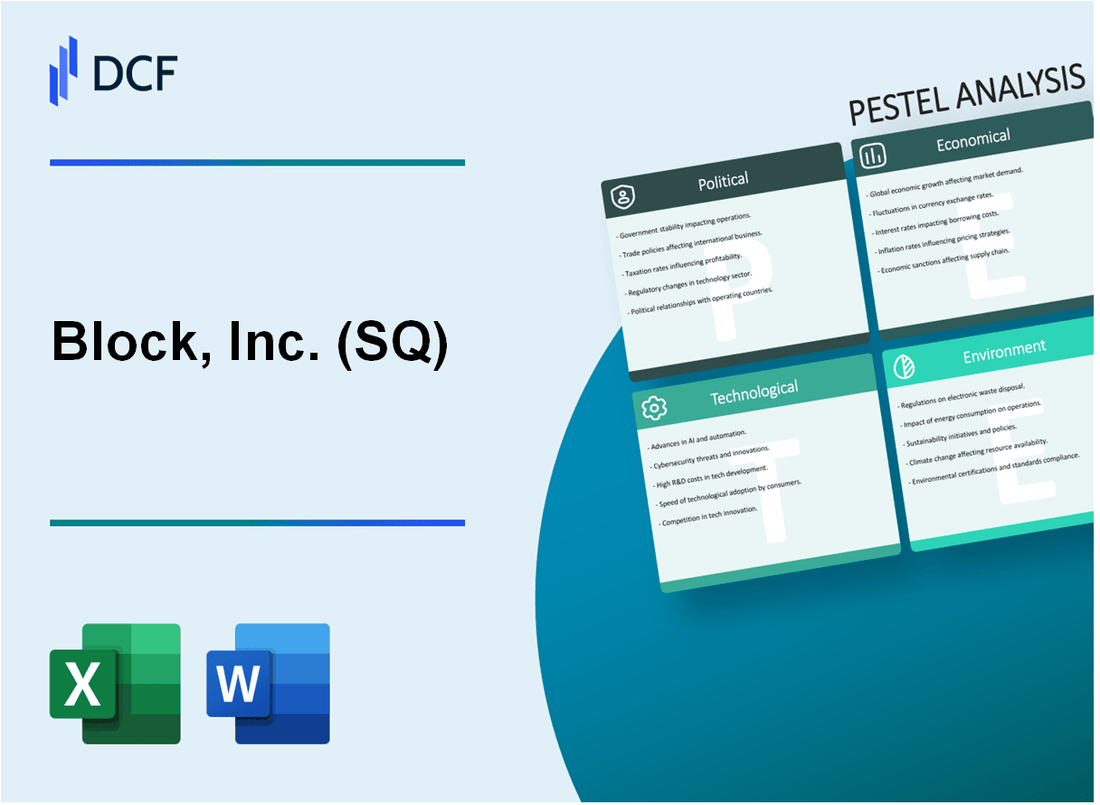
Block, Inc. (SQ): PESTLE Analysis [Nov-2025 Updated] |
Fully Editable: Tailor To Your Needs In Excel Or Sheets
Professional Design: Trusted, Industry-Standard Templates
Investor-Approved Valuation Models
MAC/PC Compatible, Fully Unlocked
No Expertise Is Needed; Easy To Follow
Block, Inc. (SQ) Bundle
You're looking at Block, Inc. (SQ) and seeing a company that's defintely firing on two cylinders-merchant services and consumer finance-but the engine is running on a volatile mix of Bitcoin and regulatory uncertainty. The numbers for 2025 are strong, with Net Revenue projected near $25.2 billion and Gross Profit around $10.5 billion, but that growth is directly exposed to political pressure on interchange fees and the environmental scrutiny of its core crypto strategy. To be fair, the tailwinds from digital wallet adoption are huge, but you need to map out the legal and technological risks right now, because the market won't wait.
Block, Inc. (SQ) - PESTLE Analysis: Political factors
Increased global scrutiny on cryptocurrency (Bitcoin) regulation, impacting Cash App's trading volume.
The political landscape for cryptocurrency, a core revenue driver for Cash App, is a study in global divergence during 2025. In the US, the shift toward a more crypto-friendly administration has created a tailwind, with a push for a clear regulatory framework to foster innovation. This political clarity is intended to accelerate institutional adoption, which is a major opportunity for Block, Inc. to grow its Bitcoin Gross Profit.
But the near-term reality is global regulatory tightening. Over 88% of global jurisdictions have introduced stricter crypto regulations, and 72 out of 98 countries are now enforcing the Financial Action Task Force (FATF) 'Travel Rule,' which mandates collecting and sharing user identity data for transfers. This global scrutiny directly impacts Cash App's ability to operate seamlessly across borders and manage its compliance risk.
We saw the volatility of this political and market environment reflected in Block's Q1 2025 results, where Bitcoin revenue slid 16% to $2.30 billion. This drop highlights how quickly regulatory or market uncertainty can erode a segment that accounted for 42.3% of the company's total sales in 2024. The political environment is defintely a double-edged sword: a huge opportunity in the US, but a rising compliance cost globally.
Potential for stricter anti-money laundering (AML) and Know Your Customer (KYC) compliance burdens globally.
The political and regulatory pressure to combat financial crime is escalating, translating directly into higher operational costs for Block. Regulators worldwide, from the US Financial Crimes Enforcement Network (FinCEN) to the EU's 6th AML Directive (AMLD6), are demanding more comprehensive, technology-enabled AML/KYC programs in 2025.
For fintechs, this isn't just a minor cost increase; it's a significant operational burden. For small to mid-sized crypto firms-a group whose regulatory challenges often mirror Block's own compliance efforts in new markets-average compliance costs rose by 28% in 2025, reaching around $620,000 annually. AML and KYC protocols alone consume about 34% of these compliance budgets. If onboarding takes 14+ days due to complex KYC, churn risk rises dramatically.
Here's the quick math on regulatory risk: non-compliance can lead to massive financial penalties. For example, the UK's FCA fined Starling Bank Limited £28.96 million ($38 million) in 2024 for financial crime failings. Block must continuously invest in its compliance RegTech (Regulatory Technology) to mitigate this risk, effectively turning compliance into a multi-million dollar, non-negotiable operating expenditure.
Government pressure on interchange fees, directly affecting Square's transaction revenue model.
The political battle over interchange fees-the fees paid by a merchant's bank to the card-issuing bank-is a critical threat to Cash App's revenue model, which earns a portion of these fees from the Cash App Card. The Federal Reserve's proposed rule to update Regulation II (Durbin Amendment) is front and center in 2025.
The proposal aims to lower the base debit interchange fee cap for large banks from 21 cents to 14.4 cents per transaction, a reduction of roughly 28%. While Square's merchant business benefits from lower fees, Cash App's growth is partially fueled by its card program, which is an issuer and therefore a recipient of interchange revenue. This proposed cap directly threatens a key, high-margin revenue stream for the Cash App ecosystem, which generated $1.62 billion in Gross Profit in Q3 2025.
Also, the potential reintroduction of the Credit Card Competition Act (CCCA) in 2025 could further intensify pressure by mandating a choice of at least two unaffiliated networks for credit card transactions, which would increase competition and likely lower overall network fees for Square's merchant customers, but also put downward pressure on all transaction-related revenues.
US political uncertainty around fintech charters and consumer protection laws.
The US regulatory environment for fintech in 2025 is defined by fragmentation and a push-pull between federal and state authorities. The new federal administration has signaled a desire for less regulatory burden and a potential renewed openness to a 'fintech charter' or Special Purpose National Bank charter. This would be a massive win for Block, allowing it to operate under a single, federal regulator instead of navigating a patchwork of state-by-state licenses for services like money transmission and lending.
However, in the absence of a clear, unified federal framework, states are stepping up. State regulators, particularly in jurisdictions like New York and California, are actively preparing to take a more aggressive role in consumer protection and financial crime enforcement. This means Block is facing multiple regulatory masters, increasing legal costs and complicating product rollouts.
The most concrete federal development is the Consumer Financial Protection Bureau (CFPB) rule that now subjects 'larger participants' in the digital payment application market to federal supervision. Given Cash App's scale of 58 million monthly active users as of September 2025, it is definitively subject to this heightened CFPB oversight.
| Political/Regulatory Factor | 2025 Key Development/Metric | Impact on Block, Inc. (SQ) |
|---|---|---|
| Global Crypto Regulation (FATF Travel Rule) | 88% of global jurisdictions introduced stricter crypto rules in 2025. | Increased compliance costs and operational friction for Cash App's Bitcoin trading, particularly for cross-border transactions. |
| US Debit Interchange Fees (Regulation II Proposal) | Federal Reserve proposed lowering the debit interchange cap from 21 cents to 14.4 cents (a 28% reduction). | Direct threat to Cash App Card's interchange revenue stream, a component of the Cash App segment which generated $1.62 billion in Gross Profit in Q3 2025. |
| AML/KYC Compliance Burden | Average compliance costs for small/mid-sized crypto firms rose 28% in 2025, with AML/KYC consuming 34% of budgets. | Significant increase in operational expense and technology investment to maintain compliance across Square and Cash App. Risk of multi-million dollar fines for deficiencies. |
| US Fintech Charters/Consumer Protection | CFPB rule subjects non-bank digital payment apps (like Cash App) with over 5 million transactions/year to federal supervision. | Increased regulatory scrutiny on Cash App's lending products (Cash App Borrow) and payment services. State-level regulation (e.g., New York, California) remains a fragmented compliance challenge. |
Block, Inc. (SQ) - PESTLE Analysis: Economic factors
Inflationary pressures and interest rate hikes slowing small business (Square) growth and consumer spending (Cash App).
You're seeing the impact of the Federal Reserve's rate hikes directly in Block, Inc.'s core segments. The sustained high-interest-rate environment, which is a tool to combat persistent inflation, is a headwind for both Square and Cash App. For Square, the higher cost of capital makes small business loans (Square Loans) more expensive, which can slow down investment and expansion for their merchant base. Plus, persistent inflation has eroded consumer purchasing power, meaning the small and medium-sized businesses (SMBs) Square serves are seeing less customer traffic and smaller average ticket sizes.
On the Cash App side, we saw a clear impact on consumer behavior in the first half of 2025. Gross profit growth for Cash App decelerated to 10% year-over-year in Q1 2025, down from a much faster pace previously. This slowdown was attributed to consumer softness, specifically a pronounced impact on discretionary spending in categories like travel and media. Non-discretionary spending, such as groceries, has been more resilient, but overall, the higher cost of living is forcing users, particularly those with lower incomes, to pull back. Block is counteracting this by expanding its credit offerings, like Cash App Borrow, to deepen user engagement.
Analyst consensus projects Block, Inc.'s 2025 Net Revenue to be around $25.2 billion.
The market is expecting Block's top line to continue growing, but at a more moderate pace than the hyper-growth seen in prior years. Analyst consensus projects Block, Inc.'s 2025 Net Revenue to be around $25.2 billion, which represents a modest increase over the full-year 2024 revenue of $24.12 billion. Here's the quick math: Q2 2025 revenue was $6.054 billion. The total revenue figure is heavily influenced by Bitcoin revenue, which is reported on a gross basis but has a very low gross profit margin. This is why investors focus more on Gross Profit as the true measure of business health.
What this estimate hides is the underlying mix. The growth is being driven more by the higher-margin subscription and services revenue than by the lower-margin transaction revenue. This shift is a positive sign for the long-term quality of earnings.
- 2024 Full-Year Revenue: $24.12 billion
- 2025 Q2 Revenue: $6.054 billion
- 2025 Projected Net Revenue: Approximately $25.2 billion
Continued strong US dollar could hurt international revenue conversion for Square's global expansion efforts.
Square is defintely pushing hard on international expansion, which is a smart move to diversify risk away from the saturated U.S. market. In Q2 2025, non-U.S. Gross Payment Volume (GPV) for Square surged by 25% year-over-year, significantly outpacing U.S. growth. International GPV now accounts for 19% of total Square payments.
But, a continued strong U.S. dollar poses a direct, mechanical risk. When Block converts revenue earned in foreign currencies (like the British Pound or Australian Dollar) back into U.S. dollars for reporting, a strong dollar means fewer dollars are recorded. This foreign exchange headwind can suppress the reported growth rate of international revenue, even if the underlying business in local currency is performing exceptionally well. It's a constant battle for any company with a global footprint.
Increased competition driving down transaction fees and pressuring the Gross Profit margin, estimated near $10.5 billion for 2025.
The payments landscape is fiercely competitive, with rivals like Stripe, PayPal, Apple Pay, and even traditional banks fighting for market share in both the merchant and consumer space. This competition drives down the effective transaction fees (take rate) Block can charge, which pressures the overall Gross Profit margin. To combat this, Block is shifting its focus to higher-margin, value-added services (VAS).
Block's full-year 2025 gross profit is officially forecasted to be around $10.17 billion, a figure the company raised after a strong Q2. The initial market estimates were closer to the $10.5 billion mark, reflecting the high expectations for the ecosystem's monetization. This gross profit is critical because it shows the true profitability of the core services, excluding the low-margin Bitcoin revenue.
The table below shows the segment-level gross profit performance, highlighting the strategy to diversify beyond simple transaction fees.
| Segment | Q1 2025 Gross Profit | Q2 2025 Gross Profit | Q1 2025 YoY Growth | Strategic Focus |
|---|---|---|---|---|
| Cash App | $1.39 billion | $1.50 billion | 10% | Lending (Cash App Borrow) and Card Services |
| Square | $898 million | $1.03 billion | 9% | Software Subscriptions (KDS, Loyalty) and Integrated Payments |
| Total Company Gross Profit (Q2 2025) | - | $2.54 billion | 14% | - |
The fact that subscriptions and value-added services contributed 24% to gross profit in Q1 2025 shows the strategy is working. Block is moving from a pure payments processor to a full-service financial platform. That's the only way to sustain margins when every competitor is trying to undercut your transaction fees.
Block, Inc. (SQ) - PESTLE Analysis: Social factors
The social landscape for Block, Inc. in 2025 is characterized by two major, and often conflicting, consumer trends: the mass adoption of digital finance and a growing demand for financial inclusion, set against a backdrop of heightened scrutiny on data security and fraud protection.
Block's Cash App is a direct beneficiary of the shift to mobile-first payments, while its Square ecosystem must adapt quickly to the merchant-side demand for seamless omnichannel commerce. The company's ability to manage its reputation risk from past security failures is defintely critical to sustaining its high-growth trajectory.
Growing consumer preference for digital wallets and peer-to-peer (P2P) payments, benefiting Cash App's network effects.
Consumer behavior has fundamentally shifted toward digital wallets and peer-to-peer (P2P) platforms, which is the core engine for Cash App's growth. By mid-2025, an estimated 65% of US adults were using a digital wallet, marking a clear year-over-year jump from 57% in 2024. This preference is particularly strong for P2P transfers, where mobile-based transactions account for roughly 70% of all P2P payments in the U.S.
This social trend directly translates into Cash App's financial performance by expanding its network effects (the value of the service increases as more people use it). In Q3 2025, Cash App reported 58 million Monthly Transacting Actives (MTAs) and saw its Gross Profit surge 24% year-over-year to $1.62 billion. That's a powerful monetization trend. The Gross Profit per monthly transacting active also grew to an annualized rate of $94 in Q3 2025, up approximately 25% from the previous year, showing customers are deepening their engagement with the platform.
Increased financial inclusion demands, pushing Block, Inc. to serve underbanked populations with products like Cash App Borrow.
A significant social opportunity lies in serving the underbanked population, a demographic that traditional financial institutions often neglect. Block, Inc. addresses this demand through products like Cash App Borrow, which offers small, short-term loans.
The product's underwriting model, which uses near real-time financial data instead of traditional credit scores, is a key component of this inclusion strategy. This approach has proven effective: more than 70% of active Cash App Borrow customers have FICO scores below 580, yet the product maintains repayment rates above 97%. This is a high-margin business that also fulfills a social need.
The financial impact of this inclusion focus is clear from the Q3 2025 results:
- Cash App Borrow loan originations grew 134% year-over-year.
- The annualized originations volume reached $22 billion.
- The product maintains a strong annualized net margin of 24%.
Shift toward omnichannel commerce, requiring Square to defintely integrate online and in-person tools seamlessly.
For the Square ecosystem, the social factor is the merchant's need to meet the consumer's expectation for a frictionless shopping experience across all channels (omnichannel commerce). Consumers expect to buy online, pick up in-store, or return an in-store purchase via an app. Square's success hinges on providing integrated software, banking, and payment tools to its sellers.
Square's Gross Payment Volume (GPV) grew 12% year-over-year to $67.2 billion in Q3 2025, demonstrating strong merchant adoption. However, its Gross Profit growth of only 9% year-over-year to $1.02 billion indicates margin pressure, partly from the cost of integrating and scaling these complex, multi-channel solutions. Mid-market sellers (annualized GPV > $500K), who are typically the heaviest users of omnichannel tools, now account for 45% of Square's GPV, up from 41% in Q3 2023. This is where the integration challenge-and the opportunity-is most pronounced.
Public trust issues related to data privacy and security breaches could erode user confidence in both ecosystems.
While digital payments are popular, security remains a top consumer concern, and Block, Inc. faces ongoing risk from past and potential future security failures. In January 2025, the company was ordered to pay up to $175 million to resolve security-related issues with the Consumer Financial Protection Bureau (CFPB). This included up to $120 million in consumer refunds and a $55 million penalty. This is a direct financial cost of trust erosion.
The CFPB alleged that Block employed weak security protocols and used inadequate investigation practices for unauthorized transactions, which can severely damage user confidence. Separately, the company agreed to a $15 million settlement in a class-action lawsuit over alleged failure to exercise reasonable care in protecting user information following a 2021 data breach. You can't ignore the reputational cost of these settlements.
| Social Factor Risk/Opportunity | Q3 2025 Metric | Impact on Block, Inc. |
|---|---|---|
| P2P/Digital Wallet Adoption (Opportunity) | Cash App MTAs: 58 million | Drives Cash App's 24% Gross Profit growth to $1.62 billion. |
| Financial Inclusion (Opportunity) | Cash App Borrow Originations: $22 billion (annualized) | High-margin growth driver (24% net margin) by serving the underbanked. |
| Omnichannel Shift (Opportunity/Risk) | Square GPV: $67.2 billion (up 12% YoY) | Volume growth is strong, but Gross Profit only grew 9%, signaling margin pressure from investment in integrated software. |
| Public Trust/Security (Risk) | CFPB Settlement (Jan 2025): Up to $175 million | Direct financial cost and significant reputational damage due to alleged weak security protocols and inadequate fraud investigation. |
Block, Inc. (SQ) - PESTLE Analysis: Technological factors
Block, Inc.'s technological landscape in 2025 is defined by a dual focus: leveraging Artificial Intelligence (AI) for ecosystem growth and risk mitigation, and aggressively pursuing a leadership role in the decentralized finance (DeFi) and Bitcoin space. This strategy is critical, as the company faces intensifying competition from embedded finance solutions that threaten to disintermediate its core payments business.
Rapid adoption of AI/Machine Learning for fraud detection and personalized financial services across all segments.
Block is using machine learning (ML) not just for security, but as a core engine for product growth and engineering efficiency. The company's focus on AI-powered fraud prevention is paying off, with confirmed scam rates remaining below 0.01% of all peer-to-peer transactions. This technology has protected customers from over $2 billion in potential fraud losses since 2020. On the growth side, AI-driven underwriting has been key to scaling high-margin products like Cash App Borrow, which saw originations grow 95% year-over-year.
Internally, Block's engineering velocity has increased by 30%, with approximately 90% of its code submissions now being AI-authored. This signals a fundamental shift in how they build products. We're also seeing new AI-powered tools roll out, like 'managerbot' for small businesses to automate payroll and scheduling, and 'moneybot' to streamline personal budgeting and taxes for consumers. This isn't just a buzzword; it's a defintely quantifiable efficiency gain.
| AI/ML Impact Area (2025 Data) | Key Metric/Value | Business Segment |
|---|---|---|
| Fraud Prevention Success | Protected >$2 Billion in potential losses since 2020 | Cash App |
| Confirmed Scam Rate | Below 0.01% of P2P transactions | Cash App |
| Lending Growth (Cash App Borrow) | Originations up 95% Year-over-Year | Cash App |
| Engineering Velocity | 30% increase in speed | Internal/All Segments |
Competition from embedded finance solutions, where non-financial companies offer payment services directly.
The rise of embedded finance is a major structural risk. The global market is projected to reach $7.2 trillion by 2030, meaning financial services are increasingly woven into non-financial platforms like Shopify and Uber. These competitors bypass traditional payment rails, threatening to commoditize Block's core transaction business. Block's counter-strategy is to embed its own financial services deeply into its ecosystems.
- Afterpay Integration: Block's Buy Now, Pay Later (BNPL) platform, Afterpay, generated an annualized gross profit of approximately $1.04 billion in Q2 2025, which is a key embedded lending service.
- Cash App Ecosystem: Cash App is evolving into a full-service banking alternative, with 58 million monthly active users by September 2025, offering a sticky, integrated experience to fight platform disintermediation.
The goal is to make the ecosystem so sticky that users don't need to leave the app for any financial service. That's the entire game.
Continued investment in the Bitcoin ecosystem and decentralized finance (DeFi) infrastructure through Spiral and TBD.
Block is doubling down on Bitcoin as a long-term technological bet, viewing it as the future financial operating system. In Q3 2025, Bitcoin-related revenue reached $1.97 billion, representing nearly one-third of the company's total revenue of $6.11 billion. This commitment is channeled through several key initiatives:
- Proto: The open Bitcoin mining system, which generated its first revenue in Q3 2025 from ASIC and mining rig sales, is positioning Block as a hardware innovator in the decentralized infrastructure space.
- Bitkey: A self-custody Bitcoin wallet designed to simplify the secure management of Bitcoin for the mass market.
- TBD/Spiral: These divisions are focused on building decentralized infrastructure, including a decentralized exchange (DEX) and tools to integrate Bitcoin payments directly into Square Terminal merchant solutions.
This is a high-risk, high-reward play that hedges against the traditional financial system and gives Block a unique, crypto-native differentiator against PayPal and Stripe.
Need to constantly update hardware (Square Readers) to keep pace with contactless and tap-to-pay standards.
The Square segment's success is tied to its hardware, which must constantly evolve to meet new payment standards and consumer habits. The push for contactless and tap-to-pay is relentless, and the company must invest heavily to ensure its point-of-sale (POS) systems remain current. Square's Gross Payment Volume (GPV) growth accelerated to 12% in Q3 2025, its fastest pace in two years, showing their hardware and software updates are resonating with sellers.
A major development in 2025 was the launch of Tap to Pay on iPhone for Business sellers in the Cash App ecosystem, which allows merchants to accept contactless payments without needing a dedicated Square Reader. While this reduces the reliance on physical hardware sales, it increases the importance of software integration and maintenance. Square's Q3 2025 gross profit of $1.02 billion, up 9% year-over-year, indicates that the core merchant business remains strong, but constant R&D investment is mandatory to maintain this growth pace.
Block, Inc. (SQ) - PESTLE Analysis: Legal factors
Ongoing regulatory investigations into Cash App's compliance with state and federal consumer finance laws.
You need to be clear-eyed about the compliance costs of rapid growth, and for Block, Inc., the penalties in 2025 were substantial and concrete. The company faced a barrage of coordinated regulatory actions from both federal and state authorities over deficiencies in its Cash App platform, specifically concerning anti-money laundering (AML) and consumer protection.
In January 2025, Block, Inc. agreed to two major settlements. First, the Consumer Financial Protection Bureau (CFPB) ordered the company to pay up to $175 million for failing to investigate and protect customers from fraudulent transactions. This total included a $55 million civil penalty and up to $120 million in redress for harmed consumers, with a guaranteed minimum of $75 million in refunds. Honestly, that's a massive expense to cover for inadequate security protocols.
Also in January 2025, Block, Inc. settled with a coalition of 48 state financial regulators, agreeing to pay an additional $80 million fine for violations of the Bank Secrecy Act (BSA) and other AML laws. Then, in April 2025, the New York Department of Financial Services (NYDFS) imposed a separate $40 million penalty, citing 'significant failures' in the BSA/AML program, notably involving 'lax treatment of high-risk Bitcoin transactions.' Here's the quick math on the total financial hit from these 2025 regulatory actions alone:
| Regulatory Action | Date (2025) | Violation Focus | Financial Impact |
|---|---|---|---|
| CFPB Settlement | January | Consumer Fraud Protection / EFTA | Up to $175 million ($55M penalty + up to $120M redress) |
| 48-State Regulator Settlement | January | BSA / AML Compliance | $80 million fine |
| NYDFS Settlement | April | BSA / AML / Virtual Currency Compliance | $40 million penalty |
| Total Financial Impact | Approximately $295 million |
Beyond the money, Block is required to hire independent monitors and consultants to overhaul its compliance programs, a significant long-term operational cost.
Data localization and cross-border data transfer rules complicating international expansion efforts, especially in Europe.
Global fintech expansion, particularly in Europe, runs straight into the General Data Protection Regulation (GDPR), and that's a brick wall for US companies. The core issue for Block, Inc.'s international services like Afterpay is the strict requirement for cross-border data transfers, which must ensure an 'essentially equivalent' level of protection to EU standards.
The main mechanism for US-to-EU data flow, the EU-U.S. Data Privacy Framework (DPF), is under intense legal scrutiny. Privacy activists have signaled a significant legal challenge to the DPF in the Court of Justice of the EU (CJEU) in 2025, which could invalidate the framework. If that happens, Block would need to rely entirely on more complex and costly mechanisms for data transfer, such as Standard Contractual Clauses (SCCs) or Binding Corporate Rules (BCRs).
This uncertainty means every international expansion decision requires a costly, in-depth Transfer Impact Assessment (TIA) to evaluate the legal risks of storing data outside the EU/UK. The compliance burden is heavy, and it slows down the rollout of Cash App or Square services in new markets.
Litigation risk related to intellectual property and patent infringement in the competitive fintech space.
The fintech sector is in a full-blown patent war, and Block, Inc. is both a combatant and a target. The company is actively defending its technological moat by securing key patents in 2025, but this also increases the risk of being sued by competitors for infringement, or vice versa.
Recent patent grants to Block, Inc. in 2025 show where they are building their defenses:
- 'Real time fraud detection and intervention' (Patent Date: September 23, 2025)
- 'Automatic triggering of receipt delivery' (Patent Date: August 26, 2025)
- 'POINT OF SALE SYSTEM TRANSACTION PROCESSING' (Publication Date: October 9, 2025)
The litigation risk isn't just about patents, though. In a separate, but related, matter, Block agreed in 2024 to pay $15 million to settle a lawsuit claiming the company failed to protect Cash App users from a data breach that compromised the personal information of approximately 8.2 million current and former users. This highlights the ongoing, multi-faceted litigation exposure that comes with managing a massive consumer data set.
New rules governing the sale and custody of digital assets, directly impacting Cash App's Bitcoin offering.
The regulatory environment for digital assets is finally taking shape at the federal level in 2025, moving from patchwork enforcement to statutory law. This is a critical development for Cash App, which generated a significant portion of its 2023 gross profit (around $4 billion) and is a major player in Bitcoin transactions.
The most significant change is the enactment of the Guiding and Establishing National Innovation for US Stablecoins (GENIUS) Act, signed into law on July 18, 2025. This is the first major federal crypto legislation, and it establishes a framework for 'payment stablecoins,' requiring new compliance standards for reserve maintenance, transparency, and AML under the Bank Secrecy Act.
Cash App's plans to allow customers to 'spend bitcoin at local businesses' and 'send and receive stablecoins' in late 2025 makes this new federal law immediately relevant. Plus, the ongoing issue of lax Bitcoin transaction oversight was explicitly cited in the $40 million NYDFS fine in April 2025. The new regulatory clarity is a double-edged sword: it legitimizes the market, but it also imposes stringent new operational and capital requirements on Block, Inc. to ensure compliance with stablecoin reserves and custody rules.
Block, Inc. (SQ) - PESTLE Analysis: Environmental factors
Growing investor and public pressure for transparency on the environmental impact of Bitcoin mining, a core part of their strategy.
You are defintely seeing a sharp increase in shareholder proposals and public scrutiny over the energy consumption of cryptocurrency, especially Bitcoin, which is a core part of Block, Inc.'s strategy via Cash App and TBD. The global Bitcoin network's estimated annual energy consumption is a massive 150 Terawatt-hours (TWh) as of mid-2025, which is comparable to the consumption of a small nation, creating a significant reputational risk for Block.
To counter this narrative, Block co-founded the Bitcoin Clean Energy Initiative (BCEI), committing $10 million to accelerate the energy transition in the mining ecosystem. This isn't just PR; it's a strategic move to future-proof their Bitcoin business. For instance, the BCEI invested in Gridless, a renewable energy-based Bitcoin mining company in Kenya, which uses computational centers to monetize excess clean energy and lower local electricity costs. They are actively trying to prove that Bitcoin mining can be a buyer of last resort for renewable energy, not just a consumer of fossil fuels.
Focus on sustainable financing and green initiatives to attract ESG-focused capital.
Attracting capital from Environmental, Social, and Governance (ESG) funds is non-negotiable for a company of Block's size, and their commitment to a net-zero target is the main lever. Block has a public goal to be Net Zero Carbon for its corporate operations (Scopes 1, 2, and 3) by 2030. This commitment helps them tap into the trillions of dollars managed by ESG-mandated funds.
In 2023, the company purchased 24,298 Renewable Energy Credits (RECs) to offset emissions and encourage clean energy production across the US, Canada, Japan, and Australia. Plus, Block has dedicated capital for direct costs associated with carbon removal purchases and emissions reduction initiatives. A key 2025 initiative is the full launch of their solar-powered Bitcoin mining facility in West Texas, which, once operational, is projected to avoid more than 58,000 tonnes of CO2e (carbon dioxide equivalent), which is the equivalent of over 146 million car miles driven. That's a concrete example of how they are translating ESG goals into physical assets.
Need for a clear, measurable plan to reduce operational carbon footprint across offices and data centers.
The clear, measurable plan is rooted in reducing their carbon intensity while the business grows. Since Block is a financial technology company, their Scope 3 emissions-those from their value chain, like credit card processing and hardware manufacturing-are the biggest challenge, accounting for about 98% of their total carbon footprint in 2022. You can't just fix a few offices and call it a day.
The company measures its progress using an emissions intensity metric: tonnes of CO2e per $1 million in gross profit. This is the quick math to show decoupling: in 2022, their carbon intensity was 65 tonnes of CO2e per $1 million in gross profit, a significant drop from 87 tonnes in 2020. The long-term goal is a 20% reduction in emissions intensity over five years, starting from 2020. This focus on intensity allows them to track genuine efficiency improvements even as their gross profit-and thus, absolute emissions-rises.
| Metric | 2020 Value | 2022 Value | Target / 2025 Context |
|---|---|---|---|
| Net Zero Goal | Announced | Progressing | Net Zero Carbon by 2030 (Corporate Operations) |
| Carbon Emissions Intensity (tCO2e / $1M Gross Profit) | 87 | 65 | Goal to reduce by 20% over five years (from 2020 baseline) |
| Scope 3 Footprint Percentage | N/A | 98% of total footprint | Primary focus area for emissions reduction efforts |
| Renewable Energy Credits (RECs) Purchased | N/A | N/A | 24,298 RECs purchased in 2023 |
Reporting requirements for climate-related financial risks becoming standard for large public companies.
The voluntary disclosures Block has been making are now rapidly becoming mandatory, especially in the US. The most critical near-term regulatory pressure comes from California's new climate disclosure laws, which affect major companies like Block that do business in the state.
Here are the key compliance actions you need to track for the 2025 fiscal year data:
- SB 261 (Climate-Related Financial Risk): Requires public disclosure of climate-related financial risks by January 1, 2026, for companies with over $500 million in annual revenue. This report must align with a framework like the Task Force on Climate-Related Financial Disclosures (TCFD).
- SB 253 (GHG Emissions Disclosure): Requires disclosure of Scope 1 and 2 greenhouse gas emissions data for the 2025 calendar year, with the initial report due in 2026. This means the data collection for 2025 is mandatory now.
- Scope 3 Disclosure: The more challenging Scope 3 (value chain) emissions disclosure under SB 253 is required starting in 2027 for the 2026 data, but Block's existing efforts on this 98% of their footprint give them a head start.
The Securities and Exchange Commission (SEC) is also pushing for similar federal rules, so even with some legal challenges to the California laws, preparing the 2025 data is a necessary action to mitigate regulatory and financial risk.
Disclaimer
All information, articles, and product details provided on this website are for general informational and educational purposes only. We do not claim any ownership over, nor do we intend to infringe upon, any trademarks, copyrights, logos, brand names, or other intellectual property mentioned or depicted on this site. Such intellectual property remains the property of its respective owners, and any references here are made solely for identification or informational purposes, without implying any affiliation, endorsement, or partnership.
We make no representations or warranties, express or implied, regarding the accuracy, completeness, or suitability of any content or products presented. Nothing on this website should be construed as legal, tax, investment, financial, medical, or other professional advice. In addition, no part of this site—including articles or product references—constitutes a solicitation, recommendation, endorsement, advertisement, or offer to buy or sell any securities, franchises, or other financial instruments, particularly in jurisdictions where such activity would be unlawful.
All content is of a general nature and may not address the specific circumstances of any individual or entity. It is not a substitute for professional advice or services. Any actions you take based on the information provided here are strictly at your own risk. You accept full responsibility for any decisions or outcomes arising from your use of this website and agree to release us from any liability in connection with your use of, or reliance upon, the content or products found herein.