

|
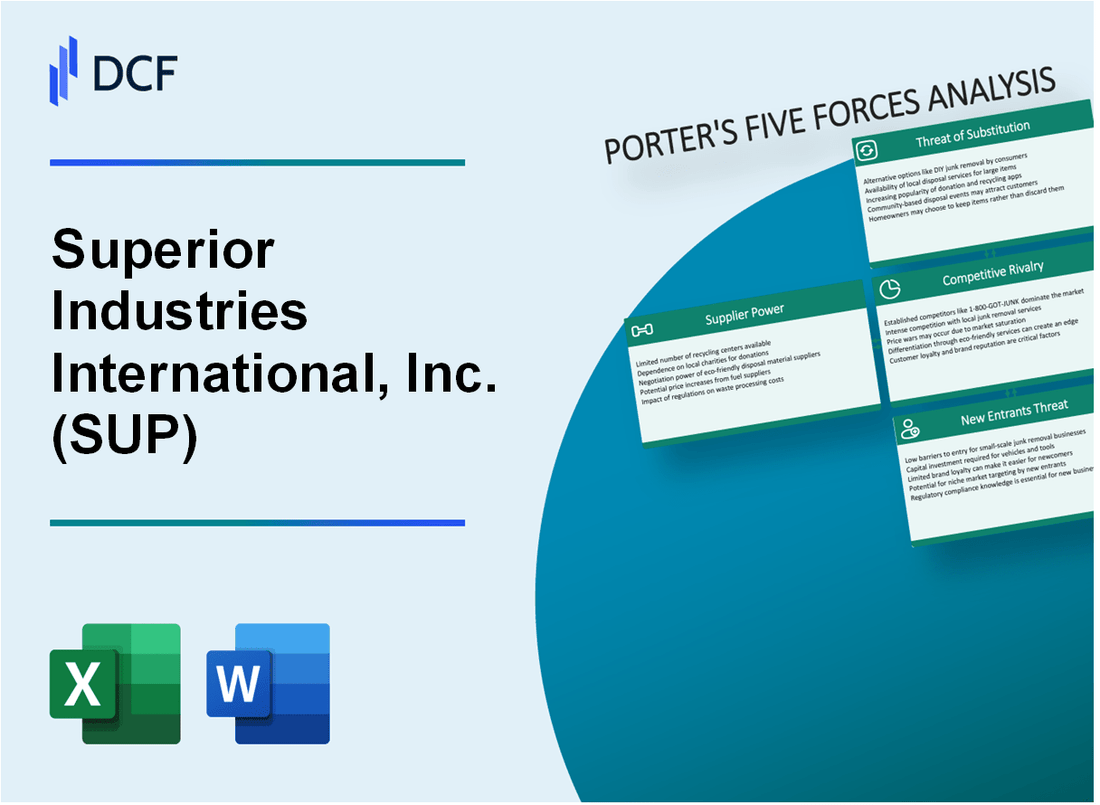
Superior Industries International, Inc. (SUP): 5 FORCES Analysis [Nov-2025 Updated] |
Fully Editable: Tailor To Your Needs In Excel Or Sheets
Professional Design: Trusted, Industry-Standard Templates
Investor-Approved Valuation Models
MAC/PC Compatible, Fully Unlocked
No Expertise Is Needed; Easy To Follow
Superior Industries International, Inc. (SUP) Bundle
You're looking at a company under serious pressure: Superior Industries International, Inc. as we hit late 2025. Honestly, the numbers paint a clear picture of high-stakes competition, driven by massive customer power-OEMs accounted for 92% of their 2024 revenue-which, after a Q1 2025 volume hit, contributed to a sharp $13 million net loss amidst intense global rivalry. With Oaktree Capital Management now at the helm, understanding how the balance of power plays out across all five of Porter's forces is defintely key to seeing the path forward for this major wheel supplier.
Superior Industries International, Inc. (SUP) - Porter's Five Forces: Bargaining power of suppliers
When looking at the bargaining power of suppliers for Superior Industries International, Inc., you have to focus almost entirely on aluminum, since it accounted for the vast majority of total raw material requirements in 2024. Aluminum is a commodity, which usually suggests lower supplier power, but for a Tier 1 supplier like Superior Industries International, Inc., a high-quality, continuous supply is absolutely critical to serving global OEMs. This necessity gives suppliers some leverage, even if the material itself is standardized.
Superior Industries International, Inc. has taken steps to manage the inherent price risk associated with this key input. Aluminum price volatility is partially mitigated by contractual price adjustment clauses with OEMs. These clauses are designed to pass along fluctuations in the cost of aluminum, as well as associated costs like silicon and alloy premiums, to the end customer. This mechanism helps protect Superior Industries International, Inc.'s margins from sudden commodity spikes.
To ensure operational continuity, Superior Industries International, Inc. proactively managed its material pipeline. The company successfully secured aluminum commitments from its primary suppliers sufficient to meet its production requirements during 2024, and it anticipated being able to source aluminum requirements to meet its expected level of production in 2025. This forward-looking procurement strategy is key to maintaining its position as one of the world's largest aluminum wheel suppliers to global OEMs, where OEM aluminum wheels accounted for approximately 92% of total sales in the fiscal year ended December 31, 2024.
The relationship with at least one principal aluminum supplier has included favorable financing terms, which speaks to Superior Industries International, Inc.'s scale. The company has an extended 90-day payment term arrangement with one principal aluminum supplier, a benefit over the standard 60 days, in exchange for a nominal adjustment to product pricing. Obligations due to the factoring institution under this specific supply chain finance arrangement were $28.1 million as of March 31, 2025, though it is important to note that subsequent to March 31, 2025, the financial institution suspended the Company's use of that program. Still, the initial negotiation demonstrates the leverage Superior Industries International, Inc. can exert.
Suppliers' power is moderate, balanced by Superior Industries International, Inc.'s scale as one of the world's largest wheel suppliers. The sheer volume of material required by a company that reported net sales of $1,267 million for the full year 2024, and employed approximately 6,500 full-time employees as of December 31, 2024, means that major aluminum producers value the business. However, the power is checked by the contractual mechanisms to pass on costs and the company's ability to secure supply commitments, even as it navigates a challenging environment that led to a significant balance sheet reset in mid-2025, reducing funded debt from approximately $982 million to only $125 million.
Here is a quick look at some relevant scale and financial context:
| Metric | Value/Date | Context |
|---|---|---|
| OEM Sales Percentage (FY 2024) | 92% | Proportion of total sales from OEM wheels. |
| Extended Payment Term | 90 days (vs. 60 days standard) | Term with one principal aluminum supplier. |
| Factored Obligations (as of 3/31/2025) | $28.1 million | Amount due under the extended payment term program. |
| Full Year 2024 Net Sales | $1,267 million | Indicates the scale of raw material purchasing power. |
| Total Employees (as of 12/31/2024) | Approximately 6,500 | Scale of the overall operation. |
The ability of Superior Industries International, Inc. to manage supplier power hinges on its ability to maintain high utilization across its North American and European facilities, which is why securing those 2025 aluminum commitments was so important.
- Contractual clauses mitigate aluminum price risk with OEMs.
- Commitments secured for expected 2025 production requirements.
- 90-day payment term arrangement exists with one supplier.
- Aluminum is a commodity, but supply continuity is critical for Tier 1 status.
- Scale balances supplier power; OEM sales were 92% of 2024 revenue.
Superior Industries International, Inc. (SUP) - Porter's Five Forces: Bargaining power of customers
You're analyzing the customer power at Superior Industries International, Inc. (SUP), and honestly, the numbers paint a clear picture: the buyers hold significant leverage. This isn't a fragmented market where Superior can dictate terms; it's a relationship dominated by a few massive Original Equipment Manufacturers (OEMs).
The core issue is concentration. OEMs represent approximately 92% of Superior Industries' 2024 total sales, creating high customer concentration risk. This dependency means any shift in purchasing strategy by one or two major players sends shockwaves through Superior Industries' operations and financials. We saw this play out starkly in the first quarter of 2025.
The company suffered a sudden volume loss from major North American OEM customers in Q1 2025, leading to liquidity constraints. Specifically, subsequent to March 31, 2025, certain larger North American OEM customers notified Superior Industries of their intent to resource all outstanding purchase orders to another supplier with minimal wind down. This loss represented a staggering 33% of Superior Industries' expected revenue for 2025. That kind of sudden demand destruction immediately strains working capital and forces reactive measures, like securing a commitment for up to $70 million of additional term loans to mitigate the short-term liquidity constraint. For context, Superior Industries' Q1 2025 Net Sales were $322 million, and the Net Loss was $13 million.
Customers like BMW, Ford, and VW Group are massive, sophisticated buyers with significant leverage. These are not small-time purchasers; they are global automotive giants that understand supply chain economics intimately. In 2024, Superior Industries' top four customers accounted for a huge chunk of their business:
| Customer (2024) | Percent of Sales (2024) |
|---|---|
| GM | 24% |
| Ford | 16% |
| VW Group | 12% |
| Toyota | 12% |
The loss of all or a substantial portion of sales to any of these entities would have a significant adverse effect on Superior Industries' financial results.
Customer switching costs are high due to long design-in cycles and product customization, which typically favors the supplier. However, the reality is that OEMs can, and do, dual-source critical components like aluminum wheels to maintain competitive tension. The Q1 2025 event confirms that the threat of switching, or at least shifting volume, is a very real lever for these buyers. Superior Industries' own competitive advantage, the 'local-for-local' manufacturing footprint in Mexico and Poland, is partly a response to OEM desires for localized supply chains, but it also makes the supplier more specialized, which can be a double-edged sword when negotiating price.
Looking ahead, the pressure to cut costs remains intense. IHS April 2025 forecasts a key customer production volume decline of 8.7%, increasing OEM pressure for cost cuts across the board. Even with adjusted EBITDA at $25 million for Q1 2025 (a margin of 15%, down from 21% in Q4 2024 for some metrics), the OEMs will use any external market weakness to demand better pricing from Superior Industries.
Here are the key dynamics that define the power of Superior Industries' customers:
- Extreme dependence on OEM sales, approximately 92% of 2024 revenue.
- Major customers (GM, Ford, VW Group) represent over 50% of 2024 sales combined.
- Demonstrated ability to shift volume suddenly, causing immediate liquidity stress.
- High fixed costs and lower production volumes in Q1 2025 led to margin compression (Adjusted EBITDA margin at 15%).
- The threat of dual-sourcing or resourcing is actively used to drive down pricing.
Finance: draft 13-week cash view by Friday.
Superior Industries International, Inc. (SUP) - Porter's Five Forces: Competitive rivalry
You're looking at a market where the fight for every order is brutal, and that's exactly what Superior Industries International, Inc. is facing. Competition here is intense and global, not just a local spat. Major players like MAXION Wheels, CITIC Dicastal, and Ronal Group are constantly vying for the same Original Equipment Manufacturer (OEM) contracts across North America and Europe. To be fair, Superior Industries has a strong product portfolio, but the sheer scale of these rivals keeps the pressure on margins.
The market structure feels moderately concentrated, but that's misleading because global overcapacity is the real driver of aggressive pricing. We see this especially from Asian exports, which forces every player, including Superior Industries, to compete fiercely on the fundamentals. This environment is why Superior Industries withdrew its fiscal 2025 outlook; the uncertainty and lost volume from certain customers created immediate stress.
Competition hinges on a few critical factors, and you can't afford to slip on any of them. Delivery speed, absolute price, and guaranteed quality are table stakes. However, the real edge comes from advanced light weighting technology, like Superior Industries' proprietary Alulite mass reduction wheel technology. This focus on innovation is necessary to meet automaker demands for fuel efficiency.
Superior Industries' Q1 2025 net loss of $12.9 million indicates significant margin pressure in this rivalry. That loss, on net sales of $322 million, shows how tough it is to maintain profitability when facing these headwinds. The Adjusted EBITDA for that quarter fell to $25 million, representing a margin drop from 18% in the prior year period to just 15%. This financial strain is a direct result of the competitive environment, including lost volume from major North American OEM customers.
Here's a quick look at how Superior Industries stacks up against the competitive field and the broader market context as of late 2025:
| Metric | Superior Industries (Q1 2025) | Competitive Context |
|---|---|---|
| Net Sales | $322 million | Global Aluminum Alloy Wheel Market projected revenue for 2025 is USD 223.76 Million (Note: This figure may represent a segment or specific report scope) |
| Net Loss | $12.9 million | Top competitors include MAXION Wheels, CITIC Dicastal, and Ronal |
| Adjusted EBITDA Margin | 15% | Competition is intensified by recent United States trade tariffs impacting sourcing |
| Key Technology Focus | Alulite mass reduction wheel technology | Competition hinges on advanced light weighting and forging/casting techniques |
The intensity is further highlighted by strategic shifts in the industry. For instance, Superior Industries received notifications from some large North American automakers about resourcing outstanding purchase orders to other suppliers. This loss of volume directly impacts the ability to cover fixed costs, which is why the gross profit margin was reported as a concerning 8.72% on a trailing twelve-month basis.
You should watch these specific competitive dynamics closely:
- Aggressive pricing from Asian exports.
- Loss of volume from key North American OEMs.
- Need for continuous investment in lightweighting like Alulite.
- Impact of recent US trade tariffs on sourcing costs.
- The shift to private ownership following the July 2025 acquisition.
The company is actively trying to reset its balance sheet, reducing funded debt from approximately USD 982 million to only USD 125 million as part of the acquisition agreement. This restructuring is a direct response to the severe competitive and macroeconomic pressures faced in the first half of 2025.
Finance: draft 13-week cash view by Friday.
Superior Industries International, Inc. (SUP) - Porter's Five Forces: Threat of substitutes
The threat of substitutes for Superior Industries International, Inc.'s core aluminum wheel business comes from alternative materials that fulfill the same basic function: providing a secure, load-bearing mounting point for a vehicle's tire. You need to look at the cost-conscious and the high-performance ends of the spectrum to gauge this pressure.
Steel wheels are definitely the most significant low-cost substitute. They hold about 20% of the 2025 wheel market share in entry-level and commercial vehicles, where initial purchase price is the main driver. To put the scale of the overall market into perspective, the global automotive wheel market revenue reached approximately USD 51.80 billion in 2025. Even within the steel segment alone, the Global Automotive Steel Wheels Market was estimated to be valued at USD 14.62 Bn in 2025. Steel's advantage is its affordability; they are significantly cheaper to produce than alloy wheels, making them the standard for economical models.
On the other side, carbon fiber and magnesium alloy wheels represent the high-performance, high-cost substitutes that are gaining traction, especially in premium and luxury segments. These materials are sought after because they offer superior strength-to-weight ratios, which directly supports the industry-wide push for efficiency. For instance, using lightweight materials like forged aluminum or magnesium can decrease wheel weight by up to 20% compared to standard wheels. The demand for these advanced materials is growing in high-end applications, even as Superior Industries International, Inc. navigates its own financial restructuring, which involved converting about ~$550 million of term loan claims into 96.5% of new common equity as of mid-2025.
The automotive industry's intense focus on EV range and fuel efficiency is a double-edged sword for Superior Industries International, Inc. While this trend increases the demand for Superior Industries' core lightweight aluminum wheels, it also validates the pursuit of even lighter materials like carbon fiber. Automakers are trying to offset battery weight and meet stringent emissions targets, which is why lightweight wheels are crucial. This pressure is evident in OEM production volumes, where North America saw a decline of 5.3% in Q1 2025, signaling a challenging environment where every component's weight matters.
Superior Industries' core aluminum product maintains a strong position because it hits the sweet spot in the mass-market premium segment due to its cost-performance balance. Aluminum alloys are known for their balance between strength, weight, and cost, making them highly popular in the premium compact and entry-level luxury segments. For context, Superior Industries International, Inc. reported Q1 2025 Net Sales of $321.6 million, with its trailing twelve-month revenue as of June 30, 2025, standing at $1.16B. The company's ability to serve major OEMs like GM and Ford, which accounted for 21% and 18% of Q1 2025 sales respectively, hinges on this balance against cheaper steel and more exotic, lighter alternatives.
Here is a quick comparison of the substitute landscape:
- Steel wheels: Primary advantage is cost-effectiveness.
- Carbon fiber/Magnesium: Primary advantage is superior weight reduction.
- Aluminum (SUP core): Offers the best cost-to-weight ratio for mainstream applications.
The market dynamics for these substitute materials can be summarized as follows:
| Material Substitute | Market Segment Focus | Key Advantage | Estimated Market Share Context (2025) |
|---|---|---|---|
| Steel Wheels | Entry-level and Commercial Vehicles | Low initial cost, durability | 20% share in entry-level/commercial segments (as per outline) |
| Carbon Fiber Wheels | High-Performance and Luxury Vehicles | Maximum weight reduction, high strength | Projected highest CAGR in High Performance segment (2025-2033) |
| Magnesium Alloy Wheels | Premium/High-Performance Segments | Lighter than aluminum, high strength | Gaining traction in premium segments |
Superior Industries International, Inc. (SUP) - Porter's Five Forces: Threat of new entrants
You're looking at the barriers to entry for a new company trying to compete directly with Superior Industries International, Inc. in the high-volume aluminum wheel segment. Honestly, the hurdles here are massive, which is a good thing for the incumbents like Superior Industries International, Inc.
The initial capital expenditure (CAPEX) required to even start up a high-volume Tier 1 wheel manufacturer is a very high barrier. Think about the scale we are discussing. While Superior Industries International, Inc. itself is currently focused on reducing capital expenditures to a minimum level to maintain existing equipment as of March 31, 2025, a new entrant needs to build from scratch. To put this into perspective for a new car manufacturing operation, total startup costs realistically range from $1.5 billion to over $7 billion. Specifically, constructing and equipping a modern factory for automotive production can demand an investment between $1.5 billion and over $5 billion. Even just the necessary integrated systems can cost between $20 million and $100 million.
New players face significant hurdles in meeting the stringent Original Equipment Manufacturer (OEM) quality standards and navigating the long qualification processes. Superior Industries International, Inc. serves a long list of major OEMs, including BMW (including Mini), Ford, GM, Honda, Toyota, and VW Group. This level of trust is earned over time. While specific wheel qualification timelines aren't public, component qualification in the automotive sector can involve notification and approval phases that each take around 6 Months. Furthermore, the expectation for longevity in automotive parts means a new supplier must prove its product reliability for 10 years or more. Superior Industries International, Inc. itself quoted on more than 53 million lifetime wheels year-to-date as of Q1 2025, showing the volume commitment required.
The established relationships and the global manufacturing footprint of Superior Industries International, Inc. are difficult for new players to replicate quickly. Superior Industries International, Inc. has strategically positioned its manufacturing in Mexico and Poland to support a 'local-for-local' supply chain for North American and European OEMs. This geographic advantage, especially when combined with tariff dynamics favoring localized production, is a powerful moat. A new entrant would need to secure land, build facilities, and establish the complex logistics network across these continents simultaneously.
Here is a quick look at the scale and financial context surrounding Superior Industries International, Inc. as of mid-2025:
| Metric | Value (as of Q1 2025 or latest report) | Context |
|---|---|---|
| Trailing 12-Month Revenue (as of 6/30/2025) | $1.16B | Overall company scale |
| Net Sales (Q1 2025) | $321.6 million | Total sales for the quarter |
| Value-Added Sales (Q1 2025) | $168.5 million | Core sales metric for the quarter |
| Manufacturing Footprint Locations | Mexico, Poland, and a new facility in New Mexico (147,500 sq. ft.) | Global/Domestic manufacturing base |
| Total Employees | 6,500 | Workforce size |
| Net Debt (as of 3/31/2025) | $462 million | Balance sheet position |
The one area where barriers might erode over time is in specialized, lower-volume parts. Additive manufacturing, or 3D printing, definitely holds the potential to lower the initial CAPEX barriers for creating specialized wheel components or prototypes in the future. However, for the high-volume, safety-critical, mass-produced wheels that form the core business of Superior Industries International, Inc., the traditional barriers remain firmly in place.
You should focus your due diligence on the OEM contract renewal cycles and the utilization rates of the Mexico and Poland facilities, as these directly counter any potential new entrant threat by maximizing the value of the existing footprint.
Disclaimer
All information, articles, and product details provided on this website are for general informational and educational purposes only. We do not claim any ownership over, nor do we intend to infringe upon, any trademarks, copyrights, logos, brand names, or other intellectual property mentioned or depicted on this site. Such intellectual property remains the property of its respective owners, and any references here are made solely for identification or informational purposes, without implying any affiliation, endorsement, or partnership.
We make no representations or warranties, express or implied, regarding the accuracy, completeness, or suitability of any content or products presented. Nothing on this website should be construed as legal, tax, investment, financial, medical, or other professional advice. In addition, no part of this site—including articles or product references—constitutes a solicitation, recommendation, endorsement, advertisement, or offer to buy or sell any securities, franchises, or other financial instruments, particularly in jurisdictions where such activity would be unlawful.
All content is of a general nature and may not address the specific circumstances of any individual or entity. It is not a substitute for professional advice or services. Any actions you take based on the information provided here are strictly at your own risk. You accept full responsibility for any decisions or outcomes arising from your use of this website and agree to release us from any liability in connection with your use of, or reliance upon, the content or products found herein.