
|
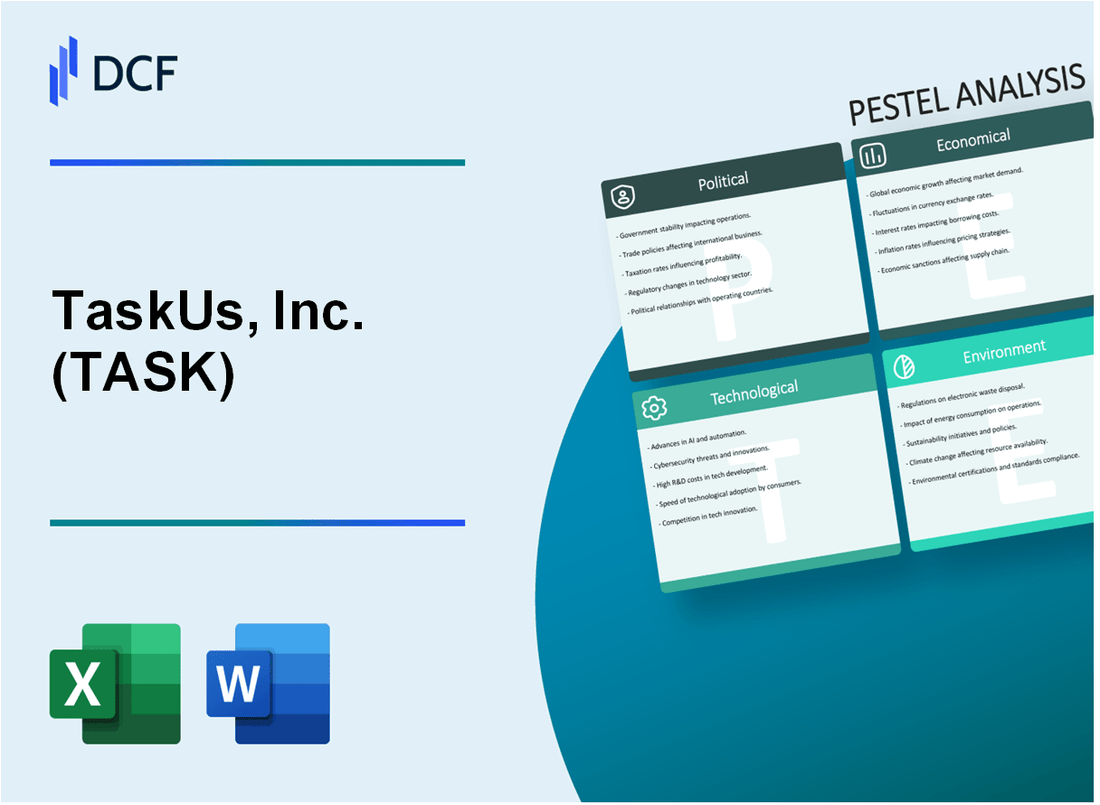
TaskUs, Inc. (TASK): PESTLE Analysis [Nov-2025 Updated] |
Fully Editable: Tailor To Your Needs In Excel Or Sheets
Professional Design: Trusted, Industry-Standard Templates
Investor-Approved Valuation Models
MAC/PC Compatible, Fully Unlocked
No Expertise Is Needed; Easy To Follow
TaskUs, Inc. (TASK) Bundle
You're trying to figure out where TaskUs, Inc. (TASK) is headed next, balancing their massive growth in AI Services-which was up over 50% year-over-year in Q3 2025-against real-world pressures like client concentration and global regulatory hurdles. This PESTLE breakdown gives you the hard facts on the political stability in their 13 operating countries, the economic tightrope walk with currency risk, and how their 63,800 teammates fit into the future of work. Dive in to see the clear actions you need to take based on these macro trends.
TaskUs, Inc. (TASK) - PESTLE Analysis: Political factors
Global operations across 12 countries face varied geopolitical stability risks.
TaskUs operates a geographically diverse model, which helps mitigate risk but also exposes the company to a complex web of political and regulatory environments. As of the first quarter ended March 31, 2025, the company had a worldwide headcount of approximately 61,400 people across 28 locations in 12 countries, including major hubs like the Philippines and India.
This global footprint means that political instability, civil unrest, or sudden changes in government policy in any one country can immediately disrupt operations and impact the company's ability to deliver services. The reliance on key outsourcing markets, where labor costs are lower, makes the business model particularly sensitive to geopolitical shifts. Honestly, a major political event in a core market could easily wipe out a quarter's worth of margin gains.
The risk is not just in service disruption; it also involves international trade relations and tariffs. TaskUs must navigate the regulatory landscape of each country to ensure compliance, which is a constant, resource-intensive task.
Changes in local labor laws could increase employee expenses in key markets like the Philippines and India.
A significant political risk for TaskUs is the continuous evolution of labor laws in its high-volume operational centers, which directly impacts the cost of its primary resource: its people. In the Philippines, a core market, the government has enacted changes in 2025 that will increase employee expenses. Specifically, a 12% increase in the daily minimum wage across Metro Manila was mandated, effective July 2025.
Also, the Social Security System (SSS) contribution rate increased from 14% to 15% starting January 1, 2025, which raises the employer's portion of social security costs. In India, the implementation of the new Labour Codes (Code on Wages, Code on Social Security, etc.) is a massive regulatory overhaul. These codes introduce a National Floor Wage and mandate overtime pay at double the normal wages, which will likely push up the overall compensation floor and increase operational costs across the country.
Here's the quick math on the Philippines' SSS change: an extra percentage point on contributions for tens of thousands of employees is a material, non-negotiable increase in the cost of labor. You have to factor these political decisions into your long-term margin forecasts.
| Key Labor Law Change (2025) | Country | Direct Financial Impact |
|---|---|---|
| Daily Minimum Wage Increase | Philippines (Metro Manila) | 12% increase, effective July 2025. |
| Social Security System (SSS) Contribution Rate | Philippines | Increased from 14% to 15% (employer contribution rises). |
| Overtime Wage Mandate | India (New Labour Codes) | Mandatory overtime pay at double the normal wages. |
| Maternity Leave Mandate | Philippines | Expanded to 105 days of fully paid leave, increasing employer liability. |
The terminated merger with Breeze Merger Corporation highlights the influence of stockholder and regulatory approval processes.
The proposed take-private transaction, where an affiliate of Blackstone Inc. and the co-founders sought to acquire the remaining public shares, was terminated on October 9, 2025, after failing to secure the necessary stockholder approval. This event is a powerful example of how political dynamics within a corporate structure-specifically the power of the public minority stockholders and the regulatory framework-can override the intentions of the majority owners.
The deal, announced on May 9, 2025, was valued at $1.62 billion and offered public stockholders $16.50 per share. The failure to secure the 'Majority of the Minority' vote, despite the Buyer Group's overwhelming voting control, demonstrates the critical role of independent stockholder sentiment and proxy advisory firm recommendations in US corporate governance. The company will now remain publicly traded on the Nasdaq.
Dual class stock structure and control by Blackstone Inc. affiliates introduce unique corporate governance dynamics.
TaskUs operates with a dual-class stock structure, which concentrates voting power in the hands of a few key entities, primarily affiliates of Blackstone Inc. and the co-founders. This structure creates a unique political dynamic where the public stockholders have limited influence over strategic decisions, even though they own a portion of the equity.
As of March 1, 2025, investment funds associated with Blackstone Inc. and the company's co-founders beneficially owned approximately 97.6% of the combined voting power of the Class A and Class B common stock. This level of control means that the company's long-term strategy, capital allocation, and executive leadership are defintely dictated by a small group of insiders, regardless of the public stock price performance.
The concentration of power is a double-edged sword:
- Opportunity: Allows for swift, long-term strategic decisions without the constant pressure of quarterly public market scrutiny.
- Risk: Creates a governance risk where the interests of the controlling shareholders (Blackstone and co-founders) may not perfectly align with those of the minority public shareholders, as evidenced by the failed take-private vote.
TaskUs, Inc. (TASK) - PESTLE Analysis: Economic factors
You're looking at the economic landscape for TaskUs, Inc. (TASK) as we head into the end of 2025. The top line looks solid, but we need to keep our eyes on a few key vulnerabilities that could shift the margins we've worked so hard to achieve.
Full Year 2025 revenue is projected to be strong, ranging from $1.173 billion to $1.175 billion
The guidance for the full fiscal year 2025 is definitely encouraging, projecting total revenue between $1.173 billion and $1.175 billion. This follows a strong third quarter where revenue hit $298.7 million, marking a 17.0% year-over-year growth. Honestly, that growth is being powered by specialized areas like AI Services, which saw over 50% growth for the third straight quarter.
To give you a clearer picture of the operational scale supporting this revenue, here are some key figures from the latest reports:
| Metric | Value (Q3 2025 or Year-End 2025 Guidance) | Context |
|---|---|---|
| Full Year 2025 Revenue Guidance (Midpoint) | $1.174 billion | Projection as of November 2025 earnings release. |
| Q3 2025 Total Revenue | $298.7 million | Represents a 17.0% year-over-year increase. |
| Nine Months Ended Sept 30, 2025 Revenue | $870.6 million | Reflects a 20.8% increase year-over-year for the period. |
| Projected Full Year Adjusted EBITDA Margin | Approximately 21.1% | Shows expected profitability discipline alongside growth. |
| Teammates as of Q3 2025 End | 63,800 | The global scale of the workforce supporting operations. |
The company is also projecting an Adjusted Free Cash Flow of approximately $100 million for the full year 2025. That's a healthy number, but it sits below the conversion rates seen earlier in the year, so watch that cash flow conversion closely.
A significant risk remains with client concentration, as the largest client accounted for 27% of Q3 2025 service revenue
Here's where we need to be careful. Despite the broad growth across service lines, revenue concentration remains a real concern. In the third quarter of 2025, the single largest client was responsible for 27% of total service revenue. That's up from 23% in the same quarter last year. If you're managing a portfolio, you know that kind of dependency is a single point of failure waiting to happen.
This concentration means that any sudden shift in that one client's strategy-say, an aggressive internal resourcing push or a major budget cut-hits TaskUs, Inc. revenue hard. It's a big lever that management doesn't fully control.
- Concentration at 27% in Q3 2025.
- Up from 23% year-over-year.
- Risk of sudden, large revenue drop.
- Requires active client diversification strategy.
The flip side is that the top 20 clients generated 68% of total revenue in Q3 2024, suggesting a slight improvement in the concentration of the very top client, but overall, reliance on the top tier is still very high.
Global delivery model exposes the company to foreign currency exchange rate fluctuations, which requires active hedging
Because TaskUs, Inc. operates globally, with major hubs in places like the Philippines and India, the value of the US Dollar against local currencies directly impacts reported earnings. When the dollar strengthens, revenue earned abroad translates to fewer dollars back home, which is a headwind. We saw this risk explicitly mentioned in prior filings, noting that changes in financial results are driven by this exposure.
To manage this, the company uses economic hedges, specifically foreign currency exchange rate forward contracts. This is standard practice for a global BPO, but it's not a perfect solution. If the currency moves unexpectedly outside the terms of the hedge, or if the hedging program isn't perfectly matched to the underlying exposure, you'll see volatility in the reported numbers. For example, Q3 2025 saw favorable foreign currency gains contributing to net income growth, but that can reverse quickly.
Client focus on cost optimization is driving demand for efficiency, pressuring traditional BPO pricing models
Clients are definitely in cost-cutting mode, even while spending on high-growth areas like AI Services. This creates a dual pressure on TaskUs, Inc. You're selling premium, specialized work, but the overall market sentiment still values lower cost. We saw evidence of this when the company undertook restructuring to manage support roles following cost optimization measures in Q2 2025.
The market is pushing back on traditional Business Process Outsourcing (BPO) pricing. To be fair, TaskUs, Inc. has historically fared better than pure-play, traditional providers because their premium, specialized offerings-like Trust + Safety and AI Services-sustain demand better than simple Tier 1 support, where automation is already causing pricing erosion. Still, the underlying expectation for efficiency gains is constant. You need to show that your value-add services, like proactive suggestions and ROI improvements, justify a rate that outpaces simple labor arbitrage. If onboarding takes 14+ days, churn risk rises because clients see that as inefficiency eating into their cost savings.
Finance: draft 13-week cash view by Friday
TaskUs, Inc. (TASK) - PESTLE Analysis: Social factors
You're managing a global service operation, and the people-your talent-are the entire product. Keeping that massive, distributed team engaged and productive is the single biggest social challenge for TaskUs, Inc. (TASK) right now, especially as the company scales past the 60,400 global teammate mark as of June 30, 2025.
The large, global workforce of 60,400 teammates requires consistent culture and retention strategies.
With a headcount nearing 60,400 people across 13 countries by mid-2025, maintaining a unified, high-performance culture is a massive undertaking. The sheer scale means that cultural drift is a real risk; what works in one region might not translate perfectly elsewhere. To combat this, TaskUs, Inc. (TASK) leans heavily on its stated 'People-First Culture,' which is clearly working, given the recent accolades.
The company's commitment to its people is validated by external recognition. TaskUs India, for example, was certified as a Great Place To Work® for 2025 and ranked No. 5 in the 2025 Top 10 Inspiring Workplaces in Asia. This suggests that, at least in key growth markets, the culture is resonating with the frontline staff.
Here are some key workforce metrics as of mid-2025:
| Metric | Value (as of mid-2025) | Source/Date Reference |
| Global Headcount | 60,400 teammates | June 30, 2025 |
| India Workforce Size | Over 15,000 teammates | Across 6 cities |
| India Female Management Representation | 27.7% of managers and above | October 2025 |
The company's 'People-First Culture' and extensive wellness programs are key differentiators in a high-attrition industry.
In the customer experience sector, attrition is the silent killer of margins. TaskUs, Inc. (TASK) uses its culture and wellness investment as a moat against this. They have an in-house Wellness & Resiliency (W+R) team dedicated to psychological health and safety programs. This isn't just abstract; they offer tangible support like 24/7 psychological health services.
The differentiator is the depth of care, like the 'Hope Beyond Life' program, which supports families of deceased employees with healthcare and scholarships. Also, in India, they offer the NextGen Scholarship of up to INR 25,000 for employees' children. These concrete benefits help reduce the industry-standard churn rate, which is a direct driver of profitability for you.
Continued expansion in India, now the second-largest base, leverages a deep, digitally-fluent talent pool.
India is not just a cost center; it's a strategic talent hub, now serving as TaskUs, Inc. (TASK)'s second-largest operational base. With operations in 6 cities, including the recent Noida site launch, the India team has grown to over 15,000 teammates. The appeal here is the high density of educated, multilingual talent, which is crucial for complex services like AI Operations and Trust & Safety.
The social alignment is strong: the local workforce is digitally native and culturally aligned with global brands, making training and integration smoother. For instance, TaskUs India was recognized with the 'Asia's Leading People-First Workplace Award' in October 2025, underscoring this successful integration.
Sustaining a robust partial work-from-home model impacts employee experience and real estate needs.
You need to know how much of that 60,400 headcount is remote. TaskUs, Inc. (TASK) champions its Work From Home (WFH) solution, Cirrus, which is designed to deliver services remotely while maintaining their culture and security standards. While the exact split isn't public in the latest filings, general 2025 trends show that flexibility is non-negotiable; surveys indicate many employees would leave a job without remote options.
The risk here is consistency. If onboarding or coaching for remote staff lags, performance dips. TaskUs, Inc. (TASK) mitigates this by investing in secure, cloud-based infrastructure for Cirrus. The challenge for you is ensuring that the real estate footprint-the physical offices in places like Gurugram and Mohali-is optimized for collaboration and training, not just baseline operations, as employees increasingly demand hybrid arrangements.
Finance: draft 13-week cash view by Friday
TaskUs, Inc. (TASK) - PESTLE Analysis: Technological factors
You're looking at the tech landscape for TaskUs, Inc. and it's clear that technology isn't just a support function; it's the main engine driving the business right now. The firm's entire narrative for 2025 hinges on its aggressive pivot toward artificial intelligence, specifically Agentic AI and Generative AI. This isn't just about using better software; it's about fundamentally changing the service delivery model. It's a smart, necessary bet, given the industry shift.
Heavy investment in Agentic AI and Generative AI is the core growth driver
TaskUs, Inc. is clearly putting its chips on AI as the primary driver for future revenue and margin expansion. This investment is operationalized through strategic initiatives, most notably the launch of its Agentic AI Consulting practice on February 27, 2025. This move signals a deeper commitment than just internal tool adoption; they are now selling the expertise to implement these complex systems for clients. CEO Bryce Maddock framed 2025 as the year for reimagining the business for the AI era, which tells you this is a top-down mandate, not a side project.
AI Services is the fastest-growing segment, showing year-over-year growth of over 50% in Q3 2025
The numbers back up the strategy. TaskUs, Inc.'s AI Services segment is exploding, marking its third consecutive quarter of massive growth in fiscal 2025. For the third quarter ending September 30, 2025, this segment saw year-over-year revenue growth of more than 50%, with some reports indicating growth exceeding 60%. To put that in perspective, the total company revenue grew by 17.0% year-over-year in that same quarter. Honestly, that gap shows where the future revenue mix is heading.
Here's a quick look at how the tech-driven segments stacked up in Q3 2025:
| Metric | Value (Q3 2025) | Context/Implication |
|---|---|---|
| AI Services YoY Growth | >50% (up to >60%) | Core growth engine, validating AI strategy. |
| Total Revenue YoY Growth | 17.0% | AI Services significantly outpaced overall growth. |
| Agentic AI Cost Reduction Potential | 25-50% | Direct impact on efficiency for specific tasks. |
| Teammates Worldwide (as of Q2 end) | Approx. 60,400 | Scale of human capital being augmented/shifted by AI. |
The new Agentic AI Consulting practice positions TaskUs as a strategic partner, not just a service vendor
Launching the Agentic AI Consulting practice is a deliberate move up the value chain. Instead of just providing human agents to execute tasks, TaskUs, Inc. is now selling the blueprint for AI transformation. They are using their deep workflow expertise to guide clients on where and how to deploy Agentic AI-systems that autonomously manage complex processes. This positions them as a strategic advisor, helping companies integrate these advanced technologies, which is a much stickier, higher-margin relationship than pure headcount outsourcing.
The practice focuses on several key areas:
- Customized AI strategies
- Deployment roadmaps by use case
- Platform configuration and integration
- AI agent testing and support
Automation is a double-edged sword, potentially cannibalizing some existing, repetitive service lines
To be fair, this technological shift presents an internal challenge. As TaskUs, Inc. successfully implements automation, especially Agentic AI, for its clients, the need for human agents on highly repetitive tasks will naturally decrease. Management acknowledged this by highlighting the expected cost reduction potential of 25-50% for customer support through Agentic AI partnerships. This is the double-edged sword: the efficiency gains are what clients pay for, but those gains directly reduce the volume of traditional, human-centric work.
What this estimate hides is the pace of transition. If onboarding for new, complex AI-driven projects takes longer than the revenue ramp-down from sunsetting old processes, margins could face near-term pressure. TaskUs is actively managing this by increasing investment in AI-driven transformation services, essentially trying to outpace the cannibalization with new, higher-value work.
Finance: draft 13-week cash view by Friday
TaskUs, Inc. (TASK) - PESTLE Analysis: Legal factors
You're navigating a minefield of global regulations, and for a company like TaskUs, that's the daily reality of doing business. The legal landscape is perhaps the most immediate external pressure point, especially given your Trust + Safety work.
Compliance with a patchwork of global data privacy regulations
Compliance with data privacy rules like GDPR in Europe and CCPA in California isn't optional; it's the cost of entry for handling sensitive client data across borders. TaskUs has to maintain rigorous controls, which is why they explicitly state they use data processing agreements to ensure all activities meet relevant laws. This is especially true when dealing with cross-border data transfers, where mechanisms like Standard Contractual Clauses are essential.
Here's what keeping the lights on legally requires:
- Maintain global Personal Data retention policy.
- Vet all third-party AI vendors for security.
- Ensure human review for AI decisions involving data.
- Adhere to strict intra-group data processing rules.
It's a constant audit, not a one-time fix.
Operating in regulated industries like financial services and healthcare
When you serve clients in sectors like financial services or healthcare, the compliance burden jumps significantly. These industries have specific mandates that flow down to you as the service provider. Your Trust + Safety segment, which saw revenue growth of 26.2% over the first nine months of fiscal 2025, often touches this sensitive data. This means your internal governance must be airtight to prevent regulatory missteps that could jeopardize those high-value contracts. Remember, TaskUs reported total revenues of $298.7 million in Q3 2025 alone, so maintaining access to these regulated revenue streams is paramount.
The risk of litigation exists from security disruptions or failure to protect client data
The threat of litigation from a data failure is real, and we saw a major example of this play out in 2025. The incident involving the bribed agents in India who leaked Coinbase customer data-affecting over 69,000 customers-resulted in a class action lawsuit against TaskUs for negligence. This event underscores that insider threats, which account for nearly 60% of data breaches according to the 2024 Verizon DBIR, are your biggest vulnerability. On the corporate side, you also settled a securities class action in February 2025 for $17.5 million.
Here's a quick look at the legal events that shaped the year:
| Legal Event Type | Date/Period Referenced | Value/Impact |
| Securities Class Action Settlement | February 2025 | $17.5 million cash settlement |
| Coinbase Data Breach Litigation | Filed in 2025 | Lawsuit filed over data leak of 69,000+ customers |
| Global Code of Conduct Update | Pre-2025 Filings | Reinforced anti-bribery compliance (FCPA, UK Bribery Act) |
One breach can cost more than a quarter's profit.
Adherence to local employment and labor laws is mandatory
You have teammates in over a dozen countries, including the Philippines, India, Mexico, and several in Europe. This means you are subject to a complex matrix of local employment and labor laws, from wage and hour rules to anti-discrimination statutes. For multijurisdictional employers like TaskUs, 2025 is seeing state and municipal bodies expand employee rights, like paid leave and pay transparency, which drives up compliance costs and litigation risk for non-compliant employers. Your Global Code of Conduct explicitly mandates compliance with all applicable labor laws across all operating jurisdictions.
Finance: draft 13-week cash view by Friday, specifically modeling potential increases in compliance overhead based on the 2025 labor law trend analysis.
TaskUs, Inc. (TASK) - PESTLE Analysis: Environmental factors
You're looking at how TaskUs, Inc. handles its environmental footprint, which is a smart move given how much scrutiny companies face now. For a BPO/IT firm, the physical impact is usually lower than manufacturing, but energy use and waste still matter to big clients. The good news is TaskUs is built on a 'light-asset approach,' meaning they don't own massive, water-intensive data centers or factories. This inherently minimizes their direct impact on water conservation areas, which they noted as immaterial in their 2024 ESG Update Report.
Energy Consumption and Renewable Commitments
The biggest environmental lever for TaskUs is energy, given their cloud-based operations. For the 2023 reporting period, their total energy consumed was 130,415 GJ, with 99% coming from grid electricity and 0% from renewable sources. That zero is about to change, defintely. TaskUs has a clear action item here: they entered into an updated Virtual Power Purchase Agreement (VPPA) intended to start in the fourth quarter of 2024. This is a big deal; it means they are now financially backing new renewable energy projects, which should start showing up as a higher percentage of renewable electricity consumption in their 2025 or 2026 reporting. For now, you should expect their Scope 2 emissions to remain largely tied to grid power for most of the 2025 fiscal year, but the commitment signals a major shift coming.
Workforce Model and Commute Emissions
The continued support for a partial work-from-home (WFH) model is a direct, measurable environmental benefit. By having teammates work remotely, TaskUs actively minimizes the Scope 3 emissions associated with daily employee commutes. This strategy also helps them grow their headcount-which stood at 60,400 teammates as of June 30, 2025-faster than they need to expand their physical facility footprint. It's a financial win that doubles as an environmental one. They also focus on minimizing travel across their global operations by pushing virtual meetings.
Waste Management and Site Initiatives
At their physical sites, the focus is on minimizing operational waste and reducing plastic use. While I don't have the 2025 waste tonnage data yet, their stated priorities are clear and actionable. They are actively working to limit single-use plastics and promote recycling and eco-friendly disposal methods. This is where you look for concrete, localized examples in their next report, such as a reduction in landfill waste tonnage or a specific percentage decrease in single-use plastic procurement across their 30 global locations.
Here's a snapshot of their 2023 energy baseline, which sets the stage for the 2025 VPPA impact:
| Metric | Value (2023) | Context/Action |
| Total Energy Consumed | 130,415 GJ | Baseline for energy efficiency efforts. |
| Percentage Grid Electricity | 99% | High reliance on grid power in 2023. |
| Percentage Renewable Energy | 0% | Expected to increase due to Q4 2024 VPPA start. |
| Water Stress Analysis | Not Conducted | Reflects light-asset model's low water intensity. |
The near-term risk is that the full benefit of the VPPA won't be reflected in 2025 numbers if the agreement only begins in Q4. The opportunity, however, is substantial: TaskUs is positioning itself to report a significant drop in its renewable energy percentage in the following year, which is what sophisticated investors are watching for.
Finance: draft 13-week cash view by Friday
Disclaimer
All information, articles, and product details provided on this website are for general informational and educational purposes only. We do not claim any ownership over, nor do we intend to infringe upon, any trademarks, copyrights, logos, brand names, or other intellectual property mentioned or depicted on this site. Such intellectual property remains the property of its respective owners, and any references here are made solely for identification or informational purposes, without implying any affiliation, endorsement, or partnership.
We make no representations or warranties, express or implied, regarding the accuracy, completeness, or suitability of any content or products presented. Nothing on this website should be construed as legal, tax, investment, financial, medical, or other professional advice. In addition, no part of this site—including articles or product references—constitutes a solicitation, recommendation, endorsement, advertisement, or offer to buy or sell any securities, franchises, or other financial instruments, particularly in jurisdictions where such activity would be unlawful.
All content is of a general nature and may not address the specific circumstances of any individual or entity. It is not a substitute for professional advice or services. Any actions you take based on the information provided here are strictly at your own risk. You accept full responsibility for any decisions or outcomes arising from your use of this website and agree to release us from any liability in connection with your use of, or reliance upon, the content or products found herein.