

|
TRACON Pharmaceuticals, Inc. (TCON): PESTLE Analysis [Nov-2025 Updated] |
Fully Editable: Tailor To Your Needs In Excel Or Sheets
Professional Design: Trusted, Industry-Standard Templates
Investor-Approved Valuation Models
MAC/PC Compatible, Fully Unlocked
No Expertise Is Needed; Easy To Follow
TRACON Pharmaceuticals, Inc. (TCON) Bundle
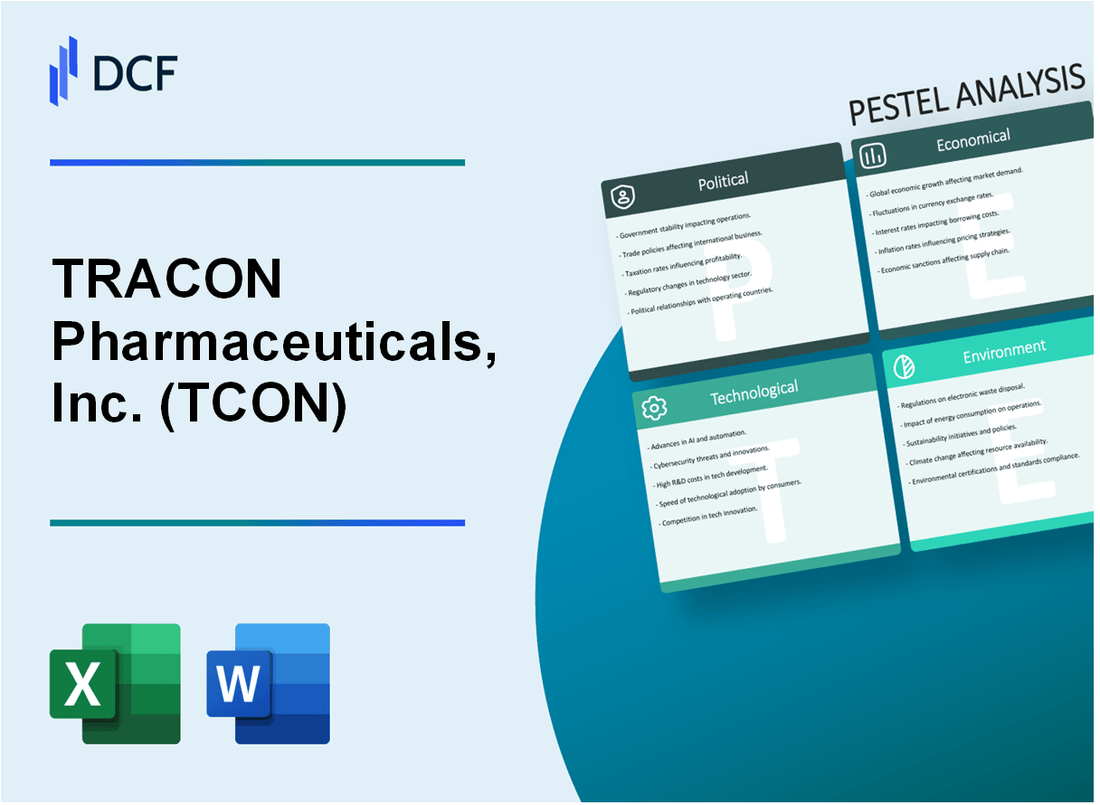
You're looking for a clear, actionable breakdown of the external forces shaping TRACON Pharmaceuticals, Inc. (TCON). As a clinical-stage oncology company, TCON's fate is tightly linked to regulatory shifts, funding access, and scientific breakthroughs. Here is the PESTLE analysis mapping those near-term risks and opportunities.
For a company like TRACON Pharmaceuticals, Inc., navigating the 2025 landscape means balancing clinical-stage execution against a brutal financing environment. Your biggest immediate risk isn't a failed trial, but a cash crunch fueled by high interest rates and tightening venture capital. We're seeing a critical need for non-dilutive capital, especially with the 2025 estimated revenue sitting at a low $1.19 million. This analysis cuts through the noise to show you exactly where TCON is exposed and where the strategic opportunities lie.
Political Factors: Regulatory Headwinds and Pricing Pressure
The political climate is a major headwind for any biotech relying on the U.S. Food and Drug Administration (FDA). Increased FDA scrutiny on accelerated approvals remains a 2025 priority. This means TCON's pathway for its lead assets, like envafolimab, faces a higher bar for confirmatory data and post-marketing requirements. Plus, the US government's focus on drug pricing legislation risks future revenue models, even for small-cap oncology firms. You have to anticipate a lower ceiling on future therapy pricing.
On the flip side, there is a potential upside: tax incentives for small-cap biotech Research & Development (R&D) could offer a defintely needed boost to offset the burn rate. Geopolitical tensions, though, continue to affect global clinical trial site access and supply chains, which adds cost and time to development timelines.
Economic Factors: The Cash Runway is Critical
This is where the rubber meets the road. High interest rates make securing non-dilutive debt financing expensive, forcing a greater reliance on the public markets, which are currently punishing clinical-stage companies. Biotech venture capital funding is tightening globally, which is a massive headwind. TCON's cash runway is critical; a failure to raise capital could force a halt in trials, which is the ultimate value destroyer.
Here's the quick math: with the Q2 2024 net loss at around $-3 million, and the 2025 revenue estimated at only $1.19 million, the company's existing cash position (which was $\sim\$8$ million in Q1 2024) demands aggressive, non-dilutive financing. Global economic slowdown impacts payer willingness to adopt new, high-cost therapies, so even if a drug is approved, market access is not guaranteed. The only way out is to execute on the Product Development Platform (PDP) licensing strategy.
Sociological Factors: Patient Demand and Public Scrutiny
The social environment presents both a clear opportunity and a public relations risk. Growing patient advocacy for rare and orphan diseases drives research focus and can accelerate trial enrollment, which is a net positive for TCON's oncology pipeline. Demand for personalized medicine and targeted oncology therapies is rising, aligning perfectly with TCON's mission to develop targeted therapeutics.
However, increased public skepticism about pharmaceutical profits pressures pricing, forcing companies to be more transparent about R&D costs. Physician and patient acceptance of novel trial designs, like basket trials (a design where multiple tumor types are tested with a single drug based on a shared genetic mutation), is key to speeding up development and cutting costs. You need to win over the clinicians first.
Technological Factors: AI and Trial Efficiency
Technology is your biggest lever for efficiency. Advancements in biomarker identification (measurable indicators of a biological state) speed up patient selection for trials, dramatically reducing the time and cost to reach statistical significance. TCON can use Artificial Intelligence (AI) to optimize clinical trial design, which is essential when quarterly R&D expenses are around $1.4 million.
What this estimate hides is the competitive threat: competitors' novel drug delivery systems could make TCON's pipeline less competitive if they offer a better patient experience or efficacy profile. Also, data security and cloud infrastructure spending must scale with the massive volume of clinical trial data being generated, creating a non-trivial CapEx requirement.
Legal Factors: IP and Regulatory Compliance
The legal landscape is a minefield of constant threats. Patent expiration and intellectual property (IP) litigation risks are constant, especially for a small company defending its assets against larger players. Stringent compliance with global data privacy laws, like the European Union's General Data Protection Regulation (GDPR), is mandatory and expensive, especially as TCON conducts international trials.
The FDA's evolving guidance on clinical trial endpoints requires constant adaptation, forcing you to potentially amend protocols mid-study. Finally, potential liability from adverse events in ongoing Phase 2 trials, such as the ENVASARC pivotal trial, requires strong insurance and meticulous risk management. You simply cannot afford a major legal misstep.
Environmental Factors: ESG and Supply Chain
Environmental, Social, and Governance (ESG) is no longer optional; increased investor focus on ESG mandates reporting, which means you need to show your work on sustainability. For a biologics company, supply chain logistics for temperature-sensitive products require robust cold chain management (a temperature-controlled supply chain), which is a high-cost operational necessity.
Waste disposal regulations for laboratory and clinical materials are getting stricter, adding to compliance costs. Sustainability in manufacturing processes is becoming a factor in partner selection, meaning future licensing or co-development deals will favor partners who can demonstrate a lower environmental footprint. This is a quiet but growing due diligence item for big pharma.
Next Step: Finance and Corporate Development: Draft a 12-month non-dilutive capital generation plan (PDP licensing, grants) by the end of the quarter, assuming zero equity funding.
TRACON Pharmaceuticals, Inc. (TCON) - PESTLE Analysis: Political factors
Increased FDA scrutiny on accelerated approvals remains a 2025 priority.
The regulatory environment for oncology drugs, which is TRACON Pharmaceuticals' focus, is defintely getting tougher. The U.S. Food and Drug Administration (FDA) is under pressure to tighten the reins on its Accelerated Approval pathway, especially after high-profile withdrawals like Biogen and Eisai's Aduhelm.
In January 2025, new draft guidance from the FDA signaled a critical shift. The agency now requires that confirmatory trials be 'underway' before granting an accelerated approval, which forces companies to commit substantial resources earlier in the development cycle. This is a major hurdle for small-cap biotechs, as it demands more capital upfront without guaranteed market access. You need to have enrollment initiated and sufficient resources committed to ensure the trial's completion.
Adding to the complexity, the FDA is now considering drug affordability as a factor in its new National Priority Voucher program, a novel dynamic that injects pricing scrutiny into the traditionally scientific review process. This means the political pressure on drug costs is now influencing the regulatory gatekeepers.
US government focus on drug pricing legislation risks future revenue models.
The focus of the U.S. government on drug pricing, driven by the Inflation Reduction Act (IRA) and new administration policies, presents a clear and present risk to future revenue models. The IRA grants the Centers for Medicare & Medicaid Services (CMS) the power to negotiate prices, which fundamentally alters the commercial landscape.
A significant issue for small-molecule developers is the IRA's 'pill penalty,' which gives small-molecule drugs only 9 years of market exclusivity before price setting, versus 13 years for large molecules (biologics). This reduces the return on investment for small-molecule programs. In January 2025, CMS released a list of the next 15 drugs selected for price setting, and all of them were small molecules, underscoring this risk.
Also, the Trump administration's 'Most-Favored-Nation' (MFN) policy, introduced in May 2025, seeks to cap Medicare drug prices at the lowest prices paid in other high-income countries, adding a layer of uncertainty that investors are watching closely.
Geopolitical tensions affect global clinical trial site access and supply chains.
Geopolitical instability is no longer an abstract risk; it's a direct operational and financial headwind. For a company running clinical trials, this means increased costs and delays due to disruptions in global supply chains and site access.
The imposition of new U.S. tariffs in 2025 is a major concern. Tariffs on pharmaceutical imports, including potential rates soaring up to 200% on certain goods, directly increase the cost of Active Pharmaceutical Ingredients (APIs). Up to 82% of API 'building blocks' for vital drugs come from China and India, making the industry highly vulnerable to trade disputes and tariffs.
You need to diversify your supply chain now. The ongoing Red Sea crisis, for example, has forced companies to reroute shipments, adding days or weeks to delivery timelines and raising freight costs.
| Geopolitical Risk Factor (2025) | Specific Impact on Biotech Operations | Quantifiable Data/Risk |
|---|---|---|
| U.S. Import Tariffs | Increased cost of Active Pharmaceutical Ingredients (APIs) and raw materials. | Tariffs of up to 200% on pharmaceutical imports; 82% of API building blocks from high-risk regions (China/India). |
| Global Conflict/Instability (e.g., Red Sea) | Disruption of global shipping routes and logistics for clinical trial supplies. | Adds days or weeks to delivery timelines; increases freight costs. |
| Clinical Trial Site Access | Inability of monitors to visit sites and general site fatigue in unstable regions. | Requires operational flexibility and diversification of patient populations. |
Tax incentives for small-cap biotech R&D could offer a defintely needed boost.
On the opportunity side, the U.S. government is providing tangible relief for R&D-focused companies. The One Big Beautiful Bill (OBBB), signed in July 2025, reversed the 2022 mandate to amortize R&D expenses. This is huge: you can now fully deduct domestic R&D expenses in the year they are incurred, starting with the 2025 tax year. Here's the quick math: a full deduction is a direct boost to cash flow compared to spreading the deduction over five years.
Small biotechs can still leverage the federal R&D tax credit to offset payroll taxes, which is critical for pre-revenue companies. The limit was increased by the Inflation Reduction Act to up to $500,000 annually, provided you have less than $5 million in gross receipts. This is real runway for hiring. Plus, as an oncology developer, you may qualify for the Orphan Drug Tax Credit, which offers a maximum credit of 25% of the amount spent on qualified clinical trials for rare diseases.
Key R&D Tax Incentives for 2025:
- Full deduction of domestic R&D expenses in the current year.
- Payroll tax offset of up to $500,000 annually for startups.
- Orphan Drug Tax Credit of up to 25% of qualified clinical trial costs.
Finance: Analyze the impact of the full R&D expensing rule on the 2025 projected tax liability and cash flow by Friday.
TRACON Pharmaceuticals, Inc. (TCON) - PESTLE Analysis: Economic factors
High interest rates make securing non-dilutive debt financing expensive.
The prevailing high-interest-rate environment in the 2025 fiscal year made securing non-dilutive debt financing-like a venture debt facility-prohibitively expensive for a micro-cap clinical-stage company like TRACON Pharmaceuticals. As of November 2025, the U.S. Bank Prime Loan Rate stood at 7.00%, a rate that dramatically increases the cost of capital for companies with no revenue. Even with the Federal Reserve lowering the target range for the federal funds rate to 3.75% to 4.00% in October 2025, the cost of commercial borrowing remains elevated. This economic reality forced the company to rely almost entirely on highly dilutive equity raises or non-dilutive strategic transactions, a difficult position given its clinical setbacks.
Here's the quick math on the cost of capital pressure:
- Debt Cost: A high prime rate means non-dilutive loans carry steep interest payments, straining an already fragile cash position.
- Equity Cost: The low stock price, with a market capitalization of only $109.725 thousand as of October 15, 2025, means any equity raise would require issuing a massive number of shares, leading to severe shareholder dilution.
Biotech venture capital funding is tightening, increasing reliance on public markets.
The broader biotech funding landscape in 2025 was marked by a 'flight to quality,' meaning investors prioritized clinical-stage assets in high-impact areas, putting immense pressure on smaller companies like TRACON Pharmaceuticals. While the third quarter of 2025 showed signs of a recovery, with total venture financing deal value growing 70.9% to $3.1 billion over Q2 2025, the overall environment remained selective. The second quarter of 2025 saw a significant tightening, with overall venture funding for biotechs falling to $4.8 billion, tied for a three-year low. This tightening VC environment meant TRACON, a publicly traded company, was essentially cut off from private funding and had to rely on a public market that had already beaten down its stock.
The market's focus on clinical-stage assets with high potential is clear:
- Q2 2025 First Financings: Fell to just $900 million (down from $2.6 billion in Q1 2025).
- Investor Focus: Clinical-stage projects and AI-driven drug discovery are prioritized over high-risk preclinical assets.
TCON's cash runway is critical; a failure to raise capital could force a halt in trials.
TRACON Pharmaceuticals' financial reality in 2025 was the ultimate consequence of its inability to secure capital. The company's cash, cash equivalents, and restricted cash stood at only $8.0 million as of March 31, 2024, with management projecting the runway would only extend 'into late Q3 2024.' The failure of the ENVASARC pivotal trial in mid-2024, which did not meet the required objective response rate, immediately eliminated the primary value driver and any realistic path to a large, non-dilutive partnership or public equity raise. This economic and clinical failure directly led to the company's announcement in July 2024 that it would wind down its operations and explore strategic alternatives.
| Metric | Value (as of March 31, 2024) | Implication for 2025 |
|---|---|---|
| Cash, Cash Equivalents, and Restricted Cash | $8.0 million | Extremely limited capital base for a clinical biotech. |
| Projected Cash Runway | Into late Q3 2024 | Forced the wind-down of operations in July 2024. |
| Market Capitalization | $109.725 thousand (Oct 15, 2025) | Reflects near-total loss of shareholder value and inability to raise capital. |
Global economic slowdown impacts payer willingness to adopt new, high-cost therapies.
While the company's clinical failure meant it never reached the commercial stage, the underlying global economic pressure still factored into its strategic demise. A global economic slowdown, even a moderate one, puts pressure on healthcare systems and payers (like insurance companies and government programs) to scrutinize the cost-effectiveness of new, high-cost oncology therapies. This commercial risk is always factored into a biotech's valuation. The high-risk, high-cost nature of the oncology space, coupled with a challenging macroeconomic environment, meant that the commercial bar for a successful drug like envafolimab was already set extremely high. The failure to meet the clinical endpoint, in an economy where payers are already tightening their belts, sealed the fate of the program and the company's ongoing viability. The market simply won't fund a high-risk asset when the eventual commercial environment is also hostile.
TRACON Pharmaceuticals, Inc. (TCON) - PESTLE Analysis: Social factors
You're looking at the social landscape for a company like TRACON Pharmaceuticals, Inc., and the core takeaway is this: the market demand for their focus area-targeted oncology and rare diseases-is exploding, but it comes with a massive, politically charged bullseye on pricing. The social forces are a double-edged sword of high patient need and intense public scrutiny.
To be fair, TRACON's decision to wind down operations, announced in July 2024, wasn't a failure of market demand, but a failure to execute against it. Still, the social trends below define the high-risk, high-reward environment that ultimately consumed their capital, which stood at only $8 million in cash reserves as of Q1 2024, against a 2024 net loss of $19.8 million. Here's the quick math on the social pressures they faced.
Growing patient advocacy for rare and orphan diseases drives research focus.
Patient advocacy groups are no longer passive recipients of care; they are active, organized drivers of drug development. This is a huge tailwind for any company, like TRACON, that had Orphan Drug Designation (ODD) for its product candidates, such as envafolimab for soft tissue sarcoma. The Orphan Drug Act incentivizes this work for diseases affecting fewer than 200,000 people in the U.S..
This patient-led revolution creates a clear mandate for biopharma: engage early, or fail to enroll. Patient-led registries are now helping to reduce the time to an accurate diagnosis, which currently averages about 7.6 years for a rare disease. You simply cannot run a trial efficiently in this space without patient organization partnership. This is a defintely a high-leverage area for small biotechs.
Increased public skepticism about pharmaceutical profits pressures pricing.
The social contract between pharma and the public is strained, primarily over the cost of new treatments. For a company focused on rare diseases, this is a critical risk, as their products fall into the high-cost specialty drug category. In 2025, branded drug acquisition costs are expected to increase by an average of 7%, continuing a multi-year trend.
Specialty drugs, which include most rare disease and targeted oncology treatments, are projected to represent a staggering 60% of total drug spending by the end of 2025. This concentration of cost fuels the public and political pressure. The median annual list price for new medicines surveyed in 2024 was over $370,000, which sets a high bar for perceived value that TRACON's pipeline would have needed to clear to justify its price tag.
Demand for personalized medicine and targeted oncology therapies is rising.
The shift from a one-size-fits-all approach to precision medicine is a dominant social and medical trend. TRACON's focus on targeted therapeutics for cancer aligns perfectly with this demand. The U.S. Precision Medicine Market is a massive and growing opportunity, projected to be worth $45.36 billion in 2025.
Within this market, oncology is the largest segment, accounting for a 42.36% market share in 2025, with Targeted Therapy holding the largest share of the product type segment at 45.72% in 2025. This shows where the patient and physician demand is concentrated. The market is demanding molecularly-driven solutions, not broad-spectrum chemotherapy.
| U.S. Precision Medicine Market Breakdown (2025 Fiscal Year) | Market Value/Share | Implication for Targeted Oncology |
|---|---|---|
| Total U.S. Market Size (Estimated) | $45.36 billion | Confirms massive commercial opportunity for targeted therapies. |
| Oncology Share of Market | 42.36% | Highest application segment, validating TRACON's primary focus. |
| Targeted Therapy Share (by Product Type) | 45.72% | Dominant therapeutic modality in precision medicine. |
| Specialty Drugs Share of Total Drug Spending | Projected 60% | Indicates high-cost, high-value, and high-scrutiny product category. |
Physician and patient acceptance of novel trial designs (like basket trials) is key.
The social and medical community's acceptance of innovative clinical trial designs, such as basket trials, is crucial for companies developing targeted therapies. A basket trial tests one drug on multiple cancer types that share a specific molecular alteration (a biomarker), regardless of where the tumor originated. This is a more efficient way to find patients for rare mutations.
The success of landmark studies like the NCI-MATCH trial and the ASCO TAPUR trial has normalized this approach, making it easier for physicians to enroll patients and for patients to accept the design. This acceptance is a direct enabler of faster development for targeted drugs like TRACON's former candidates, as it streamlines the process of finding the small, specific patient populations required.
- Embrace basket trials: Speeds up enrollment for rare genetic alterations.
- Focus on biomarkers: Shifts treatment decision from organ to molecular profile.
- Gain regulatory confidence: FDA has approved drugs based on basket trial data.
The next concrete step is for any interested party to review the disposition of TRACON Pharmaceuticals' intellectual property and Product Development Platform (PDP) assets to see if the underlying science can still capture a slice of the $45.36 billion U.S. precision medicine market. Owner: Business Development Team.
TRACON Pharmaceuticals, Inc. (TCON) - PESTLE Analysis: Technological factors
You are looking at the technological landscape for TRACON Pharmaceuticals, Inc. (TCON) during its 2025 fiscal year, and the direct takeaway is that the rapid, capital-intensive pace of modern biotech technology-specifically in AI and precision medicine-created an insurmountable cost and efficiency gap for the company, contributing to the decision to dissolve in late 2024. The technological advances that should have been opportunities became existential threats because of the massive investment required.
Advancements in biomarker identification speed up patient selection for trials.
The entire oncology space is shifting to biomarker-driven precision medicine, and TCON's ability to compete was tied to this. Faster biomarker identification (a biological signal that indicates disease or drug response) is now non-negotiable for trial success. For TCON, this pressure was acute, especially considering the termination of the ENVASARC trial after the objective response rate (ORR) fell short of the required 11%. The industry standard is moving toward advanced genomic and proteomic screening to enrich patient populations. For example, at the 2025 ASCO meeting, new data showed how AI-assisted diagnostics raised HER2 scoring accuracy in breast cancer from 89.1% to 96.1%, which drastically improves the chances of selecting the right patients for a targeted therapy. TCON, with its limited Research and Development (R&D) budget-which was $13.5 million in 2024, a figure dwarfed by large-cap pharma-simply could not afford to build or license the necessary technological infrastructure to keep up with this standard.
Use of Artificial Intelligence (AI) to optimize clinical trial design reduces costs.
The use of Artificial Intelligence (AI) for clinical trial optimization is now a primary driver of cost reduction and speed across the industry. AI can predict patient outcomes, identify optimal trial sites, and even create digital twins (virtual control groups) to reduce the number of human participants needed. This technology is cutting the time and cost of drug development for competitors. For instance, an AI tool for patient screening in heart failure trials achieved an accuracy of 97.9% to 100% and lowered the cost to as little as $0.11 per patient.
TCON's core strategy was to use a cost-efficient, Clinical Research Organization (CRO)-independent Product Development Platform (PDP). While licensing this PDP generated $3.0 million in revenue in late 2023, its internal capabilities were not enough to match the efficiency gains of competitors who were heavily investing in third-party AI platforms. The company's projected revenue for 2025 was only $1.19 million USD, which makes any significant AI investment impossible. You can't out-innovate the biggest players with a fraction of their budget.
Competitors' novel drug delivery systems could make TCON's pipeline less competitive.
The competitive threat from novel drug delivery systems (DDS) is substantial. TCON's pipeline includes envafolimab, a PD-L1 single-domain antibody given by rapid subcutaneous injection. While subcutaneous delivery is an improvement over intravenous, the broader market is rapidly advancing into next-generation DDS like targeted nanomedicine and precision particle technology. The global pharmaceutical drug delivery market was valued at $1558.72 million in 2024 and is forecast to expand at a Compound Annual Growth Rate (CAGR) of 4.75% through 2035.
Competitors are leveraging these technologies to improve drug efficacy, reduce side effects, and enhance patient compliance. This is a major headwind for TCON's existing and future pipeline, as a superior molecule delivered via a dated system will struggle to gain market share. This competitive pressure is particularly visible in the oncology space, where companies like Clovis Oncology, Corvus, and Arcus are TCON's primary competitors.
- Threat: Nanomedicine allows for targeted delivery, reducing systemic toxicity.
- Threat: Precision particle technology (like Orbis Biosciences' Unison™) enables uniform, controlled-release profiles.
- Impact: TCON's subcutaneous injection, while convenient, is quickly becoming the baseline, not a competitive advantage.
Data security and cloud infrastructure spending must scale with trial data volume.
The sheer volume of data generated by modern clinical trials-from Electronic Health Records (EHRs) and genomic sequencing to real-time data from wearable devices-is measured in terabytes daily. This necessitates a massive, secure, and scalable cloud infrastructure. For TCON, a small company with only 17 employees in 2024, this scaling requirement was a defintely a major financial and operational burden. The industry is clear: data privacy and cybersecurity are paramount and must be addressed in tandem with leveraging big data.
TCON's cash position was only $7.6 million in 2024, making the necessary investment in enterprise-level cloud security and infrastructure-which can easily run into the millions annually for a company managing Phase 2 and pivotal trials-unsustainable. The risk of a data breach, which would carry enormous regulatory and financial penalties, was a non-starter. This technological requirement represented a fixed cost floor that TCON could not meet, forcing a strategic retreat.
| Technological Factor | Industry Trend/2025 Metric | TCON's Risk/Opportunity |
|---|---|---|
| Biomarker ID & Precision Medicine | AI-assisted HER2 scoring accuracy up to 96.1%. | Risk: Failure to adopt leads to lower trial success rates (e.g., ENVASARC trial failure) and uncompetitive drug profiles. |
| AI in Clinical Trial Optimization | AI patient screening cost as low as $0.11 per patient; 97.9% to 100% accuracy. | Risk: Competitors gain massive cost and speed advantage. TCON's PDP platform cannot match this efficiency without major investment. |
| Novel Drug Delivery Systems (DDS) | Global DDS market CAGR of 4.75% (2025-2035); Focus on nanomedicine and controlled release. | Risk: TCON's existing subcutaneous delivery becomes technologically inferior, limiting market potential against advanced competitors. |
| Data Security & Cloud Infrastructure | Terabytes of data generated daily; High regulatory and security compliance costs. | Risk: Unaffordable capital expenditure given $7.6 million cash in 2024; High risk of regulatory non-compliance or breach. |
Finance: draft a clear post-dissolution asset monetization plan for the remaining PDP technology by Friday.
TRACON Pharmaceuticals, Inc. (TCON) - PESTLE Analysis: Legal factors
The legal landscape for TRACON Pharmaceuticals, Inc. in the 2025 fiscal year is dominated by the legal requirements and liabilities associated with its planned dissolution and liquidation, which was approved by the board on July 30, 2024. The company's legal focus has pivoted entirely from commercial defense to statutory compliance and liability management during the wind-down.
Patent expiration and intellectual property (IP) litigation risks are constant threats.
For a dissolving biotech, the IP risk shifts from defending market exclusivity to managing asset disposition and contract termination. TRACON's primary asset, North American rights to envafolimab, was in-licensed from Jiangsu Alphamab Biopharmaceuticals and 3D Medicines in 2019. The failure of the Phase 2 ENVASARC trial triggered a contractual provision where the rights to envafolimab will likely revert back to the licensors, effectively extinguishing TRACON's most valuable IP asset.
The company is attempting to leverage its proprietary Product Development Platform (PDP) as a final asset for sale or licensing to bolster the liquidation proceeds. This platform, which claims a fully burdened cost of less than $100,000 per patient for clinical trials, is the remaining IP value proposition. The legal risk here is a failure to successfully monetize this PDP before the final dissolution, turning a potential asset into a worthless one for shareholders.
Stringent compliance with global data privacy laws (e.g., GDPR) is mandatory.
Even in dissolution, the legal obligation to protect sensitive patient data from the terminated clinical trials remains absolute. Compliance with global data privacy laws, including the European Union's General Data Protection Regulation (GDPR) and the U.S. Health Insurance Portability and Accountability Act (HIPAA), is mandatory for the secure transfer or destruction of clinical trial data.
The company must ensure the compliant closure of the ENVASARC trial (NCT04480502), which involved over 120 sites across the U.S. and Europe. Failure to properly de-identify, transfer, or destroy this data could result in significant fines, with GDPR penalties reaching up to €20 million or 4% of global annual turnover, whichever is higher. This is a major contingent liability that must be addressed in the liquidation reserve.
FDA's evolving guidance on clinical trial endpoints requires constant adaptation.
The risk from 'evolving guidance' has been replaced by the immediate legal and regulatory cost of formally withdrawing a failed drug. The Phase 2 ENVASARC trial was terminated because the objective response rate (ORR) by blinded independent central review (BICR) was only 5% (four responders) in 82 patients, falling short of the required 11% primary endpoint to support a Biologics License Application (BLA).
The core legal action in 2025 is the formal closure of the Investigational New Drug (IND) application with the Food and Drug Administration (FDA). This process requires meticulous regulatory filing to ensure all patient safety data is accounted for and the trial is closed compliantly. Any misstep here could lead to regulatory sanctions and complicate the final wind-down.
Potential liability from adverse events in ongoing Phase 2 trials requires strong insurance.
This is the most critical near-term legal liability. Under the Plan of Dissolution, TRACON is legally required to establish a statutory reserve to cover all known and contingent liabilities, including potential product liability claims from clinical trial participants who may have experienced adverse events during the envafolimab trial.
As of June 30, 2024, the company's cash and equivalents totaled approximately $6.27 million, while total current liabilities were approximately $9.89 million. The reserve must be established from these remaining assets. The legal team must secure 'tail' insurance (extended reporting period coverage) to cover claims that may arise years after the trial's official closure. Failure to adequately fund this reserve could expose the company's directors and officers to personal liability and block the final liquidating distribution to shareholders.
Here's the quick math on the liquidity position versus liabilities:
| Metric (as of June 30, 2024) | Amount (in Millions USD) | Legal Implication |
|---|---|---|
| Cash & Equivalents | $6.27 | Primary source for funding the statutory reserve. |
| Total Current Liabilities | $9.89 | Exceeds cash, indicating a net deficit for immediate obligations. |
| Accrued Expenses | $6.94 | Includes costs for trial close-out and legal/admin fees for dissolution. |
What this estimate hides is the final, non-accrued contingent liability amount for potential lawsuits, which is a major unknown risk in the dissolution process.
TRACON Pharmaceuticals, Inc. (TCON) - PESTLE Analysis: Environmental factors
Increased investor focus on Environmental, Social, and Governance (ESG) mandates reporting.
You might think a clinical-stage biopharma with a market capitalization of only $243 thousand (as of late 2024) can ignore Environmental, Social, and Governance (ESG) reporting, but you'd be wrong. While TRACON Pharmaceuticals, with its trailing twelve-month (TTM) revenue of only $3.2 million (as of June 2024) and a small team, is not subject to the mandatory reporting thresholds-which typically start at >$1 billion in annual sales-the investor sentiment still matters. It's not about formal compliance; it's about attracting capital.
Here's the quick math: large institutional investors, like the ones that fund BlackRock's mandates, are increasingly using ESG data to screen their entire universe, even small-cap stocks. TRACON's overall ESG score is estimated at 68/100, with the Environmental component at 66/100. This score is a real-world proxy for the environmental risks perceived by the market, and it acts as a soft barrier to entry for many ESG-focused funds. You're defintely judged by the same metrics as the big players.
The Environmental score is a direct reflection of a small company's lack of formal disclosure and measurable targets, which creates an information vacuum for risk-averse investors.
| ESG Component (Estimated Score) | Score (Out of 100) | Implication for TCON |
|---|---|---|
| Environment | 66 | Reflects lack of public data on carbon footprint, energy use, and waste programs. |
| Social | 65 | Indicates risk in areas like employee health/safety and diversity, especially during a wind-down. |
| Governance | 72 | Highest score, but still reflects challenges of a small, financially distressed public company. |
Supply chain logistics for temperature-sensitive biologics require robust cold chain management.
The core of TRACON's pipeline, which includes the PD-L1 single-domain antibody envafolimab, are biologics-and biologics are fragile. These products require strict cold chain management, often maintaining a temperature range of 2°C to 8°C from the manufacturing site to the clinical trial site. This isn't just a logistics problem; it's a massive operational cost and risk.
The global biopharmaceutical cold chain market is projected to exceed US$65 billion in 2025, reflecting the high cost of specialized packaging, real-time Internet of Things (IoT) temperature monitoring, and validated transport. For a company with TRACON's limited cash reserves, every temperature excursion-a shipment falling outside the approved range-translates directly into a complete loss of high-value drug product, potentially derailing a clinical trial. Studies estimate that around 20% of temperature-sensitive healthcare products are damaged during distribution due to poor cold chain management, a risk TRACON cannot afford to take.
- Validate: Use qualified shippers for all temperature-sensitive materials.
- Monitor: Implement real-time temperature tracking for compliance evidence.
- Risk: A single batch loss can cost millions and delay regulatory filings.
Waste disposal regulations for laboratory and clinical materials are getting stricter.
The cost and complexity of disposing of laboratory and clinical waste-sharps, contaminated materials, and unused drug product-is escalating in 2025. The key driver is the full implementation of the U.S. Environmental Protection Agency's (EPA) 40 CFR Part 266 Subpart P, the Management Standards for Hazardous Waste Pharmaceuticals. This rule, being adopted and enforced by many states in 2025, forces a complete overhaul of waste protocols.
The most impactful change for a biopharma company is the nationwide ban on the sewering (flushing down the drain) of all hazardous waste pharmaceuticals. This means all unused or expired drug candidates, like the clinical trial materials for TRC102 or TRC253, must be meticulously tracked, segregated, and disposed of via incineration at a specialized hazardous waste facility, a costly process. This regulatory tightening adds a non-trivial compliance burden and cost to general and administrative (G&A) expenses, which were already $1.4 million in Q1 2024 for TRACON.
Sustainability in manufacturing processes is becoming a factor in partner selection.
Even though TRACON is a virtual company, relying on Contract Manufacturing Organizations (CMOs) and Contract Research Organizations (CROs), the environmental footprint of its partners is now its own. Large CMOs face intense pressure from their biggest clients-companies like Johnson & Johnson, which is targeting 100% renewable energy across all manufacturing sites by 2025. This pressure cascades down.
When TRACON sought a partner for manufacturing its bispecific antibodies, the partner's sustainability profile became a silent, non-negotiable factor. A CMO with a high carbon footprint or poor waste record presents a reputational risk to TRACON and, more practically, could lead to higher manufacturing costs as the partner invests in greener processes. The industry is moving toward 'green chemistry' principles to reduce solvent use and waste generation by the source, and if your partner isn't doing that, you'll pay a premium or struggle to find a reliable, compliant partner. This is a supply chain issue disguised as an environmental one.
Next Step: Finance/Operations: Conduct a final, comprehensive audit of all remaining clinical and lab waste inventory by the end of the year, classifying it under the new EPA Subpart P rules to ensure compliant disposal before final wind-down.
Disclaimer
All information, articles, and product details provided on this website are for general informational and educational purposes only. We do not claim any ownership over, nor do we intend to infringe upon, any trademarks, copyrights, logos, brand names, or other intellectual property mentioned or depicted on this site. Such intellectual property remains the property of its respective owners, and any references here are made solely for identification or informational purposes, without implying any affiliation, endorsement, or partnership.
We make no representations or warranties, express or implied, regarding the accuracy, completeness, or suitability of any content or products presented. Nothing on this website should be construed as legal, tax, investment, financial, medical, or other professional advice. In addition, no part of this site—including articles or product references—constitutes a solicitation, recommendation, endorsement, advertisement, or offer to buy or sell any securities, franchises, or other financial instruments, particularly in jurisdictions where such activity would be unlawful.
All content is of a general nature and may not address the specific circumstances of any individual or entity. It is not a substitute for professional advice or services. Any actions you take based on the information provided here are strictly at your own risk. You accept full responsibility for any decisions or outcomes arising from your use of this website and agree to release us from any liability in connection with your use of, or reliance upon, the content or products found herein.