

|
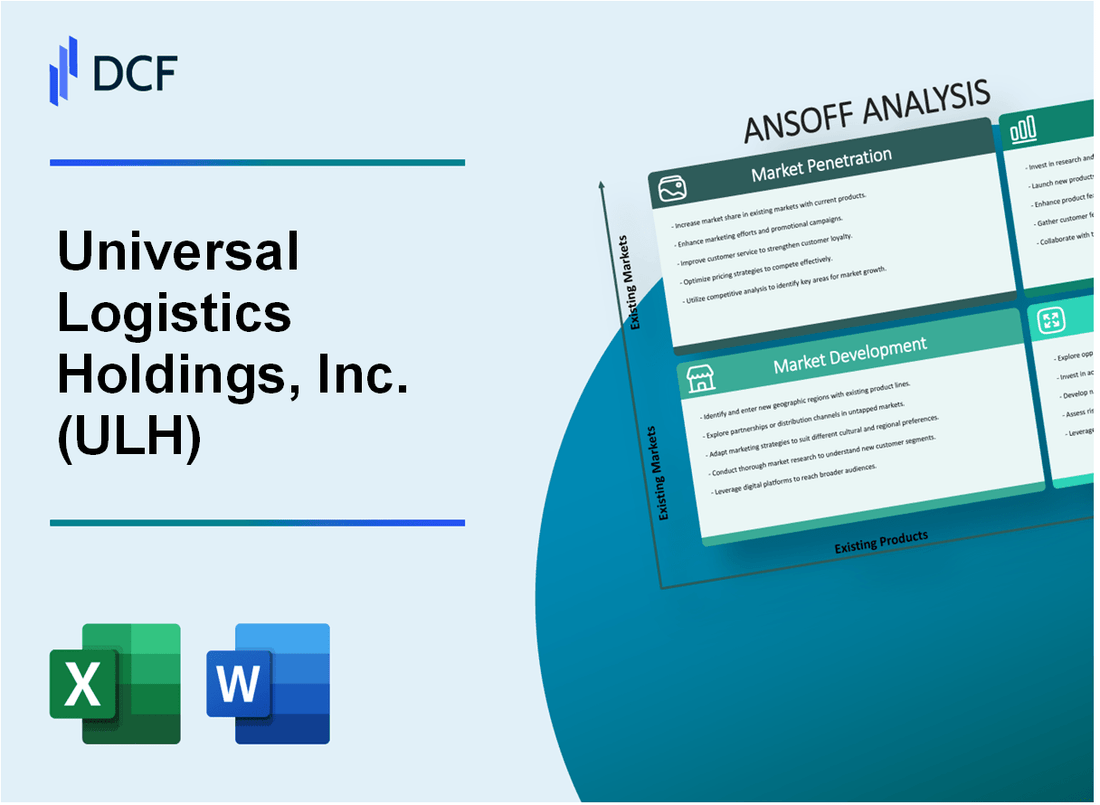
Universal Logistics Holdings, Inc. (ULH): ANSOFF MATRIX [Dec-2025 Updated] |
Fully Editable: Tailor To Your Needs In Excel Or Sheets
Professional Design: Trusted, Industry-Standard Templates
Investor-Approved Valuation Models
MAC/PC Compatible, Fully Unlocked
No Expertise Is Needed; Easy To Follow
Universal Logistics Holdings, Inc. (ULH) Bundle
You're looking at the next few years for Universal Logistics Holdings, Inc. (ULH) and need a clear map, not just vague goals. After two decades analyzing logistics plays, including my time leading the team at BlackRock, I find the Ansoff Matrix is the cleanest way to cut through the noise and show you exactly where the near-term risk and reward lie for Universal Logistics Holdings, Inc. (ULH). We're not just talking theory; we're looking at concrete actions, like boosting Midwest truckload utilization by a specific 5% or using 10% volume discounts to lock in key customers. Honestly, this framework lays out the safest bets versus the big swings-from deepening existing market share to exploring new product lines like guaranteed-capacity freight. Dive in below to see the four-quadrant strategy that will define Universal Logistics Holdings, Inc. (ULH)'s trajectory.
Universal Logistics Holdings, Inc. (ULH) - Ansoff Matrix: Market Penetration
You're looking at how Universal Logistics Holdings, Inc. (ULH) can squeeze more revenue out of its existing markets and customer base, which is the core of Market Penetration. Given the challenging freight backdrop reported through the third quarter of 2025, maximizing current asset efficiency is key.
For the third quarter of 2025, total operating revenues for Universal Logistics Holdings, Inc. were $396.8 million, against a prior year comparable of $426.8 million. The Contract Logistics segment, which houses dedicated services, brought in $264.4 million in operating revenues for Q3 2025, up from $245.2 million in Q3 2024, showing some success in that area despite overall softness. The Trucking segment, however, saw Q3 2025 operating revenues drop to $67.7 million from $87.0 million year-over-year.
Focusing on the dedicated fleet, which supports value-added services, the average number of tractors used in the comparable period (likely the Trucking segment or overall fleet data provided) decreased from 755 in Q3 2024 to 594 in Q3 2025. To achieve the goal of increasing utilization by 5% in the Midwest, management needs to ensure the remaining 594 tractors are running at higher daily or weekly capacity factors. The historical dedicated fleet profile mentioned 800 tractors, so the current active count is below that benchmark.
Here's a look at the segment performance data relevant to current market penetration efforts:
| Metric (Q3 2025 vs Q3 2024) | Contract Logistics | Intermodal | Trucking |
|---|---|---|---|
| Operating Revenues (in thousands) | $264,390 vs $245,194 | $64,679 vs $77,632 | $67,700 vs $87,000 |
| Operating Margin (%) | 5.2% vs 18.6% | (Loss) vs Operating Loss | 5.8% vs 8.2% |
| Loads Handled | 29,731 vs 36,909 | 29,731 (Implied) vs 36,909 (Implied) | 89,804 vs 119,220 |
To boost volume discounts for intermodal services, you should note that sales to the top 10 customers accounted for 56% of revenue in 2024, indicating a high degree of customer concentration that makes a 10% volume discount offer highly impactful on a concentrated revenue base. The Intermodal segment's Q3 2025 revenue was $64.7 million.
Expanding cross-selling of value-added logistics services to current truckload clients directly ties into growing the Contract Logistics segment. The company managed 87 active value-added programs at the end of the second quarter of 2025, up from 68 programs at the end of the second quarter of 2024. This represents a year-over-year increase of 19 programs, or about 27.9% growth in the number of value-added service touchpoints.
Strategies for deepening market penetration include:
- Increase dedicated truckload fleet utilization by 5% in the Midwest.
- Offer 10% volume discounts to top 20 existing customers for intermodal services.
- Expand cross-selling of value-added logistics services to current truckload clients.
- Aggressively bid on competitor contracts in the automotive and steel sectors.
- Implement a driver retention bonus program to reduce turnover and improve service defintely.
The focus on the automotive sector is critical, as softness in automotive production expectations was cited as a reason for lowering the full-year 2025 revenue guidance to between $1.7 billion and $1.8 billion. The Contract Logistics segment, which includes dedicated services, saw its Q3 2025 operating revenues increase 7.8% year-over-year to $264.4 million, partly due to the recent acquisition of Parsec, which contributed $50.2 million in Q3 2025 revenue.
The company declared a quarterly dividend of $0.105 per share in Q3 2025. Finance: draft 13-week cash view by Friday.
Universal Logistics Holdings, Inc. (ULH) - Ansoff Matrix: Market Development
Market Development for Universal Logistics Holdings, Inc. (ULH) centers on taking existing truckload, intermodal, and contract logistics services into new geographic areas or new customer segments. This strategy is critical when existing markets show softness, as seen in ULH's Q3 2025 consolidated operating revenues of $396.8 million, which followed a Q2 revenue of $393.8 million.
Target the rapidly growing nearshoring manufacturing hubs in Northern Mexico with existing U.S. truckload services.
The push into Northern Mexico leverages the established cross-border trade flow, where Mexico overtook China as the largest exporter to the United States in 2023. This region is seeing robust investment, with Chinese greenfield Foreign Direct Investment (FDI) peaking at $5.6 billion in 2023. To support this, ULH can deploy its existing U.S. truckload capacity to handle the final leg of cross-border moves. Mexico's nominal hourly manufacturing wage of $3.80 USD remains highly competitive against China's rate exceeding $7.50 USD, making the logistics proposition attractive for manufacturers establishing new operations.
The Texas freight and logistics market, a primary gateway, is estimated at $139.19 billion in 2025. Capturing cross-border truckload volume here directly supports this growth, especially as Texas supplied 42.7% of U.S. crude and 29.3% of marketed gas year-to-date through Q3 2025, indicating strong industrial activity.
Establish a sales presence in the Pacific Northwest to capture new port-to-door intermodal freight.
Expanding sales efforts to the Pacific Northwest targets the growing intermodal segment, which is projected to reach a market size of $67.62 billion in 2025. This move aims to secure Inland Point Intermodal (IPI) volumes, which saw a 40% increase in one major railroad's network in the first half of the year. Currently, domestic intermodal accounts for about 6% of the truckload freight moving 500 miles or more, a share ULH can aim to increase by offering reliable port-to-door service using existing rail partnerships. This contrasts with ULH's Q2 2025 intermodal segment, which posted an operating loss of $(5.7) million, suggesting new, high-volume lanes are necessary for segment recovery.
Partner with a major e-commerce retailer to handle final-mile delivery in the Southeast U.S.
Entering the final-mile space in the Southeast taps into a high-growth consumer segment. The U.S. last mile delivery market is projected to grow at a Compound Annual Growth Rate (CAGR) of 7.5% from 2024 to 2030. Over 40% of American consumers prioritize fast and reliable delivery, making a partnership with a major retailer essential for volume. This new market focus would utilize ULH's existing Contract Logistics capabilities, which management reaffirmed is expected to book over $1.1 billion in revenue in 2025. The segment posted a 9.3% operating margin in Q1 2025, showing strong underlying profitability that can be exported to this new service area.
The potential scale is significant:
- Global last mile market expected to reach $176.99 billion in 2025.
- ULH's current sales pipeline visibility is reported as a growing $1 billion.
- The Southeast offers dense population clusters for final-mile density.
- This leverages ULH's value-added services, which grew from 71 to 87 programs year-over-year (as of Q1 2025).
Acquire a small regional carrier to gain immediate access to the Texas oil and gas logistics market.
Acquisition provides instant scale in the specialized Texas energy sector. The Oil and Gas Logistics Market is set to grow by $5.06 billion at a CAGR of 5.4% from 2024 to 2029, with North America driving 40% of that growth. This market includes specialized needs like pipeline, rail, and tanker transport. Gaining immediate access via acquisition bypasses the slow organic build-out, allowing ULH to immediately target the high-value logistics supporting Texas production, which supplied 29.3% of U.S. marketed gas year-to-date through Q3 2025.
Leverage existing rail partnerships to offer new coast-to-coast intermodal lanes.
This strategy uses existing assets to expand service lanes, a pure Market Development play within the existing intermodal segment. The overall intermodal freight transportation market is projected to reach $67.62 billion in 2025. By establishing new coast-to-coast lanes, ULH can better compete on service consistency and cost savings-two core advantages of intermodal over long-haul truckload. This directly addresses the underperformance in ULH's intermodal segment, which recorded an operating loss of $(10.7) million in Q1 2025. Successfully shifting volume onto these new lanes would improve the overall operating margin, which was 5.1% in Q2 2025, and support the full-year revenue guidance of $1.6 billion to $1.7 billion.
Key financial metrics related to ULH's current operations:
| Metric (2025 YTD) | Value | Context/Segment |
| Quarterly Dividend Declared | $0.105 per share | Shareholder Return |
| Q3 Adjusted EBITDA | $43.3 million | Q3 2025 Performance |
| Q1 Operating Margin | 4.1% | Consolidated Q1 2025 |
| FY 2025 Capex (Equipment Guidance) | $100 million to $125 million | Investment for Growth |
| Trucking Segment Margin (Q2 2025) | 5.2% | Existing Segment Performance |
Universal Logistics Holdings, Inc. (ULH) - Ansoff Matrix: Product Development
You're looking at how Universal Logistics Holdings, Inc. (ULH) can grow by introducing new services, which is the Product Development quadrant of the Ansoff Matrix. Given that Q3 2025 operating revenues were $396.8 million, but the company posted a net loss of $(74.8) million, new, higher-margin offerings are key, especially since the Contract Logistics segment's operating margin was only 5.2% in Q3 2025, down from 18.6% the prior year.
Here's a look at the potential scale and financial context for these new product lines.
- Introduce a premium, guaranteed-capacity expedited freight service for high-value, time-sensitive cargo.
- Develop a proprietary supply chain visibility platform with real-time tracking and predictive analytics.
- Invest in electric vehicle (EV) fleet pilot programs for short-haul drayage operations near ports.
- Offer specialized warehousing and fulfillment services for cold chain logistics.
- Create a managed transportation service (MTS) for shippers with complex, multi-modal needs.
The market potential for these new products shows significant, fast-growing segments.
| Proposed Service Area | 2025 Market Size/Value | Projected CAGR (Next Decade) | Relevant ULH Context |
| Premium Expedited Freight | Expedited rates are 2x to 5x standard ground freight | Express Delivery Market: 6.4% (to 2030) | Trucking segment Q3 2025 Revenue: $67.7 million |
| Supply Chain Visibility Platform | $3.1 billion (Software Market) | 13.0% (to 2035) | Advanced analytics users see 15-20% cost savings |
| EV Fleet Pilot (Drayage) | Electric Drayage Truck Market: $1.45 billion (Global 2024) | 28.7% (Drayage EV to 2033) | 61% of road tractors operate within 100 miles |
| Specialized Cold Chain Warehousing | $361.37 billion (Global Logistics Market) | 6.38% (to 2030) | Refrigerated warehouse segment share: 65.5% through 2035 |
| Managed Transportation Service (MTS) | $15.4 billion (Global Market 2025) | 18.3% (to 2029) | U.S. TMS Market: $6,388.7 million by 2030 |
Focusing on the visibility platform, leveraging real-time data could directly impact the current performance gaps. For instance, the overall Q3 2025 Adjusted EBITDA margin was 10.9%, down from 18.0% one year prior.
For the EV pilot in drayage, the capital investment needs context against current spending. Capital expenditures totaled $54.5 million in Q3 2025, while outstanding debt stood at $827.0 million at the end of that quarter. Ports in California, Georgia, Florida, Louisiana, and New Jersey received $150 million in federal funds in April to support this transition.
The cold chain offering targets a segment where the pharmaceutical sub-sector is valued at $6.7 billion in 2025. This contrasts with ULH's Q3 2025 total operating revenues of $396.8 million.
The Managed Transportation Service (MTS) market is expected to grow from $13.03 billion in 2024 to $15.4 billion in 2025. This growth is fueled by demand for real-time visibility and scalable solutions, areas where a proprietary platform could integrate well.
The premium guaranteed service targets the high-value end of the market, where rates are significantly higher than standard. For context, the new NMFTA freight reclassification should lead to more precise cost assessments and tiered services, such as premium versus economy expedited.
- Real-time analytics integration can minimize disruptions by 30% or more.
- IoT in the supply chain market is expected to reach $35 billion by 2025.
- The global blockchain market in the supply chain sector is expected to reach $9.8 billion by 2025.
Finance: draft 13-week cash view by Friday.
Universal Logistics Holdings, Inc. (ULH) - Ansoff Matrix: Diversification
You're looking at how Universal Logistics Holdings, Inc. (ULH) might push beyond its core, established segments-intermodal, trucking, and contract logistics-into entirely new revenue streams. This diversification is a classic Ansoff Matrix move, aiming for new markets with new offerings, which is inherently riskier but offers the highest potential reward.
The current financial backdrop for ULH shows the need for new growth engines. For the third quarter of 2025, consolidated operating revenues were $396.8 million, resulting in a reported net loss of $(74.8) million, which included non-cash impairment charges totaling $81.2 million related to the intermodal segment. As of September 27, 2025, the company held cash and cash equivalents of $27.4 million against outstanding debt of $827.0 million. Capital expenditures for the nine months leading up to that date totaled $54.5 million. This financial structure suggests any new venture needs careful capital allocation.
Here are the five strategic avenues for diversification:
Launch a new business unit focused on providing industrial packaging and kitting services near major manufacturing plants.
This move targets a value-added service adjacent to existing manufacturing customers, leveraging proximity to their plants. The global Kitting and Assembly Packaging Services Market reached $9.36 billion in 2025 and is forecast to grow at a 7.10% CAGR, reaching a projected value of $13.19 billion by 2030. North America captured 34.58% of the market share in 2024. If ULH targets the electronics sector within this space, that specific end-user industry is projected to grow at a 9.05% CAGR between 2025-2030.
- Kitting and Assembly Market Size (2025): $9.36 billion.
- Projected Market Size (2030): $13.19 billion.
- North America 2024 Market Share: 34.58%.
Acquire a technology firm specializing in autonomous vehicle logistics software for future fleet integration.
This is a forward-looking play on technology adoption within the company's own asset base, particularly the trucking segment, which saw revenues of $67.7 million in Q3 2025. The Global Autonomous Freight & Logistics Market was valued at $53.45 billion in 2024 and is expected to reach $185.14 billion by 2032, growing at a 16.80% CAGR during the forecast period 2025-2032. Specifically, the Autonomous Driving Software Market was valued at $2.02 billion in 2024 and is predicted to surpass around $7.24 billion by 2034.
Enter the European market by acquiring a small, specialized air freight forwarding company.
This establishes a new geographic footprint outside of ULH's current primary focus in the US, Mexico, Canada, and Colombia. The Europe freight forwarding market generated a revenue of $61,848.7 million in 2024 and is expected to grow at a 5.9% CAGR through 2030. Within this, air freight forwarding is set to grow at a 3.38% CAGR between 2025-2030, making it a specific, high-growth niche for entry.
| European Freight Forwarding Metric | Value (2024/2025) | Forecasted Value/Rate |
| Total Market Revenue (2024) | $61,848.7 million | N/A |
| Projected Market Revenue (2030) | N/A | $86,619.6 million |
| Air Freight Forwarding CAGR (2025-2030) | N/A | 3.38% |
Develop a real estate investment trust (REIT) focused on acquiring and managing industrial warehouse properties.
This shifts capital into a real asset class that directly supports logistics operations, potentially providing stable, inflation-hedged returns. In mid-2025, STAG Industrial, a diversified industrial REIT, owned more than 600 buildings exceeding 118 million square feet of space. For prime Class A assets in early 2025, cap rates ranged from 4.5% to 6.5%, with the average industrial cap rate sitting at 6.29%, down 13 basis points from a year ago.
Offer consulting services to mid-market shippers on supply chain network optimization and design.
This leverages ULH's operational expertise into a high-margin, low-asset service line. The global Supply Chain Strategy and Operations Consulting Market was valued at $28.52 billion in 2025 and is projected to reach $106.49 billion by 2033, exhibiting a 17.9% CAGR. Around 64% of organizations are actively investing in supply chain consulting to improve agility. Finance: draft 13-week cash view by Friday.
Disclaimer
All information, articles, and product details provided on this website are for general informational and educational purposes only. We do not claim any ownership over, nor do we intend to infringe upon, any trademarks, copyrights, logos, brand names, or other intellectual property mentioned or depicted on this site. Such intellectual property remains the property of its respective owners, and any references here are made solely for identification or informational purposes, without implying any affiliation, endorsement, or partnership.
We make no representations or warranties, express or implied, regarding the accuracy, completeness, or suitability of any content or products presented. Nothing on this website should be construed as legal, tax, investment, financial, medical, or other professional advice. In addition, no part of this site—including articles or product references—constitutes a solicitation, recommendation, endorsement, advertisement, or offer to buy or sell any securities, franchises, or other financial instruments, particularly in jurisdictions where such activity would be unlawful.
All content is of a general nature and may not address the specific circumstances of any individual or entity. It is not a substitute for professional advice or services. Any actions you take based on the information provided here are strictly at your own risk. You accept full responsibility for any decisions or outcomes arising from your use of this website and agree to release us from any liability in connection with your use of, or reliance upon, the content or products found herein.