

|
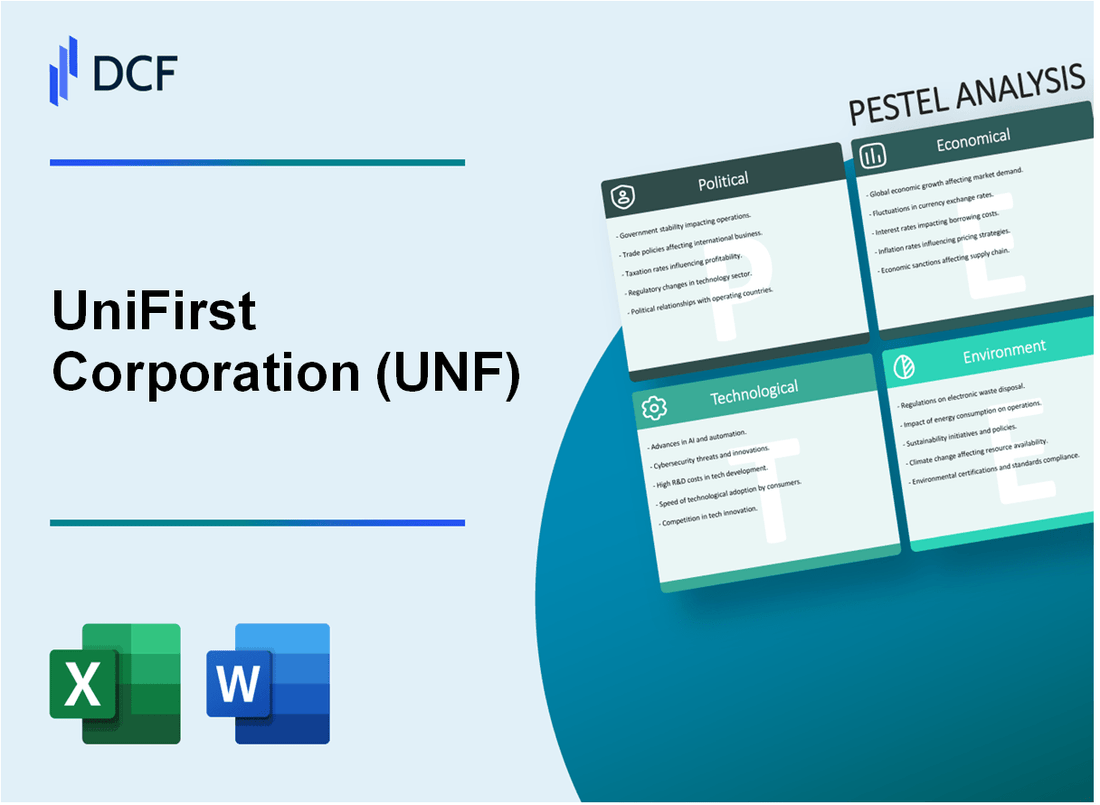
UniFirst Corporation (UNF): PESTLE Analysis [Nov-2025 Updated] |
Fully Editable: Tailor To Your Needs In Excel Or Sheets
Professional Design: Trusted, Industry-Standard Templates
Investor-Approved Valuation Models
MAC/PC Compatible, Fully Unlocked
No Expertise Is Needed; Easy To Follow
UniFirst Corporation (UNF) Bundle
You're smart to look closely at UniFirst Corporation (UNF) right now. While their core uniform and facility services business offers defensive stability-backed by a strong balance sheet with $209.2 million cash and fiscal 2025 revenues of $2.432 billion-the external environment is defintely complicated. We see a clear tension: activist investor pressure for a sale is high, but the company's major $6.8 million investment in new CRM/ERP systems is still not paying off, plus they face rising compliance costs in a soft manufacturing economy. This PESTLE breakdown maps the real political, economic, and technological forces you need to understand to assess UNF's near-term trajectory.
UniFirst Corporation (UNF) - PESTLE Analysis: Political factors
The political landscape for UniFirst Corporation right now is dominated less by Washington, D.C. legislation and more by boardroom warfare and global supply chain risk. The immediate political pressure is internal, driven by a highly public activist investor push for a sale, but the external risks from trade policy and global conflict are defintely mounting.
Activist investor Engine Capital (3.2% stake) is publicly pushing for a sale
The biggest political fire for UniFirst is coming from within its shareholder base. Activist investor Engine Capital, holding an approximately 3.2% stake in the company, went public with an open letter on November 25, 2025, demanding the Board of Directors pursue a sale. They argue the company has no realistic path to achieve the valuation a strategic buyer could pay.
This isn't just noise; it's a full-blown proxy contest. Engine Capital has nominated two director candidates and filed a preliminary proxy statement with the SEC to solicit shareholder votes. This action places immense political pressure on the long-standing Croatti family control structure, forcing a public debate on the company's future strategy and leadership effectiveness.
Board governance pressure is high after rejecting a premium Cintas offer earlier in 2025
Engine Capital's core argument hinges on the Board's unanimous rejection of a cash-rich, unsolicited acquisition proposal from rival Cintas Corporation in January 2025. The offer was for $275.00 per share for all outstanding common and Class B shares, which implied a total enterprise value of approximately $5.3 billion. Here's the quick math: the offer represented a significant 46% premium to UniFirst's ninety-day average closing price as of January 6, 2025. Rejecting a premium offer that large creates a fiduciary risk spotlight on the Board, especially the Croatti family trustees, and is the primary source of the current governance pressure.
The political fallout from this decision means the Board must now deliver a standalone performance that justifies a valuation substantially higher than $275.00 per share, or face continued shareholder revolts and potential legal challenges.
| Factor | Metric/Value | Source of Political Pressure |
|---|---|---|
| Activist Stake | 3.2% (Engine Capital) | Proxy fight for board seats, public call for sale. |
| Rejected Acquisition Price | $275.00 per share (Cintas) | Shareholder dissatisfaction over foregone premium. |
| Implied Deal Value | Approx. $5.3 billion | High bar set for standalone value creation. |
| FY2025 Revenue Guidance | $2.422 billion to $2.432 billion | Vulnerable to external political/economic factors (e.g., currency). |
US trade policies and tariffs on imported goods create volatility for merchandise costs
UniFirst operates a global supply chain, manufacturing uniforms in places like Mexico and Nicaragua, and importing goods for its North American operations. This makes the company highly sensitive to US trade policies and tariffs (taxes on imported goods). Honestly, trade policy is a near-term cost risk.
Management noted in its Q4 2025 earnings call that newly imposed tariffs had not had a significant impact on results through the end of fiscal 2025. What this estimate hides is the lag effect; the full impact of higher-cost inventory is expected to hit the cost of goods sold in the latter half of fiscal 2026 as that inventory cycles through the distribution network. This creates a political risk for the company's future guidance, as any tariff escalation would immediately increase the cost of merchandise, pressuring gross margins.
Geopolitical conflicts (e.g., Middle East, Ukraine) introduce global economic uncertainty
The current state of global affairs, specifically the conflicts in the Middle East and the war in Ukraine, introduces a layer of political uncertainty that translates directly into economic risk for UniFirst. These conflicts drive volatility in energy prices and create general global economic instability, which can depress demand from UniFirst's core industrial and commercial customer base.
The company explicitly cites these geopolitical conflicts in its fiscal 2025 risk factors, noting the potential for disruption to its supply chain and operations, particularly in its principal garment manufacturing plants located in Mexico and Nicaragua. Plus, even a non-military political factor like foreign exchange rate fluctuations impacted the 2025 revenue outlook, with the negative effect of the Canadian Dollar exchange rate cited as a factor in the full-year revenue guidance of $2.422 billion to $2.432 billion.
- Monitor energy price volatility due to Middle East/Ukraine conflicts.
- Assess political stability risk at manufacturing sites in Mexico and Nicaragua.
- Factor in foreign currency risk; the Canadian Dollar's drop already hit FY2025 revenue expectations.
UniFirst Corporation (UNF) - PESTLE Analysis: Economic factors
The economic environment in fiscal 2025 presented UniFirst Corporation with a challenging mix of slow customer-base growth and persistent cost pressures, despite the company's strong balance sheet. Your core takeaway here is that while UniFirst is financially solid, the macro economy is capping its top-line expansion.
Fiscal 2025 consolidated revenues were $2.432 billion, showing slow growth of only 0.2%.
UniFirst's total consolidated revenues for the fiscal year ending August 30, 2025, reached $2.432 billion. This figure represents a very modest year-over-year increase of only 0.2%. To be fair, this comparison is skewed because fiscal 2024 included an extra week of operations; when you adjust for that, the growth rate was a more respectable 2.1%. Still, that low headline number reflects a fundamentally sluggish economic backdrop that limits new customer acquisition and organic expansion.
Here's the quick math on the key financial performance for the year:
| Metric (Fiscal Year 2025) | Amount | YoY Change (Reported) |
|---|---|---|
| Consolidated Revenues | $2.432 billion | 0.2% |
| Net Income | $148.3 million | +1.9% |
| Operating Income | $184.5 million | +0.5% |
A soft US employment environment and manufacturing sector challenges limit new customer growth.
The company's primary market, the US industrial and service sectors, is showing signs of softness, which directly impacts the demand for new uniform and facility services. UniFirst's growth is tied to the number of people employed by its customers.
The US unemployment rate, for example, rose to 4.4% in September 2025, the highest level since late 2021. Plus, the manufacturing sector, a key segment for UniFirst, is clearly slowing down. The S&P Global Flash US Manufacturing Purchasing Managers' Index (PMI) dropped to 51.9 in November 2025, a four-month low. A PMI above 50 signals expansion, but the drop and weakening new order growth suggest a soft patch for factory production, which means fewer new uniforms are needed.
- Unemployment rate hit 4.4% in September 2025.
- Manufacturing PMI fell to 51.9 in November 2025.
- Job gains are projected to slow to 30,800 per month in Q4 2025.
Slower hiring means fewer new accounts for the Uniform & Facility Service Solutions segment. That's a defintely headwind for top-line acceleration.
Elevated inflation and interest rates increase operating costs and capital expenditure financing.
While the Federal Reserve has started to cut rates, the cost of doing business remains high. The Federal Funds Rate was lowered to a target range of 3.75%-4.00% in October 2025, still a significant cost for any new capital expenditure (CapEx) financing. UniFirst needs to invest heavily in its digital transformation (Key Initiatives) and fleet, and higher rates make that CapEx more expensive.
Also, inflation is still an issue. The US Consumer Price Index (CPI) was at 3.0% in September 2025, which is above the Fed's long-term target. This elevated inflation translates directly into higher operating expenses for UniFirst, particularly in:
- Input Costs: Manufacturers, UniFirst's suppliers, reported input costs rising at one of the fastest rates in three years in November 2025.
- Labor: Wage inflation remains a factor in a tight-but-soft labor market.
- Energy/Fuel: Higher energy prices directly impact the cost of running a large service fleet.
The company maintains a strong balance sheet with $209.2 million cash and no long-term debt as of August 30, 2025.
Despite the macro headwinds, UniFirst's financial structure provides a significant competitive advantage. As of August 30, 2025, the company reported having $209.2 million in cash, cash equivalents, and short-term investments. Crucially, the company operates with no long-term debt outstanding. This is a massive strength.
This debt-free position means the company is insulated from the rising interest rate environment and has maximum flexibility to fund its strategic investments-like the $6.8 million expensed on its CRM/ERP Key Initiatives in fiscal 2025-without taking on new financing risk. You have a war chest for acquisitions or to weather a deeper recession. The next step is for management to clearly articulate how that $209.2 million in cash will be deployed to accelerate organic growth in fiscal 2026.
UniFirst Corporation (UNF) - PESTLE Analysis: Social factors
You're looking at UniFirst Corporation's social environment, and the primary takeaway is that a tight labor market is directly hitting the bottom line, even as the company capitalizes on a niche, high-value segment like nuclear garment services. The sheer scale of their customer base-over 300,000 locations-is a massive stabilizer, but the cost of keeping their 16,000-plus Team Partners engaged is rising.
Labor market tightness impacts the ability to hire and retain the over 16,000 employee 'Team Partners.'
The competition for talent, especially in logistics and production roles, is a clear financial headwind. We see this pressure reflected not just in higher payroll costs, but in specific, non-core expenses. For example, in the third quarter of fiscal 2025, UniFirst incurred approximately $5.7 million in strategic advisory and legal costs attributed to employee matters, plus higher healthcare claims expense. This isn't just a cost of doing business; it's the cost of managing a stressed labor force and competitive environment. You can't ignore a $5.7 million expense that's directly tied to employee issues in a single quarter. The company has to keep investing in its 'Team Partners' because high employee turnover is a killer for service-based businesses.
Strong focus on workplace safety and inclusion, highlighted in the 2024 ESG Report.
UniFirst understands that a strong social foundation (the 'S' in ESG) is crucial for retention and operational efficiency. The company's Fiscal Year 2024 Environmental, Social, and Governance (ESG) Report, published in January 2025, explicitly highlights its commitment to 'enhanced workplace safety measures' and 'efforts to expand representation within management while nurturing a supportive and inclusive workplace culture.' While the specific Total Recordable Incident Rate (TRIR) is not public in the snippets, the strategic focus is on continuous improvement, which is what you want to see. They are actively managing safety risk.
Demand for specialized garments is growing, notably in the European and North American nuclear operations.
This is a high-margin, specialized segment that insulates UniFirst from some of the volatility in the general uniform market. The Specialty Garments segment, which includes nuclear decontamination and cleanroom operations, reported Q2 fiscal 2025 revenues of $44.4 million. This represented a 2.2% increase for the quarter, driven primarily by growth in the European nuclear operations. This growth shows that the social need for highly specialized, safety-critical protective wear in energy and high-tech sectors is a strong tailwind for the business.
| Fiscal 2025 Social/Labor Metric | Value/Amount (FY2025 Data) | Strategic Implication |
|---|---|---|
| Total Employee Team Partners | 16,000-plus | Scale of workforce management challenge in a tight labor market. |
| Employee-Related Costs (Q3 2025) | Approximately $5.7 million in strategic advisory/legal costs | Quantifiable financial impact of labor disputes and employee matters. |
| Specialty Garments Revenue (Q2 2025) | $44.4 million (2.2% increase) | Strong social demand for high-safety, specialized protective wear in nuclear and cleanroom industries. |
Serves a massive base of over 300,000 customer locations, reinforcing market stability.
The massive customer footprint provides a deep moat against competitors. UniFirst services over 300,000 customer locations across North America, Canada, and Europe. This scale is defintely a stabilizing factor, translating into predictable revenue streams from rental and leasing services. It also means that even small increases in customer retention or cross-selling opportunities across this base can generate significant revenue growth. They outfit more than 2 million workers every day. That's a huge, sticky business.
Here's the quick math: with over 300,000 customer locations, even a 1% churn reduction is a substantial win for revenue stability.
The social environment for UniFirst is a double-edged sword: high-value, specialized demand is up, but the cost of the labor needed to service that demand is rising, requiring constant vigilance on employee engagement and safety.
UniFirst Corporation (UNF) - PESTLE Analysis: Technological factors
You're looking at UniFirst Corporation's technological landscape, and the story is one of heavy investment in core systems that is still weighing on the bottom line. The near-term risk is that the delayed benefits from these massive system upgrades continue to suppress earnings, but the opportunity is a truly modernized, data-driven operation.
Investing heavily in Key Initiatives-CRM and ERP systems
UniFirst Corporation is in the middle of a major digital transformation, referring to its Customer Relationship Management (CRM) and Enterprise Resource Planning (ERP) projects as its 'Key Initiatives.' This is a necessary, multi-year overhaul to replace legacy systems with modern platforms that will eventually streamline everything from sales to logistics and finance. Honestly, this is the single most important internal technology project for the company's long-term efficiency.
The investment is substantial, with significant amounts already capitalized. As of the first quarter of fiscal 2025 (November 30, 2024), the company had capitalized $47.2 million related to the CRM project and $24.4 million related to the ERP project. This shows a long-term commitment to a single, integrated digital backbone.
$6.8 million in Key Initiative costs were expensed in fiscal 2025, with benefits still delayed
The financial reality of this transformation is that the costs are hitting the income statement before the full operational benefits kick in. For the full fiscal year 2025, UniFirst Corporation expensed $6.8 million of costs directly tied to these Key Initiatives. This is a headwind, pure and simple.
Here's the quick math on the impact of these expensed costs on fiscal 2025 earnings:
| Financial Metric (FY 2025 Impact) | Decrease Due to Key Initiative Costs |
|---|---|
| Operating Income and Adjusted EBITDA | $6.8 million |
| Net Income | $5.1 million |
| Diluted Earnings Per Share (EPS) | $0.28 |
What this estimate hides is the operational drag-the time and focus diverted from daily business to manage this complex rollout. If the full rollout takes longer than anticipated, the market will defintely punish the stock for the lack of a clear return on this capital.
Use of ISO-9001 certified manufacturing facilities ensures quality control and process excellence
On the manufacturing side, UniFirst Corporation maintains a clear technological advantage in process quality. The company manufactures its own branded workwear, protective clothing, and floorcare products at its three company-owned ISO-9001-certified manufacturing facilities. This ISO-9001 certification isn't a marketing buzzword; it's an internationally recognized quality management standard. It means their processes for design, production, and service are rigorously documented and audited for consistency and continuous improvement.
This commitment to process excellence is a key differentiator in a competitive industry, especially when bidding for contracts with large, quality-conscious corporate clients.
Fleet management technology is evolving, including electric vehicle (EV) pilot programs
The company's logistics backbone relies on advanced fleet technology, which is constantly evolving to cut costs and improve service. UniFirst Corporation manages its approximately 3,000 customer delivery vehicles across North America using a telematics system (GPS tracking and diagnostics) to optimize routes, reduce engine idling, and monitor driver behavior. This data-driven approach is critical for managing fuel and maintenance costs.
The company is also signaling its move into next-generation fleet technology. For example, UniFirst Corporation's Senior Vice President of Operations, Matt Croatti, is a member of the 2025 North America Customer Advisory Board for Samsara, a leading provider of AI-based video telematics and connected operations platforms. This engagement suggests an active, hands-on approach to integrating AI and real-time diagnostics into their fleet. The next logical step, which is already underway across the industry, is the electric vehicle (EV) pilot program to test new vehicle types and charging infrastructure. This is a crucial area to watch, as transitioning a fleet of this size will require significant capital expenditure, but it offers substantial long-term savings on fuel and maintenance.
- Monitor driver behavior and vehicle diagnostics in real-time.
- Optimize daily routes for over 3,000 vehicles to save fuel.
- Lay the data foundation for a future EV fleet transition.
Finance: draft a 5-year capital expenditure plan for fleet electrification by Q1 2026.
UniFirst Corporation (UNF) - PESTLE Analysis: Legal factors
Operations are subject to complex federal and state laws governing air, wastewater, and hazardous waste disposal.
The core of UniFirst Corporation's business, the industrial laundry and cleaning process, sits squarely under intense regulatory scrutiny. You're not just washing clothes; you are managing a substantial volume of wastewater, air emissions from boilers, and hazardous waste from solvents and sludges. The complexity here is not just federal-think the Clean Water Act and Resource Conservation and Recovery Act (RCRA)-but also the patchwork of state and local rules, which often have stricter discharge limits.
The company must continually accrue costs for environmental investigation and remediation (cleanup) activities at various sites, a necessary but defintely unpredictable expense. This legal burden translates directly into operational costs that erode margins. Here's the quick math: managing a single laundry facility's wastewater permit can cost tens of thousands annually, plus the capital expenditure for pretreatment equipment, which can easily run into the millions across the company's network.
Increased legal and environmental costs were noted in Q1 2025 results.
In the first quarter of fiscal 2025, ended November 30, 2024, UniFirst Corporation explicitly cited higher legal and environmental costs as a factor that partially offset operational improvements in its Core Laundry Operations segment. This increase was significant enough to be highlighted in the earnings call, signaling a clear upward trend in compliance spending.
This cost pressure, alongside other factors like healthcare and selling costs, worked against the segment's margin gains. While the exact dollar amount for just the legal and environmental increase isn't broken out, the Core Laundry Operations' operating margin increased only slightly to 8.1% from 8.0% in the prior year's quarter, indicating the rising legal and environmental expenses are a material headwind to profitability.
| Core Laundry Operations Financial Metric | Q1 Fiscal 2025 (Ended Nov 30, 2024) | Impact of Legal/Environmental Costs |
| Revenues | $532.7 million | Costs are cited as a percentage of revenues. |
| Operating Margin | 8.1% | Higher costs partially offset margin improvement. |
| Key Initiative Costs Expensed (CRM/ERP) | $2.5 million | These separate costs also decreased margin by 0.5%. |
| Full Fiscal Year 2025 Revenue Outlook | $2.425 billion to $2.440 billion | Legal/environmental compliance is a risk to meeting this target. |
Specialized cleanroom and nuclear garment services require state and Nuclear Regulatory Commission (NRC) licenses.
The Specialty Garments segment, which handles specialized apparel for highly regulated industries like nuclear power and microelectronics, operates under a completely different legal framework. This work is highly lucrative but demands stringent licensing and compliance.
For nuclear decontamination, the company must possess and maintain specific licenses from the Nuclear Regulatory Commission (NRC) for the possession and use of byproduct, source, and special nuclear materials, even if only in trace amounts on garments. The NRC's licensing process is rigorous, requiring detailed documentation on facilities, radiation protection programs, and personnel qualifications. This segment saw Q1 2025 revenues of $45.9 million, a 2.9% increase, primarily driven by growth in North American nuclear operations, making the continuous maintenance of these critical NRC licenses a top legal priority.
- Maintain NRC-specific licenses for nuclear material handling.
- Ensure compliance with state-level cleanroom certification standards.
- Manage license renewal and amendment processes, which are complex.
Compliance costs rise due to changes in SEC (Securities and Exchange Commission) and accounting rules.
As a publicly traded company, UniFirst Corporation faces rising professional and internal costs tied to new financial and non-financial reporting mandates. The trend-aware realist in me sees the biggest near-term action item here: the new SEC rules.
Specifically, the company's fiscal 2025 filings explicitly call out the financial risk from 'additional professional and internal costs necessary for compliance with any changes in or additional Securities and Exchange Commission (the 'SEC') and accounting or other rules.' This includes, without limitation, the recent rules adopted by the SEC regarding climate-related and cybersecurity-related disclosures. To comply, you need to hire or train staff, implement new data collection systems, and pay external auditors and legal counsel, all of which are significant new expenses for the 2025 fiscal year and beyond.
Finance: draft a 13-week cash view by Friday that explicitly models the estimated Q2 2025 increase in professional fees for SEC climate and cybersecurity compliance.
UniFirst Corporation (UNF) - PESTLE Analysis: Environmental factors
You're looking for the tangible environmental risks and opportunities that shape UniFirst Corporation's (UNF) operational costs and brand equity. The core takeaway is that the company's business model is inherently aligned with a circular economy, but the near-term financial impact is driven by capital investment in fleet electrification and facility energy efficiency, which is defintely a long-term play for cost reduction.
Commitment to a circular economy model through garment rental, reuse, and extending product life.
UniFirst's business model is a natural fit for the circular economy, which is a major environmental opportunity. By renting and laundering uniforms and workwear instead of selling them outright, the company maximizes asset utilization and extends the life of garments, reducing the need for new raw material inputs and minimizing textile waste.
This managed rental service model directly reduces the environmental footprint for their over 300,000 customer locations. The internal focus on resource management is evident in their water usage, which is a critical factor for a laundry-intensive operation. Here's the quick math on their water reuse efforts in select facilities:
| Facility Type/Location | Water Reuse/Recycling Metric | Impact |
|---|---|---|
| Chicago Plant | 25% of processing water is recycled | Reduces municipal water demand and wastewater volume. |
| Select Plants | 15% of water reused in initial wash stage | Lowers sewer surcharges by improving wastewater cleanliness. |
Recognized with the Clean Green Award for sustainability and waste reduction initiatives.
External validation of sustainability efforts is a key factor in managing stakeholder perception and attracting environmentally-conscious clients. In April 2025, UniFirst was recognized with the Clean Green Award by the Textile Rental Services Association (TRSA) for its sustainability milestones.
This award highlights their ongoing commitment to waste reduction and sustainable practices, which is a direct competitive advantage in an industry facing increasing regulatory scrutiny on water and chemical discharge. Still, while the commitment is clear, the latest Fiscal Year 2024 (FY 2024) ESG Report, published in January 2025, focuses on the initiatives rather than a specific, company-wide waste reduction percentage, which is a limit to this estimate.
Implementing energy management and efficiency improvements, including solar panel installations.
The company is actively working to mitigate energy costs and carbon emissions by investing in energy management software, EnergyCAP, and renewable energy. This is a clear action to hedge against volatile utility prices, which is a near-term risk.
As of FY 2024, they completed three major rooftop solar power systems at industrial laundry facilities in Austin, San Antonio, Texas, and Stockton, California. These projects collectively utilize over 2,000 high-efficiency solar panels.
The financial opportunity here is substantial and concrete:
- The 256.80kWdc solar array in Austin, Texas, is expected to generate over $69,000 in utility savings in its first year.
- The 337.92kWdc solar array in Stockton, California, is projected to save more than $90,000 in utility bill costs in its first year of production.
- Combined, these solar projects promise seven-figure energy cost savings over their projected lifetime.
Pilot programs for electric vehicles in the fleet of approximately 4,000 delivery vehicles.
The transition to electric vehicles (EVs) is a critical long-term environmental factor, especially for a company with a North American fleet of approximately 4,000 delivery vehicles.
UniFirst is moving beyond initial testing into a structured deployment. They have a Memorandum of Understanding (MOU) to purchase 200 Xos SV Stepvans, with initial deliveries of at least 30 vehicles completed in Q4 2023 and Q1 2024 to locations like Ontario, San Diego, and Stockton, California.
This pilot program, which also includes advanced charging infrastructure, is crucial for gaining real-world data on Total Cost of Ownership (TCO) for their electric fleet. If the TCO proves favorable, a full-scale transition of the 4,000-vehicle fleet would drastically reduce diesel consumption and greenhouse gas emissions, creating a massive operational advantage over competitors who lag in electrification.
Disclaimer
All information, articles, and product details provided on this website are for general informational and educational purposes only. We do not claim any ownership over, nor do we intend to infringe upon, any trademarks, copyrights, logos, brand names, or other intellectual property mentioned or depicted on this site. Such intellectual property remains the property of its respective owners, and any references here are made solely for identification or informational purposes, without implying any affiliation, endorsement, or partnership.
We make no representations or warranties, express or implied, regarding the accuracy, completeness, or suitability of any content or products presented. Nothing on this website should be construed as legal, tax, investment, financial, medical, or other professional advice. In addition, no part of this site—including articles or product references—constitutes a solicitation, recommendation, endorsement, advertisement, or offer to buy or sell any securities, franchises, or other financial instruments, particularly in jurisdictions where such activity would be unlawful.
All content is of a general nature and may not address the specific circumstances of any individual or entity. It is not a substitute for professional advice or services. Any actions you take based on the information provided here are strictly at your own risk. You accept full responsibility for any decisions or outcomes arising from your use of this website and agree to release us from any liability in connection with your use of, or reliance upon, the content or products found herein.