

|
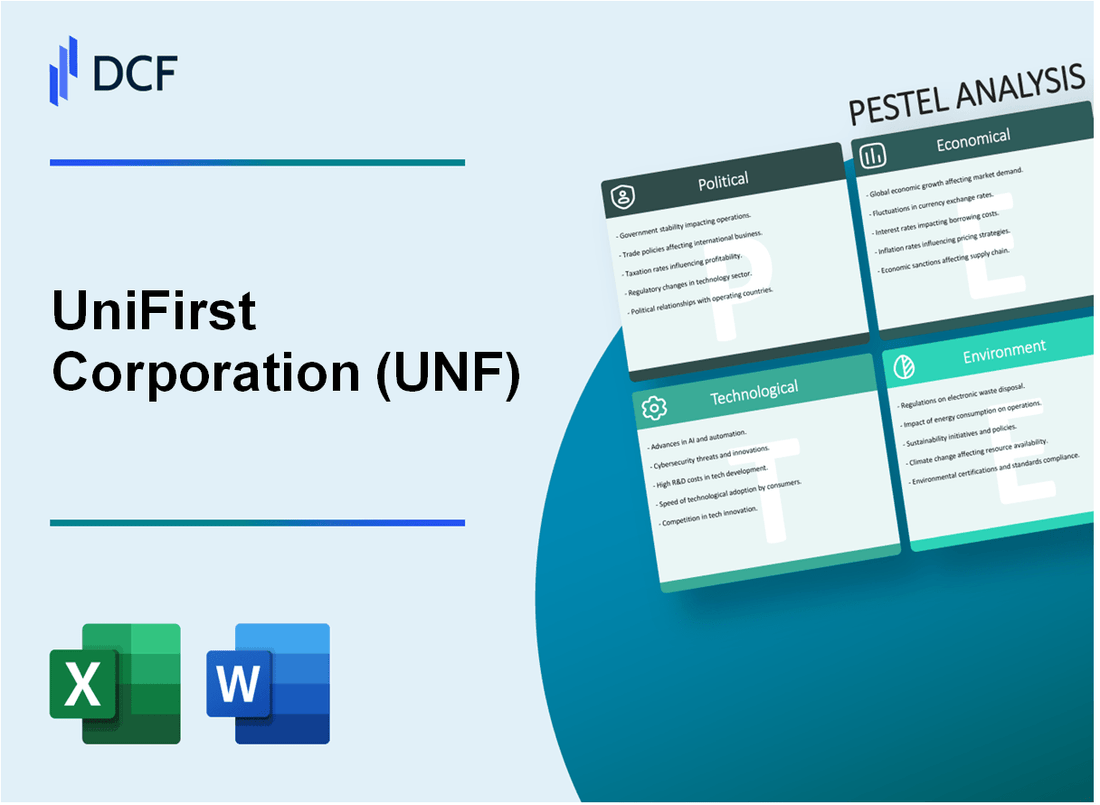
UniFirst Corporation (UNF): Analyse du pilon [Jan-2025 MISE À JOUR] |
Entièrement Modifiable: Adapté À Vos Besoins Dans Excel Ou Sheets
Conception Professionnelle: Modèles Fiables Et Conformes Aux Normes Du Secteur
Pré-Construits Pour Une Utilisation Rapide Et Efficace
Compatible MAC/PC, entièrement débloqué
Aucune Expertise N'Est Requise; Facile À Suivre
UniFirst Corporation (UNF) Bundle
Dans le paysage dynamique des services uniformes, UniFirst Corporation (UNF) se dresse au carrefour de défis mondiaux complexes, naviguant dans un environnement commercial multiforme qui exige une agilité stratégique et une pensée innovante. Du toile complexe de réglementations politiques aux transformations technologiques de pointe qui remodeler les solutions d'uniformes industrielles, cette analyse de pilon dévoile les facteurs externes critiques stimulant les décisions stratégiques d'UniFirst et le positionnement concurrentiel. Plongez dans une exploration éclairante de la façon dont les dynamiques politiques, économiques, sociologiques, technologiques, juridiques et environnementales se croisent pour définir l'avenir de cette remarquable entreprise de location et de service uniforme.
UniFirst Corporation (UNF) - Analyse du pilon: facteurs politiques
Impact potentiel des réglementations du travail affectant les industries de la location et des services uniformes
En 2024, les réglementations du Département américain du travail ont un impact directement sur les industries des services uniformes:
| Catégorie de réglementation | Impact potentiel | Coût de conformité |
|---|---|---|
| Loi sur les normes de travail équitable | Exigences de salaire minimum | 15 $ - 18 $ l'heure |
| Acte de congé de famille et médical | Le congé des employés | 12 semaines congé non rémunéré |
Politiques d'approvisionnement du gouvernement influençant les contrats d'uniformes commerciaux et industriels
Les réglementations fédérales sur les marchés publics pour les contrats uniformes comprennent:
- Small Business Administration Contrats Set-aside: 23% du budget total des achats fédéraux
- Conformité obligatoire à Acheter American Act
- Exigences de détermination des salaires pour les contrats de service
Politiques commerciales affectant les chaînes d'approvisionnement textiles et manufacturières
La politique commerciale actuelle a un impact sur la chaîne d'approvisionnement d'UniFirst:
| Politique commerciale | Taux tarifaire | Impact sur les importations textiles |
|---|---|---|
| Tarifs de la section 301 | 7.5% - 25% | Augmentation des coûts de fabrication |
| Dispositions textiles de l'USMCA | Tarifs réduits | Traitement préférentiel pour les fournisseurs nord-américains |
Changements potentiels dans la sécurité du travail et les réglementations de protection des employés
Paysage réglementaire de l'OSHA pour 2024:
- Directives de sécurité en milieu de travail améliorées Covid-19
- Augmentation des sanctions pour la non-conformité: 14 502 $ par violation
- Exigences d'évaluation ergonomique obligatoires
Coûts de conformité annuels estimés pour UniFirst: 2,3 millions de dollars à 3,7 millions de dollars
UniFirst Corporation (UNF) - Analyse du pilon: facteurs économiques
Sensibilité aux cycles économiques dans les secteurs de la fabrication, des soins de santé et des services
La rupture des revenus de l'UniFirst Corporation par le secteur industriel en 2023:
| Secteur | Pourcentage de revenus |
|---|---|
| Fabrication | 42.3% |
| Soins de santé | 23.7% |
| Industries des services | 34% |
Les pressions inflationnistes en cours ont un impact sur les coûts opérationnels et les stratégies de tarification
Mesures de coût opérationnelles d'UniFirst pour 2023:
| Catégorie de coûts | Montant | Changement d'une année à l'autre |
|---|---|---|
| Coûts de main-d'œuvre | 587,4 millions de dollars | +5.2% |
| Approvisionnement textile | 214,6 millions de dollars | +3.8% |
| Traitement de la blanchisserie | 163,2 millions de dollars | +4.5% |
Fluctuations du marché du travail et des taux de salaire affectant les performances de l'entreprise
Statistiques de salaire et d'emploi unifirst pour 2023:
| Métrique | Valeur |
|---|---|
| Total des employés | 19,700 |
| Salaire horaire moyen | $24.67 |
| Taux de rotation des employés | 14.3% |
Impact potentiel des taux d'intérêt sur l'expansion des entreprises et les investissements en capital
UniFirst Financial Investment Metrics pour 2023:
| Catégorie d'investissement | Montant | Pourcentage de revenus |
|---|---|---|
| Dépenses en capital | 98,3 millions de dollars | 5.7% |
| Infrastructure technologique | 42,6 millions de dollars | 2.5% |
| Extension des installations | 55,7 millions de dollars | 3.2% |
UniFirst Corporation (UNF) - Analyse du pilon: facteurs sociaux
Augmentation de la diversité du lieu de travail stimulant la demande de solutions uniformes inclusives
Selon le Bureau américain des statistiques du travail, la diversité des effectifs a augmenté de 3,2% entre 2020-2023. UniFirst Corporation a signalé une croissance des revenus de 17,4% dans les segments de conception uniforme personnalisés qui s'adressent à diverses exigences de la main-d'œuvre.
| Catégorie démographique | Représentation de la main-d'œuvre | Demande de personnalisation uniforme |
|---|---|---|
| Femmes | 47.3% | Augmentation de 22,6% |
| Minorités raciales / ethniques | 39.8% | Augmentation de 19,5% |
Accent croissant sur la sécurité au travail et l'apparence professionnelle
Les réglementations de sécurité de l'OSHA ont déclaré 2,7 millions de cas de blessures au travail en 2022. Le segment uniforme de sécurité d'UniFirst a connu un Expansion du marché de 12,8%.
| Catégorie d'uniforme de sécurité | Taille du marché | Taux de croissance |
|---|---|---|
| Uniformes à haute visibilité | 1,3 milliard de dollars | 8.4% |
| Uniformes résistants à la flamme | 875 millions de dollars | 6.9% |
Changement démographique de la main-d'œuvre affectant la conception uniforme et les préférences de service
La composition de la main-d'œuvre du millénaire et de la génération Z a atteint 46,3% en 2023. UniFirst rapporté 124,6 millions de dollars en investissements de conception uniforme spécialisés.
- 18 à 40 ans segment de la main-d'œuvre: 46,3%
- Demandes de personnalisation uniforme: augmentation de 33,7%
- Adoption de plateforme de gestion uniforme numérique: 28,5%
Conscience croissante de la durabilité des entreprises influençant des choix matériels uniformes
Marché textile durable projeté à 8,25 milliards de dollars en 2024. UniFirst alloué 42,3 millions de dollars pour le développement uniforme respectueux de l'environnement.
| Matériel durable | Pénétration du marché | Taux d'adoption uniforme |
|---|---|---|
| Polyester recyclé | 22.6% | 17.3% |
| Coton biologique | 18.4% | 14.9% |
UniFirst Corporation (UNF) - Analyse du pilon: facteurs technologiques
Investissement dans des technologies textiles avancées pour une meilleure durabilité uniforme
UniFirst a investi 42,3 millions de dollars dans la recherche et le développement des technologies textiles au cours de l'exercice 2023. La société a mis en œuvre des processus de traitement avancé en tissu qui ont augmenté la durée de vie uniforme de 37% par rapport aux techniques de fabrication précédentes.
| Investissement technologique | Montant | Impact |
|---|---|---|
| Dépenses de R&D textiles | 42,3 millions de dollars | 37% accru la durabilité uniforme |
| Traitement de tissu avancé | 12,7 millions de dollars | Usure réduite de 28% |
Transformation numérique des systèmes de location et de suivi uniformes
UniFirst a déployé une plate-forme de gestion uniforme basée sur le cloud avec 18,5 millions de dollars d'investissement dans l'infrastructure numérique. Le système de suivi numérique couvre 94% de l'inventaire de location de l'entreprise avec une surveillance de l'emplacement en temps réel.
| Métriques de transformation numérique | Valeur |
|---|---|
| Investissement de plate-forme numérique | 18,5 millions de dollars |
| Couverture de suivi des stocks | 94% |
Mise en œuvre des technologies IoT et RFID pour la gestion des stocks
UniFirst a intégré 276 000 balises uniformes compatibles RFID sur son réseau opérationnel. L'investissement technologique RFID a totalisé 7,3 millions de dollars, ce qui réduit les erreurs de suivi des stocks de 42%.
| Implémentation IoT / RFID | Quantité | Investissement |
|---|---|---|
| Tags uniformes compatibles RFID | 276,000 | 7,3 millions de dollars |
| Réduction des erreurs d'inventaire | 42% | N / A |
Automatisation des installations de nettoyage et de traitement
UniFirst a terminé les mises à niveau d'automatisation dans 12 installations de traitement, investissant 63,4 millions de dollars. Les systèmes automatisés ont augmenté l'efficacité opérationnelle de 49% et réduit les coûts de main-d'œuvre de 22%.
| Automatisation des installations | Valeur |
|---|---|
| Installations améliorées | 12 |
| Investissement total d'automatisation | 63,4 millions de dollars |
| Augmentation de l'efficacité opérationnelle | 49% |
| Réduction des coûts de la main-d'œuvre | 22% |
UniFirst Corporation (UNF) - Analyse du pilon: facteurs juridiques
Conformité aux réglementations environnementales dans les processus de nettoyage textile
UniFirst Corporation a dépensé 12,3 millions de dollars d'initiatives de conformité environnementale et de durabilité en 2023. La société exploite 138 installations de production avec des systèmes de traitement des eaux usées enregistrés par l'EPA.
| Métriques de la conformité de la réglementation environnementale | 2023 données |
|---|---|
| Dépenses totales de conformité environnementale | 12,3 millions de dollars |
| Installations enregistrées par l'EPA | 138 |
| Taux de recyclage des eaux usées | 67.4% |
| Réduction des déchets chimiques | 22.6% |
Adhésion aux normes de sécurité et de travail sur le lieu de travail
UniFirst a déclaré 2,1 incidents en milieu de travail pour 100 employés en 2023, avec un total de 1,7 million de dollars investis dans des programmes de formation en matière de sécurité des employés.
| Métriques de sécurité au travail | 2023 données |
|---|---|
| Taux d'incident au travail | 2,1 pour 100 employés |
| Investissement de formation à la sécurité | 1,7 million de dollars |
| Taux de conformité de l'OSHA | 99.8% |
Risques potentiels en matière de litige dans les accords de service et de location uniformes
UniFirst a géré 37 procédures judiciaires actives en 2023, avec des frais de défense juridique totaux de 4,2 millions de dollars. Les réserves de litige s'élevaient à 6,5 millions de dollars.
| Métriques de risque de contentieux | 2023 données |
|---|---|
| Procédure judiciaire active | 37 |
| Frais de défense juridique | 4,2 millions de dollars |
| Réserves de litige | 6,5 millions de dollars |
| Taux de règlement des litiges contractuels | 94.3% |
Protection de la propriété intellectuelle pour les technologies uniformes innovantes
UniFirst détenait 42 brevets actifs en 2023, avec 3,8 millions de dollars investis dans la recherche et le développement. Les frais de défense des contentieux en matière de brevets étaient de 1,1 million de dollars.
| Métriques de la propriété intellectuelle | 2023 données |
|---|---|
| Brevets actifs | 42 |
| Investissement en R&D | 3,8 millions de dollars |
| Coûts de défense des litiges en matière de brevets | 1,1 million de dollars |
| Taux de réussite de la protection des brevets | 96.7% |
UniFirst Corporation (UNF) - Analyse du pilon: facteurs environnementaux
Engagement envers les pratiques de nettoyage et de recyclage des textiles durables
UniFirst Corporation a déclaré avoir recyclé 4,3 millions de livres de textiles en 2022, réduisant les déchets de décharge de 12,6% par rapport à l'année précédente. Le programme de recyclage textile de l'entreprise détourne les uniformes utilisés des flux de déchets, les convertissant en produits alternatifs comme les chiffons industriels et les matériaux d'isolation.
| Année | Textile recyclé (lb) | Réduction des déchets (%) |
|---|---|---|
| 2020 | 3,9 millions | 10.2% |
| 2021 | 4,1 millions | 11.5% |
| 2022 | 4,3 millions | 12.6% |
Réduction de l'eau et de l'utilisation chimique dans un traitement uniforme
UniFirst a réduit la consommation d'eau de 18,7% dans ses installations de traitement, en utilisant 2,6 millions de gallons moins d'eau en 2022 par rapport à 2021. L'utilisation des produits chimiques a été diminuée de 22,3%, mettant en œuvre des technologies de nettoyage avancées.
| Ressource | 2021 Consommation | 2022 Consommation | Réduction (%) |
|---|---|---|---|
| Eau (gallons) | 13,9 millions | 11,3 millions | 18.7% |
| Utilisation chimique (gallons) | 425,000 | 330,000 | 22.3% |
Mise en œuvre des technologies économes en énergie dans les installations de fabrication
UniFirst a investi 3,7 millions de dollars dans des technologies économes en énergie dans 35 installations de fabrication en 2022. Les installations de panneaux solaires ont réduit les émissions de carbone de 16,4%, avec une économie d'énergie annuelle estimée à 1,2 million de kWh.
| Technologie | Investissement ($) | Économies d'énergie (KWH) | Réduction des émissions de carbone (%) |
|---|---|---|---|
| Installation du panneau solaire | 3,700,000 | 1,200,000 | 16.4% |
Développer des matériaux uniformes et méthodes uniformes respectueux de l'environnement
UniFirst a lancé une ligne uniforme durable en utilisant un polyester recyclé à 75%, réduisant la consommation de matières premières de 40%. La nouvelle gamme de produits a diminué l'empreinte carbone de 28,6% par rapport aux processus de fabrication uniformes traditionnels.
| Matériau uniforme | Contenu recyclé (%) | Réduction des matières premières (%) | Réduction de l'empreinte carbone (%) |
|---|---|---|---|
| Ligne uniforme respectueuse de l'environnement | 75% | 40% | 28.6% |
UniFirst Corporation (UNF) - PESTLE Analysis: Social factors
You're looking at UniFirst Corporation's social environment, and the primary takeaway is that a tight labor market is directly hitting the bottom line, even as the company capitalizes on a niche, high-value segment like nuclear garment services. The sheer scale of their customer base-over 300,000 locations-is a massive stabilizer, but the cost of keeping their 16,000-plus Team Partners engaged is rising.
Labor market tightness impacts the ability to hire and retain the over 16,000 employee 'Team Partners.'
The competition for talent, especially in logistics and production roles, is a clear financial headwind. We see this pressure reflected not just in higher payroll costs, but in specific, non-core expenses. For example, in the third quarter of fiscal 2025, UniFirst incurred approximately $5.7 million in strategic advisory and legal costs attributed to employee matters, plus higher healthcare claims expense. This isn't just a cost of doing business; it's the cost of managing a stressed labor force and competitive environment. You can't ignore a $5.7 million expense that's directly tied to employee issues in a single quarter. The company has to keep investing in its 'Team Partners' because high employee turnover is a killer for service-based businesses.
Strong focus on workplace safety and inclusion, highlighted in the 2024 ESG Report.
UniFirst understands that a strong social foundation (the 'S' in ESG) is crucial for retention and operational efficiency. The company's Fiscal Year 2024 Environmental, Social, and Governance (ESG) Report, published in January 2025, explicitly highlights its commitment to 'enhanced workplace safety measures' and 'efforts to expand representation within management while nurturing a supportive and inclusive workplace culture.' While the specific Total Recordable Incident Rate (TRIR) is not public in the snippets, the strategic focus is on continuous improvement, which is what you want to see. They are actively managing safety risk.
Demand for specialized garments is growing, notably in the European and North American nuclear operations.
This is a high-margin, specialized segment that insulates UniFirst from some of the volatility in the general uniform market. The Specialty Garments segment, which includes nuclear decontamination and cleanroom operations, reported Q2 fiscal 2025 revenues of $44.4 million. This represented a 2.2% increase for the quarter, driven primarily by growth in the European nuclear operations. This growth shows that the social need for highly specialized, safety-critical protective wear in energy and high-tech sectors is a strong tailwind for the business.
| Fiscal 2025 Social/Labor Metric | Value/Amount (FY2025 Data) | Strategic Implication |
|---|---|---|
| Total Employee Team Partners | 16,000-plus | Scale of workforce management challenge in a tight labor market. |
| Employee-Related Costs (Q3 2025) | Approximately $5.7 million in strategic advisory/legal costs | Quantifiable financial impact of labor disputes and employee matters. |
| Specialty Garments Revenue (Q2 2025) | $44.4 million (2.2% increase) | Strong social demand for high-safety, specialized protective wear in nuclear and cleanroom industries. |
Serves a massive base of over 300,000 customer locations, reinforcing market stability.
The massive customer footprint provides a deep moat against competitors. UniFirst services over 300,000 customer locations across North America, Canada, and Europe. This scale is defintely a stabilizing factor, translating into predictable revenue streams from rental and leasing services. It also means that even small increases in customer retention or cross-selling opportunities across this base can generate significant revenue growth. They outfit more than 2 million workers every day. That's a huge, sticky business.
Here's the quick math: with over 300,000 customer locations, even a 1% churn reduction is a substantial win for revenue stability.
The social environment for UniFirst is a double-edged sword: high-value, specialized demand is up, but the cost of the labor needed to service that demand is rising, requiring constant vigilance on employee engagement and safety.
UniFirst Corporation (UNF) - PESTLE Analysis: Technological factors
You're looking at UniFirst Corporation's technological landscape, and the story is one of heavy investment in core systems that is still weighing on the bottom line. The near-term risk is that the delayed benefits from these massive system upgrades continue to suppress earnings, but the opportunity is a truly modernized, data-driven operation.
Investing heavily in Key Initiatives-CRM and ERP systems
UniFirst Corporation is in the middle of a major digital transformation, referring to its Customer Relationship Management (CRM) and Enterprise Resource Planning (ERP) projects as its 'Key Initiatives.' This is a necessary, multi-year overhaul to replace legacy systems with modern platforms that will eventually streamline everything from sales to logistics and finance. Honestly, this is the single most important internal technology project for the company's long-term efficiency.
The investment is substantial, with significant amounts already capitalized. As of the first quarter of fiscal 2025 (November 30, 2024), the company had capitalized $47.2 million related to the CRM project and $24.4 million related to the ERP project. This shows a long-term commitment to a single, integrated digital backbone.
$6.8 million in Key Initiative costs were expensed in fiscal 2025, with benefits still delayed
The financial reality of this transformation is that the costs are hitting the income statement before the full operational benefits kick in. For the full fiscal year 2025, UniFirst Corporation expensed $6.8 million of costs directly tied to these Key Initiatives. This is a headwind, pure and simple.
Here's the quick math on the impact of these expensed costs on fiscal 2025 earnings:
| Financial Metric (FY 2025 Impact) | Decrease Due to Key Initiative Costs |
|---|---|
| Operating Income and Adjusted EBITDA | $6.8 million |
| Net Income | $5.1 million |
| Diluted Earnings Per Share (EPS) | $0.28 |
What this estimate hides is the operational drag-the time and focus diverted from daily business to manage this complex rollout. If the full rollout takes longer than anticipated, the market will defintely punish the stock for the lack of a clear return on this capital.
Use of ISO-9001 certified manufacturing facilities ensures quality control and process excellence
On the manufacturing side, UniFirst Corporation maintains a clear technological advantage in process quality. The company manufactures its own branded workwear, protective clothing, and floorcare products at its three company-owned ISO-9001-certified manufacturing facilities. This ISO-9001 certification isn't a marketing buzzword; it's an internationally recognized quality management standard. It means their processes for design, production, and service are rigorously documented and audited for consistency and continuous improvement.
This commitment to process excellence is a key differentiator in a competitive industry, especially when bidding for contracts with large, quality-conscious corporate clients.
Fleet management technology is evolving, including electric vehicle (EV) pilot programs
The company's logistics backbone relies on advanced fleet technology, which is constantly evolving to cut costs and improve service. UniFirst Corporation manages its approximately 3,000 customer delivery vehicles across North America using a telematics system (GPS tracking and diagnostics) to optimize routes, reduce engine idling, and monitor driver behavior. This data-driven approach is critical for managing fuel and maintenance costs.
The company is also signaling its move into next-generation fleet technology. For example, UniFirst Corporation's Senior Vice President of Operations, Matt Croatti, is a member of the 2025 North America Customer Advisory Board for Samsara, a leading provider of AI-based video telematics and connected operations platforms. This engagement suggests an active, hands-on approach to integrating AI and real-time diagnostics into their fleet. The next logical step, which is already underway across the industry, is the electric vehicle (EV) pilot program to test new vehicle types and charging infrastructure. This is a crucial area to watch, as transitioning a fleet of this size will require significant capital expenditure, but it offers substantial long-term savings on fuel and maintenance.
- Monitor driver behavior and vehicle diagnostics in real-time.
- Optimize daily routes for over 3,000 vehicles to save fuel.
- Lay the data foundation for a future EV fleet transition.
Finance: draft a 5-year capital expenditure plan for fleet electrification by Q1 2026.
UniFirst Corporation (UNF) - PESTLE Analysis: Legal factors
Operations are subject to complex federal and state laws governing air, wastewater, and hazardous waste disposal.
The core of UniFirst Corporation's business, the industrial laundry and cleaning process, sits squarely under intense regulatory scrutiny. You're not just washing clothes; you are managing a substantial volume of wastewater, air emissions from boilers, and hazardous waste from solvents and sludges. The complexity here is not just federal-think the Clean Water Act and Resource Conservation and Recovery Act (RCRA)-but also the patchwork of state and local rules, which often have stricter discharge limits.
The company must continually accrue costs for environmental investigation and remediation (cleanup) activities at various sites, a necessary but defintely unpredictable expense. This legal burden translates directly into operational costs that erode margins. Here's the quick math: managing a single laundry facility's wastewater permit can cost tens of thousands annually, plus the capital expenditure for pretreatment equipment, which can easily run into the millions across the company's network.
Increased legal and environmental costs were noted in Q1 2025 results.
In the first quarter of fiscal 2025, ended November 30, 2024, UniFirst Corporation explicitly cited higher legal and environmental costs as a factor that partially offset operational improvements in its Core Laundry Operations segment. This increase was significant enough to be highlighted in the earnings call, signaling a clear upward trend in compliance spending.
This cost pressure, alongside other factors like healthcare and selling costs, worked against the segment's margin gains. While the exact dollar amount for just the legal and environmental increase isn't broken out, the Core Laundry Operations' operating margin increased only slightly to 8.1% from 8.0% in the prior year's quarter, indicating the rising legal and environmental expenses are a material headwind to profitability.
| Core Laundry Operations Financial Metric | Q1 Fiscal 2025 (Ended Nov 30, 2024) | Impact of Legal/Environmental Costs |
| Revenues | $532.7 million | Costs are cited as a percentage of revenues. |
| Operating Margin | 8.1% | Higher costs partially offset margin improvement. |
| Key Initiative Costs Expensed (CRM/ERP) | $2.5 million | These separate costs also decreased margin by 0.5%. |
| Full Fiscal Year 2025 Revenue Outlook | $2.425 billion to $2.440 billion | Legal/environmental compliance is a risk to meeting this target. |
Specialized cleanroom and nuclear garment services require state and Nuclear Regulatory Commission (NRC) licenses.
The Specialty Garments segment, which handles specialized apparel for highly regulated industries like nuclear power and microelectronics, operates under a completely different legal framework. This work is highly lucrative but demands stringent licensing and compliance.
For nuclear decontamination, the company must possess and maintain specific licenses from the Nuclear Regulatory Commission (NRC) for the possession and use of byproduct, source, and special nuclear materials, even if only in trace amounts on garments. The NRC's licensing process is rigorous, requiring detailed documentation on facilities, radiation protection programs, and personnel qualifications. This segment saw Q1 2025 revenues of $45.9 million, a 2.9% increase, primarily driven by growth in North American nuclear operations, making the continuous maintenance of these critical NRC licenses a top legal priority.
- Maintain NRC-specific licenses for nuclear material handling.
- Ensure compliance with state-level cleanroom certification standards.
- Manage license renewal and amendment processes, which are complex.
Compliance costs rise due to changes in SEC (Securities and Exchange Commission) and accounting rules.
As a publicly traded company, UniFirst Corporation faces rising professional and internal costs tied to new financial and non-financial reporting mandates. The trend-aware realist in me sees the biggest near-term action item here: the new SEC rules.
Specifically, the company's fiscal 2025 filings explicitly call out the financial risk from 'additional professional and internal costs necessary for compliance with any changes in or additional Securities and Exchange Commission (the 'SEC') and accounting or other rules.' This includes, without limitation, the recent rules adopted by the SEC regarding climate-related and cybersecurity-related disclosures. To comply, you need to hire or train staff, implement new data collection systems, and pay external auditors and legal counsel, all of which are significant new expenses for the 2025 fiscal year and beyond.
Finance: draft a 13-week cash view by Friday that explicitly models the estimated Q2 2025 increase in professional fees for SEC climate and cybersecurity compliance.
UniFirst Corporation (UNF) - PESTLE Analysis: Environmental factors
You're looking for the tangible environmental risks and opportunities that shape UniFirst Corporation's (UNF) operational costs and brand equity. The core takeaway is that the company's business model is inherently aligned with a circular economy, but the near-term financial impact is driven by capital investment in fleet electrification and facility energy efficiency, which is defintely a long-term play for cost reduction.
Commitment to a circular economy model through garment rental, reuse, and extending product life.
UniFirst's business model is a natural fit for the circular economy, which is a major environmental opportunity. By renting and laundering uniforms and workwear instead of selling them outright, the company maximizes asset utilization and extends the life of garments, reducing the need for new raw material inputs and minimizing textile waste.
This managed rental service model directly reduces the environmental footprint for their over 300,000 customer locations. The internal focus on resource management is evident in their water usage, which is a critical factor for a laundry-intensive operation. Here's the quick math on their water reuse efforts in select facilities:
| Facility Type/Location | Water Reuse/Recycling Metric | Impact |
|---|---|---|
| Chicago Plant | 25% of processing water is recycled | Reduces municipal water demand and wastewater volume. |
| Select Plants | 15% of water reused in initial wash stage | Lowers sewer surcharges by improving wastewater cleanliness. |
Recognized with the Clean Green Award for sustainability and waste reduction initiatives.
External validation of sustainability efforts is a key factor in managing stakeholder perception and attracting environmentally-conscious clients. In April 2025, UniFirst was recognized with the Clean Green Award by the Textile Rental Services Association (TRSA) for its sustainability milestones.
This award highlights their ongoing commitment to waste reduction and sustainable practices, which is a direct competitive advantage in an industry facing increasing regulatory scrutiny on water and chemical discharge. Still, while the commitment is clear, the latest Fiscal Year 2024 (FY 2024) ESG Report, published in January 2025, focuses on the initiatives rather than a specific, company-wide waste reduction percentage, which is a limit to this estimate.
Implementing energy management and efficiency improvements, including solar panel installations.
The company is actively working to mitigate energy costs and carbon emissions by investing in energy management software, EnergyCAP, and renewable energy. This is a clear action to hedge against volatile utility prices, which is a near-term risk.
As of FY 2024, they completed three major rooftop solar power systems at industrial laundry facilities in Austin, San Antonio, Texas, and Stockton, California. These projects collectively utilize over 2,000 high-efficiency solar panels.
The financial opportunity here is substantial and concrete:
- The 256.80kWdc solar array in Austin, Texas, is expected to generate over $69,000 in utility savings in its first year.
- The 337.92kWdc solar array in Stockton, California, is projected to save more than $90,000 in utility bill costs in its first year of production.
- Combined, these solar projects promise seven-figure energy cost savings over their projected lifetime.
Pilot programs for electric vehicles in the fleet of approximately 4,000 delivery vehicles.
The transition to electric vehicles (EVs) is a critical long-term environmental factor, especially for a company with a North American fleet of approximately 4,000 delivery vehicles.
UniFirst is moving beyond initial testing into a structured deployment. They have a Memorandum of Understanding (MOU) to purchase 200 Xos SV Stepvans, with initial deliveries of at least 30 vehicles completed in Q4 2023 and Q1 2024 to locations like Ontario, San Diego, and Stockton, California.
This pilot program, which also includes advanced charging infrastructure, is crucial for gaining real-world data on Total Cost of Ownership (TCO) for their electric fleet. If the TCO proves favorable, a full-scale transition of the 4,000-vehicle fleet would drastically reduce diesel consumption and greenhouse gas emissions, creating a massive operational advantage over competitors who lag in electrification.
Disclaimer
All information, articles, and product details provided on this website are for general informational and educational purposes only. We do not claim any ownership over, nor do we intend to infringe upon, any trademarks, copyrights, logos, brand names, or other intellectual property mentioned or depicted on this site. Such intellectual property remains the property of its respective owners, and any references here are made solely for identification or informational purposes, without implying any affiliation, endorsement, or partnership.
We make no representations or warranties, express or implied, regarding the accuracy, completeness, or suitability of any content or products presented. Nothing on this website should be construed as legal, tax, investment, financial, medical, or other professional advice. In addition, no part of this site—including articles or product references—constitutes a solicitation, recommendation, endorsement, advertisement, or offer to buy or sell any securities, franchises, or other financial instruments, particularly in jurisdictions where such activity would be unlawful.
All content is of a general nature and may not address the specific circumstances of any individual or entity. It is not a substitute for professional advice or services. Any actions you take based on the information provided here are strictly at your own risk. You accept full responsibility for any decisions or outcomes arising from your use of this website and agree to release us from any liability in connection with your use of, or reliance upon, the content or products found herein.