

|
Venus Concept Inc. (VERO): 5 FORCES Analysis [Nov-2025 Updated] |
Fully Editable: Tailor To Your Needs In Excel Or Sheets
Professional Design: Trusted, Industry-Standard Templates
Investor-Approved Valuation Models
MAC/PC Compatible, Fully Unlocked
No Expertise Is Needed; Easy To Follow
Venus Concept Inc. (VERO) Bundle
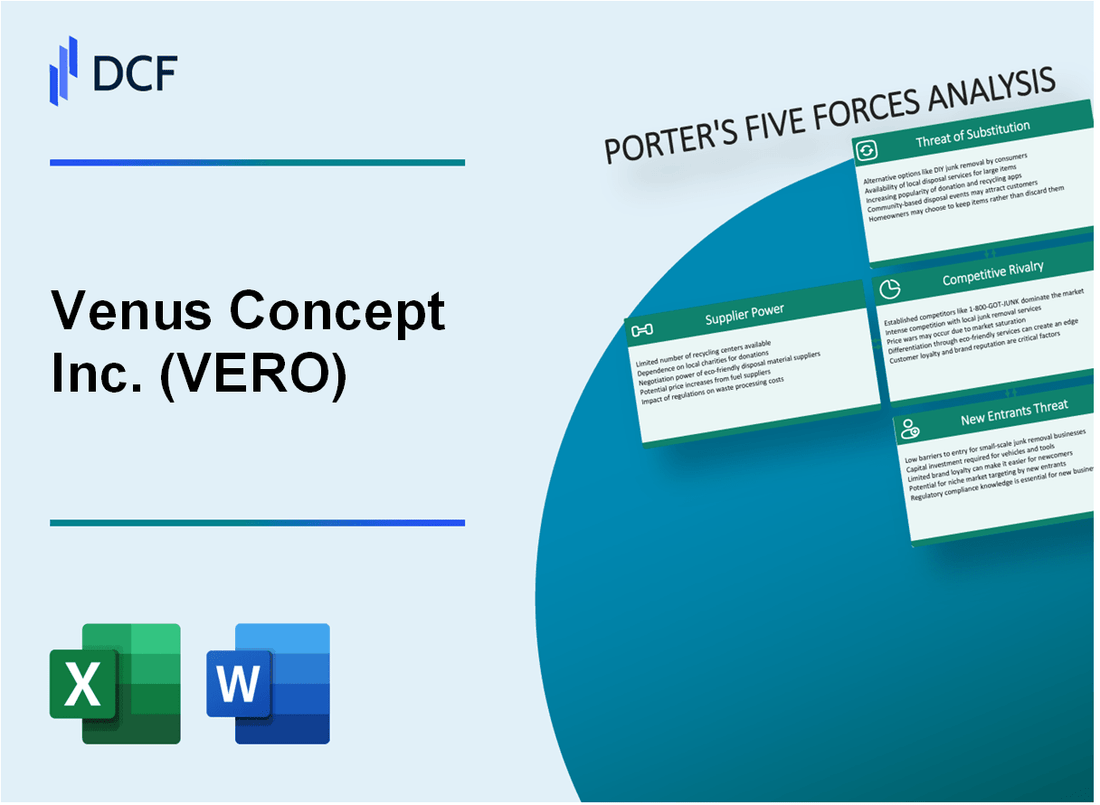
You're assessing Venus Concept Inc. (VERO) right now, trying to map out its path through the brutal medical aesthetics landscape as of late 2025. It's defintely a tough spot: Q3 revenue was $13.8 million, down 8% year-over-year, and the Adjusted EBITDA loss hit $7.8 million, showing the operational struggle. We need to look past the proprietary tech and see how the five forces-from the very high rivalry with established players to the high threat of substitutes like injectables-are truly squeezing the business. Keep reading to see the precise risk profile we uncovered.
Venus Concept Inc. (VERO) - Porter's Five Forces: Bargaining power of suppliers
You're looking at the supply chain for Venus Concept Inc. (VERO) and wondering how much leverage their component providers really have. Honestly, when you build sophisticated medical aesthetic hardware, supplier power is a real concern, especially when you rely on unique technology stacks.
The newer platforms, like the Venus NOVA which received FDA 510(k) clearance on November 10, 2025, integrate several advanced features. This system combines technologies like adaptive electrical muscle stimulation (EMS), the proprietary (MP)2 system-which marries multi-polar radio frequency with pulsed magnetic fields-and advanced VariPulse technology. This deep integration of specialized, proprietary components for platforms like Venus Versa and Venus Legacy definitely suggests that the pool of qualified suppliers capable of meeting their specifications is limited.
Here's a quick look at how supplier-related costs hit the bottom line in the most recent reported period:
| Financial Metric | Q3 2024 Value | Q3 2025 Value |
| Gross Margin | 66.1% | 64.0% |
| Gross Profit | Implied higher than $8.8M | $8.8 million |
When you see the gross margin contract, it often points to input cost pressure, which is exactly what happened here. The decrease in gross profit was $1.1 million, or 11%, compared to the third quarter of 2024. The difficulty and cost associated with qualifying alternative suppliers for key device components become a major factor when your COGS (cost of goods sold) rises, as it did here due to manufacturing overheads spread over a lower volume base.
The risk that suppliers might prioritize larger, more stable customers is a tangible near-term threat, especially given the current economic environment Venus Concept Inc. is navigating. This dynamic can easily translate into production delays or unfavorable pricing terms. We see the impact of external factors affecting costs, which suppliers can exploit:
- U.S. tariffs directly impacted devices imported into the U.S. market.
- Higher device system cost of goods sold was noted as a contributing factor.
- Overall revenue declined year-over-year in Q3 2025, reducing volume absorption.
The pressure on input costs is clear. The U.S. tariffs specifically caused the gross margin to decline to 64.0% for the three months ended September 30, 2025. If a key supplier for one of those proprietary components decides to raise prices or faces its own capacity constraints, Venus Concept Inc. has limited immediate recourse without significant re-engineering or long lead times, which you definitely don't want when trying to stabilize revenue trends.
Venus Concept Inc. (VERO) - Porter's Five Forces: Bargaining power of customers
You're looking at how much sway your customers-the clinics and med spas-have in dictating terms, and right now, that power is definitely being shaped by external financial pressures.
Customers (clinics/med spas) have many competing device options from major rivals. This availability means they can easily compare features and pricing before committing capital. Honestly, the sheer number of aesthetic device choices on the market keeps the pressure on Venus Concept Inc. to prove its value proposition.
Tighter third-party lending practices negatively impacted capital equipment sales in 2025. We saw this pressure directly reflected in the financial results; the gross profit for the third quarter of 2025 decreased $1.1 million or 11% compared to the third quarter of 2024, partly due to these tighter credit markets impacting capital equipment sales. Also, customers are sensitive to economic uncertainty, which is causing them to delay those big capital expenditure decisions.
Venus Concept Inc. is aggressively shifting its sales mix to mitigate this financing risk. Cash sales represented approximately 73% of total systems and subscription revenue in the third quarter of 2025. That's a significant move away from financing options. Specifically in the U.S., cash sales were 82% of U.S. systems and subscription revenue in Q3 2025, up from 76% in the prior year period. This focus on immediate payment reduces customer reliance on external credit, but it also means the pool of immediately qualified buyers might shrink.
Still, there are structural elements that push back against customer power. High switching costs are present due to the Practice Enhancement Program and device-specific consumables. Once a clinic is integrated into the Venus Concept Inc. ecosystem, moving to a competitor means abandoning that program structure and sourcing new, non-proprietary consumables, which creates friction.
Here's the quick math on the sales mix shift as of Q3 2025, which shows where the cash is coming from:
| Metric | Value (Q3 2025) | Comparison Point |
|---|---|---|
| U.S. Systems Revenue from Cash Sales | 82% | Up from 76% in Q3 2024 |
| Total Systems & Subscription Revenue from Cash Sales | 73% | N/A |
| Total Systems Revenue from Internal Lease/Subscription | 27% | Up from 23% in Q3 2024 |
| Energy-Based Device (EBD) Sales Revenue | $9.5 million | Up 2% Year-over-Year |
| Total Revenue | $13.8 million | Down 8% Year-over-Year |
The reliance on cash sales is a direct response to the external environment, but it highlights the customer's sensitivity to financing availability. You need to watch how quickly the new Venus NOVA launch can drive demand that overcomes these financing hurdles.
- Customers face competition from many rival device makers.
- Economic uncertainty directly impacts capital expenditure decisions.
- Tighter third-party lending constrained equipment sales in 2025.
- Switching costs exist via the Practice Enhancement Program.
- Consumables lock-in devices to specific product lines.
Finance: draft 13-week cash view by Friday.
Venus Concept Inc. (VERO) - Porter's Five Forces: Competitive rivalry
You're looking at a market where Venus Concept Inc. (VERO) is fighting an uphill battle against established giants. The competitive rivalry here is defintely very high. You're up against players like Candela Medical, Cynosure, and Lumenis, who have deep roots in the medical aesthetics space. This isn't a niche fight; it's a broad clash in the global medical aesthetics market, which is both fast-growing and highly fragmented.
The financial results from late 2025 clearly show the pressure this rivalry puts on Venus Concept's top and bottom lines. For the third quarter of 2025, total revenue came in at $13.8 million, which was an 8% drop year-over-year. Honestly, profitability is still a major challenge, as the Adjusted EBITDA loss widened to $7.8 million in Q3 2025, up from a $5.9 million loss in Q3 2024.
Here's a quick look at how the key Q3 2025 performance metrics stack up against the prior year period:
| Metric | Q3 2025 Value | Q3 2024 Value |
| Total Revenue | $13.8 million | $15.0 million (Implied: $13.8M / (1 - 0.08)) |
| Adjusted EBITDA Loss | $7.8 million | $5.9 million |
| GAAP Net Loss | $22.6 million | $9.3 million |
| Gross Profit | $8.8 million | $9.9 million (Implied: $8.8M / (1 - 0.11)) |
| Gross Margin | 64.0% | 66.1% |
The company is trying to navigate this intense environment by pivoting its strategy. Management is clearly targeting the body contouring segment, aiming to capitalize on the massive GLP-1 weight loss trends that are creating demand for skin tightening solutions. This pivot is supported by recent regulatory progress; Venus Concept received 510(k) clearance for its Venus NOVA platform on November 10, 2025.
Still, the operational struggles are evident in the revenue breakdown and balance sheet management:
- Energy Based Device (EBD) systems sales were $9.6 million, showing a slight 2% increase year-over-year.
- Lease systems revenue saw a 9% increase, while products - systems revenue dropped 12%.
- The percentage of total systems revenue from internal lease programs was 27% in Q3 2025, up from 23% in the prior year.
- Total debt obligations were reduced to approximately $30.1 million as of September 30, 2025, down from ~$39.7 million at December 31, 2024.
- Cash and cash equivalents stood at $5.9 million at the end of Q3 2025.
The divestiture of the Venus Hair business, which was expected to close in Q3 2025 for $20 million cash, is a direct response to needing to cut losses and focus resources on these core, higher-margin aesthetics.
Finance: draft 13-week cash view incorporating Q4 projections based on the Venus NOVA launch by Friday.
Venus Concept Inc. (VERO) - Porter's Five Forces: Threat of substitutes
You're analyzing the competitive landscape for Venus Concept Inc. (VERO) and need to see clearly how alternatives stack up against their energy-based device portfolio. The threat of substitutes here is quite potent, coming from both injectable products and, to a lesser extent, traditional surgery.
High threat from non-device alternatives like injectables (toxins, fillers) from companies like Evolus and Revance.
Injectables represent a massive, fast-growing segment that directly competes for the same patient dollar, often requiring less time commitment for the provider. The injectable segment is projected to hold a substantial 35.2% share of the global non-invasive aesthetic treatment market in 2025 alone. Competitors like Evolus, Inc. are aggressively gaining ground; their flagship neurotoxin market in the U.S. was estimated at $3.5 billion in 2023 and is projected to reach $6.0 billion by 2028. For context, Evolus's U.S. neurotoxin market share reached 13% year-to-date in 2024. Meanwhile, Revance Therapeutics, Inc. is pushing its long-acting neurotoxin, Daxxify, with expansions into China and Australia in 2025, increasing competitive pressure globally. These companies are also innovating with consumer-centric pricing, such as Evolus's reported subscription model offering 20 units every 90 days for $49 per month, making access predictable and affordable for consumers.
The sheer volume of non-device procedures compared to surgical ones highlights their appeal. In 2024, aesthetic providers performed 20.54 million non-surgical procedures, outpacing the 17.42 million surgical procedures reported that year. This preference for less invasive options is a double-edged sword for Venus Concept Inc. (VERO); while it supports their core technology base, it also validates the success of the injectable substitute category.
Here's a quick look at the scale of the competing markets as of 2025 estimates:
| Market Segment | Estimated Size/Share (2025 Data) | Key Growth Metric |
|---|---|---|
| Global Non-Invasive Aesthetic Treatment Market | Estimated at USD 40.06 Bn | CAGR of 13.1% (2025 to 2032) |
| Injectable Procedure Segment Share | 35.2% of Non-Invasive Market | Dominant procedure type |
| Minimally Invasive Cosmetic Procedure Market | Projected at USD 7.14 billion | CAGR of 8.78% (2025-2033) |
Surgical procedures remain a viable, though more invasive, substitute for body contouring and skin tightening.
While the trend leans toward non-invasive, surgical options like liposuction and facelifts still command significant patient volume and revenue. These procedures offer more dramatic, long-term results, which some patients prioritize over the maintenance required by energy-based or injectable treatments. The fact that 17.42 million surgical procedures were performed in 2024 shows this remains a strong, albeit more invasive, alternative for consumers seeking definitive body contouring or skin tightening.
The market trend favors minimally invasive procedures, supporting Venus Concept's technology base.
The overall momentum is clearly behind treatments that offer efficacy with minimal patient disruption. The global minimally invasive cosmetic procedure market is projected to grow at a Compound Annual Growth Rate (CAGR) of 8.78% from 2025 to 2033. Furthermore, the broader Non-Invasive Aesthetic Treatment Market is expected to expand even faster, with a CAGR of 13.1% between 2025 and 2032. This environment supports Venus Concept Inc. (VERO)'s focus on device-based, non-surgical solutions, as patient preference aligns with lower downtime.
Non-device treatments often require lower upfront capital investment for clinics.
This is a critical financial consideration for smaller clinics and medspas looking to expand their service menus. Acquiring a sophisticated energy-based device, like a high-end laser system, can require a significant initial outlay, often ranging from $50,000 to $150,000 or more for the equipment alone. Injectables, conversely, have a much lower barrier to entry in terms of capital expenditure. A clinic can start offering toxin treatments with a relatively small purchase of the consumable product and the necessary supplies, like numbing agents. This lower initial capital deployment for injectables means clinics can diversify their offerings quickly without tying up substantial cash in depreciating assets. Venus Concept Inc. (VERO) must counter this by emphasizing the high lifetime value and recurring revenue potential of their systems, especially given their Q3 2025 revenue was $13.78 million and full-year 2025 sales are estimated around $61.01 million.
- Injectables: Low initial capital, high consumable cost per treatment.
- Venus Concept Devices: High initial capital, low per-treatment consumable cost.
- Surgical Options: High barrier to entry, specialized personnel required.
Venus Concept Inc. (VERO) - Porter's Five Forces: Threat of new entrants
You're looking at the barriers to entry for Venus Concept Inc. (VERO) in the aesthetic device space, and honestly, the picture is mixed. On one hand, the regulatory gatekeeping in the U.S. is a significant hurdle that keeps the casual competitor out.
The Food and Drug Administration (FDA) process, specifically the $\mathbf{510(k)}$ premarket notification, is a major cost and time sink. For a new device to hit the market, manufacturers must prove substantial equivalence to an existing predicate device, which can take anywhere from $\mathbf{3}$ to $\mathbf{12 \text{ months}}$ for a $\mathbf{510(k)}$ clearance. Venus Concept itself just announced receiving $\mathbf{510(k)}$ clearance for its Venus NOVA platform on November 10, 2025. This shows the process is active, but it also means any new entrant needs deep regulatory expertise and patience, as marketing a device without clearance is prohibited.
The capital requirement for R&D and manufacturing complex energy-based devices is substantial. Look at Venus Concept's own investment; their research and development expenses for the full fiscal year $\mathbf{2024}$ were $\mathbf{\$0.007 \text{ billion}}$ ($\mathbf{\$7.0 \text{ million}}$). Furthermore, even while focusing on cost containment, their R&D expenses for the third quarter of $\mathbf{2025}$ still saw a year-over-year decrease of $\mathbf{\$0.4 \text{ million}}$, or $\mathbf{24\%}$. This level of sustained investment is a barrier, but it's not insurmountable for well-funded startups or established med-tech players.
To be fair, the market itself is the biggest magnet for new entrants. The projected growth suggests a gold rush environment, which naturally attracts competition. The market is highly attractive, projected to grow from $\mathbf{\$18.48 \text{ billion} \text{ in } 2024}$ to $\mathbf{\$55.99 \text{ billion} \text{ by } 2033}$ [cite: Outline]. Still, the current valuation of Venus Concept Inc. (VERO) suggests it might not be seen as a dominant incumbent by the market. As of November 26, 2025, Venus Concept has a market capitalization of approximately $\mathbf{\$3.55 \text{ million}}$.
Here's the quick math on the competitive landscape for a potential new entrant:
| Factor | Data Point | Implication for New Entrants |
|---|---|---|
| Regulatory Pathway Time (Avg. 510(k)) | $\mathbf{3}$ to $\mathbf{12 \text{ months}}$ | Requires upfront time commitment before revenue generation. |
| Venus Concept R&D (FY 2024) | $\mathbf{\$7.0 \text{ million}}$ | Indicates the scale of investment needed to develop competitive technology. |
| Market Attractiveness (Projected Growth) | $\mathbf{\$18.48 \text{ billion}}$ (2024) to $\mathbf{\$55.99 \text{ billion}}$ (2033) | High potential reward justifies the high entry costs. |
| Venus Concept Market Cap (Nov 2025) | $\mathbf{\$3.55 \text{ million}}$ | Low incumbent valuation suggests the market leader is not yet firmly established or is financially distressed. |
The regulatory environment creates a tiered entry system. New entrants must navigate specific requirements depending on their device class:
- Class I devices: Often exempt from $\mathbf{510(k)}$; timeline $\mathbf{1}$-$\mathbf{2 \text{ months}}$.
- Class II devices (like many aesthetic tools): Usually require $\mathbf{510(k)}$ clearance.
- Class III devices: Require Premarket Approval (PMA), taking $\mathbf{1}$-$\mathbf{3 \text{ years}}$.
What this estimate hides is that even if a new entrant proves substantial equivalence, the FDA requires robust documentation to support any design change, which can be a trap.
Disclaimer
All information, articles, and product details provided on this website are for general informational and educational purposes only. We do not claim any ownership over, nor do we intend to infringe upon, any trademarks, copyrights, logos, brand names, or other intellectual property mentioned or depicted on this site. Such intellectual property remains the property of its respective owners, and any references here are made solely for identification or informational purposes, without implying any affiliation, endorsement, or partnership.
We make no representations or warranties, express or implied, regarding the accuracy, completeness, or suitability of any content or products presented. Nothing on this website should be construed as legal, tax, investment, financial, medical, or other professional advice. In addition, no part of this site—including articles or product references—constitutes a solicitation, recommendation, endorsement, advertisement, or offer to buy or sell any securities, franchises, or other financial instruments, particularly in jurisdictions where such activity would be unlawful.
All content is of a general nature and may not address the specific circumstances of any individual or entity. It is not a substitute for professional advice or services. Any actions you take based on the information provided here are strictly at your own risk. You accept full responsibility for any decisions or outcomes arising from your use of this website and agree to release us from any liability in connection with your use of, or reliance upon, the content or products found herein.