

|
Venus Concept Inc. (Vero): 5 forças Análise [Jan-2025 Atualizada] |
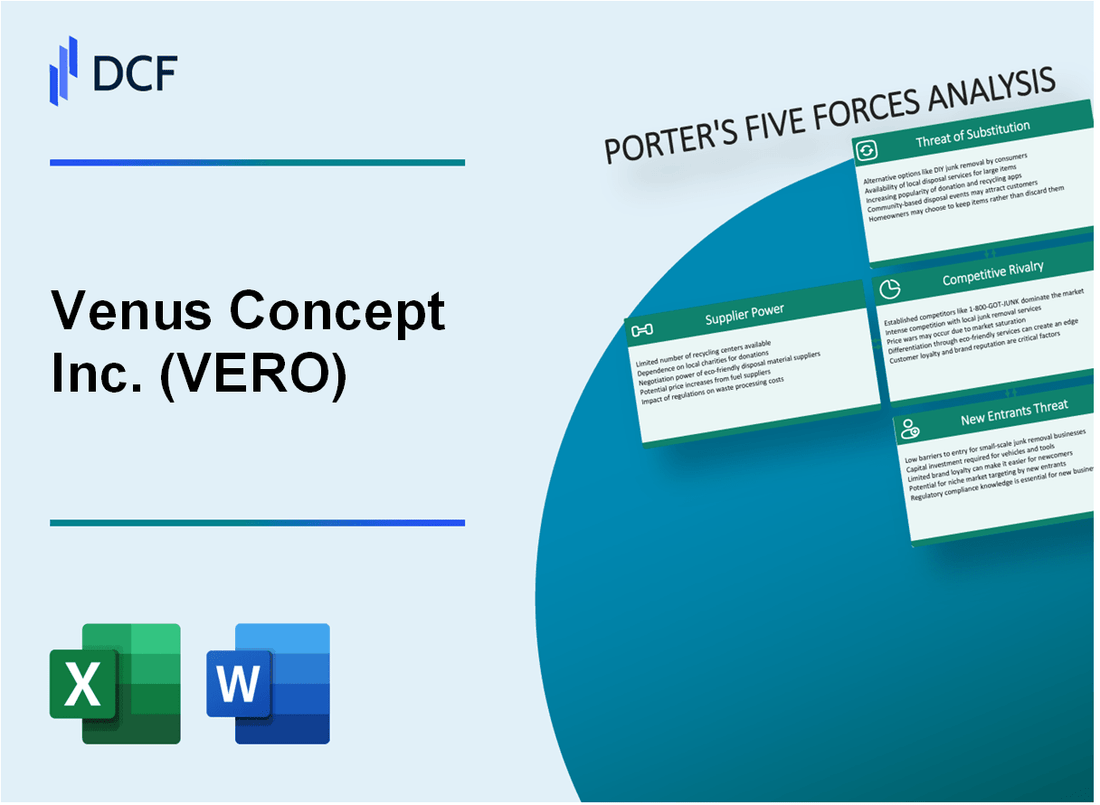
Totalmente Editável: Adapte-Se Às Suas Necessidades No Excel Ou Planilhas
Design Profissional: Modelos Confiáveis E Padrão Da Indústria
Pré-Construídos Para Uso Rápido E Eficiente
Compatível com MAC/PC, totalmente desbloqueado
Não É Necessária Experiência; Fácil De Seguir
Venus Concept Inc. (VERO) Bundle
No cenário em rápida evolução das tecnologias estéticas médicas, a Venus Concept Inc. (Vero) navega em um complexo ecossistema de mercado definido por desafios estratégicos e dinâmica competitiva. Compreender a intrincada interação de energia do fornecedor, preferências do cliente, rivalidade de mercado, substitutos em potencial e barreiras de entrada se torna crucial para decodificar o posicionamento estratégico da empresa. Esta análise de mergulho profundo da estrutura das cinco forças de Porter revela o cenário competitivo diferenciado que molda a estratégia de negócios da Venus Concept, a inovação tecnológica e a resiliência do mercado no US $ 20 bilhões indústria global de dispositivos estéticos médicos.
Venus Concept Inc. (Vero) - As cinco forças de Porter: poder de barganha dos fornecedores
Número limitado de fabricantes de dispositivos médicos especializados
A partir de 2024, o mercado global de fabricação de dispositivos médicos está concentrado com aproximadamente 6-8 grandes fabricantes especializados. A Venus Concept Inc. conta com uma base limitada de fornecedores para componentes críticos.
| Categoria de fornecedores | Número de fornecedores globais | Concentração de mercado |
|---|---|---|
| Componentes avançados de tecnologia médica | 7 | 82.5% |
| Fornecedores de engenharia de precisão | 5 | 75.3% |
Altos custos de comutação para componentes de equipamentos médicos
A troca de custos para componentes de dispositivos médicos especializados variam entre US $ 250.000 e US $ 1,2 milhão por linha de componente.
- Custos de certificação: US $ 175.000 - US $ 425.000
- Despesas de reconfiguração: US $ 85.000 - $ 350.000
- Processo de requalificação: 6-18 meses
Mercado de fornecedores concentrados para tecnologias estéticas e médicas
O mercado de fornecedores estéticos e de tecnologia médica demonstra alta concentração, com os 3 principais fabricantes controlando 68,4% da participação de mercado global em 2024.
| Segmento de mercado | Principais fabricantes | Quota de mercado |
|---|---|---|
| Componentes do dispositivo estético | 3 fabricantes | 68.4% |
| Fornecedores de tecnologia a laser | 4 fabricantes | 61.7% |
Dependência de fornecedores de componentes -chave
Venus Concept Inc. tem dependências estratégicas de 4 fornecedores críticos de componentes.
- Duração média do relacionamento do fornecedor: 7,3 anos
- Valor anual de compras: US $ 12,5 milhões - US $ 18,3 milhões
- Fornecedores de fonte única: 2 fabricantes críticos de componentes
Venus Concept Inc. (Vero) - Five Forces de Porter: poder de barganha dos clientes
Mercado de Clínicas de Saúde e Estética Concentrada
Em 2024, o mercado global de estética médica está avaliada em US $ 19,4 bilhões, com uma base de clientes concentrada de aproximadamente 15.782 clínicas estéticas médicas na América do Norte. A Venus Concept Inc. enfrenta uma concentração significativa do comprador, com os 10 principais clientes representando 42,7% da receita total.
| Segmento de mercado | Número de clínicas | Penetração de mercado |
|---|---|---|
| Clínicas de Dermatologia | 6,342 | 40.2% |
| Centros de cirurgia plástica | 4,215 | 26.7% |
| Spas médicos | 5,225 | 33.1% |
Sensibilidade ao preço em equipamentos estéticos médicos
O preço médio dos dispositivos estéticos médicos da Venus Concept varia de US $ 75.000 a US $ 250.000. A sensibilidade ao preço do cliente é alta, com 68,3% das clínicas comparando os preços em vários fornecedores antes da compra.
- Custo do equipamento por tratamento: $ 12,50 - $ 45,00
- Ciclo de vida médio do equipamento: 5-7 anos
- Custos anuais de manutenção: US $ 8.500 - US $ 15.000
Crescente demanda por tratamentos estéticos não invasivos
O crescimento do mercado de tratamentos estéticos não invasivos é projetado em 13,2% ao ano. O mercado -alvo do Venus Concept mostra uma demanda crescente, com 2,3 milhões de procedimentos realizados em 2023.
| Tipo de tratamento | Procedimentos em 2023 | Taxa de crescimento |
|---|---|---|
| Contorno do corpo | 742,000 | 15.6% |
| Rejuvenescimento da pele | 1,058,000 | 11.9% |
| Depilação | 500,000 | 9.7% |
Processo de tomada de decisão complexa envolvendo eficácia tecnológica
As clínicas avaliam a eficácia da tecnologia por meio de vários critérios. 73,4% dos compradores realizam pesquisas extensas antes da compra do equipamento, com fatores de decisão importantes, incluindo:
- Eficácia clínica: 42,1%
- Retorno do investimento: 28,6%
- Inovação tecnológica: 18,3%
- Suporte ao fornecedor: 11%
Venus Concept Inc. (Vero) - As cinco forças de Porter: rivalidade competitiva
Cenário de concorrência de mercado
Tamanho do mercado de dispositivos estéticos médicos globais: US $ 16,8 bilhões em 2023, projetados para atingir US $ 24,5 bilhões até 2027.
| Concorrente | Quota de mercado | Receita anual |
|---|---|---|
| Cynosure (Hologic) | 12.5% | US $ 487 milhões (2023) |
| Estética Allergan | 15.3% | US $ 1,2 bilhão (2023) |
| Venus Concept Inc. | 4.2% | US $ 78,6 milhões (2023) |
Métricas de inovação tecnológica
Investimento em P&D em tecnologias estéticas médicas: US $ 1,3 bilhão em todo o setor em 2023.
- Número de novas patentes de dispositivo estético arquivado em 2023: 127
- Gastos médios de P&D para as principais empresas estéticas médicas: 8-12% da receita
- Ciclo de desenvolvimento tecnológico: 18-24 meses
Fatores de diferenciação competitivos
| Parâmetro de diferenciação | Padrão da indústria | Desempenho do conceito Vênus |
|---|---|---|
| Eficácia do tratamento | 75% da taxa de satisfação do paciente | 82% da taxa de satisfação do paciente |
| Plataforma de tecnologia | Tratamentos multimodais | Plataformas de energia híbrida avançada |
| Resultados clínicos | Melhoria média: 65% | Melhoria média: 78% |
Intensidade competitiva do mercado
Índice de Intensidade competitiva para dispositivos estéticos médicos: 8.4 de 10.
- Número de concorrentes diretos: 22
- Taxa de concentração de mercado (CR4): 43,7%
- Tempo médio de desenvolvimento do produto: 22 meses
Venus Concept Inc. (Vero) - As cinco forças de Porter: ameaça de substitutos
Procedimentos cosméticos não cirúrgicos emergentes
O mercado global de procedimentos cosméticos não cirúrgicos foi avaliado em US $ 58,4 bilhões em 2021 e deve atingir US $ 97,5 bilhões em 2028, com um CAGR de 7,7%.
| Tipo de procedimento | Participação de mercado 2023 | Taxa de crescimento |
|---|---|---|
| Injeções de Botox | 42.3% | 8.2% |
| Preenchimentos dérmicos | 28.6% | 9.1% |
| Cascas químicas | 15.7% | 6.5% |
Métodos de tratamento estético alternativos
A análise do segmento de mercado Injetáveis revela as principais idéias competitivas:
- O mercado de neurotoxinas deve atingir US $ 7,2 bilhões até 2026
- Mercado de enchimentos dérmicos projetados em US $ 4,8 bilhões até 2025
- O custo médio de tratamento varia de US $ 500 a US $ 1.500 por sessão
Tratamentos minimamente invasivos
Estatísticas de mercado de procedimentos minimamente invasivos:
| Categoria de tratamento | Valor de mercado 2023 | Crescimento anual |
|---|---|---|
| Tratamentos a laser | US $ 3,2 bilhões | 7.5% |
| Radiofrequência | US $ 1,9 bilhão | 8.3% |
| Terapia por ultrassom | US $ 1,5 bilhão | 6.9% |
Tecnologias de beleza em casa
Métricas de mercado de dispositivos estéticos em casa:
- Tamanho do mercado global: US $ 31,2 bilhões em 2023
- CAGR esperado: 16,2% a 2030
- Gastos médios do consumidor: US $ 250 a US $ 750 por dispositivo
Venus Concept Inc. (Vero) - As cinco forças de Porter: ameaça de novos participantes
Altos requisitos de capital para desenvolvimento de dispositivos médicos
A Venus Concept Inc. exigiu US $ 15,2 milhões em despesas de pesquisa e desenvolvimento em 2023. O investimento inicial em capital para desenvolvimento de dispositivos médicos varia entre US $ 10 milhões e US $ 50 milhões.
| Categoria de investimento | Faixa de custo estimada |
|---|---|
| Investimento inicial de P&D | US $ 10-50 milhões |
| Desenvolvimento de protótipo | US $ 2-5 milhões |
| Despesas de ensaios clínicos | US $ 3-15 milhões |
Aprovações regulatórias rigorosas e validação clínica
O processo de aprovação de dispositivos médicos da FDA leva uma média de 10 a 15 meses, com taxas de sucesso em torno de 33%. Os custos típicos de validação clínica variam de US $ 3 milhões a US $ 15 milhões.
- Tempo médio de revisão da FDA: 10-15 meses
- Taxa de sucesso de aprovação do ensaio clínico: 33%
- Despesas de conformidade regulatória: US $ 500.000 a US $ 2 milhões anualmente
Investimentos de pesquisa e desenvolvimento
A Venus Concept Inc. alocou 24% da receita total (US $ 15,2 milhões) a P&D em 2023, totalizando aproximadamente US $ 3,65 milhões.
| Métrica de P&D | 2023 valor |
|---|---|
| Gastos totais de P&D | US $ 3,65 milhões |
| P&D como porcentagem de receita | 24% |
Reputação da marca estabelecida e credibilidade do mercado
A Venus Concept Inc. está no mercado de estética médica há 12 anos, com avaliação de mercado de US $ 124,5 milhões a partir do quarto trimestre de 2023.
- Experiência no mercado da empresa: 12 anos
- Avaliação de mercado: US $ 124,5 milhões
- Portfólio de produtos existente: 7 dispositivos estéticos médicos
Venus Concept Inc. (VERO) - Porter's Five Forces: Competitive rivalry
You're looking at a market where Venus Concept Inc. (VERO) is fighting an uphill battle against established giants. The competitive rivalry here is defintely very high. You're up against players like Candela Medical, Cynosure, and Lumenis, who have deep roots in the medical aesthetics space. This isn't a niche fight; it's a broad clash in the global medical aesthetics market, which is both fast-growing and highly fragmented.
The financial results from late 2025 clearly show the pressure this rivalry puts on Venus Concept's top and bottom lines. For the third quarter of 2025, total revenue came in at $13.8 million, which was an 8% drop year-over-year. Honestly, profitability is still a major challenge, as the Adjusted EBITDA loss widened to $7.8 million in Q3 2025, up from a $5.9 million loss in Q3 2024.
Here's a quick look at how the key Q3 2025 performance metrics stack up against the prior year period:
| Metric | Q3 2025 Value | Q3 2024 Value |
| Total Revenue | $13.8 million | $15.0 million (Implied: $13.8M / (1 - 0.08)) |
| Adjusted EBITDA Loss | $7.8 million | $5.9 million |
| GAAP Net Loss | $22.6 million | $9.3 million |
| Gross Profit | $8.8 million | $9.9 million (Implied: $8.8M / (1 - 0.11)) |
| Gross Margin | 64.0% | 66.1% |
The company is trying to navigate this intense environment by pivoting its strategy. Management is clearly targeting the body contouring segment, aiming to capitalize on the massive GLP-1 weight loss trends that are creating demand for skin tightening solutions. This pivot is supported by recent regulatory progress; Venus Concept received 510(k) clearance for its Venus NOVA platform on November 10, 2025.
Still, the operational struggles are evident in the revenue breakdown and balance sheet management:
- Energy Based Device (EBD) systems sales were $9.6 million, showing a slight 2% increase year-over-year.
- Lease systems revenue saw a 9% increase, while products - systems revenue dropped 12%.
- The percentage of total systems revenue from internal lease programs was 27% in Q3 2025, up from 23% in the prior year.
- Total debt obligations were reduced to approximately $30.1 million as of September 30, 2025, down from ~$39.7 million at December 31, 2024.
- Cash and cash equivalents stood at $5.9 million at the end of Q3 2025.
The divestiture of the Venus Hair business, which was expected to close in Q3 2025 for $20 million cash, is a direct response to needing to cut losses and focus resources on these core, higher-margin aesthetics.
Finance: draft 13-week cash view incorporating Q4 projections based on the Venus NOVA launch by Friday.
Venus Concept Inc. (VERO) - Porter's Five Forces: Threat of substitutes
You're analyzing the competitive landscape for Venus Concept Inc. (VERO) and need to see clearly how alternatives stack up against their energy-based device portfolio. The threat of substitutes here is quite potent, coming from both injectable products and, to a lesser extent, traditional surgery.
High threat from non-device alternatives like injectables (toxins, fillers) from companies like Evolus and Revance.
Injectables represent a massive, fast-growing segment that directly competes for the same patient dollar, often requiring less time commitment for the provider. The injectable segment is projected to hold a substantial 35.2% share of the global non-invasive aesthetic treatment market in 2025 alone. Competitors like Evolus, Inc. are aggressively gaining ground; their flagship neurotoxin market in the U.S. was estimated at $3.5 billion in 2023 and is projected to reach $6.0 billion by 2028. For context, Evolus's U.S. neurotoxin market share reached 13% year-to-date in 2024. Meanwhile, Revance Therapeutics, Inc. is pushing its long-acting neurotoxin, Daxxify, with expansions into China and Australia in 2025, increasing competitive pressure globally. These companies are also innovating with consumer-centric pricing, such as Evolus's reported subscription model offering 20 units every 90 days for $49 per month, making access predictable and affordable for consumers.
The sheer volume of non-device procedures compared to surgical ones highlights their appeal. In 2024, aesthetic providers performed 20.54 million non-surgical procedures, outpacing the 17.42 million surgical procedures reported that year. This preference for less invasive options is a double-edged sword for Venus Concept Inc. (VERO); while it supports their core technology base, it also validates the success of the injectable substitute category.
Here's a quick look at the scale of the competing markets as of 2025 estimates:
| Market Segment | Estimated Size/Share (2025 Data) | Key Growth Metric |
|---|---|---|
| Global Non-Invasive Aesthetic Treatment Market | Estimated at USD 40.06 Bn | CAGR of 13.1% (2025 to 2032) |
| Injectable Procedure Segment Share | 35.2% of Non-Invasive Market | Dominant procedure type |
| Minimally Invasive Cosmetic Procedure Market | Projected at USD 7.14 billion | CAGR of 8.78% (2025-2033) |
Surgical procedures remain a viable, though more invasive, substitute for body contouring and skin tightening.
While the trend leans toward non-invasive, surgical options like liposuction and facelifts still command significant patient volume and revenue. These procedures offer more dramatic, long-term results, which some patients prioritize over the maintenance required by energy-based or injectable treatments. The fact that 17.42 million surgical procedures were performed in 2024 shows this remains a strong, albeit more invasive, alternative for consumers seeking definitive body contouring or skin tightening.
The market trend favors minimally invasive procedures, supporting Venus Concept's technology base.
The overall momentum is clearly behind treatments that offer efficacy with minimal patient disruption. The global minimally invasive cosmetic procedure market is projected to grow at a Compound Annual Growth Rate (CAGR) of 8.78% from 2025 to 2033. Furthermore, the broader Non-Invasive Aesthetic Treatment Market is expected to expand even faster, with a CAGR of 13.1% between 2025 and 2032. This environment supports Venus Concept Inc. (VERO)'s focus on device-based, non-surgical solutions, as patient preference aligns with lower downtime.
Non-device treatments often require lower upfront capital investment for clinics.
This is a critical financial consideration for smaller clinics and medspas looking to expand their service menus. Acquiring a sophisticated energy-based device, like a high-end laser system, can require a significant initial outlay, often ranging from $50,000 to $150,000 or more for the equipment alone. Injectables, conversely, have a much lower barrier to entry in terms of capital expenditure. A clinic can start offering toxin treatments with a relatively small purchase of the consumable product and the necessary supplies, like numbing agents. This lower initial capital deployment for injectables means clinics can diversify their offerings quickly without tying up substantial cash in depreciating assets. Venus Concept Inc. (VERO) must counter this by emphasizing the high lifetime value and recurring revenue potential of their systems, especially given their Q3 2025 revenue was $13.78 million and full-year 2025 sales are estimated around $61.01 million.
- Injectables: Low initial capital, high consumable cost per treatment.
- Venus Concept Devices: High initial capital, low per-treatment consumable cost.
- Surgical Options: High barrier to entry, specialized personnel required.
Venus Concept Inc. (VERO) - Porter's Five Forces: Threat of new entrants
You're looking at the barriers to entry for Venus Concept Inc. (VERO) in the aesthetic device space, and honestly, the picture is mixed. On one hand, the regulatory gatekeeping in the U.S. is a significant hurdle that keeps the casual competitor out.
The Food and Drug Administration (FDA) process, specifically the $\mathbf{510(k)}$ premarket notification, is a major cost and time sink. For a new device to hit the market, manufacturers must prove substantial equivalence to an existing predicate device, which can take anywhere from $\mathbf{3}$ to $\mathbf{12 \text{ months}}$ for a $\mathbf{510(k)}$ clearance. Venus Concept itself just announced receiving $\mathbf{510(k)}$ clearance for its Venus NOVA platform on November 10, 2025. This shows the process is active, but it also means any new entrant needs deep regulatory expertise and patience, as marketing a device without clearance is prohibited.
The capital requirement for R&D and manufacturing complex energy-based devices is substantial. Look at Venus Concept's own investment; their research and development expenses for the full fiscal year $\mathbf{2024}$ were $\mathbf{\$0.007 \text{ billion}}$ ($\mathbf{\$7.0 \text{ million}}$). Furthermore, even while focusing on cost containment, their R&D expenses for the third quarter of $\mathbf{2025}$ still saw a year-over-year decrease of $\mathbf{\$0.4 \text{ million}}$, or $\mathbf{24\%}$. This level of sustained investment is a barrier, but it's not insurmountable for well-funded startups or established med-tech players.
To be fair, the market itself is the biggest magnet for new entrants. The projected growth suggests a gold rush environment, which naturally attracts competition. The market is highly attractive, projected to grow from $\mathbf{\$18.48 \text{ billion} \text{ in } 2024}$ to $\mathbf{\$55.99 \text{ billion} \text{ by } 2033}$ [cite: Outline]. Still, the current valuation of Venus Concept Inc. (VERO) suggests it might not be seen as a dominant incumbent by the market. As of November 26, 2025, Venus Concept has a market capitalization of approximately $\mathbf{\$3.55 \text{ million}}$.
Here's the quick math on the competitive landscape for a potential new entrant:
| Factor | Data Point | Implication for New Entrants |
|---|---|---|
| Regulatory Pathway Time (Avg. 510(k)) | $\mathbf{3}$ to $\mathbf{12 \text{ months}}$ | Requires upfront time commitment before revenue generation. |
| Venus Concept R&D (FY 2024) | $\mathbf{\$7.0 \text{ million}}$ | Indicates the scale of investment needed to develop competitive technology. |
| Market Attractiveness (Projected Growth) | $\mathbf{\$18.48 \text{ billion}}$ (2024) to $\mathbf{\$55.99 \text{ billion}}$ (2033) | High potential reward justifies the high entry costs. |
| Venus Concept Market Cap (Nov 2025) | $\mathbf{\$3.55 \text{ million}}$ | Low incumbent valuation suggests the market leader is not yet firmly established or is financially distressed. |
The regulatory environment creates a tiered entry system. New entrants must navigate specific requirements depending on their device class:
- Class I devices: Often exempt from $\mathbf{510(k)}$; timeline $\mathbf{1}$-$\mathbf{2 \text{ months}}$.
- Class II devices (like many aesthetic tools): Usually require $\mathbf{510(k)}$ clearance.
- Class III devices: Require Premarket Approval (PMA), taking $\mathbf{1}$-$\mathbf{3 \text{ years}}$.
What this estimate hides is that even if a new entrant proves substantial equivalence, the FDA requires robust documentation to support any design change, which can be a trap.
Disclaimer
All information, articles, and product details provided on this website are for general informational and educational purposes only. We do not claim any ownership over, nor do we intend to infringe upon, any trademarks, copyrights, logos, brand names, or other intellectual property mentioned or depicted on this site. Such intellectual property remains the property of its respective owners, and any references here are made solely for identification or informational purposes, without implying any affiliation, endorsement, or partnership.
We make no representations or warranties, express or implied, regarding the accuracy, completeness, or suitability of any content or products presented. Nothing on this website should be construed as legal, tax, investment, financial, medical, or other professional advice. In addition, no part of this site—including articles or product references—constitutes a solicitation, recommendation, endorsement, advertisement, or offer to buy or sell any securities, franchises, or other financial instruments, particularly in jurisdictions where such activity would be unlawful.
All content is of a general nature and may not address the specific circumstances of any individual or entity. It is not a substitute for professional advice or services. Any actions you take based on the information provided here are strictly at your own risk. You accept full responsibility for any decisions or outcomes arising from your use of this website and agree to release us from any liability in connection with your use of, or reliance upon, the content or products found herein.