

|
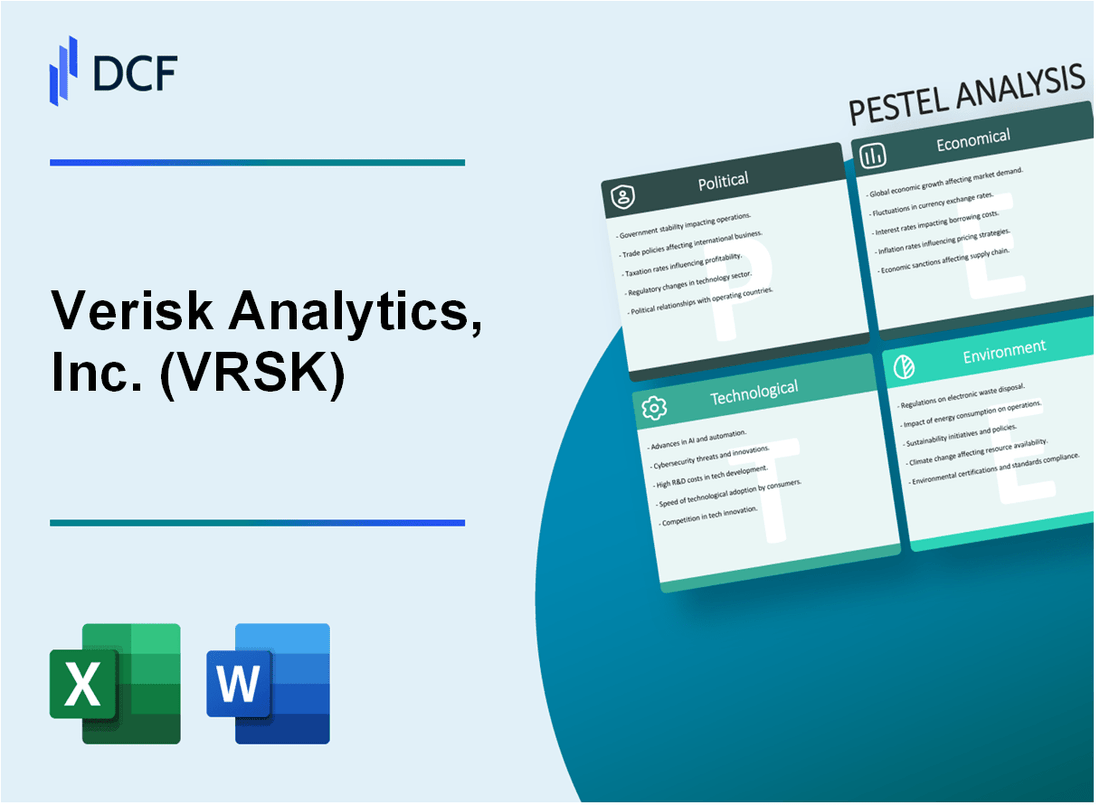
Verisk Analytics, Inc. (VRSK): PESTLE Analysis [Nov-2025 Updated] |
Fully Editable: Tailor To Your Needs In Excel Or Sheets
Professional Design: Trusted, Industry-Standard Templates
Investor-Approved Valuation Models
MAC/PC Compatible, Fully Unlocked
No Expertise Is Needed; Easy To Follow
Verisk Analytics, Inc. (VRSK) Bundle
You're digging into Verisk Analytics, Inc. (VRSK) right now, and the external environment for 2025 is definitely complex, balancing high inflation driving demand for their loss cost data against escalating climate severity, with global insured losses topping $120 billion. This PESTLE analysis cuts through the noise, showing exactly how everything from state-level regulatory scrutiny to the rapid integration of Generative AI will shape their core insurance segment's path forward, so you know where to focus your attention next.
Verisk Analytics, Inc. (VRSK) - PESTLE Analysis: Political factors
Increased US state-level regulatory scrutiny on insurance rate filings and data use.
You're seeing a significant uptick in regulatory pressure at the state level, and it's defintely impacting Verisk's core insurance data business. States like California and Florida, representing massive property and casualty (P&C) markets, are pushing back hard on rate increases and the underlying data models used to justify them.
In California, for example, the Department of Insurance has created substantial delays in approving rate filings, which directly affects how quickly Verisk's clients-the insurers-can implement new pricing based on Verisk's risk assessment tools. This scrutiny centers on the use of proprietary data and algorithms, specifically on how Verisk's models handle catastrophe risk (CAT models) and non-weather water damage. Honestly, the political climate demands more transparency, and that slows down the entire rate-setting cycle.
Here's the quick math: if a major state delays rate approvals by an average of 180 days, it creates a significant lag in the industry's ability to price risk accurately, which then pressures Verisk to provide more granular, auditable data to regulators.
- Scrutiny demands more model transparency.
- Rate filing delays impact client revenue cycles.
- Focus is on proprietary data use in CAT models.
Geopolitical tensions impacting global reinsurer capital and catastrophe risk exposure.
Geopolitical instability isn't just about trade wars; it's a direct input into catastrophe (CAT) risk modeling, which is a huge part of Verisk's value proposition. When tensions rise-say, in Eastern Europe or the South China Sea-it increases the perceived risk of non-modeled losses, like cyber warfare or political violence, which then drives up the cost of reinsurance.
Global reinsurer capital, the money insurers use to offload their biggest risks, has been under pressure. This is partly due to a string of high-cost natural catastrophes, but also because of the uncertainty from geopolitical events. The total dedicated reinsurance capital is estimated to be around $600 billion in the 2025 fiscal year, but a larger portion of that is now being held back due to political risk aversion. This forces Verisk to constantly update its models to account for these 'secondary perils' and political volatility, which is a complex and politically sensitive task.
Verisk's exposure is two-fold: they must model the risk, and their clients, the reinsurers, are facing capital constraints that make them more cautious buyers of Verisk's data services.
Government-backed insurance programs (e.g., flood) creating data-sharing complexities.
The political reality of government-backed insurance programs, like the U.S. National Flood Insurance Program (NFIP), creates a tricky data environment for Verisk. The NFIP, which is often up for reauthorization in Congress, holds vast amounts of historical claims and exposure data that is crucial for accurate flood modeling.
The political debate over NFIP reform, specifically around its pricing methodology (like the Risk Rating 2.0 initiative), directly influences the demand for and the complexity of Verisk's flood models. The government's role as both a competitor and a data source means Verisk must navigate complex data-sharing agreements and legislative mandates. For instance, if Congress mandates a specific data standard for flood risk, Verisk must quickly adapt its entire platform, which is a significant operational and political lift.
The total exposure under the NFIP is massive, estimated to be over $1.3 trillion in property value, and Verisk's ability to integrate its private market data with the government's public data is a key political and strategic challenge.
Trade policies affecting international expansion of data services.
As Verisk continues to expand its international footprint, particularly in Europe and Asia, trade policies and cross-border data flow regulations become a major political hurdle. The shift toward data localization-where data must be stored and processed within a country's borders-is a direct threat to Verisk's centralized, cloud-based data platform.
The political push for digital sovereignty in key markets means Verisk cannot simply replicate its U.S. operating model. For example, the European Union's push for stricter data governance, even post-Brexit, requires significant investment in localized infrastructure. This adds cost and complexity. Verisk's international revenue, which is a growing part of its total revenue base, is directly exposed to these political decisions.
To be fair, this isn't a new problem, but the political will to enforce these rules is strengthening. The cost of compliance for a single major market can easily exceed $10 million in initial setup and ongoing legal fees.
| Political Factor | Verisk Business Impact | Key Metric/Data Point (2025 Focus) |
| US State Regulatory Scrutiny | Slower adoption of new rate models; increased compliance costs. | Average rate filing approval delay in major states (e.g., 180 days). |
| Geopolitical Tensions | Higher demand for political violence/cyber CAT models; reinsurer capital caution. | Estimated global dedicated reinsurance capital (approx. $600 billion). |
| Government-Backed Programs (NFIP) | Complex data-sharing mandates; political influence on flood model demand. | Total property value exposure under NFIP (over $1.3 trillion). |
| Trade Policies/Data Localization | Increased need for localized data centers; higher international operating costs. | Estimated compliance cost per major international market (over $10 million). |
Verisk Analytics, Inc. (VRSK) - PESTLE Analysis: Economic factors
You're looking at how the broader economy is shaping the insurance landscape, which directly impacts the demand for Verisk Analytics, Inc.'s core data and analytics services. The economic environment in 2025 is a double-edged sword: it drives up the need for better risk modeling while simultaneously creating cost pressures for your clients.
Persistent inflation driving up insured replacement costs, boosting demand for Verisk's loss cost data
Inflation is definitely keeping the pressure on property and casualty (P&C) insurers, especially when it comes to what it costs to actually replace damaged assets. For 2025, the pace of increase in P&C replacement costs is projected to hit 3.3%, which is expected to outpace overall inflation projected at 2.5%. This means the nominal value of claims is rising, making Verisk's loss cost data more critical than ever for accurate reserving and pricing.
The sheer scale of potential catastrophe losses underscores this demand. Verisk's latest report shows the global modeled insured average annual property loss (AAL) from natural catastrophes has risen to $152 billion in 2025. Frequency perils-like severe thunderstorms and wildfires-are driving the bulk of this, accounting for $98 billion of that total modeled AAL. Inflation and climate volatility remain persistent headwinds challenging long-term underwriting profitability.
High interest rates pressuring insurer investment income, increasing demand for efficiency tools
On the flip side, the high interest rate environment that persisted into 2025 is a boon for insurers' investment portfolios, even as it creates other pressures. Higher rates mean insurers are benefiting from better returns on their fixed-income securities, which is helping offset underwriting losses. For example, major reinsurers have reported reinvestment yields climbing to over 3% in recent years. This strong investment income supported insurer net income through the first nine months of 2025.
However, this environment pressures Verisk Analytics, Inc. itself, as evidenced by its Q3 2025 results where net income growth was partially offset by higher net interest expense, reported at $165 million to $185 million for the full year guidance. For insurers, the pressure is to use efficiency tools to manage capital and liabilities better, which is where your automation and efficiency solutions come into play. Insurers are strongly recommended to review their working capital arrangements to fully benefit from higher short-term rates.
US P&C insurance premium growth projected at over 6.0% for 2025, fueling core revenue
The underlying health of the US P&C market, driven by necessary rate adjustments, continues to fuel premium volume, which is a direct input for Verisk's underwriting solutions. For the full year 2025, projections for Net Written Premium (NWP) growth are strong, with S&P Global Market Intelligence and the Insurance Information Institute (Triple-I) both forecasting growth around 6.8%.
This translates to significant top-line activity for the sector, even if it represents a deceleration from prior years. Here's a quick look at the projected growth environment:
| Metric | 2025 Projection | Source Context |
| Industry Net Written Premium (NWP) Growth | 6.8% | Insurance Information Institute/Milliman |
| Industry Direct Premiums Written (DPW) Growth | 5.5% | Swiss Re Institute |
| Verisk Underwriting Revenue Growth (Q3 2025) | 6.9% | Verisk Q3 2025 Results |
| P&C Replacement Cost Increase | 3.3% | Triple-I/Milliman |
What this estimate hides is the line-level variance; for instance, General Liability (GL) is still expected to be unprofitable with a combined ratio of 107.1 in 2025.
Global economic slowdown potentially lowering new policy volume in non-core markets
While the US market shows resilience, the global picture presents headwinds that temper Verisk's overall growth expectations. Management noted that international markets are seeing more modest growth compared to the US. For instance, in Q2 2025, Verisk's revenue growth from other international markets was only 2.1% year-over-year.
This suggests that a broader global economic slowdown is indeed dampening new policy volume outside of the core US and UK segments. This is reflected in Verisk's overall 2025 revenue guidance being revised down, with Q3 organic constant currency revenue growth slowing to 5.5%.
- Transactional revenues declined 4% in Q1 2025.
- International revenue growth was only 2.1% in Q2 2025.
- Management is focusing on subscription revenue for stability.
Finance: draft 13-week cash view by Friday.
Verisk Analytics, Inc. (VRSK) - PESTLE Analysis: Social factors
You're looking at how societal shifts are creating both tailwinds and headwinds for Verisk Analytics, Inc. (VRSK) as we move through 2025. The core takeaway here is that demand for hyper-personalized risk data is booming, but it's running right up against public skepticism about data use and a severe talent crunch in the insurance industry itself.
Growing consumer demand for personalized insurance pricing based on individual data
Customers are done with one-size-fits-all policies; they want pricing that reflects their actual risk profile, and they are willing to pay for it-or expect a discount. Honestly, the data shows this isn't a niche ask anymore. A recent analysis indicated that about 88% of insurance customers now demand more personalized products. Plus, the willingness to share the necessary data is surprisingly high; about 95% of customers report they are willing to share personal data in exchange for that tailored insurance experience. For Verisk Analytics, Inc., this means the market for its advanced analytics that power usage-based insurance (UBI) and dynamic pricing models is defintely expanding rapidly.
Here's the quick math on what this means for insurers using Verisk Analytics, Inc. solutions:
| Data Point | Value/Statistic |
|---|---|
| Customers demanding personalized products | 88% |
| Customers willing to share data for personalization | 95% |
| Growth in AI in Insurance Market (2024) | USD 8.13 billion |
Public skepticism and lower trust in large-scale data aggregation and risk scoring models
While consumers want personalized pricing, there's a clear undercurrent of distrust regarding how their data is aggregated and used in those risk models. The broader societal mood reflects this unease. The 2025 Edelman Trust Barometer, for example, showed that 61% of people globally hold a moderate or high sense of grievance, believing institutions like business serve narrow interests. This skepticism directly impacts the adoption of complex, large-scale risk scoring models. If an insurer cannot clearly articulate the transparency and fairness of the model Verisk Analytics, Inc. provides, customer acceptance-and regulatory approval-becomes harder. What this estimate hides is that trust is often localized; a data breach at one major firm can erode confidence across the entire sector overnight.
Labor shortages in insurance claims and underwriting, increasing reliance on Verisk's automated solutions
The insurance industry is struggling to find the right people, which makes Verisk Analytics, Inc.'s automation tools a necessity, not just a nice-to-have. The Bureau of Labor Statistics projects the total number of claims professionals will actually decline by 5%, yet the industry faces about 21,500 job vacancies in that area annually for the next decade. Underwriting and claims roles are among the highest growth areas for hiring, but finding experienced staff is tough. This structural shortage forces carriers to lean on technology to handle volume and complexity, directly boosting the value proposition of Verisk Analytics, Inc.'s decision-support solutions.
Key hiring needs in 2025 show where the pressure points are:
- Technology roles are in highest demand.
- Underwriting and claims staff are the next greatest needs.
- Actuarial and analytics positions are the most challenging to fill.
- Entry-level staff is most needed in claims (30% of new claims hires).
Shifting demographics (e.g., aging population) requiring new life and health risk modeling
The aging of the population is fundamentally changing the risk landscape, especially for life and health insurers who are core clients of Verisk Analytics, Inc. By 2050, advanced markets are projected to see a 35% increase in people aged 65 and older compared to 2025 levels. This demographic shift means the traditional focus on income replacement in life insurance is moving toward wealth planning and personal care risk. Also, the global dependency ratio-the number of seniors supported by working-age adults-is expected to rise to 26% by 2050, up from 16% in 2024. Insurers must build new, age-inclusive models now to price longevity risk accurately, a task perfectly suited for Verisk Analytics, Inc.'s advanced analytics capabilities.
Finance: draft 13-week cash view by Friday.Verisk Analytics, Inc. (VRSK) - PESTLE Analysis: Technological factors
You're looking at how Verisk Analytics is keeping its data edge sharp in a world moving at the speed of silicon. Honestly, the tech landscape is where the real battle for market share is being won or lost right now, especially in insurance analytics.
Rapid integration of Generative AI (GenAI) into Verisk's underwriting and claims platforms
Verisk is not just talking about Artificial Intelligence; they are shipping products. They launched XactAI, a new suite of GenAI tools integrated into their Xactware property claims software. This is designed to automate the tedious stuff-summarizing adjuster notes, labeling photos, and sorting receipts for additional living expenses. The goal is efficiency and consistency, not replacing the human expert; they call it a 'Human-in-the-Loop' approach.
On the underwriting side, they rolled out the Commercial GenAI Underwriting Assistant. This tool ingests complex datasets and spits out real-time risk appetite insights to speed up assessment. This push is critical because, according to Verisk's own 2025 State of the Industry Survey, 69% of respondents believe AI and GenAI will have the most significant impact on the industry over the next five years. This technology adoption is clearly a driver of their strong profitability, with Adjusted EBITDA growing 9.5% in Q1 2025, partly due to AI-powered workflow automation.
The math here is about speed and scale. If these tools cut research time by up to 40%, as seen with other AI enhancements, that translates directly into better pricing power and margin leverage, supporting their reaffirmed 2025 Adjusted EBITDA margin guidance of 55% to 55.8%.
Increased use of high-resolution aerial and satellite imagery for property risk assessment
The view from above is getting sharper, and Verisk is capitalizing on it. They offer near 100% coverage of the United States using high-resolution imagery, with resolutions as fine as Ultra at approximately 7.5 cm ground sampling distance (GSD). This isn't just pretty pictures; it's actionable data used to uncover pre-existing roof damage, assess wildfire mitigation factors like defensible space, and detect other coverage-impacting attributes before a loss even happens.
The refresh cycle is aggressive, with urban areas updated up to three times per year. This constant data overlay helps clients manage risk in volatile areas, like the Florida market where they've seen adoption for better underwriting. This capability is a key part of their value proposition, helping them maintain their strong position even as they navigate a year where Q3 2025 revenue came in at $768 million.
Escalating cybersecurity threats requiring continuous investment in data protection
You can't talk about data without talking about defending it. The external threat environment is only getting worse, which means Verisk's internal security spending must be continuous and robust. The FBI's 2024 Internet Crime Report showed financial losses hit $16.6 billion, a 33% jump from the prior year. That kind of threat level means data protection isn't a cost center; it's a license to operate, especially when your entire business model rests on proprietary, sensitive client data.
While I don't have Verisk's specific 2025 cybersecurity budget, their gross profit margin of 69.39% suggests they have the financial capacity to invest heavily in enterprise-grade security protocols, which they emphasize for their new AI tools. The risk of a breach, especially given the rise of ransomware, definitely requires them to spend aggressively to maintain client trust and avoid litigation or reputational damage. It's a non-negotiable line item to protect their $3.05 billion to $3.08 billion revenue target for 2025.
Expansion of internet-of-things (IoT) data from smart homes and vehicles for risk scoring
The sheer volume of data coming from connected devices is staggering, and Verisk is positioned to ingest and make sense of it for underwriting and claims. Analysts project that by 2025, IoT devices alone will generate 73.1 zettabytes of data globally. Furthermore, the connected car market is forecasted to hit over $165 billion in 2025, generating massive streams of telematics data.
For the home front, it's estimated that 57% of U.S. households will have smart home devices by the end of 2025. The challenge for Verisk is the interoperability-devices use Bluetooth, Wi-Fi, ZigBee, and more-creating unstructured data that needs standardization. Their action here is to build the common platforms that help insurers process this volume, turning the complexity of disparate IoT providers into a unified risk score. Here's the quick math: more data sources mean better predictive models, which justifies their subscription revenue growth of 10.6% in Q1 2025.
What this estimate hides is the consumer privacy hurdle; nearly all panelists agree that the data produced by connected home devices belongs to the consumer, so Verisk must navigate that line carefully.
| Technological Metric | 2025 Data Point / Projection | Relevance to Verisk |
| IoT Data Volume Generated | 73.1 zettabytes | Represents the massive data processing opportunity/challenge for risk scoring. |
| US Smart Home Penetration | 57% of households | Indicates the growing pool of home-based IoT data for underwriting. |
| Connected Car Market Size | Forecasted to cross $165 billion | Highlights the scale of vehicle telematics data available for risk modeling. |
| GenAI Impact Perception | 69% believe it will have the most significant industry impact (Verisk Survey) | Validates Verisk's accelerated investment in XactAI and Underwriting Assistant. |
| Cybercrime Loss (2024) | $16.6 billion (FBI Report) | Justifies continuous, high-level investment in data protection infrastructure. |
Finance: draft 13-week cash view by Friday
Verisk Analytics, Inc. (VRSK) - PESTLE Analysis: Legal factors
You're navigating a legal landscape that's getting more complex by the quarter, especially with how Verisk Analytics, Inc. handles and models vast amounts of sensitive data. The core legal challenge for you right now is managing the patchwork of regulations across the US and globally, which directly impacts your core insurance and risk modeling businesses.
Fragmented US state data privacy laws complicating data management
Dealing with US data privacy is a headache because there's no single federal standard yet, meaning you have to comply with a growing number of state-level rules, like those in California and Virginia. This fragmentation forces your compliance teams to build complex, layered systems just to manage data flows correctly across state lines. Honestly, this complexity increases operational friction and the risk of an accidental breach or violation, which regulators are definitely watching closely in 2025. Verisk's own Emerging Issues team has been tracking these state trends, noting developments in areas like neuro-privacy as of late 2024, showing how quickly the goalposts move.
Anti-trust risk related to industry-wide data pooling and standard-setting (ISO)
The historical role of Insurance Services Office (ISO), now part of Verisk, in setting industry standards and pooling data always puts you near the antitrust spotlight. While the US Department of Justice (DOJ) and Federal Trade Commission (FTC) leadership may be shifting their focus away from broad AI skepticism in 2025, the concern over data concentration remains a major regulatory theme. Think about the ongoing scrutiny in other data-heavy sectors, like the DOJ's challenge to RealPage's algorithmic pricing for allegedly using competitor data to fix prices; that sets a precedent for how regulators view data aggregation and recommended pricing tools. Furthermore, your pending acquisition of AccuLynx for $2.35 billion in cash is already subject to a Second Request from the FTC as of Q3 2025, which is a clear signal that merger review is rigorous.
Regulatory approval processes for new catastrophe models and scoring algorithms
Getting your cutting-edge catastrophe models accepted by state regulators is a high-stakes, time-consuming process, but you just hit a major milestone. On July 24, 2025, the Verisk Wildfire Model for the United States became the first catastrophe model to successfully complete the California Department of Insurance's (CDI) new Pre-Application Required Information Determination (PRID) framework, which started in January 2025. This is huge, as it validates your forward-looking science under a new regulatory structure, and the model was already approved in Nevada back in February 2025. The stakes are high: your 2025 Global Modeled Catastrophe Losses Report shows the global modeled Average Annual Loss (AAL) has hit $152 billion, up $32 billion from 2024, making accurate, regulator-approved models essential for the industry's stability.
International compliance with GDPR-style regulations for global data services
For your global data services, compliance with the European Union's General Data Protection Regulation (GDPR) and similar international regimes remains a non-negotiable overhead. While the EU/US Data Privacy Framework is in place, any cross-border data transfer or processing must adhere to strict consent, data minimization, and breach notification rules. The European Commission is also continuing to scrutinize digital market dominance, which could affect how you deploy certain global platforms. If onboarding takes 14+ days, churn risk rises due to data transfer delays.
Here's a quick look at the key legal/regulatory events grounding these risks as of late 2025:
| Legal Factor | Key 2025 Event/Metric | Impact/Context |
|---|---|---|
| Catastrophe Model Approval | Verisk Wildfire Model completed CA PRID review on July 24, 2025. | Sets precedent for using forward-looking models in ratemaking; global modeled AAL is $152 billion. |
| M&A Regulatory Scrutiny | AccuLynx acquisition pending FTC Second Request review (as of Q3 2025). | Demonstrates intense regulatory focus on data consolidation and market power. |
| Data Privacy Landscape | Verisk tracking state-level trends, including neuro-privacy (Nov 2024/2025). | Requires ongoing, costly adaptation to fragmented US state privacy laws. |
| Global Compliance | Continued adherence to GDPR and evolving EU Digital Markets Act scrutiny. | Mandates robust international data governance frameworks for global operations. |
Finance: draft 13-week cash view by Friday.
Verisk Analytics, Inc. (VRSK) - PESTLE Analysis: Environmental factors
You're looking at the macro environment for Verisk Analytics, Inc. (VRSK), and honestly, the environmental piece is where the rubber meets the road right now. The core of the opportunity here is that the physical world is getting riskier, and the financial world is being forced to measure it.
Accelerating frequency and severity of natural catastrophes
The sheer cost of weather events in 2025 is making risk modeling a necessity, not a luxury. For the first nine months of 2025, global insured losses from natural catastrophes are estimated to hit US$105 billion, marking the sixth straight year losses topped $100 billion. Looking ahead, Swiss Re projects full-year insured losses could reach USD 145 billion in 2025. To put that in perspective for your internal planning, Verisk's own 2025 models estimate the global modeled Annual Aggregate Loss (AAL) from natural catastrophes at $152 billion. This trend means insurers must rely on better data to price risk accurately.
Here's a quick look at the major loss drivers so far in 2025:
| Peril Type | Estimated Impact/Trend | Source of Data |
| California Wildfires (Jan 2025) | Insured losses surpassed $40 billion from just two events | |
| Severe Convective Storms (SCS) | Accounted for $44 billion in insured losses in H1 2025 (U.S. only) | |
| Frequency Perils (Total) | Account for $98 billion of Verisk's $152 billion modeled AAL for 2025 |
Mandatory climate-related financial disclosures increasing demand for Verisk's climate risk models
Regulatory bodies are pushing for transparency, which directly feeds the demand for Verisk's climate risk analytics. The U.S. Securities and Exchange Commission (SEC) finalized rules in March 2024 that would require large accelerated filers to start disclosing certain climate risks in fiscal year 2025. However, the regulatory path is bumpy; in March 2025, the SEC voted to end its defense of these rules, and the case is currently held in abeyance pending further review. What this estimate hides is that even with the legal uncertainty, the underlying physical risk remains, and sophisticated clients will demand the same level of modeling rigor for internal stress testing and capital planning regardless of the final SEC mandate.
The need for better data is clear.
- Verisk updated its 2025 Severe Thunderstorm Model using near-present climate data through 2023.
- The updated UK and Ireland Inland Flood Model simulates flooding at a granular 5m resolution.
- Climate change is estimated to contribute approximately 1% of year-on-year AAL increases across perils for Verisk in 2025.
Insurer pressure to incorporate Environmental, Social, and Governance (ESG) factors into underwriting
Stakeholder scrutiny is forcing insurers to look beyond traditional underwriting metrics. Honestly, the pressure is coming from everywhere-investors, regulators, and even customers. A recent survey found that 85% of global insurers believe ESG will impact their business across all facets, with underwriting being cited by 88% as a key area of impact. Still, adoption is uneven; less than half of Property and Casualty insurers have integrated ESG scores into their processes as of 2025.
This creates a direct opportunity for Verisk to provide the necessary data infrastructure.
- 55% of insurers report increased pressure to focus on ESG matters from stakeholders.
- ESG data is transforming underwriting profitability by enabling better risk assessments.
- Insurers are looking to use ESG data to help shape better risk management and potentially reduce premiums for climate-resilient behaviors.
Need for better wildfire, flood, and secondary peril modeling due to climate change
The most costly events in early 2025 were driven by secondary perils like wildfires and severe convective storms, not just the mega-events like hurricanes. This shift means traditional models focused only on primary perils are insufficient. For example, the January California wildfires generated economic losses exceeding $57 billion. The industry needs models that can handle these volatile, high-frequency events better.
To be fair, the science is catching up. New open-source datasets are emerging to fuse optical and radar imagery to better map fire scars and flood extents, which directly supports the need for more sophisticated modeling tools. Verisk's focus on frequency perils-severe thunderstorms, winter storms, wildfires, and inland floods-reflects this market reality, as these perils now account for a 12% greater share of the total modeled risk in 2025 compared to 2024. Finance: draft a memo by next Tuesday detailing how Verisk's 2025 model updates address the increased loss share from secondary perils.
Disclaimer
All information, articles, and product details provided on this website are for general informational and educational purposes only. We do not claim any ownership over, nor do we intend to infringe upon, any trademarks, copyrights, logos, brand names, or other intellectual property mentioned or depicted on this site. Such intellectual property remains the property of its respective owners, and any references here are made solely for identification or informational purposes, without implying any affiliation, endorsement, or partnership.
We make no representations or warranties, express or implied, regarding the accuracy, completeness, or suitability of any content or products presented. Nothing on this website should be construed as legal, tax, investment, financial, medical, or other professional advice. In addition, no part of this site—including articles or product references—constitutes a solicitation, recommendation, endorsement, advertisement, or offer to buy or sell any securities, franchises, or other financial instruments, particularly in jurisdictions where such activity would be unlawful.
All content is of a general nature and may not address the specific circumstances of any individual or entity. It is not a substitute for professional advice or services. Any actions you take based on the information provided here are strictly at your own risk. You accept full responsibility for any decisions or outcomes arising from your use of this website and agree to release us from any liability in connection with your use of, or reliance upon, the content or products found herein.