

|
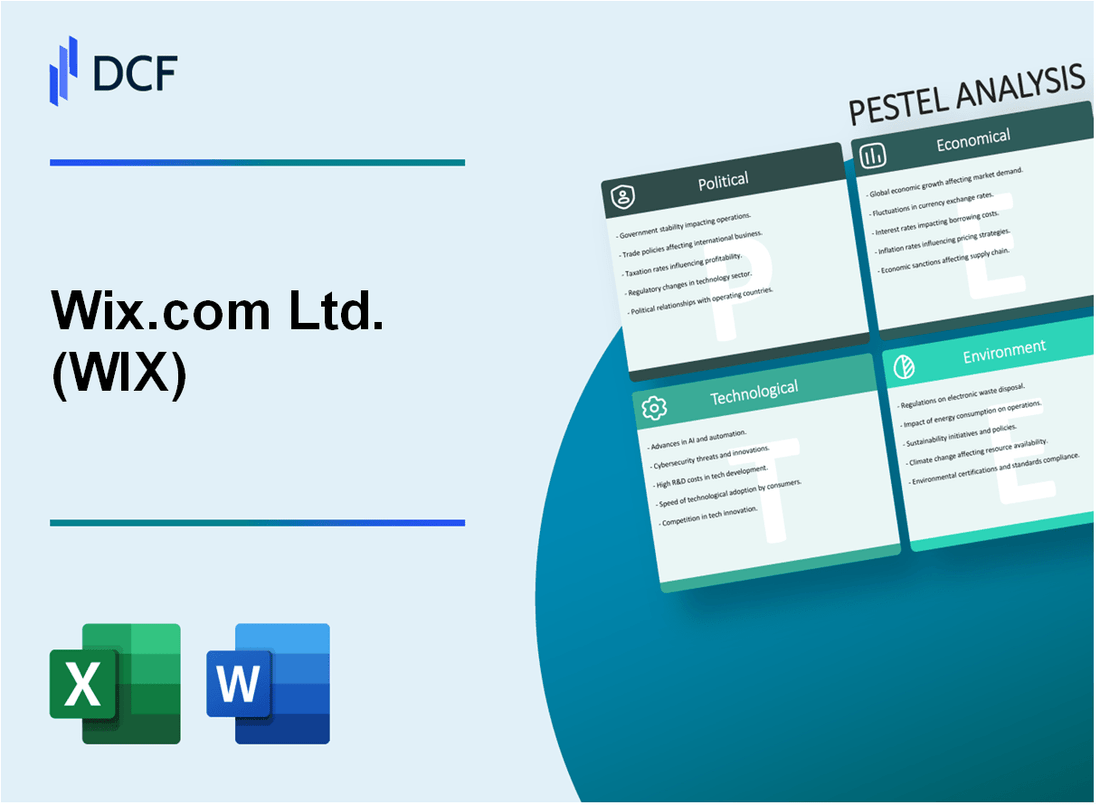
Wix.com Ltd. (WIX): PESTLE Analysis [Nov-2025 Updated] |
Fully Editable: Tailor To Your Needs In Excel Or Sheets
Professional Design: Trusted, Industry-Standard Templates
Investor-Approved Valuation Models
MAC/PC Compatible, Fully Unlocked
No Expertise Is Needed; Easy To Follow
Wix.com Ltd. (WIX) Bundle
Wix.com Ltd. (WIX) is currently facing a dual challenge: capitalizing on the explosive growth in e-commerce and the gig economy while simultaneously managing significant geopolitical instability and the relentless pressure of AI-driven competition. The near-term strategy hinges on navigating rising global inflation that squeezes small business budgets and ensuring continuous compliance with complex global data privacy laws like GDPR and CCPA. The company is at an inflection point where its R&D's geopolitical exposure and its ability to integrate cutting-edge AI will defintely determine its market share in 2025.
Wix.com Ltd. (WIX) - PESTLE Analysis: Political factors
Geopolitical stability in Israel directly impacts core R&D operations.
The political stability of Israel, where Wix.com Ltd. is headquartered and maintains its core research and development (R&D) operations, remains a significant political risk that directly affects its operating model. You need to view this as a potential supply-chain risk for innovation, not just a regional conflict. Despite the geopolitical difficulties in the region, including the conflict in Gaza and its spillover effects, Wix has demonstrated resilience.
For the twelve months ending June 30, 2025, Wix's R&D expenses were substantial at $0.514 billion, reflecting a 3.97% year-over-year increase, showing continued investment despite the environment. The company's management noted in February 2025 that two-thirds of its workforce was in 'war zones-Ukraine and Israel,' yet they still delivered strong financial performance. This exposure necessitates operational contingencies, but it also highlights the company's commitment to its Israeli base, including granting stock options to employees called up for reserve duty. The escalating Israel-Iran conflict in mid-2025 further underscores the volatility, which could disrupt staffing or infrastructure.
Increased global scrutiny on tech company market dominance (antitrust risk).
Global antitrust scrutiny is intensifying, moving beyond just the largest platforms like Google and Meta to focus on acquisitions of nascent (early-stage) competitors and platform conduct like interoperability restrictions. For Wix, which is a market leader in the commercial website building segment, this scrutiny maps directly to its growth strategy, especially its recent M&A activity.
The company is actively gaining market share and its acquisition strategy is key. For example, the 2025 acquisition of Base44, an AI-driven offering, is expected to accelerate its Annual Recurring Revenue (ARR) to between $40 million and $50 million by year-end 2025. Regulators are increasingly scrutinizing such vertical mergers and acquisitions of smaller, innovative firms to prevent the stifling of future competition. Wix needs to ensure its platform's policies on third-party developers, data access, and interoperability meet the spirit of new regulations like the EU's Digital Markets Act (DMA), even if Wix is not yet designated a 'gatekeeper.'
US-EU data transfer agreements influence international cloud operations.
The regulatory environment for cross-border data transfers remains a high-risk area for any global cloud platform. The stability of the EU-U.S. Data Privacy Framework (DPF), which allows certified U.S. companies to receive EU personal data, is constantly under legal challenge, particularly given the political shifts in the U.S. in 2025.
However, Wix benefits from a critical political advantage: its primary data controller, Wix.com Ltd., is based in Israel, a country that the European Commission has deemed to offer an adequate level of protection for the personal information of EU residents. This 'adequacy decision' provides a stronger, more stable legal basis for transferring EU user data to its Israeli headquarters compared to its US-based competitors who rely solely on the DPF or Standard Contractual Clauses (SCCs). Still, Wix must maintain compliance with the DPF for data transfers to its U.S. subsidiaries, like Wix.com Inc., and it must adhere to the EU's Digital Services Act (DSA) for content moderation and law enforcement requests, which is a new compliance layer.
Government adoption of digital services creates new, specialized contract opportunities.
The trend of government agencies modernizing their digital infrastructure presents a clear, specialized opportunity for Wix, particularly in the Small Business (SB) contracting space in the U.S. The federal government is actively streamlining procurement and pushing for greater adoption of commercial-off-the-shelf (COTS) software and AI tools.
The U.S. government's goal is to award 15% of federal contracting dollars to small, disadvantaged businesses by 2025, which opens a significant market for Wix's professional-grade tools like Wix Studio. Wix's launch of 'Wix Proposals,' a tool for creating and managing long-term financial engagements, is well-suited for the complex proposal and contract management required for government work. The opportunity is not in selling the platform to a government agency, but in enabling the millions of small businesses and consultants who do contract with the government to build compliant, professional, and secure digital presences using Wix's ecosystem.
| Political Factor | Near-Term Risk (2025) | Near-Term Opportunity (2025) | Impact Metric / Value |
|---|---|---|---|
| Geopolitical Stability (Israel) | Operational disruption due to conflict escalation and reserve duty call-ups. | Strengthened talent pool loyalty due to company support (stock options, etc.). | R&D Expenses (TTM Q2 2025): $0.514 Billion. |
| Antitrust Scrutiny (Global) | Increased regulatory risk for M&A, particularly for acquisitions of nascent AI competitors like Base44. | Proactive compliance can differentiate Wix from larger, more entrenched 'Big Tech' firms. | Base44 ARR (Expected Year-End 2025): $40 Million - $50 Million. |
| US-EU Data Transfer Agreements | Potential invalidation of the EU-U.S. Data Privacy Framework (DPF) creates legal uncertainty for data transfers to U.S. subsidiaries. | Israeli headquarters provides an 'Adequacy Decision' advantage over US-only competitors for EU data control. | EU Adequacy Decision (Israel): High-Level Legal Stability. |
| Government Digital Adoption | Compliance burden from new EU regulations like the Digital Services Act (DSA). | New market segment by enabling small business contractors to meet digital government standards. | U.S. Federal Contracting Goal (Small, Disadvantaged Businesses 2025): 15% of federal dollars. |
Wix.com Ltd. (WIX) - PESTLE Analysis: Economic factors
Global inflation pressures small and medium-sized business (SMB) customer budgets
You can't talk about 2025 economics without starting with inflation, because it hits Wix's core customer base-the small business owner-right in the cash flow. The International Monetary Fund (IMF) projects global inflation will ease to around 4.5% in 2025, but that's still well above historical norms. For an SMB, this means higher input costs for everything from raw materials to wages, which makes every subscription dollar a tougher decision.
In Q1 2025, a record-setting 58% of small business owners cited inflation as a major concern, up from 19% when tracking began in 2021. Wix's challenge is to prove that its platform is a cost-saver and revenue-driver, not just another expense line. The good news is that Wix's full-year 2025 revenue guidance is still strong, projected at $1.990 billion to $2.000 billion, up 13% to 14% year-over-year, which suggests its value proposition is holding up, but the pressure on customer acquisition cost (CAC) and churn risk is defintely elevated.
- 58% of SMBs cite inflation as a top Q1 2025 concern.
- Higher costs force SMBs to scrutinize recurring software-as-a-service (SaaS) fees.
- Wix must justify its premium pricing with clear return on investment (ROI).
Higher interest rates increase the cost of capital for competitors, but also for Wix's own expansion
The higher interest rate environment, a central bank tool to combat inflation, impacts capital allocation for all tech companies. While the pace of rate hikes may slow, the cost of debt remains higher than the pre-2020 average. This makes it more expensive for smaller, less-capitalized competitors to raise money for expansion, which is a competitive advantage for a company like Wix with a solid cash position.
Still, Wix itself isn't immune. Here's the quick math: analysts have noted that Wix's Return on Invested Capital (ROIC) is currently less than its Weighted Average Cost of Capital (WACC), which signals potential inefficiencies in how capital is being deployed for growth initiatives, like the significant investment in the Base44 AI platform. This is a critical metric to monitor, especially as the company forecasts approximately $600 million in Free Cash Flow (FCF) for the full year 2025.
US dollar strength affects revenue translation from international markets
Wix is a global platform, and currency volatility is a persistent headwind. International revenue accounts for a significant portion of the business-about 53% of total revenue as of Q1 2025. When the US dollar strengthens against currencies like the Euro or the British Pound, the revenue generated in those markets translates into fewer dollars upon consolidation. This translation effect can mute reported top-line growth, even if the underlying business performance in local currency is excellent.
This currency risk is why you see management focus heavily on non-GAAP (Generally Accepted Accounting Principles) metrics, trying to separate operational performance from FX noise. The Q3 2025 total revenue of $505.19 million was a 13.6% year-over-year increase, but a stronger dollar environment means they have to work harder just to hit the dollar-denominated guidance.
E-commerce sector's continued growth drives demand for premium Business Solutions subscriptions
The secular trend toward digital commerce is a massive tailwind that directly benefits Wix's higher-margin products. The global e-commerce market is projected to be worth around $6.42 trillion in 2025, with a growth rate of about 6.8% to 7.8% over the year. This massive market expansion drives demand for Wix's Business Solutions segment (e-commerce, payments, bookings, etc.) because every new online store needs a platform.
This is where the real opportunity lies. In Q3 2025, the Business Solutions segment revenue was $149.02 million, showing a robust year-over-year growth of 18.4%. This growth rate significantly outpaces the Creative Subscriptions segment and is crucial for hitting the full-year revenue target of up to $2.000 billion. The table below shows the segment breakdown, highlighting the strategic shift toward these higher-value services.
| Wix Q3 2025 Financial Metric | Amount | Year-over-Year (Y/Y) Growth |
|---|---|---|
| Total Revenue | $505.19 million | 13.6% |
| Creative Subscriptions Revenue | $356.17 million | 11.7% |
| Business Solutions Revenue | $149.02 million | 18.4% |
| Full-Year 2025 Revenue Outlook (Midpoint) | ~$1.995 billion | ~13.5% |
| Full-Year 2025 Free Cash Flow (FCF) Outlook | ~$600 million | ~30% of revenue |
Wix.com Ltd. (WIX) - PESTLE Analysis: Social factors
Permanent shift to remote work and the gig economy expands the target user base defintely.
The structural shift toward remote work and the gig economy is a massive tailwind for Wix.com Ltd. (WIX). We're not just seeing a temporary trend; this is a permanent change in how people earn a living, which directly translates into millions of new potential users who need a professional digital storefront fast. The global gig economy market is projected to be valued at a staggering $582.2 billion in 2025, up from previous years, and the U.S. alone has approximately 76.4 million freelancers this year.
This huge, fragmented workforce needs a simple, all-in-one platform for their business. Wix already captures a significant portion of this market, with over 272 million registered users globally as of early 2025. Nearly 79% of all active Wix sites belong to small businesses and solo entrepreneurs, showing the platform's core strength is serving this self-starter demographic. The 'Wix for Freelancers' program, which caters specifically to this group, has grown to over 600,000 active participants worldwide.
Here's the quick math: more freelancers mean more demand for DIY website creation, and Wix is positioned perfectly to catch that demand. If onboarding takes 14+ days, churn risk rises, so simplicity is everything.
| Gig/Freelancer Market Metric (2025) | Amount/Value | Implication for Wix |
|---|---|---|
| Global Gig Economy Market Size | $582.2 billion | Represents the total addressable market for business creation tools. |
| U.S. Freelancer Population | 76.4 million | A massive, highly-digitalized core customer base in the largest market. |
| Wix Active Sites by Small Business/Solo | 79% | The platform's core product-market fit is validated by small-scale users. |
Strong user demand for no-code/low-code tools simplifies website creation.
The social demand for speed and simplicity is driving the no-code/low-code movement, which is central to Wix's entire value proposition. People want to build complex digital tools without writing a single line of code. The global no-code development platforms market size is projected to hit $35.61 billion in 2025, growing at a 26.7% compound annual growth rate (CAGR).
This trend is so powerful that it's changing the enterprise landscape, too. By 2025, it's estimated that 70% of new applications developed by organizations will use low-code or no-code technologies, up from less than 25% just a few years ago. This shift is creating a new class of 'citizen developers' who will outnumber professional developers by a ratio of 4 to 1 by 2025. Wix is actively capitalizing on this with new AI-driven products.
- Wix launched Wixel in Q1 2025, an AI-powered visual design platform.
- The Wix Editor X and Wix Studio platforms now account for 20% of new sign-ups.
- No-code saves time, cutting app development time by up to 90%.
Rise of the creator economy requires specialized portfolio and monetization tools.
The creator economy-the market of individuals who monetize their content and audience-is exploding, and it's a key demographic for Wix. This market is estimated to be valued at approximately $253.1 billion in 2025. The majority of this value, a 58.7% market share, comes from individual content creators who need professional, owned platforms to control their brand and revenue streams, rather than relying solely on social media algorithms.
Wix has been smart to pivot its offerings to meet these needs, moving beyond simple brochure sites to full-stack business solutions. They host over 1.1 million portfolios for creative professionals, including photographers and designers. Furthermore, Wix Bookings, a tool essential for solo practitioners like fitness coaches and therapists, saw a 17% increase in usage, showing a direct link between the platform's tools and the growth of the service-based creator.
Consumer preference for seamless mobile-first experiences drives product development priorities.
The social reality is that most people live on their phones, and that's where they shop and consume content. This consumer preference for a seamless mobile-first experience is not optional; it's the standard. For Wix, this means mobile performance is the single biggest factor in user engagement and conversion. In 2025, a significant 61% of all Wix site traffic comes from mobile devices.
Wix's product development is clearly aligned with this fact. Mobile-first design is now enabled by default in 92% of new Wix sign-ups, essentially forcing new users to adopt the best practice. For e-commerce, the numbers are even more stark: over 70% of Wix store checkouts are now completed on smartphones. This mobile dominance is why Wix holds a strong 38% market share in the mobile website segment as of Q2 2025. The focus has to be on reducing that 12% higher mobile bounce rate.
Wix.com Ltd. (WIX) - PESTLE Analysis: Technological factors
The technological landscape for Wix.com Ltd. in 2025 is defined by a massive, two-pronged investment strategy: hyper-automation through Artificial Intelligence (AI) for the novice user, and a sophisticated, code-friendly platform for professional developers. This dual focus is necessary, but it's also straining near-term profitability, as seen in the Q3 2025 results.
You need to understand that Wix is fundamentally shifting from a simple website builder to a full-stack digital presence platform, and that requires heavy, constant reinvestment in core technology. The quick math here is that increased AI compute costs are a significant headwind to margins right now.
AI-driven website builders (e.g., Wix ADI) intensify competition and lower entry barriers
Wix's aggressive push into generative AI is both a competitive advantage and a market disruptor. Tools like Wix ADI (Artificial Design Intelligence) and the newer AI Site Builder 2.0 now automate the entire initial site creation process, which defintely lowers the barrier to entry for small businesses and individual creators.
This automation means Wix can capture a larger share of the 'self-creator' market, but it also intensifies competition with every other platform integrating similar AI features. The acquisition of the AI-driven app builder Base44 in June 2025 is a critical move, and its Annual Recurring Revenue (ARR) is targeted to reach at least $50 million by year-end 2025, demonstrating the scale of this new focus. This is a land grab for the next generation of online entrepreneurs.
The financial impact of this investment is clear in the company's recent filings:
| Metric (2025 Fiscal Year Data) | Value | Context |
|---|---|---|
| Q3 2025 Total Revenue | $505.2 million | Up 13.6% year-over-year. |
| Full Year 2025 Revenue Outlook | $1.99 - $2.00 billion | Strong top-line growth, but margin pressure remains. |
| Full Year 2025 Non-GAAP Operating Expenses Outlook | Approximately 50% of revenue | Reflects higher R&D and marketing costs for AI/Base44. |
| Q3 2025 GAAP Net Loss | $589,000 | A 102.2% deterioration from prior year profit, driven by R&D costs. |
Platform security against sophisticated cyber threats requires constant, heavy investment
Maintaining a cloud-based platform for over 272 million registered users requires enterprise-grade security, and the sophistication of cyber threats is rising. Wix has responded by embedding security into its core development lifecycle-a 'security by design' approach-and deploying new, advanced defenses.
Specifically, the 2025 platform updates include AI-Driven Threat Detection systems that analyze traffic patterns in real-time to identify and mitigate attacks like Distributed Denial of Service (DDoS) attempts. This isn't a one-time cost; it's a perpetual, escalating expense that falls under the R&D umbrella. If a major platform-wide breach were to occur, the damage to brand trust and user churn would be catastrophic, so this heavy investment is non-negotiable.
The security measures include:
- AI-Driven Threat Detection for real-time monitoring.
- Data encryption using HTTPS, TLS 1.2 and above, and SSL certificates for all sites.
- Anti-DDoS Protection as a core, built-in feature.
5G network rollout enables richer, faster site performance and complex web applications
The ongoing rollout of 5G networks in the US and globally is a massive tailwind for Wix's customers. 5G offers speeds up to 100 times faster than 4G and ultra-low latency, sometimes as low as 1-5 milliseconds. This shift fundamentally changes what a website can do.
For Wix, which sees 61% of its site traffic come from mobile devices in 2025, this means their users can now reliably host and run complex, media-rich applications without performance degradation. Think high-definition video streaming, real-time collaboration tools, and immersive Augmented Reality (AR) experiences on an e-commerce store. Wix must continue to optimize its platform for this new mobile-first, high-bandwidth reality, ensuring its sites load instantaneously to keep bounce rates low.
Velo by Wix (open-source development platform) attracts a crucial developer community
While Wix ADI targets the no-code user, Velo by Wix-the open-source development platform-is the crucial technological bridge to the professional developer and agency market. This platform allows developers to extend the core Wix functionality with custom code, APIs, and integrations, essentially turning the simple builder into a powerful, extensible application development environment.
Attracting this developer community is a long-term strategic play, as they are the ones building the most complex, high-value sites. The growth of the Wix Partner Program by 18% is a strong indicator that this strategy is gaining traction, with agencies and freelancers adopting platforms like Wix Studio (which leverages Velo) for their client work. This ecosystem is a key source of high-tier subscription revenue and long-term customer retention.
Wix.com Ltd. (WIX) - PESTLE Analysis: Legal factors
Global data privacy laws (like GDPR and CCPA) require continuous compliance and audit
The regulatory environment for data privacy is a significant and escalating legal factor for Wix.com Ltd., primarily due to its global user base. The European Union's General Data Protection Regulation (GDPR) and the California Consumer Privacy Act (CCPA) are the benchmarks, but the trend is global, requiring continuous, proactive compliance.
Wix operates as the data processor, providing tools, but its millions of customers are the 'data controllers' and bear the final responsibility. This distinction is critical, but Wix still faces platform liability and reputational risk if its tools are defintely inadequate. Non-compliance with GDPR can result in severe financial penalties, reaching up to €20 million or 4% of the company's annual global revenue, whichever amount is higher. The complexity is high because compliance requires site owners to properly configure cookie banners, manage third-party app consent, and honor data subject requests (like the Right to be Deleted).
- Wix provides the compliance tools.
- Customers must correctly set up the tools.
- Fines are severe for non-compliance.
Changes in international digital services tax (DST) impact pricing and profitability
The global push for Digital Services Tax (DST) is a volatile and direct threat to Wix's profitability, as it targets revenue derived from digital activities in jurisdictions where the company lacks a physical presence. This shifting landscape forces Wix to constantly re-evaluate its pricing models and tax provisions.
The volatility is clear: in June 2025, Canada rescinded its DST legislation, avoiding a potential retroactive tax payment of approximately $2.7 billion from major US tech companies, which highlights the risk of sudden, massive tax liabilities. Still, the cumulative cost of DSTs in countries like the UK, France, Spain, and Italy has already cost US companies over $9 billion from 2020-2024. For the 2025 fiscal year, Wix's Q3 2025 earnings showed a net loss of $0.589 million, which was primarily attributed to a sharp increase in income tax expenses, which rose to $12.280 million compared to $3.075 million in the prior year, signaling that tax-related legal and regulatory changes are already hitting the bottom line.
Intellectual property disputes over design templates and code are a persistent risk
As a platform that provides core design templates, code snippets, and now AI-generated content, Wix is constantly exposed to intellectual property (IP) disputes, ranging from copyright infringement on user content to patent litigation on its proprietary technology.
The company's Terms of Use, last revised in October 2025, explicitly carve out IP disputes from mandatory arbitration, confirming that these matters will be resolved in a court of proper jurisdiction. This means high-cost, high-visibility litigation is a persistent risk. The integration of generative AI into its platform, such as for automatic site generation, introduces a new layer of risk concerning the IP ownership and compliance of the AI-generated 'Output,' which Wix disclaims responsibility for regarding accuracy and IP compliance. Here's the quick math: defending a single complex patent infringement lawsuit can easily cost a company millions of dollars in legal fees.
| IP Risk Area | Wix's Legal Posture (2025) | Near-Term Impact |
|---|---|---|
| Design Templates/Code | Formal DMCA/Trademark infringement reporting process. | Continuous, low-level legal overhead and takedown costs. |
| Proprietary Technology | Active US patent portfolio (e.g., for AI-based site generation, Editor X). | Higher risk of patent infringement lawsuits from competitors; high defense costs. |
| AI-Generated Output | Disclaims responsibility for IP compliance of AI 'Output' in Terms of Use. | Shifts liability to the user, but exposes Wix to platform-level litigation over the AI model itself. |
Website accessibility standards (ADA compliance) are mandatory for key US markets
Website accessibility, governed by the Americans with Disabilities Act (ADA) in the US, is a rapidly growing area of litigation that presents a significant legal risk to Wix and its US-based customers.
The number of ADA website accessibility lawsuits in US federal courts continues to surge, with 2,019 cases filed in the first half of 2025, and projections suggesting the year-end total could reach 4,975 suits. This is a huge volume. The e-commerce industry, a key focus for Wix's Business Solutions, is the most heavily impacted, accounting for 69% of all web accessibility lawsuits filed in the first half of 2025. While Wix offers an Accessibility Wizard, its templates are not inherently fully ADA-compliant; customers must still invest in third-party audits and solutions to avoid costly litigation, which can include significant settlement amounts and mandatory website remediation costs.
The risk here is two-fold: direct liability for Wix as a platform provider and the indirect risk of customer churn if their sites are constantly being sued for non-compliance. This is not a technical issue; it's a legal one.
Wix.com Ltd. (WIX) - PESTLE Analysis: Environmental factors
Growing customer demand for green cloud hosting influences data center provider choices.
You need to understand that for a Software as a Service (SaaS) company like Wix.com Ltd. (WIX), the environmental footprint is not primarily from factories, but from the cloud infrastructure powering its 245 million users. The market is defintely shifting, with customers and developers increasingly demanding green cloud hosting solutions.
Wix manages its global network using a multi-cloud strategy, relying on a combination of its own data centers along with major hyperscalers like Amazon Web Services (AWS) and Google Cloud Platform (GCP). This reliance means Wix's carbon reduction efforts are heavily tethered to its providers' aggressive sustainability goals. This is a smart move, as it outsources the massive capital expenditure (CapEx) of building green data centers while inheriting the benefit of their scale.
For example, AWS has a target of 100% renewable energy use by 2025, and Google Cloud is committed to operating on carbon-free energy 24/7 by 2030. Wix's core operational risk here is vendor-specific, so their choice of partners is a direct environmental strategy.
Here's the quick math: Wix's indirect carbon impact (Scope 3) is driven by its web hosting and e-commerce platform software, making the cloud provider's environmental performance a critical factor for Wix's own sustainability claims. You can't be green if your cloud isn't.
Corporate Social Responsibility (CSR) reporting is a key factor for institutional investors.
The days of investors ignoring environmental, social, and governance (ESG) factors are over. For Wix, transparent CSR reporting is a non-negotiable requirement for maintaining institutional confidence and capital access in 2025.
Wix's latest ESG report, released in 2024, is significant because it includes, for the first time, disclosures on Scope 3 greenhouse gas (GHG) emissions related to cloud usage, which is the largest component of a software company's value chain emissions. This level of transparency is what major institutional investors-like Wellington Management Group LLP, which holds over 6.043% of shares as of November 2025-are demanding.
The market is prioritizing data quality. The total shares owned by institutions increased by 5.29% in the last three months of 2025, showing that a clear ESG narrative is attracting capital. Wix's net impact ratio, as measured by some third-party analysts, is around 16.0%, indicating an overall positive impact, but the negative contribution from GHG emissions remains a focus area that requires constant management.
Reducing the carbon footprint from global server infrastructure is a long-term operational goal.
The primary environmental challenge for Wix is the energy consumption of its massive global server infrastructure. This challenge is addressed through two main channels: internal efficiency and external provider selection.
The long-term goal is to minimize the total equivalent carbon dioxide (Mt CO2e) output. Since direct operational emissions (Scope 1 and 2) are small for a pure software company, the focus must be on the indirect Scope 3 emissions from purchased services, primarily cloud hosting. Wix's strategy is to leverage the scale of its providers to meet this goal.
The following table summarizes the key environmental metrics and targets that directly impact Wix's long-term operational goal:
| Environmental Metric | Wix.com Ltd. (WIX) Action/Status (2025) | Indirect Impact/Provider Target |
|---|---|---|
| GHG Emissions (Scope 3 - Cloud) | First-time inclusion in 2024 ESG report for cloud usage. | AWS goal of 100% renewable energy by 2025. |
| GHG Emissions (Scope 1 & 2 - Direct) | Year-over-year comparisons reported for office operations. | Focus on office energy/water efficiency benchmarks set in 2023. |
| Data Center Efficiency | Leveraging multi-cloud network (AWS, GCP, Fastly). | Google Cloud goal of carbon-free energy 24/7 by 2030. |
Sustainable office practices and supply chain transparency are becoming standard requirements.
While cloud infrastructure dominates the carbon conversation, the physical office footprint and supply chain due diligence (the upstream) are increasingly scrutinized. Wix has moved past simple qualitative statements to establish concrete benchmarks for its global offices.
Starting in 2023, Wix began collecting and reporting environmental data from its global sites to assess energy and water efficiency, which is the foundational step for setting reduction targets. This helps manage the smaller, but still material, Scope 1 and 2 emissions from corporate facilities.
Supply chain transparency is also a core focus, especially with regulations like the EU's Corporate Sustainability Reporting Directive (CSRD) creating a trickle-down effect on all global suppliers. Wix's Supplier Code of Conduct explicitly mandates environmental and ethical standards, requiring suppliers to:
- Use resources efficiently and apply energy-efficient technologies.
- Minimize negative impact on biodiversity and climate change.
- Reduce waste and emissions to air, water, and soil.
This shows a clear, proactive step to mitigate risk from its upstream value chain, ensuring that the laptops, office supplies, and other goods purchased meet a minimum environmental bar.
Disclaimer
All information, articles, and product details provided on this website are for general informational and educational purposes only. We do not claim any ownership over, nor do we intend to infringe upon, any trademarks, copyrights, logos, brand names, or other intellectual property mentioned or depicted on this site. Such intellectual property remains the property of its respective owners, and any references here are made solely for identification or informational purposes, without implying any affiliation, endorsement, or partnership.
We make no representations or warranties, express or implied, regarding the accuracy, completeness, or suitability of any content or products presented. Nothing on this website should be construed as legal, tax, investment, financial, medical, or other professional advice. In addition, no part of this site—including articles or product references—constitutes a solicitation, recommendation, endorsement, advertisement, or offer to buy or sell any securities, franchises, or other financial instruments, particularly in jurisdictions where such activity would be unlawful.
All content is of a general nature and may not address the specific circumstances of any individual or entity. It is not a substitute for professional advice or services. Any actions you take based on the information provided here are strictly at your own risk. You accept full responsibility for any decisions or outcomes arising from your use of this website and agree to release us from any liability in connection with your use of, or reliance upon, the content or products found herein.