

|
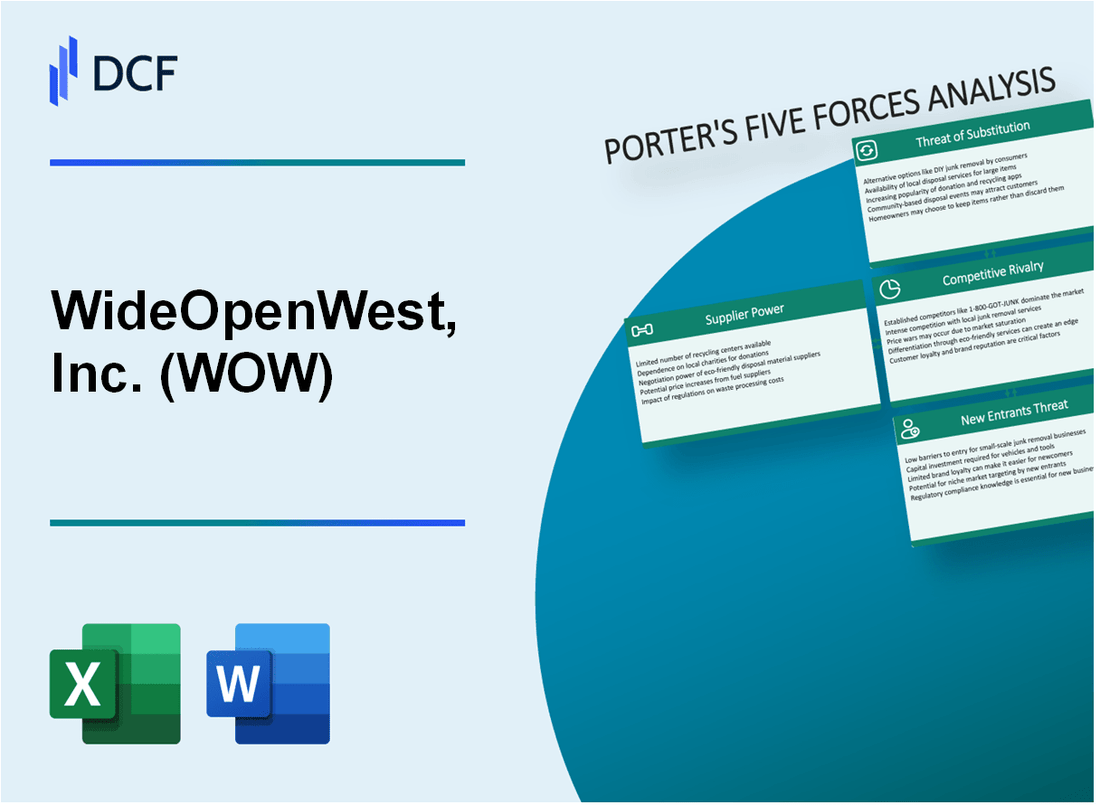
WideOpenWest, Inc. (WOW): 5 FORCES Analysis [Nov-2025 Updated] |
Fully Editable: Tailor To Your Needs In Excel Or Sheets
Professional Design: Trusted, Industry-Standard Templates
Investor-Approved Valuation Models
MAC/PC Compatible, Fully Unlocked
No Expertise Is Needed; Easy To Follow
WideOpenWest, Inc. (WOW) Bundle
You're looking at a classic broadband battleground with WideOpenWest, Inc. (WOW) right in the thick of it, trying to turn a costly fiber build into a win while facing down giants and nimble new fiber overbuilders. Honestly, the numbers from late 2025 tell a tough story: Q3 revenue was down $\mathbf{8.9\%}$ year-over-year to $\mathbf{\$144.0 \text{ million}}$, and they shed another $\mathbf{4,900}$ data subscribers that quarter, showing just how much power customers wield in a low-switching-cost world. Still, there are small wins, like programming costs falling $\mathbf{\$8.3 \text{ million}}$ as video shrinks, but the real question is whether this challenger can withstand the intense rivalry and the threat of substitutes like Fixed Wireless Access. Dive into the full five forces analysis below to see exactly where the pressure points are and what this means for their next move.
WideOpenWest, Inc. (WOW) - Porter's Five Forces: Bargaining power of suppliers
When you look at WideOpenWest, Inc.'s (WOW) supplier power, you're really looking at a tale of two supplier groups: the content providers for video and the equipment manufacturers for the network build-out. The balance of power is definitely shifting as WOW! pivots its strategy.
Programming Costs and Content Providers
For years, content providers held significant leverage, but that's changing fast as customers cut the cord. You can see this directly in the numbers from the third quarter of 2025. Operating expenses, excluding depreciation and amortization, dropped by 13.9% year-over-year to $53.9 million for the quarter ending September 30, 2025. The key driver here was a reduction in programming expenses, which fell by $8.3 million compared to Q3 2024. Honestly, this cost reduction directly mirrors the declining video subscriber base.
This trend confirms that WOW!'s video RGU (Revenue Generating Unit) decline is actively reducing the leverage held by traditional content providers. When you have fewer video customers, your total spend on content licenses goes down, giving you more negotiating room. The company's focus on its core HSD (High-Speed Data) product means less reliance on the expensive video bundle.
- Programming expense dropped $8.3 million YoY in Q3 2025.
- Total subscribers were down 5% year-over-year as of September 30, 2025.
- Total subscription revenue fell 8.9% in Q3 2025 compared to Q3 2024.
Network Equipment Suppliers and Capital Intensity
On the other side, you have the suppliers for fiber optic cable and network gear. This side of the equation still commands moderate power. Building out a modern, scalable fiber network-which WOW! is heavily focused on-requires hefty upfront capital expenditure (CAPEX) for materials like fiber strands, distribution hubs, and networking equipment. This capital intensity keeps the barrier to entry high for new suppliers and gives established ones a solid footing.
Here's a quick look at how CAPEX has been managed recently, showing where the spending is going:
| Period Ended | Total Capital Expenditures | Change YoY | Core CAPEX (% of Revenue) |
|---|---|---|---|
| March 31, 2025 (Q1) | $38.9 million | Decrease of $33.6 million | 16% |
| June 30, 2025 (Q2) | Not explicitly stated as Total CAPEX | N/A | 19% |
| September 30, 2025 (Q3) | $52.5 million | Increase of $12.0 million | N/A |
The increase in CAPEX to $52.5 million in Q3 2025, up $12.0 million from the prior year, reflects this ongoing investment in scalable infrastructure. While the company had an initial goal to build fiber to 200,000 locations by 2025, the need for continuous upgrades and expansion means these equipment suppliers maintain leverage based on WOW!'s high capital needs.
Strategic Shift and Spend Allocation
The core of WOW!'s strategy is clearly shifting spend away from legacy video content and toward high-speed data infrastructure. The CFO noted in Q2 2025 that a lower cost base, achieved by reducing video-related expenses, enables further investment in the Greenfield growth strategy. This strategic realignment directly impacts the bargaining power dynamic. Less spend on video content means less power for those suppliers, while increased investment in fiber means more reliance on, and thus more power for, network equipment suppliers.
The HSD (High-Speed Data) segment is the future, even though HSD Revenue saw a slight dip of 0.8% to $106.6 million in Q3 2025. The company is doubling down on its fiber build-out, passing 106,600 homes in Greenfield markets by Q3 2025, with a 16.0% penetration rate there. This focus means the power dynamic favors suppliers who can provide the necessary fiber and network technology to support this growth.
Finance: draft a sensitivity analysis on fiber equipment procurement costs versus the $1.5 billion enterprise value of the pending acquisition by Friday.
WideOpenWest, Inc. (WOW) - Porter's Five Forces: Bargaining power of customers
You're looking at the customer power side of the equation for WideOpenWest, Inc. (WOW), and the reality is that the power held by the end-user is significant in the current broadband environment. Power is high because customers have numerous alternatives, and for many, the cost to switch providers-the switching cost-is low or effectively zero, especially when a new fiber competitor rolls into a neighborhood. This dynamic puts constant pressure on WideOpenWest, Inc. to deliver superior value.
The numbers from the third quarter of 2025 clearly show this pressure in action. Despite efforts to retain customers, WideOpenWest, Inc. experienced a net loss of 4,900 High-Speed Data (HSD) Revenue Generating Units (RGUs) for the quarter ending September 30, 2025. This volume loss contributed to a total subscriber base that fell to approximately 464,500 total broadband subscribers. Honestly, losing nearly five thousand core service units in a single quarter is a clear signal of buyer leverage.
Still, the story isn't entirely negative on the retention front, particularly in the established service areas. WideOpenWest, Inc.'s churn in its legacy markets is reported as being near record lows. This suggests that for the customers who stay, the value proposition-which the company emphasizes as no contracts, no data caps, and simplified pricing-is resonating well against primary competitors like Comcast and Charter, as well as the growing threat of fixed wireless services.
Here's a quick look at how the volume loss and pricing power balanced out in the third quarter of 2025:
| Metric | Q3 2025 Result | Context/Impact |
|---|---|---|
| Net HSD RGU Change | -4,900 loss | Direct volume erosion from customer choice. |
| Total Subscription Revenue Change YoY | Down 8.9% | Driven by service mix shift and volume decline. |
| ARPU Increase (Absolute) | $4.9 million increase | Partially offset revenue decline due to rate hikes. |
| Legacy Churn Rate | Near record lows | Indicates high satisfaction among retained legacy customers. |
The push for new growth is evident in the expansion markets, which partially masked the legacy losses. The company added 3,700 fiber subscribers in its expansion areas, which include both Greenfield builds and 'edge-out' projects adjacent to the existing footprint. This expansion activity is crucial for future revenue stability, as it brings in new customers less exposed to incumbent competition.
Consider the specific results from the growth areas:
- Greenfield homes passed: Totaled 106,600 as of Q3 2025.
- Greenfield penetration rate: Maintained at 16.0%.
- New Greenfield HSD subscribers added: Approximately 2,500.
- Edge-out strategy success: Added 3,700 homes in legacy markets.
- 2025 Edge-out vintage penetration: Nearing 30%.
The fact that Average Revenue Per Unit (ARPU) is increasing-driven by rate increases implemented earlier in 2025 and customers opting for faster speeds-is a direct countermeasure to volume erosion. The $4.9 million increase in ARPU helped cushion the $7.3 million decrease in volume across all services. This strategy aims to extract more value from the customers who choose to stay, effectively increasing the cost of switching for them, even if the initial barrier to entry is low. Finance: draft the Q4 2025 ARPU forecast based on current speed-tier migration trends by next Tuesday.
WideOpenWest, Inc. (WOW) - Porter's Five Forces: Competitive rivalry
You're looking at an industry where the incumbents are massive, and the pressure is coming from every direction. Honestly, the competitive rivalry for WideOpenWest, Inc. (WOW) is defintely at the top of the scale. This isn't a quiet market; it's a fight for every single subscriber.
Rivalry is extremely high against incumbent cable giants like Comcast and Charter. These players have scale and deep pockets, which means they can deploy aggressive pricing or bundle services WideOpenWest, Inc. (WOW) might struggle to match across its footprint. The financial results from Q3 2025 clearly show the strain this puts on WideOpenWest, Inc. (WOW): Total revenue for Q3 2025 was $144.0 million, reflecting an 8.9% year-over-year decline. That drop isn't just a number; it's the direct result of this intense competition.
Here's a quick look at the scale of the giants WideOpenWest, Inc. (WOW) is up against, based on their Q3 2025 numbers:
| Metric | WideOpenWest, Inc. (WOW) (Q3 2025) | Comcast (Q3 2025) | Charter (Q3 2025) |
|---|---|---|---|
| Total Revenue | $144.0 million | Not Directly Comparable | Not Directly Comparable |
| Residential Internet Subscribers | Approx. 464,500 | 29 million | 27.8 million |
| YoY Subscriber Change | Down 5% | Lost 104,000 in Q3 | Subscribers decreased from 28.2 million (Q3 2024) |
| Adjusted EBITDA | $68.8 million | Not Directly Comparable | Not Directly Comparable |
Competition is intensifying from new fiber overbuilders in Greenfield expansion markets. WideOpenWest, Inc. (WOW) is fighting back by building its own next-generation network, but it's an expensive race. You have to watch the penetration rate closely here. While WideOpenWest, Inc. (WOW) is adding customers in these new areas, the overall subscriber base is still shrinking in legacy territories.
Consider the progress in the new builds:
- Total homes passed in Greenfield markets reached 106,600.
- Subscribers added in Greenfield markets during Q3 2025 totaled 2,500.
- The penetration rate in these new Greenfield markets stands at 16.0%.
- HSD RGUs (High-Speed Data Revenue Generating Units) saw a net loss of 4,900 for the quarter.
Fixed Wireless Access (FWA) from T-Mobile and Verizon is actively stealing cable customers. This is a major headache because FWA often targets the price-sensitive or lower-tier broadband user, but it's increasingly appealing to higher-tier users as well due to its simplicity and no-contract nature. WideOpenWest, Inc. (WOW) noted that its success in legacy markets is partly due to offering no-contract, no-data-caps plans, which directly counters the value proposition of FWA. Still, the pressure is real, and it contributes to the overall subscriber loss WideOpenWest, Inc. (WOW) experienced, with total subscribers falling by 5% year-over-year to approximately 464,500 as of September 30, 2025. The market is definitely punishing companies that can't keep pace with the speed of fiber and the simplicity of wireless alternatives.
WideOpenWest, Inc. (WOW) - Porter's Five Forces: Threat of substitutes
The threat of substitutes for WideOpenWest, Inc. (WOW) is substantial, driven by technological shifts and the aggressive deployment of alternative last-mile solutions. You see this pressure across both the legacy video/voice base and the core high-speed data (HSD) offering.
Fixed Wireless Access (FWA) is a substantial and growing substitute, offering a viable alternative.
Fixed Wireless Access, or FWA, is a major headwind, especially in the established legacy markets where WideOpenWest, Inc. (WOW) still derives the bulk of its revenue. The global FWA market itself is valued at approximately USD 41.2 billion in 2025, projecting a Compound Annual Growth Rate (CAGR) of 13.4% through 2035. The residential segment is expected to command 72% of the FWA market share in 2025. Furthermore, the 5G FWA segment alone is accounted for at $64.10 billion globally in 2025. WideOpenWest, Inc. (WOW) leadership has explicitly noted that major mobile carriers' fixed wireless services are primary competitors in their legacy footprints. This growth, driven by 5G rollouts, directly targets the core broadband customer base WideOpenWest, Inc. (WOW) is fighting to retain.
Over-the-Top (OTT) streaming is a near-perfect substitute for WOW's declining traditional video service.
The erosion of traditional video services is evident in WideOpenWest, Inc. (WOW)'s overall subscriber trends. While the company is heavily focused on broadband, the decline in total subscribers suggests customers are cutting the cord or shifting to streaming alternatives. In Q3 2025, WideOpenWest, Inc. (WOW)'s total subscribers stood at 464,500, a year-over-year decline of 26,000 customers. This substitution pressure is what forces the company to focus almost entirely on its HSD offering to offset video/voice losses. Here's a quick look at the subscriber base as of September 30, 2025:
| Metric | Amount (Q3 2025) |
| Total Subscribers | 464,500 |
| High-Speed Data (HSD) RGUs | 457,100 |
| Year-over-Year Subscriber Decline | 26,000 |
| HSD RGU Year-over-Year Decline | 5% |
The difference between total subscribers and HSD RGUs is small, indicating that video and voice services make up a very small portion of the remaining base, which is highly susceptible to OTT substitution, like YouTube TV (which WideOpenWest, Inc. (WOW) bundles with).
WOW's legacy HFC network faces technological substitution from superior fiber-to-the-home (FTTH) networks.
Technological substitution is a major theme as WideOpenWest, Inc. (WOW) builds out its new fiber network while its legacy infrastructure remains Hybrid Fiber-Coaxial (HFC). The company's total network passes nearly 2 million residential, business, and wholesale consumers. However, the future is fiber. As of September 2025, WideOpenWest, Inc. (WOW) had surpassed 100,000 fiber homes passed in its Greenfield markets alone, a milestone representing 25% of its stated goal of 400,000 fiber homes by 2027. This aggressive FTTH build in new areas directly substitutes the older HFC technology in those regions, and competitors are also deploying fiber, making the legacy HFC plant increasingly obsolete and a target for customer migration to superior technology.
- Greenfield Fiber Homes Passed (Sept 2025): 106,600
- Greenfield Penetration Rate (Sept 2025): 16.0%
- Original 2025 FTTH Goal (from 2021): 200,000 locations
- Total Greenfield Homes Added in Q3 2025: Approximately 15,500
Satellite internet (Starlink) poses a threat, especially in the rural/Greenfield areas WOW is targeting.
Low Earth Orbit (LEO) satellite providers, primarily Starlink, offer a viable alternative, particularly in the rural and less dense areas WideOpenWest, Inc. (WOW) is targeting with its Greenfield fiber builds. Starlink reported over 2 million active customers in the United States as of July 2025. In the US, Starlink is providing median download speeds of nearly 200 Mbps during peak demand times. This performance level directly competes with WideOpenWest, Inc. (WOW)'s core HSD product. Furthermore, Starlink is actively expanding capacity, planning to launch over 400 additional satellites to the polar inclination by the end of 2025 alone. The threat is clear: a high-speed, low-latency alternative is rapidly gaining traction where WideOpenWest, Inc. (WOW) is trying to establish new market share.
WideOpenWest, Inc. (WOW) - Porter's Five Forces: Threat of new entrants
You're analyzing WideOpenWest, Inc. (WOW) and the threat of new entrants is a major factor shaping its competitive environment, especially as the company pushes its fiber expansion. Honestly, the barrier to entry in this industry is structurally high, but recent government initiatives and technological shifts are lowering it for certain players.
The threat is definitely high in new markets because of the dual forces of fiber overbuilders and federal support. The Broadband Equity, Access, and Deployment (BEAD) program, while initially fiber-focused, saw a major policy restructuring in mid-2025, shifting to a 'technology-neutral' approach that prioritizes the lowest cost per location. This change means that fiber-only builders now face stiffer competition from providers using less capital-intensive technologies to secure those government dollars. For instance, many states must now conduct another competitive funding round based on these new, cost-focused criteria, potentially opening the door wider for new, smaller, or non-fiber entrants who can propose a cheaper build, even if it's not as future-proof as pure fiber.
Fixed Wireless Access (FWA) providers, primarily the major mobile carriers, are effectively acting as new, aggressive fixed broadband entrants. They leverage their existing, massive mobile infrastructure to offer service without laying new last-mile cable. The growth here is substantial; for example, in the second quarter of 2025, T-Mobile added 454,000 fixed wireless broadband customers, bringing its total to 7.3 million. Verizon also saw significant momentum, adding 278,000 net additions in that same quarter. These players are using their existing assets to rapidly gain share, putting direct pressure on WideOpenWest, Inc.'s legacy footprint.
To be fair, the sheer cost of building a new network remains a significant barrier for truly small, independent entrants. WideOpenWest, Inc. itself reported capital expenditures of $52.5 million in the third quarter of 2025, reflecting ongoing investments in scalable infrastructure and market expansion. This level of required investment weeds out many smaller competitors who cannot secure the necessary financing for a large-scale fiber deployment.
However, WideOpenWest, Inc. is fighting fire with fire by aggressively expanding its own footprint. The company's Greenfield fiber build is a direct counter-strategy, challenging these new entrants on their own turf by deploying superior infrastructure where competition is emerging. As of the third quarter of 2025, WideOpenWest, Inc.'s Greenfield fiber build had passed 106,600 homes. This aggressive build-out, which added another 15,500 homes in Q3 2025, is WideOpenWest, Inc.'s primary defense against new fiber competitors in those specific growth areas.
Here's a quick look at the competitive landscape metrics that define the threat level from these new and emerging entrants:
| Metric | Value/Data Point | Source Context |
|---|---|---|
| WideOpenWest, Inc. Q3 2025 Capital Expenditure | $52.5 million | Investment barrier for smaller entrants |
| WideOpenWest, Inc. Total Greenfield Homes Passed (as of Q3 2025) | 106,600 homes | Direct challenge to new fiber builders |
| T-Mobile Fixed Wireless Subscribers (Q2 2025 Total) | 7.3 million | Effectively new fixed broadband entrant |
| Verizon Fixed Wireless Net Additions (Q2 2025) | 278,000 | Demonstrates rapid FWA market entry |
| Total Major Wireless Carriers FWA Net Additions (Q2 2025) | 935,000 | Aggregate new fixed broadband competition |
| BEAD Program Status (Late 2025) | Technology-Neutral, Lowest Cost Priority | Increases threat from non-fiber entrants |
The key dynamics you need to watch regarding new entrants include:
- BEAD funding reset favoring cost-efficiency over fiber.
- FWA providers rapidly adding millions of broadband subscribers.
- The high CapEx requirement still blocking most small-scale fiber startups.
- WideOpenWest, Inc.'s own Greenfield build pace as a counter-offensive.
The market is definitely getting more crowded, but the cost of entry for a true fiber competitor remains steep.
Disclaimer
All information, articles, and product details provided on this website are for general informational and educational purposes only. We do not claim any ownership over, nor do we intend to infringe upon, any trademarks, copyrights, logos, brand names, or other intellectual property mentioned or depicted on this site. Such intellectual property remains the property of its respective owners, and any references here are made solely for identification or informational purposes, without implying any affiliation, endorsement, or partnership.
We make no representations or warranties, express or implied, regarding the accuracy, completeness, or suitability of any content or products presented. Nothing on this website should be construed as legal, tax, investment, financial, medical, or other professional advice. In addition, no part of this site—including articles or product references—constitutes a solicitation, recommendation, endorsement, advertisement, or offer to buy or sell any securities, franchises, or other financial instruments, particularly in jurisdictions where such activity would be unlawful.
All content is of a general nature and may not address the specific circumstances of any individual or entity. It is not a substitute for professional advice or services. Any actions you take based on the information provided here are strictly at your own risk. You accept full responsibility for any decisions or outcomes arising from your use of this website and agree to release us from any liability in connection with your use of, or reliance upon, the content or products found herein.