

|
WPP plc (WPP): PESTLE Analysis [Nov-2025 Updated] |
Fully Editable: Tailor To Your Needs In Excel Or Sheets
Professional Design: Trusted, Industry-Standard Templates
Investor-Approved Valuation Models
MAC/PC Compatible, Fully Unlocked
No Expertise Is Needed; Easy To Follow
WPP plc (WPP) Bundle
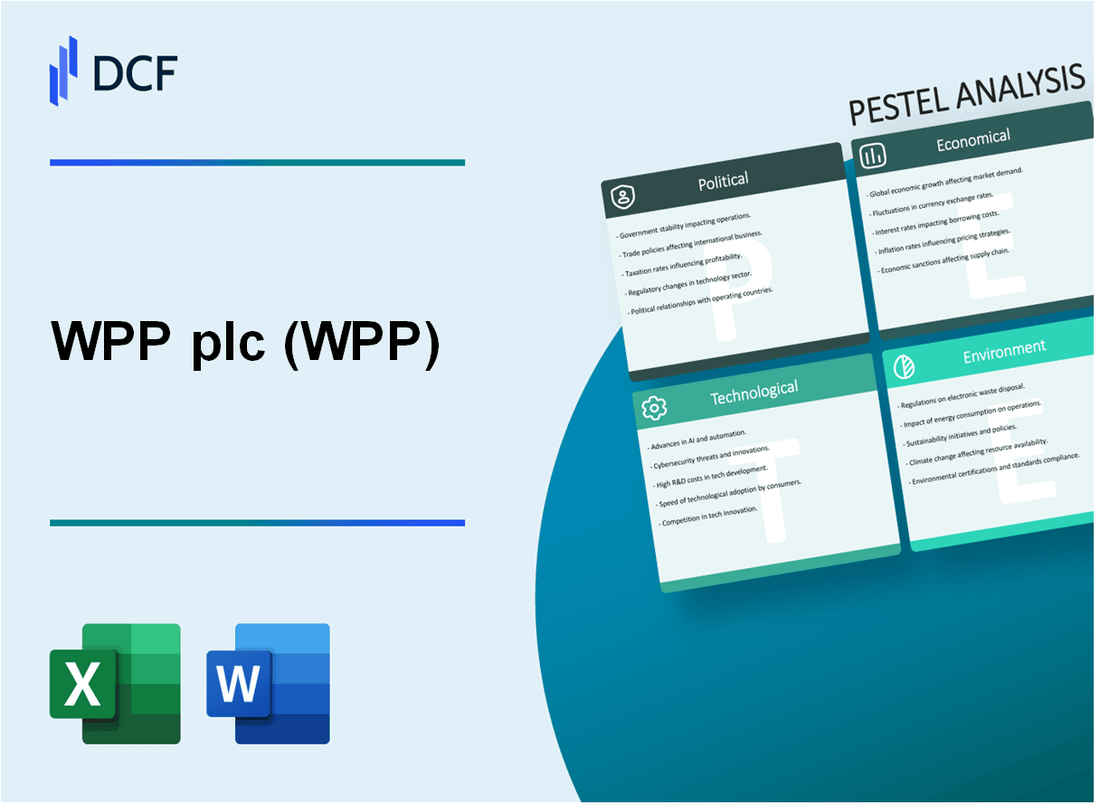
You're looking at WPP plc right now, and the landscape is a tightrope walk between massive digital opportunity and real-world economic friction, where geopolitical noise bumps up spend in some areas while inflation pressures client budgets. Honestly, understanding the macro picture-from the push to integrate Generative AI for potential 30% efficiency gains to the commitment to net-zero by 2030-is non-negotiable for your next strategic move. Let's cut through the noise and map out the Political, Economic, Sociological, Technological, Legal, and Environmental factors shaping WPP's next chapter so you can see the risks and the clear paths forward.
WPP plc (WPP) - PESTLE Analysis: Political factors
Geopolitical tensions increase defense and political advertising spend, especially in the US and Europe.
You might think global politics is just noise, but for WPP, it's a direct line item on the income statement. Geopolitical friction and trade disruptions are defintely a headwind, forcing WPP Media to downgrade its 2025 global ad spend forecast to 6.0% growth, down from the 7.7% projected just months earlier. That means the total global advertising market is now expected to reach $1.08 trillion in 2025, a significant revision that shows client caution is real. This uncertainty is a drag on commercial spending, but it creates a surge in political and defense-related advertising.
The US political cycle is a massive, cyclical opportunity. For the 2024 election cycle, total US political ad spending is projected to hit a record-breaking range of $10.7 billion to $12 billion. Here's the quick math: digital advertising alone is expected to attract around $3.46 billion of that spend, representing a 156% uptick from the 2020 presidential cycle. This influx of political money inflates media inventory prices, which can squeeze commercial clients, but it's a direct revenue stream for WPP's media-buying arm, GroupM, and its strategic communications agencies.
US-China trade relations definitely impact client marketing budgets and supply chain messaging.
The ongoing US-China trade tensions are forcing multinational clients to rethink their global supply chains and, consequently, their marketing investments. WPP is not directly impacted by tariffs, but its clients are, and that uncertainty translates immediately into budget cuts. WPP's full-year 2025 guidance was downgraded in July, foreseeing a decline in like-for-like revenue less pass-through costs between 3% and 5% due to macroeconomic conditions, with tariffs being a major factor. It's a clear signal that when clients face tariff risk, the first thing they cut is discretionary marketing spend.
The impact is most visible in key markets. For example, WPP reported that growth in China slid 17.4% in the first quarter of 2025, a sharp pullback driven by curtailed spending from technology, retail, and healthcare clients who are most exposed to the trade war and local economic slowdowns. WPP's job becomes helping clients manage the narrative around supply chain shifts, often requiring two distinct, non-conflicting messages for US and Chinese consumers, which is a complex, high-margin service.
Government scrutiny over large tech platforms (e.g., Google, Meta) affects digital ad policy and client strategy.
The regulatory hammer is dropping on the walled gardens (large tech platforms), and that fundamentally changes how WPP executes digital campaigns for its clients. As of November 2025, Google faces a crucial federal court hearing where the Justice Department is pushing for a breakup of its ad tech business due to alleged illegal monopoly. If the court mandates a divestiture, it would completely restructure the programmatic advertising ecosystem that WPP's GroupM relies on.
Also, Meta's 2025 policy changes around sensitive ad categories are restricting the functionality of its business tools, especially for mid- and lower-funnel events like 'Add to Cart.' This is a major headache for performance marketing. The sectors most affected by these new restrictions include:
- Health and Wellness
- Finance
- Political campaigns
This forces WPP to pivot client strategies away from hyper-targeted, sensitive-data-driven campaigns toward broader, more contextually relevant advertising, which requires a different kind of creative and media planning skill set.
Global tax reforms, like the OECD's Pillar Two, could alter WPP's effective tax rate from its current structure.
The global push for tax fairness, specifically the Organisation for Economic Co-operation and Development's (OECD) Pillar Two framework, is a long-term risk to WPP's tax structure. Pillar Two mandates a global minimum effective corporate tax rate of 15% for multinational enterprises (MNEs) with annual revenues exceeding EUR 750 million. Since WPP operates globally, it is squarely in scope.
WPP's reported effective tax rate on profit before taxation for the 2024 fiscal year was 39.0% (down from 43.1% in 2023), and its headline effective tax rate for H1 2024 was 28.0%. While the company noted the impact of Pillar Two was 'insignificant' to its 2024 tax charge, management expects the headline tax rate to increase over the next few years due to the changing international tax environment. The Income Inclusion Rule (IIR) and the Undertaxed Profits Rule (UTPR) are now in effect in many jurisdictions, meaning WPP can no longer rely on low-tax jurisdictions to the same extent. This will likely lead to a higher overall cash tax payment as the minimum rate is enforced across its global subsidiaries.
| Tax Metric | 2024 Fiscal Year Value | Pillar Two Minimum Target |
|---|---|---|
| Reported Effective Tax Rate (on PBT) | 39.0% | N/A (Jurisdictional ETR must be >15%) |
| Headline Effective Tax Rate (H1) | 28.0% | N/A (Jurisdictional ETR must be >15%) |
| Global Minimum Corporate Tax Rate | N/A | 15% |
| MNE Revenue Threshold (for in-scope) | N/A | EUR 750 million |
Finance: Model the Pillar Two impact on the 2025 tax provision for the top five low-tax jurisdictions by the end of the quarter.
WPP plc (WPP) - PESTLE Analysis: Economic factors
You're looking at WPP plc's exposure to the global economy in 2025, and frankly, it's a mixed bag of slowing growth and persistent cost pressure. The main takeaway is that while the overall advertising pie is still growing, WPP is currently fighting an uphill battle against client budget tightening and currency headwinds.
Global Advertising Market Growth Slowdown
The global advertising market is projected to hit a major milestone, surpassing $1.03 trillion in spending in 2025. However, the growth rate is definitely slowing down compared to the post-pandemic surge. While some forecasts suggest growth around 5.5% for the year, others point to figures like 4.9% or 5.9%.
For WPP, this means the overall environment isn't collapsing, but the easy growth is over. You have to fight harder for every dollar of new spend. Here's the quick math on the market size:
| Metric | 2025 Projection |
| Total Global Ad Spend | Over $1.03 trillion |
| Projected Growth Rate (Consensus) | Around 5.5% |
| Digital Ad Spend Share | Expected to be 75.2% of total spend |
What this estimate hides is that growth is highly uneven; digital, especially retail media, is booming, while traditional TV growth is marginal.
Client Budget Sensitivity to Interest Rates
High interest rates globally are making clients think twice before committing long-term capital to marketing. We are seeing this directly in WPP's guidance revisions. Macroeconomic pressures are causing clients to pull back, leading to shorter contract terms and a preference for project-based work over large annual retainers.
This budget caution is why WPP had to cut its full-year outlook. The company now expects like-for-like revenue less pass-through costs to decline between 3 percent and 5 percent for the full 2025 fiscal year, a significant downgrade from earlier expectations of flat to a 2 percent decline. If onboarding new, large accounts takes longer than expected, client retention risk rises.
- Client spending is weaker than anticipated.
- June performance was worse than expected.
- H1 2025 LFL revenue less pass-through costs expected to fall 4.2% to 4.5%.
Inflationary Pressure on Operating Costs
Inflation isn't just a headline risk; it hits WPP's bottom line through its largest variable cost: talent. Keeping top-tier creative and media planning staff in expensive hubs like New York and London requires competitive compensation, which means salary inflation is a constant drain on margins.
To be fair, WPP has been managing this by driving efficiency, evidenced by its 2024 operating profit margin hitting 15.0% partly due to cost savings, including letting go of about 6,000 staff over the year. Still, the cost base remains high. For example, the estimated average total compensation for a WPP employee in the US is around $133,279, while key roles in the UK, like a Media Planner, average around £54,783.
Currency Volatility Impact on Reported Figures
Because WPP generates substantial revenue outside the UK-North America was 39% of revenue in 2024-currency swings are a major factor in reported numbers. The volatility between the US Dollar, the Euro, and the Pound Sterling creates a significant gap between organic performance and the reported top line.
Look at the first quarter of 2025: WPP's LFL revenue less pass-through costs only declined by 0.7%, but the reported revenue was down 5.0% year-over-year. That difference is largely currency translation. WPP's management explicitly noted that their full-year guidance for operating profit margin excludes the impact of foreign exchange (FX) effects, showing how much they need to isolate operational performance from currency noise. This is a defintely tricky area for analysts to model.
Finance: draft a sensitivity analysis on a 10% USD/GBP swing impact on H2 2025 reported revenue by next Tuesday.
WPP plc (WPP) - PESTLE Analysis: Social factors
You're looking at how people think, what they value, and where they spend their time, because that's where the client money is going next. Honestly, the social landscape for WPP in 2025 is defined by a massive, non-negotiable shift in attention and values.
Shift to short-form video and influencer marketing requires new creative skills and measurement tools.
The game has changed from polished TV spots to quick, authentic bursts of content. WPP Media's Mid-Year Global Advertising Forecast for 2025 confirms this seismic shift: user-generated content (UGC) on platforms like TikTok, YouTube, and Instagram will attract more advertising revenue than traditional media for the very first time this year. That creator-generated revenue is projected to hit $184.9 billion in 2025, marking a 20% jump from 2024. This means your creative teams need to master the native language of these platforms, not just repurpose old assets. Short-form video ads are driving engagement rates 70% higher than what you see with traditional video ads. Success now hinges on building cultural relevance and authentic connection, which requires new measurement tools beyond simple reach metrics.
Here's the quick math on the platform power shift:
| Revenue Source Category | 2025 Projected Value/Metric | Implication for WPP |
|---|---|---|
| Creator-Generated Revenue (UGC Platforms) | $184.9 billion | Represents over half of content-driven ad revenue. |
| Influencer Marketing Industry Value | $24 billion | A substantial, specialized market segment. |
| Short-Form Video Engagement vs. Traditional | 70% higher | Demands rapid, platform-native creative output. |
| Traditional Media Ad Revenue Share | Less than half of content-driven ad revenue | Requires reallocating production and media buying resources. |
What this estimate hides is the need for new AI-powered tools to measure influence and authenticity at scale. That's a skill gap we need to close fast.
Growing consumer demand for brand authenticity and social purpose drives ESG-focused campaigns.
Consumers, especially the younger set, are using their wallets to vote for brands that align with their values. It's not enough to just sell a product; you have to stand for something. Research shows that 86% of consumers find authenticity crucial when deciding which brands to support in 2025. Furthermore, 73% of consumers globally believe brands should be actively working for the good of society and the planet right now. For WPP, this translates directly into client briefs demanding robust ESG (Environmental, Social, and Governance) narratives. If onboarding takes 14+ days, churn risk rises because clients need these purpose-driven campaigns live quickly. We must integrate genuine purpose into the core creative, not just tack it on as a CSR afterthought. To be fair, 65% of consumers prefer buying from companies that promote sustainable values.
Talent retention is a major challenge, with high-demand digital specialists commanding premium salaries.
The people who can actually execute on the trends above-AI prompt engineers, data scientists fluent in privacy-first targeting, and top-tier short-form video directors-are incredibly hard to keep. WPP employs over 100,000-plus talented people across 100 countries, but the specialized talent is the bottleneck. While the average total compensation at WPP is about $133k annually, the top earners are pulling in significantly more. For instance, the top 10% of employees report earning over $244k per year. This competition for digital expertise means we are constantly fighting market rates, which are often inflated for niche skills. We need to make sure our internal training, like the core academies covering mar-tech and AI, is seen as a perk as valuable as a higher base salary. Defintely, retaining that top-tier digital talent is a direct cost-of-doing-business issue.
- Creative Director roles see total compensation around $103k to $230k.
- Data Analyst median total compensation is reported near $134k.
- The median yearly total compensation across all roles is reported near $77,997.
Generational shifts mean clients are prioritizing platforms like TikTok and Twitch over traditional media.
The audience has left linear television and print, and client budgets are following them. As noted, UGC platforms are set to capture more than half of content-driven ad revenue in 2025. This isn't just about TikTok; it's about where younger consumers spend their time and money. For example, livestreaming apps, which include platforms like Twitch, are a major driver of consumer spend in social apps, expected to reach $17.7 billion in annual spend globally by 2025. This requires WPP to be experts not only in media buying but in community building on these interactive platforms. You're hiring before product-market fit for a new campaign concept? Make sure the first test budget goes to a platform where the target demographic is already spending time, not where they used to.
Finance: draft 13-week cash view by Friday
WPP plc (WPP) - PESTLE Analysis: Technological factors
You're looking at a landscape where technology isn't just a tool; it's the entire foundation of the business model, and frankly, the pressure is on to prove the ROI on all this digital transformation.
The biggest shift is Generative AI, which WPP has declared will have a bigger impact than even the internet, according to former CEO Mark Read. The company is heavily backing this with a five-year, at least $400 million partnership with Google to embed their tech across the group, aiming to make every employee an AI superuser. So, while you mentioned a 30% efficiency target in some creative workflows, internal projections are even more aggressive, suggesting gains of up to 70 percent in content production by combining AI design tools with data automation. Honestly, this tech push is happening while WPP navigates financial headwinds, reporting a 7.8% revenue drop in the first half of 2025.
Generative AI and Workflow Automation
WPP is aggressively integrating large language models (LLMs) and generative tools into its WPP Open operating system. This isn't just about making pretty pictures faster; it's about computational precision replacing pure intuition in parts of the creative process. As of the latest reports, 85% of WPP's client-facing employees are now using WPP Open, up from 60% in March 2025. This platform is the engine for turning basic prompts into ready-made campaigns, and the company is betting that this speed and scale will secure new business, as clients increasingly demand AI-powered partners.
Here's a snapshot of the AI deployment focus:
- Platform Adoption: 85% of client-facing staff use WPP Open.
- Investment Scale: Committing £300 million in 2025 for AI deployment.
- Efficiency Goal: Targeting up to 70% efficiency in content workflows.
- Key Partnership: Five-year deal with Google, worth at least $400 million.
The First-Party Data Imperative
With the third-party cookie deprecation finally forcing the issue, the focus has shifted entirely to first-party data activation and retail media networks. WPP's strategy, under WPP Media, is to achieve Intelligence Beyond Identity, meaning they don't need to own the data centrally to use it effectively. This is why they completed the acquisition of InfoSum in April 2025, the leading data collaboration platform. This move is designed to leapfrog competitors who rely on deteriorating identity solutions.
What this estimate hides is the complexity of stitching together disparate data sources without central ownership. Still, the ambition is clear: WPP Media claims access to data reaching five billion consumers through its federated ecosystem, connecting intelligence across Google, Amazon, and TikTok. This is crucial for privacy-safe personalization as regulations tighten under frameworks like Europe's evolving AI Act.
Proprietary Ad-Tech Investment
The investment in proprietary platforms like Choreograph and the overarching WPP Open system is the tangible result of the data strategy. Choreograph, WPP's data company, is central to this pitch, handling billions of data points. WPP is increasing its total AI-driven technology investment to £300 million in 2025, up from £250 million in 2024. This capital is used to integrate new AI models and enhance data-driven personalization capabilities within the WPP Open ecosystem, which now includes the newly acquired InfoSum technology for federated learning.
The shift is from selling time to selling platform-based solutions. Here's how the key tech investments stack up:
| Metric/Platform | 2024 Value | 2025 Target/Actual | Significance |
| AI-Driven Tech Investment | £250 million | £300 million | Commitment to maintaining tech leadership. |
| WPP Open Usage (Client-Facing) | 60% (March 2025) | 85% (H1 2025) | Rapid internal adoption driving efficiency. |
| WPP H1 2025 Revenue Change | N/A | -7.8% decline YoY | Context for the urgency of tech-led transformation. |
| Competitor Omnicom Q3 Revenue | N/A | $4.04 billion | Benchmark for the scale of the competitive set. |
Intensifying Competition from Consultancies
The competitive pressure isn't just from other holding companies; it's from the consultancies like Accenture and Deloitte who are building agency-like creative divisions. They compete by linking marketing outcomes directly to business impact, often emphasizing cost control. While WPP has historically been dismissive of their creative depth, the market reality is that these firms are hiring top creative talent and pitching for integrated work. To be fair, WPP still claims creative superiority, topping the WARC Creative 100 list for the third year running in 2025, with Ogilvy as the top network. Still, the financial results show the strain: WPP's H1 2025 revenue fell 7.8%, while rival Publicis Groupe reported 5.5% organic growth for the first nine months of 2025. That gap in growth is defintely something to watch.
Finance: draft 13-week cash view by Friday.
WPP plc (WPP) - PESTLE Analysis: Legal factors
You're navigating a legal landscape that is tightening its grip on how global agencies like WPP plc (WPP) handle data, claims, and content creation. Honestly, the days of assuming a global standard are over; compliance is now a granular, country-by-country headache.
Stricter global data privacy laws (e.g., GDPR, CCPA) necessitate complex compliance for cross-border campaigns.
The regulatory environment for data is only getting more complex in 2025. Laws like the General Data Protection Regulation (GDPR) in the EU and the California Consumer Privacy Act (CCPA) remain central, forcing WPP to ensure explicit, opt-in consent for data collection across its cross-border campaigns,,. Since WPP plc operates globally, data transfers between its operating companies, clients, and vendors are constantly exposed to interruption from evolving laws, such as changes to EU adequacy decisions. If WPP fails to adequately protect data or observe privacy legislation in every instance, it could face investigative action, legal claims, or fines.
What this means in hard numbers is that the potential penalty for non-compliance with GDPR can reach up to 4% of a company's annual global turnover. To manage this, WPP monitors pending regulatory changes and implements safeguards like Standard Contractual Clauses (SCCs) for transfers outside areas with adequate protection,. You defintely need to ensure your teams are using the latest toolkits and training on these regulations, as WPP has a Chief Privacy Officer and a dedicated Data Protection Office to manage this risk.
Here's a quick look at the potential financial sting:
| Regulation | Maximum Fine/Penalty Basis | Example of Impact |
| GDPR | 4% of annual global turnover | Potential for billions in fines for large global firms |
| CCPA | Up to $750 per consumer/violation | Fines up to $750,000 for 1,000 non-compliant data collections |
Regulatory focus on 'greenwashing' and misleading environmental claims increases legal risk for client advertisements.
The legal risk around environmental claims is seeing a 'step-change' for advertisers working with high-emitting clients,,,. In early 2025, WPP plc faced a complaint filed with the Organisation for Economic Co-operation and Development (OECD) alleging the firm breached climate and human rights duties by promoting polluters like Shell, BP, Toyota, and ExxonMobil,,. Campaigners argue that this work undermines global climate efforts and exposes WPP to greenwashing accusations,. This is not just theoretical; a Shell advert created by a WPP agency was banned by the UK Advertising Standards Authority (ASA) in 2023 for misleading consumers by omitting the company's large-scale fossil fuel operations,. WPP must now demonstrate due diligence to avoid being found in breach of OECD Guidelines by representing clients whose activities conflict with global climate standards,.
Intellectual property (IP) rights for AI-generated content remain an unresolved legal gray area.
When WPP's creative teams use generative AI, they step into an area where the law is still catching up. The core issue is human authorship; in major jurisdictions like the U.S. and the EU, content created solely by an algorithm is generally not eligible for copyright protection,,. The U.S. Copyright Office, as of March 2025, reiterated that images entirely generated by AI are ineligible for copyright. This means that if WPP relies on purely AI-generated creative, that content could effectively be treated as public domain material, open for anyone to copy,. Also, you have to worry about the input side: there are questions about whether the AI training data used by vendors was properly licensed, creating potential infringement exposure for WPP.
Your action here is to develop legal playbooks that clearly address ownership through terms of use and usage policies, especially where human input is mixed with AI generation,.
Antitrust scrutiny of mergers and acquisitions in the media and advertising sector is rising.
Competition regulators are definitely keeping an eye on consolidation, which directly impacts WPP's M&A strategy and its clients' market power. In the digital advertising space, a federal court in the Eastern District of Virginia concluded in 2025 that Google monopolized key parts of the ad tech stack, signaling strong judicial receptiveness to platform self-preferencing claims. Furthermore, vertical mergers-where a company buys a supplier or distributor-are under renewed scrutiny globally. We saw this play out in Germany in December 2024 when the Federal Cartel Office (FCO) blocked a joint marketing project between RTL2 and Warner Bros. Discovery due to concerns over market power in TV advertising space. Any major media consolidation, like the proposed Nexstar-Tegna merger, raises concerns that the combined entity could dictate advertising rates.
- Antitrust enforcement is expected to persist in 2025.
- Regulators focus on foreclosure effects in vertical deals.
- Media consolidation risks creating 'unavoidable gatekeepers'.
- AI pricing algorithms are also attracting scrutiny in digital markets.
Finance: draft 13-week cash view by Friday.
WPP plc (WPP) - PESTLE Analysis: Environmental factors
You're looking at how WPP plc is handling the growing environmental scrutiny, which is no longer just a compliance issue-it's a core business driver, especially when you consider media placement and production account for over 50% of their total carbon footprint. Honestly, this is where the real risk and opportunity lie for a company of this scale.
WPP commits to achieving net-zero carbon emissions across its operations by 2030
WPP has set some aggressive, science-based targets verified by the Science-Based Targets initiative (SBTi) to align with the 1.5°C warming scenario. While the prompt mentions 2030 for operations, the actual commitment is to reach net-zero across their direct operations (Scope 1 and 2) by 2025, with the entire supply chain (Scope 3) following suit by 2030. This is a big deal because they are the first marketing communications company to include emissions from media placement in their targets. They plan to offset residual emissions to hit these marks.
Here's a quick look at the core targets they are driving toward:
- Scope 1 and 2 absolute reduction: 84% by 2025 (from 2019 baseline).
- Scope 3 absolute reduction: 50% by 2030 (from 2019 baseline).
- Renewable electricity sourcing: 100% by 2025.
Client pressure for sustainable media planning, favoring low-carbon ad formats and supply chains
Clients are definitely leaning in on this, and it's translating directly into procurement demands. To be fair, it's smart business; four in five of WPP's top 50 clients have already set or committed to science-based carbon reduction targets. This means WPP must deliver low-carbon solutions or risk losing spend, especially in the media buying arm, GroupM. They are actively working to develop better standards for measuring emissions from media placement to help clients shift investments to lower-emission publishers.
The focus is on tangible, measurable change, not just greenwashing. WPP has even rolled out a Green Claims Guide and training accessible to all employees via their Sustainability Academy to help clients make effective, non-misleading environmental claims. If onboarding takes 14+ days, churn risk rises if you can't quickly show a low-carbon execution plan.
Reporting requirements under the Task Force on Climate-related Financial Disclosures (TCFD) are increasing
The regulatory environment is tightening, and WPP has been an early adopter of the TCFD framework. As of their early 2025 reporting, their climate-related financial disclosures were consistent with nine of the 11 TCFD recommended disclosures, with plans to become fully consistent within the timeframe of the UK's adoption of IFRS Sustainability Standards. This level of disclosure is critical for investor confidence, especially since the Board Sustainability Committee oversees the strategy.
What this estimate hides is that they still don't disclose total Scope 3 emissions in the Annual Report as of early 2025, pending third-party assurance. Still, the structure is there, focusing on governance, strategy, risk management, and metrics.
Focus on reducing the carbon footprint of media production, including travel and digital infrastructure
WPP has identified five major emission hotspots, and media and production are two of the biggest drivers in their Scope 3 footprint, alongside real estate, procurement, and enterprise technology. They are tackling this by integrating carbon reduction into their core commercial processes. For instance, they use an internal carbon price-in 2023, it was £6.88 per tCO2e for business air travel recharged to agencies.
The push for greener production is also evident in their real estate strategy, aiming to bring 85,000 people into at least 65 net-zero campuses by 2025. Digital infrastructure, about 6% of their footprint, is being addressed by migrating to energy-efficient or cloud-based technologies.
Here is a snapshot of their environmental metrics and targets as of the latest available data:
| Metric/Target Area | Baseline Year | Target/Value (as of 2025) | Context/Progress |
| Total Baseline Emissions (Scope 1, 2, 3) | 2019 | 5.4 million tCO2e | Total reported emissions for baseline year |
| Net-Zero Operations (Scope 1 & 2) | N/A | By 2025 | Offset residual emissions |
| Net-Zero Supply Chain (Scope 3) | 2019 | By 2030 | Includes media buying and production |
| Renewable Electricity Sourcing | 2021 | 100% by 2025 | Reached 83% in 2022 |
| TCFD Disclosure Alignment | FY2024 Reporting | Consistent with 9 of 11 requirements | Aims for full consistency by IFRS adoption timeline |
Finance: draft 13-week cash view by Friday
Disclaimer
All information, articles, and product details provided on this website are for general informational and educational purposes only. We do not claim any ownership over, nor do we intend to infringe upon, any trademarks, copyrights, logos, brand names, or other intellectual property mentioned or depicted on this site. Such intellectual property remains the property of its respective owners, and any references here are made solely for identification or informational purposes, without implying any affiliation, endorsement, or partnership.
We make no representations or warranties, express or implied, regarding the accuracy, completeness, or suitability of any content or products presented. Nothing on this website should be construed as legal, tax, investment, financial, medical, or other professional advice. In addition, no part of this site—including articles or product references—constitutes a solicitation, recommendation, endorsement, advertisement, or offer to buy or sell any securities, franchises, or other financial instruments, particularly in jurisdictions where such activity would be unlawful.
All content is of a general nature and may not address the specific circumstances of any individual or entity. It is not a substitute for professional advice or services. Any actions you take based on the information provided here are strictly at your own risk. You accept full responsibility for any decisions or outcomes arising from your use of this website and agree to release us from any liability in connection with your use of, or reliance upon, the content or products found herein.