
|
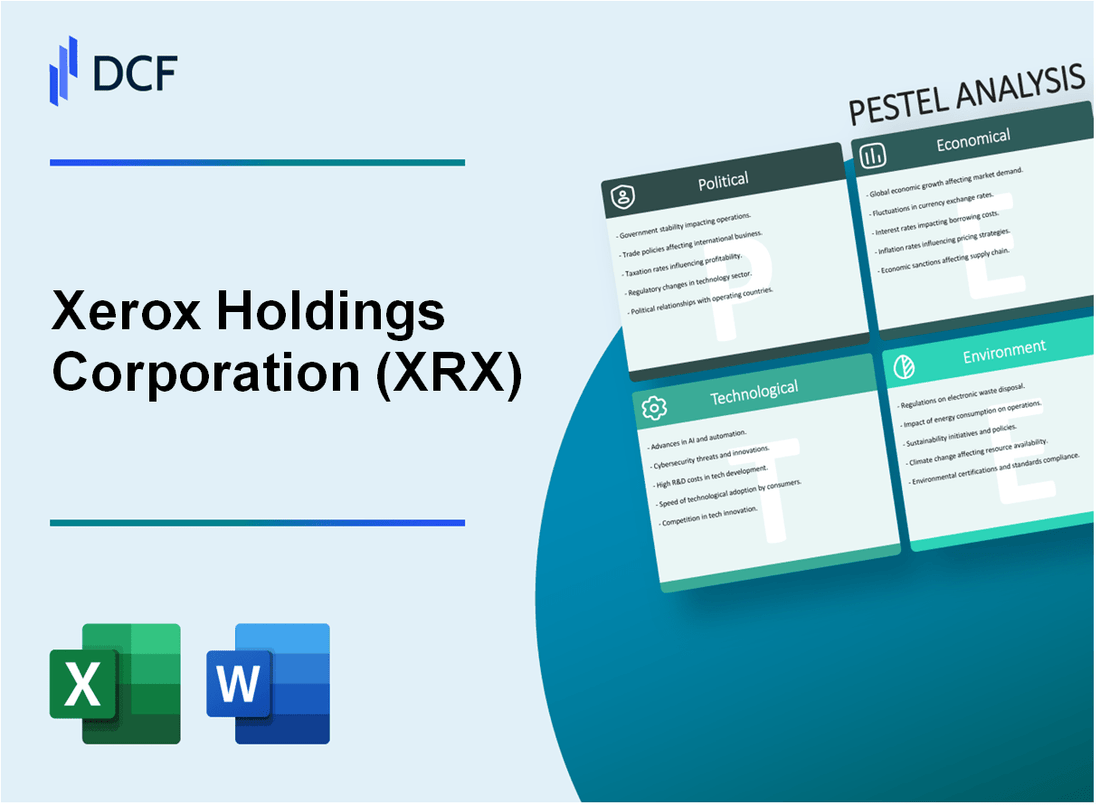
Xerox Holdings Corporation (XRX): PESTLE Analysis [Nov-2025 Updated] |
Fully Editable: Tailor To Your Needs In Excel Or Sheets
Professional Design: Trusted, Industry-Standard Templates
Investor-Approved Valuation Models
MAC/PC Compatible, Fully Unlocked
No Expertise Is Needed; Easy To Follow
Xerox Holdings Corporation (XRX) Bundle
Xerox Holdings Corporation is navigating a complex 2025 where macro forces are rewriting the playbook, so you need a clear map of the risks and opportunities. The economic reality check means full-year revenue growth guidance is now around 13% in constant currency, even with the $1 billion boost from the Lexmark acquisition, plus the political headwind of $30 million to $35 million in US-China tariffs is hitting the bottom line. Meanwhile, the shift to hybrid work and a 60% consumer preference for sustainable brands is accelerating the move from traditional print to cloud-based, AI-driven Managed Print Services, while new EU regulations like the Deforestation Regulation and Extended Producer Responsibility laws demand immediate legal and operational changes. This PESTLE analysis cuts through the noise to show exactly where Xerox Holdings Corporation must focus its capital and strategy right now.
Xerox Holdings Corporation (XRX) - PESTLE Analysis: Political factors
The political landscape for Xerox Holdings Corporation in 2025 is defined by two primary risks: the direct financial impact of US-China trade tensions and the indirect but persistent volatility from government procurement cycles. You need to account for a confirmed $50 million headwind to operating income this fiscal year due to tariffs alone.
US-China trade tensions impose $50 million in tariff headwinds for FY2025.
The ongoing trade conflict between the U.S. and China is a direct and quantifiable headwind to Xerox's 2025 financial performance. The company anticipates that the current tariff structure, including the 145% levy on certain Chinese imports, will reduce its 2025 operating income by approximately $50 million. This figure is a critical input for your financial models, as it represents a non-operational cost that directly compresses margins.
To mitigate this, Xerox is executing a strategy that includes a mix of price increases, surcharges, and a significant geographic rebalancing of its supply chain to shift production away from high-tariff regions. The reciprocal tariffs impact the company's cost of sales by less than 10%, but the sheer size of the tariff rates necessitates this aggressive supply chain overhaul.
Here's the quick math: If Xerox achieves its 2025 adjusted operating margin guidance of roughly 3.5% on an expected revenue growth of about 13% year-over-year (pro forma for the Lexmark acquisition), that $50 million tariff hit represents a substantial drag on profitability [cite: 2, 12 in first search].
Reliance on government contracts creates budget risk.
Xerox derives a significant portion of its revenue from contracts with U.S. federal, state, and local governments, as well as international government agencies. This reliance introduces a material budget risk because government entities typically finance projects using appropriated funds, and they reserve the right to change the scope of or terminate these multi-year projects due to a lack of approved funding.
While the total percentage of revenue from all government contracts is not publicly disclosed, the scale of this business is significant. For context, in fiscal year 2024, Xerox secured $37.1 million in contracts just from the U.S. Government Publishing Office (GPO) print procurement program. This steady, post-sale revenue stream is vulnerable to the unpredictable nature of legislative budget cycles.
Government funding uncertainties are currently weighing on transactional print sales in late 2025.
The budget risk is not theoretical; it is actively impacting near-term sales. In the third quarter of 2025, the company reported that 'near-term uncertainties on government funding decisions' directly weighed on its transactional print business. This macro volatility has led to continued delays in purchasing decisions, specifically among clients dependent on federal, state, and local government funding.
- Delays in purchasing decisions are primarily affecting transactional print equipment revenues.
- The uncertainty is also, to a lesser extent, impacting supplies revenue.
This situation forces a longer sales cycle and creates quarter-to-quarter revenue volatility in the Print segment.
Political instability in key international operating regions, like Latin America, can disrupt supply chains and sales.
Xerox's global footprint, with approximately 45% of its 2024 revenue generated outside the United States, exposes it to geopolitical risks beyond the US-China trade war. Political instability and conflicts are a top strategic concern for global trade professionals in 2025 [cite: 16, 20 in first search].
Regions like Latin America, where Xerox has established operations, are experiencing unprecedented disruption in logistics and supply chains due to global risks and the threat of trade wars [cite: 18 in first search]. This instability can manifest in several ways:
- Sudden policy reversals, such as abrupt trade restrictions or rapidly changing tariffs [cite: 19 in first search].
- Infrastructure risks that compromise the physical movement of goods [cite: 19 in first search].
- Currency volatility that erodes international sales revenue when translated back to U.S. Dollars.
You must factor this into your risk-adjusted discount rate for international cash flows. The global political environment is defintely transactional and unpredictable right now [cite: 21 in first search].
| Political Risk Factor | FY2025 Quantified Impact/Status | Impacted Business Area |
|---|---|---|
| US-China Trade Tariffs | Expected $50 million cut to 2025 operating income. | Cost of Sales, Operating Income, Supply Chain. |
| Government Funding Uncertainty | Caused continued delays in purchasing decisions in Q3 2025. | Transactional Print Equipment and Supplies Revenue. |
| Government Contract Reliance | Government entities retain the right to terminate contracts for lack of approved funding. | Post-Sale Revenue (Managed Print Services). |
| Geopolitical Instability (e.g., Latin America) | High-level risk of supply chain disruption and policy shifts in key international markets [cite: 18 in first search]. | International Sales, Supply Chain Logistics. |
Xerox Holdings Corporation (XRX) - PESTLE Analysis: Economic factors
The economic environment for Xerox Holdings Corporation in 2025 is a classic study in managing macro-headwinds while executing a massive, transformative acquisition. You are seeing the impact of global volatility directly hit the bottom line, forcing a significant downward revision in full-year guidance, even with the boost from the Lexmark acquisition.
Honestly, the biggest challenge isn't the acquisition itself, but the cost of doing business in a high-inflation, high-tariff world. Here's the quick math on the economic outlook for the year.
Full-Year 2025 Revenue Growth Guidance Revised Down
Macroeconomic volatility-things like fluctuating foreign exchange rates, persistent inflation, and general market uncertainty-forced Xerox to adjust its full-year 2025 revenue growth outlook. The guidance was trimmed from an initial range of 16-17% down to 13% growth in constant currency. This is a critical signal: even with the inorganic boost from a major acquisition, the core business is facing stronger-than-expected resistance from the broader economic climate. You need to factor in this lower organic growth rate when valuing the company's long-term trajectory.
Adjusted Operating Margin Trimmed Due to Costs
The profitability outlook has also been significantly impacted by external economic factors, specifically trade policy and integration costs. The full-year 2025 adjusted operating margin guidance was reduced from approximately 4.5% to around 3.5%. This 100-basis-point drop is a direct reflection of the cost pressures. The company is absorbing expenses related to tariffs and the one-time costs of integrating the Lexmark business, which is squeezing operating leverage in the near term.
Lexmark Acquisition Adds $1 Billion in 2025 Revenue
The acquisition of Lexmark International, Inc., which closed on July 1, 2025, is the single largest economic driver for Xerox this year. This deal is expected to contribute approximately $1 billion of revenue in the 2025 fiscal year. The strategic rationale is sound-it expands the core business and provides manufacturing capacity-but the immediate financial impact is mixed, as the revenue gain is partially offset by the associated integration costs and debt service.
Free Cash Flow Guidance Lowered to $150 Million
Cash generation, a key metric for any mature company, is under pressure. Free cash flow (FCF) guidance for FY2025 was lowered from around $250 million to approximately $150 million. This is a significant revision that directly ties back to two external economic factors:
- Higher in-year cash tariff expenses, estimated at around $60-65 million.
- Accelerated cash payments for Lexmark synergy implementation, totaling around $50-75 million.
You can't ignore a $100 million reduction in FCF; it defintely limits the capital available for debt paydown or share buybacks this year.
Core Printing Industry Faces Stiff Price Resistance
The core printing industry continues to be a tough market, with the economic reality being a textbook profit squeeze. Data from the commercial printing sector in 2024 shows that operating cost inflation significantly outpaced price increases. For instance, operating cost inflation averaged 5.9% during the first three quarters of 2024, while prices only rose by 4.1%. This stiff resistance to price hikes means Xerox is fighting to maintain margins on its legacy business. Worse, real (inflation-adjusted) sales, which measure production volume, decreased by 2.7% through midyear 2024, indicating that the market volume is actually shrinking.
| FY 2025 Key Financial Guidance (Revised Oct 2025) | Guidance Amount/Rate | Key Economic Driver |
|---|---|---|
| Revenue Growth (Constant Currency) | 13% (Revised Down) | Macro volatility, Lexmark acquisition boost |
| Adjusted Operating Margin | Around 3.5% (Revised Down) | Tariff expenses, Lexmark integration costs |
| Free Cash Flow | Around $150 million (Revised Down) | Cash tariff outlays ($60-65M), synergy costs ($50-75M) |
| Lexmark Revenue Contribution | Around $1 billion | Acquisition closed July 1, 2025 |
Xerox Holdings Corporation (XRX) - PESTLE Analysis: Social factors
The social landscape for Xerox Holdings Corporation is defined by a fundamental shift in how and where people work, coupled with a deep, values-driven demand for corporate sustainability. This isn't just a matter of preference; it's a structural change that directly impacts hardware sales and the growth of digital services.
Continued shift to hybrid work models drives demand for smaller, compact A4 devices and remote print solutions.
You're seeing the long-term effects of the hybrid work model play out now, moving past the initial panic-buying phase of 2020. That first wave of placing end devices in homes has largely ended, but the new opportunity for Xerox is expanding the base with more sophisticated, smaller-footprint equipment and services. The focus has moved from simply enabling remote work to optimizing it.
This means a clear shift in equipment demand, favoring smaller, more versatile A4 devices (printers and multifunction printers) that fit in a home office or a smaller corporate satellite office, plus the required software to manage them remotely. Xerox has responded by completing a total refresh of its A4 VersaLink family, which includes models like the VersaLink C415/B415, designed specifically for this new environment. This refresh is defintely a necessary move to capture the recurring revenue from consumables and managed services on these smaller units.
Here's the quick math on the market shift:
| Metric | Traditional Office Model (Pre-2020) | Hybrid Work Model (2025 Focus) |
|---|---|---|
| Primary Device Demand | Large A3 Multifunction Devices (MFPs) | Compact A4 MFPs and Desktop Printers |
| Print Volume Trend | Centralized, High Volume | Decentralized, Lower Volume, Higher Value |
| IT Budget Priority | On-Premise Infrastructure | Cloud-Based Software and Remote IT Support |
Strong consumer and corporate preference for sustainable brands, with surveys showing a 60% preference for eco-friendly products.
Honesty, this is a non-negotiable factor for corporate clients and the younger, influential demographic. You can't just talk about sustainability anymore; you have to prove it with hard data. This trend is a major tailwind for companies that can credibly demonstrate a low-carbon footprint and circular economy practices.
The market data is clear: a full 62% of people say they 'always or often' seek products to purchase because they are sustainable for the environment. Plus, for corporate clients, 78% of organizations state it is important that their supplier monitors the environmental impact of their print environment. This is a direct mandate for Xerox to lead with its remanufacturing programs and energy-efficient equipment.
- Sustainable products' market share is 17% overall.
- They account for a 32% share of market growth.
- Sustainable products grew 2.7x faster than conventional products.
- 67% of Millennial and Gen X consumers prefer to buy sustainable brands.
Digital-first workflows are accelerating the decline in traditional print volumes, favoring digital document management.
The overall volume of printed materials is still shrinking. Global demand for printed materials is estimated at approximately 16 trillion A4 pages and is declining at an annual rate of 1.9%. This is the headwind you have to manage. The simple reality is that fewer pages are being printed, but the pages that are printed are becoming more valuable, personalized, and often produced through digital printing.
The opportunity lies in the digital side of the house. Xerox's strategic move into digital document management and workflow automation is essential here. Products like Xerox Intelligent Filer, which uses AI to automatically categorize and name scanned documents, and Xerox Workflow Central, which automates tedious document tasks, are the solutions that capture the value lost from declining print volume. Digital color printing, which is often higher-margin, is expected to grow at an average annual rate of around 12% through 2030, a direct contrast to the decline in total volume.
Labor shortages and higher wages in the printing sector push companies toward automation and workflow optimization.
Labor is getting expensive, and finding skilled technicians for complex print and IT environments is a struggle for many businesses. This shortage pushes companies to look for technology that can do more with fewer people, which is a significant driver for Xerox's services business.
The solution is automation. Automation spending is forecast to reach $200 billion in 2025 globally, as companies look to reduce operational costs and boost productivity. Companies investing in automation are seeing an average 22% reduction in operating costs. This is a huge incentive.
Xerox is positioned to capitalize by selling not just a printer, but a managed service that includes Robotic Process Automation (RPA) and AI-driven features in their hardware. The new VersaLink MFPs, for instance, use machine learning to recognize common tasks and suggest more efficient processes, essentially automating the user's workflow. It's about selling a lower-labor solution. This is why 74% of German SMEs, a key market segment, see digitalization as a solution to staffing challenges.
Xerox Holdings Corporation (XRX) - PESTLE Analysis: Technological factors
AI-driven insights are revolutionizing Managed Print Services (MPS) for predictive maintenance and workflow automation
The core of Xerox's technological pivot lies in integrating Artificial Intelligence (AI) and machine learning (ML) into its Managed Print Services (MPS). This shift moves MPS beyond simple device monitoring to offering predictive maintenance, which is a significant value-add for clients. The company's investments in AI-powered automation and Robotic Process Automation (RPA) are driving proactive alerts and intelligent recommendations, streamlining workflows for the over 200,000 clients served by the combined Xerox and Lexmark entity as of late 2025.
This AI focus is critical for maintaining a competitive edge in the services-led, software-enabled business model. For example, the Xerox Production Ecosystem, which integrates with the new Kyocera cut-sheet inkjet presses, features AI-assisted workflow solutions like the updated Xerox FreeFlow. This ecosystem includes tools like PowerSplit Accelerator for faster processing of complex jobs and Vision Connect for enhanced data reporting and predictive monitoring. The goal is to reduce downtime and optimize operational costs, directly supporting the company's full-year 2025 free cash flow guidance of between $350 million and $400 million.
Accelerated adoption of cloud-based MPS platforms offers greater flexibility, security, and remote print management
The market demand for cloud-based print solutions is accelerating, with 79% of organizations considering it important for their print management provider to offer cloud-based solutions in 2025. Xerox has responded by being recognized as a leader in the Quocirca Cloud Print Services Landscape, 2025 report, highlighting its comprehensive cloud-centric portfolio.
The Xerox Workplace Cloud platform is the centerpiece of this strategy, enabling direct-to-cloud printer connectivity and centralized fleet management. This cloud-first approach is essential for supporting the modern, distributed workforce. Honestly, if you can't manage a printer fleet remotely and securely today, you're just not in the game. The platform's ability to scale and integrate advanced cloud-based analytics is a key differentiator, especially following the 2025 acquisition of Lexmark, which further strengthened the combined entity's global IoT infrastructure.
Enhanced security, including zero-trust frameworks, is now essential for networked printers to meet compliance requirements
Security is no longer an optional add-on; it's a foundational requirement, especially with networked multifunction printers acting as endpoints on the corporate network. Xerox has proactively adopted the zero-trust security framework (a 'never trust, always verify' model) for its printers and MPS offerings. This is enforced through mandatory authentication at every new connection, role-based access controls, and multi-factor authentication support via Cloud Identity Providers (IdPs) like Microsoft Azure Identity Services.
A concrete example of this commitment is the April 2025 Security Patch Update for the FreeFlow Print Server v2, which addressed over 40 critical vulnerabilities and enforced stricter encryption protocols. Specifically, the update mandated the use of SHA-2 hashing and AES-512-bit encryption for SFTP connections, aligning with the latest NIST cryptographic guidelines for 2025. This level of detail is what separates a good security posture from a defintely compliant one.
| Security Enhancement (2025 Focus) | Xerox Implementation/Product | Key Technical Detail/Metric |
|---|---|---|
| Zero-Trust Framework | Xerox Workplace Cloud & MPS | Mandatory authentication at every new connection; supports MFA via IdPs. |
| Data Encryption Standard | FreeFlow Print Server v2 (April 2025 Patch) | Enforces SHA-2 hashing and AES-512-bit encryption for SFTP. |
| Endpoint Protection | Xerox TriShield 360 Cyber Solution (Launched Nov 2025) | Real-time threat detection and response powered by Palo Alto Networks Cortex XDR. |
| Firmware Integrity | Xerox Printers (ConnectKey Technology) | Digitally signed and encrypted firmware; McAfee whitelisting for real-time malware monitoring. |
Re-entry into the fast-growing cut-sheet inkjet market via the Kyocera partnership broadens the production portfolio
Xerox's strategic partnership with Kyocera Document Solutions Inc., announced in July 2025, marks its return to the high-speed cut-sheet inkjet (CSIJ) production press market. This is a smart move to diversify the production print portfolio and tap into a high-growth segment. The global installations of cut-sheet inkjet printers are projected to grow at a Compound Annual Growth Rate (CAGR) of more than 13% between 2025 and 2030, according to IT Strategies.
The new presses will be branded and serviced by Xerox, integrating Kyocera's proven inkjet technology with Xerox's proprietary software, like the FreeFlow workflow automation tools. This re-entry is a direct response to client demand for faster, more efficient color production printing and is a core part of the company's 'Reinvention' plan, which targets revenue growth of about 13% year-over-year in constant currency for 2025.
The strategic value is clear:
- Broadens the production portfolio beyond existing offerings like the Xerox Iridesse Production Press.
- Addresses the high-value, high-growth CSIJ segment.
- Leverages Xerox's global service network and workflow automation expertise.
Next step: Production Print team needs to finalize the launch and marketing plan for the new Kyocera-sourced presses by the end of Q4 2025.
Xerox Holdings Corporation (XRX) - PESTLE Analysis: Legal factors
Stringent Data Privacy Laws: GDPR and CCPA Compliance
You can't talk about a global services and document company like Xerox Holdings Corporation without starting with data privacy. The regulatory environment here is a massive, defintely non-negotiable cost of doing business, especially with the pivot toward software-enabled services.
The European Union's General Data Protection Regulation (GDPR) and the California Consumer Privacy Act (CCPA) are the two big ones, and they mandate advanced encryption and audit trails for all document management systems. Xerox addresses this head-on by integrating compliance into its software offerings; for example, their eSignature solution, airSlate SignNow, is explicitly built to be GDPR and CCPA compliant, which is a necessity for their corporate clients.
Here's the quick math on the risk: A major breach in the EU could trigger a fine of up to €20 million or 4% of global annual revenue, whichever is higher. In California, the CCPA penalty can hit $7,500 per intentional incident with no cap on total penalties. The legal cost of non-compliance far outweighs the investment in compliance infrastructure.
New Extended Producer Responsibility (EPR) Laws
The push for a circular economy is translating directly into new legal liabilities for manufacturers, particularly with the UK and EU's Extended Producer Responsibility (EPR) laws. These regulations shift the financial and physical burden of a product's end-of-life-recycling and disposal-from local governments to the producer.
For Xerox, this means continually enhancing their already strong remanufacturing programs. The company's 2025 Corporate Social Responsibility (CSR) Report confirms they actively monitor and align their strategies with these global EPR requirements. This isn't just a cost; it's a strategic advantage when done well. Xerox's circular economy efforts for the nearest reported period are impressive:
- Remanufactured Toner Cartridges: Over 1.7 million units.
- Reuse by Weight: 90% of the remanufactured toner cartridges.
- Waste Diverted: More than 600,000 metric tons of equipment, parts, and supplies diverted from landfills since 2009.
The real action item here is managing the increasing cost of collection, sorting, and processing as the volume of returned equipment grows under these new mandates.
Compliance with US Clean Air Act (CAA) and NESHAP
Manufacturing and chemical processes, especially in toner and ink production, put Xerox under the strict purview of the US Clean Air Act (CAA) and the National Emission Standards for Hazardous Air Pollutants (NESHAP). These laws set rigorous standards for reducing Volatile Organic Compounds (VOCs) and other hazardous air pollutants.
The company must invest in process modifications and emission control technology to stay compliant. Honestly, the key metric here is the reduction in actual emissions, which shows control is working. The data for 2024 shows solid progress:
| Metric | 2024 Value (Metric Tons) | Change from 2023 | Regulatory Context |
|---|---|---|---|
| Volatile Organic Compound (VOC) Process Air Emissions | Approximately 7.9 metric tons | Down 0.8 metric tons | Compliance with US Clean Air Act/NESHAP |
Reducing emissions by 0.8 metric tons year-over-year is a clear sign of operational control, but the risk remains high, and any lapse could trigger an EPA enforcement action, leading to significant fines.
EU Deforestation Regulation (EUDR) for Paper Sourcing
The EU Deforestation Regulation (EUDR) is a near-term legal challenge that directly impacts Xerox's core paper and supplies business. This regulation, which applies to large companies starting December 30, 2025, requires proof that products like paper are deforestation-free and legally produced.
What this means is a major supply chain overhaul. Companies must provide a Due Diligence Statement (DDS) for paper products entering the EU market, including plot-level geolocation data of the land where the wood was harvested. This goes far beyond existing certifications like FSC. Xerox must ensure its paper suppliers can provide this granular level of traceability, or face potential bans on products in the lucrative EU market. This is a huge logistical lift.
Shareholder Litigation and Near-Term Legal Risk
Beyond environmental and data compliance, a significant legal risk in 2025 is the pending class action lawsuit. This litigation, with a lead plaintiff deadline of January 21, 2025, alleges that Xerox made materially misleading statements to investors. The core of the complaint centers on the fallout from a large workforce reduction, specifically claiming that the salesforce reorganization disrupted productivity, delayed key product launches, and ultimately led to lower sales and revenue. This kind of litigation can lead to substantial financial settlements and distract executive attention from the core 'Reinvention' strategy.
Xerox Holdings Corporation (XRX) - PESTLE Analysis: Environmental factors
New EU regulations, like the Catalonia ban on single-use printer consumables in 2025, push for refillable cartridges.
The regulatory landscape in Europe is shifting fast, directly impacting the consumables business. The most immediate change is the 'Waste Prevention and Efficient Resource Use Act' in Catalonia, Spain, which bans the sale and distribution of disposable printing consumables starting January 1, 2025. This isn't just a regional headache; it signals a broader EU trend toward circularity that will force manufacturers like Xerox Holdings Corporation to accelerate their remanufacturing and reuse programs. Honestly, this ban is a clear-cut risk for any company relying heavily on single-use cartridge sales in the region, but Xerox's existing programs give them a head start.
The European Toner and Inkjet Remanufacturers Association (ETIRA) is also actively pushing the European Commission for a wider Circular Economy Act that would ban non-reusable, cheap, and polluting single-use cartridges (SUCs) across the entire bloc. This movement will defintely increase the market share for remanufactured and refillable products, which aligns well with Xerox's decades-long commitment to the circular economy.
Focus on the circular economy requires designing products for easy disassembly and remanufacturing, per forthcoming EU rules.
The circular economy (CE) is no longer a niche concept; it's becoming law. The EU is currently developing regulations for printers under the Ecodesign and Energy Labelling Working Plan, which will mandate minimum requirements for repairability, durability, and energy efficiency. This means every new product design must consider its end-of-life process from day one, not as an afterthought. Xerox is positioned well here, as they've been embedding circularity since 1959.
Their design philosophy already includes easy disassembly and the use of recovered and recycled content. For example, new products feature as much as 47% post-consumer recycled (PCR) plastic content, with an average of 9% across the equipment portfolio. The goal is to ensure all new products have at least 25% PCR content at launch. This forward-thinking approach mitigates the risk of non-compliance with the forthcoming EU ecodesign rules.
Growing pressure to reduce e-waste and carbon footprint drives demand for energy-efficient devices and recycling programs.
Stakeholder pressure-from investors to corporate clients-to reduce carbon footprint and e-waste is intense. Xerox has set ambitious, Science Based Targets initiative (SBTi) verified goals to address this. Their ultimate target is to achieve net-zero greenhouse gas (GHG) emissions by 2040. For the near term, they are focused on a significant reduction in their operational emissions.
Here's the quick math on their progress as of the 2025 CSR Report (reflecting 2024 achievements):
| Environmental Metric | 2024 Achievement (vs. Baseline) | Target/Goal |
|---|---|---|
| Scope 1 & 2 GHG Emissions Reduction | 59% reduction (from 2016 baseline) | 60% reduction by 2030 (from 2016 baseline) |
| Scope 3 GHG Emissions Reduction | 9.8% year-over-year decrease (2024) | 35% reduction by 2030 (from 2016 baseline) |
| Total Waste Diverted from Landfill | Over 600,000 metric tons (since 2009) | N/A (Ongoing program) |
| Toner Cartridges Remanufactured (2024) | Over 1.7 million cartridges | N/A (Ongoing program) |
The company remanufactured over 1.7 million toner cartridges in 2024, achieving a 90% reuse rate by weight. This is a huge number that demonstrates a real commitment to keeping material out of landfills. Plus, 100% of eligible new products launched since 2010 have earned ENERGY STAR® certification, which is a clear market advantage in a world prioritizing energy efficiency.
The shift to digital document management is a key way to defintely reduce paper and energy consumption.
The biggest long-term environmental opportunity for Xerox is pivoting from physical printing to digital services. This transition reduces the need for paper, toner, and the energy required to run and service physical devices. Xerox is now a services-led, software-enabled company, which is a smart move.
They are using digital solutions to help clients cut their own footprint:
- Deploying AI and automation solutions to streamline workflows and reduce waste.
- Offering the Xerox® DocuShare® Digital Mailroom to reduce physical document handling.
- Using remote services, powered by AI and CareAR augmented reality, which are estimated to have saved over 850 metric tons of CO2e by reducing on-site service visits and travel.
This focus on digital transformation (DX) is a critical strategic hedge against the declining demand for paper-based office supplies and allows Xerox to sell environmental impact reduction as a core service. They even offer a Verified Carbon Neutrality Service to help Managed Print Services clients assess and reduce their carbon footprint.
Disclaimer
All information, articles, and product details provided on this website are for general informational and educational purposes only. We do not claim any ownership over, nor do we intend to infringe upon, any trademarks, copyrights, logos, brand names, or other intellectual property mentioned or depicted on this site. Such intellectual property remains the property of its respective owners, and any references here are made solely for identification or informational purposes, without implying any affiliation, endorsement, or partnership.
We make no representations or warranties, express or implied, regarding the accuracy, completeness, or suitability of any content or products presented. Nothing on this website should be construed as legal, tax, investment, financial, medical, or other professional advice. In addition, no part of this site—including articles or product references—constitutes a solicitation, recommendation, endorsement, advertisement, or offer to buy or sell any securities, franchises, or other financial instruments, particularly in jurisdictions where such activity would be unlawful.
All content is of a general nature and may not address the specific circumstances of any individual or entity. It is not a substitute for professional advice or services. Any actions you take based on the information provided here are strictly at your own risk. You accept full responsibility for any decisions or outcomes arising from your use of this website and agree to release us from any liability in connection with your use of, or reliance upon, the content or products found herein.