

|
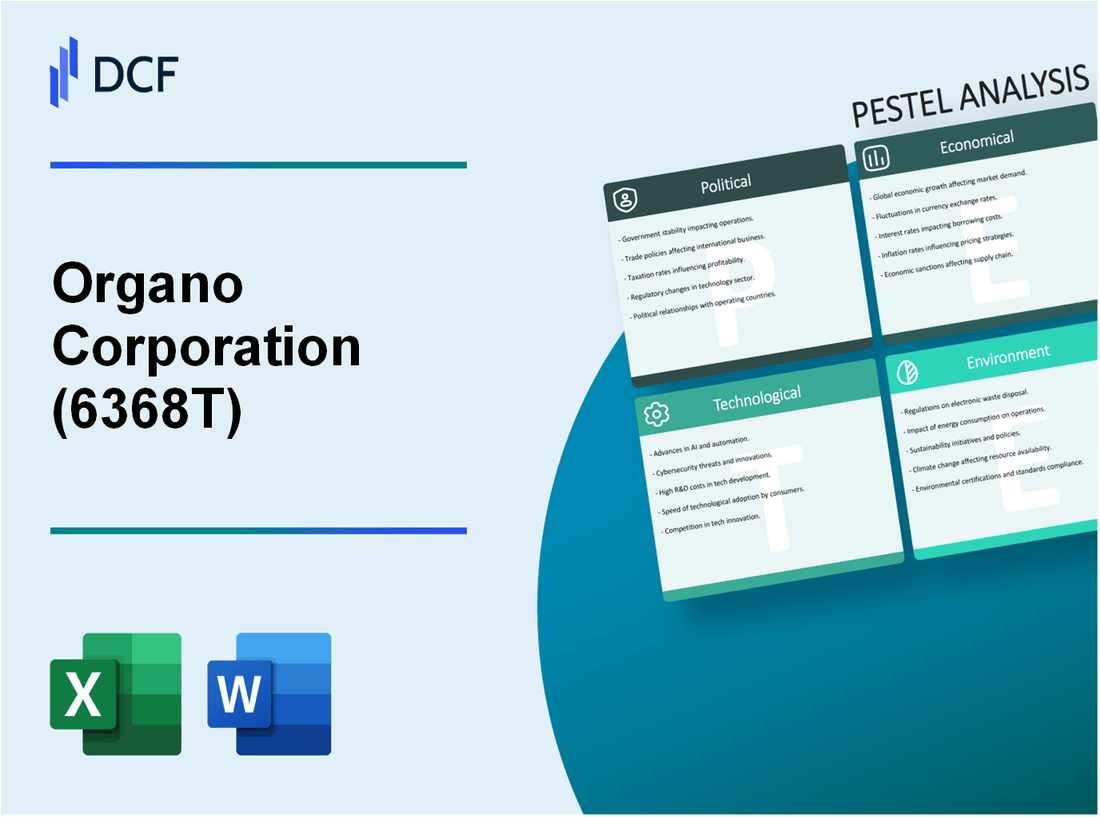
Organo Corporation (6368.T): PESTLE Analysis [Apr-2026 Updated] |
Totalmente Editável: Adapte-Se Às Suas Necessidades No Excel Ou Planilhas
Design Profissional: Modelos Confiáveis E Padrão Da Indústria
Pré-Construídos Para Uso Rápido E Eficiente
Compatível com MAC/PC, totalmente desbloqueado
Não É Necessária Experiência; Fácil De Seguir
Organo Corporation (6368.T) Bundle
Organo sits at the nexus of Japan's semiconductor revival and stricter water-quality mandates-backed by hefty government subsidies and a booming demand for ultrapure, energy-efficient recycling systems-while its tech edge in membranes, AI-driven plant management and strong IP position it to capture premium contracts; yet rising compliance costs, labor shortages, inflationary pressures, geopolitical export controls and escalating water‑scarcity risks sharpen execution challenges, making Organo's ability to scale digitally and domestically a make-or-break strategic test worth watching.
Organo Corporation (6368.T) - PESTLE Analysis: Political
Government subsidies fuel domestic semiconductor growth: Japan and other governments have increased direct and indirect financial support for semiconductor manufacturing and supporting industries. Japan's semiconductor strategy mobilizes public and private capital with government support programs and preferential tax treatment; estimates suggest combined public-private commitments in Japan and allied markets exceed ¥2 trillion (~US$13-15 billion) targeted at capacity expansion and advanced packaging through 2030. Such subsidy flows lower capital costs for suppliers of ultrapure water, chemical consumables and wastewater treatment systems - core markets for Organo - and improve project payback periods for wafer fab customers, raising demand visibility for water treatment contracts and maintenance services.
Export controls reshape supply chain risk and compliance: Export control regimes (U.S., EU, Japan, and individual Asian states) have expanded semiconductor-related restrictions on equipment, chemicals and software. The tightening of dual‑use controls since 2020 and incremental measures in 2023-2025 increase compliance burdens and create rerouting of procurement. For Organo this manifests as:
- Higher compliance costs: additional licensing, classification and local counsel engagements increasing operating expenses by an estimated 1-3% of revenue for mid-sized suppliers.
- Supply diversification opportunities: demand for domestically sourced water treatment solutions where import of certain components becomes restricted.
- Contract complexity: customers requiring supply‑chain transparency, origin certificates and audit support.
Regional special zones drive clustered semiconductor development: National and regional incentives (tax holidays, land subsidies, expedited permits) create semiconductor clusters in designated zones across Japan, Taiwan, South Korea and the U.S. These zones frequently require localized ecosystem suppliers. Data point examples include:
| Region | Type of Incentive | Notable Cluster Investment (est.) | Implication for Organo |
|---|---|---|---|
| Japan (Aichi, Kumamoto) | Tax breaks, expedited permits | ¥300-600 billion per major fab project | Proximity to fabs increases demand for point‑of‑use water systems and on‑site chemical dosing |
| USA (Arizona, Texas) | State grants, land subsidies | US$10-40 billion per major foundry facility | Long‑term service contracts and recurring chemical sales |
| Taiwan (Hsinchu) | Infrastructure upgrades, workforce programs | US$5-20 billion for expansion packages | High specification ultrapure water demand; potential for OEM partnerships |
Domestic‑sourcing mandates boost local production investments: Governments increasingly implement rules favoring local sourcing for critical semiconductor inputs. Examples include procurement preferences and localization quotas applied to public procurement and state‑backed projects. Such mandates can shift purchase decisions toward domestic suppliers and approved local vendors. For Organo, this translates into tangible commercial effects:
- Increased bidding opportunities on government‑linked fab projects where domestic content requirements reach 20-50%.
- Need for capacity expansion: potential capital expenditure to scale local manufacturing or assembly to meet procurement thresholds, with estimated CAPEX for a mid‑scale chemical blending facility in Japan ranging ¥200-500 million.
- Contractual premium: localized supply often commands price premiums of 5-15% relative to global commodity imports due to assured compliance and shorter lead times.
Water treatment chemicals elevated as critical national materials: Policymakers now identify chemicals and water‑treatment technologies used in semiconductor fabs as critical for national technology security. Classification as "critical materials" or "strategic infrastructure" increases export scrutiny and creates prioritized procurement channels. Relevant impacts and metrics include:
| Political Action | Typical Industry Impact | Quantitative Indicator | Effect on Organo |
|---|---|---|---|
| Designation as critical material | Export controls, domestic priority allocation | Processing chemicals for fabs → subject to licensing in >8 jurisdictions (2024-2025) | Secures domestic demand; complicates international sales logistics |
| Priority allocation during shortages | Governments can direct supply to strategic fabs | Allocation protocols cover ~30-50% of production in crisis scenarios | Improves contract stability with strategic customers; requires contingency planning |
| Subsidized infrastructure grants | Reduced capex burden for customers | Grants covering 10-40% of eligible project costs | Shortens sales cycles; increases install base for treatment equipment |
Organo Corporation (6368.T) - PESTLE Analysis: Economic
Rising capital costs amid higher BOJ rates
The Bank of Japan's policy normalization since 2022-2024 has shifted short-term rates from deeply negative to a positive territory, putting upward pressure on corporate borrowing costs. For Organo, financing costs have increased through higher bank loan spreads and higher yields on corporate bonds. Estimated effects include a rise in average interest expense by 15-40% year-over-year for new borrowings and refinance activity, depending on tenor and credit spread.
| Metric | Pre-normalization (approx.) | Post-normalization (approx.) | Impact on Organo |
|---|---|---|---|
| BOJ short-term policy rate | -0.10% to 0.00% | 0.10% to 0.75% | Higher benchmark for loan pricing |
| Japanese 10y JGB yield | ~0.00%-0.25% | ~0.50%-1.00% | Higher long-term funding costs |
| Estimated increase in interest expense on new debt | - | +15% to +40% | Compresses free cash flow if unchanged |
| Working capital financing cost | ~LIBOR/TONA+50-150bps | ~TONA+100-250bps | Higher W/C carrying cost |
Yen strength affects overseas service contract value
Appreciation of the JPY versus USD and other regional currencies reduces the yen-converted revenues from overseas service contracts and exports. Between cyclical low points and recent appreciation phases, the yen strengthened roughly 10-20% against the USD/EUR in periods of repatriation. For Organo, which invoices a meaningful portion of semiconductor and water-treatment service contracts in USD/foreign currencies, a 10% yen appreciation can reduce reported JPY revenues by ~9-10% for constant foreign-currency sales and compress reported operating profit similarly unless hedged.
- FX exposure: estimated 30-50% of revenue sensitive to USD/EUR/SGD movements (depending on segment).
- Hedging: forward contracts and natural hedges reduce volatility; unhedged portion remains earnings risk.
- Translation effect: reported consolidated sales and margins susceptible to quarterly FX swings.
Semiconductor market growth expands ultrapure water demand
Global semiconductor capacity expansion drives demand for ultrapure water (UPW) and related process equipment-core to Organo's industrial water solutions. Industry forecasts implied semiconductor equipment capex growing at a 4-10% CAGR (varies by source) over 2024-2028. UPW market estimates show a CAGR of ~6-9% to reach $6-8 billion by the late 2020s. Organo's addressable market growth from semiconductor customers can lift service contracts, consumables, and long-term maintenance revenue, which historically yield higher gross margins (service/consumables margin often 20-40% vs. equipment sales lower).
| Indicator | 2023/2024 level | Projected CAGR (2024-2028) | Relevance to Organo |
|---|---|---|---|
| Global semiconductor capex | ~$100-160bn annual | 4%-10% | More fabs → higher UPW demand |
| Ultrapure water market size | ~$4.0-5.5bn | 6%-9% | Direct addressable revenue growth |
| Service/consumables revenue share (industry typical) | 30%-50% of lifecycle revenue | - | Recurring, higher-margin opportunity |
Inflation pressures push price adjustments and margins
Elevated global input costs-chemicals, membranes, energy, freight, and labor-are pressuring gross margins. Japan's headline inflation running near 2-3% (periodic spikes higher) and higher input inflation in ASEAN/EM markets can force suppliers to increase selling prices. Organo faces the trade-off of passing cost increases to customers versus absorbing costs to maintain volume. Typical responses include annual index-linked pricing, renegotiated service contract terms, and efficiency-driven OPEX reductions. Sensitivity analysis: a 5% increase in input cost could reduce gross margin by 1.5-3.0 percentage points absent price adjustments.
- Price passthrough: partial-depends on contract structure and competitive dynamics.
- Margin levers: product mix shift toward recurring services, cost optimization, and productivity improvements.
- Inflation indexing: more common in multi-year service contracts post-2022.
Southeast Asia market shift aligns with export dynamics
Southeast Asia's industrialization and fab investment relocation (Malaysia, Singapore, Vietnam, Thailand, Indonesia) is shifting Organo's geographic revenue mix toward export-oriented markets. Exports from Japan and regional manufacturing hubs benefit from supply-chain rebalancing, but also expose Organo to local currency and trade-policy risks. Regional GDP growth projected at ~4-5% annually for key ASEAN economies supports demand for municipal and industrial water treatment. Export dynamics-logistics costs, tariffs (typically low for equipment), and preferential trade agreements (RCEP, bilateral FTAs)-influence competitiveness.
| Region | GDP growth (estimate) | Semiconductor/industrial investment trend | Implication for Organo |
|---|---|---|---|
| Malaysia | ~3.5%-4.5% | High (packaging, test, backend) | Growing UPW/service demand |
| Singapore | ~2.5%-3.5% | High (advanced nodes, R&D) | Premium service contracts |
| Vietnam/Thailand/Indonesia | ~4.5%-6.5% | Rising (assembly, supporting industries) | Expanding municipal & industrial water market |
Organo Corporation (6368.T) - PESTLE Analysis: Social
The Japanese demographic shift is a primary sociological pressure on Organo: Japan's population aged 65+ reached 29.1% in 2023 (Cabinet Office), producing a shrinking labor pool and increasing specialized labor shortages in water treatment engineering and plant operations. Organo faces higher wage inflation for skilled technicians (estimated 3-5% annual premium vs. general labor) and rising recruitment/training costs; replacement demand for retiring specialists is projected at 12-18% of the sector workforce over the next five years.
Public demand for stricter water quality and health protection intensifies regulatory and reputational risk. Japan's Water Quality Standards and the Ministry of Health's tightening of contaminants (e.g., stricter limits for trihalomethanes and PFAS in recent years) lead municipalities and corporations to accelerate upgrades. Consumer surveys indicate 72% of urban households in Japan express high concern about tap-water contaminants, driving municipal procurement cycles and aftermarket service requirements for water-treatment firms like Organo.
ESG investing exerts measurable pressure on disclosure and sustainable operations. ESG assets under management in Japan exceeded ¥200 trillion (~US$1.5 trillion) by 2023; institutional investors increasingly require sustainability reporting aligned with TCFD and ISSB. Organo's access to lower-cost capital, institutional shareholder support, and procurement from ESG-driven buyers correlate with transparent metrics (Scope 1-3 emissions, water reuse rates). Failure to provide robust ESG data risks higher cost of capital-estimated spread of 20-40 bps for lower-rated ESG performers.
Urban concentration affects service demand and community expectations. Japan's urbanization rate is ~91% (World Bank), concentrating water infrastructure demand in metropolitan areas where utility fees and neighborhood expectations for service reliability and environmental stewardship are higher. Urban municipalities often face higher per-connection investment costs and demand 24/7 service, increasing O&M revenue opportunities but also elevating SLAs and reputational exposure for any disruptions.
Social trends favor circular economy models in water technology. Public and corporate adoption of water recycling, resource recovery (phosphorus, energy-from-sludge), and product stewardship is rising: target municipal reuse rates and industrial closed-loop projects have grown 15-25% year-on-year in pilot programs. Organo can leverage this by expanding offerings that enable water reuse, nutrient recovery, and energy-efficient treatment, aligning with national circular-economy targets and municipal green procurement policies.
| Sociological Factor | Key Metrics / Data | Direct Impact on Organo |
|---|---|---|
| Aging workforce | 65+ population: 29.1% (2023); projected specialist retirements: 12-18% (5 yrs) | Higher recruitment/training costs; need for automation and knowledge transfer |
| Public water quality concern | 72% of urban households express high concern; regulatory tightening of PFAS/trihalomethanes | Increased retrofit and monitoring demand; higher compliance service revenues |
| ESG investing pressure | ESG AUM in Japan: ¥200T+; demand for TCFD/ISSB-aligned reporting | Necessity for transparent sustainability metrics; influence on cost of capital |
| Urban concentration | Urbanization: ~91%; higher per-connection utility fees in metro areas | Concentrated contracts with higher SLAs; opportunities for premium services |
| Circular economy trends | Reuse/closed-loop pilot growth: 15-25% YoY in projects; national circular targets | Product development opportunities in reuse, resource recovery, energy efficiency |
Strategic implications and action areas:
- Invest in automation, remote monitoring, and knowledge-transfer programs to mitigate skilled labor shortages.
- Expand advanced monitoring and treatment product lines to capture retrofit demand driven by stricter water-quality expectations.
- Enhance ESG disclosures (TCFD/ISSB alignment) and quantify Scope 1-3 impacts to access ESG capital and procurement channels.
- Prioritize metropolitan service offerings with premium reliability and community engagement programs to meet urban neighborliness expectations.
- Develop circular-economy solutions (water reuse, nutrient/energy recovery) and commercialize performance-based contracts tied to resource savings.
Organo Corporation (6368.T) - PESTLE Analysis: Technological
Ultrapure water standards drive advanced filtration R&D: Organo's product development roadmap is increasingly shaped by rising ultrapure water (UPW) demands in semiconductor, pharmaceutical and power industries where resistivity targets exceed 18.2 MΩ·cm and particulate levels must be <1 particle/mL (≥0.1 µm). Since 2021 Organo has allocated ¥2.4 billion (~US$17.5M) cumulatively to membrane and ion-exchange R&D, targeting a 25-40% improvement in TOC (total organic carbon) removal and a 30% reduction in conductivity deviation under variable feedwater conditions by 2027.
AI and IoT enable predictive maintenance and efficiency: Deployment of AI-driven analytics and IoT-enabled instrumentation reduces unplanned downtime and chemical consumption. Field pilots reported by Organo in 2023 show a 38% reduction in unscheduled service calls and a 22% reduction in CIP (clean-in-place) cycle frequency when AI models predict fouling events. Predictive alerts also cut emergency spare-parts expenditure by approximately 18% annually.
High-recovery membranes enable substantial water savings: New high-recovery reverse osmosis (RO) and electrodialysis modules increase plant-level recovery rates from typical 70% to 85-92% in specific brackish and industrial wastewater cases. For a 10,000 m3/day client facility, moving from 72% to 88% recovery equates to ~1,600 m3/day less raw intake - roughly 584,000 m3/year saved - translating to feeding-water cost reductions of ¥30-50M/year depending on local tariffs.
Digital transformation shortens project timelines and costs: Use of digital twins, BIM (building information modeling), and cloud-based project management has shortened design-to-commissioning cycles. Organo reports typical project lead times falling from 14 months to 9-10 months for mid-scale systems since adopting digital workflows, yielding capex savings of 6-12% per project and reduction in on-site labor by ~20%.
5G sensor networks enhance real-time data and uptime: Integration of 5G-enabled sensor arrays improves telemetry bandwidth and latency for remote monitoring of critical parameters (pressure, turbidity, pH, conductivity, TOC). Trials indicate latency <50 ms and packet loss <0.1% versus previous LTE setups, enabling closed-loop control and automated emergency shutdowns that can prevent membrane damage. This connectivity supports SaaS service models that have achieved ~15% higher ARR (annual recurring revenue) retention for service contracts containing remote monitoring.
| Technology | Key Metric | Reported Impact | Timeframe |
|---|---|---|---|
| Ultrapure water R&D | TOC reduction target | 25-40% improvement | By 2027 |
| AI predictive maintenance | Unscheduled downtime reduction | 38% reduction | Pilots 2022-2024 |
| High-recovery membranes | Recovery increase | From ~70% to 85-92% | Commercialized 2023-2025 |
| Digital twin / BIM | Project lead time | From 14 to 9-10 months | Adopted since 2021 |
| 5G sensor networks | Telemetry latency | <50 ms; packet loss <0.1% | Trials 2023-2024 |
- R&D expenditure: ¥2.4 billion allocated since 2021 to filtration and membrane innovation.
- Operational efficiency: AI-driven maintenance cuts CIP frequency ~22% and emergency parts spend ~18%.
- Water savings example: 10,000 m3/day plant - ~584,000 m3/year saved at recovery increase from 72% to 88%.
- Project economics: Digital workflows reduce capex by 6-12% and on-site labor by ~20%.
- Service revenue: Remote-monitoring-enabled contracts show ~15% higher ARR retention.
Organo Corporation (6368.T) - PESTLE Analysis: Legal
PFAS regulations mandate wastewater upgrades and fines: Recent national and prefectural regulations in Japan and export markets increasingly restrict per- and polyfluoroalkyl substances (PFAS) in industrial effluent. For a water-treatment equipment and chemicals provider such as Organo Corporation, this creates direct legal obligations to upgrade plant-level wastewater treatment systems, validate removal performance, and maintain monitoring records under penalty regimes.
Estimated compliance and penalty figures:
| Item | Estimate (JPY) | Estimate (USD) | Timing |
|---|---|---|---|
| Capital upgrades to existing wastewater treatment (facility-level) | ¥800 million - ¥2.4 billion | $6.0M - $18.0M | 2024-2028 |
| Annual operational & monitoring costs | ¥60 million - ¥180 million/year | $0.45M - $1.35M/year | Ongoing |
| Maximum administrative fines per violation (regional jurisdictions) | ¥5 million - ¥50 million | $36k - $360k | Immediate |
| Potential product recall / remediation exposure (worst-case) | ¥1.0 billion - ¥5.0 billion | $7.5M - $37.5M | Contingent |
Legal implications include mandatory disclosure of PFAS monitoring results to regulators, tightened contractual indemnities with industrial customers, and potential class-action liability if contamination events occur. Non-compliance risk elevates counterparty risk with major industrial clients and could affect procurement contracts worth several billion JPY annually.
Labor law reforms raise staffing and overtime costs: Japan's continuing labor-law reforms (work-style reforms, stricter overtime caps, enhanced mandatory leave, and stronger protections for dispatched workers) directly increase payroll and compliance overhead. Organo's field-service and installation workforce is labor-intensive and subject to overtime and travel allowances.
Quantified impact on labor expense (company-level illustrative):
| Category | Pre-reform baseline | Post-reform impact | Estimated incremental annual cost (JPY) |
|---|---|---|---|
| Overtime caps / premium pay | Overtime ~8% of total payroll | Overtime reduced but premium pay rises; subcontracting increases | ¥50M - ¥140M |
| Temporary/staffing agency compliance | Agency spend ¥120M | Compliance & agency premiums +10-25% | ¥12M - ¥30M |
| Recordkeeping / HR compliance systems | Legacy systems | One-time upgrade & training | ¥15M - ¥45M (one-off) |
Practical legal outcomes include increased litigation risk for misclassification of workers, mandatory documentation subject to inspection, and higher insurance premiums. To mitigate, Organo will likely shift to higher-priced subcontractors, automate scheduling, or absorb costs-each compressing margins unless passed to customers via price adjustments.
Strengthened IP protection and patent linkage: Japan and export jurisdictions (US, EU, China) have been strengthening patent enforcement and linkage mechanisms for technologies critical to industrial processes and water-treatment chemicals. For Organo, proprietary membrane technology, specialty resins, and process control software are strategic assets. Enhanced IP regimes expand remedies (injunctions, higher damages) and streamline patent linkage between product approval and patent expiry dates in certain markets.
Relevant metrics and exposures:
- Number of active patents and pending applications (global) relevant to water-treatment core tech: ~45-70 families.
- Estimated annual revenue at risk from IP injunction (if a core patent is upheld): ¥2.0 billion - ¥6.0 billion.
- Average annual spend on IP portfolio management and litigation readiness: ¥25M - ¥80M.
Legal strategies will include intensified patent filing (+10-20% yearly in key jurisdictions), defensive patent pools, strengthened confidentiality agreements, and tighter supplier IP clauses. The company faces regulatory requirements linking patent status to product authorization in some overseas markets, which can delay market entry or force licensing fees.
Mandatory climate and Scope 3 disclosure increases compliance burden: Regulatory shifts toward mandatory climate disclosures-GHG Scope 1, 2, and increasingly Scope 3-are expanding legal compliance obligations in Japan and export markets. The Financial Services Agency (FSA), Tokyo Stock Exchange (TSE) guidance, and international investor expectations are driving mandatory reporting standards (e.g., TCFD-aligned disclosures), creating audit and legal-attestation demands.
| Disclosure Requirement | Scope | Estimated incremental cost to Organo (annual) | Compliance deadline / status |
|---|---|---|---|
| Scope 1 & 2 reporting (ascertained) | Direct & purchased energy emissions | ¥6M - ¥18M/year | Ongoing (already required) |
| Scope 3 reporting (value chain) | Purchased goods, upstream/downstream use | ¥30M - ¥120M/year plus data collection capex ¥20M-¥60M | Phased implementation 2024-2027 |
| Third-party assurance / verification | Independent attestation of disclosures | ¥8M - ¥25M/year | Increasingly expected by 2025 |
Consequences include higher operational costs for supplier data collection, legal risk from inaccurate disclosures attracting regulatory sanctions or investor lawsuits, and capital allocation pressures to decarbonize operations (capital expenditures to reduce Scope 1/2 emissions estimated ¥200M-¥800M over 5 years). Mitigation measures require investments in IT systems, supplier engagement programs, and third-party verification to avoid reputational and financial penalties.
Legal risk summary (actionable items):
- PFAS: prioritize capital planning and contract renegotiation; estimate contingency reserve equal to 1-3% of annual revenue.
- Labor: update HR policies, implement time-recording systems, and review subcontractor agreements to limit misclassification exposure.
- IP: increase patent filings in priority markets, budget for litigation defense, and strengthen licensing frameworks.
- Climate/Scope 3: deploy enterprise data management, engage suppliers, and budget for assurance to meet 2025-2027 disclosure expectations.
Organo Corporation (6368.T) - PESTLE Analysis: Environmental
Carbon neutrality targets push energy-efficient water solutions: Japan's 2050 net-zero commitment and corporate targets (many large utilities targeting 2030-2040 interim goals) force Organo to prioritize low-energy membrane filtration, advanced oxidation and heat-recovery pumps. Organo's product R&D pipeline shows projected energy intensity reductions of 20-35% per m3 treated by 2030 versus 2024 baselines. Capital expenditure reallocation is evident: FY2024-2027 R&D and capex guidance increases by an estimated JPY 2.5-3.5 billion to accelerate electrification and efficiency retrofits in delivered projects.
Water scarcity drives risk assessments and recycling adoption: Increasing frequency of droughts in Asia-Pacific (FAO/UN data: regions experiencing >20% reduction in available surface water in seasonal windows since 2000) raises client demand for closed-loop and reuse systems. Organo's service contracts now include site-specific water-risk assessments in 92% of bids for industrial clients and municipalities in water-stressed basins. Adoption metrics show water recycling systems account for 28% of order intake in FY2024 (vs. 13% in FY2020), with average contract EBITDA margins approximately 3-5 percentage points higher due to recurring service revenue.
Circular economy mandates boost water recycling usage: Regulatory trends in Japan, Southeast Asia and selected Middle East markets require increased reuse rates and resource recovery. Extended producer responsibility and circularity targets (e.g., municipal reuse mandates aiming for 30-50% non-potable reuse by 2035 in several jurisdictions) position Organo as a supplier of reuse and resource-recovery modules (e.g., nutrient recovery, sludge-to-energy integration). These mandates influence procurement scoring in public tenders, where lifecycle environmental performance accounts for up to 40% of evaluation weighting.
| Metric | 2020 | 2024 | Target/Projection (2030) |
|---|---|---|---|
| Share of revenue from recycling/reuse systems | 13% | 28% | 45% |
| R&D & capex incremental allocation (JPY bn) | 0.8 | 1.2 | 3.5 |
| Energy intensity reduction per m3 treated | - | 12% | 20-35% |
| Share of bids with water-risk assessment | 45% | 92% | ~100% |
| EBITDA premium for recurring-service recycling contracts | +1-2 ppt | +3-5 ppt | +4-6 ppt |
Climate-resilient infrastructure becomes standard in tenders: Increasing climate impacts (sea-level rise, storm intensity, extreme rainfall) require hardened plant designs and redundancy. Public and private tenders now routinely request design life extensions to 50-60 years, flood-proofing to 1-in-100-year events plus margin, and resilience features (elevated electrical rooms, redundant pumping, remote monitoring). These requirements increase baseline project costs by an estimated 6-12% but reduce lifecycle operational risk and insurance premiums.
- Design & construction implications: increased unit costs (6-12%), longer lead times (+8-14%), higher specification for materials and controls.
- Operational advantages: reduced downtime risk (projected downtime reduction 30-50%), lower insurance loading (estimated 1-3% premium reduction over lifecycle).
- Commercial effects: tenders score lifecycle resilience (up to 40% weighting), favoring suppliers with integrated O&M and digital monitoring capabilities.
Data-driven procurement and financing shifts: Green financing instruments and sustainability-linked loans now tie pricing to environmental KPIs (e.g., energy intensity, percentage of reused water). Organo's access to green project financing improves when projects deliver quantifiable emissions or water savings; preliminary internal modeling indicates a potential reduction in financing cost of 25-75 bps for qualifying projects, improving NPV and enabling competitive bid pricing.
Disclaimer
All information, articles, and product details provided on this website are for general informational and educational purposes only. We do not claim any ownership over, nor do we intend to infringe upon, any trademarks, copyrights, logos, brand names, or other intellectual property mentioned or depicted on this site. Such intellectual property remains the property of its respective owners, and any references here are made solely for identification or informational purposes, without implying any affiliation, endorsement, or partnership.
We make no representations or warranties, express or implied, regarding the accuracy, completeness, or suitability of any content or products presented. Nothing on this website should be construed as legal, tax, investment, financial, medical, or other professional advice. In addition, no part of this site—including articles or product references—constitutes a solicitation, recommendation, endorsement, advertisement, or offer to buy or sell any securities, franchises, or other financial instruments, particularly in jurisdictions where such activity would be unlawful.
All content is of a general nature and may not address the specific circumstances of any individual or entity. It is not a substitute for professional advice or services. Any actions you take based on the information provided here are strictly at your own risk. You accept full responsibility for any decisions or outcomes arising from your use of this website and agree to release us from any liability in connection with your use of, or reliance upon, the content or products found herein.