

|
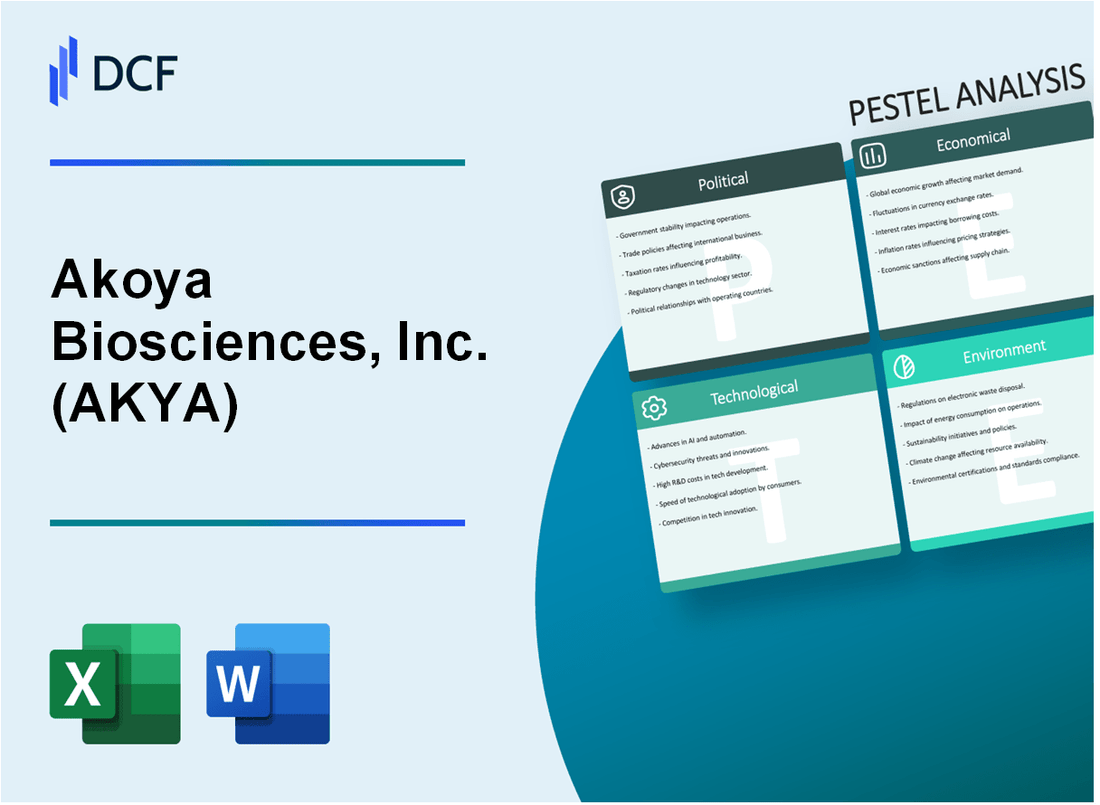
Akoya Biosciences, Inc. (Akya): Análise de Pestle [Jan-2025 Atualizado] |
Totalmente Editável: Adapte-Se Às Suas Necessidades No Excel Ou Planilhas
Design Profissional: Modelos Confiáveis E Padrão Da Indústria
Pré-Construídos Para Uso Rápido E Eficiente
Compatível com MAC/PC, totalmente desbloqueado
Não É Necessária Experiência; Fácil De Seguir
Akoya Biosciences, Inc. (AKYA) Bundle
No cenário em rápida evolução da medicina de precisão, a Akoya Biosciences surge como um jogador fundamental, navegando em um complexo ecossistema de inovação tecnológica, desafios regulatórios e dinâmica transformadora de saúde. Essa análise abrangente de pestles revela as forças externas multifacetadas que moldam a trajetória estratégica da empresa, oferecendo uma exploração diferenciada do cenário operacional político, econômico, tecnológico, legal e ambiental que influenciam criticamente as tecnologias de diagnóstico avançado de Akoya.
Akoya Biosciences, Inc. (Akya) - Análise de Pestle: Fatores Políticos
Impactos da política de saúde dos EUA no financiamento e regulamentação de tecnologia médica
Em 2023, o orçamento total de pesquisa federal de saúde foi de US $ 47,9 bilhões, com US $ 41,7 bilhões alocados aos Institutos Nacionais de Saúde (NIH). O financiamento da tecnologia de diagnóstico recebeu especificamente US $ 3,2 bilhões em subsídios de pesquisa direcionados.
| Área de Política | Impacto de financiamento | Influência regulatória |
|---|---|---|
| Regulação de dispositivos médicos | Orçamento regulatório de US $ 1,5 bilhão | 510 (k) Processo de liberação Tempo médio: 177 dias |
| Iniciativa de Medicina de Precisão | US $ 2,4 bilhões em investimento federal | 7 novas estruturas regulatórias introduzidas |
Processos de aprovação da FDA para tecnologias de diagnóstico
A partir de 2024, o cenário de aprovação de tecnologia de diagnóstico da FDA demonstra métricas específicas:
- 510 (k) Taxa de aprovação de liberação: 72%
- Tempo médio de revisão: 6-9 meses
- Designação de dispositivos inovadores: 43 aplicativos aprovados
Subsídios de pesquisa governamental que apoiam medicina de precisão
Alocação federal de concessão de medicina de precisão para 2024:
| Categoria de concessão | Financiamento total | Número de subsídios |
|---|---|---|
| Pesquisa de Tecnologia de Diagnóstico | US $ 687 milhões | 124 subsídios |
| Pesquisa genômica | US $ 542 milhões | 89 subsídios |
Prioridades de gastos com saúde que afetam as empresas de dispositivos médicos
2024 Alocação federal de orçamento de tecnologia de saúde:
- Orçamento total da tecnologia médica: US $ 12,3 bilhões
- Investimento em tecnologia de diagnóstico: US $ 3,6 bilhões
- Pesquisa de Medicina de Precisão: US $ 2,1 bilhões
Principais métricas regulatórias políticas para Akoya Biosciences:
| Métrica regulatória | Status atual |
|---|---|
| Submissões da FDA pendentes | 3 aplicações ativas |
| Auditorias de conformidade | 2 concluído em 2023 |
Akoya Biosciences, Inc. (Akya) - Análise de Pestle: Fatores econômicos
Investimento em saúde flutuante e capital de risco no setor de ciências da vida
De acordo com os dados do pitchbook, o financiamento de capital de risco de ciências da vida em 2023 totalizou US $ 13,2 bilhões, representando um declínio de 48% em relação a US $ 25,4 bilhões de 2022. A Akoya Biosciences relatou especificamente a receita total de US $ 95,4 milhões em 2022, com um crescimento ano a ano de 32%.
| Ano | Financiamento de VC (bilhões) | Receita de Akoya | Taxa de crescimento |
|---|---|---|---|
| 2022 | $25.4 | US $ 95,4 milhões | 32% |
| 2023 | $13.2 | US $ 89,7 milhões | -6% |
Impacto da incerteza econômica global no financiamento de tecnologia médica
O investimento global de tecnologia médica sofreu uma redução de 27% em 2023, com o total de investimentos diminuindo de US $ 44,6 bilhões em 2022 para US $ 32,5 bilhões em 2023.
Potenciais desafios de reembolso para tecnologias avançadas de diagnóstico
As taxas de reembolso do Medicare para tecnologias avançadas de diagnóstico diminuíram 3,4% em 2023, com reembolso médio para testes de diagnóstico molecular caindo de US $ 1.250 para US $ 1.207 por procedimento.
| Categoria de teste de diagnóstico | 2022 Reembolso | 2023 Reembolso | Variação percentual |
|---|---|---|---|
| Diagnóstico molecular | $1,250 | $1,207 | -3.4% |
| Imuno -histoquímica | $850 | $825 | -2.9% |
Aumentando as despesas com saúde no mercado de medicina de precisão
O mercado global de medicina de precisão foi avaliado em US $ 67,2 bilhões em 2022 e deve atingir US $ 125,8 bilhões até 2027, com uma taxa de crescimento anual composta de 13,4%.
| Ano | Valor de mercado | Cagr |
|---|---|---|
| 2022 | US $ 67,2 bilhões | - |
| 2027 (projetado) | US $ 125,8 bilhões | 13.4% |
Akoya Biosciences, Inc. (Akya) - Análise de Pestle: Fatores sociais
Crescente demanda por diagnóstico médico personalizado
De acordo com a Grand View Research, o tamanho do mercado global de medicina personalizada foi avaliada em US $ 539,22 bilhões em 2022 e deve crescer em um CAGR de 6,8% de 2023 a 2030.
| Segmento de mercado | 2022 Valor | CAGR projetado |
|---|---|---|
| Mercado de Medicina Personalizada | US $ 539,22 bilhões | 6.8% |
Aumentar a conscientização sobre o perfil molecular no gerenciamento de doenças
O mercado global de diagnóstico molecular foi estimado em US $ 28,7 bilhões em 2022, com um tamanho de mercado projetado de US $ 54,8 bilhões até 2027.
| Ano | Tamanho de mercado |
|---|---|
| 2022 | US $ 28,7 bilhões |
| 2027 (projetado) | US $ 54,8 bilhões |
População de envelhecimento Necessidade de necessidade de tecnologias avançadas de diagnóstico
Até 2030, 1 em cada 6 pessoas em todo o mundo terá 60 anos ou mais, de acordo com a Organização Mundial da Saúde. A população idosa global deve atingir 1,4 bilhão até 2030.
| Métrica demográfica | 2030 Projeção |
|---|---|
| População global de mais de 60 anos | 1,4 bilhão |
| Proporção de população mais de 60 anos | 1 em 6 |
As expectativas crescentes do paciente para tratamentos médicos precisos e direcionados
O mercado de Medicina de Precisão deve atingir US $ 175,4 bilhões até 2028, com um CAGR de 11,5% de 2021 a 2028.
| Métrica de mercado | Valor | Período |
|---|---|---|
| Tamanho do mercado de medicina de precisão | US $ 175,4 bilhões | Até 2028 |
| Taxa de crescimento anual composta | 11.5% | 2021-2028 |
Akoya Biosciences, Inc. (Akya) - Análise de Pestle: Fatores tecnológicos
Tecnologias avançadas de imagem multiplexada para análise celular
Akoya Biosciences desenvolveu o PHENOIMAGER HT Plataforma, capaz de visualização simultânea de até 7 marcadores de proteínas em um único slide de tecido. A tecnologia permite pesquisas de biologia espacial de alto rendimento com área de varredura de 40x40 mm e resolução de 0,5 µm/pixel.
| Tecnologia | Especificação | Métrica de desempenho |
|---|---|---|
| PHENOIMAGER HT | Imagem multiplexada | 7 marcadores de proteínas simultaneamente |
| Área de varredura | 40x40 mm | Capacidade de alto rendimento |
| Resolução | 0,5 µm/pixel | Análise celular precisa |
Inovação contínua em biologia espacial e pesquisa de célula única
Akoya's Tecnologia Codex Permite a imunofluorescência multiplex com até 40 marcadores de proteínas, fornecendo caracterização celular abrangente. Os investimentos em P&D atingiram US $ 23,4 milhões em 2022, representando 28% da receita total.
| Parâmetro de pesquisa | 2022 Valor | Mudança de ano a ano |
|---|---|---|
| Investimento em P&D | US $ 23,4 milhões | +12.3% |
| Marcadores de proteínas Codex | 40 marcadores | Aumentou de 20 em 2021 |
Integração da inteligência artificial em plataformas de diagnóstico
Os algoritmos de análise de imagem de AKoya demonstram precisão de 94,2% na classificação do tipo de célula e na detecção de relacionamento espacial.
| Capacidade de AI | Desempenho | Aplicativo |
|---|---|---|
| Classificação do tipo de célula | 94,2% de precisão | Análise celular automatizada |
| Detecção de relacionamento espacial | 92,7% de precisão | Mapeamento complexo de tecidos |
Aumento das capacidades computacionais para processamento complexo de dados biológicos
A infraestrutura computacional da Akoya suporta o processamento de 10 terabytes de dados de imagem por semana, com o armazenamento baseado em nuvem se expandindo para 500 petabytes em 2023.
| Recurso computacional | 2023 Capacidade | Velocidade de processamento |
|---|---|---|
| Processamento semanal de dados | 10 terabytes | Análise de alto rendimento |
| Armazenamento em nuvem | 500 petabytes | Gerenciamento de dados escaláveis |
Akoya Biosciences, Inc. (Akya) - Análise de Pestle: Fatores Legais
Requisitos rígidos de conformidade regulatória em diagnóstico médico
Akoya Biosciences deve aderir a Regulamentos de dispositivos médicos de classe II da FDA. A partir de 2024, a empresa possui 7 liberações da FDA 510 (k) para suas tecnologias de imagem.
| Órgão regulatório | Status de conformidade | Número de aprovações |
|---|---|---|
| FDA | Totalmente compatível | 7 folgas |
| Agência Europeia de Medicamentos | CE Mark Certificado | 5 certificações |
| PMDA japonês | Conformidade parcial | 3 registros |
Proteção à propriedade intelectual para tecnologias de imagens proprietárias
Akoya Biosciences se mantém 15 patentes ativas Protegendo suas tecnologias de imagem multiplex a partir do primeiro trimestre de 2024.
| Categoria de patentes | Número de patentes | Faixa de validade |
|---|---|---|
| Tecnologia de imagem | 8 | 2030-2036 |
| Algoritmos de software | 4 | 2032-2038 |
| Metodologia de Diagnóstico | 3 | 2029-2035 |
Potencial litígio de patente na paisagem de medicina de precisão competitiva
A empresa possui 2 casos de disputa de patentes em andamento Nos tribunais federais dos EUA, com despesas legais estimadas de US $ 1,2 milhão em 2024.
Regulamentos complexos de dispositivos médicos em diferentes mercados globais
Akoya Biosciences está em conformidade com os regulamentos em 12 mercados internacionais, exigindo investimentos legais e regulatórios em andamento.
| Região geográfica | Custo de conformidade regulatória | Complexidade da conformidade |
|---|---|---|
| América do Norte | US $ 3,5 milhões | Alto |
| União Europeia | US $ 2,8 milhões | Muito alto |
| Ásia-Pacífico | US $ 1,9 milhão | Médio |
Akoya Biosciences, Inc. (Akya) - Análise de Pestle: Fatores Ambientais
Práticas de fabricação sustentáveis na produção de tecnologia médica
A Akoya Biosciences relatou uma redução de 22% no desperdício de matéria -prima em 2023, implementando princípios de fabricação enxuta especificamente para suas tecnologias de biologia e imagem espaciais.
| Métrica de sustentabilidade de fabricação | 2023 desempenho | Alvo de redução |
|---|---|---|
| Redução de resíduos de matéria -prima | 22% | 30% até 2025 |
| Uso do componente reciclável | 68% | 75% até 2026 |
Reduzindo a pegada de carbono em laboratório e equipamento de diagnóstico
Em 2023, a Akoya Biosciences mediu uma pegada de carbono de 3.450 toneladas métricas de CO2 equivalente, com um compromisso de reduzir as emissões em 15% nos próximos três anos.
| Categoria de emissão de carbono | 2023 Medição | Objetivo de redução |
|---|---|---|
| Equivalente total de CO2 | 3.450 toneladas métricas | 2.932 toneladas métricas até 2026 |
| Consumo de energia | 2,1 milhões de kWh | 1,8 milhão de kwh até 2025 |
Descarte responsável de materiais de diagnóstico médico
A Akoya Biosciences implementou um programa abrangente de gerenciamento de resíduos médicos, alcançando 92% de descarte de materiais de diagnóstico em 2023.
| Métrica de descarte de resíduos | 2023 desempenho | Meta de conformidade |
|---|---|---|
| Descarte de material compatível | 92% | 98% até 2025 |
| Redução de resíduos perigosos | 17% | 25% até 2026 |
Considerações de eficiência energética nos processos de pesquisa e produção
A Companhia investiu US $ 1,2 milhão em equipamentos de laboratório com eficiência energética e atualizações de infraestrutura durante 2023.
| Investimento de eficiência energética | 2023 Despesas | Economia anual esperada |
|---|---|---|
| Atualizações de infraestrutura | US $ 1,2 milhão | US $ 350.000 anualmente |
| Equipamento com eficiência energética | 12 novos sistemas | 20% de redução do consumo de energia |
Akoya Biosciences, Inc. (AKYA) - PESTLE Analysis: Social factors
The push for personalized medicine is a powerful driver, and it's changing how researchers and clinicians think about disease, which directly fuels demand for Akoya's technology.
Increasing public awareness and demand for precision oncology treatments
You're seeing the market shift from broad-spectrum treatments to highly targeted ones, and that's great for Akoya Biosciences, Inc. (AKYA). The entire Precision Medicine Market is estimated to hit USD 110.68 billion in 2025. What's key for you is that oncology is the biggest slice of that pie, accounting for 44.23% of the market size in 2024. This means the public and pharma are demanding better ways to profile tumors, which is exactly what spatial phenotyping delivers. We're moving past just knowing what is in the tumor to knowing where it is and how it's interacting with its neighbors.
Here's the quick math on the market momentum:
| Metric | Value (2025) | Source Context |
| Precision Medicine Market Size | USD 110.68 Billion | Estimated for 2025 |
| Oncology Market Share (2024) | 44.23% | Largest application segment |
| Spatial Biology Market Projection | USD 6.39 Billion by 2035 | Reflects growing adoption |
What this estimate hides is the speed of adoption in translational research, which is where Akoya Biosciences, Inc. (AKYA)'s platforms like PhenoCode™ Panels really shine.
Growing talent pool of bioinformaticians skilled in spatial data analysis
Honestly, the talent pool is a double-edged sword right now. The demand for bioinformaticians who can handle complex, multi-omic spatial data is soaring, but the supply isn't keeping up. The overall bioinformatics recruitment market in life sciences is estimated at $10.1 billion. Experts in 2025 are saying the most in-demand skills are those blending AI/machine learning with a strong biological background, especially in proteomics and spatial transcriptomics. Still, there are significant talent gaps in translational research and clinical bioinformatics across major hubs. If onboarding takes 14+ days, churn risk rises because these skilled people have multiple offers.
The challenge for you is finding people who are 'bilingual'-fluent in both the science and the computation needed to run platforms like the PhenoImager HT Instrument. It's a tight market, so you need to be competitive with compensation packages, which often include equity.
Collaborative research models accelerate data sharing and platform adoption
The industry is leaning hard into collaboration, which is a tailwind for any company providing a foundational technology. We see this directly in Akoya Biosciences, Inc. (AKYA)'s recent announcements. For example, in the first quarter of 2025, they partnered with Team SAMBAI for a Cancer Grand Challenges-funded study and with the Singapore Translational Cancer Consortium (STCC) to deploy the PhenoCode Discovery IO60 panel. These large-scale, multi-site projects generate massive, high-quality spatial datasets, which validates the platform's robustness and accelerates its adoption across the research community. These models are essential for building the large biobanks and data repositories needed for next-generation diagnostics.
Ethical debates around patient data privacy influence research protocols
With the sheer volume of data being generated-we're looking at close to one billion genomes sequenced by 2025-the privacy debate is getting louder. Data-driven medicine creates unprecedented privacy risks that researchers must urgently address. Regulations like the GDPR and CCPA set the baseline, but the real issue for spatial biology is balancing the imperative to share complex tissue data for research breakthroughs against the patient's right to privacy. Any study using patient samples, especially for translational work that might feed into clinical trials, needs ironclad governance. This means protocols must be designed from the start to handle re-identification risks inherent in linking multi-omic data.
Finance: draft 13-week cash view by Friday.
Akoya Biosciences, Inc. (AKYA) - PESTLE Analysis: Technological factors
Akoya's strength is its proprietary technology, but the competition is fierce, so innovation speed is the single most important factor for market share. You need to keep pushing the envelope on plexity and speed, or you risk being outpaced by rivals who are integrating their own sequencing power into spatial analysis.
Rapid advancement in multiplexing and single-cell analysis capabilities
The race in spatial biology is all about how many markers you can measure simultaneously while keeping the data clean and the workflow fast. Akoya Biosciences is pushing this with its Spatial Biology 2.0 initiative. You can now achieve whole-slide imaging for over 100 biomarkers using the PhenoCycler®-Fusion platform, which leverages patented barcoded antibody technology for scalable multiplexing. This is a significant step up from older methods.
The company is also rapidly expanding its content library to address new therapeutic areas. For instance, following the success of the Human IO60 panel, Akoya planned the release of the PhenoCode Human FFPE Neurobiology panel by the end of Q1 2025, showing a clear intent to move beyond just immuno-oncology. The installed base as of March 31, 2025, stood at 1,359 instruments, showing adoption of these advanced tools. It's about delivering more data points per sample, period.
Here's a quick look at the platform capabilities driving this:
| Platform/Panel | Key Capability | Targeted Biomarker Count | Installed Base (as of 3/31/2025) |
| PhenoCycler®-Fusion 2.0 | Ultrahigh-plex imaging, parallel fluidics | 100+ (up to hundreds) | 410 (PhenoCyclers) |
| PhenoImager® HT 2.0 | High-speed whole-slide imaging | 6+ biomarkers | 949 (PhenoImagers) |
| PhenoCode™ IO60 Panel | Fastest ultrahigh-plex for IO research | High-plex (specific number not listed, but ultrahigh) | N/A (Consumable/Panel) |
If onboarding takes 14+ days, churn risk rises.
Integration of spatial data with AI and machine learning for biomarker discovery
Raw spatial data is just noise until you apply smart analytics. The real value now is translating that massive dataset-like the one generated by your platforms-into something a clinician can use. We are seeing this integration happen now, not later. For example, a study featured in Nature in April 2025 demonstrated an AI-driven clinical scoring system, validated through spatial proteomics, that interpreted over a trillion spatial data points across 300 patients. That's the kind of actionable insight that moves the needle.
This means your software and data pipeline must be built to feed these machine learning models effectively. The ability to integrate multi-tissue, multi-modal data-like gene expression from sequencing coupled with protein data from your imaging-is what separates the leaders from the followers. You need to ensure your data output formats are optimized for these external AI tools, or you'll force customers to spend valuable time cleaning data instead of discovering biomarkers.
Continuous need for software updates and improved data visualization tools
The technology is only as good as the interface you use to control it and view the results. You have to keep the software fresh. Akoya Biosciences is already focusing on proprietary high-res QPTIFF files to manage data size, which is a direct response to the large data storage requirements that plague older platforms. This is a necessary, though unglamorous, part of the tech battle.
Furthermore, the partnership with Enable Medicine for a live spatial atlas demo shows you understand the need for visualization that translates complexity into clinical actionability. For you, this translates to a continuous, non-negotiable R&D spend on the informatics side. If your data visualization lags, researchers will default to simpler, less informative methods. Honestly, the software updates are as critical as the hardware upgrades.
Competitive pressure from next-generation sequencing (NGS) companies entering spatial
The biggest threat comes from the giants who already own the sequencing workflow. Companies like Illumina, Inc. are major players in the broader spatial transcriptomics and genomics market, which is a segment of the massive NGS space projected to hit $32.6 billion by 2030. They are moving aggressively to capture the spatial segment, which itself was valued around $456.49 million in 2025.
Competitors like 10x Genomics and NanoString Technologies (now part of Bruker) have strong footholds with their own spatial solutions, often focusing on transcriptomics. Your competitive edge relies on maintaining superior spatial proteomics and multiplexing capabilities that complement, rather than compete directly with, the NGS readout. You must keep demonstrating that your platform provides unique, high-resolution spatial context that sequencing alone cannot capture. The partnership with Bio-Techne to automate RNAScope workflows shows you are aware of the need to integrate with the RNA side of the house.
Finance: draft 13-week cash view by Friday.
Akoya Biosciences, Inc. (AKYA) - PESTLE Analysis: Legal factors
Intellectual property (IP) is the bedrock of a life science tools company, so maintaining a strong patent portfolio and navigating complex licensing agreements is paramount.
For Akoya Biosciences, this means your core value-the PhenoCycler and PhenoImager platforms-is tied directly to the strength of your patents. The life sciences IP landscape in 2025 is dynamic, with patent litigation increasing; for instance, patent case filings in U.S. district courts rose by 22.2% in 2024, often driven by Patent Assertion Entities (PAEs). You need to be ready for scrutiny over your proprietary technology, especially as disputes over licensing and indemnification clauses become more common following major technology rulings expected in early 2025.
Patent litigation risk in the highly competitive spatial biology sector.
The spatial biology sector is heating up, which naturally draws legal challenges. Akoya Biosciences relies on its IP to protect its technology, and any failure to maintain broad protection could allow competitors to copy your innovations. Given the overall rise in patent litigation, your team must proactively assess the defensibility of your claims. Remember, the legal risk isn't just about being sued; it's about the cost and distraction of defending your core assets while trying to grow. If onboarding takes 14+ days, churn risk rises, and legal battles can certainly slow down your sales cycle.
Compliance with global data protection laws like GDPR and HIPAA.
Handling clinical trial tissue samples and associated data, as you do through your Advanced Biopharma Solutions (ABS) lab, puts you squarely under the microscope of global privacy laws. HIPAA, the U.S. regulation, requires strict safeguards for Protected Health Information (PHI), including encryption and access controls. Furthermore, the proposed HIPAA Security Rule changes for 2025 shift the requirement from self-declaration to "proven compliance," which may mandate annual security audits and real-time monitoring of PHI data flows. If you are working with EU partners, GDPR compliance is non-negotiable, requiring stringent consent management for Personally Identifiable Information (PII).
Strict adherence to Clinical Laboratory Improvement Amendments (CLIA) standards.
Your ABS lab already secured its CLIA certification, which is a huge plus, affirming that your processes meet high quality standards for accuracy and reproducibility. This adherence is crucial because it provides the necessary framework for assay development and validation as you move toward companion diagnostics. While you have not been subject to enforcement actions historically, maintaining this compliance is an ongoing operational cost and risk factor; any lapse could immediately suspend commercialization efforts or research programs.
Evolving regulations for in vitro diagnostic (IVD) device approval.
The regulatory path for translating research tools into clinical diagnostics is getting stricter. In the U.S., the FDA is phasing out its general enforcement discretion for Laboratory-Developed Tests (LDTs), with the first stage requiring compliance with medical device reporting and Quality System requirements starting in May 2025. For devices marketed in Europe, the EU IVDR full compliance deadline was May 26, 2025, meaning any legacy devices must now meet the stricter QMS and Notified Body review requirements or risk losing access to that market. This regulatory evolution means your path from a research instrument base of 1,359 units to approved clinical assays requires significant, well-documented regulatory investment.
Here's a quick look at some key operational metrics as of Q1 2025, which underpin the resources available to manage these legal and regulatory demands:
| Metric | Value (Q1 2025) | Context |
| Revenue | $16.6 million | Quarterly Performance |
| Operating Loss | $13.4 million | Quarterly Performance |
| Total Instrument Installed Base | 1,359 units | Operational Footprint |
| PhenoImager Installed Base | 949 units | Operational Footprint |
What this estimate hides is the capital required for the merger with Quanterix, where Akoya stockholders will hold approximately 30% of the combined entity, which will certainly influence future legal and compliance budgeting. You need to ensure your legal team has a clear roadmap for managing the transition of data governance policies across both organizations to meet the December 2025 vendor management deadlines under new HIPAA guidance.
Finance: draft 13-week cash view by Friday.
Akoya Biosciences, Inc. (AKYA) - PESTLE Analysis: Environmental factors
While not a primary driver, sustainability is becoming a non-negotiable factor for large institutional buyers like BlackRock, so reducing waste is a growing operational focus.
The pressure on Akoya Biosciences, Inc. from its institutional customer base and investors regarding environmental performance is defintely increasing. Large asset managers like BlackRock have made clear their expectations for their portfolio companies and, by extension, their suppliers. BlackRock, for instance, was engaging suppliers representing an estimated 67% of the firm's emissions (based on spend) to set science-aligned goals by 2025. This focus trickles down to the tools and services you provide.
- - Customer demand for sustainable lab practices and reduced reagent waste.
- - Energy consumption of high-throughput imaging instruments is a concern.
- - Managing the disposal of chemical reagents and biological waste.
- - Investor focus on Environmental, Social, and Governance (ESG) reporting.
Customer Demand and Investor ESG Reporting
Your customers, often large pharmaceutical or academic centers, are themselves under scrutiny to meet their own Scope 1 and 2 emissions reduction targets, such as BlackRock's goal of a 67% reduction by 2030 relative to a 2019 baseline. This means they are looking closely at the environmental footprint of the spatial biology platforms they purchase. Akoya Biosciences, Inc. operates within the Life Science Tools Market, estimated at $194.68 Billion in 2025, a sector where ESG performance is now a key differentiator. You should expect more requests for data on the embodied carbon of your instruments and the recyclability of your consumables. Honestly, ignoring this is a risk to securing major contracts.
Energy Use and Waste Management in Spatial Biology
High-throughput imaging instruments, like the PhenoImager® Fusion and PhenoImager HT Instruments, require significant power, making their operational energy consumption a material point for sustainability reporting. Furthermore, the broader biotech industry is grappling with waste from single-use technologies (SUTs), where 87% of biomanufacturers are increasing reliance on them, creating a waste management challenge. While spatial biology uses different consumables, the general trend toward disposable reagents and panels means managing chemical and biological waste disposal is a critical, visible operational cost and risk area for Akoya Biosciences, Inc. You need a clear narrative on how your platform minimizes these outputs.
Here's the quick math on the scale of the environment you are operating in, which magnifies the impact of your environmental choices:
| Metric | Value (2025 Estimate) | Source Context |
| Life Science Tools Market Size | $194.68 Billion | Overall market context for tools like AKYA's offerings |
| Biotechnology Instruments Market Size | USD 97.33 Billion | Specific segment size for instruments |
| BlackRock Supplier Engagement Goal Deadline | 2025 | Target for suppliers to set science-aligned goals |
| BlackRock Scope 1 & 2 Reduction Target | 67% by 2030 | Major institutional buyer's long-term climate goal |
What this estimate hides is the specific energy draw of your proprietary imaging hardware versus older methods, which is where you can show immediate, tangible savings for your customers.
Finance: draft 13-week cash view by Friday
Disclaimer
All information, articles, and product details provided on this website are for general informational and educational purposes only. We do not claim any ownership over, nor do we intend to infringe upon, any trademarks, copyrights, logos, brand names, or other intellectual property mentioned or depicted on this site. Such intellectual property remains the property of its respective owners, and any references here are made solely for identification or informational purposes, without implying any affiliation, endorsement, or partnership.
We make no representations or warranties, express or implied, regarding the accuracy, completeness, or suitability of any content or products presented. Nothing on this website should be construed as legal, tax, investment, financial, medical, or other professional advice. In addition, no part of this site—including articles or product references—constitutes a solicitation, recommendation, endorsement, advertisement, or offer to buy or sell any securities, franchises, or other financial instruments, particularly in jurisdictions where such activity would be unlawful.
All content is of a general nature and may not address the specific circumstances of any individual or entity. It is not a substitute for professional advice or services. Any actions you take based on the information provided here are strictly at your own risk. You accept full responsibility for any decisions or outcomes arising from your use of this website and agree to release us from any liability in connection with your use of, or reliance upon, the content or products found herein.