

|
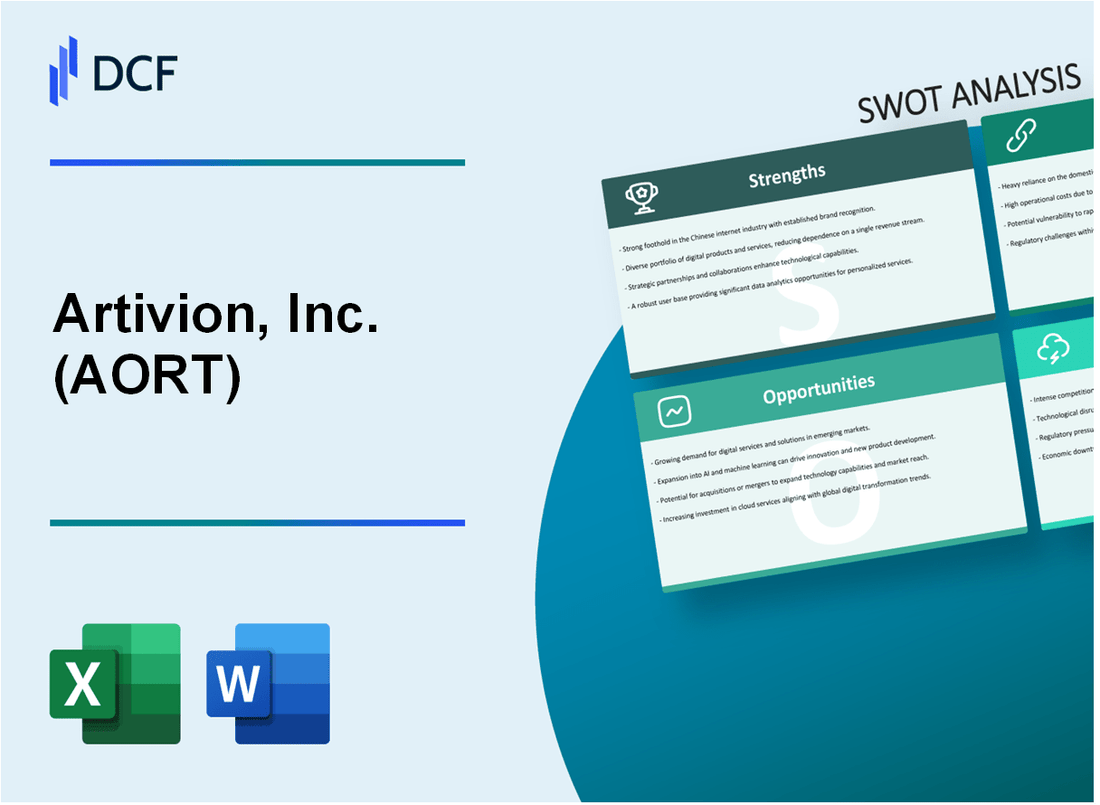
Artivion, Inc. (AORT): Análise SWOT [Jan-2025 Atualizada] |
Totalmente Editável: Adapte-Se Às Suas Necessidades No Excel Ou Planilhas
Design Profissional: Modelos Confiáveis E Padrão Da Indústria
Pré-Construídos Para Uso Rápido E Eficiente
Compatível com MAC/PC, totalmente desbloqueado
Não É Necessária Experiência; Fácil De Seguir
Artivion, Inc. (AORT) Bundle
No cenário dinâmico da tecnologia médica, a Artivion, Inc. (aort) está em um momento crítico, navegando em desafios complexos de mercado e oportunidades inovadoras. Essa análise SWOT abrangente revela o posicionamento estratégico da Companhia, explorando seus pontos fortes em soluções cardiovasculares, trajetórias de crescimento potenciais e o intrincado ecossistema competitivo que define seu futuro. Ao dissecar as capacidades internas da Artivion e as forças do mercado externo, fornecemos uma perspectiva diferenciada sobre como essa empresa de tecnologia médica especializada pode aproveitar suas vantagens únicas e mitigar riscos potenciais em um cenário de assistência médica cada vez mais exigente.
Artivion, Inc. (aort) - Análise SWOT: Pontos fortes
Empresa especializada em tecnologia médica
A Artivion, Inc. se concentra exclusivamente em soluções cardiovasculares e cirúrgicas, com uma capitalização de mercado de US $ 455,32 milhões em janeiro de 2024. A Companhia gera receita anual de aproximadamente US $ 241,7 milhões, especializada em tecnologias médicas avançadas.
Portfólio forte de dispositivos médicos inovadores
Artivion mantém um portfólio robusto de produtos com as principais ofertas tecnológicas:
| Categoria de produto | Segmento de mercado | Contribuição anual da receita |
|---|---|---|
| Tecnologias de válvula cardíaca | Cardiovascular cirúrgico | US $ 127,5 milhões |
| Enxertos vasculares | Reconstrução cirúrgica | US $ 68,3 milhões |
| Tecnologias de processamento de tecidos | Medical Biologics | US $ 45,9 milhões |
Reputação estabelecida em mercados médicos
Artivion demonstra forte posicionamento de mercado com as seguintes métricas -chave:
- Participação no mercado em tecnologias de válvulas cardíacas: 14,2%
- Distribuição do enxerto cirúrgico global: 22 países
- Dispositivos médicos aprovados pela FDA: 7 linhas de produtos principais
Investimento de pesquisa e desenvolvimento
Compromisso com a inovação evidenciada por despesas substanciais de P&D:
| Ano fiscal | Investimento em P&D | Porcentagem de receita |
|---|---|---|
| 2022 | US $ 32,6 milhões | 13.5% |
| 2023 | US $ 36,4 milhões | 15.1% |
Métricas principais de inovação:
- Portfólio de patentes: 83 patentes ativas
- Ciclo de desenvolvimento de novos produtos: 18-24 meses
- Acordos de colaboração de pesquisa: 5 instituições acadêmicas
Artivion, Inc. (AORT) - Análise SWOT: Fraquezas
Capitalização de mercado relativamente pequena
Em janeiro de 2024, a capitalização de mercado da Artivion é de aproximadamente US $ 435 milhões, significativamente menor em comparação com os principais concorrentes de dispositivos médicos:
| Concorrente | Cap |
|---|---|
| Medtronic | US $ 124,3 bilhões |
| Edwards Lifesciences | US $ 46,7 bilhões |
| Artivion | US $ 435 milhões |
Dependência de segmentos especializados de produtos médicos
A concentração de receita da Artivion é evidente em suas linhas de produtos especializadas:
- Preservação do tecido cirúrgico: 42% da receita total
- Enxertos vasculares: 33% da receita total
- Produtos de cirurgia cardíaca: 25% da receita total
Vulnerabilidade potencial a mudanças regulatórias
Os custos de conformidade regulatória da área de saúde para o Artivion em 2023 foram estimados em US $ 7,2 milhões, representando 5,4% do total de despesas operacionais.
Diversificação de receita geográfica limitada
| Região | Porcentagem de receita |
|---|---|
| Estados Unidos | 78% |
| Europa | 15% |
| Resto do mundo | 7% |
Artivion, Inc. (AORT) - Análise SWOT: Oportunidades
Crescente demanda global por tecnologias médicas cardiovasculares avançadas
O mercado global de dispositivos médicos cardiovasculares foi avaliado em US $ 78,2 bilhões em 2022 e deve atingir US $ 126,5 bilhões até 2030, com um CAGR de 6,2%.
| Segmento de mercado | 2022 Valor | 2030 Valor projetado | Cagr |
|---|---|---|---|
| Dispositivos médicos cardiovasculares | US $ 78,2 bilhões | US $ 126,5 bilhões | 6.2% |
Expansão potencial para mercados emergentes de saúde
Os mercados emergentes apresentam oportunidades significativas de crescimento para tecnologias cardiovasculares:
- O mercado de dispositivos cardiovasculares da Ásia-Pacífico deve crescer para US $ 44,3 bilhões até 2027
- O mercado cardiovascular do Oriente Médio projetou -se para atingir US $ 3,8 bilhões até 2025
- Mercado de dispositivos cardiovasculares da América Latina estimada em US $ 2,6 bilhões em 2023
Aumente o envelhecimento da população que exige intervenções cardiovasculares
As tendências demográficas apóiam o aumento da demanda de intervenção cardiovascular:
| Região | População 65+ até 2030 | Prevalência de doenças cardiovasculares |
|---|---|---|
| Estados Unidos | 74,1 milhões | 48,6% da população |
| Europa | 129,6 milhões | 53,2% da população |
| Japão | 36,8 milhões | 56,4% da população |
Potencial para parcerias estratégicas ou aquisições no setor de tecnologia médica
Cenário de fusões e aquisições de Tecnologia Médica em 2023:
- Total de dispositivos médicos fusões e aquisições de fusões e aquisições: 312
- Valor total da transação: US $ 42,6 bilhões
- Tamanho médio da transação: US $ 136,5 milhões
As possíveis áreas de foco estratégico da Artivion incluem:
- Tecnologias de engenharia de tecidos
- Dispositivos de intervenção cirúrgica avançada
- Soluções cardiovasculares minimamente invasivas
Artivion, Inc. (AORT) - Análise SWOT: Ameaças
Concorrência intensa nos mercados de dispositivos médicos e de tecnologia cardiovascular
O Artivion enfrenta pressões competitivas significativas no mercado de dispositivos médicos cardiovasculares. Os principais concorrentes incluem:
| Concorrente | Quota de mercado | Receita anual |
|---|---|---|
| Medtronic | 22.3% | US $ 31,7 bilhões |
| Edwards Lifesciences | 15.6% | US $ 5,4 bilhões |
| Boston Scientific | 18.9% | US $ 12,6 bilhões |
Recordações rigorosas da FDA e requisitos regulatórios de dispositivos médicos internacionais
Os desafios regulatórios apresentam ameaças significativas às operações comerciais da Artivion:
- O processo de aprovação da FDA leva uma média de 10 a 15 meses
- Os custos de conformidade variam de US $ 10 milhões a US $ 50 milhões por dispositivo
- Taxas de rejeição regulatória para dispositivos médicos: 33%
Possíveis desafios de reembolso em sistemas de saúde
| Métrica de reembolso | Status atual |
|---|---|
| Taxa de reembolso do Medicare | Diminuindo 2,5% anualmente |
| Cobertura de seguro privado | Reduzido em 7,3% em procedimentos cardiovasculares |
| Tendência global de reembolso de saúde | Redução projetada de 4,2% até 2025 |
Incertezas econômicas que afetam os gastos com saúde
Fatores econômicos que afetam os investimentos em tecnologia médica:
- Volatilidade dos gastos com saúde global: ± 3,5% de flutuação anual
- Taxa de crescimento do mercado de dispositivos médicos: 4,2% (2023-2024)
- Redução de investimentos em pesquisa e desenvolvimento: 6,7% em 2023
Projeção cumulativa de impacto de risco: Estimado 12-15% potencial redução de receita devido a ameaças combinadas.
Artivion, Inc. (AORT) - SWOT Analysis: Opportunities
You're looking for where Artivion, Inc. can capture near-term growth, and the answer is clear: the pipeline products are transitioning into market drivers, and international expansion is already yielding double-digit returns. The company's strategic focus on complex aortic procedures is creating distinct, high-margin market opportunities that are just now starting to inflect.
Expanding market penetration for the PerClot hemostatic agent globally.
The opportunity here is to accelerate the growth of the Surgical Sealants product line, which includes PerClot and BioGlue, by leveraging Artivion's existing global sales infrastructure. While the overall Surgical Sealants segment showed a modest constant currency growth of only 2% in the third quarter of 2025, PerClot, a hemostatic agent used to stop bleeding during surgery, is a key component for expansion.
Artivion began manufacturing and supplying PerClot under a Transitional Manufacturing and Supply Agreement with Baxter International, Inc. in the second quarter of 2023. The real opportunity lies in securing new regulatory approvals and distribution channels in high-volume surgical centers outside of established markets. Honestly, a 2% growth rate for a product line is too low for a growth-focused medical device company, so this is a low-hanging fruit opportunity to improve commercial execution and distribution for a product that is already in-house.
Clinical trial success and subsequent market launch of new aortic stent grafts.
This is the most defintely compelling growth driver for Artivion, with multiple products in the pipeline moving toward or already in the market. The early success of the AMDS Hybrid Prosthesis is already reflected in the Q3 2025 financials, where Stent Graft revenues jumped 31% year-over-year on a constant currency basis.
Here's the quick math on the near-term market size:
- The AMDS Hybrid Prosthesis, which received HDE approval, is targeting a $150 million annual U.S. market opportunity.
- The Arcevo LSA Hybrid Stent Graft System, which began its ARTIZEN pivotal trial in November 2025, is estimated to open an incremental $80 million U.S. market opportunity upon Premarket Approval (PMA) as soon as 2029.
The company is targeting PMA for AMDS in 2026, which will allow for full commercial distribution in the U.S.. This steady cadence of new product launches and approvals is what will sustain the double-digit revenue growth Artivion is projecting.
Geographic expansion into high-growth emerging markets in Asia and Latin America.
The company's strategy to expand its commercial footprint in emerging markets is already paying off, as evidenced by the Q3 2025 regional revenue performance. These markets offer a long runway for growth as healthcare infrastructure improves and access to advanced aortic repair procedures increases.
The latest Q3 2025 results show that Artivion is successfully penetrating these regions:
- Asia-Pacific revenue increased 18% compared to the third quarter of 2024.
- Latin America revenue increased 10% compared to the third quarter of 2024.
This regional performance is outpacing the growth in North America, which saw a 19% increase in Q3 2025, but on a much larger base. The opportunity is to continue investing in direct sales and distributor networks in countries like Brazil, where Artivion already sells directly to end customers, and in the broader Asia-Pacific region.
Potential for strategic, tuck-in acquisitions to broaden the vascular portfolio.
Artivion is an aortic-focused company, and its acquisition strategy is highly targeted. The most concrete opportunity is the potential acquisition of Endospan, the developer of the NEXUS Stent Graft System.
Artivion currently holds an option to acquire Endospan, contingent on the FDA approval of the NEXUS device. This acquisition would immediately broaden the company's aortic arch repair portfolio with an off-the-shelf solution. Management has stated that capital allocation is focused on funding this acquisition and pipeline development. This is a smart way to manage risk: you commit to the acquisition after the major regulatory hurdle is cleared. The NEXUS trial data is expected to be presented in January 2026, with FDA approval anticipated in the second half of 2026.
Here is a snapshot of Artivion's 2025 financial outlook, which provides the capital base for these opportunities:
| Metric | Full-Year 2025 Guidance (as of Q3 2025) | Growth Driver |
|---|---|---|
| Reported Revenue | $439 million to $445 million | AMDS launch, On-X valve market share gains |
| Constant Currency Revenue Growth | 13% to 14% (Year-over-Year) | New product adoption and geographic expansion |
| Adjusted EBITDA | $88 million to $91 million | Expected to grow at twice the rate of revenue growth |
| Q3 2025 Stent Graft Revenue Growth (Constant Currency) | 31% | U.S. launch of AMDS Hybrid Prosthesis |
Artivion, Inc. (AORT) - SWOT Analysis: Threats
Intense competition from larger rivals like Medtronic and Abbott Laboratories
You are operating in the aortic disease space, a niche market, but you are directly competing with medical device giants who have overwhelming scale and resources. Artivion's projected full-year 2025 revenue is between $439 million and $445 million, which is a strong number for a focused company, but it pales in comparison to the scale of your primary competitors.
Here's the quick math: Medtronic's Cardiovascular Portfolio alone generated $12.481 billion in revenue for its fiscal year 2025, while Abbott Laboratories' Medical Devices segment brought in $5.45 billion in just the third quarter of 2025. That means Medtronic's cardiovascular revenue is roughly 28 times Artivion's total projected 2025 revenue at the midpoint. This extreme disparity means these rivals can outspend you on R&D, sales force, and clinical trials without breaking a sweat.
The bigger companies also have a much broader product portfolio, giving them greater leverage with large hospital systems (Group Purchasing Organizations or GPOs) during contract negotiations. They can bundle products to secure exclusive deals, making it defintely harder for your sales team to get a foot in the door with single-product offerings like BioGlue or On-X. Abbott, for example, already holds approximately 18% of the US cardiovascular market share.
| Company (2025 Fiscal Data) | Relevant Revenue/Portfolio Size | Scale Disparity to Artivion (AORT) |
|---|---|---|
| Artivion, Inc. (AORT) | Projected FY2025 Revenue: $439M - $445M | Base of Comparison |
| Medtronic (MDT) | FY2025 Cardiovascular Portfolio Revenue: $12.481 Billion | ~28x Artivion's Total Revenue |
| Abbott Laboratories (ABT) | Q3 2025 Medical Devices Revenue: $5.45 Billion | ~12x Artivion's Total Revenue |
Regulatory hurdles and delays for product approvals in key markets
The timeline for new product approvals is your single biggest growth risk. Your most significant new product, the AMDS Hybrid Prosthesis, has a massive market opportunity-an estimated $150 million annual US market for all acute DeBakey Type I dissections. While you secured a Humanitarian Device Exemption (HDE) for a subset of patients, the full Premarket Approval (PMA) is not expected until late 2025. Any delay there means a direct loss of revenue opportunity and a longer wait to fully capitalize on your R&D investment.
Also, the NEXUS stent graft, which is already marketed in Europe, is not expected to receive FDA approval in the US until the second half of 2026. This creates a gap where competitors can launch rival products or gain market entrenchment. You also face specific regulatory risk in your tissue processing business, as new FDA Guidances on reducing the risk of tuberculosis transmission in processed human tissue were paused until at least May 2025. If implemented as written, these could significantly reduce the supply of safe implantable human tissue, directly impacting your Preservation Services revenue.
Reimbursement risk and pricing pressure from hospital systems and payers
Even with a novel product like AMDS, securing favorable reimbursement is not guaranteed and remains a major threat. While the HDE approval should support positive reimbursement discussions, the broader trend in MedTech involves constant pricing pressure from hospital systems and payers. These organizations are relentlessly focused on cost containment, especially for high-cost devices.
Your high gross margin, which hit 65.6% in Q3 2025, is a testament to the premium nature of your products like BioGlue and On-X, but it also makes you a target for aggressive price negotiations. If a major payer or hospital system decides to limit coverage or negotiate a deep discount, your profitability takes a direct hit. This risk is amplified by:
- Consolidation of hospital systems: Larger systems have more power to demand lower prices.
- Shifting payer mix: Changes in the mix of commercial versus government payers can lower the average selling price (ASP) across your product lines.
- Competitive product launches: New, cheaper, or clinically comparable devices from Medtronic or Abbott could force you to lower the price of your existing products to maintain market share.
Macroeconomic headwinds impacting elective surgery volumes and hospital budgets
The current macroeconomic environment, characterized by inflation and higher interest rates, puts a squeeze on hospital finances that ultimately impacts your top line. Hospital CFOs are navigating rising labor costs and mounting financial pressures in 2025. When budgets tighten, hospitals defer capital expenditures and scrutinize device costs more closely, which can slow down the adoption of new, premium-priced technologies like yours.
More importantly, your elective surgery volumes are vulnerable. While aortic procedures are often critical, a portion of your business, and the broader MedTech market, relies on elective procedures. A peer company, Surgery Partners, revised its full-year 2025 guidance, citing a $3.275 billion to $3.3 billion revenue range, partly due to a more cautious outlook on commercial payer mix and volume in the latter half of the year. This is a clear signal that patient volumes and payer-mix stability are not guaranteed, which could lead to:
- Delayed or cancelled non-emergency procedures, reducing demand for your devices.
- Increased scrutiny on hospital inventory and utilization rates.
- Slower onboarding of new technologies at hospitals due to capital constraints.
You can't control inflation or interest rates, so you defintely need a plan for a slowdown in hospital purchasing. The risk of a dip in surgical procedural volumes is real.
Disclaimer
All information, articles, and product details provided on this website are for general informational and educational purposes only. We do not claim any ownership over, nor do we intend to infringe upon, any trademarks, copyrights, logos, brand names, or other intellectual property mentioned or depicted on this site. Such intellectual property remains the property of its respective owners, and any references here are made solely for identification or informational purposes, without implying any affiliation, endorsement, or partnership.
We make no representations or warranties, express or implied, regarding the accuracy, completeness, or suitability of any content or products presented. Nothing on this website should be construed as legal, tax, investment, financial, medical, or other professional advice. In addition, no part of this site—including articles or product references—constitutes a solicitation, recommendation, endorsement, advertisement, or offer to buy or sell any securities, franchises, or other financial instruments, particularly in jurisdictions where such activity would be unlawful.
All content is of a general nature and may not address the specific circumstances of any individual or entity. It is not a substitute for professional advice or services. Any actions you take based on the information provided here are strictly at your own risk. You accept full responsibility for any decisions or outcomes arising from your use of this website and agree to release us from any liability in connection with your use of, or reliance upon, the content or products found herein.