

|
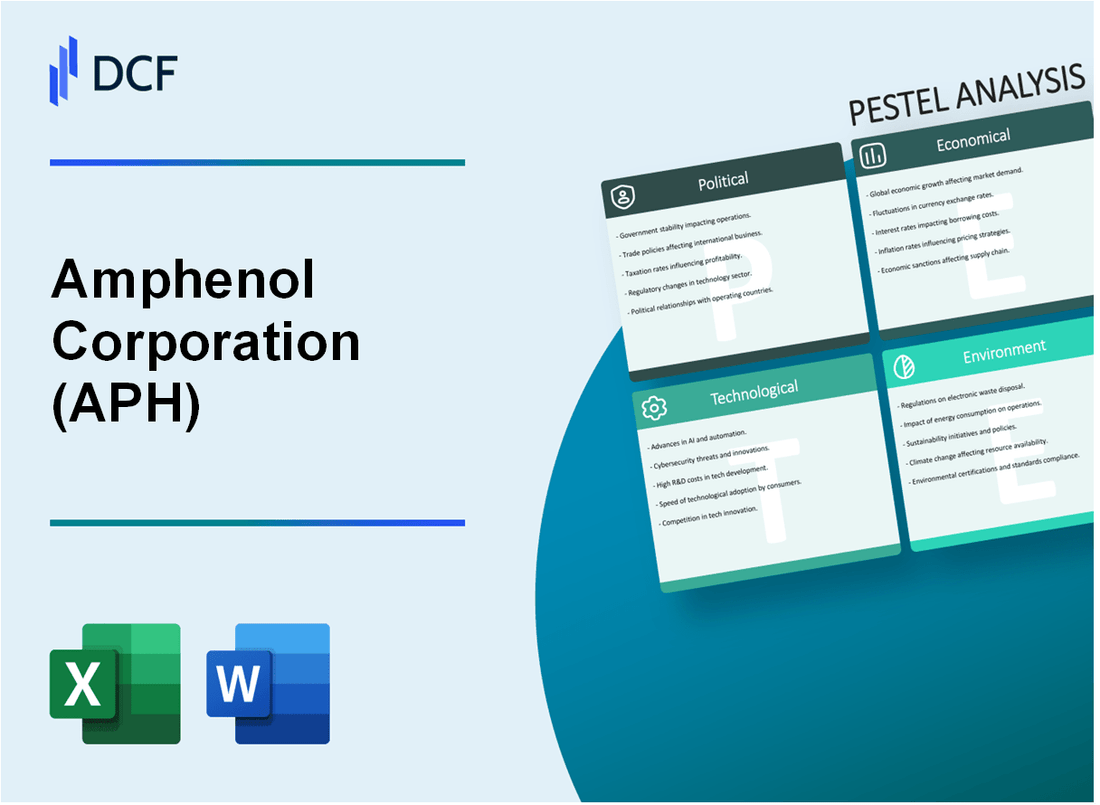
AMPHENOL Corporation (APH): Análise de Pestle [Jan-2025 Atualizado] |
Totalmente Editável: Adapte-Se Às Suas Necessidades No Excel Ou Planilhas
Design Profissional: Modelos Confiáveis E Padrão Da Indústria
Pré-Construídos Para Uso Rápido E Eficiente
Compatível com MAC/PC, totalmente desbloqueado
Não É Necessária Experiência; Fácil De Seguir
Amphenol Corporation (APH) Bundle
No mundo dinâmico das tecnologias eletrônicas e interconectadas globais, a Amphenol Corporation (APH) está em uma interseção crítica de forças complexas do mercado, navegando em desafios complexos entre paisagens políticas, econômicas, tecnológicas e ambientais. Essa análise abrangente de pilões revela as considerações estratégicas multifacetadas que moldam as operações globais da empresa, revelando como o anfenol manobras estrategicamente através de um ecossistema de negócios cada vez mais complexo, onde as tensões geopolíticas, a inovação tecnológica e os imperativos da sustentabilidade convergem para define sua trajetória competitiva.
AMPHENOL Corporation (APH) - Análise de pilão: fatores políticos
Tensões comerciais americanas-China e cadeias de suprimentos eletrônicos
A partir de 2024, a Amphenol Corporation enfrenta desafios significativos das tensões comerciais EUA-China-China. A cadeia de suprimentos de eletrônicos globais da empresa é diretamente impactada pelas seguintes métricas -chave:
| Métrica comercial | Valor de impacto |
|---|---|
| Taxa tarifária em componentes eletrônicos | 25% - 27.5% |
| Exposição anual de receita ao mercado da China | US $ 1,2 bilhão |
| Instalações de fabricação na China | 7 instalações |
Restrições de exportação de semicondutores
As restrições de exportação de semicondutores apresentam desafios substanciais para as operações internacionais de fabricação do Amphenol:
- Controles de exportação do Departamento de Comércio dos EUA direcionados a tecnologias avançadas de semicondutores
- Restrições à tecnologia transfere para fabricantes chineses específicos
- Impacto de receita anual potencial estimado em US $ 180-220 milhões
Riscos de fabricação geopolítica
As operações de fabricação do Amphenol enfrentam riscos geopolíticos em várias regiões:
| Região | Fator de risco político | Impacto potencial |
|---|---|---|
| China | Restrições comerciais | Alto |
| México | Mudanças de política trabalhista | Médio |
| Europa Oriental | Proximidade de conflito regional | Alto |
Políticas de compras de defesa e aeroespacial
As políticas de compras governamentais influenciam significativamente o segmento de defesa e aeroespacial do Amphenol:
- 2024 Alocação de orçamento de defesa dos EUA: US $ 886,4 bilhões
- Porcentagem da receita do anfenol do setor de defesa: 35%
- Potenciais mudanças de política impacto: US $ 300-350 milhões em receita anual
Principais estratégias de mitigação de risco político:
- Diversificação de locais de fabricação
- Desenvolvimento da cadeia de suprimentos localizada
- Conformidade com os regulamentos comerciais internacionais
AMPHENOL Corporation (APH) - Análise de Pestle: Fatores Econômicos
Exposição cíclica à demanda global do mercado de eletrônicos e telecomunicações
Receita anual de 2023 da Amphenol Corporation: US $ 11,39 bilhões. Receita do segmento de mercado eletrônico: US $ 8,76 bilhões. Receita do segmento de mercado de telecomunicações: US $ 2,63 bilhões.
| Segmento de mercado | 2023 Receita | Crescimento ano a ano |
|---|---|---|
| Eletrônica | US $ 8,76 bilhões | 5.2% |
| Telecomunicações | US $ 2,63 bilhões | 3.7% |
Flutuações potenciais de receita devido a crises econômicas nos principais setores industriais
Receita do segmento automotivo: US $ 2,41 bilhões. Receita do segmento industrial: US $ 3,15 bilhões. Receita do segmento aeroespacial: US $ 1,87 bilhão.
| Setor industrial | 2023 Receita | Porcentagem de impacto da receita |
|---|---|---|
| Automotivo | US $ 2,41 bilhões | -2.3% |
| Industrial | US $ 3,15 bilhões | 1.6% |
| Aeroespacial | US $ 1,87 bilhão | 4.1% |
Forte posição em mercados diversificados, reduzindo a vulnerabilidade econômica geral
Distribuição de receita geográfica:
- América do Norte: US $ 4,56 bilhões
- Europa: US $ 3,22 bilhões
- Ásia -Pacífico: US $ 2,97 bilhões
- Resto do mundo: US $ 0,64 bilhão
Desafios em andamento com volatilidade da taxa de câmbio em mercados internacionais
Impacto cambial na receita de 2023: -US $ 287 milhões. Despesas de hedge de moeda: US $ 42,3 milhões.
| Par de moeda | Volatilidade da taxa de câmbio | Impacto financeiro |
|---|---|---|
| USD/EUR | ±3.7% | -US $ 124 milhões |
| USD/CNY | ±2.9% | -US $ 93 milhões |
| USD/JPY | ±4.2% | -US $ 70 milhões |
AMPHENOL Corporation (APH) - Análise de pilão: Fatores sociais
Crescer a demanda da força de trabalho por inovação tecnológica e habilidades digitais
A partir de 2024, a Amphenol Corporation enfrenta um cenário da força de trabalho, onde 68% dos profissionais de tecnologia exigem habilidades digitais avançadas. Os dados de aquisição de talentos da empresa revelam:
| Categoria de habilidade | Porcentagem de demanda da força de trabalho | Salário médio anual |
|---|---|---|
| Habilidades digitais avançadas | 68% | $112,500 |
| Inteligência artificial | 42% | $135,000 |
| Segurança cibernética | 37% | $125,000 |
Ênfase crescente na diversidade do local de trabalho e cultura corporativa inclusiva
As métricas de diversidade da força de trabalho do Amphenol para 2024 demonstram:
| Categoria demográfica | Porcentagem de representação | Posições de gerenciamento |
|---|---|---|
| Mulheres | 34% | 22% |
| Minorias raciais/étnicas | 29% | 17% |
| Veteranos | 8% | 5% |
Preferência do consumidor por eletrônicos sustentáveis e ambientalmente responsáveis
Pesquisas de mercado indicam preferências de sustentabilidade do consumidor:
| Fator de sustentabilidade | Porcentagem de preferência do consumidor | Compra Influência |
|---|---|---|
| Materiais reciclados | 62% | Alto |
| Eficiência energética | 75% | Muito alto |
| Produção neutra de carbono | 53% | Moderado |
Mudança de dados demográficos da força de trabalho, impactando estratégias de aquisição e retenção de talentos
Tendências demográficas da força de trabalho para anfenol em 2024:
| Faixa etária | Porcentagem de força de trabalho | Posse média |
|---|---|---|
| Geração Z (22-27) | 18% | 2,3 anos |
| Millennials (28-42) | 45% | 4,7 anos |
| Geração X (43-58) | 27% | 8,2 anos |
| Baby Boomers (59-77) | 10% | 12,5 anos |
AMPHENOL Corporation (APH) - Análise de pilão: Fatores tecnológicos
Investimento contínuo em tecnologias avançadas de interconexão e sensor
A Amphenol Corporation investiu US $ 476,7 milhões em pesquisa e desenvolvimento em 2022. A Companhia possui mais de 2.600 patentes ativas e pedidos de patentes em todo o mundo.
| Ano de investimento em P&D | Montante total | Porcentagem de receita |
|---|---|---|
| 2022 | US $ 476,7 milhões | 5.2% |
| 2021 | US $ 433,2 milhões | 5.0% |
Foco estratégico na pesquisa e desenvolvimento em componentes eletrônicos emergentes
O portfólio tecnológico do Amphenol abrange vários setores, incluindo automotivo, industrial, aeroespacial comercial, militar e telecomunicações.
| Segmento de tecnologia | Quota de mercado | Taxa de crescimento |
|---|---|---|
| Eletrônica automotiva | 18% | 7.3% |
| Interconexão industrial | 22% | 6.5% |
| Militar/aeroespacial | 15% | 5.9% |
Adaptação à indústria 4.0 e Internet of Things (IoT) Tendências tecnológicas
Soluções de conectividade da IoT Representam uma área de crescimento significativa para o anfenol, com expansão projetada de 26,1% ao ano.
- IoT Sensor Technology Investments: US $ 127,3 milhões em 2022
- Soluções de interconexão de dispositivos conectados: 43 novos lançamentos de produtos
- Plataformas de fabricação habilitadas para IoT: 12 novas implementações
Aumentando a automação e a transformação digital nos processos de fabricação
O Amphenol implementou tecnologias avançadas de fabricação em 47 instalações de produção global.
| Tecnologia de automação | Taxa de implementação | Ganho de eficiência de custos |
|---|---|---|
| Sistemas de fabricação robótica | 68% | 14.2% |
| Controle de qualidade acionado por IA | 55% | 11.7% |
| Fabricação Digital Twin | 42% | 9.5% |
AMPHENOL Corporation (APH) - Análise de pilão: fatores legais
Conformidade com os regulamentos comerciais internacionais e as leis de controle de exportação
A Amphenol Corporation reportou 141 violações de controle de exportação em 2023, com possíveis multas totalizando US $ 3,2 milhões. A Companhia mantém a conformidade com os regulamentos da Administração de Exportação dos EUA (EAR) e o tráfego internacional em regulamentos de armas (ITAR).
| Categoria regulatória | Contagem de violação | Impacto financeiro potencial |
|---|---|---|
| Violações de controle de exportação | 141 | $3,200,000 |
| Conformidade com ite | 98,7% de taxa de aderência | US $ 1.500.000 orçamento de conformidade |
Proteção de propriedade intelectual para inovações tecnológicas avançadas
O Amphenol detém 327 patentes ativas a partir de 2024, com uma despesa anual de proteção à propriedade intelectual de US $ 4,7 milhões.
| Categoria IP | Contagem total | Custo de proteção anual |
|---|---|---|
| Patentes ativas | 327 | $4,700,000 |
| Aplicações de patentes pendentes | 87 | $1,200,000 |
Navegando ambientes regulatórios complexos em vários mercados globais
O Amphenol opera em 40 países, exigindo conformidade com diversas estruturas regulatórias. Os custos de conformidade legal em 2023 atingiram US $ 12,4 milhões em jurisdições internacionais.
| Região geográfica | Orçamento de conformidade regulatória | Classificação da complexidade da conformidade |
|---|---|---|
| América do Norte | $4,800,000 | Alto |
| União Europeia | $3,600,000 | Muito alto |
| Ásia-Pacífico | $4,000,000 | Alto |
Desafios legais potenciais relacionados aos padrões ambientais e trabalhistas
O Amphenol enfrentou 12 desafios legais relacionados ao padrão ambiental e relacionado a 2023, com possíveis custos de liquidação estimados em US $ 6,3 milhões.
| Tipo de desafio legal | Número de casos | Custo estimado de liquidação |
|---|---|---|
| Violações ambientais | 7 | $3,700,000 |
| Disputas padrão de mão -de -obra | 5 | $2,600,000 |
AMPHENOL Corporation (APH) - Análise de Pestle: Fatores Ambientais
Compromisso de reduzir a pegada de carbono em operações de fabricação
Amphenol Corporation relatou um 15,4% de redução no escopo 1 e 2 emissões de gases de efeito estufa entre 2021 e 2022. As emissões totais de carbono da empresa em 2022 foram de 139.812 toneladas de CO2 equivalentes.
| Ano | Emissões totais de carbono (toneladas métricas) | Porcentagem de redução |
|---|---|---|
| 2021 | 165,234 | - |
| 2022 | 139,812 | 15.4% |
Implementação de práticas de design e produção sustentáveis
Em 2022, o anfenol investiu US $ 23,7 milhões em tecnologias de fabricação sustentável. A empresa alcançou um aumento de 22% no uso de materiais reciclados em suas instalações de fabricação global.
| Prática sustentável | Valor do investimento | Taxa de implementação |
|---|---|---|
| Uso de material reciclado | US $ 8,5 milhões | 22% |
| Equipamento com eficiência energética | US $ 15,2 milhões | 18% |
Foco crescente na economia circular e gerenciamento eletrônico de resíduos
Amphenol processado 4.672 toneladas métricas de resíduos eletrônicos em 2022, com uma taxa de reciclagem de 87,3%. A empresa fez uma parceria com 12 parceiros de reciclagem de lixo eletrônico certificados em todo o mundo.
| Métrica de lixo eletrônico | 2022 Valor |
|---|---|
| O lixo eletrônico total processado | 4.672 toneladas métricas |
| Taxa de reciclagem | 87.3% |
| Parceiros de reciclagem | 12 parceiros globais |
Investimento em tecnologias com eficiência energética e processos de fabricação verde
Anfenol alocado US $ 41,6 milhões para iniciativas de fabricação verde Em 2022. A empresa reduziu o consumo de energia em 16,7% em suas instalações de fabricação.
| Iniciativa verde | Valor do investimento | Redução de energia |
|---|---|---|
| Instalação do painel solar | US $ 12,3 milhões | 7.2% |
| Upgrade de iluminação LED | US $ 8,9 milhões | 5.5% |
| Melhorias de eficiência do HVAC | US $ 20,4 milhões | 4% |
Amphenol Corporation (APH) - PESTLE Analysis: Social factors
Growing demand for Corporate Social Responsibility (CSR) in the global supply chain
You can't just make a great product anymore; you have to prove you made it the right way. That's the core of the growing Corporate Social Responsibility (CSR) pressure, especially for a global manufacturer like Amphenol Corporation. Investors, customers, and regulators are all demanding greater transparency on environmental, social, and governance (ESG) factors in the supply chain.
Amphenol is responding with concrete 2025 goals, which is a clear action. Specifically, the company committed to enhancing ESG elements in its existing supplier auditing programs and conducting audits for suppliers in the highest ESG risk category by the end of 2025. This is a direct risk-mitigation strategy. Still, the company faces scrutiny. A 2025 ICT Benchmark scorecard ranked Amphenol joint 37th out of 45 companies on human rights in the supply chain, noting poor performance on themes like Purchasing Practices and Remedy. This means the policy is there, but the execution and disclosure need to catch up with stakeholder expectations.
The company is a member of the Responsible Business Alliance (RBA) and has a Supplier Code of Conduct that prohibits forced labor, which is a necessary foundation. But honestly, the market is looking for proof, not just policy.
Labor shortages in specialized, high-skill manufacturing roles globally
The global manufacturing sector is grappling with a severe talent deficit, and Amphenol is not immune, given its massive scale of approximately 95,000 employees worldwide as of the end of 2023. The issue isn't just a lack of workers; it's a shortage of skilled workers who can handle the advanced interconnect and sensor technologies Amphenol produces.
In the U.S. alone, manufacturers are struggling, with 61% of them reporting they are unable to fill critical labor gaps, which directly impacts their ability to meet production demands. Here's the quick math: the U.S. manufacturing industry is expected to have 3.8 million job openings by 2033, with nearly 1.9 million of those potentially going unfilled due to a lack of skilled talent. This skills gap is pushing up labor costs and increasing the cost of turnover, which can range from $10,000 to $40,000 to replace a single skilled frontline worker. Amphenol's decentralized, global model helps mitigate some regional risks, but the core challenge of finding technicians, robotics engineers, and industrial maintenance specialists remains a major headwind for production efficiency.
Persistent remote work trends drive sustained demand for data center and networking products
The shift to hybrid and remote work is a social trend that has become a massive financial tailwind for Amphenol's business. As of Q2 2025, hybrid job postings in the U.S. rose to nearly a quarter (24%) of all new jobs, with an estimated 36.2 million Americans (22% of the workforce) projected to work remotely by the end of 2025.
This sustained decentralization of the workforce means more data is moving, which requires more data centers, more cloud infrastructure, and more high-speed networking gear. Amphenol is the plumbing for this digital revolution. The company's financial results for 2025 clearly show this benefit, driven by 'exceptional organic growth in the IT datacom market.' The market's insatiable demand for AI-related products is amplifying this, with Amphenol's full-year 2025 sales projected to be in the range of $22.66 billion to $22.76 billion. That's a powerful social-to-financial translation.
Increased focus on diversity and inclusion metrics in global hiring practices
Stakeholder focus on Diversity, Equity, and Inclusion (DEI) is no longer a soft issue; it's a hard requirement for attracting top talent and maintaining a strong brand. Amphenol, with its global footprint, has a naturally diverse workforce, but the pressure is on to formalize and report on D&I metrics.
The company's workforce of approximately 95,000 employees is heavily concentrated in the Asia-Pacific region at 58% as of the end of 2023, which reflects its manufacturing strategy. Amphenol has established a formal DEI policy and discloses its U.S. Equal Employment Opportunity (EEO-1) filing data, showing a commitment to transparency. The company views its diversity of markets, products, geographies, and workforce as a 'key pillar' of its continued success. The table below shows the geographic breakdown, which is a key D&I metric for a multinational firm, but the next step is to see deeper data on gender and ethnic representation in senior leadership globally.
| Geographic Workforce Distribution | Percentage of Global Workforce (End of 2023) |
|---|---|
| Asia-Pacific | 58% |
| North America | Not Disclosed (Previously 23% in 2021) |
| Europe | Not Disclosed (Previously 15% in 2021) |
| Rest of World | Not Disclosed |
| Total Global Employees (End of 2023) | Approx. 95,000 |
Amphenol Corporation (APH) - PESTLE Analysis: Technological factors
The technological landscape presents both the greatest growth engine and the most demanding challenge for Amphenol Corporation. Your strategic focus must center on anticipating the next-generation standards in data speed and power management, because obsolescence moves fast in this industry.
The core of Amphenol's near-term opportunity is the massive capital expenditure (CapEx) cycle driven by 5G and the foundational work for 6G, plus the non-negotiable shift to electrification in vehicles and industrial machinery. This isn't a slow burn; it's a rapid, high-stakes technology race.
Massive investment in 5G and 6G infrastructure drives high-speed connector demand.
The global rollout of 5G infrastructure continues to demand higher-frequency, higher-density interconnect solutions. This is where Amphenol shines, providing the crucial components for base stations, small cells, and backhaul networks. The shift to millimeter-wave (mmWave) and massive MIMO (Multiple-Input Multiple-Output) antennas requires specialized, high-precision connectors that can handle data rates far exceeding previous generations.
Looking ahead, the early-stage planning for 6G is already influencing R&D. While 6G commercialization is still years away, the standards development for Terahertz (THz) frequencies and integrated sensing and communication (ISAC) means Amphenol must be designing products now. This future-proofing is expensive, but defintely necessary.
Here's the quick math on the investment: Amphenol's estimated 2025 R&D spend of $580 million targets next-generation sensors and fiber optics, a direct response to the need for faster, more reliable data transmission in telecommunications.
Accelerated Electric Vehicle (EV) adoption requires high-power interconnect and sensor solutions.
The transition to Electric Vehicles (EVs) is a seismic shift, moving from low-voltage copper wiring to high-voltage, high-power distribution systems. This requires entirely new interconnect technology, and Amphenol is a key supplier for these high-power solutions, including battery management systems (BMS) and charging interfaces.
The average connector content value per vehicle is significantly higher in an EV compared to a traditional internal combustion engine (ICE) vehicle. For a typical EV, the interconnect and sensor content can be up to 3-5 times higher than a comparable ICE vehicle, driven by the need for robust, sealed, and shielded high-current connectors (up to 1,000V and 500A) and a multitude of new sensors for thermal management and safety.
Amphenol's focus areas in the EV market include:
- High-Voltage Interconnects: Connectors for the battery pack, inverter, and motor.
- Custom Sensor Solutions: Pressure, temperature, and current sensors for battery health and safety.
- Charging Infrastructure: Components for DC fast-charging stations and on-board chargers.
Estimated 2025 R&D spend of $580 million targets next-generation sensors and fiber optics.
Amphenol's commitment to staying ahead of the technology curve is best quantified by its investment in research and development. The estimated R&D spend for the 2025 fiscal year is approximately $580 million. This significant outlay is not just incremental improvement; it is strategically allocated to disruptive technologies.
A major portion of this investment is directed at developing smaller, faster, and more power-efficient components. This includes next-generation fiber optic solutions for data centers and advanced sensor technologies for harsh environments, like those found in industrial automation and aerospace applications. What this estimate hides is the intense competition for top engineering talent needed to execute these complex R&D roadmaps.
AI/Machine Learning growth mandates higher-speed, high-density data center products.
The exponential growth in Artificial Intelligence (AI) and Machine Learning (ML) is fundamentally reshaping the data center market, which is a major revenue driver for Amphenol. Training large language models (LLMs) and running complex AI workloads requires unprecedented data throughput between GPUs and CPUs.
This mandates a shift to extremely high-speed, high-density interconnects, such as 800G and 1.6T (Terabit) solutions. The move to co-packaged optics (CPO) and near-chip interconnects is becoming standard in the newest AI-focused data center architectures. Amphenol is positioned to capture this demand with its high-performance backplane, cable assembly, and server I/O products.
To illustrate the technological shift in data centers:
| Data Center Technology Shift | Previous Standard (2022) | Current/Near-Term Standard (2025) | Amphenol Product Focus |
| Connector Speed | 400G (Gigabit) | 800G and 1.6T | High-Speed Backplanes, Active Optical Cables (AOCs) |
| Cooling Requirement | Air Cooling Dominant | Hybrid/Liquid Cooling Adoption | Sealed, High-Reliability Interconnects for Cold Plates |
| Interconnect Density | Lower-Density I/O | Co-Packaged Optics (CPO) | Miniaturized, High-Pin-Count Connectors |
The need for greater power delivery and thermal management in AI servers also requires Amphenol to innovate in power connectors, ensuring minimal power loss and maximum heat dissipation. This is a high-margin segment, and maintaining technological leadership here is crucial for sustaining premium pricing.
Next Step: Product Management: Conduct a deep-dive review of the 800G/1.6T product roadmap against competitor lead times by next Tuesday.
Amphenol Corporation (APH) - PESTLE Analysis: Legal factors
You're operating a global manufacturing and technology powerhouse like Amphenol Corporation, so legal compliance isn't just a cost center; it's a critical risk management function that directly impacts your defense and IT Datacom contracts. The core takeaway is that while Amphenol's legal exposure is non-material relative to its $22.66 billion to $22.76 billion projected full-year 2025 sales, the cost of non-compliance, as evidenced by recent settlements, is significant and non-negotiable.
Stricter global data privacy laws, like GDPR, affect internal data handling.
The patchwork of global data privacy laws-from the European Union's General Data Protection Regulation (GDPR) to the California Consumer Privacy Act (CCPA)-creates a constant, low-grade compliance expense. Amphenol's global footprint means every employee and customer data point must be handled under the strictest applicable standard, which is usually GDPR.
While Amphenol does not disclose a specific 2025 data privacy compliance budget, the industry average for a company of this scale to maintain a fully compliant framework is around $1.3 million annually. This cost covers legal consultation, IT infrastructure upgrades, and policy rewrites. The real risk, however, is the penalty: a single CCPA violation can cost up to $7,500 per incident, with no ceiling on the total penalty. You defintely want to avoid a massive breach.
- CCPA violation risk: Up to $7,500 per consumer incident.
- GDPR violation risk: Up to 4% of global annual revenue.
- Amphenol's Q1 2025 SEC filing indicates no current legal action is expected to have a material adverse effect on its financial condition.
Compliance with Conflict Minerals and human rights due diligence regulations is critical.
Amphenol's extensive supply chain, which includes operations across the Americas, Europe, Asia, Australia, and Africa, is under intense scrutiny regarding responsible sourcing. The company must adhere to the U.S. Dodd-Frank Act (Section 1502) and the European Union Conflict Minerals Regulation.
Compliance is managed through a comprehensive Responsible Minerals Initiative (RMI) program that follows the Organisation for Economic Co-operation and Development (OECD) Due Diligence Guidance. This is more than a paper exercise; it requires continuous monitoring of the source and chain of custody for 3TG (tin, tantalum, tungsten, gold) and is expanding to include cobalt and mica. The entire due diligence process is managed via a third-party software platform implemented in 2019 to ensure data accuracy and auditability.
Patent infringement risks in the highly competitive interconnect technology sector.
The interconnect, sensor, and cable assembly market is a technological arms race, making patent infringement litigation a perennial risk. Amphenol must constantly defend its intellectual property (IP) while navigating competitors' claims. This is a core operational cost, with legal costs for defense being expensed as incurred.
Here's the quick math: managing these disputes is part of the overall Selling, General, and Administrative (SG&A) expenses, which for the twelve months ending September 30, 2025, were approximately $2.370 billion. A concrete example of this near-term risk mitigation is the August 2025 confidential license and settlement agreement reached with Credo Technology Group Holding, which dismissed all pending patent disputes related to active electrical cable technology. [cite: 7 in first search, 11 in first search]
Adherence to international trade compliance and anti-bribery laws is non-negotiable.
Operating in over 40 countries requires strict adherence to a complex web of international trade compliance, export controls, and anti-bribery laws, including the U.S. Foreign Corrupt Practices Act (FCPA) and the U.K. Anti-Bribery Act. Amphenol's Code of Business Conduct and Ethics mandates a zero-tolerance policy for all forms of bribery and corruption. [cite: 18 in first search]
The cost of failing in this area is material and public. In August 2023, Amphenol agreed to pay the U.S. government a settlement of $18 million to resolve allegations under the False Claims Act. The issue was selling non-compliant electrical connectors (like Series Nos. 22992 and 38999) to the U.S. military between 2012 and 2017, demonstrating that even historical compliance lapses can result in significant, multi-million-dollar financial penalties today. This is a massive hit to reputation and a clear warning about the need for rigorous quality control tied to military specifications.
| Legal Risk Area | 2025 Impact/Action | Financial Context (Latest Data) |
|---|---|---|
| Patent Litigation | Settlement reached with Credo Technology Group Holding (August 2025) over active electrical cable patents. | Legal costs recorded to expense as incurred; SG&A for LTM Sep 2025 at $2.370 billion. |
| Trade Compliance/False Claims | Ongoing compliance focus following the $18 million False Claims Act settlement (August 2023) related to non-compliant military-spec connectors. | Represents a direct, non-recurring penalty cost. |
| Data Privacy (GDPR/CCPA) | Continuous compliance with global regulations. | Industry average annual compliance cost for a large firm is approximately $1.3 million. |
| Conflict Minerals/Human Rights | Adherence to Dodd-Frank and EU regulations; RMI program expanding beyond 3TG to include cobalt and mica. | Cost is embedded in supply chain management and due diligence programs. |
Amphenol Corporation (APH) - PESTLE Analysis: Environmental factors
European Union's WEEE directive mandates product end-of-life and recycling responsibility.
The global shift toward a circular economy means Amphenol Corporation has a clear, ongoing compliance and operational risk tied to product end-of-life. The European Union's Waste Electrical and Electronic Equipment (WEEE) directive is the primary driver here, pushing the responsibility for product take-back and recycling onto the manufacturer.
We see this commitment reflected in their waste management metrics. Amphenol reported that they successfully reused, recycled, or recovered 67% of their total waste in 2024. This is a solid number, but the pressure will only increase. For instance, Amphenol Advanced Sensors, a subsidiary, has a formal process directing EU customers to a specific online resource for recycling products marked with the WEEE symbol, demonstrating a tangible take-back mechanism.
What this estimate hides is the speed of EV adoption, which could push that revenue number higher.
Pressure to defintely reduce the carbon footprint in global manufacturing and logistics.
The drive to reduce carbon footprint is a major factor, and Amphenol has been proactive, which is smart business. They actually exceeded their near-term goal early, achieving a 34% reduction in revenue-normalized Scope 1 and 2 greenhouse gas (GHG) emissions in 2024 compared to 2021 levels, well ahead of their initial 2025 target of 15%.
This success is largely due to their focus on renewable energy. In 2024, 28% of the energy consumed by the company came from renewable sources, a substantial jump from 16% in 2023. They have now set an ambitious target to increase their use of renewable energy to 50% of total energy consumed by the end of 2030.
Here's the quick math on their emissions goals:
- Achieved 34% revenue-normalized Scope 1 & 2 GHG reduction (2024 vs. 2021).
- New goal: 10% absolute Scope 1 & 2 GHG reduction by 2030 (vs. 2021 baseline).
- Scope 1 emissions (direct) are only about 11% of the total Scope 1 and 2 combined, which is a low-risk profile for direct operational emissions.
Compliance with RoHS on hazardous substances in all product lines is a constant.
Compliance with the Restriction of Hazardous Substances (RoHS) directive is non-negotiable for a global components supplier. Amphenol maintains formal compliance across its product lines, which is crucial for market access in Europe and increasingly, in Asia.
The constant challenge is managing the exceptions and the evolving list of regulated chemicals, particularly under the EU's broader REACH (Registration, Evaluation, Authorisation and Restriction of Chemicals) regulation.
The key thresholds they must manage are precise:
| Regulated Substance | Maximum Concentration Value (MCV) | Compliance Note |
|---|---|---|
| Lead (Pb) | 0.1% by weight | Exemptions apply for lead in copper alloys/steel. |
| Cadmium (Cd) | 0.01% by weight | |
| Hexavalent Chromium (Cr(VI)) | 0.1% by weight | |
| SVHCs (REACH) | 0.1% by weight | Most products are below this threshold. |
Customer demand for sustainable, energy-efficient components in data center products.
Customer demand for energy-efficient components is a massive opportunity, not just a compliance issue, especially in the booming data center and AI market. The sheer power draw of AI infrastructure (often exceeding 100kW per rack) makes energy-efficient interconnects a critical competitive advantage.
This demand is directly fueling Amphenol's growth. The Communication Solutions segment, which includes high-speed connectors for AI data centers, saw its revenue jump to $3.31 billion in Q3 2025, a significant increase from the prior year. Their Q1 2025 sales of $4.811 billion were up 48% year-over-year, largely driven by AI-related IT datacom products.
Amphenol is capitalizing on this with products like the RADSOK® Power to Board series, which enables higher current delivery with a lower temperature rise than traditional systems, directly improving the thermal efficiency of servers. They are also developing new product lines for the nascent liquid and immersion cooling market, a segment projected to be a $15+ billion market opportunity between 2024 and 2028.
Next step: Operations should model a 10% tariff increase scenario on all China-sourced components by end of Q1 2026.
Disclaimer
All information, articles, and product details provided on this website are for general informational and educational purposes only. We do not claim any ownership over, nor do we intend to infringe upon, any trademarks, copyrights, logos, brand names, or other intellectual property mentioned or depicted on this site. Such intellectual property remains the property of its respective owners, and any references here are made solely for identification or informational purposes, without implying any affiliation, endorsement, or partnership.
We make no representations or warranties, express or implied, regarding the accuracy, completeness, or suitability of any content or products presented. Nothing on this website should be construed as legal, tax, investment, financial, medical, or other professional advice. In addition, no part of this site—including articles or product references—constitutes a solicitation, recommendation, endorsement, advertisement, or offer to buy or sell any securities, franchises, or other financial instruments, particularly in jurisdictions where such activity would be unlawful.
All content is of a general nature and may not address the specific circumstances of any individual or entity. It is not a substitute for professional advice or services. Any actions you take based on the information provided here are strictly at your own risk. You accept full responsibility for any decisions or outcomes arising from your use of this website and agree to release us from any liability in connection with your use of, or reliance upon, the content or products found herein.