
|
Aramark (Armk): Análise de Pestle [Jan-2025 Atualizado] |
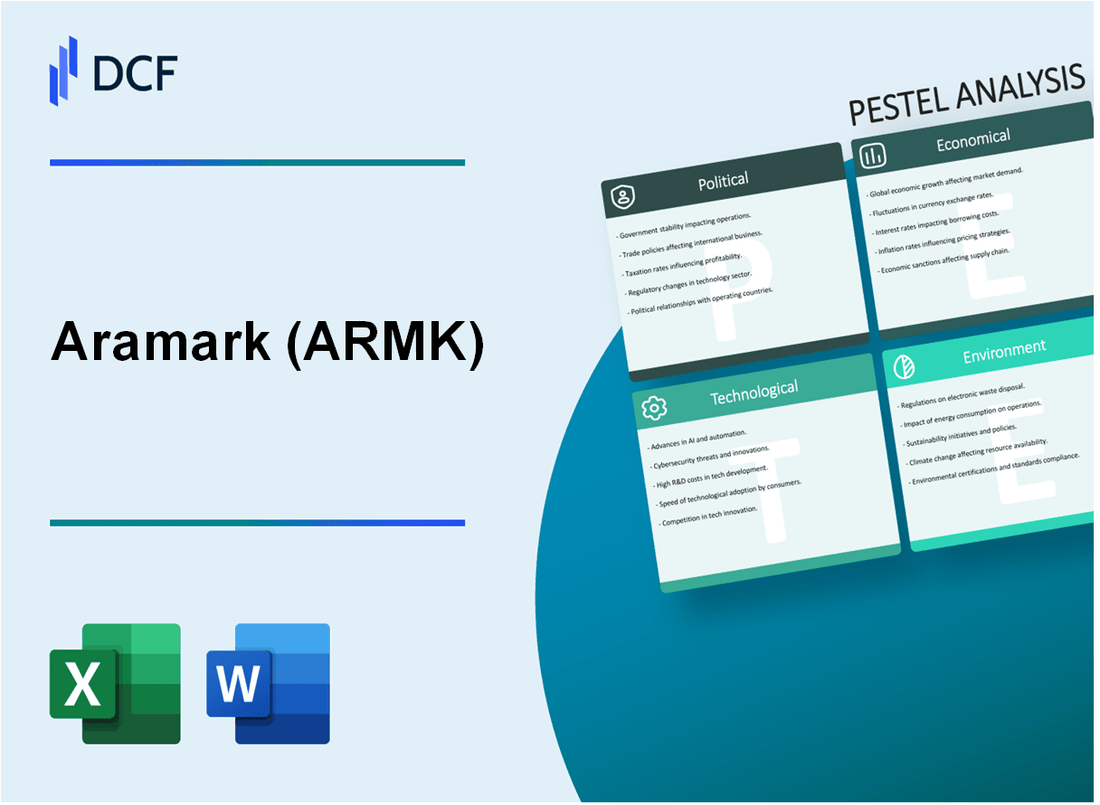
Totalmente Editável: Adapte-Se Às Suas Necessidades No Excel Ou Planilhas
Design Profissional: Modelos Confiáveis E Padrão Da Indústria
Pré-Construídos Para Uso Rápido E Eficiente
Compatível com MAC/PC, totalmente desbloqueado
Não É Necessária Experiência; Fácil De Seguir
Aramark (ARMK) Bundle
No cenário dinâmico do gerenciamento de serviços de alimentação e instalações, Aramark (Armk) fica na encruzilhada de desafios globais complexos e soluções inovadoras. Essa análise abrangente de pestles revela a intrincada rede de fatores políticos, econômicos, sociológicos, tecnológicos, legais e ambientais que moldam a trajetória estratégica da empresa, oferecendo uma exploração diferenciada de como as forças externas se cruzam com o ecossistema operacional da Aramark. Desde a navegação de paisagens regulatórias até a resposta às expectativas em evolução do consumidor, a resiliência e a adaptabilidade de Aramark emergem como determinantes críticos de seu sucesso sustentado em um ambiente de negócios cada vez mais interconectado e transformador rapidamente.
Aramark (Armk) - Análise de Pestle: Fatores Políticos
Indústria de serviços de alimentação regulada com contratos governamentais complexos
Aramark mantém contratos significativos de serviço do governo em vários setores:
| Tipo de contrato | Valor anual | Setores primários |
|---|---|---|
| Contratos do governo federal | US $ 1,2 bilhão | Militar, correções, saúde |
| Contratos do governo do estado | US $ 750 milhões | Instituições educacionais, instalações estaduais |
Políticas de compras federais e estaduais
Os principais requisitos de conformidade regulatória incluem:
- Regulamentação Federal de Aquisição (FAR) Conformidade
- Diretrizes de Administração de Pequenas Empresas (SBA)
- Requisitos de participação de negócios de propriedade minoritária
Exposição regulatória de mão -de -obra e saúde
Os possíveis impactos regulatórios incluem:
| Área regulatória | Impacto financeiro potencial |
|---|---|
| Regulamentos de salário mínimo | Potencial de ajuste anual de US $ 85-120 milhões |
| Mandato de assistência médica Conformidade | Custo anual de US $ 65-95 milhões |
Riscos internacionais da cadeia de suprimentos geopolíticos
A exposição global à cadeia de suprimentos inclui:
- Operações em 19 países
- Exposição tarifária comercial: aproximadamente US $ 45-60 milhões de impacto potencial
- Orçamento de mitigação de risco geopolítico: US $ 22 milhões anualmente
Aramark (Armk) - Análise de Pestle: Fatores Econômicos
Modelo de negócios cíclicos ligados aos mercados institucionais de serviços de alimentação
A receita da Aramark para o ano fiscal de 2023 foi de US $ 20,0 bilhões, com os mercados institucionais de serviços de alimentação gerando partes significativas dessa renda.
| Segmento de mercado | Contribuição da receita | 2023 desempenho |
|---|---|---|
| Assistência médica | 32.5% | US $ 6,5 bilhões |
| Educação | 28.3% | US $ 5,66 bilhões |
| Serviços de negócios | 39.2% | US $ 7,84 bilhões |
Vulnerabilidade a crises econômicas
Os principais indicadores econômicos que afetam o desempenho de Aramark:
- Taxa de crescimento do PIB dos EUA em 2023: 2,5%
- Taxa de inflação em 2023: 3,4%
- Taxa de desemprego: 3,7%
Benefícios potenciais da recuperação econômica
| Indicador econômico | 2023 valor | Impacto projetado 2024 |
|---|---|---|
| Gastos corporativos | US $ 4,1 trilhões | Aumento potencial de 3-5% |
| Orçamento educacional | US $ 752 bilhões | Crescimento potencial de 2-4% |
| Gasto de saúde | US $ 4,5 trilhões | Aumento potencial de 4-6% |
Pressões inflacionárias
A quebra de custo operacional de Aramark para 2023:
- Custos de alimentos: 35% da receita (US $ 7 bilhões)
- Custos de mão -de -obra: 45% da receita (US $ 9 bilhões)
- Despesas operacionais: 20% da receita (US $ 4 bilhões)
Ajustes da estratégia de preços:
- Aumento médio de preço: 3-4% entre segmentos de serviço
- Frequência de renegociação contratada: a cada 2-3 anos
Aramark (Armk) - Análise de Pestle: Fatores sociais
A demanda crescente por opções de serviço de alimentação mais saudáveis e sustentáveis
De acordo com o relatório de sustentabilidade 2022 do Hartman Group, 76% dos consumidores consideram a sustentabilidade ao comprar alimentos. O mercado de alimentos baseado em vegetais atingiu US $ 7,5 bilhões em 2022, com um CAGR projetado de 12,5% até 2027.
| Métricas de sustentabilidade de serviços de alimentação | 2022 dados | 2023 Projeção |
|---|---|---|
| Valor de mercado de alimentos sustentáveis | US $ 42,3 bilhões | US $ 54,7 bilhões |
| Preferência do consumidor por opções orgânicas | 68% | 72% |
| Tamanho do mercado de alimentos à base de plantas | US $ 7,5 bilhões | US $ 8,4 bilhões |
Aumentando as expectativas de diversidade e inclusão no local de trabalho
Aramark relatou 54% de mulheres e 46% de pessoas de cor em posições de liderança em 2023. O relatório de diversidade 2022 da McKinsey indica empresas com gerenciamento diversificado, veja 35% maior desempenho financeiro.
| Métrica de diversidade | Aramark 2023 dados | Média da indústria |
|---|---|---|
| Mulheres em liderança | 54% | 42% |
| Pessoas de cor em liderança | 46% | 38% |
| Razão de patrimônio líquido | 1.02 | 0.97 |
As preferências do consumidor mudam para experiências gastronômicas personalizadas e habilitadas para tecnologia
As plataformas de pedidos digitais cresceram 54% em 2022, com 67% dos millennials preferindo experiências gastronômicas integradas em tecnologia. O mercado de pedidos de alimentos móveis deve atingir US $ 154 bilhões até 2027.
| Métrica de adoção de tecnologia | 2022 dados | 2024 Projeção |
|---|---|---|
| Crescimento de pedidos digitais | 54% | 62% |
| Mercado de pedidos de alimentos móveis | US $ 87 bilhões | US $ 124 bilhões |
| Preferência gastronômica integrada à tecnologia | 67% | 73% |
A crescente conscientização sobre a responsabilidade social corporativa e o fornecimento ético
A Aramark se comprometeu com 50% de fornecimento sustentável de alimentos até 2025. O mercado de fornecimento ético projetado para atingir US $ 6,5 trilhões globalmente até 2024.
| Métrica de RSE | 2023 dados | 2025 Target |
|---|---|---|
| Suprimento sustentável de alimentos | 35% | 50% |
| Compromisso de redução de carbono | 25% | 40% |
| Valor de mercado de fornecimento ético | US $ 5,2 trilhões | US $ 6,5 trilhões |
Aramark (Armk) - Análise de Pestle: Fatores Tecnológicos
Investimento em plataformas de pedidos digitais e sem contato
A Aramark investiu US $ 12,3 milhões em tecnologias de transformação digital em 2023. A empresa registrou um aumento de 47% nos downloads de aplicativos móveis e um crescimento de 35% nas plataformas de pedidos digitais em seus segmentos de serviço.
| Plataforma digital | Taxa de adoção do usuário | Investimento anual |
|---|---|---|
| Aplicativo de pedidos móveis | 37% | US $ 5,2 milhões |
| Pagamento sem contato | 42% | US $ 3,7 milhões |
| Quiosques de autoatendimento | 28% | US $ 3,4 milhões |
Implementando a IA e a análise de dados para eficiência operacional
A Aramark implantou análises preditivas orientadas pela IA em 68% de suas instalações operacionais. A tecnologia gera US $ 14,6 milhões em economia anual de custos por meio de gerenciamento otimizado de inventário e previsão de demanda.
| Aplicação de tecnologia da IA | Redução de custos | Melhoria de eficiência |
|---|---|---|
| Otimização de inventário | US $ 7,3 milhões | 42% |
| Previsão de demanda | US $ 5,2 milhões | 36% |
| Manutenção preditiva | US $ 2,1 milhões | 22% |
Explorando a automação na preparação de alimentos e prestação de serviços
A Aramark implementou sistemas de preparação de alimentos robóticos em 23 instalações, resultando em redução de 29% nos custos de mão -de -obra e na melhoria de 18% na velocidade de preparação de alimentos.
| Tecnologia de automação | Instalações implementadas | Economia de custos |
|---|---|---|
| Preparação de alimentos robóticos | 23 | US $ 4,7 milhões |
| Embalagem automatizada | 17 | US $ 2,9 milhões |
| Sistemas de serviço transportadores | 12 | US $ 1,8 milhão |
Medidas aprimoradas de segurança cibernética para proteger os dados operacionais e de clientes
A Aramark alocou US $ 8,6 milhões à infraestrutura de segurança cibernética em 2023. A Companhia experimentou zero violações de dados principais e manteve 99,97% de conformidade de proteção de dados em suas plataformas digitais.
| Investimento de segurança cibernética | Taxa de proteção de dados | Nível de conformidade |
|---|---|---|
| Infraestrutura de segurança cibernética | US $ 8,6 milhões | 99.97% |
| Sistemas de detecção de ameaças | US $ 3,4 milhões | 99.85% |
| Treinamento de segurança cibernética de funcionários | US $ 1,2 milhão | 98.5% |
Aramark (Armk) - Análise de Pestle: Fatores Legais
Conformidade com os regulamentos de segurança e saúde alimentares
Aramark enfrenta requisitos regulatórios rigorosos em várias jurisdições. A partir de 2024, a empresa deve aderir a:
| Categoria de regulamentação | Requisito de conformidade | Faixa fina potencial |
|---|---|---|
| Lei de Modernização da Segurança Alimentar da FDA | Implementação completa de protocolos HACCP | $ 50.000 - US $ 500.000 por violação |
| Padrões de segurança no local de trabalho da OSHA | Treinamento de segurança completo para manuseio de alimentos | US $ 15.625 por violação séria |
| Códigos de saúde em nível estadual | Conformidade trimestral de inspeção | US $ 1.000 - US $ 10.000 por incidente |
Possíveis desafios da lei trabalhista
Os riscos de litígios trabalhistas incluem:
- Disputas de salário e hora: liquidação média $ 250.000
- Reivindicações de discriminação: a resolução mediana custa US $ 160.000
- Alegações de assédio no local de trabalho: possíveis despesas legais de US $ 300.000 por caso
Gerenciamento de riscos para segurança no local de trabalho
| Métrica de segurança | Desempenho atual | Responsabilidade potencial |
|---|---|---|
| Taxa de lesões no local de trabalho | 3,2 por 100 funcionários | US $ 1,2 milhão em potencial exposição de compensação dos trabalhadores |
| Conformidade com segurança do equipamento | Classificação de conformidade de 92% | US $ 500.000 potenciais penalidades da OSHA |
Obrigações contratuais Complexidade
Principais áreas de risco contratual:
- Contratos de Serviço Governamental: 37 contratos ativos
- Acordos de instalações de saúde: 22 principais contratos institucionais
- Disposições de serviço educacional: 45 contratos universitários/faculdades
Exposição total de responsabilidade contratual potencial: US $ 75 milhões entre os setores de serviço.
Aramark (Armk) - Análise de Pestle: Fatores Ambientais
Foco crescente no fornecimento sustentável de alimentos e redução de resíduos
A Aramark se comprometeu a adquirir 50% de seus produtos de fontes locais e sustentáveis até 2025. A Companhia relatou reduzir o desperdício de alimentos em 28,3% em suas operações em 2023.
| Métrica de sustentabilidade | 2023 desempenho | 2025 Target |
|---|---|---|
| Fornecimento de alimentos locais | 37.6% | 50% |
| Redução de resíduos de alimentos | 28.3% | 35% |
| Ingredientes orgânicos | 22.1% | 30% |
Compromisso em reduzir a pegada de carbono em operações de serviço de alimentação
A Aramark reduziu as emissões de gases de efeito estufa em 15,2% em 2023, com uma redução de 30% direcionada até 2030 em suas operações globais.
| Métrica de emissão de carbono | 2023 desempenho | 2030 gol |
|---|---|---|
| Redução total de emissões de CO2 | 15.2% | 30% |
| Redução do consumo de energia | 12.7% | 25% |
Implementando a tecnologia verde e práticas com eficiência energética
Aramark investiu US $ 42,3 milhões em infraestrutura de tecnologia verde em 2023, com Instalações do painel solar cobrindo 18,6% de suas instalações de serviço de alimentação.
| Investimento em tecnologia verde | 2023 Despesas |
|---|---|
| Investimento total em tecnologia verde | US $ 42,3 milhões |
| Cobertura do painel solar | 18.6% |
| Atualização de equipamentos com eficiência energética | US $ 12,7 milhões |
Respondendo às demandas do consumidor por práticas ambientalmente responsáveis
A preferência do consumidor por opções sustentáveis de alimentos aumentou 37,5% em 2023, impulsionando a estratégia ambiental da Aramark.
| Preferências de sustentabilidade do consumidor | 2023 porcentagem |
|---|---|
| Demanda por opções baseadas em plantas | 42.3% |
| Preferência por alimentos de origem local | 37.5% |
| Interesse em práticas de desperdício zero | 33.2% |
Aramark (ARMK) - PESTLE Analysis: Social factors
Growing demand for healthier, plant-based, and locally sourced menu options.
The shift in consumer values toward personal health and planetary sustainability is a major social driver for Aramark. You see this most clearly in the explosive growth of plant-based foods. The global plant-based food market is projected to be valued at nearly USD 56.37 billion in 2025, with the U.S. market expected to grow at an 11.70% Compound Annual Growth Rate (CAGR) from 2025 to 2033. That kind of growth isn't a niche; it's a mainstream expectation.
Aramark has responded by integrating these preferences into its core offerings through its 'Be Well. Do Well.' platform. This includes a commitment to empowering healthy consumers and increasing plant-forward menu options. To show they're serious, the company has committed to reducing red meat purchases by 12% and has completed the transition to using 100% cage-free liquid and processed eggs in the United States. This isn't just good PR; it's smart risk management against changing consumer and client demands.
Hybrid work models reducing daily meal volume in Business & Industry (B&I) segment.
The hybrid work model is a permanent fixture, not a passing fad. In North America, approximately 60% of business leaders report their company operates a hybrid model, which means most employees are not in the office five days a week. This fundamental change directly impacts the daily meal volume in Aramark's Business & Industry (B&I) segment, which historically relied on a consistent, five-day-a-week office population.
Here's the quick math: fewer bodies in the office means fewer daily transactions. Still, Aramark is successfully counteracting this volume risk by securing major new contracts. The B&I segment has shown resilience, with the FSS United States: Business & Industry revenue growing by a strong 13% year-over-year in the second quarter of fiscal year 2025. This growth is driven by a focus on 'net new business,' meaning they are winning enough new client locations and first-time outsourcing contracts to outpace the reduced daily attendance at existing sites. It's a volume-per-location challenge that they are solving with new-client acquisition.
Increased focus on social equity and fair labor practices by corporate clients.
Corporate clients, especially in the B&I and Education segments, are increasingly demanding that their service providers adhere to high Environmental, Social, and Governance (ESG) standards, with a heavy emphasis on the 'S' for Social. This focus on social equity and fair labor is a non-negotiable part of the contract bidding process now. Aramark's 'Be Well. Do Well.' strategy directly addresses this through its 'people priorities,' which include engaging employees and sourcing ethically and inclusively.
The company's commitment is quantifiable. It has been recognized as a top-scorer on the Disability Equality Index (DEI) and has expanded its internal 'Pronouns Matter' education campaign. Furthermore, the launch of the 'myWholeSelf' self-identification campaign in 2023 was a defintely necessary step to better track and support their diverse employee populations, including LGBTQ+, veterans, and employees with disabilities. This transparent approach helps them win and retain clients who have their own stringent supplier diversity and social responsibility mandates.
Customer preference for frictionless, personalized dining experiences.
Today's consumer, whether a college student or a corporate employee, expects a frictionless, personalized experience-think Amazon-level convenience in a dining hall. Technology is the only way to deliver this at scale. The industry trend for 2025 is hyper-personalization, and consumers are willing to pay for it; about 74% of consumers report returning to restaurants after a unique experience, and they are open to sharing data for a more tailored experience.
Aramark is deploying its Hospitality IQ platform, which uses AI-enabled technology to streamline operations and enhance the customer journey. For example, in Collegiate Hospitality, they use an AI-driven chatbot named SAM to instantly answer questions about dining and meal plans. In their Senior Living segment, they are using AI-powered tools to simplify forecasting, inventory tracking, and vendor management, which directly leads to more personalized menus and better resident satisfaction. They are using tech to get their people out from behind the register and back into the dining room to build human connections.
| Social Trend Driver | Aramark's 2025 Response/Metric | Strategic Implication for ARMK |
|---|---|---|
| Growing Demand for Plant-Based/Healthy Options | Commitment to reduce red meat purchases by 12%. US Plant-Based Food Market CAGR of 11.70% (2025-2033). | Opportunity: Capture share in a high-growth market segment and meet client ESG mandates. |
| Hybrid Work Impact on B&I Meal Volume | FSS US Business & Industry revenue grew 13% in Q2 FY25. Focus on 'net new business' wins. | Risk Mitigation: Daily volume risk is offset by strong new client acquisition and first-time outsourcing contracts. |
| Focus on Social Equity & Fair Labor | Top-scorer on the Disability Equality Index (DEI). Expanded 'Pronouns Matter' campaign and 'myWholeSelf' self-ID initiative. | Competitive Advantage: Strengthens client relationships and improves retention by aligning with corporate ESG policies. |
| Preference for Frictionless/Personalized Dining | Deployment of AI-driven chatbot SAM and Hospitality IQ platform for forecasting and menu personalization. | Action: Use technology to improve customer experience (CX) and operational efficiency, driving repeat business. |
Aramark (ARMK) - PESTLE Analysis: Technological factors
Investment in self-checkout kiosks and mobile ordering apps to cut labor costs.
Aramark is aggressively deploying self-service technology to combat rising labor costs and improve throughput, a critical move given the tight US labor market. The company is leveraging its Connected Global suite, which includes AI-powered self-checkout and mobile ordering solutions, across its high-volume venues.
For the 2025 NFL season, Aramark Sports + Entertainment implemented AI-powered self-checkout technology at multiple iconic stadiums, using computer vision and machine learning for a frictionless purchasing experience. This strategy reduces queues and allows staff to focus on high-impact hospitality, not just transactions. The global self-checkout systems market is estimated at $3.926.1 billion in 2025, reflecting the industry-wide shift toward this efficiency model. Aramark's self-ordering solutions, available via mobile devices, kiosks, or table-side technology, eliminate wait times and are a direct response to consumer demand for minimal physical interaction.
Use of predictive analytics for inventory management to reduce food waste.
The core of Aramark's operational efficiency push in 2025 centers on predictive analytics (a form of Artificial Intelligence) to optimize its massive supply chain and reduce food waste. This is a crucial area, as food waste is a significant cost and sustainability issue for large-scale food service providers.
The company's proprietary Hospitality IQ platform now incorporates AI-enabled technology and advanced analytics, particularly in its new Consultative Services program for Aramark SeniorLife+. This platform gives operators control over purchasing and inventory through simplified forecasting and integrated tracking. The goal is simple: order only what you need, when you need it. Here's the quick math: predictive models in food supply chains can reduce perishable inventory waste by up to 25%, which translates to significant cost savings on an annual revenue base that reached approximately $18.9 billion in fiscal 2025.
Digital platforms to enhance customer engagement and loyalty programs.
Digital platforms are now the primary tool for Aramark to drive customer retention and increase per-capita spending. The focus is on creating a seamless, personalized experience that encourages repeat business, which is far cheaper than acquiring new customers. Honestly, a small bump in retention yields huge profit gains.
The digital strategy is multi-faceted, utilizing the same self-ordering and self-checkout systems to capture valuable, real-time data. This data feeds back into the system to enable:
- Real-time menu updates and dynamic promotions.
- Personalized suggestions based on purchase history.
- Increased customer satisfaction through self-directed service.
The overall corporate client retention rate was a strong 96.3% in fiscal 2025, the highest in the company's history, which is defintely supported by these enhanced digital, client-facing tools deployed globally.
Automation in food preparation and delivery to improve efficiency.
Automation is moving beyond simple kiosks and into the kitchen itself to address the persistent labor shortage and ensure 24/7 service consistency. Aramark is strategically investing in robotic solutions, recognizing that the global Food Automation Market is projected to reach $34.76 billion in 2025.
A concrete example of this commitment came in October 2025 with the strategic investment in RoboEatz' Autonomous Robotic Kitchen (ARK) technology. This system is designed to provide round-the-clock robotic meal service, initially targeting healthcare environments where overnight dining options are often limited. This adoption of robotics is a key part of the company's productivity initiatives, which are deployed globally to streamline operations and improve efficiency. This technology is a game-changer for high-volume, consistent-quality service needs.
| Technological Initiative | Fiscal Year 2025 Impact / Value | Strategic Benefit |
|---|---|---|
| AI-Powered Self-Checkout / Mobile Ordering | Part of a market estimated at $3.926.1 billion in 2025. | Reduces labor costs, increases transaction speed, and improves customer experience (CX). |
| Predictive Analytics (Hospitality IQ) | Potential to reduce perishable inventory waste by up to 25%. | Optimizes inventory forecasting, reduces food waste, and drives supply chain efficiencies. |
| RoboEatz Autonomous Robotic Kitchen (ARK) | Investment announced in October 2025 for deployment in Healthcare. | Enables 24/7 service consistency and mitigates labor shortages in food preparation. |
| Global Digital Platforms & Client-Facing Tools | Contributed to a record client retention rate of 96.3% in FY2025. | Enhances customer engagement, drives repeat business, and provides real-time data insights. |
Aramark (ARMK) - PESTLE Analysis: Legal factors
Complex, varied state and local health and safety regulations for food service
The sheer scale of Aramark's operations across the U.S., serving everything from schools to prisons to hospitals, means you are navigating a patchwork of complex health and safety regulations. These aren't just federal Food and Drug Administration (FDA) rules; they are hyper-local, varying by county and state, covering everything from food temperature logs to facility cleanliness and employee hygiene.
Non-compliance in this area is an immediate operational risk. A single violation can lead to temporary site closures, contract termination clauses being triggered by clients, and significant reputational damage that is hard to recover from.
Ongoing litigation risk related to foodborne illness and workplace safety
For a company with over 266,000 employees and millions of daily customers, litigation is a cost of doing business, but the risks are intensifying. Aramark faces constant exposure to lawsuits related to food safety (like foodborne illness outbreaks) and workplace safety (like slips, falls, and negligence).
In September 2025, for example, a wrongful death lawsuit was filed in a Pennsylvania federal court alleging negligence by cleaning and security staff in an international facility, highlighting the global and diverse nature of this risk. While the company manages risk through its captive insurance structure, cash and cash equivalents held by the Captive were substantial, at $94.7 million as of September 27, 2024, showing the capital dedicated to managing these liabilities.
Stricter data privacy laws (e.g., CCPA) impacting customer data handling
You might think data privacy is just for tech companies, but Aramark's digital ordering, loyalty programs, and payment systems are collecting massive amounts of customer data. The regulatory environment is fragmenting fast in the US, making compliance a defintely costly exercise.
The year 2025 is a watershed moment, with eight new comprehensive state data privacy laws taking effect across states like Delaware, New Jersey, and Maryland. This means the rules for obtaining consent, data minimization, and handling consumer rights requests must be constantly updated across all US operations. Here's the quick math: the average cost of a data breach in the hospitality sector is already estimated at $2.94 million, according to the IBM Cost of a Data Breach Report 2023, so the compliance investment is a necessary premium to avoid a much larger fine or settlement.
Compliance with evolving labor laws, including scheduling and overtime rules
The low-margin, high-volume nature of the food service business makes it a prime target for wage and hour litigation, especially in employee-friendly states like California. Compliance with complex scheduling, meal, and rest break rules is a continuous challenge.
The financial impact is concrete. In August 2025, Aramark sought initial approval for a proposed class action settlement in California for wage and break claims totaling $95,000. This follows a separate January 2024 approval of a $460,000 settlement for unpaid wages and meal/rest period violations. Plus, the company reported $36.4 million in severance and other charges for the full fiscal year 2025, which often includes costs associated with labor restructuring and legal settlements.
The regulatory scrutiny is not just about wages. For fiscal 2025, Aramark incurred $2.5 million in legal charges related to an anti-trust review, showing that the legal environment is tightening across all aspects of the business, from labor practices to market competition.
The table below summarizes the key legal costs and litigation data from Aramark's fiscal 2025 filings:
| Legal/Compliance Cost Factor | Fiscal Year 2025 Amount/Value | Context/Nature of Charge |
|---|---|---|
| Legal Charges Related to Anti-Trust Review | $2.5 million | Expense related to ongoing anti-trust review of business practices. |
| Severance and Other Charges | $36.4 million | Adjustments for severance expenses, often related to operational restructuring and labor costs. |
| Proposed Wage & Break Settlement (CA) | $95,000 | Proposed class action settlement for meal and rest break violations (August 2025). |
| Prior Wage & Hour Settlement (CA) | $460,000 | Approved settlement for unpaid wages and meal/rest period violations (January 2024). |
You need to prioritize investment in automated labor scheduling and compliance software.
Aramark (ARMK) - PESTLE Analysis: Environmental factors
The environmental forces impacting Aramark are dominated by aggressive, investor-driven demands for verifiable decarbonization and waste reduction, which are now core to the company's operational efficiency and capital expenditure. You're seeing a clear shift from voluntary goals to mandatory, science-based targets (SBTs), which defintely changes the risk profile.
Pressure from clients and investors to meet aggressive carbon reduction targets
The pressure to decarbonize is intense, especially since nearly half of Aramark's greenhouse gas (GHG) emissions come from the food it purchases and serves. The company's near-term targets, validated by the Science Based Targets initiative (SBTi) in 2023, are now a critical performance metric tied directly to executive compensation via an ESG Scorecard. This is a clear signal to the market that climate risk is a financial risk.
The immediate goal for the end of the 2025 fiscal year is a 15% reduction in U.S. GHG emissions from a 2019 baseline. The longer-term commitment is a path to net-zero GHG emissions across the value chain by FY2050.
| GHG Reduction Commitment | Target Reduction | Base Year | Target Year |
|---|---|---|---|
| U.S. GHG Emissions (Scope 1 & 2) | 15% | 2019 | FY2025 |
| Absolute Scope 1 & 2 Emissions | 57.1% | FY2019 | FY2030 |
| Absolute Scope 3 Emissions (Use of Sold Products) | 28% | FY2019 | FY2030 |
Commitment to reduce food waste by 25% by 2030 across operations
This is a two-part commitment, so let's be precise. Aramark is committed to reducing food loss and waste by 50% by 2030 across its U.S. operations. This is the primary operational goal. Separately, the company has committed to reducing food-related emissions by 25% by 2030 through the Coolfood Pledge. The latter is achieved by increasing the availability of climate-healthy, plant-forward menu options.
Here's the quick math: reducing food waste cuts disposal costs and food purchasing costs, while reducing food emissions mitigates Scope 3 supply chain risk. Since 2015, the company has already eliminated more than 15 million pounds of waste, showing this is an active program.
Increased sourcing of sustainable and ethically produced food ingredients
Aramark's Sustainable Sourcing Policy is a key lever for reducing its Scope 3 emissions and managing brand reputation. This is where the rubber meets the road on supply chain due diligence. They are pushing No-Deforestation policies (a commitment to avoid sourcing from areas where tropical forests have been cleared for agriculture) deep into the supply chain.
Specific sustainable sourcing goals for the 2025 fiscal year include:
- Sourcing all contracted beef products from regions with no-deforestation risk by the end of 2025.
- Transitioning to a global cage-free egg goal for shell, liquid, and processed egg products by the end of 2025, though the 2025 avian flu outbreak created significant supply chain headwinds.
- Maintaining 100% of shellfish from sources that meet their Sustainable Seafood Policy.
They are also actively engaging their supplier base; as of the end of FY2024, approximately 900 suppliers had been engaged through the EcoVadis sustainability assessment program, with over 55% scored.
Water usage restrictions in drought-prone regions impacting operational costs
While Aramark does not publicly disclose a specific dollar value for the impact of water usage restrictions, the risk is clearly identified in their climate-related financial disclosures. Operations in water-stressed areas-like their leisure and hospitality contracts in the Western U.S.-face potential reduced revenue from decreased visitation and higher operational costs from water surcharges or the need for water-saving equipment.
The main action is operational efficiency. Aramark is implementing water efficiency improvements across the nearly one billion square feet of client facilities they manage worldwide. This focus on efficiency helps conserve resources, but also acts as a financial hedge against future water price volatility and regulatory restrictions. They help clients, like universities, develop climate action plans that include water conservation, effectively turning a risk into a service opportunity.
Disclaimer
All information, articles, and product details provided on this website are for general informational and educational purposes only. We do not claim any ownership over, nor do we intend to infringe upon, any trademarks, copyrights, logos, brand names, or other intellectual property mentioned or depicted on this site. Such intellectual property remains the property of its respective owners, and any references here are made solely for identification or informational purposes, without implying any affiliation, endorsement, or partnership.
We make no representations or warranties, express or implied, regarding the accuracy, completeness, or suitability of any content or products presented. Nothing on this website should be construed as legal, tax, investment, financial, medical, or other professional advice. In addition, no part of this site—including articles or product references—constitutes a solicitation, recommendation, endorsement, advertisement, or offer to buy or sell any securities, franchises, or other financial instruments, particularly in jurisdictions where such activity would be unlawful.
All content is of a general nature and may not address the specific circumstances of any individual or entity. It is not a substitute for professional advice or services. Any actions you take based on the information provided here are strictly at your own risk. You accept full responsibility for any decisions or outcomes arising from your use of this website and agree to release us from any liability in connection with your use of, or reliance upon, the content or products found herein.