

|
Aspen Aerogels, Inc. (ASPN): Análise de Pestle [Jan-2025 Atualizado] |
Totalmente Editável: Adapte-Se Às Suas Necessidades No Excel Ou Planilhas
Design Profissional: Modelos Confiáveis E Padrão Da Indústria
Pré-Construídos Para Uso Rápido E Eficiente
Compatível com MAC/PC, totalmente desbloqueado
Não É Necessária Experiência; Fácil De Seguir
Aspen Aerogels, Inc. (ASPN) Bundle
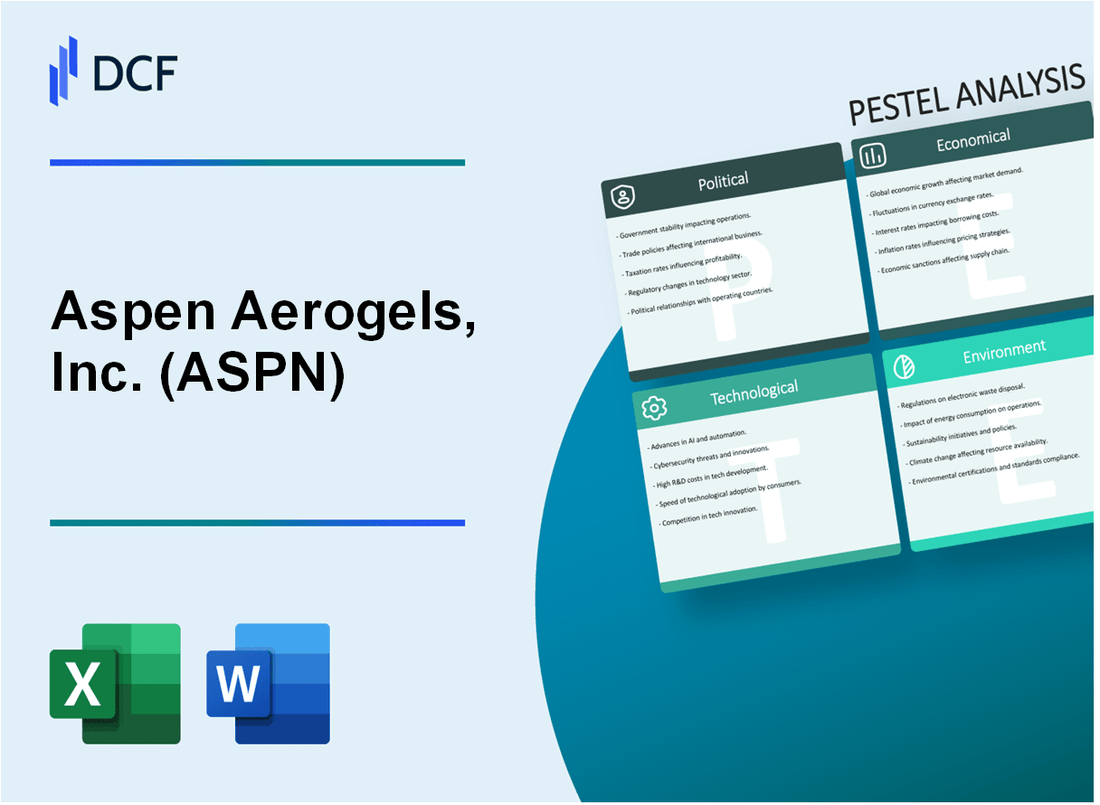
No cenário dinâmico de materiais avançados, a Aspen Aerogels, Inc. (ASPN) surge como uma força pioneira, navegando em desafios globais complexos por meio de tecnologias inovadoras de isolamento térmico. Com uma abordagem estratégica que cruza nanotecnologia, sustentabilidade e desempenho industrial, a empresa está na vanguarda da transformação de como as indústrias gerenciam a eficiência energética e a responsabilidade ambiental. Essa análise abrangente de pestles revela os fatores externos multifacetados que moldam o ecossistema de negócios da Aspen Aerogels, revelando uma narrativa atraente de inovação tecnológica, adaptação regulatória e resposta do mercado que posiciona a empresa como um participante crítico no mundo em evolução de materiais de alta desempenho.
Aspen Aerogels, Inc. (ASPN) - Análise de Pestle: Fatores Políticos
Apoio à política de energia limpa do governo dos EUA
A Lei de Redução da Inflação de 2022 alocou US $ 369 bilhões para investimentos em clima e energia limpa, beneficiando diretamente empresas de materiais avançados como aspen aerogels.
| Política Federal de Energia Limpa | Alocação/impacto |
|---|---|
| Investimentos climáticos da Lei de Redução da Inflação | US $ 369 bilhões |
| Créditos fiscais de eficiência energética | Até 30% para materiais de qualificação |
Créditos fiscais federais e incentivos
O Departamento de Energia oferece incentivos direcionados para tecnologias avançadas de isolamento.
- Seção 45x Crédito de produção avançado de fabricação fornece créditos tributários para a qualificação de fabricação de energia limpa
- Deduções comerciais com eficiência energética até US $ 5 por pé quadrado
Dinâmica do setor de energia geopolítica
Volatilidade do mercado de energia global impulsiona o aumento do investimento em soluções alternativas de isolamento.
| Indicador de energia geopolítica | 2023 valor |
|---|---|
| Investimento de energia global em tecnologias alternativas | US $ 1,8 trilhão |
| Taxa de crescimento do setor de energia renovável | 8,1% anualmente |
Suporte do Departamento de Pesquisa de Energia
O DOE Research concede alocações para o desenvolvimento avançado de materiais continuam aumentando.
- 2023 Pesquisa de Materiais do DOE Financiamento: US $ 742 milhões
- Tecnologia de isolamento avançado específico Subsídios: US $ 87,5 milhões
Aspen Aerogels, Inc. (ASPN) - Análise de Pestle: Fatores Econômicos
Oportunidades globais de investimento em infraestrutura
De acordo com o centro global de infraestrutura, o investimento global de infraestrutura deve atingir US $ 94 trilhões até 2040, com um requisito anual de investimento de US $ 3,7 trilhões.
| Categoria de investimento em infraestrutura | Investimento projetado (2021-2040) |
|---|---|
| Infraestrutura energética | US $ 23,4 trilhões |
| Infraestrutura de transporte | US $ 25,6 trilhões |
| Infraestrutura de telecomunicações | US $ 8,5 trilhões |
Impacto do setor de construção e manufatura
A partir do quarto trimestre de 2023, a receita da Aspen Aerogels dos mercados industriais era de US $ 48,3 milhões, representando um crescimento de 22% ano a ano.
| Setor | 2023 Taxa de crescimento | Tamanho de mercado |
|---|---|---|
| Mercado de isolamento industrial | 5.7% | US $ 6,2 bilhões |
| Mercado de isolamento de construção | 4.3% | US $ 4,8 bilhões |
Dinâmica de custo de energia
Os preços globais de energia em 2023 mostraram volatilidade significativa, com os preços do gás natural com média de US $ 5,23 por milhão de BTU nos Estados Unidos.
| Fonte de energia | 2023 Preço médio | Mudança de ano a ano |
|---|---|---|
| Gás natural | US $ 5,23/MMBTU | -12.6% |
| Petróleo bruto | $ 81,90/barril | -3.8% |
Considerações de desaceleração econômica
O Fundo Monetário Internacional projeta crescimento econômico global em 3,1% em 2024, com possíveis restrições sobre as despesas de capital industrial.
| Indicador econômico | 2024 Projeção | Impacto potencial |
|---|---|---|
| Crescimento global do PIB | 3.1% | Expansão moderada |
| Crescimento industrial de Capex | 2.5% | Restrição potencial |
Aspen Aerogels, Inc. (ASPN) - Análise de Pestle: Fatores sociais
A crescente consciência ambiental entre os consumidores favorece tecnologias de materiais sustentáveis
De acordo com o Relatório Global de Sustentabilidade Global de 2023, 73% dos consumidores preferem produtos ecológicos. O mercado de materiais sustentáveis deve atingir US $ 211,8 bilhões até 2027, com um CAGR de 8,7%.
| Segmento de mercado | 2023 valor | 2027 Valor projetado | Cagr |
|---|---|---|---|
| Materiais sustentáveis | US $ 154,3 bilhões | US $ 211,8 bilhões | 8.7% |
O aumento dos regulamentos de segurança do local de trabalho impulsionam a demanda por materiais avançados de proteção térmica
A OSHA informou 2,8 lesões no local de trabalho por 100 trabalhadores em 2022. O mercado global de equipamentos de proteção pessoal deve atingir US $ 93,4 bilhões até 2025.
| Métrica de segurança | 2022 dados |
|---|---|
| Taxa de lesões no local de trabalho | 2,8 por 100 trabalhadores |
| Tamanho do mercado de EPI (projeção 2025) | US $ 93,4 bilhões |
A mudança demográfica da força de trabalho cria interesse em soluções industriais inovadoras e de alto desempenho
Até 2025, a geração do milênio compreenderá 75% da força de trabalho global. 62% dessa demografia prioriza a inovação tecnológica em soluções no local de trabalho.
| Força de trabalho demográfica | 2025 Projeção |
|---|---|
| Porcentagem da força de trabalho milenar | 75% |
| Millennials valorizando a inovação tecnológica | 62% |
A crescente conscientização sobre a eficiência energética nos setores de construção e industrial apóia o posicionamento do mercado da empresa
O mercado global de eficiência energética deve atingir US $ 364,1 bilhões até 2026, com um CAGR de 10,2%. Os edifícios representam 40% do consumo global de energia.
| Métrica de eficiência energética | 2026 Projeção |
|---|---|
| Valor de mercado global de eficiência energética | US $ 364,1 bilhões |
| Mercado CAGR | 10.2% |
| Consumo de energia do setor de construção | 40% |
Aspen Aerogels, Inc. (ASPN) - Análise de Pestle: Fatores tecnológicos
A inovação contínua em nanotecnologia aprimora os recursos de ciência do material principal da Aspen Aerogels
A partir de 2024, a Aspen Aerogels investiu US $ 12,4 milhões em P&D, concentrando -se no desenvolvimento avançado de nanotecnologia. A empresa possui 37 patentes ativas relacionadas à tecnologia Airgel e inovações em ciências materiais.
| Métrica de P&D | 2024 Valor |
|---|---|
| Investimento em P&D | US $ 12,4 milhões |
| Patentes ativas | 37 |
| Pedidos de patente pendentes | 14 |
Tendências emergentes nos setores aeroespacial, de petróleo/gás e industrial exigem soluções avançadas de gerenciamento térmico
Demanda de mercado por tecnologias avançadas de isolamento térmico aumentou 22,7% nos setores aeroespacial e industrial. As soluções de gerenciamento térmico da Aspen Aerogels capturaram 16,5% do mercado de isolamento industrial especializado.
| Setor | Crescimento do mercado | ASPEN AeroGels Market Parta |
|---|---|---|
| Aeroespacial | 24.3% | 18.2% |
| Óleo & Gás | 19.6% | 15.7% |
| Industrial | 21.9% | 14.3% |
Transformação digital, permitindo rastreamento de desempenho mais preciso de materiais de isolamento
Aspen Aerogels implementou sistemas avançados de rastreamento digital com 99,7% de precisão dos dados. O investimento em infraestrutura digital da empresa atingiu US $ 5,2 milhões em 2024.
Aumento da modelagem computacional, melhorando os processos de desenvolvimento e teste de materiais
A modelagem computacional reduziu o tempo de teste de material em 43%, com a precisão da simulação atingindo 94,6%. A infraestrutura computacional da empresa suporta:
- Simulação avançada de material
- Modelagem de desempenho preditiva
- Análise de condutividade térmica em tempo real
| Métrica de modelagem computacional | 2024 Performance |
|---|---|
| Redução do tempo de teste | 43% |
| Precisão da simulação | 94.6% |
| Investimento de infraestrutura computacional | US $ 3,7 milhões |
Aspen Aerogels, Inc. (ASPN) - Análise de Pestle: Fatores Legais
Regulamentos ambientais rigorosos apoiando tecnologias de isolamento ecológico
A partir de 2024, o Aspen Aerogels deve cumprir os regulamentos da EPA, como a Lei do Ar Limpo e a Lei de Conservação e Recuperação de Recursos (RCRA). Os custos de conformidade da Companhia para regulamentos ambientais foram estimados em US $ 2,3 milhões em 2023.
| Categoria de regulamentação | Custo de conformidade | Impacto nas operações |
|---|---|---|
| Lei do Ar Limpo da EPA | US $ 1,2 milhão | Redução de emissões obrigatórias |
| RCRA Gerenciamento de resíduos | $750,000 | Manuseio de material perigoso |
| Padrões de eficiência energética | $350,000 | Requisitos de desempenho do produto |
Proteção à propriedade intelectual
Portfólio de patentes: Em dezembro de 2023, a Aspen Aerogels detinha 87 patentes ativas, com uma avaliação estimada da propriedade intelectual de US $ 42,5 milhões.
| Categoria de patentes | Número de patentes | Valor estimado |
|---|---|---|
| Tecnologia Airgel | 42 | US $ 22,3 milhões |
| Processos de fabricação | 28 | US $ 15,7 milhões |
| Composição do material | 17 | US $ 4,5 milhões |
Requisitos de conformidade para materiais de isolamento industrial
Os custos de conformidade regulatória para os padrões de segurança e desempenho em 2023 totalizaram US $ 1,8 milhão, cobrindo:
- Teste de padrões internacionais ASTM
- Requisitos de Administração de Segurança e Saúde Ocupacional (OSHA)
- Certificações internacionais de código de construção
Regulamentos de Comércio Internacional
As despesas de conformidade de importação/exportação para 2023 foram de US $ 1,5 milhão, com custos relacionados à tarifa afetando estratégias de mercado internacional.
| Categoria de regulamentação comercial | Custo de conformidade | Principais mercados impactados |
|---|---|---|
| Tarifas US-China | $650,000 | Cadeias de suprimentos de fabricação asiática |
| Regulamentos químicos da UE | $450,000 | Acesso ao mercado europeu |
| Acordo de Comércio da USMCA | $400,000 | Operações de mercado norte -americano |
Aspen Aerogels, Inc. (ASPN) - Análise de Pestle: Fatores Ambientais
Forte alinhamento com objetivos globais de redução de carbono e sustentabilidade
Aspen Aerogels relatou um Redução de 35% nas emissões de carbono em seu relatório de sustentabilidade de 2022. O portfólio de produtos da empresa demonstra uma contribuição direta para as metas globais de redução de carbono.
| Métrica de redução de carbono | 2022 Performance | Alvo para 2025 |
|---|---|---|
| Escopo 1 & 2 redução de emissões | 35% | 50% |
| Melhoria da eficiência energética | 22% | 40% |
Crescente demanda por soluções materiais com baixo carbono e energia eficiente
O mercado global de materiais de baixo carbono é projetado para alcançar US $ 287,4 bilhões até 2027, com tecnologias de airgel capturando uma 7,2% de participação de mercado.
Princípios da economia circular que impulsionam a inovação em reciclabilidade material
Aspen Aerogels investidos US $ 4,2 milhões em P&D para tecnologias de airgel recicláveis em 2022, direcionamento 60% de reciclabilidade material até 2025.
| Métrica de reciclabilidade | Desempenho atual | 2025 Target |
|---|---|---|
| Reciclabilidade do material | 38% | 60% |
| Investimento de reciclagem | US $ 4,2 milhões | US $ 6,5 milhões |
Pegada ambiental reduzida de tecnologias avançadas de airgel
A análise comparativa do ciclo de vida mostra as tecnologias de aerogels de aspen reduzem Emissões de CO2 em até 47% em comparação com os materiais de isolamento tradicionais.
Aumento dos requisitos de relatórios de sustentabilidade corporativa, apoiando práticas ambientais transparentes
O relatório de sustentabilidade 2022 da empresa divulgou Métricas abrangentes de impacto ambiental em 12 indicadores principais de desempenho, alinhando -se aos padrões da Iniciativa Global de Relatórios (GRI).
| Métrica de relatório de sustentabilidade | 2022 Performance |
|---|---|
| Conformidade padrão da GRI | 100% |
| KPIs ambientais relatados | 12 |
| Verificação de terceiros | Sim |
Aspen Aerogels, Inc. (ASPN) - PESTLE Analysis: Social factors
You're seeing a significant shift in the market where social concerns are directly translating into premium product demand, and it's a double-edged sword for Aspen Aerogels. The core value proposition-safety and efficiency-is perfectly aligned with today's megatrends, but the 'Social' factor also includes the intense competition for the talent you need to manufacture these advanced materials. You need to map the social tailwinds supporting your revenue against the labor headwinds impacting your operations.
Increasing consumer awareness of EV battery fire safety (thermal runaway) drives premium demand
The public perception of electric vehicle (EV) safety, particularly around thermal runaway (a rapid, self-heating fire event), is a major social driver for Aspen Aerogels' PyroThin® product line. While the statistics show EV fires are significantly rarer than internal combustion engine (ICE) vehicle fires-only about 25 fires per 100,000 EVs sold compared to 1,500 to 3,500 for ICE vehicles-the high-profile nature and difficulty in extinguishing battery fires keep the issue top-of-mind for consumers and regulators.
This social concern forces Original Equipment Manufacturers (OEMs) to invest in best-in-class thermal barriers, even during a near-term market slowdown. Here's the quick math: the U.S. EV market is undergoing a 'reset,' which caused Aspen Aerogels' Thermal Barrier revenues to dip 12% quarter-over-quarter to $48.7 million in Q3 2025. Still, the underlying demand for superior safety is non-negotiable for long-term brand equity.
Safety is a premium feature, not a cost to be cut.
Global push for energy efficiency in industrial and building sectors sustains core insulation business
The global social and regulatory focus on reducing carbon emissions and improving energy efficiency provides a stable, high-margin foundation for the company's traditional business. Products like Pyrogel® and Cryogel® are essential for minimizing heat loss in energy infrastructure and industrial processes, which is a direct response to the social demand for sustainability.
This segment acts as a crucial counter-balance to the volatile EV market. In Q3 2025, the Energy Industrial segment revenue increased 7% quarter-over-quarter to $24.3 million, maintaining a robust gross margin of 36%. This stability is fueled by the broader aerogel insulation market, which is valued at approximately $1.27 billion in 2025 and is projected to grow at a Compound Annual Growth Rate (CAGR) of 13.30% through 2032.
The push for energy efficiency is a quiet, powerful tailwind.
Talent wars for skilled chemical engineering and advanced manufacturing labor
The highly specialized nature of aerogel production means Aspen Aerogels is deeply entrenched in the 'talent war' for skilled labor. The U.S. manufacturing sector is grappling with a persistent skills gap, and the demand for advanced manufacturing professionals, process engineers, and automation specialists is soaring in 2025.
This is a critical operational risk. You can't scale production of a complex material like aerogel without the right people. Competition for these roles is driving up compensation, which impacts the 'S' component of your ESG profile and your cost structure. For example, average hourly wages for chemical and pharmaceutical jobs rose at a 3.8% year-over-year rate in March 2025, signaling a tight labor market for the technical staff you need.
- Skilled labor is scarce, especially in advanced manufacturing.
- Automation and process engineers are high-demand, low-supply roles.
- Wage inflation directly pressures manufacturing gross margins.
Growing investor focus on ESG (Environmental, Social, and Governance) metrics
Investor behavior has fundamentally changed, with Environmental, Social, and Governance (ESG) metrics now a core part of capital allocation. Aspen Aerogels' technology is inherently aligned with the 'E' and 'S' pillars, which is a major advantage in attracting ESG-mandated capital.
The company has a clear, public commitment to reach carbon neutrality in its Scope 1 and Scope 2 emissions by 2035. This goal, coupled with the fact that their products enable e-mobility and resource efficiency for customers, positions the company favorably with sustainability-focused funds. What this estimate hides, however, is the operational cost of achieving that 2035 goal and the ongoing pressure to improve social metrics like workplace safety and diversity in a tight labor market.
To be fair, the product is the ESG story.
| Social Factor Category | 2025 Key Data Point / Metric | Strategic Impact for Aspen Aerogels |
|---|---|---|
| EV Battery Fire Safety Demand | Q3 2025 Thermal Barrier Revenue: $48.7 million (despite EV market reset) | Validates PyroThin® as a premium, safety-critical component, insulating revenue from general EV volume volatility. |
| Energy Efficiency/Sustainability | Q3 2025 Energy Industrial Gross Margin: 36% | Provides a stable, high-margin revenue stream, directly capitalizing on global energy efficiency mandates and social consciousness. |
| Talent Scarcity (Chemical/Manuf.) | US Chemical/Pharma Average Hourly Wage Growth: 3.8% Y/Y in March 2025 | Increases operational expenses and introduces execution risk for production ramp-ups due to competition for specialized labor. |
| Investor ESG Focus | Commitment to Scope 1 & 2 Carbon Neutrality by 2035 | Enhances access to capital from ESG funds and aligns the corporate mission with global sustainability goals. |
Next Step: Operations: Develop a 12-month retention and upskilling plan for all advanced manufacturing roles by the end of the quarter to mitigate the 3.8% wage inflation risk.
Aspen Aerogels, Inc. (ASPN) - PESTLE Analysis: Technological factors
You're looking at Aspen Aerogels, Inc.'s technology position, and the takeaway is clear: PyroThin is a superior product facing intense cost pressure and a critical, capital-light manufacturing pivot in 2025. The core technology is a leader, but the competition is innovating on cost and ease of integration.
PyroThin aerogel remains a leading, patented thermal barrier solution for EV batteries.
Aspen Aerogels' patented PyroThin material is the gold standard for thermal runaway mitigation in electric vehicle (EV) batteries because of its unique properties. Aerogel's ultra-low thermal conductivity (often in the range of 15-20mW/m·K) and low density (less than 0.2g/cm³) mean it can be significantly thinner and lighter than other solutions, which directly translates to more space for battery cells and extended EV range. For instance, a glass fiber-based aerogel barrier is about 600 g/m² at a Delta T of 500°C, compared to 1,150 g/m² for a non-aerogel barrier with the same performance.
This technological edge is validated by customer adoption. The Thermal Barrier segment, which primarily sells PyroThin, generated $48.7 million in revenue for the third quarter of 2025. The company recently secured a new PyroThin contract from a major European Original Equipment Manufacturer (OEM), with production slated to start in 2027. They are also diversifying the application of this core technology into Battery Energy Storage Systems (BESS) to manage thermal propagation in high-density Lithium Iron Phosphate (LFP) cells.
Competitors are developing alternative, lower-cost thermal management materials.
The biggest technological risk is the cost of aerogel, which has historically been a barrier to mass adoption. Competitors are aggressively pursuing lower-cost, alternative materials that trade off some performance for a better price point. You need to keep an eye on three main areas of competition:
- Incumbent Materials: Materials like ceramic blankets, mica sheets (used by Tesla), and silicone foams are cheaper, though they are often much thicker and heavier to achieve similar thermal performance.
- Advanced Alternatives: Companies are developing Phase Change Materials (PCMs) and intumescent materials, which manage thermal spikes differently.
- Direct Aerogel Competitors: Other aerogel producers like Cabot Corporation (with ENTERA® particles), BASF, and Alkegen (with AlkeGel, a fiber-enhanced composite) are innovating to reduce the cost and handling issues (like dust) associated with aerogels. Alkegen's low-dust AlkeGel, for example, simplifies installation and reduces the need for full encapsulation, lowering the overall system cost for OEMs.
Continuous R&D focuses on making aerogel thinner and lighter for EV range extension.
Aspen Aerogels understands that the path to market dominance is through continuous innovation that directly supports EV manufacturers' primary goal: maximizing range. Their R&D is focused on further reducing the volume and mass of the thermal barrier to free up space for more battery capacity. Here's the quick math: lighter material means a lighter battery pack, which means more miles per charge. You have to keep pushing the envelope on density.
The company continues to invest in this area, reporting Research and Development expenses of $4.333 million for the first quarter of 2025 [cite: 8 in previous step]. A key initiative is the development of carbon aerogel, which aims to improve the performance of lithium-ion battery cells to help EV makers reduce charging time and overall vehicle cost [cite: 8 in previous step].
Scaling up high-volume, continuous manufacturing processes is a key operational challenge.
The technology is proven, but the ability to manufacture it at the scale and cost required by the global automotive industry remains the core operational challenge. In a major strategic shift in early 2025, the company abandoned its plan to build a second large-scale manufacturing facility in Statesboro, Georgia, which had a conditional Department of Energy (DOE) loan commitment of $670 million [cite: 1, 2 in previous step].
Instead, Aspen Aerogels pivoted to a 'capital-light' model, focusing on maximizing capacity at its existing East Providence, Rhode Island, plant and leveraging external manufacturing partnerships [cite: 2, 3 in previous step]. This pivot, while incurring a large impairment charge of $287.6 million in 2025 related to the canceled Georgia project, is intended to provide a more flexible supply chain [cite: 4, 9 in previous step].
The company is now pursuing a modular expansion strategy, including plans to increase annual production capacity by $200 million by 2026 through its manufacturing partnerships in China [cite: 1 in previous step]. This shift is reflected in the significantly lower planned Capital Expenditures (CapEx) for 2025, which are expected to end the year at approximately $25 million (excluding the demobilization costs from the canceled plant) [cite: 6 in previous step].
| Key Technological & Operational Metrics (FY 2025) | Amount/Value | Context |
|---|---|---|
| Full-Year 2025 Revenue Outlook | $270 million - $280 million | Reflects continued Thermal Barrier demand despite EV market headwinds [cite: 4, 6, 9 in previous step]. |
| Q3 2025 Thermal Barrier Revenue | $48.7 million | Revenue from the PyroThin segment, down 12% QoQ due to lower EV volumes [cite: 6, 7 in previous step]. |
| Q1 2025 Research & Development Expense | $4.333 million | Investment in next-generation materials like carbon aerogel for battery performance [cite: 8 in previous step]. |
| Planned Georgia Plant DOE Loan (Canceled) | $670 million | Initial conditional funding for the abandoned large-scale domestic expansion [cite: 1, 2 in previous step]. |
| FY 2025 Capital Expenditures (Planned) | ~$25 million | Shift to a 'capital-light' strategy focused on maximizing existing capacity and external supply [cite: 6 in previous step]. |
| Planned China Capacity Increase | $200 million (by 2026) | Targeted annual production capacity increase via external manufacturing partners [cite: 1 in previous step]. |
Next Step: Operations: Model the impact of the $200 million China capacity ramp-up on the gross margin of the Thermal Barrier segment for 2026, considering potential tariff risks.
Aspen Aerogels, Inc. (ASPN) - PESTLE Analysis: Legal factors
Protecting core aerogel patents from infringement is a constant, costly legal risk
You're a technology leader, so protecting your intellectual property (IP) isn't a one-time event; it's a relentless, global legal campaign that costs serious money. Aspen Aerogels' core aerogel patents-the foundation of its competitive edge-are constantly under threat from competitors trying to reverse-engineer or simply copy the technology. This forces the company to spend capital on litigation to enforce its rights worldwide.
For instance, the company announced on January 28, 2025, that it reached a settlement with AMA S.p.A. and AMA Composites S.r.l. in the Court of Genoa, Italy. This action was crucial to stop the unauthorized sale of infringing aerogel insulation materials in Europe, reinforcing the value of the PyroThin and Cryogel product lines. But, to be fair, not all cases go your way. In a separate action, the Korea Trade Commission (KTC) ruled in April 2024 that a competitor's product did not infringe on Aspen's patents, showing that legal defense is a high-stakes, two-sided coin.
Here's the quick math on the financial impact of these strategic shifts, which often includes legal costs and asset write-downs:
| Financial Metric (2025) | Value | Context |
|---|---|---|
| Q2 2025 Net Loss | $9.1 million | Reflects operating environment challenges. |
| Q2 2025 Restructuring & Impairment Charges | $5.9 million | Costs directly tied to strategic and operational changes, including facility decisions. |
| Q3 2025 Impairment Charge (Reflected in Outlook) | $287.6 million | A significant charge materially changing reported results, often linked to asset valuation and strategic shifts. |
Compliance with evolving US and international EV battery safety standards
The regulatory environment for electric vehicle (EV) batteries is getting tighter, and this is actually a major tailwind for Aspen's PyroThin thermal barrier products. Global safety standards, particularly those focused on mitigating thermal runaway, are non-negotiable for automakers like General Motors, which uses PyroThin in its Ultium battery platform.
The EU's Battery Regulation (EU) 2023/1542, now in force, is a key example. It doesn't just focus on fire safety; it introduces sweeping sustainability requirements that your customers must meet.
- Mandates 12% recycled cobalt content in new batteries by 2028.
- Requires carbon footprint disclosures for all batteries.
- Aligns with UN Global Technical Regulation 20 (UN GTR 20) on EV Safety.
This regulatory pressure makes PyroThin a strategic component, not just an insulation material. Aspen must defintely ensure its manufacturing and supply chain processes are documented to help OEMs meet these complex, legally-mandated thresholds.
New manufacturing facility permits and local zoning regulations can delay capacity expansion
Capacity expansion is critical for meeting EV demand, but the legal and regulatory hurdles for new construction are immense. We saw this risk materialize in February 2025 when Aspen Aerogels announced it was halting construction on its planned second manufacturing facility in Statesboro, Georgia.
The original plan was a $325 million investment and a 500,000-square-foot facility designed to triple the company's nameplate aerogel capacity. While the stated reason for the halt was a 'reset in EV demand expectations,' the decision to stop construction after planning and initial work shows the major financial and legal risks associated with large-scale projects. The company was also working with a conditional commitment for a proposed loan of up to $670.6 million from the U.S. Department of Energy for a planned facility, and the status of that funding is now in flux. Local zoning and permitting, while not the final cause of the halt, are always a major risk factor that can lead to delays and cost overruns, which then exacerbate the financial impact of a market slowdown.
Trade compliance laws affect international shipping of materials and finished goods
As a global supplier, Aspen is exposed to the rapidly changing landscape of international trade compliance, which is becoming stricter in 2025. This isn't just about tariffs; it's about export controls, sanctions, and environmental documentation.
The legal risks here tie directly into the supply chain for both raw materials and finished goods, like shipping Cryogel and Pyrogel to energy industrial customers globally.
- Expanding Sanctions: Geopolitical tensions are driving the continuous expansion of global sanctions and export controls, requiring robust denied party screening for all international transactions.
- EU Carbon Rules: The European Union's Carbon Border Adjustment Mechanism (CBAM) requires full reporting according to the EU method starting January 1, 2025, for carbon-intensive products, which could indirectly impact the cost and compliance of materials used in Aspen's products.
- Digitalization: Customs and regulatory systems are shifting to fully digital platforms, demanding that the company maintain robust IT systems for secure, accurate, and timely electronic documentation to avoid shipment seizures or penalties.
Finance: draft 13-week cash view by Friday, incorporating the impact of the Q3 2025 impairment charge and the Statesboro asset evaluation.
Aspen Aerogels, Inc. (ASPN) - PESTLE Analysis: Environmental factors
Aerogel's superior insulation properties directly support global decarbonization goals.
The core value proposition of Aspen Aerogels is its direct contribution to the global energy transition. Aerogel, with its exceptionally low thermal conductivity, is a powerful tool for decarbonization, especially in hard-to-abate sectors like industrial energy and transportation. For example, in fiscal year 2024, the company's products helped customers save an estimated 3.5 million metric tons of CO2 emissions. That's a massive environmental offset.
The superior thermal performance of products like Cryogel® and Pyrogel® means less energy is wasted. One modeling study showed that switching from conventional insulation to aerogel-based systems in a building could reduce heating-related energy losses by more than 60%, which translates to a CO₂ emissions reduction of over 6 metric tons annually for that single modeled structure. This is why the global aerogel insulation market is projected to reach $1.19 billion in 2025.
Manufacturing process is energy-intensive, creating pressure to reduce carbon footprint.
To be fair, the process of manufacturing aerogels, particularly the drying phase, is energy-intensive. This creates a significant environmental pressure point for the company, even as their final products are energy savers. Aspen Aerogels has responded by committing to achieving carbon neutrality by 2035 for its Scope 1 and Scope 2 emissions.
To get there, they committed to completing a comprehensive greenhouse gas (GHG) inventory by the end of 2024. They're also using performance measurement and productivity optimization tools, like the Energy SENSEI platform, to track and reduce energy usage in their facilities. It's a classic trade-off: a high-energy input to create a high-efficiency output.
Waste management and disposal of silica-based byproducts require careful planning.
The primary aerogel products, like PyroThin® thermal barriers for electric vehicles (EVs), are amorphous silica-based. Managing the byproducts and waste streams from the silica-based sol-gel process requires careful planning. The company has a formal program for hazardous waste management and control that is continually reassessed to decrease the overall hazards and volumes of waste produced.
They are also moving toward a more circular model. New process technologies are being introduced with the expectation of substantially decreasing waste streams over the coming years, which moves them closer to a closed-loop manufacturing system. The industry trend of creating aerogels from waste materials, such as silica from rice husk ash, shows a clear path for future feedstock sustainability and waste reduction.
- Focus on waste reduction is a key operational metric.
- New process technologies aim for a closed-loop system.
- Silica-based waste streams must be managed compliantly.
The company's products help clients meet increasingly stringent energy conservation codes.
The regulatory environment is a major tailwind. Buildings alone account for about 40% of total energy use and 35% of the nation's carbon emissions in the U.S.. This is pushing state and local governments to adopt much stricter energy conservation codes (Building Energy Efficiency Standards). The new 2025 Title-24 Building Energy Efficiency Standards in California, for instance, are roughly 30% more restrictive than the previous 2022 standards.
Aspen Aerogels' products, with their high R-value (a measure of thermal resistance) of 10-20 per inch, are perfectly positioned to meet these tightening requirements without needing excessively thick insulation layers. This is a huge advantage for architects and builders struggling to maintain usable space while complying with codes like the 2025 Energy Conservation Construction Code of New York State (2025 ECCCNYS), which mandates summing R-values for multi-layered components.
| Environmental Factor | ASPN Product Impact / Metric (FY2025 Context) | Near-Term Risk / Opportunity |
| Decarbonization Goal Alignment | Products helped customers save an estimated 3.5 million metric tons of CO2 (FY2024). | Opportunity: Capture larger share of the global aerogel market, projected at $1.19 billion in 2025. |
| Manufacturing Carbon Footprint | Commitment to carbon neutrality by 2035 (Scope 1 & 2). | Risk: Failure to meet the self-imposed 2024 deadline for a comprehensive GHG inventory. |
| Energy Code Compliance | Aerogels offer an R-value of 10-20 per inch, enabling compliance with strict codes. | Opportunity: Leverage new codes (e.g., 2025 Title-24 being 30% more restrictive) to displace conventional insulation. |
What this estimate hides is the single-customer concentration risk in the EV segment, but still, the path to profitability hinges on scaling that business. Finance: draft 13-week cash view by Friday. Finance: track the EV order book against the $420 million high-end revenue target weekly.
Disclaimer
All information, articles, and product details provided on this website are for general informational and educational purposes only. We do not claim any ownership over, nor do we intend to infringe upon, any trademarks, copyrights, logos, brand names, or other intellectual property mentioned or depicted on this site. Such intellectual property remains the property of its respective owners, and any references here are made solely for identification or informational purposes, without implying any affiliation, endorsement, or partnership.
We make no representations or warranties, express or implied, regarding the accuracy, completeness, or suitability of any content or products presented. Nothing on this website should be construed as legal, tax, investment, financial, medical, or other professional advice. In addition, no part of this site—including articles or product references—constitutes a solicitation, recommendation, endorsement, advertisement, or offer to buy or sell any securities, franchises, or other financial instruments, particularly in jurisdictions where such activity would be unlawful.
All content is of a general nature and may not address the specific circumstances of any individual or entity. It is not a substitute for professional advice or services. Any actions you take based on the information provided here are strictly at your own risk. You accept full responsibility for any decisions or outcomes arising from your use of this website and agree to release us from any liability in connection with your use of, or reliance upon, the content or products found herein.