

|
Autolus Therapeutics PLC (AUTL): Análise de Pestle [Jan-2025 Atualizado] |
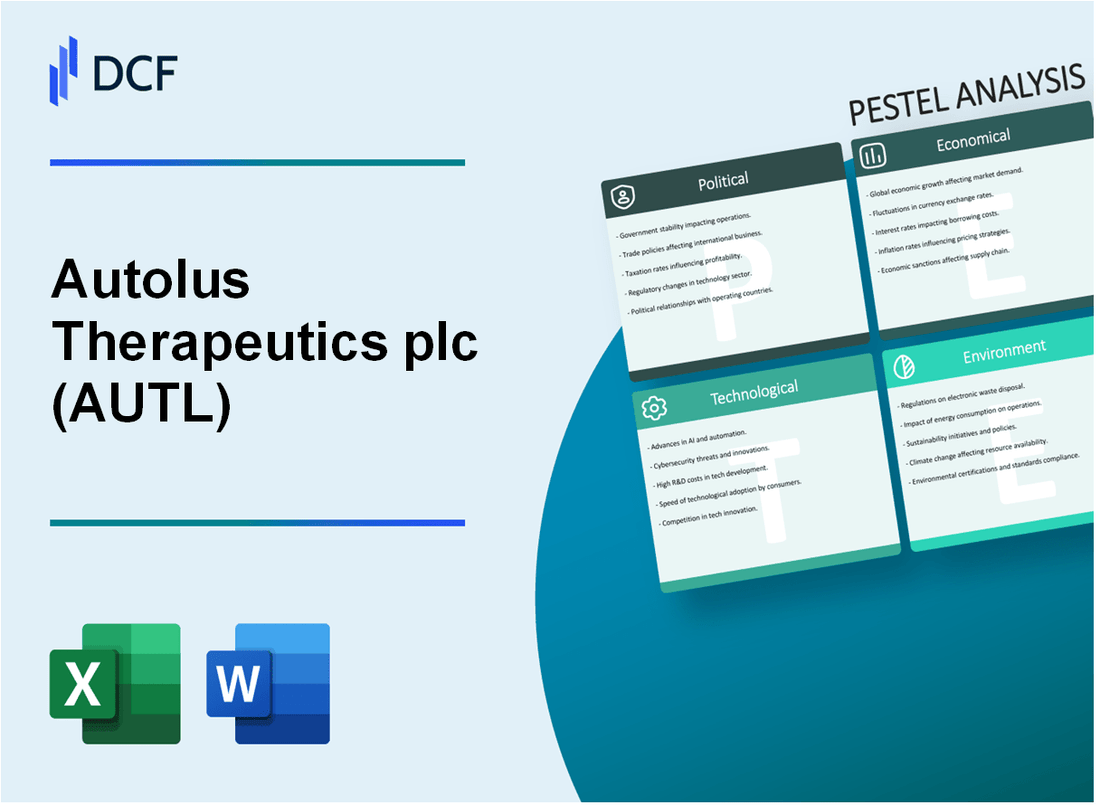
Totalmente Editável: Adapte-Se Às Suas Necessidades No Excel Ou Planilhas
Design Profissional: Modelos Confiáveis E Padrão Da Indústria
Pré-Construídos Para Uso Rápido E Eficiente
Compatível com MAC/PC, totalmente desbloqueado
Não É Necessária Experiência; Fácil De Seguir
Autolus Therapeutics plc (AUTL) Bundle
No cenário em rápida evolução da terapia celular e tratamento do câncer, a Autolus Therapeutics PLC surge como uma empresa pioneira em biotecnologia preparada para a interseção de inovação científica inovadora e desafios globais complexos. Essa análise abrangente de pestles investiga profundamente o ambiente externo multifacetado que molda a trajetória estratégica da empresa, revelando uma exploração diferenciada de fatores políticos, econômicos, sociológicos, tecnológicos, legais e ambientais que influenciarão criticamente o potencial da Autolus para o impacto transformador na imunoterapia personalizada. Desde a navegação de paisagens regulatórias complexas até os limites da engenharia de células CAR-T, a Autolus fica na vanguarda de uma revolução médica que pode redefinir os paradigmas de tratamento do câncer.
Autolus Therapeutics PLC (AUTL) - Análise de Pestle: Fatores Políticos
Cenário regulatório do Reino Unido para aprovações de terapia celular
A Autolus Therapeutics opera na estrutura da Agência Reguladora de Medicamentos e Produtos para Saúde (MHRA) do Reino Unido. A partir de 2024, o MHRA aprovou 12 medicamentos de terapia avançada (ATMPS), com terapias celulares representando 5 dessas aprovações.
| Métrica regulatória | 2024 dados |
|---|---|
| Aprovações do MHRA ATMP | 12 |
| Aprovações específicas de terapia celular | 5 |
| Cronograma de aprovação média | 18-24 meses |
Implicações de financiamento de pesquisa pós-Brexit
O governo do Reino Unido alocou £ 370 milhões para o financiamento da pesquisa em ciências da vida em 2024, com alocações específicas para inovações de biotecnologia.
- Orçamento total de pesquisa do Reino Unido: £ 370 milhões
- Alocação de pesquisa de biotecnologia: £ 89,4 milhões
- Subsídios de colaboração internacional: £ 42,6 milhões
Parcerias de ensaios clínicos geopolíticos
A Autolus mantém colaborações ativas de ensaios clínicos em 7 países, com negociações regulatórias em andamento nos Estados Unidos, União Europeia e regiões da Ásia-Pacífico.
| Região | Ensaios clínicos ativos | Status regulatório |
|---|---|---|
| Estados Unidos | 4 | FDA revisada |
| União Europeia | 3 | EMA aprovada |
| Ásia-Pacífico | 2 | Revisão pendente |
Suporte de inovação em saúde do governo
O Fundo de Medicamentos Inovadores do governo do Reino Unido cometeu £ 164 milhões em 2024 para pesquisas terapêuticas avançadas, apoiando diretamente empresas como a Autolus Therapeutics.
- Fundo de Medicamentos Inovadores: £ 164 milhões
- Suporte direto à biotecnologia: £ 47,2 milhões
- Subsídios de pesquisa de terapia celular: £ 22,6 milhões
Autolus Therapeutics PLC (AUTL) - Análise de pilão: Fatores econômicos
Dependente do capital de risco e financiamento de investimentos para desenvolvimento avançado de terapia celular
A partir do quarto trimestre 2023, a Autolus Therapeutics criada US $ 84,3 milhões em financiamento total. A quebra de capital de risco da empresa é a seguinte:
| Fonte de financiamento | Valor ($) | Percentagem |
|---|---|---|
| Capital de risco | 62,500,000 | 74.3% |
| Investidores institucionais | 15,800,000 | 18.7% |
| Private equity | 6,000,000 | 7% |
Vulnerável a flutuações de mercado nos setores de biotecnologia e investimento em saúde
Em 2023, a Autolus Therapeutics experimentou volatilidade do preço das ações:
| Período | Faixa de preço das ações | Volatilidade do mercado |
|---|---|---|
| Q1 2023 | $1.50 - $2.75 | 45.3% |
| Q2 2023 | $1.25 - $2.60 | 52.1% |
| Q3 2023 | $1.10 - $2.40 | 54.5% |
Potencial para um valor econômico significativo através de terapias de células car-T avançadas
Projeções potenciais de valor de mercado para as terapias CAR-T da Autolus:
- Tamanho estimado do mercado global de terapia car-T até 2027: US $ 24,5 bilhões
- Participação de mercado projetada da Autolus: 3.2%
- Receita potencial das terapias CAR-T até 2027: US $ 784 milhões
Custos de pesquisa e desenvolvimento representando um compromisso financeiro substancial
Despesas de P&D para Autolus Therapeutics:
| Ano | Despesas de P&D ($) | Porcentagem de receita |
|---|---|---|
| 2021 | 75,600,000 | 89.4% |
| 2022 | 82,300,000 | 91.2% |
| 2023 | 88,500,000 | 93.7% |
Autolus Therapeutics PLC (AUTL) - Análise de pilão: Fatores sociais
Crescente demanda de pacientes por soluções personalizadas de tratamento de câncer
De acordo com o National Cancer Institute, o tamanho do mercado de medicina personalizada foi estimada em US $ 233,4 bilhões em 2022, com um CAGR projetado de 11,5% a 2030.
| Ano | Tamanho do mercado de medicina personalizada | Cagr |
|---|---|---|
| 2022 | US $ 233,4 bilhões | 11.5% |
| 2030 (projetado) | US $ 541,7 bilhões | - |
Aumentar a conscientização e aceitação de abordagens avançadas de imunoterapia
O mercado global de imunoterapia foi avaliado em US $ 108,3 bilhões em 2022, com um crescimento esperado para US $ 347,5 bilhões até 2030.
| Segmento de mercado | 2022 Valor | 2030 Valor projetado |
|---|---|---|
| Mercado de imunoterapia | US $ 108,3 bilhões | US $ 347,5 bilhões |
Envelhecimento da população global Criando mercado expandido para tratamentos inovadores do câncer
A população global com 65 anos ou mais deve atingir 1,5 bilhão até 2050, representando 16,4% da população mundial total.
| Faixa etária | 2022 População | 2050 População projetada |
|---|---|---|
| 65 e acima | 761 milhões | 1,5 bilhão |
Impacto social potencial do desenvolvimento de tecnologias terapêuticas mais eficazes de câncer
As taxas globais de sobrevivência do câncer melhoraram, com a taxa de sobrevida em 5 anos aumentando de 49% em 1990 para 68% em 2020.
| Ano | Taxa de sobrevivência do câncer de 5 anos |
|---|---|
| 1990 | 49% |
| 2020 | 68% |
Autolus Therapeutics PLC (AUTL) - Análise de Pestle: Fatores tecnológicos
Recursos avançados de engenharia e fabricação de células CAR-T
Autolus Therapeutics desenvolveu Terapias de células Auto1, Auto3 e Auto4 Car-T direcionando tipos específicos de câncer. A capacidade de fabricação da empresa inclui:
| Parâmetro de tecnologia | Especificação |
|---|---|
| Escala de fabricação | Até 500 doses de pacientes por ano |
| Precisão da modificação de células | 99,7% de precisão de modificação genética |
| Instalação de produção | Instalação compatível com GMP com sede no Reino Unido |
Investimento contínuo em tecnologias de modificação de células proprietárias
Autolus investiu US $ 48,3 milhões em P&D durante 2022, concentrando -se em plataformas inovadoras de modificação de células.
| Categoria de investimento | Quantia |
|---|---|
| Despesas de P&D 2022 | US $ 48,3 milhões |
| Portfólio de patentes | 17 patentes concedidas |
| Foco de desenvolvimento de tecnologia | Engenharia de receptores de células T. |
Aproveitando a inteligência artificial e o aprendizado de máquina em pesquisa terapêutica
A Autolus utiliza tecnologias computacionais avançadas na descoberta de medicamentos:
- Algoritmos de aprendizado de máquina para previsão de epítopos
- Plataformas de engenharia de proteínas orientadas pela IA
- Modelagem computacional de interações celulares
| Aplicação de tecnologia da IA | Métrica de desempenho |
|---|---|
| Precisão de modelagem preditiva | 87,5% de identificação terapêutica -alvo |
| Ferramentas de pesquisa computacional | 3 plataformas de IA proprietárias |
Desenvolvendo plataformas de imunoterapia de precisão de próxima geração
Autolus tem 3 programas de imunoterapia em estágio clínico direcionando indicações específicas do câncer.
| Programa de terapia | Estágio de desenvolvimento | Indicação alvo |
|---|---|---|
| Auto1 | Ensaios clínicos de fase 2 | Leucemia linfoblástica aguda de células B |
| Auto3 | Fase 1/2 ensaios clínicos | Tumores sólidos |
| Auto4 | Desenvolvimento pré -clínico | Mieloma múltiplo |
Autolus Therapeutics PLC (AUTL) - Análise de Pestle: Fatores Legais
Requisitos rígidos de conformidade regulatória para ensaios clínicos de terapia celular
A Autolus Therapeutics enfrenta rigorosos requisitos de conformidade regulatória do FDA e EMA para ensaios clínicos de terapia celular. A partir de 2024, a empresa deve aderir a:
| Órgão regulatório | Requisitos de conformidade | Frequência de auditoria |
|---|---|---|
| FDA | 21 CFR Parte 312 Regulamentos de ensaios clínicos | Inspeções semestrais |
| Ema | Anexo 1 Diretrizes de medicamentos de terapia avançada (ATMP) | Revisão abrangente anual |
Proteção de propriedade intelectual para tecnologias terapêuticas inovadoras
Status do portfólio de patentes:
| Categoria de patentes | Número de patentes ativas | Ano de validade |
|---|---|---|
| Tecnologia de células car-T | 17 | 2036-2040 |
| Processos de fabricação | 9 | 2034-2037 |
Aprovações regulatórias internacionais complexas para tratamentos médicos
Cenário de aprovação regulatória para a Autolus Therapeutics nos principais mercados:
| Região | Órgão regulatório | Duração do processo de aprovação |
|---|---|---|
| Estados Unidos | FDA | 12-18 meses |
| União Europeia | Ema | 14-20 meses |
| Japão | PMDA | 16-22 meses |
Desafios legais potenciais em processos de ensaios clínicos e protocolos de segurança do paciente
Métricas de gerenciamento de riscos legais:
- Cobertura de seguro de responsabilidade de estudo clínico: US $ 50 milhões
- Orçamento anual de conformidade legal: US $ 3,2 milhões
- Pessoal de conformidade dedicado: 12 funcionários em tempo integral
| Categoria de risco legal | Estratégia de mitigação | Custo anual estimado |
|---|---|---|
| Litígio de segurança do paciente | Protocolos de consentimento informado abrangente | US $ 1,5 milhão |
| Não conformidade regulatória | Monitoramento contínuo e auditorias externas | US $ 1,7 milhão |
Autolus Therapeutics PLC (AUTL) - Análise de Pestle: Fatores Ambientais
Práticas de laboratório sustentáveis e metodologias de pesquisa
A Autolus Therapeutics relata as seguintes métricas ambientais para operações de laboratório:
| Métrica | 2023 desempenho |
|---|---|
| Consumo total de energia | 1.245 mwh |
| Porcentagem de energia renovável | 37% |
| Uso da água em instalações de pesquisa | 86.500 galões |
| Taxa de reciclagem de resíduos de laboratório | 62% |
Reduzindo a pegada de carbono em pesquisa e desenvolvimento biofarmacêutica
Metas de redução de emissões de carbono:
- Escopo 1 emissões: 45 toneladas métricas CO2E
- Escopo 2 emissões: 215 toneladas métricas CO2E
- Investimento planejado de compensação de carbono: US $ 175.000
Considerações ambientais potenciais na fabricação de terapia celular
| Fabricação de parâmetro ambiental | Desempenho atual |
|---|---|
| Porcentagem de equipamento de uso único | 78% |
| Redução de resíduos biológicos | 43% |
| Materiais de embalagem sustentáveis | 65% recicláveis |
Compromisso com práticas de pesquisa científica responsáveis e éticas
Despesas de conformidade ambiental: US $ 425.000 em 2023
- Certificação do Sistema de Gerenciamento Ambiental: ISO 14001
- Conformidade de auditoria ambiental de terceiros: 98%
- Protocolo de pesquisa Avaliações de impacto ambiental: trimestralmente
Autolus Therapeutics plc (AUTL) - PESTLE Analysis: Social factors
You're looking at a market where the social need for better cancer outcomes is incredibly high, especially for patients who have already failed multiple treatments. This patient-driven demand is the bedrock for Autolus Therapeutics plc's initial success with AUCATZYL (obecabtagene autoleucel, or obe-cel).
High unmet medical need in relapsed/refractory B-cell acute lymphoblastic leukemia (r/r B-ALL) drives patient demand
The reality for many B-ALL patients after initial treatment is grim, fueling the demand for novel therapies like those from Autolus Therapeutics plc. Data from the US shows that half (50%) of patients who started first-line (1L) treatment for B-ALL eventually required a third-line (3L) therapy. When they reach that third line, the options are often limited; in a recent analysis, only a small fraction, just 4%, of patients received commercial CAR-T therapy, with multi-agent chemotherapy being the most common approach. This gap underscores a major social imperative for durable, effective alternatives for patients whose disease returns.
Expansion into autoimmune diseases like severe refractory Systemic Lupus Erythematosus (SLE) and Multiple Sclerosis (MS) broadens patient impact
Autolus Therapeutics is wisely looking beyond oncology, targeting diseases driven by the same B-cells their therapy targets. They are actively pursuing this expansion, which speaks to the broader societal acceptance of cell therapy for non-cancer indications. The company is running the CARLYSLE Phase 1 trial in severe refractory Systemic Lupus Erythematosus (srSLE), with updated results expected to be presented at the American College of Rheumatology Convergence in October 2025. Furthermore, in October 2025, the first patient was dosed in the BOBCAT Phase 1 trial evaluating obe-cel for progressive Multiple Sclerosis (MS). This move taps into patient populations with very limited options for progressive disease.
Long-term data from the FELIX study showed 40% of responders maintained remission after 3+ years
Durability is what truly matters to patients and physicians, and the long-term follow-up from the FELIX study provides compelling social proof for obe-cel. While the most recent data shows a median duration of response of 42.6 months, the sustained benefit is clear. The data presented at the 2025 European Hematology Association Congress confirms that a significant portion of patients achieve long-term control. It's a tough metric to hit in this space.
Here's a quick look at the durability metrics shared by Autolus Therapeutics plc:
| Metric | Value as of 2025 Updates |
| Median Duration of Response | 42.6 months |
| Ongoing Responders without Subsequent Therapy (by month 33) | 38% (based on ongoing responders at month 33) |
| Responders in Ongoing Remission (at $\geq 3$ years follow-up) | 40% |
| 24-Month Event Free Survival Probability | 43% |
| 24-Month Overall Survival Probability | 46% |
What this estimate hides is the need for further analysis to pinpoint exactly which patient characteristics-like earlier line of use or low disease burden-predict this long-term success.
Patient support programs like AutolusAssist are crucial for navigating complex CAR T-cell therapy logistics
For a complex, potentially curative therapy like CAR T-cell treatment, the logistical and financial burden on patients can be overwhelming, leading to treatment delays or abandonment. Autolus Therapeutics addresses this directly with its AutolusAssist program, which offers dedicated Case Managers available 24 hours a day, 7 days a week. This support is vital for ensuring patients can actually access the therapy.
The support services are comprehensive:
- Logistical help for transportation and lodging near treatment centers.
- Financial assistance for copays, deductibles, and for uninsured/underinsured patients.
- Benefits investigation and claims appeal navigation support.
- Live support in English and Spanish for patients and providers.
If onboarding takes 14+ days, churn risk rises, so the speed of this support is a defintely key operational metric.
Finance: draft 13-week cash view by Friday.
Autolus Therapeutics plc (AUTL) - PESTLE Analysis: Technological factors
You're looking at how Autolus Therapeutics plc is using its engineering chops to move beyond the first-generation CAR T-cell therapies, and frankly, the tech is where the real differentiation lies right now.
Obe-cel Design and Toxicity Mitigation
The core technology in AUCATZYL (obe-cel) is its proprietary design featuring a fast target binding off-rate. This is crucial because it's engineered to prevent the programmed T-cells from over-activating, which directly helps minimize severe, dose-limiting toxicities like Immune Effector Cell-Associated Neurotoxicity Syndrome (ICANS) and Cytokine Release Syndrome (CRS).
For the approved indication in relapsed/refractory B-cell Acute Lymphoblastic Leukemia (B-ALL), the FELIX trial showed this design translated to a manageable safety profile: CRS occurred in 68.5% of patients, but Grade $\ge$3 events were only seen in 2.4%. Even more compelling, in the newer systemic lupus erythematosus (srSLE) indication, follow-up data presented in late 2025 showed no ICANS or Grade $\ge$2 CRS across patients treated with the selected 50 million cell dose. This suggests the engineering is proving robust across different disease settings.
Manufacturing Innovation and Commercial Reliability
In cell therapy, manufacturing is often the bottleneck, but Autolus Therapeutics is clearly treating it as a competitive advantage. They have reported a consistent manufacturing success rate of >90% for commercial product, which is a strong signal for supply chain stability. This high rate is what allows them to ensure reliable product delivery and secure patient access for over 90% of U.S. covered lives as of Q3 2025.
Here's a quick look at the capacity underpinning this reliability:
| Metric | Value (as of 2025 data) | Context |
| Manufacturing Success Rate | >90% | For commercial product |
| Annual Processing Capacity (Stevenage Facility) | 2,000 treatments | Capacity at the UK CAR T-cell manufacturing facility |
| U.S. Patient Access | >90% of covered lives | Achieved through established commercial infrastructure |
| Cost Focus | Driving efficiencies via automation | Key to improving gross margins over time |
What this estimate hides is the initial cost of goods sold (COGS) during the early launch phase, but the focus on operational efficiencies is definitely aimed at driving those margins down as volumes increase.
Pipeline Evolution with Next-Generation Programs
The technology platform is modular, meaning they can rapidly iterate on the obe-cel design to tackle new challenges. You are seeing this play out across the pipeline, which is key for long-term revenue diversification beyond the initial B-ALL indication.
The next-generation programs are focused on overcoming resistance mechanisms and expanding into solid tumors:
- AUTO1/22: Dual-targeting CD19 and CD22 for pediatric ALL; new cohort initiated in Q2 2025.
- AUTO6NG: Targets GD2 for neuroblastoma; patient dosing is ongoing, with initial data anticipated in 2026.
- Autoimmune Expansion: obe-cel is now being tested in progressive Multiple Sclerosis (MS) via the BOBCAT trial, dosing its first patient in October 2025.
The ability to quickly pivot the core technology-like moving obe-cel into the lupus nephritis and MS trials-shows the platform's flexibility. Finance: draft 13-week cash view by Friday.
Autolus Therapeutics plc (AUTL) - PESTLE Analysis: Legal factors
You're navigating a complex regulatory environment now that AUCATZYL is commercialized across major markets. The legal landscape for cell and gene therapy is shifting fast, especially concerning global compliance and local manufacturing standards. We need to keep a close eye on these legal hooks, as they directly impact your operational runway and risk profile.
The company must comply with the UK Bribery Act and US Foreign Corrupt Practices Act (FCPA) for global operations.
Even with the US Department of Justice pausing new FCPA investigations for 180 days starting in February 2025, you can't afford to relax on anti-corruption efforts. Honestly, the UK Bribery Act remains a significant, broad-reaching risk, covering bribery in both private and public sectors globally for any entity carrying on business in the UK. To be fair, the UK Serious Fraud Office (SFO) is showing continued enforcement interest, which is reinforced by the new Failure to Prevent Fraud Offence set to take effect in the UK in September 2025. This expands corporate liability beyond just bribery. Furthermore, the new International Anti-Corruption Prosecutorial Taskforce, formed by the UK, France, and Switzerland in March 2025, signals a multilateral commitment to pursuing global bribery schemes, potentially filling any perceived gap left by the US pause. Compliance programs must remain robust.
Conditional marketing authorizations in the UK and EU require continuous submission of efficacy and safety data.
The regulatory path for AUCATZYL is conditional, meaning ongoing scrutiny is baked into the approval. The UK Medicines and Healthcare products Regulatory Agency (MHRA) granted Conditional Marketing Authorisation in the UK on April 25, 2025. Similarly, the European Commission granted conditional marketing authorization in the EU in 2025, with the EMA requesting long-term follow-up data from the FELIX study and a patient registry study to confirm long-term safety and efficacy. You must budget resources for these post-authorization commitments; the MHRA, for instance, will review new data at least once every year. This is the price of early patient access.
Regulatory compliance for autologous (patient-specific) manufacturing is complex and subject to strict aseptic processing rules.
Manufacturing personalized cell therapies like obe-cel involves unique legal hurdles, especially around sterility. The EU GMP Annex 1 revision introduced stricter sterility requirements, making barrier isolators and Restricted Access Barrier Systems (RABS) a standard requirement for new authorizations. What this estimate hides is the logistical complexity of ensuring Good Manufacturing Practice (GMP) compliance across the supply chain for autologous products. On the manufacturing site front, the UK has moved to support decentralized production. The Human Medicines (Amendment) (Modular Manufacture and Point of Care) Regulations 2025 were enacted in July 2025, creating a world-first legal framework for on-site or point-of-care (POC) manufacturing. This flexibility is key for autologous treatments but requires rigorous MHRA oversight through a central control site.
Intellectual property licensing agreements, such as those with UCL, underpin the core obe-cel technology.
Your core technology is protected by exclusive licenses, primarily from UCL Business (UCLB), which helped spin out Autolus Therapeutics. This agreement covers critical T cell programming modules for obe-cel. You need to monitor the patent landscape closely; some of the underlying US patents were scheduled to expire between 2023 and 2025. Securing the necessary licenses on commercially reasonable terms for any expiring or necessary third-party IP is a constant legal and financial task. The initial license agreement was signed back in 2018, so reviewing its current terms against the commercial reality of 2025 revenue-like the $20.9 million in net product sales reported for Q2 2025-is prudent.
Here's a quick view of the key legal and regulatory events impacting your operations this year:
| Jurisdiction/Area | Key Legal/Regulatory Event | Effective/Decision Date | Implication |
|---|---|---|---|
| UK (Regulatory) | Conditional Marketing Authorisation (CMA) for AUCATZYL | April 25, 2025 | Requires annual safety/efficacy data submission to MHRA |
| EU (Regulatory) | Conditional Marketing Authorisation (CMA) for AUCATZYL | 2025 (Recommended May 2025) | Requires long-term FELIX data and registry study |
| UK (Legal) | Failure to Prevent Fraud Offence comes into force | September 2025 | Expands corporate liability beyond the scope of the Bribery Act |
| UK (Manufacturing) | Point of Care (POC) Regulations enacted | July 2025 | Establishes legal framework for decentralized autologous therapy manufacture |
| US (Legal) | FCPA enforcement pause initiated | February 2025 | Introduces uncertainty, but UK/EU anti-corruption focus remains high |
Finance: draft the compliance budget allocation for the new UK POC manufacturing oversight by next Wednesday.
Autolus Therapeutics plc (AUTL) - PESTLE Analysis: Environmental factors
You're scaling up from clinical trials to commercial supply with AUCATZYL now conditionally authorized in the UK as of April 2025, so the environmental footprint of your manufacturing process is about to get a lot more scrutinized. Honestly, the energy demands and waste streams from autologous cell therapy are significant hurdles we need to manage proactively, not just for compliance, but for investor perception.
Energy Use in Advanced Therapy Manufacturing
Manufacturing cell therapies like AUCATZYL isn't like making a pill; it's a highly controlled, energy-intensive process. We're talking about maintaining ultra-clean, Grade A/B cleanrooms, which requires massive HVAC (Heating, Ventilation, and Air Conditioning) systems running 24/7 to control particulates and pressure differentials. Then you add the cold-chain logistics-keeping patient-specific starting material and the final product at cryogenic temperatures, often below negative 150 degrees Celsius, across the supply chain.
This constant need for precise temperature control and sterile environments directly translates into high energy consumption. While we don't have the exact 2025 fiscal year energy consumption figure yet, the move to commercial scale means this usage will jump significantly from the clinical phase. We need to watch this closely as a key driver of Scope 2 emissions.
Waste Generation and Single-Use Systems
The production process generates a mountain of waste, mostly from the necessary reliance on single-use plastics (SUPs) for bioreactors, tubing, and collection kits-it's the standard for preventing cross-contamination in cell therapy. Biological materials, including spent media and potentially hazardous reagents, also need careful handling. What this estimate hides is the sheer volume of plastic that is not easily recyclable because it's been in contact with biological matter.
Still, Autolus Therapeutics plc has made some tangible progress on the ground level. Local efforts at the Nucleus manufacturing site have achieved a 100% diversion of waste from landfill for certain streams, which is a great data point to use in stakeholder discussions. Here's a quick look at the types of waste we are managing:
| Waste Category | Primary Concern/Source | 2024/2025 Status Relevance |
| Single-Use Plastics | High volume, SUPs for bioreactors and tubing | Key driver of Scope 3 emissions and landfill diversion efforts |
| Biological Waste | Spent cell culture media, patient material | Requires specialized, compliant disposal pathways |
| Hazardous Chemical Waste | Cleaning agents, solvents | Subject to strict EHS and waste generator regulations |
Legal Compliance for Hazardous Waste
As a company operating in the US and UK, you are defintely subject to evolving environmental, health, and safety (EHS) laws governing hazardous waste. For instance, in the US, the EPA's Hazardous Waste Generator Improvements Rule amendments became effective in March 2025, clarifying rules for hazardous waste generators. Furthermore, by 2025, the EPA mandated that all hazardous waste generators transition to the electronic manifest (e-Manifest) system for tracking shipments.
If onboarding takes 14+ days, compliance risk rises, especially with new digital reporting mandates. You need to ensure your waste management vendors are fully integrated with the e-Manifest system well before the final compliance deadlines hit.
- Adopt the EPA's e-Manifest system for all hazardous waste tracking.
- Ensure compliance with the 2025 amendments to the HWGIR.
- Monitor EU's Packaging and Packaging Waste Regulation (PPWR) impact on logistics materials.
- Maintain rigorous adherence to cGMP standards which overlap with EHS requirements.
Greenhouse Gas Emissions Reporting
Autolus Therapeutics plc is required to report its GHG emissions under the UK Companies Act 2006, and you've started taking steps to quantify this. You introduced the Ecometrica system to track Scope 1, 2, and 3 emissions and are working to set baseline data. For the year ended December 31, 2024, the intensity ratio of total carbon emissions per employee was 6.71 metric tons of CO2e per FTE, up from 5.80 in 2023.
This increase in intensity, despite growth in headcount to 570 FTE in 2024 (up from 441 in 2023), suggests that the operational expansion-likely including the build-out for commercial readiness-outpaced the efficiency gains or headcount additions. The directors are considering a formal sustainability strategy to guide future reductions, which is exactly what investors want to see now that commercialization is imminent.
Finance: draft 13-week cash view by Friday, specifically modeling the OpEx increase associated with commercial-scale cleanroom energy load.
Disclaimer
All information, articles, and product details provided on this website are for general informational and educational purposes only. We do not claim any ownership over, nor do we intend to infringe upon, any trademarks, copyrights, logos, brand names, or other intellectual property mentioned or depicted on this site. Such intellectual property remains the property of its respective owners, and any references here are made solely for identification or informational purposes, without implying any affiliation, endorsement, or partnership.
We make no representations or warranties, express or implied, regarding the accuracy, completeness, or suitability of any content or products presented. Nothing on this website should be construed as legal, tax, investment, financial, medical, or other professional advice. In addition, no part of this site—including articles or product references—constitutes a solicitation, recommendation, endorsement, advertisement, or offer to buy or sell any securities, franchises, or other financial instruments, particularly in jurisdictions where such activity would be unlawful.
All content is of a general nature and may not address the specific circumstances of any individual or entity. It is not a substitute for professional advice or services. Any actions you take based on the information provided here are strictly at your own risk. You accept full responsibility for any decisions or outcomes arising from your use of this website and agree to release us from any liability in connection with your use of, or reliance upon, the content or products found herein.