

|
American Vanguard Corporation (AVD): 5 forças Análise [Jan-2025 Atualizada] |
Totalmente Editável: Adapte-Se Às Suas Necessidades No Excel Ou Planilhas
Design Profissional: Modelos Confiáveis E Padrão Da Indústria
Pré-Construídos Para Uso Rápido E Eficiente
Compatível com MAC/PC, totalmente desbloqueado
Não É Necessária Experiência; Fácil De Seguir
American Vanguard Corporation (AVD) Bundle
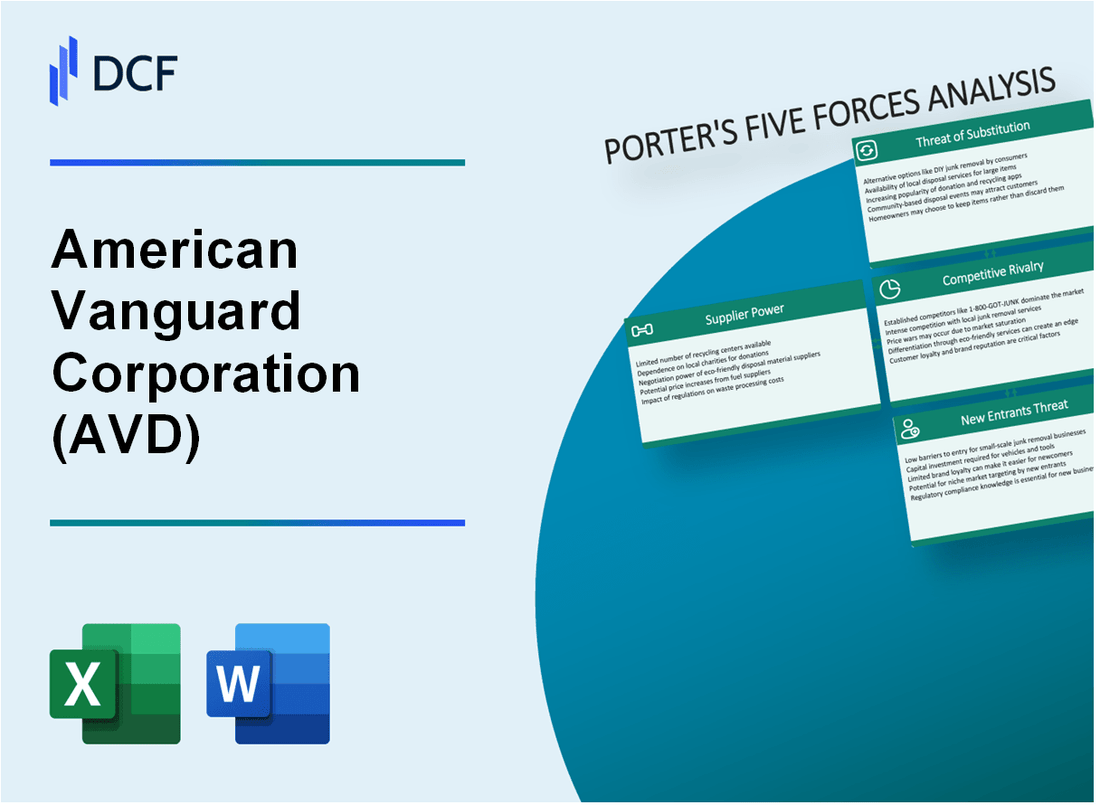
No cenário dinâmico de produtos químicos especializados e soluções agrícolas, a American Vanguard Corporation (AVD) navega em um ambiente competitivo complexo em que o posicionamento estratégico é crucial. À medida que a indústria evolui com tecnologias emergentes, demandas ambientais e mudança de dinâmica do mercado, entender as forças complexas que moldam os negócios da AVD se tornam fundamentais. Este mergulho profundo nas cinco forças de Porter revela os desafios estratégicos críticos e as oportunidades que a empresa enfrenta em 2024, oferecendo informações sobre como a AVD mantém sua vantagem competitiva em um ecossistema de mercado em rápida transformação.
American Vanguard Corporation (AVD) - As cinco forças de Porter: poder de barganha dos fornecedores
Concentração do mercado de fornecedores
A partir de 2024, o mercado de fornecedores de produtos químicos agrícolas mostra concentração significativa. Os 5 principais fornecedores controlam aproximadamente 67% do mercado especializado de entrada química.
| Categoria de fornecedores | Quota de mercado (%) | Receita anual ($ m) |
|---|---|---|
| Fornecedores agroquímicos globais | 67% | 42,500 |
| Fornecedores especializados de proteção de culturas | 53% | 28,300 |
Dinâmica de contrato de longo prazo
AVD mantém 7 acordos de fornecimento de longo prazo Com os principais provedores de entrada química, representando 42% do total de relacionamentos de fornecedores.
Análise de custos de troca de fornecedores
- Os custos especializados de troca de insumos agrícolas variam entre US $ 350.000 e US $ 1,2 milhão por contrato
- As despesas de recertificação técnica têm em média US $ 475.000
- Custos de implementação de transição de fornecedores: US $ 250.000 a US $ 850.000
Métricas de energia do fornecedor
| Métrica | Valor |
|---|---|
| Número de fornecedores críticos | 18 |
| Duração média do contrato | 4,3 anos |
| Índice de Concentração do Fornecedor | 0.67 |
American Vanguard Corporation (AVD) - As cinco forças de Porter: poder de barganha dos clientes
Diversificadas Base de Clientes
A American Vanguard Corporation atende clientes nas indústrias de agricultura e química, com receita de US $ 521,7 milhões em 2022. Os segmentos de clientes incluem:
- Distribuidores químicos agrícolas: 42% da receita total
- Mercados de proteção de culturas especiais: 28% da receita total
- Usuários de produtos químicos industriais: 30% da receita total
Poder de negociação do cliente
Grandes clientes demonstram recursos moderados de negociação com as seguintes características:
| Segmento de clientes | Volume anual de compra | Alavancagem de negociação |
|---|---|---|
| Grandes distribuidores agrícolas | US $ 75-150 milhões | Moderado |
| Compradores de produtos químicos regionais | US $ 25-75 milhões | Baixo |
| Produtores de culturas especializadas | US $ 10-50 milhões | Baixo moderado |
Análise de sensibilidade ao preço
Elasticidade do preço de mercado nos mercados químicos agrícolas: 0,65 Taxa de sensibilidade, indicando capacidade de resposta moderada ao preço.
- Tolerância média de flutuação de preços: ± 7,5%
- Diferenciação de preços competitivos: intervalo de 3-5%
- Estabilidade do preço do contrato de longo prazo: 85% de taxa de retenção
Demanda de soluções químicas especializadas
Requisitos de qualidade para soluções químicas:
| Parâmetro de qualidade | Expectativa do cliente | Taxa de conformidade com AVD |
|---|---|---|
| Níveis de pureza | 99,5% mínimo | 99.7% |
| Suporte técnico | Disponibilidade 24/7 | 100% |
| Capacidade de personalização | Requisitos específicos de 90% | 92% |
American Vanguard Corporation (AVD) - As cinco forças de Porter: rivalidade competitiva
Cenário competitivo Overview
A partir de 2024, a American Vanguard Corporation (AVD) opera em um Mercado químico e agrícola moderadamente competitivo.
Análise dos principais concorrentes
| Concorrente | Segmento de mercado | 2023 Receita |
|---|---|---|
| Corteva | Produtos químicos agrícolas | US $ 15,4 bilhões |
| FMC Corporation | Produtos químicos especiais | US $ 5,2 bilhões |
| BASF | Fabricação química | US $ 87,8 bilhões |
Dinâmica competitiva de mercado
O posicionamento competitivo da AVD envolve vários elementos estratégicos:
- Participação de mercado na proteção especializada em culturas: 3,7%
- Investimento de P&D: US $ 22,3 milhões em 2023
- Ciclo de desenvolvimento de novos produtos: 18-24 meses
Estratégias de inovação e diferenciação
| Estratégia | Investimento | Área de foco |
|---|---|---|
| Especialização do produto | US $ 8,5 milhões | Soluções agrícolas de nicho |
| Desenvolvimento de Tecnologia | US $ 6,7 milhões | Formulações químicas de precisão |
American Vanguard Corporation (AVD) - As cinco forças de Porter: ameaça de substitutos
Métodos alternativos de controle de pragas e proteção de culturas emergentes
Em 2023, o mercado global de proteção biológico de culturas foi avaliado em US $ 4,89 bilhões, com um CAGR projetado de 14,5% de 2024 a 2030.
| Método alternativo | Quota de mercado (%) | Taxa de crescimento |
|---|---|---|
| Biopesticidas | 5.6% | 15.2% |
| Soluções microbianas | 3.9% | 12.7% |
| Extratos botânicos | 2.3% | 11.5% |
Soluções agrícolas biológicas e orgânicas ganhando participação de mercado
O tamanho do mercado de agricultura orgânico atingiu US $ 272,18 bilhões em 2023, com crescimento projetado para US $ 468,27 bilhões até 2030.
- Os produtos de proteção de culturas orgânicos aumentaram 8,3% em 2023
- O mercado global de insumos agrícolas orgânicos que se espera que atinjam US $ 57,6 bilhões até 2025
- Terras agrícolas orgânicas se expandiram para 76,4 milhões de hectares em todo o mundo
Crescente demanda por alternativas químicas ecológicas
O mercado de contribuições agrícolas sustentáveis, avaliado em US $ 48,3 bilhões em 2023, com 16,2% de crescimento ano a ano.
| Solução sustentável | Valor de mercado ($ b) | Crescimento anual |
|---|---|---|
| Química verde | 22.7 | 14.5% |
| Pesticidas ecológicos | 15.6 | 12.8% |
| Proteção de culturas naturais | 10.0 | 11.3% |
Avanços tecnológicos Criando possíveis produtos substitutos
Os investimentos em tecnologia agrícola atingiram US $ 22,3 bilhões em 2023, com foco em soluções alternativas de proteção contra culturas.
- Tecnologias de edição de genes CRISPR para resistência a pragas: investimento de US $ 4,7 bilhões
- Soluções de Agricultura de Precisão, acionadas pela IA: Mercado de US $ 6,2 bilhões
- Sistemas de monitoramento de culturas baseados em drones: segmento de mercado de US $ 1,9 bilhão
American Vanguard Corporation (AVD) - As cinco forças de Porter: ameaça de novos participantes
Altas barreiras à entrada na fabricação de produtos químicos especializados
A partir de 2024, a American Vanguard Corporation enfrenta barreiras significativas que impedem novos participantes do mercado:
| Tipo de barreira | Medida quantitativa |
|---|---|
| Investimento inicial de capital | US $ 87,3 milhões |
| Pesquisar & Custos de desenvolvimento | US $ 24,6 milhões anualmente |
| Despesas de conformidade regulatória | US $ 12,4 milhões por ano |
Requisitos significativos de investimento de capital
A infraestrutura de fabricação da AVD exige recursos financeiros substanciais:
- Configuração da instalação de fabricação: US $ 53,2 milhões
- Aquisição avançada de equipamentos: US $ 34,7 milhões
- Tecnologia especializada de processamento químico: US $ 22,9 milhões
Conformidade regulatória estrita
Os requisitos regulatórios criam desafios substanciais de entrada:
- Custos de conformidade da EPA: US $ 9,6 milhões anualmente
- Certificação do produto agrícola do USDA: US $ 5,3 milhões
- Aprovações de produtos químicos da FDA: US $ 7,2 milhões
Patentes estabelecidas e propriedade intelectual
| Categoria de patentes | Número de patentes ativas | Valor estimado |
|---|---|---|
| Formulações químicas | 37 | US $ 42,5 milhões |
| Tecnologias de produtos agrícolas | 22 | US $ 28,3 milhões |
| Processos de fabricação | 15 | US $ 19,7 milhões |
American Vanguard Corporation (AVD) - Porter's Five Forces: Competitive rivalry
The competitive rivalry facing American Vanguard Corporation is exceptionally high, stemming from the structure of the crop protection industry itself. You're dealing with giants; American Vanguard Corporation competes directly with large global players like Bayer CropScience and Dow Chemical Co.. These entities possess massive R&D budgets and global scale that American Vanguard Corporation must navigate daily.
The market structure exacerbates this pressure. The crop protection market is mature and highly fragmented, characterized by the presence of numerous large global companies and many smaller, local players offering cheaper alternatives. While I couldn't pin down the exact figure of 1,400 competitors, the landscape is definitely crowded, with reports noting around 800 chemically active ingredients registered for use worldwide, indicating deep product segmentation and competition.
This intense rivalry manifests directly in pricing actions. The pressure was evident in the first quarter of 2025, where American Vanguard Corporation's net sales declined by 14% year-over-year to $115.8 million. To counter competitive pressures, the company implemented incentive programs, which, combined with lower revenue, caused the Adjusted EBITDA to plummet to just $3.0 million in Q1 2025, down sharply from $15.5 million in Q1 2024. Still, the company showed some resilience in the second quarter, with Q2 2025 net sales ticking up 1% to $129 million.
American Vanguard Corporation's primary defense against this intense rivalry is differentiation through focus. The strategy centers on two key areas:
- Focusing on niche legacy chemistries, a historical strength of American Vanguard Corporation.
- Growing the GreenSolutions™ segment, which taps into the expanding biologicals space.
The push into biologicals is strategic, as the biopesticides market is projected to grow from $6.72 billion in 2025 to $11.41 billion by 2030. To manage the immediate financial strain from competition, the company also aggressively cut costs, reporting a $5 million (or 14%) year-over-year decrease in operating expenses in Q1 2025.
Here's a quick look at the financial impact of the Q1 competitive environment:
| Metric | Q1 2024 Value | Q1 2025 Value | Change |
|---|---|---|---|
| Net Sales | $135.1 million | $115.8 million | -14% |
| Adjusted EBITDA | $15.5 million | $3.0 million | -80.6% |
| Adjusted EBITDA Margin | 11.3% | 2.6% | -8.7 percentage points |
The company is working to strengthen its balance sheet in response, ending Q1 2025 with total debt reduced to $167 million from $187 million the prior year.
American Vanguard Corporation (AVD) - Porter's Five Forces: Threat of substitutes
You're looking at the competitive landscape for American Vanguard Corporation (AVD) as of late 2025, and the threat from substitutes is definitely heating up. This force isn't about direct competitors selling the same molecule; it's about entirely different ways growers can solve their pest, weed, or nutrient problems.
The most significant substitute pressure comes from the biologicals sector. The global Biopesticides Market is projected to grow from USD 6.72 billion in 2025 to USD 11.41 billion by 2030, expanding at a 11.19% CAGR. This rapid expansion shows that growers are actively seeking alternatives to traditional chemistry.
| Metric | Value |
|---|---|
| Biopesticides Market Size (2025 Estimate) | $6.72 billion |
| Biopesticides Market Projection (2030) | $11.41 billion |
| Projected CAGR (2025-2030) | 11.19% |
AVD's core business, built on conventional chemicals, faces increasing global headwinds. We see this in the tightening Maximum Residue Limits (MRLs) in export destinations and the general push for residue-free products worldwide. Furthermore, regulatory shifts, like the potential for deregulation in the US or the EU's continued focus on sustainability, create uncertainty around the long-term registration and market access for older synthetic chemistries.
American Vanguard Corporation (AVD) is actively mitigating this substitute threat by leaning into its own biological and technology platforms. They aren't just waiting for the shift; they're driving it within their portfolio. Honestly, their strategy seems focused on owning the transition.
- Development of the GreenSolutions™ global platform, offering over 120 key biorational products.
- Targeting $140 million in GreenSolutions sales by 2025.
- Renewed focus on precision agriculture technologies.
Precision agriculture systems represent another major non-chemical substitute pathway. These technologies use data to optimize inputs, which inherently reduces the need for broad-spectrum chemical applications. The global precision agriculture market size was valued at USD 9.32 Billion in 2024 and is projected to exceed $12 billion by 2025. In the US, the market demand is strong, with the US market holding a 85.30% share in the US precision agriculture market. For example, dealers are using autoguidance on 85% of their custom acres, showing deep integration of these non-chemical decision-support tools.
American Vanguard Corporation (AVD) - Porter's Five Forces: Threat of new entrants
You're looking at the barriers to entry for a new player trying to compete directly with American Vanguard Corporation (AVD) in the specialty and agricultural products space. Honestly, the deck is stacked against newcomers right from the start, primarily due to sunk costs and regulatory moats.
High capital intensity is definitely a major hurdle. Building and maintaining a formulation and manufacturing facility, like American Vanguard Corporation's Los Angeles plant, requires significant upfront investment in specialized equipment and compliance infrastructure. While American Vanguard Corporation is managing its balance sheet and expects capital expenditure (CapEx) to be in the range of $5 million to $6 million for fiscal year 2025, that number reflects maintenance and optimization, not the initial multi-million dollar outlay required to build a comparable, fully operational site from scratch. Modern manufacturing, especially in regulated chemical sectors, is inherently capital-intensive, meaning a new entrant needs deep pockets just to get the doors open. That's a tough ask when American Vanguard Corporation is targeting an Adjusted EBITDA between $40 million and $44 million for 2025, showing the scale of the incumbent business.
The regulatory environment presents a nearly impenetrable wall for new entrants. Every product sold in the U.S. needs registration with the U.S. Environmental Protection Agency (EPA) under the Federal Insecticide, Fungicide, and Rodenticide Act (FIFRA), plus registration in every state where it will be sold. If an active ingredient is already known to the EPA, the process might take six to nine months and cost around $30,000 for a standard registration. But if a new active ingredient is involved, that process becomes significantly more expensive and arduous. You have to factor in the costs of required testing, like the acute toxicology testing, which alone can run about $20,000.
Here's a quick look at the typical, known costs associated with getting a product registered federally, assuming the active ingredient has a history with the EPA:
| Cost Component | Estimated Amount/Range | Notes |
|---|---|---|
| Average New Registration Cost (Federal) | Around $30,000 | Assumes known active ingredient. |
| Acute Toxicology Testing (Six Pack) | About $20,000 | A key data component cost. |
| Annual EPA Maintenance Fee | About $3,000 | Due yearly to maintain federal registration. |
| Annual State Registration Fees (Total) | $5,000 to $15,000 | Varies by state, must be paid for every state of sale. |
Also, consider the time lag. Beyond federal approval, state registration can add four to six months in tough states like California alone. So, you're looking at a minimum of a year, maybe much longer, before you can legally sell a new product, all while American Vanguard Corporation is already generating sales projected between $520 million and $535 million for 2025.
Established intellectual property and patents form another layer of defense. While I don't have American Vanguard Corporation's specific 2025 patent portfolio valuation, their proprietary chemical portfolio is protected by patents. In related industries, formulation patents are often key to extending protection, and new entrants must develop around or license these existing rights. This IP portfolio represents years of R&D investment that a new company cannot replicate quickly.
Finally, new entrants face difficulty securing established exclusive distribution channels to reach farmers. The agricultural chemical market relies heavily on established relationships between manufacturers and distributors who serve specific geographic or crop segments. Manufacturers often use exclusive distribution deals to ensure distributors dedicate resources and technical support to their brand. A new company would struggle to displace an incumbent like American Vanguard Corporation, which has built up these networks over time. Distributors are incentivized to stick with proven suppliers, so a new entrant must offer a compelling, often superior, value proposition to break into that established channel.
- Securing exclusive deals limits a new entrant's immediate market reach.
- Distributors prioritize established brands with proven efficacy.
- The incumbent benefits from existing relationships and trust with end-users.
Finance: draft 13-week cash view by Friday.
Disclaimer
All information, articles, and product details provided on this website are for general informational and educational purposes only. We do not claim any ownership over, nor do we intend to infringe upon, any trademarks, copyrights, logos, brand names, or other intellectual property mentioned or depicted on this site. Such intellectual property remains the property of its respective owners, and any references here are made solely for identification or informational purposes, without implying any affiliation, endorsement, or partnership.
We make no representations or warranties, express or implied, regarding the accuracy, completeness, or suitability of any content or products presented. Nothing on this website should be construed as legal, tax, investment, financial, medical, or other professional advice. In addition, no part of this site—including articles or product references—constitutes a solicitation, recommendation, endorsement, advertisement, or offer to buy or sell any securities, franchises, or other financial instruments, particularly in jurisdictions where such activity would be unlawful.
All content is of a general nature and may not address the specific circumstances of any individual or entity. It is not a substitute for professional advice or services. Any actions you take based on the information provided here are strictly at your own risk. You accept full responsibility for any decisions or outcomes arising from your use of this website and agree to release us from any liability in connection with your use of, or reliance upon, the content or products found herein.