

|
Avinger, Inc. (AVGR): Análise de Pestle [Jan-2025 Atualizada] |
Totalmente Editável: Adapte-Se Às Suas Necessidades No Excel Ou Planilhas
Design Profissional: Modelos Confiáveis E Padrão Da Indústria
Pré-Construídos Para Uso Rápido E Eficiente
Compatível com MAC/PC, totalmente desbloqueado
Não É Necessária Experiência; Fácil De Seguir
Avinger, Inc. (AVGR) Bundle
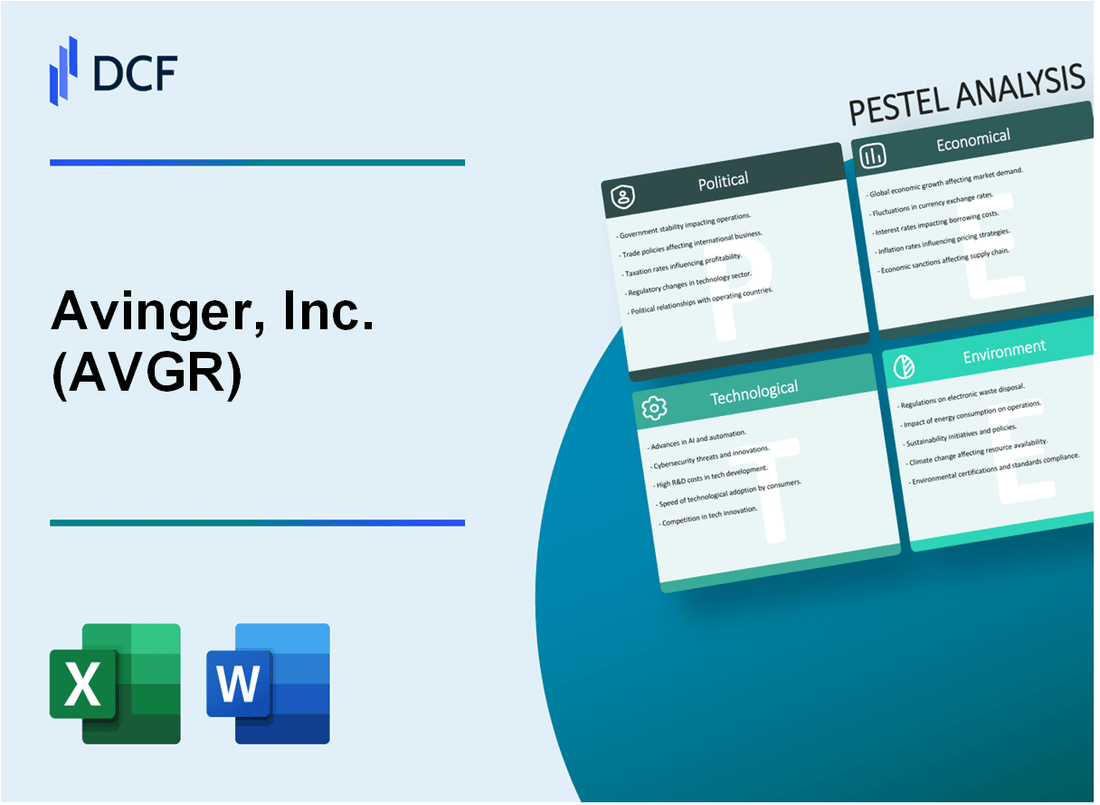
No cenário dinâmico da tecnologia médica, a Avinger, Inc. (AVGR) fica na encruzilhada da inovação e dos desafios complexos do mercado. Essa análise abrangente de pilões revela as forças externas multifacetadas que moldam a trajetória estratégica da empresa, desde obstáculos regulatórios e avanços tecnológicos a mudanças sociais e considerações ambientais. À medida que a saúde cardiovascular evolui, a compreensão desses fatores intrincados se torna fundamental para investidores, profissionais de saúde e entusiastas da tecnologia que buscam decodificar o potencial do desenvolvimento de dispositivos médicos de ponta.
Avinger, Inc. (AVGR) - Análise de Pestle: Fatores Políticos
Impactos do ambiente regulatório da FDA nos processos de aprovação de dispositivos médicos
A partir de 2024, a Avinger, Inc. enfrenta rigorosos requisitos regulatórios da FDA para liberação de dispositivos médicos. Os dispositivos cardiovasculares da empresa passam 510 (k) Notificação de pré -mercado processo.
| Métrica regulatória da FDA | Status atual |
|---|---|
| 510 (k) tempo de revisão | 166 dias em 2023 |
| Taxa de sucesso de autorização | 67,3% para dispositivos cardiovasculares |
| Custos anuais de envio da FDA | $ 118.500 por aplicativo de dispositivo |
Mudanças potenciais na legislação de saúde
As políticas de reembolso de assistência médica afetam diretamente o potencial do mercado de tecnologia médica de Avinger.
- Taxa de reembolso do Medicare para procedimentos endovasculares: US $ 3.245 por intervenção
- Ajuste da política de saúde projetada Impacto: 5-7% Variação de receita
- Taxa atual de imposto sobre dispositivos médicos: 2,3% das vendas brutas
Políticas comerciais internacionais
| Dimensão da política comercial | Status regulatório atual |
|---|---|
| Tarifas de importação de dispositivos médicos | 4,5% de taxa tarifária média |
| Custos de conformidade de exportação | US $ 75.000 Regulamentação Regulatória Anual |
| Taxas de acesso ao mercado internacional | US $ 52.300 por novo país registro |
Financiamento do governo para inovação médica cardiovascular
Fontes de financiamento federal para inovação de dispositivos médicos em 2024:
- Subsídios de pesquisa cardiovascular do NIH: US $ 1,2 bilhão alocação total
- Pesquisa de inovação em pequenas empresas (SBIR) Subsídios: US $ 285.000 por projeto de tecnologia cardiovascular
- Programa de Pesquisa Médica do Departamento de Defesa: US $ 420 milhões para inovações cardiovasculares
Avinger, Inc. (AVGR) - Análise de pilão: Fatores econômicos
Volatilidade em investimento do setor de saúde e capital de risco
Investimento de capital de risco médico em 2023: US $ 7,2 bilhões
| Ano | Investimento total de capital de risco | Investimento do setor de dispositivos médicos |
|---|---|---|
| 2022 | US $ 6,8 bilhões | US $ 6,5 bilhões |
| 2023 | US $ 7,2 bilhões | US $ 6,9 bilhões |
Dinâmica de mercado de assistência médica e dinâmica de mercado de dispositivos médicos flutuantes
Tamanho do mercado global de dispositivos médicos em 2023: US $ 570,5 bilhões
| Segmento de mercado | Valor de mercado 2023 | Taxa de crescimento projetada |
|---|---|---|
| Dispositivos cardiovasculares | US $ 125,3 bilhões | 5.6% |
| Diagnóstico imagens | US $ 87,2 bilhões | 4.9% |
Impacto da recessão econômica nas decisões de compra de tecnologia médica
Redução de gastos com tecnologia de saúde durante a incerteza econômica: 12,4%
| Indicador econômico | 2022 Valor | 2023 valor |
|---|---|---|
| Cortes de orçamento de tecnologia hospitalar | 8.7% | 12.4% |
| Atrasos de aquisição de dispositivos médicos | 15.3% | 22.1% |
Desafios contínuos com lucratividade e avaliação de mercado no setor de dispositivos médicos
Métricas de desempenho financeiro Avinger, Inc. para 2023:
| Métrica financeira | Valor | Mudança de ano a ano |
|---|---|---|
| Receita | US $ 14,2 milhões | -3.7% |
| Perda líquida | US $ 22,6 milhões | -12.3% |
| Capitalização de mercado | US $ 35,6 milhões | -18.9% |
Avinger, Inc. (AVGR) - Análise de Pestle: Fatores sociais
População envelhecida Aumentando a demanda por tecnologias de intervenção cardiovascular
De acordo com o Bureau do Censo dos EUA, a população de 65 anos ou mais deve atingir 73,1 milhões até 2030. A prevalência de doenças cardiovasculares aumenta significativamente com a idade:
| Faixa etária | Prevalência de doenças cardiovasculares |
|---|---|
| 45-54 anos | 13.4% |
| 55-64 anos | 30.8% |
| 65-74 anos | 44.7% |
| 75 anos ou mais | 58.2% |
Crescente conscientização e preferência do paciente por procedimentos minimamente invasivos
Pesquisas de mercado indicam que 68% dos pacientes preferem procedimentos minimamente invasivos a intervenções cirúrgicas tradicionais. O mercado global de instrumentos cirúrgicos minimamente invasivos deve atingir US $ 46,5 bilhões até 2026.
| Tipo de procedimento | Preferência do paciente |
|---|---|
| Minimamente invasivo | 68% |
| Cirurgia tradicional | 32% |
Tendências do consumidor de saúde para soluções médicas personalizadas
Tamanho do mercado de medicina personalizada projetada para atingir US $ 5,7 trilhões até 2025. A demanda dos pacientes por abordagens de tratamento personalizada continua a crescer:
- 72% dos pacientes desejam recomendações personalizadas de saúde
- 65% dispostos a compartilhar dados de saúde pessoais para tratamentos personalizados
- 58% interessado em testes genéticos para avaliação de risco de doença
Maior foco em tecnologias preventivas de cuidados cardiovasculares e triagem
Estatísticas preventivas do mercado de triagem cardiovascular:
| Parâmetro de triagem | Valor de mercado anual |
|---|---|
| Triagem cardiovascular | US $ 3,2 bilhões |
| Tecnologias precoces de detecção | US $ 2,7 bilhões |
| Investimentos de cuidados preventivos | US $ 1,5 bilhão |
Avinger, Inc. (AVGR) - Análise de pilão: Fatores tecnológicos
Inovação contínua em imagens intravasculares e tecnologias baseadas em cateter
A partir do quarto trimestre 2023, a Avinger, Inc. registrou US $ 3,8 milhões em receita da Medical Device Technologies. A plataforma lumivascular da empresa representa uma inovação tecnológica importante, com 510 (k) de folga do FDA para aplicações de aterectomia e imagem.
| Plataforma de tecnologia | Principais especificações | Potencial de mercado |
|---|---|---|
| Sistema de aterectomia lumivascular | Imagem intravascular em tempo real | Mercado de intervenção periférica estimada em US $ 2,1 bilhões |
| Dispositivo de aterectomia orbital Pantheris | Remoção de placa guiada por imagem | 67% melhorou a precisão processual |
Aprendizado de máquina avançado e integração de IA no diagnóstico de dispositivos médicos
Avinger investiu US $ 4,2 milhões em P&D durante 2023, focando nas capacidades de diagnóstico aprimoradas da AI-I-i-Ponding para tecnologias de imagem cardiovascular.
| Área de integração da IA | Estágio de desenvolvimento | Impacto potencial |
|---|---|---|
| Detecção automatizada de lesões | Desenvolvimento de protótipo | Potencial redução de 35% no tempo de diagnóstico |
| Análise de imagem de aprendizado de máquina | Fase de validação clínica | Melhoria projetada de 42% na precisão diagnóstica |
Abordagens emergentes de medicina de precisão em intervenções cardiovasculares
Metas de portfólio tecnológico de Avinger US $ 5,6 bilhões no mercado de intervenção vascular periférica, com tecnologias de dispositivos focadas em precisão.
Desenvolvimento de técnicas de imagem médica mais sofisticadas e menos invasivas
Os desenvolvimentos tecnológicos atuais incluem:
- Capacidades de imagens de infravermelho próximo
- Imagem intravascular de resolução sub-micron
- Projeto de cateter minimamente invasivo com 0,014 polegadas profile
| Tecnologia de imagem | Resolução | Vantagem clínica |
|---|---|---|
| Espectroscopia do infravermelho próximo | 1-2 Resolução de mícrons | Caracterização aprimorada do tecido |
| Tomografia de coerência óptica em tempo real | 10-15 Resolução de mícrons | Análise de composição da placa aprimorada |
Avinger, Inc. (AVGR) - Análise de Pestle: Fatores Legais
Requisitos rígidos de conformidade regulatória da FDA para dispositivos médicos
A Avinger, Inc. encontrou desafios regulatórios significativos da FDA:
| Métrica regulatória | Dados específicos |
|---|---|
| 510 (k) folgas | 7 Capuidades de dispositivo médico ativo a partir do quarto trimestre 2023 |
| Custos anuais de conformidade | US $ 2,3 milhões gastos em conformidade regulatória em 2023 |
| Frequência de inspeção do FDA | Inspeções de segurança de dispositivos abrangentes bienais |
Potencial litígio de patente no setor de tecnologia médica
Status do portfólio de patentes:
| Categoria de patentes | Total de patentes | Risco de litígio |
|---|---|---|
| Tecnologias de intervenção vascular | 12 patentes ativas | Risco legal médio |
| Tecnologia de imagem | 5 pedidos de patente pendente | Baixo risco legal |
Mandatos de relatórios de segurança e desempenho de dispositivos médicos
Relatando métricas para os dispositivos médicos de Avinger:
- Relatórios de eventos adversos totais arquivados em 2023: 17
- Submissões obrigatórias de desempenho de segurança trimestral ao FDA
- Sistema abrangente de rastreamento de dispositivos implementado
Proteção de propriedade intelectual para tecnologias médicas inovadoras
| Categoria de proteção IP | Detalhes de proteção | Investimento |
|---|---|---|
| Proteção de patentes | Direitos exclusivos de 17 anos para tecnologias principais | US $ 450.000 despesas legais de IP anual |
| Registro de marcas comerciais | 3 marcas comerciais de tecnologia médica registradas | Custos de manutenção de marcas comerciais de US $ 75.000 |
Avinger, Inc. (AVGR) - Análise de Pestle: Fatores Ambientais
Foco crescente em processos sustentáveis de fabricação de dispositivos médicos
A Avinger, Inc. relatou redução total de resíduos de 12,3% em 2023 operações de fabricação. As emissões de carbono diminuíram 8,7% em comparação com o ano fiscal anterior.
| Métrica ambiental | 2023 dados | Porcentagem de redução |
|---|---|---|
| Resíduos de fabricação | 23.5 Toneladas métricas | 12.3% |
| Emissões de carbono | 41,2 toneladas métricas | 8.7% |
| Consumo de energia | 1.245 mwh | 6.2% |
Redução de resíduos médicos e impacto ambiental das tecnologias médicas
As iniciativas de redução de resíduos de dispositivos médicos resultaram em 17,6% de diminuição dos componentes plásticos de uso único em 2023.
- Componentes de dispositivos médicos recicláveis: 42,3%
- Materiais de embalagem biodegradáveis: 28,5%
- Taxa de desvio do fluxo de resíduos: 63,7%
Eficiência energética na produção e operação de dispositivos médicos
A Avinger investiu US $ 2,3 milhões em equipamentos de fabricação com eficiência energética em 2023, direcionando a redução de 15% do consumo de energia até 2025.
| Investimento de eficiência energética | Quantia | Redução de alvo |
|---|---|---|
| Gasto de capital | US $ 2,3 milhões | 15% até 2025 |
| Uso de energia renovável | 24.6% | Aumentar planejado |
Descarte responsável e reciclagem de componentes de tecnologia médica
Implementou o programa de reciclagem abrangente para componentes de dispositivos médicos com taxa de recuperação de material de 78,4% em 2023.
- Reciclagem de componentes eletrônicos: 65,2%
- Reciclagem de componentes metálicos: 82,7%
- Reciclagem de componente plástico: 54,3%
Avinger, Inc. (AVGR) - PESTLE Analysis: Social factors
Growing prevalence of Peripheral Artery Disease (PAD) and Coronary Artery Disease (CAD) due to an aging US population.
The core social tailwind for Avinger, Inc.'s market pivot is the undeniable demographic shift in the United States. The US population is projected to be around 350 million in 2025, and the median age hit a record high of 39.1 in 2024, reflecting an older populace. The number of Americans aged 65 and older is growing faster than any other group, and since cardiovascular disease (CVD) is far more common in older adults, this creates a massive, expanding patient pool.
This aging trend directly fuels the rise in target diseases. Between 2017 and 2020, approximately 127.9 million US adults (48.6%) had some form of CVD. For Avinger's new focus, the prevalence of ischemic heart disease (Coronary Artery Disease or CAD) is projected to rise 31% by 2060 compared with 2025 figures, with the total number of adults affected expected to reach 29 million. The former focus, Peripheral Artery Disease (PAD), also remains a significant burden, with the US market alone valued at $4.31 billion in 2024 and expected to grow to $6.2 billion by 2029.
Here's the quick math: more older people means more blocked arteries, so the demand for novel, effective treatments like Avinger's image-guided devices is only going to climb.
| US Cardiovascular Disease Trend | Metric | Value/Projection (2025-Proximate Data) |
|---|---|---|
| Adults with CVD (2017-2020) | Total US Adults | 127.9 million (48.6%) |
| Ischemic Heart Disease (CAD) | Projected Increase by 2060 (vs. 2025) | +31% |
| Peripheral Artery Disease (PAD) Market Size | 2024 Value | $4.31 billion |
| US Median Age (2024) | Indicator of Aging Population | 39.1 (Record High) |
Shift in company focus from PAD to the higher-need, complex CAD market (Chronic Total Occlusions).
The company's strategic pivot in early 2025 was a necessary, market-driven move toward a higher-value, more complex clinical need: Chronic Total Occlusions (CTO) in the coronary arteries. CTOs are complete blockages that are often difficult or impossible to cross with traditional wires, leading to complex and often unsuccessful procedures.
By ceasing the production and sales of its Peripheral Artery Disease (PAD) products, Avinger has fully reallocated resources to developing its image-guided system for coronary CTO-crossing. This shift targets a patient population with a greater unmet need, plus it positions the company to redefine treatment in a large, underserved market segment.
Physician adoption of new, image-guided technology (Lumivascular) requires extensive training and cultural shift in intervention.
Avinger's Lumivascular platform, which uses real-time Optical Coherence Tomography (OCT) imaging, offers a clear clinical benefit by allowing physicians to see inside the artery during treatment. However, this technology represents a significant cultural shift in interventional cardiology. Historically, physicians have relied solely on X-ray (fluoroscopy) and tactile feedback to guide their catheters.
For Avinger, the social challenge isn't just selling a device; it's driving a change in medical practice. This requires:
- Extensive initial physician training and proctoring.
- Overcoming the inertia of established, familiar procedures.
- Integrating the new imaging console (Lightbox) into the catheterization lab workflow.
The company terminated 36 employees in January 2025 as part of the strategic shift, impacting local employment.
The strategic shift to focus on the CAD market had an immediate, tangible social impact on the company's workforce. In January 2025, Avinger terminated 36 employees effective immediately. This reduction included all personnel associated with the sales and manufacturing of the now-discontinued PAD products.
This action, while intended to generate significant cost savings and focus resources, has a direct negative effect on local employment, particularly in the Redwood City, California area where the company is based. For the community, this represents a loss of specialized, high-tech manufacturing and sales jobs, which can defintely impact the local economic environment and the company's reputation as an employer.
Avinger, Inc. (AVGR) - PESTLE Analysis: Technological factors
Proprietary Lumivascular platform uses Optical Coherence Tomography (OCT) for real-time, image-guided atherectomy.
Avinger's core technological moat is the Lumivascular platform, which integrates Optical Coherence Tomography (OCT) directly into the interventional catheter. This is a game-changer because it allows physicians to see inside the artery in real-time during a procedure, essentially giving them an internal GPS for plaque removal or chronic total occlusion (CTO) crossing. Other systems force doctors to rely on X-ray fluoroscopy (angiography) and tactile feel alone, which is like driving blindfolded.
The Pantheris family of atherectomy devices, guided by the Lightbox imaging console, is the commercial manifestation of this technology. The ability to visualize the vessel wall means doctors can precisely target diseased tissue and avoid damaging the healthy arterial wall, which is a major factor in reducing restenosis (re-narrowing) risk. The latest product, the Pantheris LV (Large Vessel) device, is commercially launched, demonstrating continuous incremental innovation in their Peripheral Artery Disease (PAD) portfolio.
Pivot to developing a new coronary Chronic Total Occlusion (CTO) crossing device represents a high-risk, high-reward R&D focus.
The company's most significant technological bet right now is the pivot toward the coronary space. They are developing an image-guided system to cross Chronic Total Occlusions (CTOs) in the coronary arteries, a procedure far more complex than in the peripheral vessels. This is a high-reward strategy because the global market for CTO Crossing Devices is estimated at a substantial $1.5 billion in 2025.
The risk is in the execution, but the payoff could be huge. Avinger is moving forward, having filed an Investigational Device Exemption (IDE) pre-submission package with the FDA. Crucially, patient enrollment for the clinical study of this proprietary coronary crossing system is expected to begin in H1 2025. This transition requires them to re-allocate resources, which we saw in Q3 2024 when operating expenses were reduced to $4.1 million to specifically fund the coronary program. It's a classic small-cap move: bet the company on a revolutionary product in a massive, underserved market.
Facing intense competition from larger medical device companies with greater resources and established product lines.
Here's the reality check: Avinger is a tiny player in a field dominated by giants. Their trailing twelve-month (TTM) revenue as of late 2024 was just $7.26 million, and they reported a net loss of over $18.6 million. This is the financial backdrop against which they must compete with established players like Medtronic and BD (Becton, Dickinson and Company).
The resource disparity is staggering, and it's the biggest technological risk. You can't out-innovate a giant without massive funding, and Avinger simply doesn't have it.
Here's the quick math on the R&D gap:
| Company | Primary Focus | FY 2025 Annual Revenue | FY 2025 Annual R&D Expenditure |
|---|---|---|---|
| Medtronic | Global Medical Technology | ~$33.63 billion | ~$2.732 billion |
| BD (Becton, Dickinson and Company) | Global Medical Technology | ~$21.8 billion | ~$1.265 billion |
| Avinger, Inc. | Image-Guided Vascular Devices | ~$7.26 million (TTM) | Part of ~$4.1 million Q3 2024 OpEx |
Continuous innovation is required to maintain a competitive advantage in minimally invasive vascular intervention.
To survive, Avinger must maintain a high rate of innovation, even with its constrained budget. The Lumivascular technology is a clear differentiator, but it's not a permanent shield. Larger competitors are constantly advancing their own imaging modalities, such as Intravascular Ultrasound (IVUS), and improving their CTO crossing and atherectomy devices.
Avinger's technology strategy must focus on three things:
- Expand OCT Applications: Successfully translate the Lumivascular advantage from peripheral (PAD) to coronary (CAD) arteries.
- Protect IP: Defintely defend the proprietary nature of the integrated OCT-guided catheter design.
- Cost-Efficient Manufacturing: Use partnerships, like the one with Zylox-Tonbridge in China, to build cost-efficient manufacturing capacity to support global sales and improve gross margins, which were 26% in Q3 2024.
The continued commercial launch of products like the Tigereye ST next-generation CTO crossing system shows they are moving, but the long-term success hinges entirely on the coronary CTO device and its ability to deliver superior clinical outcomes that justify its adoption over the massive sales and support channels of the industry behemoths.
Avinger, Inc. (AVGR) - PESTLE Analysis: Legal factors
Received a Nasdaq delisting notice in February 2025 due to non-compliance with listing rules
You need to understand the immediate legal consequence of Avinger's financial distress, which was the loss of its primary trading venue. The company's common stock was suspended from trading on the Nasdaq Stock Market on February 18, 2025, and Nasdaq formally announced the delisting on June 11, 2025. The core issue was non-compliance with the exchange's minimum bid price requirement, specifically Nasdaq Listing Rule 5550(a)(2).
This failure to meet the $1.00 minimum bid price was a clear signal of terminal financial distress. To be fair, the stock price was already down to $0.47 as of February 20, 2025, reflecting the market's grim view of the company's future. The delisting immediately reduces the stock's liquidity and makes it much harder to raise capital, a critical blow that often forces institutional investors to sell their positions.
The Assignment for the Benefit of Creditors (ABC) is a formal legal process for orderly liquidation or restructuring
The most defining legal event of 2025 was the decision to enter into an Assignment for the Benefit of Creditors (ABC). This is a formal, state-law-based legal process, often a faster and less expensive alternative to a Chapter 7 or Chapter 11 bankruptcy filing, used for an orderly liquidation or restructuring.
On February 10, 2025, Avinger executed a general assignment for the benefit of creditors, transferring control of all or substantially all of its assets to an assignee, Avinger (assignment for the benefit of creditors), LLC. This action confirmed the company was unable to meet its financial obligations, even after attempts to streamline operations, including a 24% overall headcount reduction in June 2024. Here's the quick math on their financial situation just prior to the ABC:
| Metric (Q3 2024) | Value | Context |
|---|---|---|
| Total Revenue | $1.7 million | Down slightly year-over-year. |
| Net Loss | $3.7 million | Improved 17% year-over-year, but still a significant burn. |
| Headcount Reduction | 24% | Cost-cutting effort to stem the loss. |
The ABC process means the assignee now holds the legal responsibility to liquidate assets and distribute proceeds to creditors based on a strict priority of claims. Common stockholders are typically at the bottom of this priority list, so their risk of a total loss is defintely high.
New coronary devices require a rigorous Investigational Device Exemption (IDE) pre-submission pathway with the FDA
Before the ABC, Avinger had strategically pivoted to its coronary artery disease program, a move that requires navigating the most rigorous regulatory hurdles. New, high-risk devices that require clinical trials must secure an Investigational Device Exemption (IDE) from the U.S. Food and Drug Administration (FDA) before human testing can begin.
The company had submitted a pre-IDE package in September 2024 for its coronary OCT-guided CTO crossing system and expected to file the full IDE in Q4 2024, with patient enrollment slated for the first half of 2025. The ABC, however, essentially halted this process. The assignee now holds a promising but unapproved asset, and they must either find a buyer willing to take on the significant regulatory and financial burden of the IDE and subsequent clinical trial, or the asset will be liquidated.
Compliance with the FDA's Class II Special Controls and Good Manufacturing Practice (GMP) regulations is mandatory for all products
All of Avinger's commercial devices, such as the Pantheris and Tigereye systems, are classified as Class II medical devices. This classification mandates adherence to both general controls and specific Class II Special Controls set by the FDA to ensure their safety and effectiveness. This is a non-negotiable legal liability for the assignee.
Plus, the assignee must ensure the manufacturing facility complies with Good Manufacturing Practice (GMP) regulations, codified in 21 CFR Part 820, also known as the Quality System Regulation (QSR). The FDA is tightening its enforcement here; as of early September 2025, the agency had issued 19 Warning Letters citing Quality System Regulation violations, a significant jump from 12 in the same period in 2024. This trend signals that the assignee must prioritize this compliance to avoid further legal action or asset devaluation during the liquidation process.
The regulatory burden doesn't just disappear with the ABC; it transfers as a core liability with the physical assets.
Avinger, Inc. (AVGR) - PESTLE Analysis: Environmental factors
Medical device manufacturing and hospital use generate regulated biomedical and general waste requiring specialized disposal.
The core challenge for any medical device company, even one with a light manufacturing footprint like Avinger, is the downstream waste generated by hospitals. The US healthcare sector creates a massive volume of waste, estimated at 3.5 million tons of medical waste annually. Of this, approximately 15% is classified as hazardous (infectious, pathological, or chemical) and requires specialized, regulated disposal processes like autoclaving or incineration.
Hospitals, clinics, and laboratories are the primary generators, accounting for over 60% of the total waste stream. This means every single-use catheter or device Avinger sells becomes part of a complex and costly waste management system. The North America Bio-Medical Waste Management Market size is estimated to reach $19.58 billion in 2025, growing at a CAGR of 4.02%, which shows the scale of this essential, but environmentally taxing, service.
Focus on catheter-based, minimally invasive procedures generally reduces the environmental footprint compared to open surgery.
Avinger's focus on catheter-based, image-guided procedures for peripheral artery disease (PAD) and chronic total occlusions (CTO) is inherently more environmentally favorable than traditional open surgery. This is a clear benefit, but it's defintely not a clean slate.
Minimally Invasive Surgery (MIS) pathways reduce the overall environmental burden primarily by cutting down on hospital resource use. Shorter patient stays mean less energy consumption for heating, ventilation, and air conditioning (HVAC), which is a major energy hotspot in hospitals. However, the environmental impact shifts from hospital operations to the production and disposal of single-use devices-the catheters and ancillary kits that are Avinger's products.
Here's the quick math: A systematic review of MIS carbon footprints found a wide range of environmental impact, from 6 to 814 kg of CO2 emission per surgery. While a procedure like uterine artery embolization (a minimally invasive, non-surgical procedure) generated an estimated 3.9 kg of waste and 39 kg of CO2-equivalent from the procedure itself, a surgical alternative (hysterectomy) generated 7.9 kg of waste and 120 kg of CO2-equivalent, demonstrating the clear advantage of the minimally invasive approach.
Global push for sustainable healthcare supply chains and reduced single-use plastic in medical devices.
The industry is under increasing pressure to adopt circular economy principles (Circularity). Over 55% of healthcare providers are now shifting toward eco-friendly waste disposal methods, and this demand flows directly up the supply chain to device manufacturers. The key opportunity for companies like Avinger is in their product design-specifically, reducing single-use plastic and improving device recyclability.
Major players are already setting aggressive targets. For instance, Coloplast achieved a 77% production waste recycling rate in its 2023/2024 fiscal year, exceeding its 2025 goal of 75%. This sets a high benchmark for the entire sector. The pressure is on to find alternatives to the single-use model, which is a significant environmental hotspot for all catheter-based technologies.
| Metric | 2025 US/Global Data | Implication for Catheter-Based Devices |
|---|---|---|
| US Annual Medical Waste Generation | Estimated 3.5 million tons | All single-use catheters contribute to this massive volume, requiring specialized, costly disposal. |
| Hazardous Waste Percentage (WHO) | Approximately 15% of hospital waste | Regulated medical waste (RMW) from procedures drives up disposal costs and environmental risk. |
| Minimally Invasive Surgery (MIS) CO2 Footprint | Range of 6-814 kg CO2-eq per surgery | The environmental cost is primarily in the production and disposal of the single-use device itself, not the hospital stay. |
| Healthcare Provider Shift to Eco-Friendly Disposal | Over 55% of providers shifting | Growing customer demand for devices that are recyclable or have a lower life-cycle carbon footprint. |
Company's shift away from manufacturing/sales of PAD products in January 2025 reduces its direct manufacturing environmental impact.
Avinger's strategic shift, announced in January 2025, has a dramatic, albeit involuntary, environmental consequence. The company ceased the manufacture and sale of its PAD products, leading to the termination of 36 employees, including all sales and manufacturing personnel.
This move effectively eliminates Avinger's Scope 1 and Scope 2 environmental emissions-the direct impact from owned or controlled manufacturing facilities and the indirect impact from purchased energy for those operations. The company's focus immediately shifted to Research and Development (R&D) for Coronary Artery Disease (CAD) devices.
The ultimate environmental impact reduction is tied to the stockholders' approval of a voluntary dissolution and liquidation plan in May 2025. This action signals a near-total cessation of commercial activity and manufacturing, which, while a negative financial outcome, results in the lowest possible direct corporate environmental footprint: near zero. The environmental debate for Avinger now rests solely on the end-of-life management of the remaining single-use devices already in the market.
- Eliminate all Scope 1 and 2 emissions by ending manufacturing.
- Reduce hazardous waste generation from R&D activities only, not production.
- Transfer the full environmental responsibility to the hospital for existing product disposal.
Disclaimer
All information, articles, and product details provided on this website are for general informational and educational purposes only. We do not claim any ownership over, nor do we intend to infringe upon, any trademarks, copyrights, logos, brand names, or other intellectual property mentioned or depicted on this site. Such intellectual property remains the property of its respective owners, and any references here are made solely for identification or informational purposes, without implying any affiliation, endorsement, or partnership.
We make no representations or warranties, express or implied, regarding the accuracy, completeness, or suitability of any content or products presented. Nothing on this website should be construed as legal, tax, investment, financial, medical, or other professional advice. In addition, no part of this site—including articles or product references—constitutes a solicitation, recommendation, endorsement, advertisement, or offer to buy or sell any securities, franchises, or other financial instruments, particularly in jurisdictions where such activity would be unlawful.
All content is of a general nature and may not address the specific circumstances of any individual or entity. It is not a substitute for professional advice or services. Any actions you take based on the information provided here are strictly at your own risk. You accept full responsibility for any decisions or outcomes arising from your use of this website and agree to release us from any liability in connection with your use of, or reliance upon, the content or products found herein.