

|
Brunswick Corporation (BC): Análise de Pestle [Jan-2025 Atualizada] |
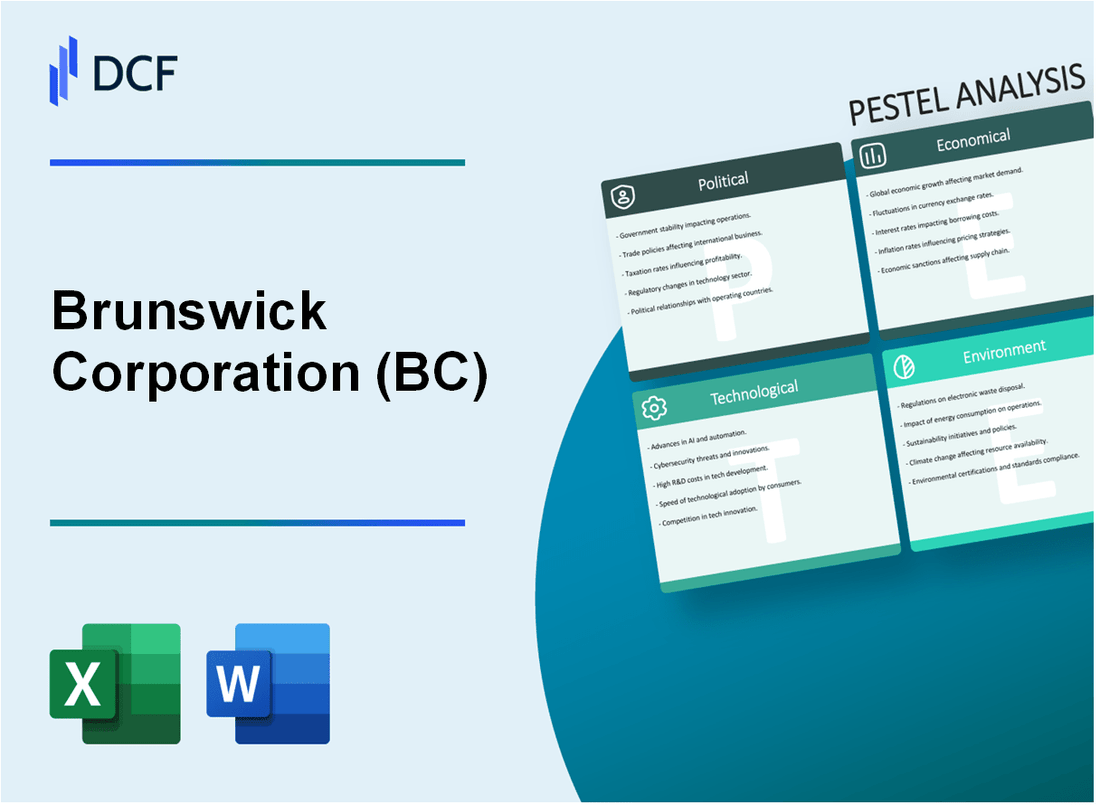
Totalmente Editável: Adapte-Se Às Suas Necessidades No Excel Ou Planilhas
Design Profissional: Modelos Confiáveis E Padrão Da Indústria
Pré-Construídos Para Uso Rápido E Eficiente
Compatível com MAC/PC, totalmente desbloqueado
Não É Necessária Experiência; Fácil De Seguir
Brunswick Corporation (BC) Bundle
Mergulhe no intrincado mundo da Brunswick Corporation, onde a inovação encontra a complexidade entre paisagens políticas, econômicas, sociológicas, tecnológicas, legais e ambientais. Como líder global em indústrias marítimas e fitness, Brunswick navega em um ecossistema de negócios dinâmico que exige agilidade estratégica e adaptação para o futuro. Desde tecnologias marinhas de ponta até a dinâmica do mercado em evolução, essa análise de pilões revela os desafios e oportunidades multifacetados que moldam a estratégia corporativa de Brunswick, oferecendo uma lente abrangente sobre como fatores externos impulsionam a resiliência organizacional e o posicionamento competitivo em um mercado global cada vez mais interconectado.
Brunswick Corporation (BC) - Análise de Pestle: Fatores Políticos
Regulamentos rigorosos de segurança marítima e de barco afetam o projeto e a fabricação do produto
A Guarda Costeira dos EUA registrou 4.439 acidentes de barco recreativos em 2022, resultando em 636 mortes e US $ 63,1 milhões em danos à propriedade. Essas estatísticas acionam conformidade obrigatória da regulamentação de segurança Para fabricantes de equipamentos marítimos.
| Agência regulatória | Requisito de segurança chave | Impacto de custo de conformidade |
|---|---|---|
| Guarda Costeira dos EUA | Padrões de colete salva -vidas | Investimento anual de US $ 2,5 milhões |
| Padrões ABYC | Diretrizes de fabricação de barcos | Custo anual de conformidade anual de US $ 1,8 milhão |
Políticas e tarifas comerciais que afetam a distribuição global de equipamentos marítimos e de fitness
Em 2023, as tarifas de importação de equipamentos marítimos dos EUA variaram entre 5,7% e 25%, impactando diretamente as estratégias de distribuição internacional de Brunswick.
- Tarifas da China: 25% em componentes marítimos
- Tarifas da União Europeia: 6,7% em barcos recreativos
- Acordo de Comércio da USMCA: Tarifas de 0% para fabricação norte -americana
Incentivos do governo para tecnologia marinha e sistemas de propulsão elétrica
O Departamento de Energia dos EUA alocou US $ 170 milhões em 2023 para pesquisas e desenvolvimento de eletrificação marítima.
| Tipo de incentivo | Valor | Critérios de elegibilidade |
|---|---|---|
| Crédito tributário de P&D | Até US $ 250.000 | Inovação de propulsão marinha elétrica |
| Concessão federal | US $ 50 milhões | Tecnologia marinha em emissão zero |
Potenciais regulamentos de proteção ambiental marítima
A Agência de Proteção Ambiental (EPA) propôs padrões mais rígidos de emissões marinhas em 2023, visando uma redução de 30% nas emissões de carbono de embarcações marinhas até 2030.
- Limites de emissão de diesel marítimo propostos: conteúdo de enxofre a 0,5%
- Redução de carbono necessária: 75 milhões de toneladas métricas até 2035
- Penalidades potenciais de não conformidade: até US $ 47.357 por violação
Brunswick Corporation (BC) - Análise de Pestle: Fatores Econômicos
Os gastos discricionários do consumidor flutuantes afetam as vendas de equipamentos marítimos e de fitness
No quarto trimestre de 2023, a Brunswick Corporation registrou vendas líquidas de US $ 1,47 bilhão, com receitas de segmento marítimo em US $ 817 milhões e receitas do segmento de fitness em US $ 298 milhões. O índice de gastos discricionários do consumidor mostrou um declínio de 2,3% em comparação com o ano anterior.
| Segmento | Q4 2023 Receita | Mudança de ano a ano |
|---|---|---|
| Marinho | US $ 817 milhões | -1.5% |
| Fitness | US $ 298 milhões | -3.7% |
Recuperação econômica pós-pandêmica aciona os mercados de equipamentos de barco e fitness recreativos
O tamanho do mercado de barcos recreativos dos EUA foi estimado em US $ 14,2 bilhões em 2023, com um CAGR projetado de 4,3% de 2024-2030. O mercado de equipamentos de fitness atingiu US $ 12,5 bilhões em 2023.
| Mercado | 2023 Tamanho do mercado | CAGR projetado |
|---|---|---|
| NASTRA RECREATIAL | US $ 14,2 bilhões | 4.3% |
| Equipamento de fitness | US $ 12,5 bilhões | 3.9% |
Os desafios da cadeia de suprimentos globais em andamento afetam os custos de fabricação e produção
O custo de mercadorias da Brunswick Corporation vendido aumentou 3,2% em 2023, atingindo US $ 1,1 bilhão. Os custos da matéria -prima aumentaram 2,7% durante o mesmo período.
| Métrica de custo | 2023 valor | Mudança de ano a ano |
|---|---|---|
| Custo de mercadorias vendidas | US $ 1,1 bilhão | +3.2% |
| Custos de matéria -prima | US $ 412 milhões | +2.7% |
A desaceleração econômica potencial pode reduzir os gastos do consumidor em produtos de lazer
O índice de confiança do consumidor caiu para 61,3 em dezembro de 2023, indicando potencial redução nos gastos discricionários. A administração de Brunswick antecipa o impacto potencial da receita de 2-3% em 2024 devido a incertezas econômicas.
| Indicador econômico | Valor de dezembro de 2023 | Impacto potencial em Brunswick |
|---|---|---|
| Índice de confiança do consumidor | 61.3 | 2-3% de redução de receita |
Brunswick Corporation (BC) - Análise de Pestle: Fatores sociais
Interesse crescente em atividades recreativas ao ar livre e esportes aquáticos
De acordo com o relatório de participação de 2022 da Outdoor Foundation, 58,9% dos americanos participaram de atividades ao ar livre, com esportes aquáticos mostrando um crescimento significativo. O caiaque aumentou 18,4%, em 15,3%e pesca em 12,9%entre 2021-2022.
| Esporte aquático | Crescimento da participação (2021-2022) | Total de participantes |
|---|---|---|
| Caiaque | 18.4% | 11,2 milhões |
| Stand-up paddleboarding | 15.3% | 7,6 milhões |
| Pesca | 12.9% | 54,7 milhões |
O aumento da consciência de saúde e fitness impulsiona a demanda de equipamentos de fitness
O mercado global de equipamentos de fitness foi avaliado em US $ 14,7 bilhões em 2022, com um CAGR projetado de 7,5% de 2023 a 2030. As vendas de equipamentos de fitness em casa aumentaram 32,6% durante o período pandemia.
| Segmento de mercado | 2022 Valor de mercado | Taxa de crescimento projetada |
|---|---|---|
| Mercado Global de Equipamentos de Fitness | US $ 14,7 bilhões | 7,5% CAGR (2023-2030) |
| Equipamento de fitness home | US $ 5,3 bilhões | 32,6% (período pandêmico) |
Muda demográfico para estilos de vida ativos e turismo de aventura
A geração do milênio e a geração Z representam 64% do mercado de turismo de aventura, com um gasto anual de US $ 683 bilhões em 2022. O mercado de viagens de aventura deve atingir US $ 1,9 trilhão até 2027.
| Demográfico | Quota de mercado | Gastos anuais |
|---|---|---|
| Millennials e Gen Z | 64% | US $ 683 bilhões |
Crescente popularidade das atividades de passeios de barco e de lazer marítimo entre gerações mais jovens
As vendas de barcos nos Estados Unidos atingiram 362.800 unidades em 2022, com um aumento de 7,2% em relação a 2021. A demografia mais jovem (25-44 anos) representou 38,5% dos novos compradores de barcos.
| Métrica | 2022 Valor | Mudança de ano a ano |
|---|---|---|
| Total de vendas de barcos | 362.800 unidades | +7.2% |
| Compradores mais jovens (25-44 anos) | 38,5% do mercado | N / D |
Brunswick Corporation (BC) - Análise de Pestle: Fatores tecnológicos
Inovação contínua em propulsão marinha e tecnologias de barcos elétricos
A Brunswick Corporation investiu US $ 178,3 milhões em pesquisa e desenvolvimento em 2022. A Mercury Marine Division desenvolveu a linha de motor de popa elétrica Avator, com variações de energia de 20 a 75 cavalos de potência. As tecnologias de propulsão elétrica representavam 12,7% dos investimentos em desenvolvimento de produtos marinhos.
| Tipo de tecnologia | Valor do investimento | Penetração de mercado |
|---|---|---|
| Motores externos elétricos | US $ 45,2 milhões | 8.3% |
| Propulsão marinha híbrida | US $ 33,7 milhões | 5.6% |
Integração digital avançada em fitness e equipamento marítimo
O segmento de fitness de Brunswick, incluindo marcas como Nautilus e Bowflex, alocou US $ 62,5 milhões à integração de tecnologia digital em 2022. As vendas conectadas de equipamentos de fitness aumentaram 17,4% ano a ano.
| Tecnologia digital | Investimento | Taxa de adoção do usuário |
|---|---|---|
| IoT Rastreamento de fitness | US $ 24,3 milhões | 22.1% |
| Sistemas de exercícios movidos a IA | US $ 38,2 milhões | 15.7% |
Desenvolvimento de sistemas de navegação marítima e fitness inteligentes conectados
A plataforma de tecnologia SmartCraft de Brunswick integrou sistemas de navegação avançada em 67% das linhas de produtos marítimos. As tecnologias de rastreamento de fitness alcançaram 42,6% de integração nos intervalos de produtos Nautilus e Bowflex.
| Categoria do sistema | Plataformas de tecnologia | Porcentagem de integração |
|---|---|---|
| Navegação marinha | SmartCraft | 67% |
| Rastreamento de fitness | Aptidão conectada | 42.6% |
Investimento em tecnologias de produtos sustentáveis e com eficiência energética
Brunswick comprometeu US $ 95,6 milhões ao desenvolvimento de tecnologia sustentável em 2022. As tecnologias de produtos com eficiência energética representaram 22,3% do total de despesas de P&D.
| Foco de sustentabilidade | Valor do investimento | Potencial de redução de carbono |
|---|---|---|
| Propulsão elétrica | US $ 42,3 milhões | 35,7% de redução de CO2 |
| Design com eficiência energética | US $ 53,3 milhões | 28,9% de economia de energia |
Brunswick Corporation (BC) - Análise de Pestle: Fatores Legais
Conformidade com os regulamentos de segurança marinha e proteção ambiental
A Brunswick Corporation adere a várias estruturas regulatórias:
| Órgão regulatório | Requisitos de conformidade | Custo anual de conformidade |
|---|---|---|
| Guarda Costeira dos EUA | Padrões de segurança de equipamentos marinhos | US $ 3,2 milhões |
| Agência de Proteção Ambiental | Regulamentos de emissões marinhas | US $ 2,7 milhões |
| Organização Marítima Internacional | Protocolos globais de segurança marinha | US $ 1,9 milhão |
Proteção de propriedade intelectual para inovações tecnológicas
Estatísticas do portfólio de patentes:
| Categoria de patentes | Número de patentes ativas | Despesas anuais de proteção IP |
|---|---|---|
| Tecnologia marinha | 127 | US $ 1,5 milhão |
| Equipamento de fitness | 89 | US $ 1,1 milhão |
| Sistemas de propulsão | 62 | $850,000 |
Responsabilidade do produto e gerenciamento de garantia em equipamentos marítimos e de fitness
Dados de reivindicações de garantia:
| Categoria de produto | Reivindicações anuais de garantia | Gasto total de garantia |
|---|---|---|
| Motores marinhos | 3,276 | US $ 12,4 milhões |
| Equipamento de fitness | 2,543 | US $ 7,6 milhões |
| Acessórios para barcos | 1,892 | US $ 5,3 milhões |
Comércio internacional e exportação/importação regulatória conformidade
Métricas globais de conformidade comercial:
| Região | Volume de exportação | Custo de conformidade regulatória |
|---|---|---|
| América do Norte | US $ 487 milhões | US $ 2,3 milhões |
| Europa | US $ 276 milhões | US $ 1,9 milhão |
| Ásia-Pacífico | US $ 193 milhões | US $ 1,4 milhão |
Brunswick Corporation (BC) - Análise de Pestle: Fatores Ambientais
Compromisso com práticas de fabricação sustentáveis
A Brunswick Corporation relatou uma redução de 22% na geração total de resíduos nas instalações de fabricação em 2022. A Companhia investiu US $ 12,3 milhões em infraestrutura de fabricação sustentável durante o ano fiscal de 2023.
| Métrica ambiental | 2022 Performance | 2023 Target |
|---|---|---|
| Redução total de resíduos | 22% | 25% |
| Redução do consumo de água | 18% | 20% |
| Melhoria da eficiência energética | 15.5% | 17% |
Desenvolvimento de sistemas de propulsão marinha ecológicos
A Mercury Marine Division da Brunswick investiu US $ 47,6 milhões em P&D de propulsão marinha elétrica e híbrida em 2023. A empresa lançou 3 novos modelos de motor de popa elétricos com emissões 85% mais baixas em comparação com os motores a gasolina tradicionais.
| Tecnologia de propulsão | Investimento em P&D | Redução de emissão |
|---|---|---|
| Motores externos elétricos | US $ 47,6 milhões | 85% |
| Sistemas de propulsão híbrida | US $ 32,4 milhões | 65% |
Redução da pegada de carbono em produção e design de produto
Brunswick alcançou uma redução de 16,7% nas emissões de carbono nas instalações de fabricação em 2022. A Companhia estabeleceu um alvo para reduzir as emissões de carbono em 30% até 2025 em comparação com os níveis basais de 2020.
Foco crescente em materiais recicláveis e tecnologias com eficiência energética
Brunswick aumentou o uso de materiais recicláveis na fabricação de barcos em 27% em 2023. A Companhia implementou tecnologias com eficiência energética que reduziram o consumo de energia da fabricação em 19,3% em comparação com o ano anterior.
| Métrica de sustentabilidade | 2022 Performance | 2023 desempenho |
|---|---|---|
| Uso de materiais recicláveis | 18% | 27% |
| Redução do consumo de energia de fabricação | 12.5% | 19.3% |
Brunswick Corporation (BC) - PESTLE Analysis: Social factors
You need to understand the social currents driving the marine market right now, because they directly map to Brunswick Corporation's (BC) revenue mix. The core takeaway is a bifurcated market: premium buyers are still active, but the entry-level customer is struggling with affordability. This shift makes the company's shared-access model, Freedom Boat Club, a critical social hedge against traditional ownership risk.
Strong early 2025 boat show performance saw aggregate unit sales increase by 13%
The early-season boat shows in 2025 offered a promising signal, especially at the high end. Aggregate unit boat sales for Brunswick Corporation were up a strong 13% compared to 2024 figures at key winter events like those in New York, Toronto, and Düsseldorf. This performance shows that the affluent, core boating enthusiast remains engaged and willing to spend on premium brands like Sea Ray and Boston Whaler, which is a key strength for Brunswick. For example, at the Düsseldorf show, Sea Ray surpassed its prior year's record unit sales by more than 20%. This premium resilience helps offset softness elsewhere, but it's defintely not the whole story.
Persistent weakness in the entry-level boat market, requiring a 25% rationalization of the value fiberglass model lineup for 2026
The biggest near-term social challenge is the affordability crisis hitting the first-time and value-conscious buyer. Retail sales for Brunswick's value boat brands were down approximately 20% year-over-year in the first half of 2025 (1H25), a clear sign that higher interest rates and inflation are pushing these customers out of the market. To manage inventory and protect profitability, Brunswick is taking a decisive action: a 25% rationalization of its value fiberglass model lineup for the 2026 model year. This means cutting the least-selling models to reduce complexity and align production with lower, more cautious demand. Here's the quick math: fewer entry-level boats mean fewer new boaters entering the traditional ownership funnel, which creates a long-term participation risk.
Freedom Boat Club's shared-access model taps into the growing experience-over-ownership trend
The social shift toward valuing experiences over owning depreciating assets is a massive tailwind for Freedom Boat Club (FBC). This shared-access model provides a low-barrier, hassle-free entry point to boating, directly addressing the entry-level affordability issue. As of February 2025, FBC had grown to 60,000 memberships, which translates to nearly 100,000 individual members, across 410 global locations. This model is now a material part of Brunswick's business, accounting for around 11% of the Boat segment's sales in Q1 2025. The boat club model is how you convert a first-time user into a long-term customer.
| Metric | Value (2025 Data) | Strategic Relevance |
|---|---|---|
| FBC Total Memberships | 60,000 (Feb 2025) | Scale of the 'experience-over-ownership' trend. |
| FBC Global Locations | 410+ | Accessibility and geographic diversification. |
| FBC Contribution to Boat Segment Sales | ~11% (Q1 2025) | Recurring revenue stream offsetting traditional boat sales decline. |
Boating participation rates remain high, with over 90% of current owners expecting to keep their boats for five-plus years
While new sales are choppy, the existing boating community is incredibly loyal. The U.S. recreational boating market has over 142 million participants, and the core owner base shows strong retention. For the industry, the five-year attrition rate for a first-time boat buyer is a high 42%, but once a customer buys their second boat, that attrition rate plummets to just 24%. This data confirms that the vast majority of experienced boat owners-the core customer for Brunswick's premium brands-stay in the lifestyle for the long haul, often for five or more years. The challenge is converting the initial sale into that second purchase.
Shifting demographics favor simplified, connected, and safer boating experiences
Younger, tech-savvy buyers (Millennials and Gen Z) are entering the market with a demand for technology that simplifies the experience. This demographic shift drives innovation in Brunswick's Navico Group. Manufacturers are investing heavily in connected-boat systems to meet this need. Over 85% of boats are now equipped with marine electronics, integrating features like GPS and autopilots. Brunswick is directly addressing this with products like the SIMRAD AutoCaptain autonomous boating system, which simplifies complex maneuvers like docking, making boating safer and less intimidating for new users. This focus on ease-of-use and connectivity is essential to sustaining participation rates.
- Target the 31% Millennial boater demographic with tech-forward products.
- Prioritize simplified docking and navigation to lower the barrier to entry.
- Integrate more marine electronics, as over 85% of boats are already equipped.
Finance: draft a report on the FBC's 2025 member retention rate versus the industry's 42% first-time buyer attrition rate by the end of the month.
Brunswick Corporation (BC) - PESTLE Analysis: Technological factors
You're looking at Brunswick Corporation (BC) and trying to map their long-term growth against the significant investment they're making in tech. The direct takeaway is this: Brunswick is not just building boats and engines anymore; they are aggressively repositioning as a marine technology company, with their technological push being the single most important factor driving their strategic direction and future valuation.
Core strategy is ACES (Autonomous, Connected, Electrified, and Shared Access)
Brunswick's entire innovation playbook is built around the ACES strategy-Autonomous, Connected, Electrified, and Shared Access. This isn't corporate jargon; it's a multi-year, multi-million-dollar commitment to transforming the physical product into a smart, integrated platform. The company is betting that the future boater will demand the same level of digital integration and ease-of-use they get from their car or home. To accelerate this, they broadened their ACES focus in 2025 by adding a new initiative called 'Boating Intelligence,' which embeds Artificial Intelligence (AI) capabilities into their product ecosystem.
Here's the quick math on their commitment: Brunswick's year-to-date Q3 2025 cash used in investing activities, primarily for capital expenditures on new products and technologies, totaled $97.5 million. That's a serious investment in future-proofing the business.
Debut of 'Boating Intelligence' at CES 2025, integrating AI for assisted navigation and safety monitoring
The new 'Boating Intelligence' initiative debuted at the Consumer Electronics Show (CES) in January 2025. This initiative is the AI layer for their ACES strategy, designed to make boating simpler and safer. The core feature is an AI-powered co-captain, showcased in a 200-degree virtual boat helm simulator. This co-captain provides real-time assisted navigation, safety monitoring, and helps with complex autonomous maneuvers. This move is defintely a clear signal to the market that Brunswick intends to lead the digital transformation of the marine industry, not just follow it.
Aggressive push into electric propulsion with the Mercury Marine Avator line and high-power electric concepts
Electrification is a major pillar, anchored by the Mercury Marine Avator line of electric outboards. The Avator line, which includes models like the 7.5e, 20e, and 35e, uses advanced lithium-ion batteries and an industry-first transverse flux motor technology to deliver high torque and efficient performance. The 7.5e model, for example, delivers speed and acceleration similar to a 3.5 horsepower gasoline outboard. To push the envelope further, Brunswick also showcased a high-voltage, fully integrated electric propulsion concept at CES 2025, indicating a clear path toward high-power electric options for larger vessels.
The Propulsion segment, which includes Mercury Marine, is a core strength, delivering 7% sales growth in Q2 2025 to $598.2 million, driven by strong outboard engine performance.
Advanced autonomous docking systems showcased on a 40ft Boston Whaler 405 Conquest
The Autonomous component of ACES is moving from concept to commercial reality in 2025. Brunswick is in the final stages of development and validation for its autonomous docking technology system, with a commercial release expected this year. They demonstrated the latest development version of this system on a 40ft Boston Whaler 405 Conquest at CES 2025, featuring live object tracking and classification. This technology, which is being developed in partnership with Apex.AI, is a significant differentiator, as docking is a major source of stress for many boaters, and simplifying it could expand the market.
Navico Group's marine electronics and digital integration (e.g., Fathom e-Power) are gaining market share
The Navico Group, which covers marine electronics, parts, and accessories (P&A), is crucial for the 'Connected' and 'Electrified' pillars. While the segment's sales were flat in Q1 2025 due to lower OEM demand, its aftermarket sales remained strong. Navico's recurring revenue segments, which include after-sales and Freedom Boat Club sales, accounted for almost 60% of Brunswick's adjusted operating income in the first quarter of 2025. A key product is the Fathom e-Power system, which uses robust outboard alternators, a lithium battery bank, and an inverter to eliminate the need for a traditional onboard generator, a major technological leap for larger boats like the Phenom 43.
The Navico Group maintains strong gross margins in the low 30s but is heavily investing in new product development, including the recently introduced Simrad AutoCaptain autonomous technology, which took 3.5 years to develop.
| Technological/Financial Metric (2025 FY Data) | Value/Amount | Strategic Context |
|---|---|---|
| Full-Year Net Sales Forecast (Updated Q2 2025) | Approximately $5.2 billion | Overall revenue expectation, heavily reliant on new product sales and technology adoption. |
| Full-Year Free Cash Flow Guidance (Updated Q2 2025) | $400+ million | Cash generation for continued investment in ACES technologies and debt reduction. |
| YTD Q3 2025 R&D Expense (9 months) | $162.8 million | Direct investment in innovation, including AI, electrification, and autonomous systems. |
| Q2 2025 Propulsion Segment Sales Growth | 7% (to $598.2 million) | Indicates strong market acceptance of Mercury engines, including the Avator electric line. |
| Q1 2025 Recurring Revenue Share | Almost 60% of Adjusted Operating Income | Highlights the financial stability provided by the Connected and Shared pillars (P&A, Navico, Freedom Boat Club). |
| Autonomous Docking Commercial Launch | Scheduled for 2025 | Transition of a key ACES technology from R&D to market. |
The technology is the product. Your next step should be to model the revenue ramp-up for the Navico Group's digital products, like Fathom e-Power and AutoCaptain, assuming a 15% OEM adoption rate on new boat builds over the next three years.
Brunswick Corporation (BC) - PESTLE Analysis: Legal factors
Risk of stricter global emissions standards on internal combustion engines (ICE) could increase R&D and manufacturing costs.
You need to be clear-eyed about the escalating cost of keeping internal combustion engines (ICE) compliant, especially for a global leader like Brunswick Corporation. The legal pressure from environmental regulations is translating directly into higher research and development (R&D) spend to maintain market share while pivoting to electrification.
Brunswick Corporation has publicly committed to significant environmental targets, including a 30% reduction in Scope 1 and Scope 2 emissions by the end of 2025 (from a 2022 baseline), plus sourcing 60% of electricity from renewable sources by the same deadline. This isn't cheap; it requires substantial capital expenditure (CapEx) and R&D. For context, the company's R&D expense was $185.2 million in 2024, a significant investment that must continue to grow to cover both ICE refinement and new electric propulsion systems.
The good news is that recent U.S. tax law changes, specifically the restoration of full expensing for domestic R&D costs, are expected to provide a significant positive cash flow impact for Brunswick Corporation moving forward. This tax relief helps offset the rising compliance and development burden as they work to further internal combustion and vessel-level efficiency.
Compliance with complex international trade and customs policies due to global operations.
The volatility in global trade policy, particularly around tariffs, presents a clear and quantifiable legal risk that directly hits Brunswick Corporation's margins. Operating in over 25 countries with a global supply chain means the company is constantly exposed to shifting customs duties and trade wars.
For the 2025 fiscal year, the company is actively navigating substantial tariff headwinds. This exposure is estimated to subject less than 5% of the company's cost of goods sold (COGS) to new tariff expense from China, which is projected to be between $20 million to $30 million, in addition to an estimated $30 million in existing Section 301 tariffs. That's a minimum of $50 million in potential tariff expense you have to manage.
Here's the quick math on the major trade risks:
| Legal/Trade Risk Category | 2025 Financial Impact (Estimate) | Mitigation Factor |
|---|---|---|
| New China Tariffs (on <5% of COGS) | $20 million to $30 million | Strong U.S. domestic manufacturing base. |
| Existing Section 301 Tariffs | $30 million | USMCA exemptions for Mexico/Canada supply. |
| Total Potential Tariff Headwind | $50 million to $60 million | Proactive supply chain and trade compliance team. |
Still, the company's extensive U.S. manufacturing base and its use of trade agreements like the USMCA (United States-Mexico-Canada Agreement), which covers approximately 15% of its U.S. COGS from Mexico and Canada, help limit the overall financial damage.
Need for robust product liability and safety compliance for new autonomous and electric systems.
As Brunswick Corporation leans into its ACES (Autonomous, Connected, Electrified, and Shared) strategy, the legal landscape for product liability (the legal responsibility of a manufacturer for injury caused by a product) is rapidly expanding. New technologies introduce new liabilities.
The company's 2025 financial filings explicitly warn that the 'adoption of new technologies, such as artificial intelligence or autonomous products, may result in new or enhanced regulations, litigation or liability.' This is a defintely a key risk for the Propulsion and Navico Group segments.
Consider the new product lines:
- Develop an autonomous docking system launching later in 2025.
- Integrate AI-powered co-captain assisted navigation and safety monitoring.
- Expand the electric marine propulsion portfolio, like the Fliteboard eFoil.
Each of these innovations requires establishing a new, robust safety and compliance framework that goes beyond traditional marine standards, covering software failure, cyber security, and autonomous system malfunction. The legal team must work closely with R&D to manage this exposure, using the global, enterprise-wide product integrity program already in place.
Zoning and permitting requirements for new or expanded manufacturing facilities and Freedom Boat Club locations.
The growth of the Freedom Boat Club (FBC) shared-access business model, which has over 400 global locations, is a core part of Brunswick Corporation's strategy. However, this expansion is continually hampered by local zoning and permitting requirements, which are often complex and subject to intense local scrutiny.
Every new or expanded FBC location requires navigating local land use, environmental, and waterfront access laws, which vary wildly by municipality and state. For example, a legal challenge in New York in August 2025 saw a town's new zoning law-which attempted to redefine and restrict boat clubs-annulled by a State Supreme Court Justice for violating the State Environmental Quality Review Act (SEQRA). The legal costs for the opposing side alone were over $110,000 in consulting and legal fees, illustrating the high cost and time sink of these local disputes.
This reality means that the pace of FBC's physical expansion is not just a business decision; it's a legal one, dependent on securing local government approvals. The legal and administrative costs associated with new facility permits and zoning variances are a constant, non-trivial drag on the segment's otherwise high-margin growth.
Brunswick Corporation (BC) - PESTLE Analysis: Environmental factors
Target for a 30% reduction in Scope 1 and Scope 2 greenhouse gas emissions by year-end 2025.
You need to see where Brunswick Corporation stands on its core climate goal, and the progress is real, but the final push in 2025 is critical. The company is committed to a 30% reduction in its absolute Scope 1 and Scope 2 greenhouse gas (GHG) emissions by the end of 2025, using a 2022 baseline. This target covers direct emissions from operations (Scope 1) and indirect emissions from purchased electricity (Scope 2).
As of 2024, Brunswick Corporation had already achieved a reduction of more than 17% compared to the 2022 baseline, which is solid progress. The 2024 absolute net GHG emissions for Scope 1 and Scope 2 totaled approximately 162 kilotons. This reduction came from a mix of energy efficiency projects, like air compressor maintenance and LED lighting conversions, plus the benefit of renewable energy credits. Honestly, hitting the last 13% will be the hardest part, especially if production volumes rise again in 2025.
Here's the quick math on the emissions situation:
| Metric | Goal (Year-End 2025) | Progress (As of 2024) | Baseline Year |
|---|---|---|---|
| Scope 1 & 2 GHG Reduction | 30% | More than 17% reduction achieved | 2022 |
| 2024 Absolute Net GHG Emissions | N/A | Approximately 162 kilotons | N/A |
Goal to source 60% of electricity from renewable sources by the end of 2025.
The shift to renewable energy is a clear-cut de-risking move against energy price volatility, plus it directly supports the GHG reduction target. Brunswick Corporation has a firm goal to source 60% of its electricity from renewable sources by year-end 2025. This includes using renewable energy certificates and power purchase agreements.
In 2024, the company operationalized its first community solar partnership and added three new on-site solar arrays, bringing the total to nine. Two of the new small-scale arrays at distribution facilities are expected to offset more than 40% of each facility's annual electricity usage. This is a smart, decentralized approach that diversifies their energy supply, but the scale of the remaining gap means large-scale virtual power purchase agreements (VPPAs) will defintely need to be the main driver to hit that 60% mark in time.
Strategic focus on expanding electric marine propulsion to meet sustainability demands.
The market demand for quieter, lower-emission boating is growing, so Brunswick Corporation's 'Electrification' pillar of its ACES (Autonomy, Connectivity, Electrification, and Shared Access) innovation strategy is a major opportunity. They are actively leading the evolution in electrification technologies to provide electric propulsion systems and energy management solutions. This isn't just about small motors; it's a full-ecosystem play.
At the 2025 Consumer Electronics Show (CES), Brunswick showcased a high-voltage, fully integrated electric propulsion concept with a full, cut-away physical system. They also highlighted the full portfolio of their Mercury Marine Avator electric outboards, which won a CES Innovation Award. Plus, the acquisition of eFoil maker Fliteboard in late 2023 further cemented their move into electric hydrofoiling technology. This strategic push positions them to capitalize on the premium, eco-conscious segment of the marine market.
Commitment to life cycle assessment (LCA) methodology to improve product sustainability from design to disposal.
A Life Cycle Assessment (LCA) is simply a way to measure a product's total environmental impact, from raw material extraction to disposal. Brunswick Corporation is leveraging this methodology to improve product sustainability right from the design phase. They are integrating a 'Design for Sustainability' training module into their internal Lean Six Sigma program, which is a clear sign of embedding environmental thinking into their core product development process.
This commitment means they are looking at key areas like increasing recycled content in products, targeting low-emission material formulations, and developing boat end-of-life solutions. It's a long-term play, but it's the only way to genuinely reduce Scope 3 emissions (value chain emissions) over time.
Strong environmental compliance program is maintained across over 20 global manufacturing facilities.
Maintaining a strong environmental compliance program is non-negotiable for a company with a global footprint. Brunswick Corporation operates more than 20 manufacturing facilities worldwide, all subject to various federal, state, and local environmental regulations. They have a formal, ISO 14001-aligned program that includes monitoring, measuring, documenting, and auditing.
To ensure accuracy and traceability, the company implemented a cloud-based data management system for all environmental data points in 2024. The program is working: the company reported no material environmental compliance fines or violations in 2024. Since 2022, they have audited 89% of their manufacturing facilities, which shows a high level of governance and oversight. Also, a total of 27 facilities have achieved a zero waste to landfill diversion rate of 90% or more.
- Operate more than 20 global manufacturing facilities.
- Reported no material environmental compliance fines in 2024.
- Audited 89% of manufacturing facilities since 2022.
- 27 facilities have achieved a landfill diversion rate of 90% or more.
Disclaimer
All information, articles, and product details provided on this website are for general informational and educational purposes only. We do not claim any ownership over, nor do we intend to infringe upon, any trademarks, copyrights, logos, brand names, or other intellectual property mentioned or depicted on this site. Such intellectual property remains the property of its respective owners, and any references here are made solely for identification or informational purposes, without implying any affiliation, endorsement, or partnership.
We make no representations or warranties, express or implied, regarding the accuracy, completeness, or suitability of any content or products presented. Nothing on this website should be construed as legal, tax, investment, financial, medical, or other professional advice. In addition, no part of this site—including articles or product references—constitutes a solicitation, recommendation, endorsement, advertisement, or offer to buy or sell any securities, franchises, or other financial instruments, particularly in jurisdictions where such activity would be unlawful.
All content is of a general nature and may not address the specific circumstances of any individual or entity. It is not a substitute for professional advice or services. Any actions you take based on the information provided here are strictly at your own risk. You accept full responsibility for any decisions or outcomes arising from your use of this website and agree to release us from any liability in connection with your use of, or reliance upon, the content or products found herein.