

|
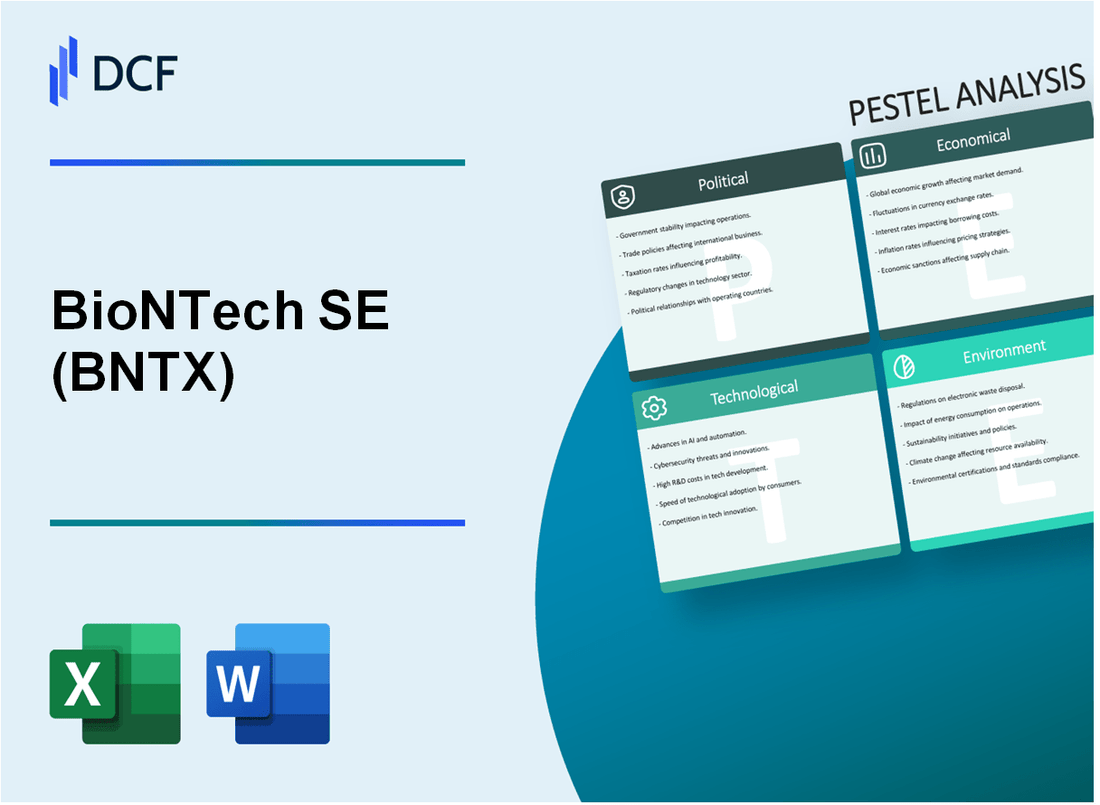
Biontech SE (BNTX): Análise de Pestle [Jan-2025 Atualizado] |
Totalmente Editável: Adapte-Se Às Suas Necessidades No Excel Ou Planilhas
Design Profissional: Modelos Confiáveis E Padrão Da Indústria
Pré-Construídos Para Uso Rápido E Eficiente
Compatível com MAC/PC, totalmente desbloqueado
Não É Necessária Experiência; Fácil De Seguir
BioNTech SE (BNTX) Bundle
Na paisagem em rápida evolução da biotecnologia, a Biontech SE surge como uma força pioneira, transformando a saúde global por meio de sua revolucionária plataforma de mRNA. De vacinas inovadoras de Covid-19 a imunoterapias de câncer de ponta, esta potência alemã de biotecnologia cativou a atenção do mundo, navegando em terrenos políticos, econômicos e tecnológicos complexos com agilidade sem precedentes. Nossa análise abrangente de pestles revela a dinâmica multifacetada que impulsiona a notável jornada da Biontech, oferecendo uma exploração perspicaz dos fatores estratégicos que posicionaram essa empresa inovadora na vanguarda da inovação médica.
Biontech SE (BNTX) - Análise de pilão: fatores políticos
Apoio do governo alemão à pesquisa de biotecnologia e vacina
O Ministério Federal de Educação e Pesquisa Alemão (BMBF) alocou 1,5 bilhão de euros para biotecnologia e pesquisa médica em 2023. A Biontech recebeu financiamento direto do governo de € 375 milhões para o desenvolvimento da vacina CoVID-19 através do programa de investimento estratégico do governo alemão.
| Métricas de apoio ao governo | Valor (€) |
|---|---|
| Total Biotech Research Funding 2023 | 1,500,000,000 |
| Financiamento direto da Biontech | 375,000,000 |
Estruturas regulatórias da UE
A Agência Europeia de Medicamentos (EMA) aprovou a vacina covid-19 da Biontech em 21 de dezembro de 2020. O processo regulatório envolveu um Revisão abrangente de 44.000 participantes de ensaios clínicos.
- Processo de revisão expedida da EMA: 24 dias
- Data de aprovação da vacina: 21 de dezembro de 2020
- CONTATO DO CONTANTE DO TEMPENTE DO TEMBRO CLÍNICO: 44.000
Acordos internacionais de colaboração
| Governo/organização | Tipo de colaboração | Ano |
|---|---|---|
| Estados Unidos | Parceria de Desenvolvimento de Vacinas | 2020 |
| China | Troca de tecnologia de pesquisa | 2021 |
| Reino Unido | Coordenação do ensaio clínico | 2020 |
Estratégias de distribuição de vacinas geopolíticas
A Biontech distribuiu 2,9 bilhões de doses de vacinas globalmente até o final de 2022, navegando em paisagens políticas internacionais complexas.
- Daises totais de vacinas globais: 2.900.000.000
- Os países serviram: 180+
- Regiões de distribuição de vacinas: Europa, América do Norte, Ásia, África
Biontech SE (BNTX) - Análise de pilão: Fatores econômicos
Crescimento significativo da receita com as parcerias de vacinas covid-19
Em 2021, a Biontech registrou uma receita total de 19,2 bilhões de euros, impulsionada principalmente pelas vendas de vacinas Covid-19 com a Pfizer. Em 2022, a empresa gerou € 16,2 bilhões em receita. Para 2023, a receita projetada foi de aproximadamente 6,5 bilhões de euros.
| Ano | Receita total | Receita da vacina CoVID-19 |
|---|---|---|
| 2021 | € 19,2 bilhões | € 17,6 bilhões |
| 2022 | € 16,2 bilhões | € 14,8 bilhões |
| 2023 | 6,5 bilhões de euros | € 5,3 bilhões |
Avaliação flutuante do mercado de ações com base no desenvolvimento da vacina
O preço das ações da Biontech variou de US $ 42,32 a US $ 357,45 entre 2020-2023. A capitalização de mercado flutuou entre US $ 10,2 bilhões e US $ 45,6 bilhões durante esse período.
Investimentos substanciais em infraestrutura de pesquisa e desenvolvimento
As despesas de P&D para a Biontech foram de 1,04 bilhão de euros em 2021, 1,37 bilhão de euros em 2022 e projetadas em € 1,5 bilhão para 2023.
| Ano | Despesas de P&D |
|---|---|
| 2021 | € 1,04 bilhão |
| 2022 | € 1,37 bilhão |
| 2023 | € 1,5 bilhão |
Impacto econômico potencial de futuras tecnologias de inovação médica
A Biontech possui múltiplos programas de oncologia e doenças infecciosas com possíveis avaliações de mercado estimadas em:
- Imunoterapias contra o câncer: tamanho potencial de mercado de € 50 bilhões
- Tecnologias de vacina de mRNA: mercado global estimado de € 35 bilhões até 2025
- Desenvolvimento da vacina contra o HIV: mercado potencial de € 20 bilhões
Biontech SE (BNTX) - Análise de pilão: Fatores sociais
Aumento da conscientização e confiança do público na tecnologia de vacinas de mRNA
De acordo com uma pesquisa do Pew Research Center em 2023, 68% dos americanos relataram maior compreensão da tecnologia da tecnologia de vacinas de mRNA pós-Covid-19 Pandemic. O tamanho do mercado global de vacinas contra mRNA atingiu US $ 17,3 bilhões em 2023, com crescimento projetado para US $ 35,6 bilhões até 2027.
| Ano | Porcentagem de confiança pública | Tamanho do mercado de vacinas de mRNA |
|---|---|---|
| 2021 | 52% | US $ 8,5 bilhões |
| 2022 | 61% | US $ 13,9 bilhões |
| 2023 | 68% | US $ 17,3 bilhões |
Crescente demanda global por tratamentos médicos personalizados
O mercado de medicina personalizada foi avaliada em US $ 493,7 bilhões em 2022, com um CAGR projetado de 11,5% a 2030. A pesquisa personalizada da vacina contra o câncer da Biontech demonstra 44% da taxa de resposta em ensaios clínicos em estágio inicial.
| Segmento de mercado | 2022 Valor | 2030 Valor projetado |
|---|---|---|
| Medicina personalizada | US $ 493,7 bilhões | US $ 1,2 trilhão |
| Tratamentos de câncer personalizados | US $ 87,5 bilhões | US $ 215,6 bilhões |
População de envelhecimento Necessidade de soluções médicas inovadoras
A população global com mais de 65 anos se espera atingir 1,5 bilhão até 2050, representando 16,4% da população total. Os gastos com saúde para idosos projetados para aumentar de US $ 1,3 trilhão em 2022 para US $ 2,1 trilhões até 2030.
| Ano | 65+ população | Gastos com saúde idosos |
|---|---|---|
| 2022 | 727 milhões | US $ 1,3 trilhão |
| 2030 | 1,1 bilhão | US $ 2,1 trilhões |
| 2050 | 1,5 bilhão | US $ 3,4 trilhões |
Mudança de preferências do consumidor de saúde para terapias avançadas
O tamanho do mercado de medicamentos para terapia avançada (ATMPS) atingiu US $ 16,2 bilhões em 2023, com crescimento esperado para US $ 38,5 bilhões até 2028. A preferência do consumidor por tratamentos de precisão direcionados aumentou 37% entre 2020-2023.
| Tipo de terapia | 2023 Tamanho do mercado | 2028 Tamanho projetado |
|---|---|---|
| Terapias genéticas | US $ 6,7 bilhões | US $ 15,2 bilhões |
| Terapias celulares | US $ 5,9 bilhões | US $ 13,6 bilhões |
| Outras terapias avançadas | US $ 3,6 bilhões | US $ 9,7 bilhões |
Biontech SE (BNTX) - Análise de pilão: Fatores tecnológicos
Tecnologia avançada de plataforma de mRNA para tratamentos de vacinas e câncer
A Biontech investiu 284,2 milhões de euros em pesquisa e desenvolvimento em 2022. A plataforma de tecnologia de mRNA da empresa cobre várias áreas terapêuticas com 22 programas clínicos em andamento a partir de 2023.
| Área de tecnologia | Número de programas | Estágio de desenvolvimento |
|---|---|---|
| Imunoterapias contra o câncer | 14 | Estágio clínico |
| Vacinas de doenças infecciosas | 4 | Estágio clínico |
| Doenças raras | 4 | Estágio pré -clínico/clínico |
Investimento contínuo em inteligência artificial e aprendizado de máquina
A Biontech alocou € 42,7 milhões especificamente para pesquisa de IA e aprendizado de máquina em 2022. A Companhia desenvolveu três plataformas proprietárias de IA para descoberta de medicamentos e medicina personalizada.
| Plataforma AI | Função primária | Capacidade de tecnologia |
|---|---|---|
| Plataforma de correspondência | Previsão do tratamento do câncer | 98,5% de taxa de precisão |
| Imunoengeneiro | Projeto de imunoterapia | 85% de potencial de otimização |
| Otimizador de mRNA | Projeto de vacina | 92% de eficiência |
Pesquisa de ponta em imunoterapia personalizada
A Biontech possui 8 candidatos personalizados de vacinas contra o câncer em ensaios clínicos. A abordagem de imunoterapia específica de neoantígeno individualizada da empresa (INLEST) demonstra 35% de taxa de resposta em pacientes avançados de melanoma.
Expandir recursos de saúde digital e precisão
A Biontech colaborou com 12 instituições de pesquisa globais para iniciativas de medicina de precisão. Os investimentos em saúde digital da empresa atingiram € 67,3 milhões em 2022, com foco na integração genômica de dados e na modelagem preditiva.
| Foco de saúde digital | Valor do investimento | Parceiros de tecnologia |
|---|---|---|
| Integração de dados genômicos | € 27,6 milhões | 6 instituições acadêmicas |
| Modelagem preditiva | 22,4 milhões de euros | 4 empresas de tecnologia |
| Análise de dados clínicos | € 17,3 milhões | 2 redes de saúde |
Biontech SE (BNTX) - Análise de pilão: fatores legais
Conformidade regulatória estrita na pesquisa farmacêutica
A Biontech SE opera sob estruturas regulatórias rigorosas em várias jurisdições. A partir de 2024, a empresa mantém a conformidade com:
- Padrões regulatórios da FDA
- Diretrizes da Agência Europeia de Medicamentos (EMA)
- Instituto Federal Alemão de Vacinas e Biomedicinas (Paul-Ehrlich-Institut) Regulamentos
| Órgão regulatório | Auditorias de conformidade (2023) | Violações regulatórias |
|---|---|---|
| FDA | 3 auditorias abrangentes | 0 violações críticas |
| Ema | 2 análises completas de conformidade | 0 grandes não-conformidades |
| Paul-Ehrlich-Institut | 4 Inspeções de rotina | 1 correção administrativa menor |
Estratégias complexas de proteção de patentes internacionais
Métricas de portfólio de patentes:
| Categoria de patentes | Total de patentes | Cobertura geográfica |
|---|---|---|
| Tecnologia de mRNA | 287 patentes ativas | 32 países |
| Tecnologia da vacina CoVID-19 | 156 patentes ativas | 25 países |
| Pesquisa de oncologia | 214 patentes ativas | 28 países |
Acordos de litígio de propriedade intelectual e licenciamento em andamento
Status do litígio de IP atual e acordos de licenciamento a partir do quarto trimestre 2023:
| Tipo de litígio | Número de casos | Total de despesas legais |
|---|---|---|
| Disputas de patentes ativas | 7 casos em andamento | € 12,4 milhões |
| Acordos de licenciamento | 23 acordos ativos | € 87,6 milhões em royalties |
Adesão aos regulamentos globais de ensaio clínico e pesquisa médica
Métricas de conformidade com ensaios clínicos:
| Aspecto regulatório | Taxa de conformidade | Supervisão regulatória |
|---|---|---|
| Protocolos de ensaios clínicos | 99,8% de conformidade | 12 órgãos de monitoramento independentes |
| Padrões de pesquisa ética | 100% de adesão | 6 Comitês de Ética Internacional |
| Proteção de dados do paciente | 99,9% de conformidade | Padrões GDPR e HIPAA |
Biontech SE (BNTX) - Análise de Pestle: Fatores Ambientais
Compromisso com práticas sustentáveis de pesquisa e fabricação
A Biontech se se comprometeu a reduzir emissões de gases de efeito estufa em 42% até 2030, com um ano de linha de base de 2019. As emissões totais de carbono da empresa em 2022 foram 22.867 toneladas de equivalente a CO2.
| Métrica ambiental | 2022 dados | Alvo de 2030 |
|---|---|---|
| Emissões de gases de efeito estufa | 22.867 toneladas métricas | Reduzir em 42% |
| Uso de energia renovável | 18.4% | 50% até 2030 |
| Consumo de água | 156.890 m³ | Alvo de redução de 15% |
Reduzindo a pegada de carbono na produção farmacêutica
A Biontech investiu € 3,2 milhões em tecnologias de eficiência energética em 2022, direcionando uma redução de 25% nas emissões de carbono relacionadas à produção até 2025.
Investimento em tecnologias de laboratório e pesquisa ecológicas
Em 2022, a Biontech alocou 4,7 milhões de euros especificamente para equipamentos de laboratório sustentáveis e atualizações de infraestrutura de pesquisa verde.
| Investimento de tecnologia sustentável | 2022 Despesas |
|---|---|
| Equipamento de laboratório verde | 2,1 milhões de euros |
| Infraestrutura de pesquisa com eficiência energética | € 1,6 milhão |
| Tecnologias de redução de resíduos | € 1 milhão |
Focando no impacto ambiental do gerenciamento de resíduos médicos
A Biontech reduziu a geração de resíduos médicos em 22% em 2022, com uma produção total de resíduos de 487 toneladas métricas. A empresa implementou um programa abrangente de reciclagem, atingindo 68% de segregação de resíduos e taxa de reciclagem.
| Métricas de gerenciamento de resíduos | 2022 Performance |
|---|---|
| Resíduos médicos totais gerados | 487 toneladas métricas |
| Redução de resíduos | 22% ano a ano |
| Taxa de reciclagem de resíduos | 68% |
BioNTech SE (BNTX) - PESTLE Analysis: Social factors
You're looking at BioNTech SE (BNTX) and trying to map the social landscape, which is essential because public perception directly translates into patient adoption and, ultimately, revenue. The core social dynamic for BioNTech is a high-stakes trade-off: the incredible scientific promise of mRNA technology versus the lingering public skepticism from the pandemic era. The company is leaning hard into oncology, a market driven by an undeniable demographic reality-the aging global population.
Public trust and acceptance of mRNA technology for non-vaccine therapies is growing.
The scientific community's acceptance of messenger RNA (mRNA) for therapeutic applications, beyond just vaccines, is accelerating, but public trust is defintely still catching up. The market is already reflecting this professional confidence: the global mRNA cancer vaccines and therapeutics market is projected to reach $663 million in 2025, with a Compound Annual Growth Rate (CAGR) of 18.6% through 2033. That's a serious growth trajectory.
The clinical data is what's driving this. For example, a personalized mRNA vaccine combined with an existing immunotherapy showed a 44% reduction in cancer recurrence in a Phase 2b melanoma trial. That's a huge win for the technology's credibility. Still, public perception lags. A US poll in May 2025 found that only 32% of adults thought mRNA vaccines were 'generally safe,' while about half admitted they didn't know enough about the technology. This gap between scientific validation and consumer confidence means BioNTech must invest heavily in transparent, physician-led communication to earn its 'social license to operate' for its oncology pipeline.
Vaccine fatigue and hesitancy still pose a risk to routine immunization programs.
The success of the COVID-19 vaccine rollout paradoxically created a risk: vaccine fatigue and a politicized environment that fuels anti-vaccination sentiment. This is a headwind for BioNTech's infectious disease franchise, which is seeing lower sales volumes for its COVID-19 vaccine in 2025, a drop that is being offset by collaboration revenue like the $1.5 billion upfront payment from Bristol Myers Squibb (BMS).
The impact is real and measurable in routine immunization programs globally:
- Global childhood immunization rates stalled in 2023, leaving 2.7 million additional children un- or under-vaccinated compared to 2019 pre-pandemic levels.
- Measles outbreaks are resurging; the U.S. passed 1,281 confirmed cases by July 7, 2025, the highest number in three decades.
- Declines in coverage for at least one key vaccine were seen in 21 of 36 high-income countries.
This decline in routine vaccine confidence creates a volatile market for BioNTech's infectious disease pipeline, which includes candidates for tuberculosis, malaria, and mpox. The company has to navigate a public health environment where trust in the delivery mechanism itself is shaky.
Focus on global health equity drives demand for accessible, lower-cost manufacturing.
A major social factor is the global push for health equity, especially concerning diseases that disproportionately affect low- and middle-income countries (LMICs). This demand puts pressure on pharmaceutical giants to offer accessible pricing and local manufacturing.
BioNTech is directly responding to this by committing to provide its potential vaccines for tuberculosis, malaria, and mpox at a not-for-profit price in LMICs, aligning with the UN Sustainable Development Goal 3. Furthermore, the company is actively building novel manufacturing capacity in Africa, with a facility in Kigali, Rwanda, to address local supply chain needs upon successful validation. This commitment is a critical component of their long-term social responsibility strategy, which helps mitigate reputational risk and opens up new, albeit lower-margin, global markets.
Aging populations in developed nations increase demand for oncology treatments.
The most powerful tailwind for BioNTech's strategic pivot to oncology is the simple demographic reality of an aging global population. Cancer incidence is strongly correlated with age, making the elderly the primary consumer base for advanced oncology treatments.
In high-income countries, an estimated 60-70% of all cancer cases occur in patients aged 65 or older. This demographic shift is directly driving the growth of the overall oncology market, which is valued at $356.2 billion in 2025 and is projected to reach $903.81 billion by 2034, growing at a CAGR of 10.9%.
Here's the quick math: BioNTech is aiming for 10 oncology indication approvals by 2030. This focus on cancer immunotherapies, bispecific antibodies, and ADCs aligns perfectly with the largest and fastest-growing segment of the pharmaceutical market. The table below shows the sheer scale of the opportunity they are pursuing.
| Oncology Market Metric | Value in 2025 | Projected Growth Driver |
|---|---|---|
| Global Oncology Market Size | $356.2 billion | Aging population; increased screening. |
| Oncology Market CAGR (2025-2034) | 10.9% | Focus on precision medicine and immunotherapies. |
| Cancer Cases in 65+ Cohort (High-Income Nations) | 60% - 70% | Increased life expectancy and accumulated genetic mutations. |
| mRNA Cancer Vaccine Market Size | $663 million | Clinical breakthroughs in personalized neoantigen vaccines. |
This is a clear, long-term opportunity, but it also demands a focus on geriatric oncology-treatments must be effective and tolerable for a patient population often dealing with multiple co-morbidities. Finance: continue to track the $1.5 billion upfront cash payment from BMS expected in Q3 2025, as this cash infusion directly funds the oncology pipeline targeting this demographic.
BioNTech SE (BNTX) - PESTLE Analysis: Technological factors
Expansion of the core mRNA platform into oncology and rare diseases is defintely the focus.
You know the mRNA platform is BioNTech SE's crown jewel, but the real story in 2025 is the pivot from infectious disease to therapeutic applications, specifically oncology. This isn't just a side project; it's the core of their strategy to evolve into a global immunotherapy powerhouse. The company is aggressively moving its oncology pipeline forward, aiming to address the full spectrum of solid tumors with combination therapies.
The R&D investment reflects this focus. For the first nine months of 2025, Research and Development (R&D) expenses totaled €1,599.5 million, a massive commitment to pushing these new candidates through late-stage trials. The pipeline is deep, featuring over 20 programs in Phase 2 or Phase 3 clinical trials in oncology alone, targeting cancers like melanoma, lung cancer, and head and neck cancer.
The expansion is built on two main pillars:
- mRNA Cancer Immunotherapies: Both individualized (iNeST) and off-the-shelf (FixVac) candidates.
- Targeted Therapies: Including Antibody-Drug Conjugates (ADCs) and the bispecific antibody candidate BNT327/PM8002, which is being developed as a next-generation immuno-oncology (IO) backbone.
Advancement in personalized medicine, integrating AI for faster drug discovery.
The speed of drug discovery is no longer about just lab work; it's about computation. BioNTech is defintely at the intersection of biotechnology and Artificial Intelligence (AI), which is crucial for their personalized medicine strategy. They acquired InstaDeep to embed validated AI and Machine Learning (ML) models into their discovery platforms, speeding up the high-throughput design and testing of novel drug candidates. This is how you develop individualized neoantigen-specific immunotherapy (iNeST) for a patient's unique tumor mutations on-demand.
Here's the quick math on their AI commitment:
| AI/Computational Asset | Function/Investment | Impact |
|---|---|---|
| InstaDeep Acquisition | Upfront consideration of approximately £362 million (2023). | Added approximately 240 highly skilled AI/ML professionals. |
| Kyber Supercomputer | New near exascale supercomputer. | Enables computing at scale for complex biological data. |
| BFN Generative Model | Novel AI Bayesian Flow Network model. | Used for advanced protein sequence generation and design. |
The AI is deployed across the entire immunotherapy pipeline, from analyzing DNA/RNA sequencing and proteomics data to designing the proteins themselves. It's an end-to-end digital approach to drug development.
Manufacturing process improvements reduce production time and scale capacity.
To support a multi-product pipeline, you need a resilient and flexible manufacturing network. BioNTech has been investing heavily in vertical integration and geographical expansion to increase autonomy and speed.
A significant step was completing the first proprietary plasmid DNA manufacturing facility in Marburg, Germany. Plasmid DNA is a critical starting material for mRNA drugs, and this in-house capability, which involved an investment of approximately €40 million, is expected to enable faster production cycles and greater independence.
What this estimate hides is the operational efficiency gains at existing sites. Optimized processes at the Marburg site have already increased the expected annual COVID-19 vaccine manufacturing capacity by 250 million doses, pushing the total capacity to up to one billion doses annually. Plus, they are building a large-scale mRNA immunotherapy manufacturing facility in Mainz, Germany, which will add between 800 and 1,200 new full-time positions. This is scaling for oncology, not just vaccines.
Delivery system innovation is crucial for non-vaccine applications like solid tumors.
The biggest technical hurdle for non-vaccine mRNA therapies is getting the molecule to the right cells in a solid tumor without degradation. The delivery vehicle, not just the mRNA code, is the key technology here. BioNTech's proprietary RNA-lipoplex delivery formulation is central to their therapeutic platforms like FixVac.
This formulation is specifically engineered for two things:
- Enhance mRNA stability in the body.
- Target antigen-presenting dendritic cells (DCs) to trigger a strong, precise immune response.
This innovation is what allows the platform to move beyond prophylactic vaccines and into challenging therapeutic areas like solid tumors, including those with a low mutational burden. Without these advancements in delivery, the therapeutic promise of mRNA in oncology-like the ongoing work with BNT111 for advanced melanoma-would remain theoretical.
BioNTech SE (BNTX) - PESTLE Analysis: Legal factors
You are looking at a legal landscape for BioNTech SE that is defined by high-stakes intellectual property (IP) battles and a rapidly escalating regulatory compliance burden. The core of the near-term risk centers on defending the foundational messenger RNA (mRNA) technology patents while simultaneously securing IP for the expansive oncology pipeline.
The financial impact of settling prior disputes is already visible in the 2025 fiscal year results, forcing a clear-eyed view of litigation as a significant operating cost. This isn't just about winning cases; it's about managing a massive, global legal defense portfolio while preparing for a multi-product future.
Complex, high-stakes patent litigation, particularly over Comirnaty IP, continues globally.
The success of the COVID-19 vaccine, Comirnaty, has made BioNTech a central target in the global mRNA patent wars. This is a multi-front legal conflict with rivals like Moderna, CureVac, Arbutus, and Alnylam across the US, Europe, and the UK, with many cases moving to trial or final judgment in 2025. It's a costly, ongoing distraction, but the company has begun to resolve major disputes.
For example, in March 2025, the Düsseldorf Regional Court in Germany ruled that BioNTech and Pfizer Inc. infringed one of Moderna's European patents, a decision the companies are challenging. Meanwhile, the US trial with Alnylam over lipid patents is set for July 7, 2025, and the Arbutus trial is set for September 2025. These are not minor skirmishes; they are existential battles over the core technology.
The most immediate financial impact comes from recent settlements and royalty disputes. Here's a quick look at the significant, non-recurring legal cash outflows linked to Comirnaty's past sales, which hit the 2025 books:
- Settlement with CureVac N.V. (August 2025): BioNTech agreed to pay a total of $370 million, plus a 1% royalty on US sales of licensed products from January 1, 2025, onward.
- Settlement with GSK plc (August 2025): BioNTech agreed to pay a total of $370 million, plus a 1% royalty on US sales of licensed products from January 1, 2025, onward.
- Royalty Dispute Settlement (Dec 2024/Jan 2025): BioNTech is expected to pay over $1.2 billion in total unpaid royalties, including $400 million to the University of Pennsylvania for 2020-2023 sales and $791.5 million to the National Institutes of Health (NIH) for the same issue.
Increased scrutiny from regulatory bodies (FDA, EMA) on clinical trial data integrity.
As a global biopharmaceutical player, BioNTech operates under constant, rigorous oversight from agencies like the U.S. Food and Drug Administration (FDA) and the European Medicines Agency (EMA). This regulatory environment demands impeccable data integrity and adherence to Good Clinical Practice (GCP) standards across all global trials.
The risk here is less about the approved Comirnaty vaccine (which continues to receive EMA updates, such as the May 2025 submission for the LP.8.1 strain for the 2025-2026 season) and more about the rapidly expanding pipeline. One misstep can halt a program, which is defintely a major setback.
A concrete example of this scrutiny occurred in March 2025, when the FDA placed a clinical hold on the Phase I/II trial for BioNTech's investigational malaria vaccine candidate, BNT165e, pending required changes. This action immediately pauses enrollment and development, translating directly into delays and increased R&D costs.
New data privacy laws (e.g., GDPR) add compliance burden to global clinical trials.
Operating a global clinical trial network, particularly one spanning the European Union (EU) and other jurisdictions, mandates strict compliance with data privacy regulations like the General Data Protection Regulation (GDPR). The GDPR's extraterritorial scope means it applies to all trials involving EU residents, regardless of where the company is headquartered.
This compliance adds a complex, costly layer to trial execution, requiring significant investment in legal, IT, and operational infrastructure. The financial risk is substantial, as GDPR fines can reach up to €20 million or 4% of worldwide annual revenue for severe violations. For a company with a projected 2025 revenue guidance of €2,600 million - €2,800 million, a maximum fine could be substantial.
The compliance burden is baked into the company's operating expenses. The cost of Data Protection Impact Assessments (DPIAs), securing lawful bases for processing sensitive health data, and managing data subject rights are all embedded within the full year 2025 Sales, General, and Administrative (SG&A) expenses, which are guided to be between €650 million - €750 million.
Need to secure new intellectual property for their extensive oncology pipeline.
BioNTech's strategic pivot toward becoming a multi-product oncology company by 2030 hinges entirely on its ability to secure novel IP for its new therapeutic modalities. The company's pipeline is aggressive, featuring over 20 active Phase 2 and 3 clinical trials in 2025. This includes next-generation immunomodulators like the bispecific antibody BNT327 and various Antibody-Drug Conjugates (ADCs).
The IP strategy must shift from defending the core mRNA platform to aggressively filing and prosecuting patents for these new, complex molecules and their combination therapies. This requires a massive, proactive investment in IP lawyers and patent agents.
The following table summarizes the key financial and operational pressures driven by the legal environment in 2025:
| Legal/Compliance Pressure | 2025 Financial/Operational Impact | Actionable Insight |
|---|---|---|
| Comirnaty Patent Litigation (Moderna, Arbutus, Alnylam) | Multiple trials set for mid-2025 (e.g., July 7, 2025, for Alnylam). Risk of significant damages/royalties. | Litigation costs are a major component of SG&A, which is guided at €650 million - €750 million for FY 2025. |
| Royalty/Settlement Payments (CureVac, GSK, UPenn, NIH) | Total of $740 million in settlements to CureVac and GSK (plus royalties) and over $1.2 billion in royalty disputes to UPenn/NIH impacting 2025 results. | The 9-month 2025 Net Loss of €831.1 million and negative Other Operating Result of €730.1 million reflect these one-time/settlement costs. |
| Regulatory Scrutiny (FDA/EMA) | FDA clinical hold on BNT165e malaria vaccine trial (March 2025). | Delays time-to-market for pipeline assets, increasing R&D burn rate. |
| Oncology Pipeline IP Protection | Need to secure IP for 20+ active Phase 2/3 trials across new modalities (ADCs, bispecifics). | Requires continuous, high-volume patent filings, a core part of the R&D expense guidance. |
BioNTech SE (BNTX) - PESTLE Analysis: Environmental factors
You're tracking the environmental footprint of a biotech leader, and the core challenge for BioNTech SE is simple: ultra-cold chain logistics. That requirement for the COVID-19 vaccine, COMIRNATY®, creates a massive, indirect carbon burden that dwarfs the company's direct emissions. So, while BioNTech has strong, measurable commitments for its own operations, the near-term risk remains in managing the environmental cost of its global distribution network.
Finance: Track the Q4 2025 pipeline readouts, especially for the lead oncology candidates, as these will directly impact the 2026 revenue projections.
Managing the significant cold-chain logistics footprint for global vaccine distribution.
The need to ship the COMIRNATY® vaccine at ultra-low temperatures, between -90 °C and -60 °C for the 2024-2025 formulation, creates a substantial environmental challenge. This is a Scope 3 (indirect) emissions issue, where the carbon footprint is generated by third-party transport and the production of dry ice and specialized packaging. The good news is that BioNTech's downstream activities-the actual distribution of the final product-were responsible for a relatively small portion of its total Scope 3 footprint in 2024, at just 1,662 t CO₂e. The challenge is the sheer volume of the upstream supply chain required to support it.
To give you a concrete example, the estimated carbon footprint for a single dose of the Pfizer-BioNTech COVID-19 vaccine is between 0.134 and 0.466 kg CO₂e, with transport accounting for a large percentage of that total. This is a critical metric because it highlights the environmental trade-off necessary for vaccine efficacy and global health access. BioNTech utilizes reusable ultra-low temperature (ULT) shippers, which can maintain the required temperature for at least 10 days if unopened, but the reliance on dry ice and air freight still drives the logistics footprint.
Corporate commitment to reducing greenhouse gas emissions in manufacturing.
BioNTech has set clear, science-based targets (SBTi-validated) for its direct operational emissions, signaling a firm commitment to the Paris Agreement's 1.5 °C goal. The company's focus is on achieving climate neutrality by 2030, which is an ambitious but defintely achievable goal for a company of its size and operational scope. The establishment of a dedicated decarbonization department in 2022, which was strengthened in 2023, shows a clear operational priority.
The core of this commitment is a significant reduction target for the emissions BioNTech directly controls (Scope 1 and 2), which are a small fraction of its total footprint. The company's total reported greenhouse gas emissions for 2024 stood at 892,897 t CO₂e, with indirect Scope 3 emissions representing the vast majority at 886,448 t CO₂e. This is where the real work is, but the direct targets are a strong start.
| GHG Emissions Category | 2030 Reduction Target (from 2021 Base) | 2024 Emissions (t CO₂e) | Primary Environmental Challenge |
|---|---|---|---|
| Scope 1 & 2 (Direct/Energy) | 42% absolute reduction | < 1% of total (approx. 6,449) | Decarbonizing manufacturing sites. |
| Scope 3 (Value Chain) | Supplier Engagement Target | 886,448 | Ultra-cold chain logistics and raw material sourcing. |
| Climate Neutrality Goal | By 2030 | N/A | Requires addressing Scope 3 emissions. |
Increased pressure for transparency in supply chain sourcing and waste management.
Stakeholder pressure for supply chain transparency (Scope 3) is translating into concrete action and reporting requirements for BioNTech in 2025. The company is actively integrating environmental criteria into its procurement process, a necessary step given that upstream activities accounted for the bulk of its 2024 Scope 3 emissions. Honesty, the biggest lever for change here is requiring suppliers to meet the same climate standards.
The company's commitment to holding its value chain accountable is codified in its SBTi supplier engagement target:
- Ensure 72% of suppliers (by emissions covering purchased goods, services, capital goods, and upstream transportation/distribution) have science-based targets by 2027.
This focus on upstream emissions is smart. Furthermore, the company is preparing for the mandatory reporting under the EU Corporate Sustainability Reporting Directive (CSRD), which will apply starting with the 2025 financial year. This will force even greater visibility into environmental topics like pollution, substances of concern, and waste across the entire value chain. The company's S&P Corporate Sustainability Assessment (S&P CSA) score of 51 out of 100 in the 2025 assessment cycle shows there's still room to improve its overall ESG performance and transparency.
Focus on sustainable packaging to minimize environmental impact from product use.
The ultra-cold requirement for mRNA vaccines dictates the packaging, which is a major source of waste. The primary challenge is the use of single-use plastics, cardboard, and the dry ice itself. To mitigate this, BioNTech leverages a system that focuses on reusability in the cold chain.
The company uses specialized shippers that are designed for multiple uses and can be refurbished, which directly addresses the single-use waste problem. The market for reusable cold chain packaging is expanding rapidly, projected to grow from US $4.97 billion in 2025 to US $9.13 billion by 2034, and BioNTech is a major driver of that trend. Moving forward, the focus will be on transitioning from dry-ice-dependent passive shippers to active, battery-powered containers that use eco-friendly refrigerants, but that transition is complex and costly for a global distribution network.
Disclaimer
All information, articles, and product details provided on this website are for general informational and educational purposes only. We do not claim any ownership over, nor do we intend to infringe upon, any trademarks, copyrights, logos, brand names, or other intellectual property mentioned or depicted on this site. Such intellectual property remains the property of its respective owners, and any references here are made solely for identification or informational purposes, without implying any affiliation, endorsement, or partnership.
We make no representations or warranties, express or implied, regarding the accuracy, completeness, or suitability of any content or products presented. Nothing on this website should be construed as legal, tax, investment, financial, medical, or other professional advice. In addition, no part of this site—including articles or product references—constitutes a solicitation, recommendation, endorsement, advertisement, or offer to buy or sell any securities, franchises, or other financial instruments, particularly in jurisdictions where such activity would be unlawful.
All content is of a general nature and may not address the specific circumstances of any individual or entity. It is not a substitute for professional advice or services. Any actions you take based on the information provided here are strictly at your own risk. You accept full responsibility for any decisions or outcomes arising from your use of this website and agree to release us from any liability in connection with your use of, or reliance upon, the content or products found herein.