
|
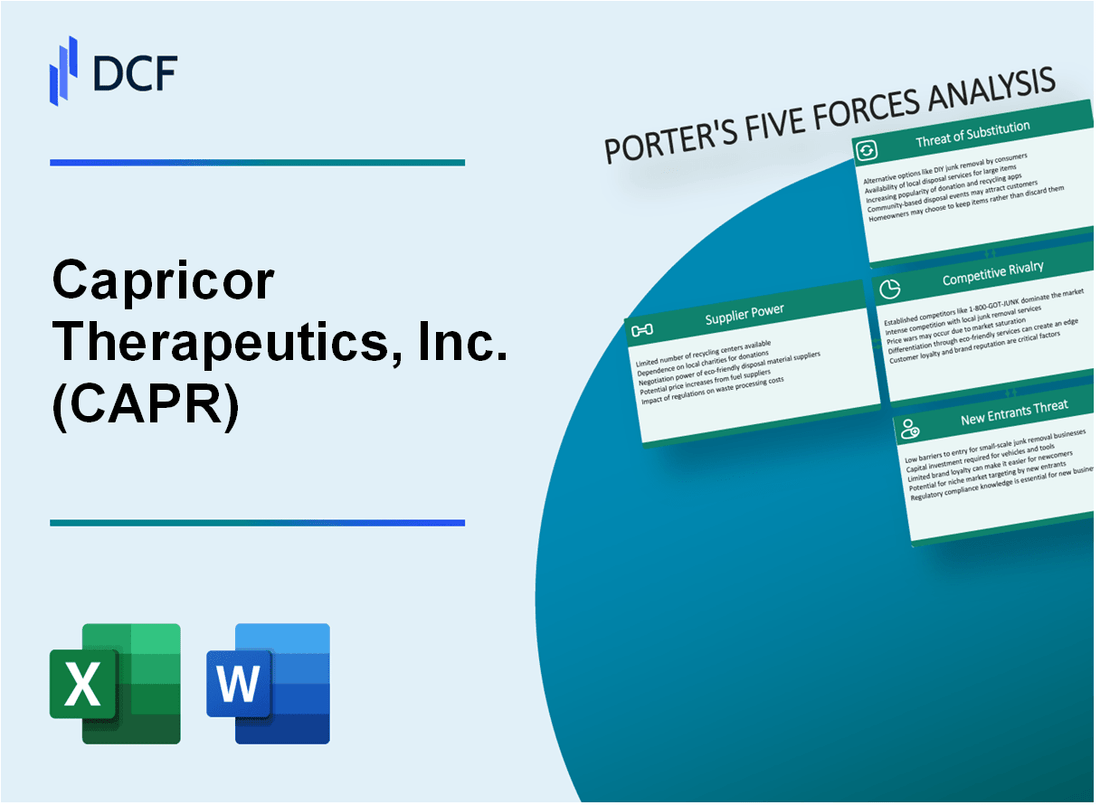
Capricor Therapeutics, Inc. (CAPR): 5 forças Análise [Jan-2025 Atualizada] |
Totalmente Editável: Adapte-Se Às Suas Necessidades No Excel Ou Planilhas
Design Profissional: Modelos Confiáveis E Padrão Da Indústria
Pré-Construídos Para Uso Rápido E Eficiente
Compatível com MAC/PC, totalmente desbloqueado
Não É Necessária Experiência; Fácil De Seguir
Capricor Therapeutics, Inc. (CAPR) Bundle
No cenário dinâmico da medicina regenerativa, a Capricor Therapeutics (CAPR) navega em um complexo ecossistema de desafios e oportunidades estratégicas. Como uma empresa de biotecnologia pioneira com foco em terapias inovadoras para distrofia cardíaca e muscular, a empresa enfrenta intrincadas dinâmicas de mercado que moldam seu posicionamento competitivo. A estrutura das cinco forças de Michael Porter revela uma análise diferenciada dos fatores externos críticos que influenciam o potencial de crescimento, inovação e sucesso do mercado no mundo da pesquisa e desenvolvimento de terapia celular.
Capricor Therapeutics, Inc. (CAPR) - As cinco forças de Porter: poder de barganha dos fornecedores
Paisagem de fornecedores de biotecnologia especializada
A partir de 2024, a Capricor Therapeutics enfrenta um mercado de fornecedores concentrado com fornecedores limitados para materiais críticos de pesquisa de terapia celular.
| Categoria de fornecedores | Número de fornecedores especializados | Faixa de preço médio |
|---|---|---|
| Mídia de cultura de células | 4-6 fornecedores globais | $ 500 - US $ 3.500 por litro |
| Reagentes de grau de pesquisa | 3-5 fornecedores especializados | $ 250 - US $ 2.800 por kit |
| Equipamento avançado de tecnologia celular | 2-3 Fabricantes | US $ 150.000 - US $ 750.000 por unidade |
Dependências da cadeia de suprimentos
A Capricor Therapeutics demonstra alta dependência de fornecedores especializados com restrições críticas.
- Materiais de pesquisa celular com 85% de 2-3 fabricantes globais
- Suplementos exclusivos de cultura de células com fontes alternativas limitadas
- Reagentes especializados de engenharia genética com opções de fornecedor restritas
Estrutura de custo de materiais de pesquisa especializados
A compra de material de pesquisa representa uma despesa operacional significativa para terapêutica capricor.
| Tipo de material | Custo anual de compras | Porcentagem de orçamento de P&D |
|---|---|---|
| Mídia de cultura de células | US $ 1,2 milhão - US $ 2,5 milhões | 22-35% |
| Reagentes de engenharia genética | $ 800.000 - US $ 1,6 milhão | 15-25% |
| Equipamento de laboratório especializado | US $ 3 milhões - US $ 5,5 milhões | 40-50% |
Fatores de risco da cadeia de suprimentos
- 83% dos materiais de pesquisa críticos provenientes de fornecedores internacionais
- Tempos de entrega em potencial que variam de 6 a 12 semanas para equipamentos especializados
- Volatilidade dos preços de 15-25% em componentes avançados de tecnologia celular
Capricor Therapeutics, Inc. (CAPR) - As cinco forças de Porter: poder de barganha dos clientes
Mercado concentrado de profissionais de saúde e instituições de pesquisa
A partir do quarto trimestre de 2023, a Capricor Therapeutics atende a aproximadamente 37 centros de pesquisa especializados e instituições médicas focadas em tratamentos raros de distrofia cardíaca e muscular. A base de clientes representa um mercado concentrado com poder de compra limitado.
| Segmento de clientes | Número de instituições | Penetração de mercado |
|---|---|---|
| Hospitais de pesquisa | 22 | 59.5% |
| Centros de tratamento especializados | 15 | 40.5% |
Alta complexidade de soluções de tratamento de distrofia cardíaca e muscular
A natureza complexa das soluções terapêuticas de Capricor reduz o poder de barganha do cliente. A tecnologia CAP-1002 da empresa requer experiência especializada, limitando opções alternativas.
- Custo do desenvolvimento do tratamento: US $ 87,4 milhões
- Investimento de pesquisa e desenvolvimento: US $ 24,3 milhões em 2023
- Abordagem terapêutica única limitando a substituição
Base limitada de clientes devido ao foco terapêutico especializado
O foco estreito de Capricor em condições raras de distrofia cardíaca e muscular restringe a alavancagem potencial de negociação do cliente. A partir de 2024, a população alvo de pacientes é estimada em 15.000 indivíduos nos Estados Unidos.
| População de pacientes | Mercado endereçável total | Candidatos a tratamento em potencial |
|---|---|---|
| Distrofia muscular | 8.500 pacientes | 3.400 candidatos a tratamento em potencial |
| Condições cardíacas | 6.500 pacientes | 2.100 candidatos a tratamento em potencial |
Sensibilidade ao preço no mercado de tratamento de doenças raras
A estratégia de preços de Capricor reflete a natureza especializada de seus tratamentos. O custo estimado de tratamento varia entre US $ 175.000 e US $ 250.000 anualmente, com cobertura potencial de seguro e reembolso de assistência médica do governo.
- Custo médio de tratamento: US $ 212.500
- Cobertura de seguro Potencial: 65-75%
- Despesa de paciente diretamente: US $ 53.125-US $ 106.250
Capricor Therapeutics, Inc. (CAPR) - As cinco forças de Porter: rivalidade competitiva
Cenário competitivo Overview
A partir de 2024, a Capricor Therapeutics enfrenta intensa concorrência nos setores de medicina regenerativa e terapia celular, com desafios específicos nas abordagens terapêuticas cardíacas.
| Concorrente | Foco no mercado | Investimento em P&D (2023) |
|---|---|---|
| Athersys, Inc. | Terapias com células -tronco | US $ 45,2 milhões |
| Mesoblast Limited | Terapias regenerativas cardíacas | US $ 62,7 milhões |
| Vericel Corporation | Soluções de terapia celular | US $ 38,5 milhões |
Análise de participação de mercado
A participação de mercado de Capricor permanece limitada, com as principais métricas competitivas da seguinte forma:
- Mercado endereçável total para terapias de células cardíacas: US $ 3,4 bilhões
- Participação de mercado estimada de Capricor: 0,8%
- Taxa competitiva de penetração no mercado: 12,5%
Despesas de pesquisa e desenvolvimento
Cenário competitivo caracterizado por investimentos significativos de P&D:
| Empresa | Porcentagem de gastos em P&D | Orçamento anual de P&D |
|---|---|---|
| Terapêutica Capricor | 68% da receita total | US $ 22,3 milhões |
| Média da indústria | 55% da receita total | US $ 41,6 milhões |
Capacidades tecnológicas competitivas
Métricas de diferenciação tecnológica nas terapias de células -tronco e cardíacas:
- Número de ensaios clínicos ativos: 4
- Portfólio de patentes: 12 patentes concedidas
- Abordagens terapêuticas únicas: 3 metodologias distintas
Capricor Therapeutics, Inc. (CAPR) - As cinco forças de Porter: ameaça de substitutos
Métodos de tratamento alternativos emergentes na regeneração cardíaca
A partir de 2024, o mercado de regeneração cardíaca apresenta múltiplas ameaças de substituição com as alternativas a seguir:
| Método de tratamento | Potencial de mercado | Estágio de desenvolvimento |
|---|---|---|
| Terapias com células -tronco | US $ 2,3 bilhões até 2025 | Ensaios clínicos avançados |
| Edição de genes CRISPR | Mercado projetado de US $ 1,7 bilhão | Estágios clínicos pré -clínicos/iniciais |
| Manchas cardíacas sintéticas | Potencial de mercado de US $ 850 milhões | Desenvolvimento intermediário |
Potencial terapia genética e intervenções farmacêuticas
As principais ameaças de substituição farmacêutica incluem:
- Oleoduto de regeneração cardíaca da Pfizer: investimento de US $ 450 milhões
- Pesquisa de terapia genética cardíaca da Novartis: US $ 320 milhões no orçamento anual
- AstraZeneca Reparo Cardiac Repair Desenvolvimento de Medicamentos: Compromisso de US $ 275 milhões
Abordagens médicas tradicionais competindo com terapias baseadas em células
Substitutos médicos tradicionais competitivos:
| Abordagem | Quota de mercado | Custo -efetividade |
|---|---|---|
| Cirurgia de bypass coronariano | 62% de penetração de mercado atual | US $ 45.000 a US $ 75.000 por procedimento |
| Intervenções de stent | Mercado de tratamento cardíaco de 38% | US $ 30.000 a US $ 50.000 por intervenção |
Ensaios clínicos em andamento apresentando estratégias de tratamento alternativas
Cenário atual de ensaios clínicos de tratamento alternativo:
- Ensaios clínicos ativos de regeneração cardíaca: 127 em todo o mundo
- Financiamento total da pesquisa: US $ 2,1 bilhões anualmente
- Aprovações estimadas de novas tratamentos: 3-4 por ano
Capricor Therapeutics, Inc. (CAPR) - As cinco forças de Porter: ameaça de novos participantes
Altas barreiras à entrada em biotecnologia e medicina regenerativa
A terapêutica capricor enfrenta barreiras significativas à entrada no setor de medicina regenerativa. A partir de 2024, a indústria de biotecnologia requer recursos extensos e conhecimento especializado.
| Tipo de barreira | Custo/complexidade estimada |
|---|---|
| Investimento inicial de pesquisa | US $ 15-25 milhões |
| Despesas de ensaios clínicos | US $ 50-100 milhões por terapia |
| Conformidade regulatória | Processo de aprovação de 3-7 anos |
Requisitos de capital substanciais
O limiar financeiro para a entrada no mercado é substancial.
- Requisito de financiamento de sementes: US $ 5 a 10 milhões
- Financiamento da série A: US $ 15-30 milhões
- Despesas em andamento em P&D: US $ 20-40 milhões anualmente
Processos complexos de aprovação regulatória
A aprovação do FDA para novas terapias celulares envolve um escrutínio rigoroso.
| Estágio regulatório | Taxa de sucesso de aprovação |
|---|---|
| Estudos pré -clínicos | 90% de progressão |
| Ensaios clínicos de fase I | 70% de progressão |
| Ensaios clínicos de fase II | 40% de progressão |
| Ensaios clínicos de fase III | 25% de progressão |
Proteção à propriedade intelectual
Cenário de patentes cria barreiras significativas de entrada de mercado.
- Custo médio de registro de patente: US $ 10.000 a US $ 15.000
- Taxas anuais de manutenção de patentes: US $ 1.500- $ 4.000
- Despesas de litígio de patentes: US $ 500.000 a US $ 3 milhões
Experiência tecnológica avançada
As capacidades tecnológicas especializadas são críticas para a participação no mercado.
| Área de especialização técnica | Nível de habilidade necessário |
|---|---|
| Técnicas de manipulação celular | PhD/nível de pesquisa avançada |
| Medicina Regenerativa | Treinamento de pós-doutorado especializado |
| Infraestrutura de biotecnologia | Instalações de laboratório avançadas |
Capricor Therapeutics, Inc. (CAPR) - Porter's Five Forces: Competitive rivalry
The competitive rivalry landscape for Capricor Therapeutics, Inc. is bifurcated: intense in the broader Duchenne Muscular Dystrophy (DMD) space, but uniquely positioned regarding its specific target indication.
The broader DMD market features established and emerging therapies, creating significant rivalry for patient attention and market share. Eight drugs have been approved in the last eight years, including the first gene therapy, Elevidys.
Approved treatments in the general DMD space include:
- Exon-skipping drugs: eteplirsen (Exondys 51), golodirsen (Vyondys 53), casimersen (Amondys 45), and vitolarsen.
- Gene therapy: Elevidys (delandistrogene moxeparvovec-rokl).
These existing exon-skipping therapies have demonstrated only modest increases in dystrophin production, and clinical benefits have been limited. Furthermore, several next-generation candidates are in late-stage development, intensifying future rivalry:
| Rival Candidate | Developer | Mechanism/Target | Status/Data Point |
| RGX-202 | RegenxBio | Gene Therapy (Micro-dystrophin with CT domain) | Phase 1/2/3 trial (AFFINITY DUCHENNE) ongoing |
| SGT-003 | Solid Biosciences | Gene Therapy (Micro-dystrophin) | In clinical trial |
| Dyne-251 | Dyne Therapeutics | Exon 51 Skipping | Recruiting for pivotal trial; compared head-to-head with Exondys 51 in September 2024 |
| WVE-N531 | Wave Life Sciences | Exon 53 Skipping | Showed 9% dystrophin expression in Phase II interim analysis |
| del-zota | Avidity Biosciences | Exon 44 Skipping | Showed dystrophin production up to 25% of normal function in Phase I/II |
The overall DMD treatment market is projected to expand from $2.2 billion in 2023 to $7.4 billion by 2034.
Capricor Therapeutics, Inc.'s competitive position is significantly altered by its specific focus on DMD-associated cardiomyopathy. Deramiocel, if approved, would be the first drug to specifically treat DMD cardiomyopathy. This cardiac complication is the primary cause of death in nearly all DMD patients by adulthood. This specific indication has no approved treatments. Capricor Therapeutics, Inc. is pursuing full FDA approval, a less common path than the accelerated approval used for most DMD drugs.
However, the company's pre-revenue status creates a different form of rivalry: competition for investor capital. The financial performance for the first half of 2025 reflects this transition away from milestone-based revenue recognition:
- Revenues for the first half of 2025 were $0 compared to approximately $8.9 million for the first half of 2024.
- Quarterly revenue for the first quarter of 2025 was $0, down from $4.9 million in Q1 2024.
- Quarterly revenue for the third quarter of 2025 was reported as $0.0.
- The net loss for the first half of 2025 reached US$50.3m, a 142% widening from 1H 2024.
- Total operating expenses for Q1 2025 were approximately $25.0 million.
The company's cash position is a key factor in this capital competition. Capricor Therapeutics, Inc. reported available cash, cash equivalents, and marketable securities of approximately $145 million at the end of Q1 2025, expected to support operations into 2027. Another report noted a cash balance of approximately $123 million expected to last into the fourth quarter of 2026.
The clinical success of the HOPE-3 trial is the defintely critical differentiator against rivals seeking to enter the DMD cardiomyopathy space or against the general DMD pipeline competition. The HOPE-3 study is a pivotal Phase 3, randomized, double-blind, placebo-controlled trial involving n=105 participants.
Key data points related to the HOPE-3 trial and regulatory path include:
- The trial is powered to measure both skeletal and cardiac function, specifically PUL v2.0 and LVEF by cMRI.
- Topline results were expected in the coming weeks (Q4 2025) as of the November 10, 2025 update.
- The FDA supported using the HOPE-3 results to address the Complete Response Letter (CRL) received in July 2025.
- The FDA and Capricor Therapeutics, Inc. aligned on PUL v2.0 as the primary efficacy endpoint for the resubmission.
- Previous data from the HOPE-2 trial showed slowing of disease progression in non-ambulatory patients by almost 50% in terms of loss of upper limb performance.
Capricor Therapeutics, Inc. (CAPR) - Porter's Five Forces: Threat of substitutes
You're analyzing Capricor Therapeutics, Inc. (CAPR) and need to gauge how easily patients could switch to an alternative therapy instead of using Deramiocel, assuming it gains approval for Duchenne Muscular Dystrophy (DMD) cardiomyopathy. The threat of substitutes is complex here, spanning both general heart failure management and the rapidly evolving DMD treatment landscape.
Moderate Threat from Existing Standard-of-Care Treatments for Heart Failure
For the cardiac component of DMD, the threat from established, non-DMD specific heart failure treatments is present but moderated by the specific patient population. Standard-of-care drugs like ACE inhibitors and beta-blockers are foundational in managing general Congestive Heart Failure (CHF). The global CHF drugs market size was estimated to grow from USD 10 billion in 2025 to USD 31.5 billion by 2034, showing a robust market for these alternatives. The U.S. CHF drugs market alone was valued at USD 3.1 billion in 2024. However, Deramiocel is specifically targeting DMD cardiomyopathy, which is the leading cause of death in DMD, and for which there are currently no approved therapies. This specialization limits the direct substitution by general CHF drugs, which do not address the underlying dystrophin deficiency or the specific inflammatory/fibrotic drivers in DMD hearts.
Key established CHF therapies include:
- ACE inhibitors or beta-blockers.
- Angiotensin receptor-neprilysin inhibitors (ARNIs).
- Sodium-glucose cotransporter-2 (SGLT2) inhibitors.
For context on market leaders, Novartis and Otsuka's Entresto generated over $4 billion in the 7MM in 2023, though its U.S. exclusivity loss is anticipated in 2025.
High Threat from Other DMD Therapies
The threat level escalates significantly when considering other therapies targeting the broader DMD condition, as skeletal muscle preservation often correlates with cardiac benefit. The DMD treatment market itself is projected to expand from $2.27 billion in 2024 to $7.4 billion by 2034. Any therapy that effectively treats the underlying cause could substitute for a treatment focused only on the cardiomyopathy complication.
Consider these competing DMD pipeline agents:
| Therapy/Company | Type | Status/Data Point (as of late 2025) |
|---|---|---|
| Sarepta's Elevidys | Gene Therapy | List price around $3.2 million per patient. FDA resumed shipments for ambulatory patients in August 2025. |
| RegenxBio RGX-202 | Gene Therapy | BLA submission anticipated by 2026. |
| Solid Biosciences SGT-003 | Gene Therapy | Expected approval by 2026. |
| Wave Life Sciences WVE-N531 | Exon Skipper | Showed 9% dystrophin expression at six months in Phase II. |
The existence of approved, high-cost gene therapies like Elevidys, which carries a price tag of approximately $3.2 million, sets a high bar for any new DMD treatment. Furthermore, other exon-skipping drugs, such as Exondys 51 and Vyondys 53, carry annual costs exceeding $300,000. These established, albeit mutation-specific, treatments provide alternatives that address the core genetic defect, which is a strong substitute for a therapy like Deramiocel that targets a secondary complication.
Gene Therapy Advancements as Superior Substitutes
Advancements in gene therapy represent the most potent long-term substitute threat because they aim for a curative effect by addressing the root cause-the dystrophin deficiency. Therapies like RGX-202 and SGT-003 aim to deliver a functional dystrophin gene. If these therapies demonstrate durable efficacy across both skeletal and cardiac muscle, they could render a cell-based therapy like Deramiocel, which is administered quarterly, obsolete or relegated to a second-line option. The fact that Capricor Therapeutics, Inc. is expecting topline results from its HOPE-3 Phase 3 study in Q4 2025 suggests the market is still waiting for definitive proof of Deramiocel's superiority or differentiation against these genetic approaches. Capricor Therapeutics, Inc. ended Q3 2025 with approximately $98.6 million in cash, which will support operations into Q4 2026 as they await these critical data points.
Deramiocel's Differentiated Mechanism
Deramiocel's defense against substitution lies in its unique mechanism of action as an allogeneic cardiosphere-derived cell therapy. It is designed to exert potent immunomodulatory and anti-fibrotic actions specifically to preserve cardiac function, which is the primary cause of mortality in DMD. Capricor Therapeutics, Inc. has generated four-year data from its HOPE-2 Open-Label Extension study showing continued preservation of cardiac function (LVEF) and slowing of skeletal muscle decline. This focus on the heart, which is often the last organ system to fail but the most fatal, provides a clear differentiation point against therapies primarily focused on skeletal muscle strength or general dystrophin restoration. The company is preparing to resubmit its Biologics License Application (BLA) following the HOPE-3 topline readout, aiming for a potential 2026 market introduction.
The cell-based approach offers a different biological intervention that is not directly mimicked by the current generation of gene therapies or exon-skipping drugs, making a direct, head-to-head substitution difficult without clinical proof of non-inferiority or superiority in the cardiac domain.
Capricor Therapeutics, Inc. (CAPR) - Porter's Five Forces: Threat of new entrants
The threat of new entrants for Capricor Therapeutics, Inc. is very low. This industry segment, particularly advanced cell and exosome-based therapeutics, presents formidable barriers to entry that few organizations can overcome.
The most significant hurdle is the regulatory pathway. Any new competitor must navigate the extremely high regulatory barriers imposed by the U.S. Food and Drug Administration (FDA), which includes the necessity of filing a Biologics License Application (BLA) for a product like deramiocel. The recent experience of Capricor Therapeutics, which received a Complete Response Letter (CRL) in July 2025 for its BLA, underscores that even with priority review, demonstrating the statutory requirement for substantial evidence of effectiveness demands rigorous, costly, and time-consuming clinical validation.
Launching a comparable therapy requires substantial financial backing. Consider the capital intensity of late-stage development; Phase 3 trials in this sector are inherently expensive. For Capricor Therapeutics, the operating expenses reflect this burn rate. The company's H1 2025 operating expenses were reported as $52.7 million. This level of sustained investment, even before achieving commercial revenue, immediately filters out most potential entrants.
Here's a look at Capricor Therapeutics' recent operating expense profile, showing the ramp-up in spending:
| Metric | Q1 2025 Expense | Q3 2025 Expense | Phase 3 Trial Average (2024) |
| Total Operating Expenses (Approximate) | $25.0 million | $26.3 million | $36.58 million |
Beyond the clinical trial costs, new entrants must immediately address the need for proprietary cell therapy manufacturing expertise and specialized, compliant facilities. Manufacturing cell therapies is not a commodity process; it requires highly specialized, closed-system capabilities and strict adherence to current Good Manufacturing Practices (cGMP), which demands massive upfront capital expenditure and specialized operational know-how.
Finally, Capricor Therapeutics has established a strong intellectual property moat. This protection is critical in deterring direct competition. The company holds patent protection on its core technology, including U.S. Patent 9,828,603 covering cardiosphere-derived cell exosomes, which is expected to run until at least 2033. Furthermore, their StealthX™ exosome platform represents a proprietary technology for targeted delivery, creating a technological barrier that requires independent, long-term R&D investment to replicate.
The barriers to entry can be summarized by the required foundational elements:
- Navigating BLA submission and FDA priority review timelines.
- Securing capital exceeding $50 million for half-year operations.
- Developing proprietary, scalable, cGMP-compliant cell manufacturing.
- Establishing a defensible intellectual property portfolio with patents lasting past 2033.
It's a high-stakes game requiring deep pockets and years of regulatory navigation.
Disclaimer
All information, articles, and product details provided on this website are for general informational and educational purposes only. We do not claim any ownership over, nor do we intend to infringe upon, any trademarks, copyrights, logos, brand names, or other intellectual property mentioned or depicted on this site. Such intellectual property remains the property of its respective owners, and any references here are made solely for identification or informational purposes, without implying any affiliation, endorsement, or partnership.
We make no representations or warranties, express or implied, regarding the accuracy, completeness, or suitability of any content or products presented. Nothing on this website should be construed as legal, tax, investment, financial, medical, or other professional advice. In addition, no part of this site—including articles or product references—constitutes a solicitation, recommendation, endorsement, advertisement, or offer to buy or sell any securities, franchises, or other financial instruments, particularly in jurisdictions where such activity would be unlawful.
All content is of a general nature and may not address the specific circumstances of any individual or entity. It is not a substitute for professional advice or services. Any actions you take based on the information provided here are strictly at your own risk. You accept full responsibility for any decisions or outcomes arising from your use of this website and agree to release us from any liability in connection with your use of, or reliance upon, the content or products found herein.