

|
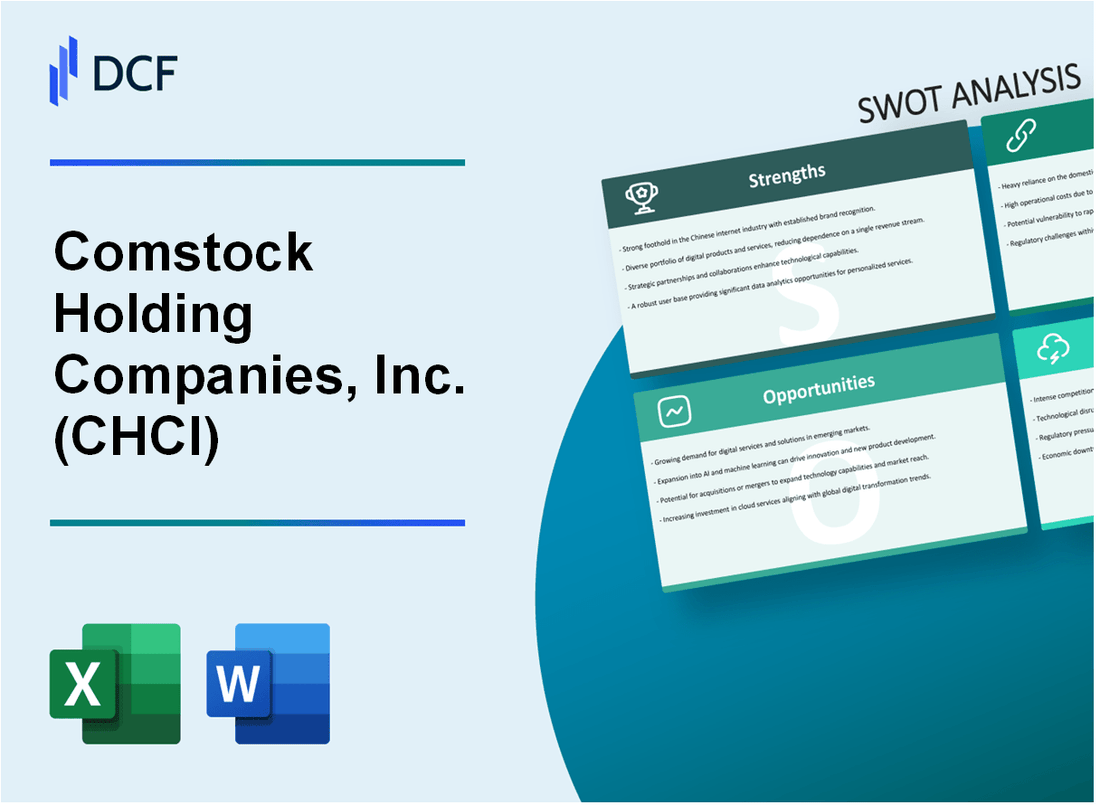
Comstock Holding Companies, Inc. (CHCI): SWOT Analysis [Apr-2026 Updated] |
Totalmente Editável: Adapte-Se Às Suas Necessidades No Excel Ou Planilhas
Design Profissional: Modelos Confiáveis E Padrão Da Indústria
Pré-Construídos Para Uso Rápido E Eficiente
Compatível com MAC/PC, totalmente desbloqueado
Não É Necessária Experiência; Fácil De Seguir
Comstock Holding Companies, Inc. (CHCI) Bundle
You need a clear-eyed view of Comstock Holding Companies, Inc. (CHCI) right now, especially with the real estate market still adjusting to higher interest rates. Here is the SWOT analysis, cutting straight to the core risks and opportunities.
Comstock Holding Companies, Inc. (CHCI) is facing a classic real estate dilemma: strong, high-quality assets in a great location versus a heavy debt load in a high-rate environment. The direct takeaway is that their strategic focus on transit-oriented development (TOD) in Northern Virginia is a powerful long-term advantage, but near-term liquidity and refinancing risk presents a defintely material challenge.
Strengths: The Power of Location and Recurring Income
CHCI's greatest strength is its concentrated asset base, specifically in high-growth Northern Virginia submarkets like Reston Station. This is not just any real estate; it's prime, mixed-use, transit-oriented development (TOD) property. This focus drives stable foot traffic and makes the properties sticky for tenants, which is a huge plus when office vacancies are a problem elsewhere. Plus, the recurring revenue from property management and leasing services provides a reliable cash flow stream, helping to service the debt.
The management team's deep regional expertise in the Washington D.C. Metro area real estate cycle is also a critical, non-financial asset. They know the local market better than most competitors, which is key to successful development and leasing. This localized knowledge helps them capitalize on the flight-to-quality trend, attracting tenants willing to pay a premium for modern, well-connected spaces.
Weaknesses: Debt and Concentration Risk
The biggest headwind for CHCI is the balance sheet. High leverage is a significant issue, with debt maturities coming due in the near-term. This presses liquidity and limits financial flexibility. For a company with a relatively small market capitalization-often less than $100 million-compared to major peers, this high debt load limits access to large-scale capital, making refinancing harder.
Also, the asset concentration risk is real. A downturn in the Northern Virginia commercial office market would hit CHCI hard because so much of their value is tied up there. To be fair, they are exposed to rising construction and labor costs, which squeezes development project margins. This isn't unique to CHCI, but it compounds the pressure on their smaller capital base.
Opportunities: Capitalizing on Market Distress
The current market environment, while challenging, presents clear opportunities. CHCI can capitalize on the flight-to-quality trend. As companies downsize and consolidate, they are choosing best-in-class, modern assets like those at Reston Station over older, less-amenitized buildings. This allows CHCI to maintain strong occupancy and rental rates.
Another smart move would be to expand asset management services to third-party owners. This grows fee income without needing to deploy CHCI's own capital, which is capital-constrained right now. Also, with interest rates stressing competitors, there's an opportunity to acquire distressed or undervalued commercial properties from overleveraged players in the region. The big opportunity, still, is the potential to refinance existing debt at better terms if the Federal Reserve pivots its interest rate policy in 2026, which could unlock significant cash flow.
Threats: Interest Rates and Vacancy Headwinds
The most immediate threat is persistent high interest rates. If they remain elevated, new development financing becomes prohibitively expensive, effectively stalling growth. This is a capital-intensive business, and the cost of capital is everything. Plus, office vacancy rates remaining elevated in the D.C. Metro area-currently hovering around 15% in some submarkets-challenges lease renewals and puts downward pressure on rents.
Increased competition from large, well-capitalized institutional investors entering the Northern Virginia market is also a threat. These players have deeper pockets and can often outbid or out-finance CHCI on new acquisitions or developments. Finally, regulatory changes, such as stricter zoning or environmental standards, could delay project approvals, turning a six-month timeline into a year, which is costly when carrying significant debt.
Actionable Next Step
Finance: Draft a detailed 13-week cash view by Friday, specifically modeling various refinancing scenarios for near-term debt maturities and quantifying the interest savings required to justify a 2026 debt pivot.
Comstock Holding Companies, Inc. (CHCI) - SWOT Analysis: Strengths
You're looking for a clear-eyed view of Comstock Holding Companies, Inc. (CHCI), and the core strength here is simple: they've cornered the market on premium, transit-adjacent real estate in one of the nation's most resilient economies. Their fee-based, asset-light model, coupled with deep regional expertise, creates a defintely reliable foundation for cash flow and future growth.
Concentrated asset base in high-growth Northern Virginia submarkets like Reston Station
Comstock Holding Companies, Inc. has strategically concentrated its portfolio in the fastest-growing segments of the Washington, D.C. Metro area, particularly Northern Virginia. This isn't just random land; it's a focus on trophy-class assets. The flagship Reston Station development stands out, recognized as among the largest and most prominent mixed-use, transit-oriented developments (TOD) in the Mid-Atlantic region. This concentration minimizes the risk of exposure to weaker submarkets in the broader D.C. area.
Here's the quick math on the value of this concentration:
- The JW Marriott Residences, a 94-unit luxury condominium tower at Reston Station, has already achieved nearly $90 million in sales.
- In a single month, September 2025, the company closed $20 million in sales at this property alone.
- The recent landmark lease with Booz Allen Hamilton, Inc. for its global headquarters covers over 310,000 square feet across two new Trophy-office towers at Reston Row Plaza.
Strong focus on mixed-use, transit-oriented development (TOD) assets, driving stable foot traffic
The company's focus on Transit-Oriented Development (TOD) assets-properties strategically located at key Metro stations-is a powerful structural advantage. These developments, like the 10 million square feet managed portfolio at full build-out, command premium rents and maintain high occupancy because they cater to the modern tenant's demand for a live-work-gather environment. This is a simple formula: put the office, residential, and retail spaces right next to the train, and people will use them.
The stability of the existing portfolio clearly reflects this strategy:
- Stabilized Commercial Managed Portfolio: 93% leased as of the end of Q3 2025.
- Residential Managed Portfolio Occupancy: 96% as of the end of Q3 2025.
- Average In-Place Residential Rent: Increased nearly 4% over the previous year as of Q3 2025.
Management's deep regional expertise in the Washington D.C. Metro area real estate cycle
Comstock Holding Companies, Inc. was founded in 1985, giving its leadership team, including CEO Chris Clemente, four decades of experience navigating the Washington, D.C. Metro real estate market. This is crucial because the D.C. market, with its unique government, defense, and technology sectors, operates on its own cycle. This deep regional knowledge allows them to secure and execute complex, large-scale public-private partnership developments that competitors often miss or can't manage effectively. The Row at Reston Station, Phase II of the development, was recognized as the largest privately-funded development in the region, which is a testament to this expertise.
Recurring revenue from property management and leasing services provides a defintely reliable cash flow stream
The shift to a fee-based, asset-light business model is the single biggest strength for financial stability. It means the company is less exposed to the capital-intensive, cyclical risks of pure property development and more reliant on steady, predictable management fees. This is a low-risk, high-reward structure that has allowed the company to operate with a debt-free balance sheet.
The growth in these recurring revenue streams is significant as of the 2025 fiscal year:
| Revenue Metric (Q3 2025) | Amount / Growth Rate | Commentary |
| Total Q3 2025 Revenue | $13.32 million | Increased 2.5% year-over-year. |
| Recurring, Fee-Based Revenue (YoY Growth) | Increased 30% | Includes property management and parking. |
| Fee-Based Revenue from Management Subsidiaries (YTD Growth) | Surged 37% | Growth for the first nine months of 2025. |
| Property Management Revenue (Q3 2025) | $2.89 million | A core component of the stable fee stream. |
| Parking Management (ParkX) Third-Party Revenue (YoY Growth) | Increased 96% | Shows successful expansion of the parking subsidiary. |
This fee structure has driven 27 consecutive quarters of year-over-year revenue growth, including 25 quarters with double-digit growth. That's a powerful track record of consistency.
Comstock Holding Companies, Inc. (CHCI) - SWOT Analysis: Weaknesses
Reliance on Highly-Leveraged Managed Assets (Off-Balance Sheet Risk)
You might expect a real estate company to be weighed down by debt, but Comstock Holding Companies, Inc. (CHCI) has intentionally structured itself as an asset-light, debt-free entity, a significant shift from its old model. This means the 'high leverage' risk doesn't sit on their balance sheet. Instead, the weakness is an indirect one: the stability of their recurring, fee-based revenue is tied to the financial health of the properties they manage for others-the Anchor Portfolio-which are heavily leveraged.
Their core business is collecting fees from the management of approximately 10 million square feet of assets at full build-out. If a downturn forces the property owners to restructure or default on their debt, CHCI's management contracts and incentive fees could be at risk. For a company with a net cash position of about $28 million as of November 2025, the risk is not insolvency, but a sudden, material drop in the fee revenue stream that drives their earnings. [cite: 12 in previous search]
Asset Concentration Risk in Northern Virginia
Comstock Holding Companies has a market-leading position in the Northern Virginia Dulles Corridor, particularly with flagship developments like Reston Station and Loudoun Station. [cite: 8 in previous search, 10 in previous search] While this focus has been a strength-it capitalizes on the growth around Metro's Silver Line-it also creates a massive concentration risk. If the Northern Virginia commercial office market sees a significant downturn, the impact on CHCI's fee revenue would be immediate and severe. [cite: 8 in previous search]
Their business is not diversified geographically, so a local economic shock-like a major federal contractor downsizing or a sustained drop in demand for Trophy Class office space-would hit hard. To be fair, their stabilized portfolio is currently performing well, with the Commercial portfolio 93% leased and the Residential portfolio 96% leased as of Q3 2025, but this concentration is still a single point of failure.
Relatively Small Market Capitalization Limiting Capital Access
As of November 2025, Comstock Holding Companies' market capitalization hovers around $130 million to $170 million, firmly placing it in the Micro-Cap category. [cite: 3 in previous search, 4 in previous search, 5 in previous search] This small size is a structural weakness. It limits their access to the large-scale, institutional capital markets that major Real Estate Investment Trusts (REITs) and larger competitors use to fund massive acquisitions or developments.
Here's the quick math: a market cap of $130.62 million (as of November 19, 2025) [cite: 6 in previous search] makes the stock less liquid and more volatile. This size also means institutional ownership remains relatively low, at around 6.45% as of late 2025, which can exacerbate price swings and make it harder to raise equity for their own co-investments or strategic acquisitions. [cite: 6 in previous search] Small-cap stocks are just riskier. [cite: 12 in previous search]
Exposure to Rising Construction and Labor Costs, Squeezing Development Project Margins
Despite the fee-based model being less capital-intensive, CHCI is still exposed to rising costs through its development and property management services, which include construction management. This is defintely a real-world problem. In the third quarter of 2025, the company reported a notable increase in operating costs and expenses, which squeezed net income.
The rise in costs was substantial, with operating costs and expenses increasing by 24.5% in Q3 2025 compared to the prior year. This nearly $2.5 million comparative increase was primarily driven by a $1.7 million net increase in personnel-related expenses, which included the onboarding costs for 139 new ParkX employees to staff new service offerings. While this investment supports new revenue streams, it immediately compresses margins, showing the vulnerability to labor market pressures.
| Financial Metric (Q3 2025) | Value (Q3 2025) | Comparative Impact |
|---|---|---|
| Total Revenue | $13.3 million | Increased 2.5% vs. Q3 2024 |
| Operating Costs & Expenses Increase | $2.5 million | Increased 24.5% vs. Q3 2024 |
| Personnel-Related Expense Increase | $1.7 million | Primary driver of cost increase |
| Net Income | $0.5 million | Decreased from $2.4 million in Q3 2024 |
Key cost pressures include:
- Labor Shortages: Requiring significant wage increases and new hiring (like the 139 new ParkX employees) to meet contract demands.
- Construction Cost Inflation: The broader construction industry anticipates cost increases between 3% to 6% in 2024 and likely higher into 2025, which directly impacts the profitability of their development pipeline projects. [cite: 16 in previous search]
Next Step: Strategy Team: Model a 10% vacancy rate scenario for the Anchor Portfolio to quantify the maximum potential fee revenue loss by the end of Q2 2026.
Comstock Holding Companies, Inc. (CHCI) - SWOT Analysis: Opportunities
Capitalize on the flight-to-quality trend, attracting tenants to new, modern assets like Reston Station.
You are seeing a massive bifurcation in commercial real estate, where older, less-amenitized buildings are struggling while new, transit-oriented, and high-quality properties are thriving. Comstock Holding Companies, Inc. is perfectly positioned to capture this flight-to-quality. Their stabilized commercial managed portfolio is already 93% leased as of the third quarter of 2025, which is a stark contrast to the Washington, D.C. Metropolitan area's overall office vacancy rate of 18.0% in the same period.
The flagship Reston Station development, a ~$1.5 billion project, is the core opportunity here. The recent landmark lease with Booz Allen Hamilton to relocate its global headquarters to Reston Station, occupying over 310,000 square feet across two Trophy-office towers, validates the premium nature of these assets. This major commitment, alongside the Q3 2025 delivery of the JW Marriott Reston Station, provides a clear runway for continued leasing momentum and higher fee generation.
Expand asset management services to third-party owners, growing fee income without needing capital.
The company's asset-light business model is a significant advantage, allowing revenue growth with minimal capital expenditure risk. The opportunity is to aggressively scale the third-party asset management business, moving beyond the core Comstock Partners, LC relationship. The financial results from 2025 show this strategy is working: total recurring fee-based revenue increased by 30% year-over-year in the third quarter of 2025.
This growth is fueled by subsidiaries like ParkX Management, which saw its third-party revenue surge by 96% in Q3 2025. Here's the quick math: if they continue to capture new third-party contracts at this rate, they get a high-margin, predictable income stream. The long-term goal is to manage a portfolio of approximately 10 million square feet with a fair market value exceeding $5 billion at full build-out, which represents a huge increase in potential fee income.
- Recurring fee-based revenue: Up 30% YoY in Q3 2025.
- ParkX third-party revenue: Up 96% in Q3 2025.
- Target managed portfolio: 10 million square feet at full build-out.
Acquire distressed or undervalued commercial properties from overleveraged competitors in the region.
The current market environment is creating a perfect hunting ground for a financially strong operator. The Washington, D.C. metro area is experiencing significant commercial distress, with a total office vacancy rate of 18.0% in Q3 2025, and net negative absorption of -714,170 square feet in the same quarter. This means many competitors are overleveraged on outdated or poorly located assets.
Comstock Holding Companies, Inc.'s debt-free balance sheet as of June 30, 2025, plus a cash position of approximately $28 million in Q1 2025, gives them the dry powder to move quickly on distressed, value-add opportunities. The strategy is to acquire these properties at a discount and then immediately bring them into the asset management portfolio for a fee, or redevelop them into high-performing, transit-oriented assets that align with the flight-to-quality trend. This is a defintely a time to be a buyer.
| D.C. Metro Office Market Metric (Q3 2025) | Value | Implication for CHCI |
| Total Vacancy Rate | 18.0% | High distress creates motivated sellers. |
| Net Absorption (Q3 2025) | -714,170 SF | Weak demand outside of Trophy-Class assets. |
| CHCI Stabilized Commercial Portfolio Leased % (Q3 2025) | 93% | Proof of concept for premium assets. |
Refinance existing debt at better terms as the Federal Reserve potentially pivots its interest rate policy in 2026.
While Comstock Holding Companies, Inc. has no outstanding debt as of mid-2025, the opportunity here is not refinancing, but securing new capital for growth at favorable rates. The Federal Reserve has already begun a pivot, with the benchmark interest rate dropping into the 3.75% to 4.0% range as of October 2025.
Analysts are forecasting additional rate cuts, with institutions like J.P. Morgan Asset Management expecting the Fed to reduce rates 2-3 times through 2026, potentially bringing them into the 3.0%-3.25% range. This anticipated decline in borrowing costs in 2026 is a green light for CHCI to leverage its pristine balance sheet. They can draw on their undrawn $10.0 million revolving credit facility, which expires in March 2030, or secure a much larger, low-cost institutional loan to fund the acquisition of distressed assets, maximizing their return on investment. The market is thawing, and cheap debt is coming back.
Comstock Holding Companies, Inc. (CHCI) - SWOT Analysis: Threats
The primary threats to Comstock Holding Companies, Inc. (CHCI) stem from the broader macroeconomic environment and the persistent structural challenges in the Washington, D.C. Metro area's commercial real estate (CRE) market. While Comstock's asset-light, fee-based model provides a buffer, these external forces still impact the value of the assets it manages and the feasibility of new development projects.
Persistent high interest rates making new development financing prohibitively expensive.
You need to be a realist about the cost of capital, even with Comstock's relatively debt-free balance sheet. While Comstock Holding Companies has reported 'zero debt' and a net cash position of $28 million as of late 2025, the market-wide cost of construction financing remains a major headwind for new projects and for Comstock's institutional partners.
Construction loans, which Comstock's partners would use for new developments, are currently priced aggressively, with rates generally falling in the range of 7.5% to 13% depending on the risk profile and asset class, as of Q4 2025. This cost environment increases the required return on equity for any new development, making many projects unfeasible and slowing the pipeline of assets Comstock might manage in the future. For stabilized properties, average bank loan rates are in the 6.5% to 7.25% range, which still pressures valuations and refinancing for existing assets in the D.C. Metro area. That's a high hurdle for a new project to clear.
Office vacancy rates remaining elevated in the D.C. Metro area, challenging lease renewals.
The D.C. Metro office market continues to struggle with elevated vacancy, driven by hybrid work models and federal government space reduction. This is a direct threat to the fee revenue Comstock earns from managing commercial properties.
As of Q3 2025, the overall office vacancy rate in the Washington D.C. Metropolitan Area is high, ranging from 18.0% to 22.1% depending on the reporting firm. More critically, the region recorded a year-to-date net negative absorption of up to negative 1.4 million square feet in 2025, indicating that more space is being vacated than leased. While Comstock's Stabilized Commercial managed portfolio maintains a strong 93% leased percentage, this market pressure makes lease renewals difficult and favors short-term deals.
For example, in Q3 2025, approximately 67% of all renewal activity in the D.C. market was for short-term leases, which highlights a pervasive lack of long-term commitment from tenants. This trend forces Comstock to constantly work harder to maintain its high occupancy rates and puts a cap on potential rent growth.
| D.C. Metro Office Market Metric | Q3 2025 Value | Implication for CHCI |
|---|---|---|
| Overall Vacancy Rate | Up to 22.1% | High competition for tenants and downward pressure on rents. |
| Year-to-Date Net Absorption | Up to negative 1.4 M SF | Market contraction, limiting new leasing opportunities. |
| CHCI Stabilized Commercial Portfolio Leased | 93% | Outperforming the market, but exposed to regional volatility. |
| Construction Loan Interest Rate Range | 7.5% to 13.0%+ | Increases development costs for partners and slows new project starts. |
Increased competition from large, well-capitalized institutional investors entering the Northern Virginia market.
Northern Virginia is considered a resilient and investable region, making it a magnet for global capital. This influx of large, well-funded institutional investors poses a threat because they can outbid Comstock's partners on new acquisitions or development sites and offer highly competitive tenant concessions.
These players, such as PGIM Real Estate-which manages $137 billion in assets and raised a $1 billion core-plus real estate fund for markets like Virginia-have a cost of capital advantage and a longer investment horizon. They are specifically targeting 'stabilized Class A assets in core corridors,' the exact segment where Comstock operates. The total sales transactions in the D.C. Metro area reached $800,960,000 in Q3 2025, reflecting significant capital chasing deals. To be fair, Comstock's low institutional ownership of only 6.45% suggests its stock value is currently less exposed to the whims of these large funds, but their market presence still raises the competitive bar for all real estate activities in the region.
Regulatory changes, such as stricter zoning or environmental standards, delaying project approvals.
Comstock's concentration in the D.C. Metro area, particularly Northern Virginia, exposes it to significant regional and regulatory volatility. The complexity of local zoning and approval processes can lead to costly delays or outright cancellation of projects, impacting the future pipeline of managed assets.
A concrete example of this risk is the recent judicial voiding of the Prince William Digital Gateway approval in Virginia. This 1,700-acre, $2.2 billion development was put on hold due to a regulatory issue-inadequate public notice-even for a highly desirable asset class like data centers. This demonstrates that even massive, well-funded projects are vulnerable to local regulatory hurdles. Furthermore, the massive power demand from the region's data center boom, which is projected to double to 35 gigawatts by 2030, is prompting utility-related infrastructure and environmental planning from Dominion Energy, which could lead to new, stricter environmental or utility-related zoning standards that delay future mixed-use developments.
- A Virginia judge voided the $2.2 billion Prince William Digital Gateway approval in 2025, citing inadequate public notice.
- New environmental standards are likely due to projected power demand doubling to 35 gigawatts by 2030.
- Geographic concentration in the D.C. Metro area exposes the company to specific regional volatility.
Disclaimer
All information, articles, and product details provided on this website are for general informational and educational purposes only. We do not claim any ownership over, nor do we intend to infringe upon, any trademarks, copyrights, logos, brand names, or other intellectual property mentioned or depicted on this site. Such intellectual property remains the property of its respective owners, and any references here are made solely for identification or informational purposes, without implying any affiliation, endorsement, or partnership.
We make no representations or warranties, express or implied, regarding the accuracy, completeness, or suitability of any content or products presented. Nothing on this website should be construed as legal, tax, investment, financial, medical, or other professional advice. In addition, no part of this site—including articles or product references—constitutes a solicitation, recommendation, endorsement, advertisement, or offer to buy or sell any securities, franchises, or other financial instruments, particularly in jurisdictions where such activity would be unlawful.
All content is of a general nature and may not address the specific circumstances of any individual or entity. It is not a substitute for professional advice or services. Any actions you take based on the information provided here are strictly at your own risk. You accept full responsibility for any decisions or outcomes arising from your use of this website and agree to release us from any liability in connection with your use of, or reliance upon, the content or products found herein.