

|
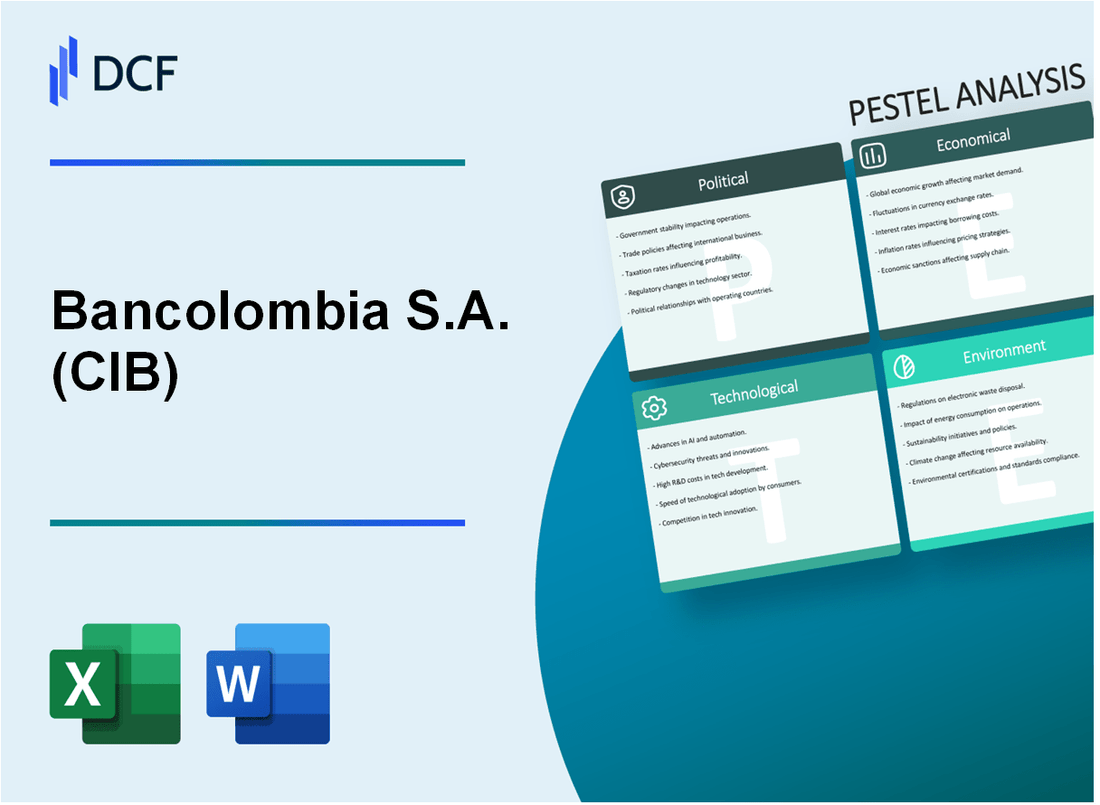
Bancolombia S.A. (CIB): Análise de Pestle [Jan-2025 Atualizada] |
Totalmente Editável: Adapte-Se Às Suas Necessidades No Excel Ou Planilhas
Design Profissional: Modelos Confiáveis E Padrão Da Indústria
Pré-Construídos Para Uso Rápido E Eficiente
Compatível com MAC/PC, totalmente desbloqueado
Não É Necessária Experiência; Fácil De Seguir
Bancolombia S.A. (CIB) Bundle
No cenário dinâmico do setor bancário colombiano, o Bancolombia S.A. se destaca como uma instituição financeira fundamental que navega por fatores interdependentes complexos que moldam sua trajetória estratégica. De reformas políticas às inovações tecnológicas, essa análise abrangente de pestles revela o ambiente externo multifacetado que influencia o ecossistema operacional do banco, revelando o quão complexa a dinâmica global e local se cruzam para desafiar e impulsionar a jornada transformadora de Bancolombia em um mundo financeiro cada vez mais interconectado.
Bancolombia S.A. (CIB) - Análise de Pestle: Fatores Políticos
A estabilidade política da Colômbia e o impacto do setor bancário
Em 2024, o índice de risco político da Colômbia é de 58,4 em 100, indicando estabilidade política moderada. O ambiente operacional da Bancolombia é diretamente influenciado por esse cenário político.
| Indicador de risco político | Valor |
|---|---|
| Índice de Estabilidade Política | 58.4 |
| Índice de Percepção de Corrupção do Governo | 39/100 |
| Pontuação da qualidade regulatória | 52.4 |
Regulamentos bancários do governo
Regulamentos de transparência financeira tornaram -se cada vez mais rigorosos no setor bancário da Colômbia.
- Os custos de conformidade de lavagem de dinheiro para os bancos aumentaram 12,3% em 2023
- Requisitos obrigatórios de relatório de transações digitais expandidas
- Protocolos aprimorados de conhecimento do seu cliente (KYC) implementados
Negociações de paz e reformas econômicas
As reformas econômicas em andamento da Colômbia afetam diretamente as estratégias de investimento bancário.
| Área de Reforma Econômica | Impacto no investimento |
|---|---|
| Financiamento regional de desenvolvimento | US $ 2,1 bilhões alocados |
| Incentivos de investimento estrangeiro | 15% de redução de impostos para novos investimentos |
Políticas monetárias do banco central
As políticas monetárias do Banco Central da Colômbia influenciam significativamente o desempenho do setor bancário.
- Taxa de juros do banco central: 13,25% em janeiro de 2024
- Faixa alvo de inflação: 2-4%
- Taxa de requisitos de reserva para bancos: 11,25%
O posicionamento estratégico do Bancolombia requer adaptação contínua a essas complexas dinâmicas políticas e regulatórias.
Bancolombia S.A. (CIB) - Análise de pilão: Fatores econômicos
A recuperação econômica da Colômbia apoia o crescimento do setor bancário
A taxa de crescimento do PIB da Colômbia em 2023 atingiu 2,5%. O total de ativos do setor bancário aumentou para 612,2 trilhões de pesos colombianos. Os ativos totais do Bancolombia a partir do terceiro trimestre de 2023 foram de 156,1 trilhões de pesos colombianos.
| Indicador econômico | 2023 valor | Mudança ano a ano |
|---|---|---|
| Taxa de crescimento do PIB | 2.5% | +0.8% |
| Setor Bancário Total de Ativos | 612,2 trilhões de policiais | +7.3% |
| Bancolombia Total de ativos | 156,1 trilhões de policiais | +5.9% |
As taxas de câmbio flutuantes criam desafios e oportunidades para operações bancárias internacionais
A taxa de câmbio do USD/COP em média de 4.532,45 em 2023. Operações internacionais da Bancolombia geraram 23,7% da receita total das transações transfronteiriças.
| Métricas de moeda | 2023 valor |
|---|---|
| Taxa de câmbio médio de USD/COP | 4,532.45 |
| Contribuição da receita internacional | 23.7% |
As tendências de inflação e taxa de juros afetam significativamente as estratégias de empréstimos e investimentos da Bancolombia
A taxa de inflação da Colômbia em 2023 foi de 9,62%. A taxa de juros do banco central ficou em 13,25% no final de 2023. A carteira de empréstimos da Bancolombia cresceu 12,4% durante o mesmo período.
| Indicador financeiro | 2023 valor |
|---|---|
| Taxa de inflação | 9.62% |
| Taxa de juros do banco central | 13.25% |
| Crescimento da carteira de empréstimos de Bancolombia | 12.4% |
A economia digital crescente impulsiona a inovação do serviço financeiro e a expansão do mercado
As transações bancárias digitais aumentaram 35,2% em 2023. Os usuários da plataforma digital da Bancolombia atingiram 7,3 milhões, representando 62% da base total de clientes.
| Métricas bancárias digitais | 2023 valor |
|---|---|
| Crescimento da transação digital | 35.2% |
| Usuários da plataforma digital | 7,3 milhões |
| Porcentagem de usuário digital | 62% |
Bancolombia S.A. (CIB) - Análise de pilão: Fatores sociais
O aumento da alfabetização digital entre a população colombiana impulsiona a adoção do banco digital
Em 2023, a taxa de alfabetização digital da Colômbia atingiu 67,2%, com 35,7 milhões de usuários da Internet representando 69% da população total. A penetração da Internet móvel é de 63,4%.
| Métrica de alfabetização digital | Percentagem | Usuários totais |
|---|---|---|
| Penetração na Internet | 69% | 35,7 milhões |
| Usuários móveis da Internet | 63.4% | 32,8 milhões |
| Usuários bancários digitais | 42.5% | 22 milhões |
Mudanças demográficas para clientes mais jovens e experientes em tecnologia reformulam modelos de serviços bancários
A idade média da Colômbia é de 31,6 anos, com 62,5% da população com menos de 35 anos. A geração do milênio e a geração Z representam 45% dos clientes bancários.
| Segmento demográfico | Percentagem | Faixa etária |
|---|---|---|
| Abaixo de 35 população | 62.5% | 0-35 anos |
| Idade mediana | 31,6 anos | N / D |
| Clientes bancários milenares/gen z | 45% | 18-40 anos |
A crescente desigualdade de renda influencia a acessibilidade e o design do produto bancário
O coeficiente de Gini da Colômbia é de 0,517, indicando uma desigualdade significativa de renda. Os 10% principais da população detêm 40,5% da renda nacional.
| Métrica de desigualdade de renda | Valor |
|---|---|
| Coeficiente de Gini | 0.517 |
| Tain 10% de participação de renda | 40.5% |
| Salário mensal mínimo | Policial 1.160.000 |
O aumento da migração urbana cria novos segmentos de mercado de serviços financeiros
A população urbana na Colômbia atingiu 77,1% em 2023, com 38,5 milhões de pessoas vivendo em áreas urbanas. As principais cidades como Bogotá, Medellín e Cali dirigem a inovação de serviços financeiros.
| Métrica de migração urbana | Percentagem | População total |
|---|---|---|
| População urbana | 77.1% | 38,5 milhões |
| População rural | 22.9% | 11,5 milhões |
| Penetração bancária urbana | 85.3% | 32,8 milhões |
Bancolombia S.A. (CIB) - Análise de Pestle: Fatores tecnológicos
Investimento significativo em plataformas bancárias fintech e digital
Em 2023, a Bancolombia investiu 362,5 milhões de COP em iniciativas de transformação digital. A plataforma digital do banco processou 1,2 bilhão de transações em 2023, representando um aumento de 42% em relação a 2022.
| Métrica da plataforma digital | 2022 Valor | 2023 valor | Porcentagem de crescimento |
|---|---|---|---|
| Transações digitais | 845 milhões | 1,2 bilhão | 42% |
| Usuários bancários digitais | 4,8 milhões | 5,6 milhões | 16.7% |
| Downloads de aplicativos bancários móveis | 2,3 milhões | 3,1 milhões | 34.8% |
Inteligência artificial e aprendizado de máquina
A Bancolombia implantou modelos de avaliação de risco movidos a IA que reduziram o tempo de avaliação de risco de crédito em 67%. Os algoritmos de aprendizado de máquina processaram 3,2 milhões de interações com os clientes em 2023, melhorando a precisão da resposta em 54%.
| Métrica de desempenho da IA | 2023 valor |
|---|---|
| Redução de tempo de avaliação de risco | 67% |
| Processamento de interação do cliente | 3,2 milhões |
| Melhoria da precisão da resposta | 54% |
Foco de segurança cibernética
A Bancolombia alocou 214,7 milhões de policiais à infraestrutura de segurança cibernética em 2023. O Banco impediu 98,6% das ameaças cibernéticas em potencial, bloqueando 12.500 tentativas de violação de segurança.
Blockchain e exploração de criptomoeda
A Bancolombia investiu 45,3 milhões de policiais na infraestrutura de transações de Blockchain Research and Cryptocurrency. O banco processou 78.000 transações relacionadas à criptomoeda em 2023, representando um aumento de 36% em relação a 2022.
| Métrica de investimento em blockchain | 2023 valor |
|---|---|
| Blockchain Research Investment | 45,3 milhões de policiais |
| Transações de criptomoeda | 78,000 |
| Crescimento da transação | 36% |
Bancolombia S.A. (CIB) - Análise de Pestle: Fatores Legais
Regulamentos bancários rígidos da superintendência financeira colombiana
A Superintendencia Fina Financhera de Colômbia (SFC) impõe Requisitos de adequação de capital Basileia III com mandatos específicos:
| Métrica regulatória | Porcentagem necessária | Nível de conformidade da Bancolombia |
|---|---|---|
| Índice de capital mínimo | 9.0% | 11.2% |
| Índice de capital de camada 1 | 6.0% | 8.5% |
| Índice de cobertura de liquidez | 100% | 135% |
Conformidade com os padrões internacionais de lavagem de dinheiro
Bancolombia adere a Recomendações do GAFI (Força -Tarefa de Ação Financeira):
| Área de conformidade | Investimento anual | Relataram transações suspeitas |
|---|---|---|
| Infraestrutura de tecnologia da AML | COP 52,3 bilhão | 3.745 relatórios em 2023 |
| Treinamento da equipe de conformidade | Policial 8,6 bilhões | 1.200 funcionários treinados |
Leis de proteção de dados impacto
Conformidade com Lei de Proteção de Dados Colombianos (Lei 1581):
- 100% de criptografia de dados do cliente
- Orçamento anual de segurança cibernética: policial 37,5 bilhões
- Oficiais dedicados de proteção de dados: 45 profissionais
Requisitos regulatórios bancários sustentáveis e éticos
Métricas de conformidade regulatória para bancos sustentáveis:
| Métrica de sustentabilidade | Alvo regulatório | Desempenho da Bancolombia |
|---|---|---|
| Portfólio de crédito verde | 15% do empréstimo total | 18,3% de conquista |
| ESG RELATÓRIO CONSELHAÇÃO | Divulgação completa | 100% de conformidade |
| Redução de emissão de carbono | Redução de 20% até 2025 | 12,7% de redução alcançada |
Bancolombia S.A. (CIB) - Análise de Pestle: Fatores Ambientais
Compromisso crescente com iniciativas bancárias sustentáveis e de finanças verdes
Em 2023, a Bancolombia cometeu 7,1 trilhões de pesos colombianos em projetos de financiamento sustentável. A emissão de títulos verdes do banco atingiu 500 milhões de dólares no mesmo ano. O financiamento sustentável representou 17,4% da carteira total de empréstimos do banco.
| Métrica financeira sustentável | 2023 valor |
|---|---|
| Total de financiamento sustentável | 7,1 trilhões de policiais |
| Emissão de títulos verdes | 500 milhões de dólares |
| Porcentagem de carteira de empréstimo sustentável | 17.4% |
Estratégias de redução de pegada de carbono em operações bancárias
A Bancolombia reduziu suas emissões operacionais de carbono em 42,3% em 2023 em comparação com a linha de base de 2018. O banco alcançou 100% de consumo de energia renovável em suas operações, com 23 megawatts de geração direta de energia renovável.
| Métrica de redução de carbono | 2023 valor |
|---|---|
| Redução de emissões de carbono | 42.3% |
| Consumo de energia renovável | 100% |
| Geração de energia renovável direta | 23 MW |
Apoiar projetos de energia renovável e de desenvolvimento sustentável
Em 2023, a Bancolombia financiou 15 projetos de energia renovável, totalizando 872 MW de capacidade instalada. O Banco investiu 1,2 trilhão de COP no desenvolvimento de infraestrutura solar e de energia eólica.
| Investimento de energia renovável | 2023 valor |
|---|---|
| Número de projetos renováveis | 15 |
| Capacidade total instalada | 872 MW |
| Investimento em infraestrutura renovável | 1,2 trilhão de policiais |
Avaliação de riscos ambientais integrados às decisões de empréstimos e investimentos
A Bancolombia implementou a avaliação de risco ambiental, social e de governança (ESG) para 98,6% de seu portfólio de empréstimos corporativos em 2023. O Banco rejeitou 42 propostas de financiamento de projetos devido a preocupações de risco ambiental.
| Métrica de gerenciamento de riscos ambientais | 2023 valor |
|---|---|
| Cobertura de avaliação de risco ESG | 98.6% |
| Projetos rejeitados devido a riscos ambientais | 42 |
Bancolombia S.A. (CIB) - PESTLE Analysis: Social factors
High demand for financial inclusion, especially in rural and underserved areas
The drive for financial inclusion, or inclusión financiera, remains a critical social mandate in Colombia, presenting both a challenge and a massive growth opportunity for Bancolombia. While access to deposit products is near-universal in urban areas, a significant disparity persists in rural settings, where only 65.6% of the population has access to deposits, as of the 2024 Financial Inclusion Report. This wide urban-rural gap, coupled with poor mobile connectivity in remote areas, means the bank must prioritize non-traditional and digital-first strategies to reach the remaining population.
Bancolombia's strategy to bridge this gap relies heavily on its network and digital products. The bank operates over 34,604 banking agents (corresponsales bancarios) as of September 30, 2024, which are essential for providing basic services in remote municipalities. Additionally, its digital deposit product, Bancolombia A La Mano (BALM), had over 6.36 million clients in 2023, demonstrating the scale of demand for simple, low-cost financial tools among the previously unbanked. Honestly, closing that 34.4% rural access gap is a clear path to market share growth.
| Colombian Financial Inclusion Gap (2024) | Access to Deposit Products |
|---|---|
| Urban Areas | Universal Access |
| Rural Areas | 65.6% |
| Gender Gap (Men vs. Women) | 6.9 percentage points (99.4% vs. 92.5%) |
Bancolombia serves a massive base of over 32 million customers, requiring diverse product offerings
Bancolombia's immense scale dictates a complex, multi-segment product strategy. As of September 30, 2024, Grupo Bancolombia served more than 32 million customers across Colombia and Central America. This customer base is highly diversified, spanning retail individuals, microenterprises, and large corporate clients, which helps the bank withstand a cooling economy.
Serving such a vast and varied population requires a full spectrum of financial services, from micro-credit for small business owners to sophisticated investment banking products. This is why the bank is structured into multiple operating segments, including Banking Colombia, Banking Panama, Banking El Salvador, Banking Guatemala, Trust, Investment banking, and Brokerage. The sheer size of the customer base means a one-size-fits-all approach is defintely not an option.
Growing middle class drives demand for mortgages and wealth management products
The gradual expansion of the middle class in Colombia continues to shift the social demand from basic savings to more complex, long-term financial products. This demographic is actively seeking to build wealth and secure assets, directly increasing demand for mortgages, consumer loans, and wealth management services. The bank is positioning itself to capture this growth.
For example, in the fourth quarter of 2024, home lending posted the largest growth in the bank's loan portfolio, a direct result of reduced interest rates making housing more accessible. Overall, the bank forecasts a consolidated loan growth of 5.6% for the 2025 fiscal year, driven partly by this recovering consumer and home-buying segment. This trend demands that Bancolombia continually refine its digital advisory tools and expand its investment offerings to cater to a more financially sophisticated clientele.
Increased public scrutiny on bank fees and transparency, necessitating empathetic communication
The social contract between banks and consumers is under constant pressure, particularly concerning fees, interest rates, and transparency. Public scrutiny is high, especially as households contend with persistent asset quality pressure due to weakening income capacity and rising debt. This environment necessitates a focus on empathetic communication and clear pricing structures to maintain public trust.
The regulatory focus on consumer protection is evident with the election of the Financial Consumer Ombudsman for the 2023-2025 period, signaling continued oversight of banking practices. To mitigate reputational risk and avoid regulatory fines, Bancolombia must focus on:
- Simplifying complex product disclosures.
- Proactively managing non-performing assets (NPAs), which are projected to be around 3.3% to 3.5% in 2024-2025.
- Prioritizing customer support to address debt concerns before they escalate.
What this estimate hides is the potential for social media backlash to amplify any perceived unfairness in fees or lending practices.
Bancolombia S.A. (CIB) - PESTLE Analysis: Technological factors
The Nequi digital platform continues its rapid expansion, now exceeding 21 million users.
You cannot discuss Bancolombia's technology without starting with Nequi. This digital neobank, which operates as a separate business unit, has become a core strategic asset, not just a side project. It's a massive driver for financial inclusion and a clear competitive advantage in the digital space.
As of 2025, Nequi serves over 21.3 million customers, a figure that represents a significant portion of Colombia's adult population. This scale is what makes the platform so valuable. It allows Bancolombia to reach the unbanked and underbanked segments of the market, which is a huge growth area. This twin growth-the traditional bank serving over 30 million customers and Nequi's separate digital base-is the key to their overall strategy.
Here's the quick math: Nequi's growth trajectory has been explosive, and it's now a major player in the payments ecosystem, cornering a market share that few incumbent banks in the region can match. They are defintely a digital powerhouse. One clean one-liner: Nequi is a digital moat around Bancolombia's customer base.
Significant annual investment in cybersecurity to protect the vast digital customer base.
With a user base of over 30 million across the Group, including Nequi, the risk profile is enormous. Bancolombia's response is to treat cybersecurity not as a cost center, but as a strategic enabler of digital growth. They have a dedicated Technology and Cybersecurity Committee, which reports directly to the Board, showing you how seriously they take digital trust. The scale of the national challenge is clear: the Colombian Digital Transformation Plan (2022-2026) allocates USD 1.2 billion toward general ICT development, a substantial share of which is for cybersecurity, and Bancolombia is a leading employer in this high-demand field.
The investment focus is on hardening the infrastructure against increasingly sophisticated attacks, especially those leveraging valid credentials or infostealers, which are on the rise globally. This focus on digital security is directly tied to business results; internal automation projects have already cut operational risk by around 28%, which is a material gain in efficiency and safety.
Adoption of Artificial Intelligence (AI) and machine learning for credit scoring and fraud detection.
The bank is rapidly deploying Artificial Intelligence (AI) and machine learning (ML) capabilities, not just for customer service, but for core banking functions like risk and credit. This is where the rubber meets the road for profitability and financial inclusion. They are using Generative AI (Gen AI) to drive operational excellence, plus they have an internal Center of Excellence in Artificial Intelligence to ensure these capabilities are deployed across the organization.
The impact of this technology is immediate and measurable:
- AI fraud engines can reduce false positives by 50-70%.
- AI-driven credit models improve predictive power by 20-30% for thin-file customers.
- The use of alternative data allows for faster, more inclusive credit decisions.
Open Banking framework development is a near-term priority for data sharing.
The regulatory environment in Colombia is accelerating the shift to Open Finance, or Open Banking, which mandates secure, consent-based data sharing. What started as a voluntary initiative in Colombia is moving to a mandatory framework, which is a huge near-term consideration for Bancolombia. The draft decree for this mandatory Open Finance System was published for public consultation until July 4, 2025.
The formal issuance of the decree will trigger a phased implementation, with payment initiation services expected to be implemented within twelve months of the final decree. Bancolombia is already ahead of the curve, evolving its business model to participate in these collaborative opportunities, including Banking-as-a-Service. They are enabling customers to consolidate accounts from other providers within their own app, setting the stage for a more competitive, data-driven financial ecosystem.
Here is a summary of the key technological metrics and their impact on Bancolombia's strategic position as of the 2025 fiscal year:
| Technological Metric | 2025 Fiscal Year Data/Target | Strategic Impact |
|---|---|---|
| Nequi Customer Base | Over 21.3 million users | Dominates digital financial inclusion; secures a massive, digitally-native customer funnel. |
| AI-Driven Operational Risk Reduction | Approximately 28% reduction in operational risk via automation projects | Directly lowers operating expenses and enhances platform stability and security. |
| AI Credit Scoring Predictive Power | Improvement of 20-30% with alternative data models | Unlocks credit access for thin-file customers, expanding the addressable market while managing risk. |
| Open Finance Framework Status | Draft decree published; payment initiation services implementation expected within 12 months of formal decree | Mandates data-sharing, forcing the bank to optimize its Open API strategy to maintain market share against FinTechs. |
| Cloud Migration Progress | Around 79% into the cloud journey in Colombia | Increases scalability, reduces time-to-market for new products, and improves cost efficiencies. |
Bancolombia S.A. (CIB) - PESTLE Analysis: Legal factors
New regulations for consumer data protection and privacy are being drafted, increasing compliance costs
You need to anticipate a significant jump in compliance spending, defintely in the data and privacy realm. Colombia is rapidly moving toward a mandatory Open Finance system, which fundamentally changes how Bancolombia S.A. must handle customer data. The Financial Regulation Unit (URF) published a new draft decree for public consultation until July 4, 2025, proposing a mandatory data-sharing framework for all financial entities. This means Bancolombia must invest heavily in new Application Programming Interfaces (APIs) and security protocols to comply with the mandated data standardization and secure exchange.
Plus, the Superintendence of Industry and Commerce (SIC) issued External Circular No. 01 of 2025, which tightens the rules for data processing in digital financial services. This circular mandates the principle of data minimization, meaning you can only collect data strictly necessary for the service. For example, a digital wallet application like Nequi (which had 23.5 million accounts as of March 31, 2025) cannot access a user's image gallery or contact list for collection purposes. Non-compliance is costly; SIC sanctions rose by 22% in 2024, showing regulators are serious.
Here's a quick look at the new consumer privacy restrictions that require immediate system updates:
- Debt collection contact is limited to once per day and through a single authorized channel per week.
- Permitted contact hours are restricted to Monday through Friday from 7:00 am to 7:00 pm, and Saturdays from 8:00 am to 3:00 pm.
- Strict rules for processing sensitive data like biometrics require explicit, differentiated consent.
Implementation of stricter anti-money laundering (AML) and know-your-customer (KYC) protocols
The regulatory pressure on Anti-Money Laundering (AML) and Counter-Terrorist Financing (CTF) is tightening, driven by the Financial Information and Analysis Unit (UIAF) and the Superintendencia Financiera de Colombia (SFC). Bancolombia must continuously enhance its compliance technology to keep up. The cost of failure is steep: penalties for breaches of international payment regulations can reach up to 200% of the transaction value. Fines for stablecoin non-compliance alone topped USD 1.5 million last year, reflecting the rising enforcement risk.
The focus is shifting to digital assets and real-time payments. A bill to regulate Virtual Asset Service Providers (VASPs) was introduced in February 2025, requiring a formal registration system and stronger AML controls for digital asset transactions. For any transactions involving crypto that exceed USD 150, mandatory reporting and full sender/recipient data capture are now required. Bancolombia, as a major financial intermediary, is on the hook for ensuring these controls are embedded across all its digital channels, including the immediate payment system, Bre-B, which the SFC is currently implementing.
Potential for new legislation governing digital-only financial service providers
While Colombia lacks a single, consolidated Fintech law, the regulatory framework is a patchwork of decrees that collectively govern digital-only services and create both a challenge and an opportunity for Bancolombia. The new Open Finance decree, for instance, mandates participation, effectively bringing the entire financial sector into a regulated digital ecosystem. This levels the playing field, forcing traditional banks to compete directly with pure-play fintechs under a common set of data-sharing rules.
The government is actively promoting innovation but within a supervised environment. The Regulatory Sandbox (Decree 1234 of 2020) allows new products to be tested under regulatory supervision. For Bancolombia, the risk lies in the agility of digital competitors who can operate with lower overheads. The opportunity is to use its scale and the Open Finance data access to launch new, personalized products faster than ever before. This is a battle for the customer experience, backed by compliance.
Ongoing scrutiny from the Superintendencia Financiera de Colombia (SFC) on capital adequacy
The SFC maintains rigorous scrutiny over capital adequacy, especially as Bancolombia continues its digital expansion and manages loan portfolio quality. The good news is that Bancolombia S.A. remains comfortably above the minimum regulatory capital requirements, demonstrating strong financial health despite market pressures.
As of the second quarter of 2025 (2Q25), the bank's consolidated capital ratios, which are under constant SFC review, were robust:
| Metric | Value (2Q25) | Regulatory Status |
|---|---|---|
| Basic Capital (Tier I) | 10.98% | Comfortably above minimum |
| Basic Capital (Tier I) Amount | COP 21,987,955 million | Strong capital base |
| Total Solvency Ratio (1Q25) | 12.91% | Meets all required levels |
| Non-performing Loan / Total Portfolio (30 days) | 4.33% | Indicates portfolio quality under review |
The Basic Capital (Tier I) ratio of 10.98% as of June 30, 2025, is a key metric the SFC watches closely. While the ratio remains strong, the SFC's focus on portfolio quality is evident in the Non-performing Loan ratio of 4.33% for the same period. The bank must continue to manage credit risk proactively, as any significant deterioration would trigger enhanced regulatory action. You must maintain this strong capital buffer to absorb potential credit losses and fund the mandatory technology upgrades for Open Finance.
Bancolombia S.A. (CIB) - PESTLE Analysis: Environmental factors
Pressure from investors to align lending portfolios with net-zero and climate transition goals.
You are defintely seeing institutional investors-the BlackRocks and Vanguards of the world-pressure commercial banks like Bancolombia S.A. to align their lending books with net-zero targets. This isn't just a moral push; it's a risk management mandate. When a significant portion of your loan portfolio is exposed to high-carbon industries, that's a clear transition risk.
Bancolombia has responded by joining the global Net-Zero Banking Alliance (NZBA) and the Net-Zero Asset Managers Initiative (NZAMI), which means they are committed to aligning their investment and lending portfolios with climate-neutral scenarios by 2050. To make this actionable, they submitted targets to the Science Based Targets initiative (SBTi) to reduce financed emissions.
Here's the quick math on their portfolio alignment:
- Portfolio targets cover 23% of total investment and lending assets as of 2021.
- The bank commits to reducing GHG emissions from its corporate loan portfolio in the electricity generation sector by 74.5% per MWh by 2030.
- They have a policy to phase out credit exposure to thermal coal mining and coal-based power generation industries entirely by 2030.
The immediate risk is that this policy limits lending to existing thermal coal clients to only short-term, 12-month working capital loans through the end of 2025. Any new clean investment for these clients must be financed with a deadline of December 31, 2027. This is a clear signal to the market: transition now, or you lose long-term financing.
Bancolombia has a public commitment to facilitate over $14.5 billion in sustainable financing by 2025.
The bank is pushing hard to meet its public commitment to facilitate over $14.5 billion in sustainable financing by the end of 2025. This is a massive capital redirection effort aimed at fostering a low-carbon economy across Colombia and Central America.
To be fair, the larger, long-term ambition is to finance more than 40 trillion pesos (approximately $10.3 billion USD, depending on the 2025 exchange rate) by 2030 for sectors like agriculture, renewable energy, and sustainable construction. The near-term progress shows they are actively deploying capital.
For example, in the first half of 2024, they allocated US$56.95 million specifically to projects in renewable energy, sustainable construction, water efficiency, and the circular economy. That's real money moving to real projects. They also use innovative financial instruments, like the COP 640 billion (approximately US$150 million) Sustainability-Linked Bond (SLB) issued in 2022, which ties the bond's interest rate directly to achieving a 35% reduction in the carbon intensity of their portfolio.
Increased reporting requirements on Environmental, Social, and Governance (ESG) metrics.
You can't manage what you don't measure, and the reporting landscape is getting stricter. Bancolombia faces mounting pressure from regulators and investors to provide granular, verifiable data on its environmental impact. This is no longer a voluntary exercise; it's a core financial disclosure.
The bank's reporting framework is built on globally recognized standards, which significantly increases the complexity and cost of compliance, but also boosts investor confidence. They use:
- Global Reporting Initiative (GRI) standards for comprehensive sustainability disclosure.
- Sustainability Accounting Standards Board (SASB) standards, which focus on financially material ESG topics.
- Partnership for Carbon Accounting Financials (PCAF) methodologies to quantify the CO2 emissions financed by their loan portfolio.
Plus, the terms of the US$150 million SLB require an external auditor to monitor and certify annual progress toward the carbon intensity reduction goal. If they miss the target, the bond's interest rate increases, making this a direct financial incentive to report accurately and achieve results.
Operational focus on reducing the bank's own carbon footprint and energy consumption.
Beyond their lending portfolio (Scope 3 emissions), Bancolombia is aggressively tackling its own operational footprint (Scope 1 and 2 emissions). This is a critical action because it demonstrates internal commitment and reduces direct operating costs.
Their headline target is to reduce absolute Scope 1 and 2 greenhouse gas (GHG) emissions by 95% by 2030, using a 2021 base year. That's a huge commitment. This effort focuses heavily on reducing energy consumption in their branches and corporate offices, especially since their operations are in a region with relatively low grid carbon intensity.
Here is the latest available data on their operational emissions, showing the downward trend:
| Emissions Scope | 2022 Total (kg CO2e) | 2023 Total (kg CO2e) | Year-on-Year Reduction |
|---|---|---|---|
| Total Carbon Emissions (Scopes 1, 2, & 3) | 7,448,000 | 5,307,000 | 28.7% |
| Scope 1 (Direct Emissions) | N/A | 547,000 | N/A |
| Scope 2 (Energy Purchased) | N/A | 3,073,000 | N/A |
The total emissions dropped by over 2.1 million kg CO2e from 2022 to 2023. That's a significant cut in one year, showing the operational focus is already yielding results as we head into the 2025 fiscal year.
Disclaimer
All information, articles, and product details provided on this website are for general informational and educational purposes only. We do not claim any ownership over, nor do we intend to infringe upon, any trademarks, copyrights, logos, brand names, or other intellectual property mentioned or depicted on this site. Such intellectual property remains the property of its respective owners, and any references here are made solely for identification or informational purposes, without implying any affiliation, endorsement, or partnership.
We make no representations or warranties, express or implied, regarding the accuracy, completeness, or suitability of any content or products presented. Nothing on this website should be construed as legal, tax, investment, financial, medical, or other professional advice. In addition, no part of this site—including articles or product references—constitutes a solicitation, recommendation, endorsement, advertisement, or offer to buy or sell any securities, franchises, or other financial instruments, particularly in jurisdictions where such activity would be unlawful.
All content is of a general nature and may not address the specific circumstances of any individual or entity. It is not a substitute for professional advice or services. Any actions you take based on the information provided here are strictly at your own risk. You accept full responsibility for any decisions or outcomes arising from your use of this website and agree to release us from any liability in connection with your use of, or reliance upon, the content or products found herein.