
|
COLGATE-PALMOLIVE COMPANY (CL): Análise de Pestle [Jan-2025 Atualizada] |
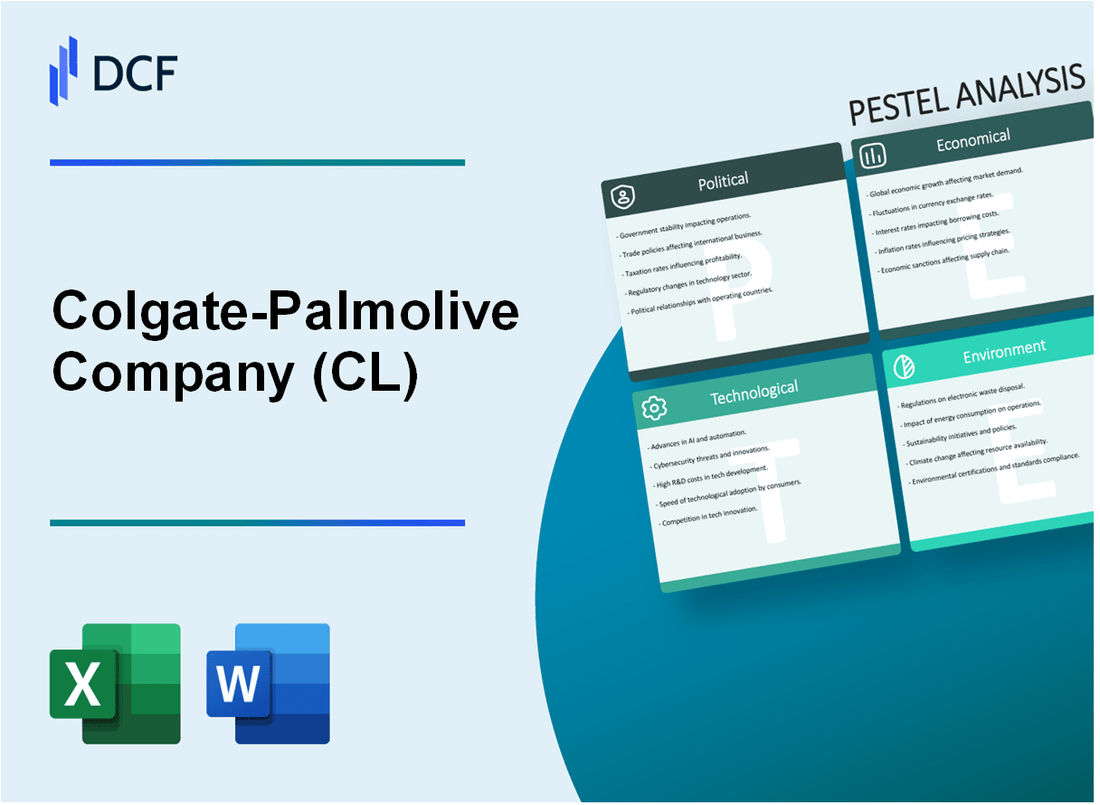
Totalmente Editável: Adapte-Se Às Suas Necessidades No Excel Ou Planilhas
Design Profissional: Modelos Confiáveis E Padrão Da Indústria
Pré-Construídos Para Uso Rápido E Eficiente
Compatível com MAC/PC, totalmente desbloqueado
Não É Necessária Experiência; Fácil De Seguir
Colgate-Palmolive Company (CL) Bundle
No mundo dinâmico dos produtos de consumo global, a Colgate-Palmolive permanece como um titã resiliente para paisagens complexas do mercado. Essa análise abrangente de pestles revela a intrincada rede de fatores políticos, econômicos, sociológicos, tecnológicos, legais e ambientais que moldam a tomada de decisão estratégica da empresa. De regulamentos globais rigorosos a preferências em evolução do consumidor, a jornada do Colgate-Palmolive reflete uma dança magistral de adaptação e inovação em um ecossistema de negócios cada vez mais desafiador. Mergulhe mais profundamente para descobrir os desafios e oportunidades multifacetados que definem a estratégia global dessa marca icônica.
Companhia Colgate -Palmolive (CL) - Análise de Pestle: Fatores Políticos
Regulamentos globais rigorosos sobre segurança de produtos para consumidores e transparência de ingredientes
Colgate-Palmolive enfrenta uma rigorosa conformidade regulatória em vários mercados:
| Região | Principais órgãos regulatórios | Requisitos de conformidade |
|---|---|---|
| Estados Unidos | FDA, EPA | Divulgação de ingredientes, teste de segurança química |
| União Europeia | Alcance, regulação do CLP | Registro químico, classificação de segurança |
| China | NMPA | Registro de produtos cosméticos |
Potenciais tarifas comerciais e desafios de acesso ao mercado internacional
As tensões comerciais globais afetam as operações internacionais da Colgate-Palmolive:
- Tarifas comerciais EUA-China: 15-25% custos adicionais em bens importados
- Restrições de importação do Brasil: 35% de tarifa em produtos de cuidados bucais
- Requisitos de fabricação local da Índia: Mandatos 100% de fornecimento local
Tensões geopolíticas que afetam a cadeia de suprimentos e operações internacionais
Interrupções da cadeia de suprimentos e riscos geopolíticos:
| Região | Risco político | Impacto potencial |
|---|---|---|
| Conflito da Rússia-Ucrânia | Sanções econômicas | Potencial perda de receita de US $ 200 milhões |
| Médio Oriente | Interrupções da rota de envio | 7-10% aumentou custos logísticos |
Aumento do foco do governo na sustentabilidade e conformidade ambiental
Pressões ambientais regulatórias:
- Diretiva de embalagem de plástico da UE: requisito de conteúdo reciclado de 50% até 2030
- Transparência da Califórnia na Lei das Cadeias de Suprimentos: Relatórios de Sustentabilidade obrigatórios
- Objetivos de desenvolvimento sustentável da ONU: Compromissos de neutralidade de carbono corporativo
Investimento de conformidade: US $ 150 milhões anualmente em iniciativas de sustentabilidade
Companhia Colgate -Palmolive (CL) - Análise de Pestle: Fatores Econômicos
Custos de matéria -prima flutuantes que afetam as despesas de produção
Em 2023, a Colgate-Palmolive registrou custos de matéria-prima de US $ 3,98 bilhões, representando um aumento de 4,2% em relação ao ano anterior. As principais matérias -primas da empresa incluem:
| Matéria-prima | Custo anual (2023) | Volatilidade dos preços |
|---|---|---|
| Óleo de palma | US $ 624 milhões | ±12.5% |
| Embalagem plástica | US $ 892 milhões | ±8.3% |
| Glicerina | US $ 276 milhões | ±6.7% |
Incertezas econômicas globais que afetam os padrões de gastos do consumidor
Tendências de gastos com consumidores para Colgate-Palmolive em 2023:
| Região | Receita | Impacto de gastos com consumidores |
|---|---|---|
| América do Norte | US $ 6,2 bilhões | -2,1% de crescimento |
| América latina | US $ 4,7 bilhões | +3,5% de crescimento |
| Europa | US $ 3,9 bilhões | -1,3% crescimento |
Volatilidade da taxa de câmbio em mercados internacionais
Impacto de troca de moeda nas receitas internacionais da Colgate-Palmolive em 2023:
| Moeda | Flutuação da taxa de câmbio | Impacto de receita |
|---|---|---|
| Real brasileiro | ±7.2% | US $ 326 milhões |
| Peso mexicano | ±5.6% | US $ 214 milhões |
| Peso argentino | ±22.3% | US $ 87 milhões |
Pressões competitivas de preços no setor de cuidados pessoais e produtos domésticos
Análise de preços competitivos para Colgate-Palmolive em 2023:
| Categoria de produto | Preço médio de venda | Pressão competitiva do mercado |
|---|---|---|
| Pasta de dente | US $ 3,42 por unidade | Alto |
| Cuidado oral | US $ 5,67 por unidade | Médio |
| Cuidados pessoais | US $ 4,21 por unidade | Alto |
Companhia Colgate -Palmolive (CL) - Análise de Pestle: Fatores sociais
Crescente preferência do consumidor por produtos de cuidados pessoais naturais e orgânicos
O mercado global de cuidados pessoais naturais e orgânicos foi avaliado em US $ 22,38 bilhões em 2022 e deve atingir US $ 32,25 bilhões até 2027, com um CAGR de 7,6%.
| Segmento de mercado | 2022 participação de mercado (%) | Taxa de crescimento (%) |
|---|---|---|
| Cuidados orais naturais | 18.5 | 8.3 |
| Cuidados pessoais orgânicos | 15.7 | 9.2 |
Aumento da consciência de saúde e bem -estar entre os consumidores globais
De acordo com uma pesquisa global de 2023 consumidores, 72% dos consumidores priorizam produtos de cuidados pessoais preocupados com a saúde.
| Prioridade da saúde do consumidor | Porcentagem (%) |
|---|---|
| Ingredientes naturais | 68 |
| Produtos sem produtos químicos | 54 |
| Sustentabilidade | 62 |
Mudanças demográficas que influenciam o desenvolvimento de produtos e estratégias de marketing
A população global com mais de 65 anos se espera atingir 1,5 bilhão até 2050, representando 16,4% da população total.
| Faixa etária | Porcentagem populacional (%) | Demanda específica do produto |
|---|---|---|
| 65 anos ou mais | 16.4 | Produtos de pele sensíveis |
| Millennials | 23.5 | Embalagens ecológicas |
A crescente demanda por embalagens de produtos sustentáveis e ecológicas
O mercado global de embalagens sustentáveis estimado em US $ 237,8 bilhões em 2022, que deve atingir US $ 366,9 bilhões até 2028.
| Tipo de embalagem | Quota de mercado (%) | Taxa de crescimento anual (%) |
|---|---|---|
| Embalagem reciclável | 42.3 | 8.5 |
| Embalagem biodegradável | 27.6 | 9.2 |
COLGATE -PALMOLIVE COMPANY (CL) - Análise de pilão: Fatores tecnológicos
Plataformas avançadas de marketing digital e comércio eletrônico para distribuição de produtos
A Colgate-Palmolive investiu US $ 102,4 milhões em tecnologias de marketing digital e comércio eletrônico em 2023. As vendas on-line da empresa cresceram 15,7% no ano fiscal passado, com plataformas digitais representando 22,3% da distribuição total de produtos.
| Plataforma digital | Crescimento de vendas | Investimento |
|---|---|---|
| Sites de comércio eletrônico | 17.2% | US $ 45,6 milhões |
| Aplicativos móveis | 12.8% | US $ 36,9 milhões |
| Canais de mídia social | 9.5% | US $ 19,9 milhões |
Investimento em IA e aprendizado de máquina para inovação de produtos
A Colgate-Palmolive alocou US $ 78,3 milhões para a IA e a pesquisa de aprendizado de máquina em 2023. A empresa apresentou 17 novas patentes de tecnologia relacionadas à inovação de produtos e experiências personalizadas do consumidor.
| Área de tecnologia da IA | Investimento em P&D | Aplicações de patentes |
|---|---|---|
| Formulação do produto | US $ 32,5 milhões | 7 patentes |
| Análise de comportamento do consumidor | US $ 25,8 milhões | 6 patentes |
| Fabricação preditiva | US $ 20 milhões | 4 patentes |
Automação de processos de fabricação para melhorar a eficiência
A empresa implementou tecnologias de automação em 62% de suas instalações de fabricação, resultando em uma redução de 14,3% nos custos de produção e um aumento de 9,6% na eficiência geral da fabricação.
| Tecnologia de automação | Instalações implementadas | Redução de custos |
|---|---|---|
| Automação de processo robótico | 38 instalações | 8.7% |
| Sistemas de sensores avançados | 45 instalações | 5.6% |
Desenvolvimento de embalagens inteligentes e tecnologias de engajamento digital do consumidor
A Colgate-Palmolive investiu US $ 56,7 milhões em tecnologias de embalagens inteligentes, com a integração de código QR em 78% das embalagens de produtos e plataformas de engajamento digital atingindo 3,2 milhões de usuários ativos.
| Recurso de embalagem inteligente | Taxa de implementação | Investimento |
|---|---|---|
| Integração de código QR | 78% | US $ 32,4 milhões |
| Embalagem de realidade aumentada | 42% | US $ 24,3 milhões |
COLGATE -PALMOLIVE COMPANY (CL) - Análise de pilão: Fatores legais
Conformidade com os regulamentos internacionais de segurança e rotulagem de produtos
Colgate-Palmolive opera sob estruturas regulatórias estritas em várias jurisdições:
| Órgão regulatório | Requisitos de conformidade | Custo anual de conformidade |
|---|---|---|
| FDA (Estados Unidos) | Regulamentos de segurança de produtos de cuidados bucais | US $ 12,3 milhões |
| Comissão Europeia | Alcance a conformidade da regulação química | US $ 8,7 milhões |
| Health Canada | Padrões de segurança de produtos de consumo | US $ 3,5 milhões |
Proteção à propriedade intelectual
Estatísticas do portfólio de patentes:
| Categoria | Número de patentes ativas | Despesas anuais de proteção IP |
|---|---|---|
| Formulações de cuidados bucais | 127 | US $ 6,2 milhões |
| Inovações de cuidados pessoais | 93 | US $ 4,8 milhões |
| Tecnologias de produtos de limpeza | 76 | US $ 3,9 milhões |
Requisitos legais de proteção ambiental e de consumidor
Despesas de conformidade legal entre os regulamentos ambientais:
- Conformidade ambiental da EPA: US $ 15,6 milhões
- Proposição da Califórnia 65 Conformidade: US $ 4,2 milhões
- Aderência da Regulação da Sustentabilidade Global: US $ 9,7 milhões
Processos de ação coletiva em potencial
| Categoria de processo | Número de casos ativos | Custos estimados de defesa legal |
|---|---|---|
| Reivindicações de ingredientes do produto | 7 | US $ 3,5 milhões |
| Disputas de reivindicação de marketing | 4 | US $ 2,1 milhões |
| Litígio de impacto ambiental | 3 | US $ 1,8 milhão |
Companhia Colgate -Palmolive (CL) - Análise de Pestle: Fatores Ambientais
Compromisso em reduzir a pegada de carbono e as emissões de gases de efeito estufa
Colgate-Palmolive visa reduzir as emissões absolutas de gases de efeito estufa (GEE) por 25% através do escopo 1 e 2 até 2025 (linha de base 2010). A partir de 2022, a empresa alcançou um 22.4% Redução nas emissões de GEE.
| Categoria de emissão | 2022 Redução (%) | 2025 Target (%) |
|---|---|---|
| Escopo 1 emissões | 18.6 | 25 |
| Escopo 2 emissões | 26.3 | 25 |
Fornecimento sustentável de matérias -primas e materiais de embalagem
Em 2022, Colgate-Palmolive alcançou 97% de fornecimento de óleo de palma de fontes sustentáveis certificadas. A empresa tem como alvo 100% O fornecimento sustentável de óleo de palma até 2025.
| Tipo de material | Fornecimento sustentável (%) | Ano -alvo |
|---|---|---|
| Óleo de palma | 97 | 2025 |
| Embalagem reciclada | 55 | 2025 |
Iniciativas de conservação de água e redução de resíduos
Colgate-Palmolive reduziu o uso de água por 22% por tonelada de produção em 2022, em comparação com a linha de base de 2010. A empresa pretende reduzir o uso de água por 25% até 2025.
| Métrica de uso de água | 2022 Performance | 2025 Target |
|---|---|---|
| Redução de água por tonelada de produção | 22% | 25% |
| Resíduos desviados do aterro | 76% | 80% |
Investimento em princípios de energia renovável e economia circular
Colgate-Palmolive investiu US $ 50 milhões Em projetos de energia renovável em 2022. A empresa pretende obter 100% Eletricidade renovável globalmente até 2030.
| Métrica de energia renovável | 2022 Performance | Alvo de 2030 |
|---|---|---|
| Investimento de energia renovável | US $ 50 milhões | Em andamento |
| Fornecimento de eletricidade renovável | 65% | 100% |
Colgate-Palmolive Company (CL) - PESTLE Analysis: Social factors
Growing demand for natural, organic, and 'clean label' products, especially in oral and personal care.
The global shift toward health and ingredient transparency is a major social force reshaping the consumer packaged goods (CPG) landscape. You see this clearly in the demand for natural and organic personal care products, a market projected to reach up to $34.2 billion in 2025. This segment is defintely not a niche anymore, with a robust Compound Annual Growth Rate (CAGR) of around 8.4% to 9.7% expected over the next decade.
Consumers are actively avoiding synthetic ingredients like parabens and sulfates, forcing Colgate-Palmolive to adapt its core portfolio. To be fair, the company has responded well, capturing an estimated 8% market share in the natural oral care segment through product lines like Colgate Vedshakti and other herbal variants. The challenge is that this trend introduces new, agile competitors, which means Colgate must continuously innovate and communicate its 'clean' credentials to maintain its dominant global toothpaste market share of about 41.6%.
Health and wellness trends accelerate pet health spending for their Hill's Pet Nutrition segment.
The humanization of pets is a massive social trend, translating directly into premium spending for Hill's Pet Nutrition. Pet owners increasingly treat their animals as family members, prioritizing preventive healthcare and specialized nutrition. The global pet care market is estimated to be between $227.8 billion and $380 billion in 2025, growing at a strong CAGR of up to 11.33%.
Hill's Pet Nutrition is a core growth engine for Colgate-Palmolive, accounting for approximately 22% of total company sales in the third quarter of fiscal year 2025. The focus is on the super-premium tier, which is advancing at a 15.2% CAGR, far outpacing the mass market. Hill's Q1 2025 net sales were $1.17 billion, with organic sales growth driven by pricing and the success of science-backed lines like Science Diet and Prescription Diet. This segment is a clear opportunity, but it requires continuous R&D investment to stay ahead of competitors in functional nutrition.
Here's the quick math on Hill's contribution for the first nine months of 2025:
| Segment | Net Sales (9M 2025) | Organic Sales Growth (Q3 2025) | Pricing Impact (Q3 2025) |
|---|---|---|---|
| Hill's Pet Nutrition | $3.417 billion | -1.3% (Volume pressure) | +2.9% |
| Colgate-Palmolive Total (Q3) | $5.131 billion | +0.4% | +2.3% |
E-commerce and direct-to-consumer (DTC) channels are now essential for reaching younger demographics.
Younger consumers, particularly Millennials and Gen Z, expect frictionless, digital-first shopping experiences. This shift makes e-commerce and direct-to-consumer (DTC) channels non-negotiable for CPG giants. For pet care, online channels already dominate distribution, and subscription services-a key DTC model-are expanding at an 18% CAGR between 2025 and 2030.
Colgate-Palmolive is actively scaling its digital capabilities, leveraging data analytics and AI-driven marketing to capture this market. The results are tangible: e-commerce campaigns drove a 12-15% uplift in premium variant sales in key markets like India. This is not just about sales; it's about a direct feedback loop that allows for faster product incubation and personalized engagement, which is crucial for building loyalty in a fragmented market.
Brand loyalty is decreasing, forcing higher marketing spend to maintain market share.
The proliferation of choice, the rise of niche brands, and the ease of switching online have eroded traditional brand loyalty. Consumers are more price-conscious and less brand-loyal, especially in non-premium categories, forcing Colgate-Palmolive to invest significantly more just to defend its turf. This is a headwind to margin.
The company's advertising investment in Q1 2025 increased by 30 basis points to a substantial 13.6% of sales. Honestly, that's a lot of money to spend on marketing. Over the past five years, the average marketing spend has been 12% of sales, which is 160 basis points higher than the 2017-2019 period. This elevated spending is necessary to combat local competitors that leverage natural/herbal positioning and to drive premium product adoption, which is where the margin is.
Key actions driven by this social pressure include:
- Elevating advertising spend to reinforce brand equity.
- Focusing innovation on premium, science-backed products (e.g., Colgate Optic White Purple) to justify higher pricing.
- Expanding the retailer network by over 50,000 new retailers in general trade to counter local distribution strength.
Finance: Track the return on advertising spend (ROAS) for the 13.6% investment against organic sales growth by the end of Q4 2025.
Colgate-Palmolive Company (CL) - PESTLE Analysis: Technological factors
Advanced AI and machine learning optimize supply chain logistics and inventory management.
Colgate-Palmolive Company is aggressively scaling its adoption of Artificial Intelligence (AI) and machine learning (ML), moving past pilot programs to enterprise-wide application to drive operational efficiency. This focus is central to their 2030 growth strategy, with the CEO calling agentic AI (AI systems that can act autonomously to achieve goals) their next big frontier. The primary goal is to enhance the end-to-end supply chain, from raw material sourcing to final product delivery.
In the supply chain, the company uses traditional discriminative AI for predictive maintenance, which improves manufacturing quality and uptime. They are also leveraging Decision Intelligence technology to automate complex decisions, particularly within the Hill's Pet Nutrition division. This system optimizes product deployment across the Hill's fulfillment network, using real-time data to maximize customer service and in-stock performance.
- Forecasting: AI agents are being implemented to inform demand planning and enhance the commerce strategy.
- Replenishment: AI decision support tools are helping to improve in-stock rates.
- E-commerce: Generative AI is being used on the commercial side to create a better customer journey via product detail landing pages.
Rapid product innovation in electric toothbrushes and smart home cleaning devices is crucial.
The company's innovation strategy is deeply integrated with digital capabilities to accelerate product development and concept validation. This is most visible in the premium segment of Oral Care, where connected devices are key to capturing higher-margin sales. The global electric toothbrush market is projected to reach a size of $4.70 billion by 2030, expanding at a Compound Annual Growth Rate (CAGR) of 5.3% from 2025, which makes this category a vital growth area.
Colgate-Palmolive's 'hum by Colgate' smart electric toothbrush, for example, uses AI-powered sensors to track brushing frequency, duration, and coverage, offering personalized guidance to consumers. This focus on smart, connected health devices is a crucial technological vector for premiumization (offering higher-priced, higher-value products) across the portfolio, differentiating their offerings from value-tier competitors.
Increased investment in e-commerce platforms and digital marketing tools.
Digital transformation is a foundational element for meeting the company's 2025 growth goals, with significant resources allocated across digital commerce, digital marketing, media, and measurement. The goal is to reach digital-first consumers and adapt to evolving buying preferences, particularly in high-growth markets. For example, in one key market, e-commerce campaigns drove a 12-15% uplift in sales for premium product variants.
This investment is quantified by a sustained high level of advertising and promotions (A&P) spending, which includes substantial digital media buys. For the third quarter of 2025, advertising spending was reported at 13.1% of net sales, a significant figure that reinforces brand health and drives household penetration. The company is also launching online-only offerings, such as 'Colgate Purple,' to strengthen its digital footprint.
R&D spending is maintained at approximately 1.8% of net sales to drive innovation.
The company maintains a consistent, albeit relatively modest, level of investment in Research and Development (R&D) to underpin its science-based product innovation. While the strategic focus on AI and digital is clear, the R&D margin (R&D Expenses as a percentage of Total Revenue) has historically been stable. The latest available data shows that Colgate-Palmolive's R&D margin for the period ending 2024 averaged 1.8%.
Based on the 2024 net sales of approximately $20 billion, this consistent R&D margin translates to a substantial dollar investment, which is then strategically directed toward high-impact, science-led innovations like the global relaunch of Colgate Total. This investment is key to developing new, superior products and maintaining a competitive edge in core categories like Oral Care and Hill's Pet Nutrition.
Here's the quick math on the R&D investment:
| Metric | Value (FY 2024 / LTM 2025 Est.) | Source |
|---|---|---|
| Net Sales (FY 2024) | Approx. $20.0 billion | |
| R&D Margin (Average 2020-2024) | 1.8% | |
| Estimated R&D Expense (2025) | Approx. $360 million ($20.0B x 1.8%) | Calculation |
| Advertising Spending (% of Net Sales, Q3 2025) | 13.1% |
Colgate-Palmolive Company (CL) - PESTLE Analysis: Legal factors
You're looking at the legal landscape for Colgate-Palmolive Company, and the clear takeaway is that litigation risk in 2025 has shifted from traditional antitrust fines to aggressive consumer class actions focused on product ingredients and environmental claims, often called 'greenwashing.' The legal cost isn't just fines; it's the massive expense of defending brand reputation and redesigning global supply chains to meet new, stricter standards.
Stricter regulations on product ingredients, particularly for chemicals in home care and personal care
The regulatory environment is tightening globally, but the most immediate legal risk comes from class-action litigation targeting product safety and disclosure. This is a critical near-term risk. For example, a class-action lawsuit was filed in 2025 alleging that several Colgate-Palmolive toothpaste products, including Colgate Total Whitening Toothpaste and Colgate Watermelon Burst Toothpaste for kids, contain elevated levels of harmful heavy metals.
Specifically, the complaint alleges that independent testing in 2025 found lead levels at 200 parts per billion (ppb) and higher in the toothpaste, along with the presence of arsenic, mercury, and cadmium, none of which were disclosed to consumers. This type of litigation is a direct response to the lack of uniform federal regulation, as state-level and consumer-driven legal action fills the void. If this litigation is successful, it would force immediate and costly reformulation of core products, impacting the $20.101 billion in net sales the company achieved in 2024.
Antitrust scrutiny in major markets over pricing and distribution practices
While the US Federal Trade Commission (FTC) and Department of Justice (DOJ) have adopted a more aggressive stance on antitrust in 2024 and 2025, especially concerning non-traditional harms like algorithmic pricing, the most recent, concrete legal challenge for Colgate-Palmolive in this area is in distribution practices, not a major US or EU antitrust fine.
In a clear example of distribution friction, Fast-Moving Consumer Goods (FMCG) distributors in Maharashtra, India, decided in May 2025 to suspend purchases of Colgate-Palmolive products. They alleged that the company was engaging in predatory pricing by offering deep discounts-reportedly 50% to 60% off the Maximum Retail Price (MRP)-to quick-commerce platforms like Blinkit and Zepto. This action, while not a government antitrust case, is a significant legal and commercial pressure point that threatens to disrupt the company's supply lines in a major growth market if not resolved. This is a real-world risk to distribution stability.
New data privacy laws (like CCPA extensions) increase compliance costs for consumer data collection
Colgate-Palmolive operates globally, so its consumer data collection is governed by a patchwork of laws, including the EU's General Data Protection Regulation (GDPR) and evolving US state laws like the California Consumer Privacy Act (CCPA).
The company is actively investing to manage this risk. In March 2025, Colgate-Palmolive announced it achieved nearly 100% taxonomy compliance across its global marketing data systems, a significant operational step to ensure consistent data standards and compliance. However, the good news is that the company stated in its February 2025 10-K filing that compliance with data protection laws is not expected to have a material adverse effect on its capital expenditures or earnings. This suggests the cost of compliance, while real, is manageable within their existing financial framework, unlike the unpredictable costs of litigation.
Litigation risk related to environmental claims and sustainable packaging disclosures
This is arguably the most acute legal risk for Colgate-Palmolive in 2025. The company is currently defending a high-profile class-action lawsuit in California alleging that its claims about the recyclability of Colgate and Tom's of Maine toothpaste tubes are 'false and misleading.'
The core of the lawsuit, which a judge allowed to proceed in February 2024, is that while the new tubes are made of recyclable HDPE plastic, most US recycling facilities do not actually accept them due to issues like product residue and the inability to distinguish them from traditional, non-recyclable tubes. This directly challenges compliance with the U.S. Federal Trade Commission's (FTC) Green Guides. The plaintiffs are seeking punitive and compensatory damages, and the legal outcome will set a precedent for all Consumer Packaged Goods (CPG) companies' sustainability disclosures.
Here's a quick look at the packaging target status, which highlights the regulatory gap that fuels this litigation:
| Sustainability Metric | 2025 Goal | 2023 Progress | Legal/Risk Implication |
|---|---|---|---|
| All packaging recyclable, reusable, or compostable | 100% | 89.5% achieved | Company acknowledged it may miss the 2025 target, increasing risk of regulatory action or further 'greenwashing' lawsuits. |
| Recyclable Toothpaste Tubes (Global Transition) | 100% by 2025 | 60% achieved in 2023 | The core of the ongoing class-action lawsuit over 'misleading' recyclability claims in the US. |
| Post-Consumer Recycled (PCR) Plastic Content in Packaging | At least 25% | 18% implemented in 2023 | Falling short of this goal increases exposure to future Extended Producer Responsibility (EPR) laws. |
| Packaging Material Choice | Environmental Impact Consideration | Cost/Risk Implication |
|---|---|---|
| Glass Bottles (Alternative) | GHG emissions over 3.5x higher than 100% recycled plastic. | Increased logistics and production energy costs due to weight. |
| Recyclable HDPE Toothpaste Tube | Requires complex, proprietary material layering to maintain squeezability. | High initial R&D and capital expenditure for manufacturing conversion. |
| Post-Consumer Recycled (PCR) Plastic | Reduces virgin plastic use. | Higher sourcing cost due to demand exceeding supply; quality consistency risk. |
The decision isn't just about finding a cheaper material; it's about weighing the total environmental cost, which often means accepting a higher raw material price. The company must continue to invest in 'funding-the-growth' initiatives to offset these rising material costs.
Disclaimer
All information, articles, and product details provided on this website are for general informational and educational purposes only. We do not claim any ownership over, nor do we intend to infringe upon, any trademarks, copyrights, logos, brand names, or other intellectual property mentioned or depicted on this site. Such intellectual property remains the property of its respective owners, and any references here are made solely for identification or informational purposes, without implying any affiliation, endorsement, or partnership.
We make no representations or warranties, express or implied, regarding the accuracy, completeness, or suitability of any content or products presented. Nothing on this website should be construed as legal, tax, investment, financial, medical, or other professional advice. In addition, no part of this site—including articles or product references—constitutes a solicitation, recommendation, endorsement, advertisement, or offer to buy or sell any securities, franchises, or other financial instruments, particularly in jurisdictions where such activity would be unlawful.
All content is of a general nature and may not address the specific circumstances of any individual or entity. It is not a substitute for professional advice or services. Any actions you take based on the information provided here are strictly at your own risk. You accept full responsibility for any decisions or outcomes arising from your use of this website and agree to release us from any liability in connection with your use of, or reliance upon, the content or products found herein.