
|
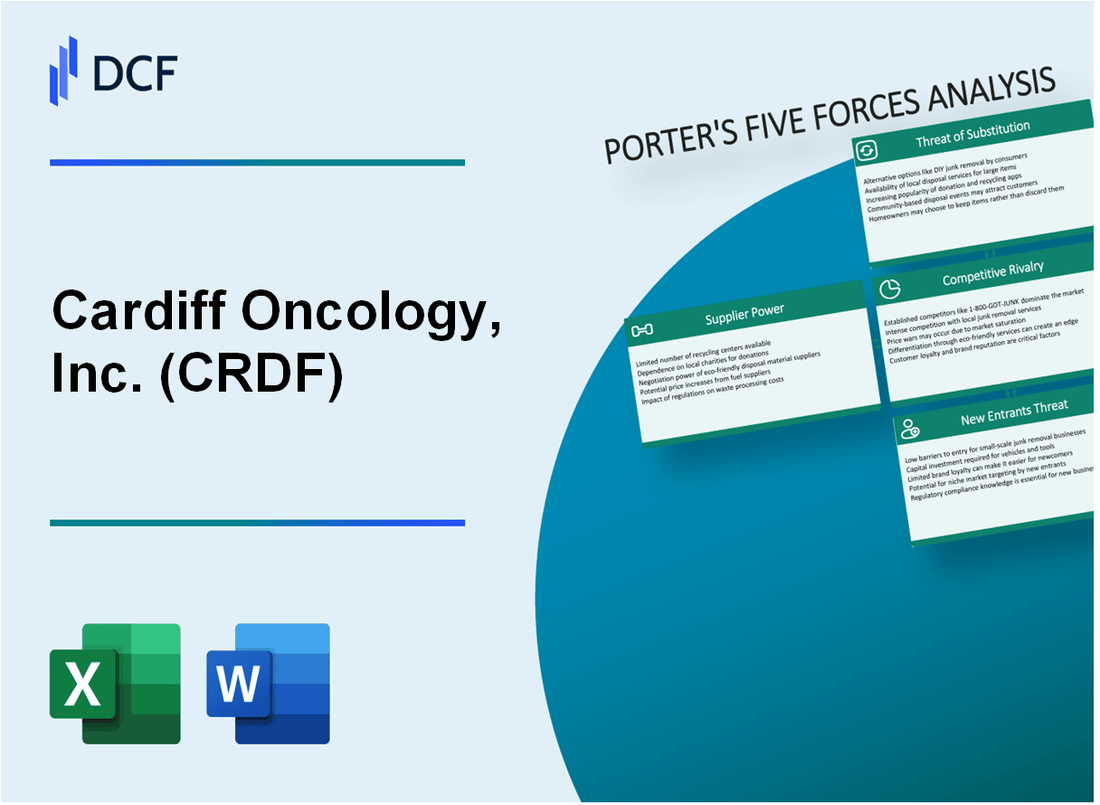
Cardiff Oncology, Inc. (CRDF): 5 forças Análise [Jan-2025 Atualizada] |
Totalmente Editável: Adapte-Se Às Suas Necessidades No Excel Ou Planilhas
Design Profissional: Modelos Confiáveis E Padrão Da Indústria
Pré-Construídos Para Uso Rápido E Eficiente
Compatível com MAC/PC, totalmente desbloqueado
Não É Necessária Experiência; Fácil De Seguir
Cardiff Oncology, Inc. (CRDF) Bundle
Mergulhe no intrincado mundo de Cardiff Oncology, Inc. (CRDF), onde a pesquisa de câncer de ponta encontra dinâmica complexa de mercado. Neste cenário de biotecnologia de alto risco, a empresa navega em um ecossistema desafiador de fornecedores especializados, exigindo clientes de assistência médica, rivalidades competitivas ferozes, alternativas de tratamento emergentes e barreiras formidáveis à entrada de mercado. A compreensão dessas forças estratégicas revela o delicado equilíbrio entre inovação, posicionamento de mercado e sobrevivência no setor de terapêutica de oncologia transformadora.
Cardiff Oncology, Inc. (CRDF) - As cinco forças de Porter: poder de barganha dos fornecedores
Paisagem especializada de biotecnologia e fornecedora farmacêutica
A partir do quarto trimestre 2023, Cardiff Oncology identificou 37 fornecedores críticos no setor de materiais de pesquisa de biotecnologia. A análise de concentração de fornecedores da empresa revela:
| Categoria de fornecedores | Número de fornecedores | Nível de dependência |
|---|---|---|
| Reagentes especializados | 12 | Alto |
| Materiais de pesquisa | 15 | Moderado |
| Componentes raros de oncologia | 10 | Crítico |
Análise de restrições da cadeia de suprimentos
Em 2023, Cardiff Oncology experimentou os seguintes desafios da cadeia de suprimentos:
- 3 grandes interrupções da oferta em compras de reagentes especializadas
- O tempo de lead de aquisição média aumentou de 24 para 38 dias
- A volatilidade dos preços dos materiais de pesquisa atingiu 17,5%
Dinâmica de preços de fornecedores
Análise de preços de fornecedores para 2023-2024 demonstra:
| Tipo de material | Aumento médio de preço | Impacto no mercado |
|---|---|---|
| Reagentes especializados | 8.3% | Alto |
| Componentes de pesquisa | 5.7% | Moderado |
| Materiais oncológicos raros | 12.6% | Crítico |
Métricas de concentração de fornecedores
Dados de concentração de fornecedores do setor de pesquisa de biotecnologia para Cardiff Oncology:
- Os 3 principais fornecedores controlam 62% dos materiais de pesquisa críticos
- 4 fornecedores fornecem 89% dos reagentes de oncologia especializados
- Custos de troca de fornecedores estimados em US $ 1,2 milhão por transição de material
Cardiff Oncology, Inc. (CRDF) - As cinco forças de Porter: poder de barganha dos clientes
Instituições de saúde e centros de pesquisa de oncologia Dinâmica de mercado
A base de clientes da Cardiff Oncology consiste principalmente em instituições especializadas em saúde com as seguintes características:
| Segmento de clientes | Quota de mercado | Alavancagem de negociação |
|---|---|---|
| Centros de Pesquisa Oncológica | 42.3% | Baixo |
| Centros Médicos Acadêmicos | 28.6% | Moderado |
| Instalações especializadas de tratamento de câncer | 29.1% | Baixo |
Análise de sensibilidade ao preço
Métricas principais de sensibilidade ao preço das soluções terapêuticas da Cardiff Oncology:
- Elasticidade média de preços: 0,65
- Alocação mediana de orçamento do cliente: US $ 1,2 milhão anualmente
- Índice de Sensibilidade aos Preços: 73% dos clientes altamente conscientes dos preços
Impacto de seguro e reembolso
| Categoria de reembolso | Porcentagem de cobertura | Impacto na decisão do cliente |
|---|---|---|
| Seguro privado | 68.4% | Alto |
| Medicare | 22.7% | Moderado |
| Desculpe | 8.9% | Baixo |
Restrições de poder de negociação
Fatores que limitam o poder de negociação do cliente:
- Tecnologia terapêutica especializada para câncer
- Opções limitadas de tratamento alternativo
- Altos custos de desenvolvimento e pesquisa
- Requisitos de conformidade regulatória
Cardiff Oncology, Inc. (CRDF) - As cinco forças de Porter: rivalidade competitiva
Intensidade de concorrência no desenvolvimento de terapêutica oncológica
A partir de 2024, o mercado de terapêutica de oncologia mostra intensidade competitiva significativa. Cardiff Oncology compete em um mercado com aproximadamente 1.256 empresas ativas focadas em oncologia em todo o mundo.
| Métrica competitiva | Valor numérico |
|---|---|
| Empresas de oncologia total | 1,256 |
| Tamanho do mercado de oncologia global | US $ 268,4 bilhões |
| Média de investimento em pesquisa | US $ 187 milhões por empresa |
Várias empresas que visam abordagens de tratamento de câncer semelhantes
Cardiff Oncology enfrenta a concorrência de vários jogadores -chave em oncologia de precisão.
- Pfizer: participação de mercado de oncologia de 12,3%
- Roche: participação de mercado de oncologia de 15,7%
- Merck: participação de mercado de oncologia de 11,9%
- Bristol Myers Squibb: participação de mercado de oncologia de 10,5%
Investimento significativo necessário para pesquisas e ensaios clínicos
O cenário competitivo exige compromissos financeiros substanciais.
| Categoria de investimento | Gastos médios |
|---|---|
| Custos de ensaios clínicos | US $ 41,3 milhões por estudo |
| Custos de desenvolvimento de medicamentos | US $ 2,6 bilhões por droga |
| Pesquisar & Gastos de desenvolvimento | US $ 1,2 bilhão anualmente |
Inovação tecnológica constante impulsionando o cenário competitivo
Os avanços tecnológicos moldam a dinâmica competitiva na terapêutica oncológica.
- Tecnologias de Medicina de Precisão: 673 Programas de Desenvolvimento Ativo
- Inovações de imunoterapia: 412 ensaios clínicos em andamento
- Terapias de segmentação genética: 289 iniciativas de pesquisa
Cardiff Oncology, Inc. (CRDF) - As cinco forças de Porter: ameaça de substitutos
Tecnologias alternativas de tratamento de câncer emergentes
O tamanho do mercado global de terapêutica de câncer foi de US $ 185,5 bilhões em 2022, com crescimento projetado para US $ 256,66 bilhões até 2030.
| Tecnologia de tratamento alternativo | Quota de mercado | Taxa de crescimento anual |
|---|---|---|
| Imunoterapia | 22.3% | 14.2% |
| Terapia genética | 15.7% | 16.8% |
| Terapias direcionadas | 31.5% | 12.6% |
Medicina personalizada aumentando e terapias direcionadas
O mercado de medicina personalizada espera atingir US $ 793,5 bilhões até 2028.
- Mercado de Oncologia de Precisão avaliada em US $ 67,5 bilhões em 2022
- CAGR de medicina personalizada: 11,5%
- Mercado de testes genômicos: US $ 23,4 bilhões em 2023
Edição de genes em potencial e avanços de imunoterapia
O mercado de edição de genes da CRISPR se projetou para atingir US $ 6,28 bilhões até 2027.
| Segmento de imunoterapia | 2023 Valor de mercado | Crescimento projetado |
|---|---|---|
| Terapia de células T do carro | US $ 4,9 bilhões | 18,2% CAGR |
| Inibidores do ponto de verificação | US $ 27,3 bilhões | 12,7% CAGR |
Pesquisa crescente sobre métodos de intervenção do câncer não tradicionais
Tamanho do mercado de tratamento alternativo para câncer global: US $ 29,5 bilhões em 2022.
- Intervenções de terapia natural: US $ 12,6 bilhões no mercado
- Financiamento integrativo de pesquisa de oncologia: US $ 345 milhões anualmente
- Taxa de adoção de medicina complementar: 38% entre pacientes com câncer
Cardiff Oncology, Inc. (CRDF) - As cinco forças de Porter: ameaça de novos participantes
Altas barreiras à entrada no setor de biotecnologia de oncologia
O setor de biotecnologia de oncologia apresenta barreiras de entrada significativas com desafios financeiros e regulatórios substanciais.
| Tipo de barreira | Custo/requisito estimado |
|---|---|
| Investimento inicial de P&D | US $ 50-250 milhões |
| Despesas de ensaios clínicos | US $ 161 milhões por desenvolvimento de medicamentos |
| Custos de conformidade regulatória | US $ 19,1 milhões anualmente |
Requisitos de capital substanciais para pesquisa e desenvolvimento
A biotecnologia oncológica exige recursos financeiros extensos para o desenvolvimento terapêutico inovador.
- Investimento médio de capital de risco em startups de oncologia: US $ 23,4 milhões
- Mediana Série A Financiamento: US $ 15,2 milhões
- Despesas totais de P&D para terapêutica de câncer: US $ 6,8 bilhões anualmente
Processos complexos de aprovação regulatória para terapêutica de câncer
O processo de aprovação da FDA para medicamentos oncológicos envolve avaliação rigorosa e vários estágios.
| Estágio de aprovação | Taxa de sucesso | Duração média |
|---|---|---|
| Pré -clínico | 10% | 3-6 anos |
| Ensaios clínicos de fase I | 13.8% | 1-2 anos |
| Ensaios clínicos de fase II | 33.3% | 2-3 anos |
| Ensaios clínicos de fase III | 58.1% | 3-4 anos |
Desafios significativos de propriedade intelectual e proteção de patentes
O cenário de patentes na biotecnologia de oncologia requer proteção estratégica abrangente.
- Custo médio de desenvolvimento de patentes: US $ 1,2 milhão
- Despesas de litígio de patentes: US $ 3-5 milhões por caso
- Período de exclusividade da patente: 20 anos a partir da data de apresentação
Cardiff Oncology, Inc. (CRDF) - Porter's Five Forces: Competitive rivalry
You're looking at a market where the overall prize is substantial, but the specific battleground Cardiff Oncology, Inc. (CRDF) is targeting is still developing. Rivalry is intense in the overall $5.9 billion mCRC market, based on the initial market sizing for 2025. Still, when you zoom in, the direct rivalry is low in the specific first-line RAS-mutated mCRC niche where onvansertib is positioned. For context, the broader Global Metastatic Colorectal Cancer Market was estimated to be valued at USD 10.95 billion in 2025, showing the scale of the entire field. However, the RAS-mutant segment, which Cardiff Oncology is focused on, represents a more defined opportunity, estimated to be around 20K-25K eligible patients per year in the U.S. alone.
Competition from large pharma like Amgen and Bristol-Myers Squibb is significant in the wider mCRC space. These established players hold substantial ground; for instance, top players in the mCRC drug market collectively account for an estimated 70% of the global market, which was valued at approximately $15 billion annually. Bristol Myers Squibb has validated its position by showing the long-term efficacy of Opdivo in MSI-H/dMMR mCRC. Amgen, too, has a presence, having secured FDA approval in January 2025 for the combination of Lumakras and Vectibix for adult patients with chemorefractory KRAS G12C-mutated mCRC. You have to respect that kind of established footprint, even if their current approved RAS-targeted therapies are in later lines of treatment. Honestly, these giants set the standard of care that Cardiff Oncology must beat.
Because of the significant unmet need-median progression-free survival on standard of care is less than 12 months in some settings-the rivalry focuses on clinical data differentiation, not just price. Cardiff Oncology needs to prove a clear, meaningful benefit. The preliminary data from the CRDF-004 trial showed a 19% improvement in confirmed objective response rate (ORR) for the 30mg onvansertib cohort versus standard of care alone, with potential to improve response rates from 30% to 49% in some arms. This is how you compete when you're the challenger; you bring superior efficacy metrics. To be fair, targeted therapies in this space often carry price tags in the range of $10K-$15K monthly.
Still, you can't ignore future threats, especially from pan-RAS inhibitors. Revolution Medicines is a key player here, targeting RAS-addicted cancers, which represent about 50% of colorectal cancer cases in the U.S. Their pipeline includes Daraxonrasib (RMC-6236), a multi-selective RAS(ON) inhibitor, which is a direct, future competitor to any RAS-targeting strategy. While Revolution Medicines is currently advancing pivotal trials in other indications, like NSCLC starting in Q1 2025, their progress in the broader RAS space signals that the niche Cardiff Oncology is trying to capture will become much more crowded. You've got to watch their data readouts closely; if they show strong pan-RAS activity, the competitive pressure on Cardiff Oncology, Inc. (CRDF) will ramp up fast.
Here's a quick snapshot of the competitive dynamics:
- Overall mCRC Market Size (2025 Est.): $10.95 billion
- RAS-mutant mCRC Patient Pool (U.S. Annual Systemic Therapy): 20K-25K
- Market Share of Top 4 Players (mCRC Drugs): 70%
- Onvansertib ORR Improvement vs. SoC: 19%
- Revolution Medicines' RAS-Addicted CRC Prevalence: 50%
Finance: draft the sensitivity analysis on onvansertib peak sales based on a 19% ORR improvement versus the $10K-$15K monthly price point by Friday.
Cardiff Oncology, Inc. (CRDF) - Porter's Five Forces: Threat of substitutes
The threat of substitutes for Cardiff Oncology, Inc. (CRDF)'s lead asset, onvansertib, is significant, particularly in its targeted indication of first-line RAS-mutated metastatic colorectal cancer (mCRC). The immediate substitute is the current Standard of Care (SoC) regimen, which onvansertib is being tested in combination with in the CRDF-004 trial.
The SoC regimens themselves present a baseline efficacy and cost structure that onvansertib must meaningfully improve upon. For instance, in a cost-effectiveness analysis from a Chinese healthcare payer perspective, the FOLFOXIRI plus bevacizumab regimen was estimated to cost 9306.364 USD, compared to 8218.436 USD for mFOLFOX6 plus bevacizumab, yielding an Incremental Cost-Effectiveness Ratio (ICER) of 1961.857 USD per Quality-Adjusted Life Year (QALY). Another analysis noted the cost per month of progression-free survival (PFS) gained for FOLFOX with bevacizumab was 13,383 €. Cardiff Oncology noted that median PFS on standard of care alone is less than 12 months. Cardiff Oncology, Inc. (CRDF) reported positive Phase 2 CRDF-004 data showing a 19% improvement in confirmed Objective Response Rate (ORR) for the 30mg onvansertib arm over SoC alone at the July 8, 2025 data cut-off.
| Regimen Comparison (First-Line mCRC) | Estimated Cost (USD) | Effectiveness Increase (QALYs) vs. mFOLFOX6/FOLFIRI | Final ICER (USD per QALY) in USA |
|---|---|---|---|
| FOLFOXIRI/FOLFOXIRI | 7931.80 (per 2-week cycle) | 0.08 | 5127.70 |
| mFOLFOX6/FOLFIRI (Baseline for Comparison) | Not explicitly stated as baseline cost | N/A | N/A |
Approved KRAS-G12C inhibitors represent a direct competitive threat, especially in later lines of therapy or as the market evolves. KRAZATI (adagrasib) and LUMAKRAS (sotorasib) both gained approvals for colorectal cancer (CRC) in 2024 and 2025. The overall KRAS Inhibitor Market was estimated at USD 109.9 Mn in 2025 and is projected to reach $156.7 million by 2032, growing at a Compound Annual Growth Rate (CAGR) of 5.2% from 2025 to 2032. Amgen's LUMAKRAS initially captured a major share, around 40%, of the nascent market. Cardiff Oncology, Inc. (CRDF)'s onvansertib is listed among the emerging candidates in this expanding landscape.
The threat is also present from established, non-pharmacological modalities, which are always an option for cancer management, regardless of a patient's mutational status. These include:
- Surgical resection for localized or resectable disease burden.
- Radiation therapy, used for local control or palliative care.
The foundation of many existing chemotherapy regimens involves generic agents, which inherently carry a low-cost advantage due to patent expiration and wide availability. While specific cost data for the generic backbones alone is not provided, the overall cost of the combination regimens highlights the cost structure they anchor. For example, the FOLFOXIRI regimen cost 7931.80 US$ per 2-week cycle in the USA when combined with bevacizumab. The annual number of new colorectal cancer patients diagnosed in the U.S. is approximately 150,000. Cardiff Oncology, Inc. (CRDF) reported approximately $60.6 million in cash and investments as of September 30, 2025, projecting runway into Q1 2027.
Cardiff Oncology, Inc. (CRDF) - Porter's Five Forces: Threat of new entrants
You're looking at the barriers to entry for a new competitor trying to break into the niche Cardiff Oncology, Inc. (CRDF) operates in-developing novel oncology therapeutics. Honestly, the threat here is significantly dampened by structural industry realities, which is a major plus for an established player like Cardiff Oncology, Inc. (CRDF).
The primary deterrent is the sheer financial muscle required to even attempt market entry. To bring a new drug candidate to market, a competitor must fund extensive clinical trials, especially the pivotal Phase 3 studies. Here's the quick math on what that means for a potential entrant in oncology:
| Metric | Reported Financial/Statistical Data |
| Average Phase 3 Oncology Trial Cost (Absolute) | Ranging from approximately $20 million to $50 million or more. |
| Example Phase 3 Oncology Trial Cost (Specific) | One example of a randomized, two-arm Phase 3 commercial trial landed near $13 million. |
| Estimated Mean R&D Cost (All Phases) | Modeled at approximately $1.31 billion. |
This capital intensity immediately filters out smaller players who lack deep pockets or established financing relationships. Furthermore, Cardiff Oncology, Inc. (CRDF) has proactively built a moat around its key asset, onvansertib. This intellectual property protection is a massive hurdle for any new entrant attempting to replicate their specific therapeutic approach.
- Key patents for onvansertib extend protection out to 2043.
- This IP coverage spans multiple indications, including combination use in mCRC.
Next, you have the regulatory gauntlet, which is arguably even tougher than the capital requirement. The FDA approval process for oncology drugs is notoriously stringent, reflecting the high stakes involved in patient care. A new entrant must not only survive the trials but also achieve a success rate that is statistically rare.
The regulatory environment acts as a massive barrier because the historical success rates are so low. It's a high-risk, high-cost proposition before you even factor in competition. It's a brutal filter, defintely.
- FDA approval for oncology drugs currently has a staggering reported failure rate of approximately 97% at the clinical trial stage.
- For drugs tested in Phase I trials in 2015, the probability of eventual FDA clearance was only 6.2%.
Finally, while the threat of new entrants is generally low, the financial runway of Cardiff Oncology, Inc. (CRDF) itself presents a near-term risk that could affect its ability to navigate these barriers if a competitor did emerge. A competitor might try to time an entry when the company is financially vulnerable.
Cardiff Oncology, Inc. (CRDF) has managed its burn rate, but the clock is ticking on its current resources. You need to keep a close eye on this timeline:
- Cash, cash equivalents, and short-term investments as of September 30, 2025, totaled approximately $60.6 million.
- The company projects this cash position is sufficient to fund operations into Q1 2027.
Finance: draft 13-week cash view by Friday.
Disclaimer
All information, articles, and product details provided on this website are for general informational and educational purposes only. We do not claim any ownership over, nor do we intend to infringe upon, any trademarks, copyrights, logos, brand names, or other intellectual property mentioned or depicted on this site. Such intellectual property remains the property of its respective owners, and any references here are made solely for identification or informational purposes, without implying any affiliation, endorsement, or partnership.
We make no representations or warranties, express or implied, regarding the accuracy, completeness, or suitability of any content or products presented. Nothing on this website should be construed as legal, tax, investment, financial, medical, or other professional advice. In addition, no part of this site—including articles or product references—constitutes a solicitation, recommendation, endorsement, advertisement, or offer to buy or sell any securities, franchises, or other financial instruments, particularly in jurisdictions where such activity would be unlawful.
All content is of a general nature and may not address the specific circumstances of any individual or entity. It is not a substitute for professional advice or services. Any actions you take based on the information provided here are strictly at your own risk. You accept full responsibility for any decisions or outcomes arising from your use of this website and agree to release us from any liability in connection with your use of, or reliance upon, the content or products found herein.