

|
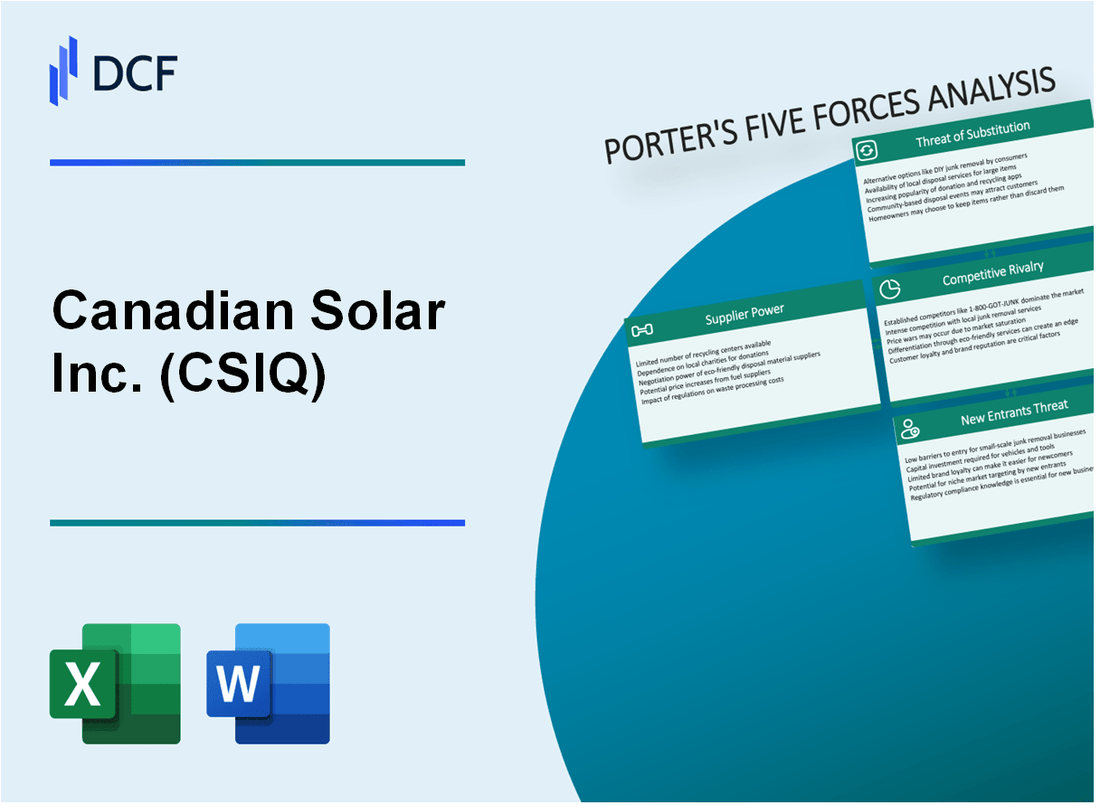
Canadian Solar Inc. (CSIQ): 5 forças Análise [Jan-2025 Atualizada] |
Totalmente Editável: Adapte-Se Às Suas Necessidades No Excel Ou Planilhas
Design Profissional: Modelos Confiáveis E Padrão Da Indústria
Pré-Construídos Para Uso Rápido E Eficiente
Compatível com MAC/PC, totalmente desbloqueado
Não É Necessária Experiência; Fácil De Seguir
Canadian Solar Inc. (CSIQ) Bundle
No mundo dinâmico da energia solar, a Canadian Solar Inc. (CSIQ) navega em um cenário comercial complexo moldado pelas cinco forças de Michael Porter. De combater a intensa concorrência global ao gerenciamento de relacionamentos com fornecedores e expectativas dos clientes, a empresa está no cruzamento da inovação tecnológica e dos desafios do mercado. À medida que a energia renovável transforma o setor de energia global, a compreensão dessas dinâmicas estratégicas revela os intrincados caminhos solares canadenses devem atravessar para manter sua vantagem competitiva e impulsionar o crescimento sustentável em um mercado cada vez mais competitivo.
Canadian Solar Inc. (CSIQ) - As cinco forças de Porter: poder de barganha dos fornecedores
Número limitado de fabricantes de matérias-primas de painel solar de alta qualidade
A partir de 2024, o mercado global de polissilício é dominado por alguns fabricantes importantes:
| Fabricante | Quota de mercado (%) | Capacidade de produção (toneladas métricas) |
|---|---|---|
| Grupo Tongwei | 35.6% | 320,000 |
| Wacker Chemie AG | 22.3% | 215,000 |
| GCL-Poly Energy Holdings | 18.7% | 180,000 |
Concentração de fornecedores de polissilício e componentes semicondutores
A cadeia de suprimentos de componentes semicondutores revela as seguintes métricas de concentração:
- Os 3 principais fabricantes de wafer controlam 72% do mercado global
- Concentração geográfica de fornecedores de semicondutores:
- China: 53%
- Taiwan: 22%
- Coréia do Sul: 15%
Impacto de integração vertical
A estratégia de integração vertical da Canadian Solar demonstra as seguintes métricas:
| Métrica de integração | 2023 valor |
|---|---|
| Capacidade de fabricação interna | 9.5 GW |
| Porcentagem de componentes autoproduzidos | 48% |
| Redução na dependência externa do fornecedor | 27% |
Contratos de fornecimento de longo prazo
Detalhes do contrato de oferta solar da Canadian Solar:
- Duração média do contrato: 5-7 anos
- Mecanismos de preços fixos: 62% dos contratos
- Cláusula de escalada de preços: presente em 38% dos contratos
Canadian Solar Inc. (CSIQ) - As cinco forças de Porter: poder de barganha dos clientes
Sensibilidade significativa ao preço no mercado de energia solar
Em 2023, o mercado global de energia solar mostrou a sensibilidade dos preços com os preços médios do painel solar em 12,5% em comparação com 2022. O Canadian Solar Inc. enfrenta pressão direta no mercado dos clientes preocupados com o preço.
| Segmento de clientes | Sensibilidade média ao preço | Impacto da negociação |
|---|---|---|
| Clientes em escala de utilidade | 15,3% de sensibilidade ao preço | Alta alavancagem de negociação |
| Clientes comerciais | 11,7% de sensibilidade ao preço | Poder de negociação moderado |
| Clientes residenciais | 8,9% de sensibilidade ao preço | Capacidade de negociação limitada |
Grande poder de compra de clientes de utilidade e clientes comerciais
Os grandes clientes de serviços públicos representaram 68,4% da receita total da Canadian Solar em 2023, demonstrando influência substancial de compra.
- Os 5 principais clientes de serviços públicos representam 42,7% do total de contratos de projeto solar
- Valor médio do contrato para projetos em escala de utilidade: US $ 87,6 milhões
- Ciclo de aquisição típico: 12-18 meses
Alta concorrência leva a negociações de preços de clientes
O cenário competitivo da indústria solar em 2023 mostrou 7 grandes fabricantes competindo pela participação de mercado, permitindo negociações de preços ao cliente.
| Concorrente | Quota de mercado | Competitividade de preços |
|---|---|---|
| Solar canadense | 12.5% | Alto |
| Primeiro solar | 10.3% | Alto |
| Jinkosolar | 11.8% | Alto |
A crescente demanda de energia renovável aumenta as opções do cliente
O mercado global de energia renovável se projetou para atingir US $ 1,97 trilhão até 2024, com solar representando 32,4% das novas adições de capacidade.
- O investimento em energia solar deve crescer 15,2% em 2024
- Previsão global de capacidade solar: 1.427 GW até o final de 2024
- Custo de troca de clientes: aproximadamente 5-7% do valor total do projeto
Canadian Solar Inc. (CSIQ) - As cinco forças de Porter: rivalidade competitiva
Cenário competitivo de fabricação solar global
A Canadian Solar Inc. enfrenta intensa concorrência de fabricantes globais de energia solar com o seguinte posicionamento de mercado:
| Concorrente | Participação de mercado global (%) | Produção anual de módulos solares (GW) | 2023 Receita (USD) |
|---|---|---|---|
| Primeiro solar | 4.2% | 25.4 | 3,7 bilhões |
| Jinko Solar | 5.1% | 32.6 | 4,9 bilhões |
| Solar canadense | 4.5% | 29.8 | 4,2 bilhões |
Métricas de inovação tecnológica
Avanços tecnológicos do painel solar que impulsionam a dinâmica competitiva:
- A eficiência média do painel solar aumentou de 17,5% para 22,3% em 2023
- Os investimentos em pesquisa e desenvolvimento atingiram US $ 186 milhões em 2023
- Novas aplicações de patentes de tecnologia fotovoltaica: 42 em 2023
Análise de pressões de preços
Tendências de preços do setor de manufatura de painéis solares:
| Ano | Preço médio do painel solar por watt (USD) | Redução de preços (%) |
|---|---|---|
| 2022 | 0.38 | -6.2% |
| 2023 | 0.35 | -7.9% |
Estratégia de diversificação geográfica
Distribuição global de fabricação e vendas:
- Instalações de fabricação em 4 países
- Presença de vendas em 25 mercados internacionais
- Distribuição de receita:
- China: 35%
- América do Norte: 28%
- Europa: 22%
- Outras regiões: 15%
Canadian Solar Inc. (CSIQ) - As cinco forças de Porter: ameaça de substitutos
Tecnologias de energia renovável emergente
A capacidade global de energia eólica atingiu 743,8 GW em 2022. O mercado de energia de hidrogênio projetado para atingir US $ 19,65 bilhões até 2028 com um CAGR de 9,2%.
| Tecnologia de energia | Capacidade global 2022 | Valor de mercado projetado até 2028 |
|---|---|---|
| Energia eólica | 743.8 GW | US $ 380 bilhões |
| Energia de hidrogênio | 0,7 GW | US $ 19,65 bilhões |
Soluções de armazenamento de energia
A capacidade global de armazenamento de bateria deve atingir 358 GWh até 2030.
- Os preços da bateria de íons de lítio diminuíram 89% entre 2010-2022
- Os investimentos em armazenamento de bateria em escala de grade atingiram US $ 7,5 bilhões em 2022
Custos de produção do painel solar
O custo médio de produção do painel solar caiu para US $ 0,20 por watt em 2023.
Incentivos energéticos renováveis do governo
A Lei de Redução de Inflação dos Estados Unidos alocou US $ 369 bilhões em investimentos em energia limpa.
| País | Orçamento de incentivo energético renovável | Ano -alvo |
|---|---|---|
| Estados Unidos | US $ 369 bilhões | 2030 |
| União Europeia | € 503 bilhões | 2030 |
Canadian Solar Inc. (CSIQ) - As cinco forças de Porter: ameaça de novos participantes
Altos requisitos de capital inicial para fabricação solar
A Canadian Solar Inc. requer aproximadamente US $ 500 milhões a US $ 1 bilhão em investimento inicial de capital para uma moderna instalação de fabricação solar. Os custos de construção da planta de produção de painéis solares variam entre US $ 200 e US $ 350 milhões por instalação.
| Categoria de investimento | Faixa de custo estimada |
|---|---|
| Construção de instalações de fabricação | US $ 200 a US $ 350 milhões |
| Equipamento e máquinas | US $ 100 a US $ 250 milhões |
| Pesquisa e desenvolvimento | $ 50- $ 150 milhões |
Requisitos complexos de especialização tecnológica
O painel solar exige recursos tecnológicos especializados:
- Conhecimento avançado de fabricação de semicondutores
- Experiência em engenharia celular fotovoltaica
- Especialização da Ciência do Material
Economias estabelecidas de proteção de escala
O volume de produção da Canadian Solar em 2023: 26,4 GW de módulos solares. Custo médio de produção por watt: US $ 0,22 a US $ 0,28.
| Métrica de produção | 2023 valor |
|---|---|
| Produção total do módulo | 26.4 GW |
| Custo de produção por watt | $0.22-$0.28 |
Barreiras regulatórias de conformidade e certificação
Os custos e processos de certificação criam desafios significativos de entrada no mercado:
- Custo da certificação UL: US $ 50.000 a US $ 150.000
- Certificação da Comissão Eletrotécnica Internacional (IEC): US $ 75.000 a US $ 200.000
- Manutenção anual de conformidade: US $ 25.000 a US $ 75.000
Canadian Solar Inc. (CSIQ) - Porter's Five Forces: Competitive rivalry
Competitive rivalry is defintely extremely high right now. You see it in the industry-wide price compression, which has pushed module operating margins down, especially outside the US. To be fair, Wood Mackenzie forecasts that solar module prices are expected to rise in 2025 as manufacturers try to claw back profit losses from the prior two years. Still, the margin pressure is real; Canadian Solar's gross margin was only 11.7% in Q1 2025, though it rebounded to 29.8% in Q2 2025. Looking ahead to Q3 2025, the guidance for gross margin is much tighter, projected to be between 14% and 16%. For context on international pressure, export-oriented Indian manufacturers faced diminished margins on US sales due to a 50% tariff imposed as of August 2025.
Competition is a global slugfest, with major Chinese players leveraging massive capacity to fight for every point of market share. China's control over the entire PV supply chain-polysilicon, ingots, wafers, cells, and modules-exceeds 80% in 2025. This scale gives them an undeniable cost advantage, which intensifies the rivalry for everyone else. Canadian Solar remains a significant player, but it sits below the top tier dominated by these giants.
Here's a quick look at how the shipment landscape stacked up, showing the scale of the competition Canadian Solar Inc. faces:
| Company/Group | Estimated 2025 Shipments (GW) | Approximate Global Market Share (2023) |
|---|---|---|
| LONGi Green Energy | Exceeding 45 | N/A (Top 4 Chinese held 68.5% of c-Si in 2023) |
| JA Solar | 38-40 | 12.8% |
| Tongwei Solar | Exceeding 30 | N/A |
| Canadian Solar Inc. (CSIQ) | 25 to 27 (Guidance) | 6% |
Canadian Solar Inc.'s own 2025 module shipment guidance of 25 GW to 27 GW confirms its position as a volume leader, but it also shows the sheer scale required to compete. This volume is a direct response to the market dynamics, but it still places them behind the top Chinese firms whose projected shipments are in the 30 GW to 40 GW range and above. The rivalry is certainly intensified by this volume race.
The rivalry is, however, somewhat mitigated in the US market for Canadian Solar Inc. This is thanks to the strategic mid-2025 ramp-up of US manufacturing capacity. The company's module factory in Mesquite, Texas, was expected to contribute approximately 3 GW of volume delivery this year. This domestic production helps Canadian Solar Inc. increase the share of US-made products in its total US shipments, which is crucial for navigating Foreign Entity of Concern (FEOC) restrictions that take effect in 2026.
- Q2 2025 module shipments for Canadian Solar Inc. totaled 7.9 GW.
- The Texas facility aims to deliver about 3 GW in 2025 volume.
- Canadian Solar Inc.'s 2025 full-year shipment guidance is 25 GW to 27 GW.
- The top four Chinese players accounted for nearly 50% of the market's top ten threshold shipments in 2024.
Canadian Solar Inc. (CSIQ) - Porter's Five Forces: Threat of substitutes
You're looking at the landscape of alternatives to Canadian Solar Inc.'s core solar module business, and honestly, the picture is nuanced. The threat of substitution isn't a single monolithic thing; it breaks down by application, which is why we need to look closely at the numbers.
For utility-scale projects, the threat from other renewables like wind and geothermal is definitely present, but it's not overwhelming. We see this when we map out the unsubsidized Levelized Cost of Energy (LCOE) data from Lazard's 2025 report. Onshore wind often registers the absolute lowest LCOE, but solar is right there with it, making it a very close competitor for new builds. Geothermal, while offering dispatchable power, generally remains more expensive, though it provides a critical flexibility that solar alone historically could not.
The threat for Canadian Solar Inc.'s solar modules themselves, viewed in isolation, is relatively low because solar's LCOE is so compelling. Unsubsidized utility-scale solar LCOE sits in a range of $0.038/kWh to $0.217/kWh. This means new solar is often cheaper than building new natural gas plants, and it even competes with already-operating gas facilities. That cost competitiveness is the primary defense against substitution by other energy sources.
Here's a quick look at how utility-scale solar stacks up against its main renewable competitor, onshore wind, based on recent Lazard analysis:
| Technology | Unsubsidized LCOE Range (per kWh) | Key Context |
|---|---|---|
| Onshore Wind | $0.037 to $0.086 | Registers the lowest possible LCOE over the narrowest range. |
| Utility-Scale Solar PV | $0.038 to $0.217 | Highly competitive, but with a wider cost spread. |
| Natural Gas Combined Cycle | $0.048 to $0.109 | More expensive than the low end of solar and wind. |
| Utility-Scale Solar + 2-Hour Storage | $0.05 to $0.131 | Cost of firming power is declining rapidly. |
Anyway, the threat of substitution is actively being countered by Canadian Solar Inc.'s own strategy. The growth of the e-STORAGE segment is key here. By bundling solar with storage, Canadian Solar Inc. moves the competitive battleground away from just the module price to the total system solution-offering firm power and grid stability. This bundling strategy is clearly working, as the e-STORAGE contracted backlog, which includes these bundled solutions and long-term service agreements, grew to $3.1 billion as of October 31, 2025, up from the $3 billion reported in June 2025. That backlog provides significant earnings visibility and locks in customers who might otherwise look at alternatives.
Now, for the long-term view, emerging solar technologies definitely pose a substitution risk, but it's not a near-term worry for Canadian Solar Inc.'s current silicon module dominance. I'm talking about perovskites, of course. Researchers are hitting incredible efficiency milestones, with tandem cells reaching efficiencies like 34.6% in the lab. However, the real-world constraint is durability; silicon lasts 25-30 years, while perovskites are still working to match that lifespan.
The market is clearly signaling this is a future play, not a 2025 problem. While some manufacturers are moving to pilot-scale production in 2025, a full-blown market introduction for perovskite-silicon tandems is widely expected by 2030, if not before. The global market for perovskite solar cells is projected to reach US$ 8,805.49 million by 2032, showing massive potential, but that's still several years out. For now, Canadian Solar Inc. can focus on its current technology advantage while keeping an eye on these next-generation threats.
- Silicon module durability target: 25-30 years.
- Perovskite tandem cell efficiency record (lab): Up to 34.6%.
- Expected significant market role for perovskites: By 2030.
- e-STORAGE contracted backlog (latest reported): $3.1 billion as of October 31, 2025.
Canadian Solar Inc. (CSIQ) - Porter's Five Forces: Threat of new entrants
The threat of new entrants for Canadian Solar Inc. remains a subject of careful consideration, landing in the moderate to high range. Honestly, while the capital expenditure required to compete in module manufacturing and large-scale project development is substantial, it isn't an absolute moat anymore.
For context on the capital needed, Canadian Solar's own full-year 2025 capital expenditure outlook is set at approximately $1.2 billion, largely directed toward investment in U.S. Manufacturing initiatives. You can see the scale of capital commitment by looking at the balance sheet; total debt, including financing liabilities, stood at $6.3 billion as of June 30, 2025. That's a big number to clear just to start.
Still, that high capital barrier is being actively lowered by government policy, specifically the U.S. Inflation Reduction Act (IRA). The IRA is actively encouraging domestic entrants by making the initial outlay less punishing. For instance, the Section 48C Investment Tax Credit can cover up to 30% of the capital investment for companies building or expanding solar manufacturing facilities. This policy has already catalyzed significant domestic growth, with U.S. solar and storage companies announcing over $100 billion in new private sector investments since the law passed. This influx of subsidized capital makes setting up shop domestically more tenable for well-funded newcomers.
Canadian Solar Inc. fights back with established reputation and scale. The company's guidance for full-year 2025 revenue sits in the range of $5.6 billion to $6.3 billion, showing the sheer volume of business it commands. This scale is reinforced by external validation; Canadian Solar Inc. was named a Tier 1 PV module supplier and a Tier 1 Battery Energy Storage System supplier in the inaugural 2025 Tier 1 Cleantech Companies list released by S&P Global Commodity Insights on September 11, 2025. That Tier 1 status is a powerful signal to developers and financiers about reliability.
New entrants still face significant risk, though, which acts as a deterrent. Even for an established player like Canadian Solar Inc., the market's current dynamics show the pressure. Analysts tracking the company noted that the free cash flow for the last twelve months ended near the third quarter of 2025 was -$1.56 billion. That cash burn, even for a market leader, signals that achieving positive cash flow while scaling up is a major hurdle for anyone stepping in.
Here's a quick look at the financial scale Canadian Solar Inc. operates at, which new entrants must contend with:
| Metric | Value / Range | Date / Period |
|---|---|---|
| Full Year 2025 Revenue Guidance | $5.6 billion to $6.3 billion | Full Year 2025 |
| Projected Manufacturing CapEx | $1.2 billion | 2025 Outlook |
| Total Debt (Including Financing Liabilities) | $6.3 billion | As of June 30, 2025 |
| LTM Free Cash Flow (Analyst Estimate) | -$1.56 billion | Last Twelve Months (LTM) |
| e-STORAGE Contracted Backlog | $3.1 billion | As of October 31, 2025 |
The competitive landscape for new entrants is shaped by these factors:
- IRA incentives directly offset 30% of new U.S. manufacturing CapEx.
- Canadian Solar Inc. has Tier 1 status in both modules and BESS.
- The company's project pipeline includes 27 GWp in solar and 80 GWh in battery storage as of Q2 2025.
- New entrants must navigate supply chain maturity and established bankability.
Finance: draft 13-week cash view by Friday.
Disclaimer
All information, articles, and product details provided on this website are for general informational and educational purposes only. We do not claim any ownership over, nor do we intend to infringe upon, any trademarks, copyrights, logos, brand names, or other intellectual property mentioned or depicted on this site. Such intellectual property remains the property of its respective owners, and any references here are made solely for identification or informational purposes, without implying any affiliation, endorsement, or partnership.
We make no representations or warranties, express or implied, regarding the accuracy, completeness, or suitability of any content or products presented. Nothing on this website should be construed as legal, tax, investment, financial, medical, or other professional advice. In addition, no part of this site—including articles or product references—constitutes a solicitation, recommendation, endorsement, advertisement, or offer to buy or sell any securities, franchises, or other financial instruments, particularly in jurisdictions where such activity would be unlawful.
All content is of a general nature and may not address the specific circumstances of any individual or entity. It is not a substitute for professional advice or services. Any actions you take based on the information provided here are strictly at your own risk. You accept full responsibility for any decisions or outcomes arising from your use of this website and agree to release us from any liability in connection with your use of, or reliance upon, the content or products found herein.