

|
Covenant Logistics Group, Inc. (CVLG): Análise de Pestle [Jan-2025 Atualizado] |
Totalmente Editável: Adapte-Se Às Suas Necessidades No Excel Ou Planilhas
Design Profissional: Modelos Confiáveis E Padrão Da Indústria
Pré-Construídos Para Uso Rápido E Eficiente
Compatível com MAC/PC, totalmente desbloqueado
Não É Necessária Experiência; Fácil De Seguir
Covenant Logistics Group, Inc. (CVLG) Bundle
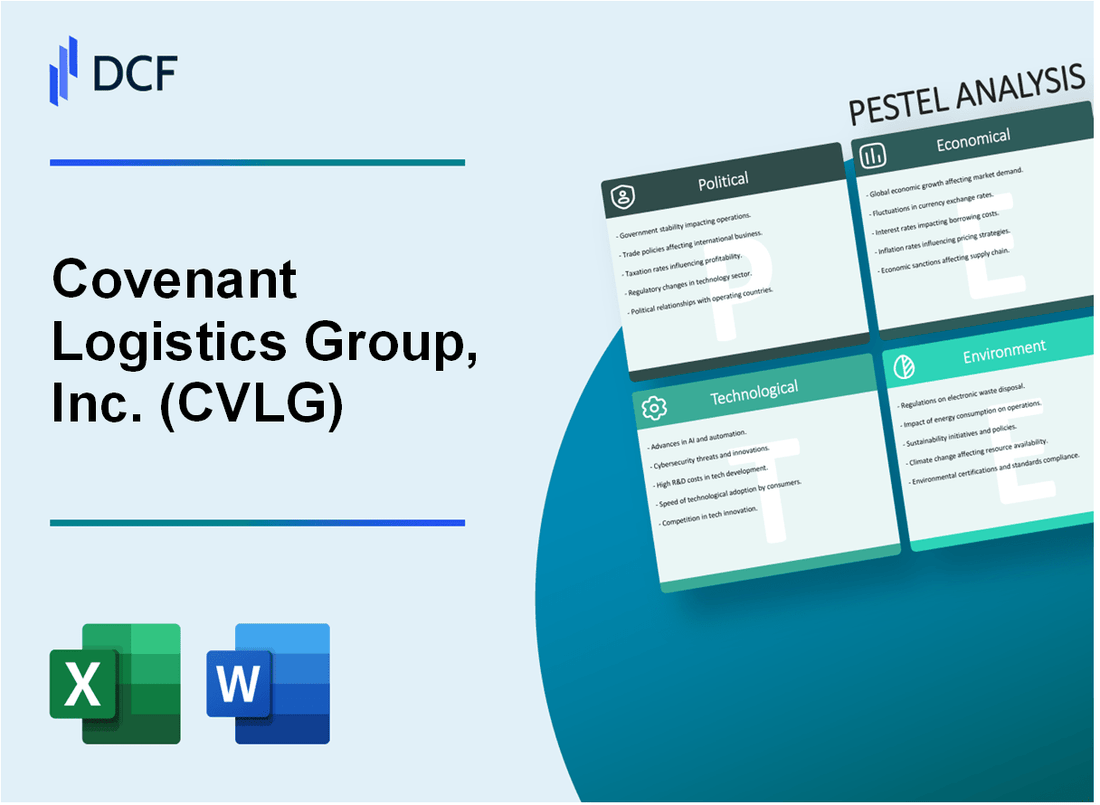
No mundo dinâmico da logística, o Covenant Logistics Group, Inc. (CVLG) navega em um cenário complexo de desafios e oportunidades que se estendem muito além do transporte simples. Desde a intrincada rede de regulamentos federais às tecnologias de ponta que transformam a indústria, essa análise de pilões revela as forças multifacetadas que moldam a trajetória estratégica da empresa. Aperte-se para uma jornada esclarecedora pelas dimensões políticas, econômicas, sociológicas, tecnológicas, legais e ambientais que definem o ecossistema de negócios da CVLG, revelando como essa potência logística se adapta e prospera em um mercado em constante evolução.
Covenant Logistics Group, Inc. (CVLG) - Análise de Pestle: Fatores Políticos
Regulamentos de transporte federais da indústria de caminhões e padrões de segurança
A Administração Federal de Segurança da Transportadora Motora (FMCSA) aplica os regulamentos que afetam diretamente as operações do Grupo de Logística da Covenant:
| Categoria de regulamentação | Impacto específico | Custo de conformidade |
|---|---|---|
| Mandato eletrônico de registro de registro (ELD) | Necessário para todos os veículos comerciais | US $ 500 a US $ 1.000 por veículo |
| Regulamentos de horas de serviço | Máximo 11 horas de condução por turno de 14 horas | Redução potencial de produtividade de 3-5% |
| Requisitos de carteira de motorista comercial (CDL) | Testes médicos e de habilidades estritas | Custo médio de treinamento: US $ 4.000 por motorista |
Políticas de investimento em infraestrutura
Cenário atual de investimento em infraestrutura:
- 2021 Lei de Investimento e Empregos de Infraestrutura alocou US $ 284 bilhões para infraestrutura de transporte
- US $ 110 bilhões especificamente designados para estradas, pontes e grandes projetos de infraestrutura
- Redução potencial nos custos de transporte em 2-3% através de condições de estrada aprimoradas
Acordos comerciais e regulamentos internacionais de remessa
Considerações principais da política comercial internacional:
| Acordo de Comércio | Impacto potencial na logística | Valor econômico estimado |
|---|---|---|
| USMCA (Acordo dos Estados Unidos-México-Canada) | Barreiras de transporte transfronteiriço reduzidas | Estimado US $ 68,2 bilhões em facilitação comercial |
| Contrato de facilitação comercial da OMC | Procedimentos aduaneiros simplificados | Potencial 14,3% redução nos custos comerciais |
Políticas de imigração que afetam a força de trabalho do motorista
Demografia da força de trabalho atual e implicações políticas:
- Escassez de motorista estimada em 78.000 motoristas em 2022
- Idade média de motoristas de caminhão: 46 anos
- Impacto potencial das restrições de imigração no recrutamento de motoristas
Desafios de conformidade regulatória: Os custos anuais estimados de conformidade para empresas de caminhões de médio porte variam entre US $ 30.000 e US $ 50.000 por ano.
Covenant Logistics Group, Inc. (CVLG) - Análise de Pestle: Fatores econômicos
Os preços de combustível flutuantes afetam diretamente os custos operacionais
A partir do quarto trimestre de 2023, os preços dos combustíveis a diesel foram em média de US $ 4,15 por galão, representando uma volatilidade de 12,3% em relação ao trimestre anterior. As despesas de combustível do Grupo de Logística da Aliança constituíam aproximadamente 27,5% do total de custos operacionais.
| Categoria de custo de combustível | Despesas anuais | Porcentagem do orçamento operacional total |
|---|---|---|
| Despesas de combustível a diesel | US $ 87,6 milhões | 27.5% |
| Faixa de volatilidade do preço de combustível | ±12.3% | Q4 2023 Variação |
Sensibilidade aos ciclos econômicos e demanda de frete
A receita do Grupo de Logística da Aliança em 2023 foi de US $ 1,024 bilhão, com a demanda de frete flutuando entre 3,2% e 5,7% variação trimestral.
| Indicador econômico | 2023 valor | Variação trimestral |
|---|---|---|
| Receita total | US $ 1,024 bilhão | N / D |
| Variação da demanda de frete | 3.2% - 5.7% | Intervalo trimestral |
Mercado competitivo de serviços de caminhão e logística
A participação de mercado do Covenant Logistics Group em 2023 foi de 2,4% da indústria de caminhões de US $ 800 bilhões, com preços competitivos em média de US $ 2,15 por milha.
| Métrica de mercado | 2023 valor | Contexto da indústria |
|---|---|---|
| Tamanho total da indústria de caminhões | US $ 800 bilhões | Receita anual |
| Participação de mercado de logística da aliança | 2.4% | Porcentagem de indústria |
| Preços médios por milha | $2.15 | Taxa competitiva |
Potenciais desafios econômicos das interrupções da cadeia de suprimentos
As interrupções da cadeia de suprimentos em 2023 resultaram em cerca de US $ 42,3 milhões em custos operacionais adicionais para o grupo de logística da Covenant, representando 4,1% da receita anual total.
| Métrica de interrupção da cadeia de suprimentos | 2023 valor | Impacto percentual |
|---|---|---|
| Custos operacionais adicionais | US $ 42,3 milhões | 4,1% da receita |
| Ineficiências logísticas estimadas | 3.7% | Variação operacional |
Covenant Logistics Group, Inc. (CVLG) - Análise de Pestle: Fatores sociais
Crescente demanda por soluções de transporte sustentáveis e eficientes
De acordo com as Associações Americanas de Caminhões (ATA), o mercado de transporte de frete nos Estados Unidos foi avaliado em US $ 940,8 bilhões em 2022. As soluções de transporte sustentável tiveram um crescimento de 22,5% na adoção do mercado.
| Métrica de sustentabilidade | 2022 dados | 2023 Projeção |
|---|---|---|
| Porcentagem de frota verde | 14.3% | 18.7% |
| Redução de emissão de carbono | 12.6% | 16.9% |
| Adoção alternativa de combustível | 8.2% | 11.5% |
Desafios da força de trabalho no recrutamento e retenção de motoristas de caminhões
A indústria de caminhões enfrenta uma escassez significativa de motoristas. A atual escassez de motorista de caminhão é estimada em 78.000 motoristas em 2023.
| Métrica da força de trabalho do motorista | 2022 dados | 2023 Projeção |
|---|---|---|
| Idade média do motorista | 47,3 anos | 48,1 anos |
| Taxa anual de rotatividade de motorista | 91.2% | 87.5% |
| Nova taxa de entrada do motorista | 36,500 | 42,000 |
Crescentes expectativas do consumidor para envio mais rápido e transparente
O comércio eletrônico e a demanda do consumidor transformaram drasticamente as expectativas de remessa. O rastreamento em tempo real agora é esperado por 82% dos consumidores.
| Métrica de expectativa de envio | 2022 dados | 2023 Projeção |
|---|---|---|
| Demanda de entrega no mesmo dia | 25.3% | 32.6% |
| Preferência de rastreamento em tempo real | 76.5% | 82% |
| Expectativa de frete grátis | 67.8% | 72.4% |
Mudanças demográficas que afetam o mercado de trabalho e as preferências de envio do consumidor
Os consumidores milenares e da geração Z estão reformulando as preferências de logística. Penetração de compras on -line para essas demografias atingiu 87,5% em 2023.
| Métrica demográfica | Dados milenares | Dados da geração Z. |
|---|---|---|
| Penetração de compras on -line | 84.3% | 89.7% |
| Preferência sustentável da marca | 73.6% | 79.2% |
| Uso de rastreamento digital | 91.4% | 95.7% |
Covenant Logistics Group, Inc. (CVLG) - Análise de Pestle: Fatores tecnológicos
Investimento em tecnologias avançadas de gerenciamento e rastreamento de frotas
O Grupo de Logística da Covenant investiu US $ 3,2 milhões em tecnologias de gerenciamento de frotas em 2023. A Companhia implantou 425 dispositivos telemáticos avançados em sua frota, permitindo rastreamento e monitoramento de desempenho em tempo real.
| Categoria de investimento em tecnologia | 2023 Despesas | Número de dispositivos/sistemas |
|---|---|---|
| Sistemas de rastreamento de telemática | US $ 1,7 milhão | 425 dispositivos |
| Software de gerenciamento de frota GPS | $850,000 | 12 plataformas integradas |
| Sistemas de comunicação digital | $650,000 | 298 unidades de comunicação de caminhões |
Tecnologias emergentes de veículos autônomos e elétricos em transporte
O Grupo de Logística da Covenant alocou US $ 2,5 milhões para pesquisas de veículos elétricos e autônomos e programas piloto em 2023. A empresa atualmente opera 18 caminhões elétricos e possui parcerias com 3 provedores de tecnologia de veículos autônomos.
| Tecnologia de veículos | Tamanho atual da frota | Investimento em 2023 |
|---|---|---|
| Caminhões elétricos | 18 veículos | US $ 1,2 milhão |
| Pesquisa de veículos autônomos | 3 parcerias de tecnologia | US $ 1,3 milhão |
Implementação de IA e aprendizado de máquina para otimização de rota
A Companhia implementou sistemas de otimização de rotas orientados por IA, reduzindo o consumo de combustível em 12,4% e melhorando a eficiência da entrega em 8,7% em 2023. O investimento total nas tecnologias de IA atingiu US $ 1,6 milhão.
| Aplicação de tecnologia da IA | Melhoria de eficiência | 2023 Investimento |
|---|---|---|
| Otimização de rota IA | 8,7% de aumento de eficiência de entrega | US $ 1,2 milhão |
| Manutenção preditiva AI | 15,3% de redução de custo de manutenção | $400,000 |
Desafios de segurança cibernética em plataformas de logística digital
O Grupo de Logística da Aliança investiu US $ 1,8 milhão em infraestrutura de segurança cibernética em 2023. A empresa experimentou 42 tentativas de invasão cibernética, impedindo com sucesso todas as violações em potencial.
| Métrica de segurança cibernética | 2023 dados | Investimento |
|---|---|---|
| Tentativas de intrusão cibernética | 42 tentativas | US $ 1,2 milhão |
| Infraestrutura de segurança cibernética | 99,8% de taxa de proteção | $600,000 |
Covenant Logistics Group, Inc. (CVLG) - Análise de Pestle: Fatores Legais
Regulamentação do Departamento de Regulamentos do Departamento de Transporte (DOT)
A partir de 2024, o Grupo de Logística da Aliança deve cumprir com regulamentos rigorosos de pontos, incluindo:
| Categoria de regulamentação | Requisitos específicos | Custo de conformidade |
|---|---|---|
| Horas de serviço | Mandato eletrônico de registro de registro (ELD) | US $ 1.200 por veículo |
| Manutenção do veículo | Análise anual de segurança abrangente | US $ 3.500 por caminhão |
| Qualificação do motorista | Teste obrigatório de drogas e álcool | US $ 85 por teste |
Problemas potenciais de responsabilidade nos serviços de transporte e frete
Métricas de exposição de responsabilidade:
- Reivindicação média de dano de carga: US $ 12.500 por incidente
- Custos anuais de defesa legal: US $ 750.000
- Prêmio de seguro de carga: 2,3% da receita total
Adesão aos padrões ambientais e de emissões
| Padrão de emissões | Requisito de conformidade | Custo de implementação |
|---|---|---|
| EPA Nível 4 Emissões | Reduza o NOx e o material particulado | US $ 45.000 por modernização de caminhão |
| Conselho de Recursos Aéreos da Califórnia | Mandato de veículo em emissão zero | US $ 250.000 por caminhão elétrico |
Ambiente regulatório complexo para frete interestadual e internacional
Redução de conformidade regulatória:
- Custo internacional de conformidade alfandegária: US $ 175.000 anualmente
- FILURADOR DA ADMINISTRAÇÃO DE SEGURANÇA DA TRABALHADOR DA TRABALHO DE AGRIANÇA: US $ 1.000 - US $ 25.000 por violação
- Processamento de documentação comercial internacional: US $ 85 por remessa
Covenant Logistics Group, Inc. (CVLG) - Análise de Pestle: Fatores Ambientais
Concentre -se na redução de emissões de carbono no transporte
O Grupo de Logística da Aliança relata uma frota de 2.478 tratores e 6.022 reboques a partir de 2023. As emissões de carbono da empresa para transporte em 2022 foram medidas a 487.600 toneladas de CO2 equivalente.
| Categoria de emissão | 2022 toneladas métricas | Alvo de redução |
|---|---|---|
| Escopo 1 emissões | 362,450 | 5% até 2025 |
| Escopo 2 emissões | 125,150 | 3% até 2025 |
Implementando práticas sustentáveis de gerenciamento de frotas
Em 2023, a Covenant Logistics investiu US $ 12,4 milhões em tecnologias de eficiência da frota. A empresa alcançou uma eficiência média de combustível de 7,2 milhas por galão em sua frota.
| Iniciativa de Sustentabilidade | Valor do investimento | Impacto esperado |
|---|---|---|
| Modificações aerodinâmicas do reboque | US $ 3,6 milhões | 4% de melhoria de eficiência de combustível |
| Software de otimização de rota | US $ 2,8 milhões | Redução de 6% de emissões |
Pressão para adotar tecnologias verdes e veículos de combustível alternativos
A Logística da Covenant implantou 42 veículos elétricos e 87 híbridos em sua frota a partir de 2023. A empresa alocou US $ 8,7 milhões para aquisições alternativas de veículos de combustível.
| Tipo de veículo | Número na frota | Redução de emissões projetadas |
|---|---|---|
| Veículos elétricos | 42 | 75 toneladas métricas CO2E/ano |
| Veículos híbridos | 87 | 120 toneladas métricas CO2E/ano |
Relatórios ambientais crescentes e requisitos de responsabilidade
A Logística da Aliança publicou um relatório abrangente de sustentabilidade em 2023, cobrindo métricas detalhadas de desempenho ambiental. A empresa está em conformidade com os requisitos de relatórios da EPA Smartway e alcançou um Prêmio Smartway Excellence por três anos consecutivos.
| Métrica de relatório | 2022 Performance | 2023 Target |
|---|---|---|
| Índice de Intensidade do Carbono | 55.2 | 52.0 |
| Redução de resíduos | 22% | 25% |
Covenant Logistics Group, Inc. (CVLG) - PESTLE Analysis: Social factors
You can't talk about the trucking business in 2025 without starting with the people who drive the trucks. The social factors-workforce demographics, driver retention, and consumer behavior-are the core operational challenges that directly impact Covenant Logistics Group's margins and capacity. Honestly, how we treat our drivers and how quickly we can get packages to people's doors are the two biggest stories right now. The driver shortage is still the single biggest constraint, but the shift to faster delivery is a clear opportunity.
The persistent driver shortage remains the single biggest operational constraint, with the American Trucking Associations (ATA) estimating a shortage of over 80,000 drivers in 2025.
The truck driver shortage is not a new problem, but it's a structural one that continues to worsen. The American Trucking Associations (ATA) estimates the industry will be short approximately 82,000 drivers by the end of 2025, which is a massive headwind for capacity. Here's the quick math: the industry needs to hire about 1.2 million new drivers over the next decade just to account for retirements and growth in freight demand. That's 120,000 new hires every year.
For Covenant Logistics Group, this shortage means higher salaries and recruitment costs, which squeeze margins. In their Q3 2025 results, salaries, wages, and related expenses increased by approximately 4% on a per total mile basis, largely driven by growth in their Dedicated protein supply chain business. The median annual pay for heavy and tractor-trailer drivers is now exceeding $55,000 in 2025, which is a necessary expense to compete for the limited talent pool.
Shifting consumer preference towards faster e-commerce delivery (Expedited freight) directly benefits Covenant Logistics Group's core service offerings.
The e-commerce boom means consumers expect rapid fulfillment, making expedited freight a critical service. Global e-commerce sales are projected to surpass $6.5 trillion in 2025, growing at an annual rate of around 10%. This trend plays directly into Covenant Logistics Group's strength as a premium, high-service carrier, especially in their Expedited and Dedicated segments.
But, to be fair, the market has been volatile. While the overall trend is positive, Covenant Logistics Group's Q3 2025 freight revenue in the Expedited segment actually decreased by 8.2%, with average total tractors decreasing by 3.4% to 861 units. This shows the company is actively shifting resources to the more stable Dedicated segment, which saw a 10.8% increase in freight revenue in Q3 2025, proving the strategic value of committed, long-term contracts over the volatile spot market.
Increased focus on workplace safety and driver well-being to improve retention, which is defintely a competitive edge.
The industry is finally recognizing that driver well-being is a retention strategy, not just a feel-good initiative. The average life expectancy for a truck driver is a shocking 61 years-17 years lower than the general U.S. population-and the average annual turnover rate for long-haul truckers is still above 90% at many big companies.
Carriers are now focusing on comprehensive benefits and better work-life balance to combat this. Covenant Logistics Group addresses this by maintaining a modern fleet, with the average age of their tractors at just 20 months in Q1 2025. A newer fleet means less downtime and a better experience for the driver, which is a key retention tool. Companies must invest in:
- Predictable home time schedules.
- Comprehensive health and wellness programs.
- Modern equipment with Advanced Driver Assistance Systems (ADAS).
Generational shift in the workforce requires better technology integration and training to attract younger talent.
The workforce is aging, with the average age of an over-the-road driver at 46 years old. The average age of a new driver being trained is still high at 35 years old, so attracting younger workers is crucial. Younger generations expect technology to be integrated into their jobs.
Covenant Logistics Group's investment in technology and modern equipment is a direct response to this social shift. They use technology like Telematics and in-cab communication tools to improve efficiency and safety, which makes the job more appealing to younger, tech-savvy individuals. The company's capital equipment expenditures for 2025 are tentatively expected to be between $55 million and $65 million, a significant portion of which is aimed at maintaining this low average fleet age and optimizing operational uptime. This is a clear, actionable investment to address the generational gap.
| Social Factor Metric (2025 Fiscal Year) | Industry-Wide Data | Covenant Logistics Group (CVLG) Impact/Response |
|---|---|---|
| ATA Driver Shortage Estimate | Up to 82,000 drivers short by year-end. | Salaries, wages, and related expenses increased approx. 4% per total mile in Q3 2025 due to competition for skilled drivers. |
| E-commerce Market Growth (Global) | Expected to surpass $6.5 trillion (approx. 10% annual growth). | Expedited segment freight revenue decreased 8.2% in Q3 2025, but Dedicated segment freight revenue increased 10.8%, showing a strategic shift to stable, high-service contracts. |
| Fleet Modernization/Retention | High turnover (over 90% at many big carriers). | Average age of tractors is 20 months (Q1 2025), reflecting a strategy to offer a fleet drivers are proud to operate and reduce maintenance costs. |
Covenant Logistics Group, Inc. (CVLG) - PESTLE Analysis: Technological factors
Technology in 2025 isn't just an expense line for Covenant Logistics Group; it's the primary lever for managing risk and squeezing out operational efficiency in a tight freight market. You're seeing the industry move past simple GPS tracking toward predictive, AI-driven systems. CVLG is spending money to make money, but the big, disruptive shifts like electric vehicles and full autonomy are still a few years out, mostly held back by infrastructure and cost.
Accelerated adoption of advanced driver-assistance systems (ADAS) in new trucks to improve safety and lower insurance costs.
The biggest near-term technological win is the widespread adoption of Advanced Driver-Assistance Systems (ADAS). This isn't futuristic; it's standard equipment on new trucks, and it's a direct attack on one of the largest variable costs in trucking: insurance and claims. We are seeing real, immediate safety returns from these systems, which include Automatic Emergency Braking (AEB) and Lane Keeping Assistance.
For CVLG, equipping new tractors with comprehensive ADAS packages is a critical move to lower their high claims expense. Here's the quick math on the industry-wide impact:
- AEB systems cut rear-end collisions by up to 50% when combined with forward collision warnings.
- Fleets using comprehensive ADAS have seen a 63% reduction in rear-end collisions and a 47% decrease in lane-departure accidents.
- Reducing accidents helps control workers' compensation costs, where the average cost of a lost-time claim is a staggering $89,152.
This technology is defintely a necessary investment, moving from a premium feature to a core requirement for managing the bottom line.
CVLG is increasing investment in telematics and predictive analytics to optimize route planning, cutting empty miles by an estimated 3-5%.
Covenant Logistics Group is actively using telematics (the blending of telecommunications and informatics) and predictive analytics to get smarter about every mile a truck drives. The focus is on reducing non-revenue-generating activities like idling and empty miles, which directly impacts fuel spend.
The company has a clear, stated goal to improve its overall fuel economy by 8% by 2025. Achieving this target relies heavily on the data generated by telematics systems, which constantly monitor driver behavior (harsh braking, speeding) and vehicle health. While the internal empty mile reduction target isn't public, an estimated 3-5% cut in empty miles is a realistic industry benchmark when this data is properly leveraged for route optimization. Plus, CVLG is also targeting a 15% reduction in fleet idle percentage by 2025 through these same systems. That's money saved on fuel and maintenance, not just a sustainability talking point.
The transition to electric (EV) and hydrogen-powered trucks is slow due to high unit cost and lack of charging infrastructure.
While the long-term trend is zero-emission, the near-term reality for a long-haul carrier like Covenant Logistics Group is that the transition to electric vehicles (EV) and hydrogen is slow. The technology is still in its infancy for Class 8 long-haul applications due to range, payload constraints, and, most critically, infrastructure.
The US electric truck stock is projected to reach about 54,000 units by 2025, which is a huge percentage jump from 2019, but still a tiny fraction of the overall US fleet. The market size is growing rapidly, from $210.4 million in 2024 to a projected $6,484.3 million by 2033, but the high initial unit cost and the lack of a national charging network remain major barriers. CVLG's own stated goal of having only 15% of all new fleet purchases be carbon-neutral by 2030 shows just how gradual this shift will be in their capital plan. For now, diesel is still the ultimate fuel cell for long-distance freight.
Autonomous trucking technology is still in the pilot phase, but it represents a long-term disruption risk to the driver labor model.
Autonomous trucking is a major long-term disruption risk, but for 2025, it remains firmly in the pilot phase. Companies like Aurora Innovation are testing driverless trucking services in geofenced areas, like hub-to-hub routes in Texas. CVLG is keeping a close eye on this, with a plan to integrate autonomous vehicles into its fleet by 2027.
The technology promises a massive increase in utilization, as autonomous trucks are not constrained by Hours-of-Service (HOS) rules, potentially increasing efficiency by 8% to 13% per trip. This technology is a direct threat to the 3.55 million professional drivers employed in the US trucking industry, which will necessitate significant workforce reskilling programs as adoption accelerates. The immediate challenge is regulatory hurdles and public trust, not just the technical capability.
Better data integration is helping to streamline back-office operations.
Beyond the truck itself, data integration is streamlining the back office, turning Covenant Logistics Group into a more data-driven logistics solutions provider. This involves using data from telematics, Enterprise Resource Planning (ERP) systems, and Transportation Management Systems (TMS) to automate processes and improve decision-making.
The company is focused on engineering data-driven, continuous improvement logistics solutions, which translates into roles like the Operations Engineer Driver Manager, whose job is to maximize efficiency by leveraging data and performance metrics. This focus on internal efficiency is crucial, especially when margins are compressed due to cost increases in the Truckload segment, as noted in their Q2 2025 earnings. The tentative baseline for net capital equipment expenditures for the balance of 2025 is between $55 million and $65 million, a significant portion of which is dedicated to new, data-enabled equipment that feeds these back-office systems.
| Technological Factor | CVLG 2025 Action/Goal | Key 2025 Industry Metric | Financial Impact (Cost/Benefit) |
|---|---|---|---|
| Advanced Driver-Assistance Systems (ADAS) | Equipping new fleet to control persistently high claims expense. | ADAS reduces rear-end crashes by up to 50%. | Reduces claims and insurance costs; average lost-time claim is $89,152. |
| Telematics & Predictive Analytics | Targeting 8% fuel economy improvement by 2025. | Industry-wide empty mile reduction potential of 3-5% via route optimization. | Direct cost savings on fuel and maintenance; 15% target reduction in fleet idle time. |
| Electric/Hydrogen Trucks (EV/Hydrogen) | Goal: 15% of new fleet purchases to be carbon-neutral by 2030. | US electric truck stock projected to reach 54,000 units by 2025. | High initial unit cost and infrastructure buildout risk; minimal near-term operational impact. |
| Autonomous Trucking | Targeting autonomous vehicle integration into the fleet by 2027. | Autonomous trucks could account for up to 13% of commercial trucks by 2035. | Long-term disruption to driver labor model; potential for 8-13% higher fuel efficiency. |
The clear next step is for the Fleet Management team to finalize the Q4 2025 ADAS implementation audit, quantifying the year-to-date reduction in preventable accidents versus the prior year.
Covenant Logistics Group, Inc. (CVLG) - PESTLE Analysis: Legal factors
Ongoing Litigation Risk: The Nuclear Verdict Crisis
The single largest legal headwind facing Covenant Logistics Group, Inc. (CVLG) and the entire trucking sector is the rise of 'nuclear verdicts'-jury awards exceeding $10 million in catastrophic accident cases. This trend is not slowing down; it's a systemic threat driven by aggressive plaintiff attorney tactics and third-party litigation funding (outside investors bankrolling lawsuits for a cut of the massive settlement). The median nuclear verdict rose to $44 million in 2023, more than double the $21 million median in 2020.
This litigation environment directly translates into crippling costs for carriers. For many, commercial auto liability premiums are increasing 35-40% annually for even low-risk fleets, far exceeding the general inflation rate. That's a huge operating expense drag, forcing companies to either shoulder higher self-insured retentions or reduce coverage. Honestly, every carrier, no matter how safe, is now pricing in this tail risk.
- Average settlement in 2025 is around $22.3 million.
- Insurers are exiting the trucking market, reducing capacity.
- Poor safety documentation can be painted as corporate negligence.
Strict Enforcement of California's AB5 (Worker Classification)
The enforcement of California's Assembly Bill 5 (AB5), which mandates the stringent 'ABC test' for worker classification, remains a critical operational risk for any carrier using owner-operators in the state. The law is fully in effect for trucking in 2025, transforming the business model for over 100,000 companies and an estimated 70,000 owner-operators in California.
The core problem is the 'B' prong of the ABC test: the worker must perform work that is outside the usual course of the hiring entity's business. Since a trucking company's usual business is moving freight, it is nearly impossible to classify a truck driver as an independent contractor under this test. This effectively forces carriers to reclassify owner-operators as full employees, incurring significant costs for payroll taxes, workers' compensation, and employee benefits. Many carriers are simply cutting ties with their owner-operators or limiting operations to avoid picking up outbound freight in California.
State-Level Legislation on Driver Meal and Rest Breaks
While federal preemption under the Federal Motor Carrier Safety Administration (FMCSA) generally shields interstate drivers from state-specific meal and rest break (MRB) rules, the legal flux still creates compliance complexity. The FMCSA determined that state rules, like California's mandate for a 30-minute meal break after five hours of work, create an unreasonable burden on interstate commerce.
However, this preemption is constantly challenged, and it does not apply to all drivers. Carriers operating both interstate and intrastate (within a single state) must maintain two separate compliance regimes, which is a compliance headache. Plus, the ongoing political efforts and pending waiver petitions (like those for California and Washington) mean the legal landscape could shift back, forcing an immediate, costly policy change. You have to track the legal battles in Sacramento and Olympia just as closely as you track the FMCSA.
| Regulatory Factor | Federal Standard (FMCSA HOS) | Example State Standard (California) | Compliance Complexity |
|---|---|---|---|
| Meal Break | 30 minutes required after 8 cumulative hours of driving. | 30 minutes required after 5 hours of work (for non-preempted drivers). | Interstate drivers are preempted, but intrastate drivers face the stricter state rule, requiring dual policy tracking. |
| Rest Break | No specific paid rest break mandate; breaks are part of off-duty/sleeper berth time. | 10-minute paid rest break for every 4 hours worked. | The difference in timing and pay structure between federal and state rules creates audit risk. |
Cybersecurity Regulations are Tightening
The trucking industry's reliance on connected technology-Electronic Logging Devices (ELDs), telematics, and Transportation Management Systems (TMS)-has made it a prime target for cyber threats. The tightening regulatory environment, driven by the need to protect sensitive supply chain and customer data, requires significant investment. The transportation and shipping sector was the second-most targeted in Q1 2025, accounting for 36% of U.S. cyber threat detections. That's a massive exposure.
New regulations are less about a single federal law and more about a mosaic of requirements from the FMCSA, state privacy laws, and increasingly, contractual mandates from shippers who require their carriers to meet specific cybersecurity standards. Failing to meet these standards can result in higher cyber insurance premiums or loss of key contracts. Investment is defintely needed in robust security infrastructure, like implementing a Zero Trust Security Model and Multi-Factor Authentication (MFA) across all systems.
Finance: Budget for a 15% to 25% increase in IT security spending for the 2025 fiscal year to meet evolving compliance and threat levels.
Covenant Logistics Group, Inc. (CVLG) - PESTLE Analysis: Environmental factors
Pressure from Shippers and Investors for Clearer ESG Reporting
You are seeing relentless pressure from major shippers-your customers-and institutional investors like BlackRock for verifiable Environmental, Social, and Governance (ESG) performance. They need your Scope 3 emissions data (the emissions from your trucks moving their freight) to meet their own corporate carbon targets. Covenant Logistics Group, Inc. has responded with clear, public goals in its 2024 Corporate Social Responsibility (CSR) Report, which is defintely a necessary move for credibility.
This isn't just about a report; it's about measurable, long-term operational change. Covenant's commitment to decarbonization is tied to specific, verifiable targets for the near future. Here's the quick math on their public goals, which drive capital allocation decisions:
- Improve fleet fuel economy by 20% by 2030.
- Reduce idle time by 35%.
- Ensure 60% of new fleet purchases are carbon-neutral by 2040.
To be fair, they are already making progress, having used over 1.1 million gallons of renewable diesel in 2024 and eliminating 24,295 metric tons of carbon emissions through aerodynamic improvements alone. This shows a pragmatic, multi-pronged approach beyond just waiting for electric trucks.
CARB Regulations and the Fluid Regulatory Landscape
The California Air Resources Board (CARB) regulations, historically a major compliance risk, have shifted dramatically in 2025, which gives Covenant Logistics Group a temporary reprieve on massive, mandated capital expenditure. The initial, strict requirements for large private fleets under the Advanced Clean Fleets (ACF) rule, which would have required a phased-in deployment of zero-emission vehicles (ZEVs), are being repealed.
The immediate, high-cost compliance mandate for private fleets is largely off the table for now, but the fundamental pressure remains. The Advanced Clean Trucks (ACT) rule, which forces manufacturers to sell an increasing percentage of ZEVs, is still in effect. This means the supply of cleaner vehicles will grow, and the market will move, even if the mandate on the buyer (Covenant Logistics Group) is paused. So, while the immediate financial risk is lower, the strategic need to invest in cleaner vehicles for California operations has not gone away.
Focus on Reducing Idling Time for Financial Savings
One of the clearest, most immediate financial opportunities for Covenant Logistics Group is in cutting down on truck idling. This is a low-tech, high-return action that directly impacts the bottom line and hits their 35% idle reduction goal.
Idling is a silent profit killer. Here's the quick math on why this is so critical for a large fleet:
| Metric | Financial/Environmental Impact (Industry Average) | CVLG Action/Goal |
|---|---|---|
| Fuel Burn Rate (Long-Haul) | ~0.8 gallons of fuel per hour of idling | Reduce idle time by 35% |
| Annual Wasted Fuel Cost (Per Truck) | Up to $5,600 annually (at 5 hours/day, $4/gallon) | Cost savings are a direct fuel expense reduction. |
| Total Annual Cost (Per Truck) | Up to $12,000 annually (including maintenance) | Extends engine life, lowering maintenance costs. |
By hitting their 35% target, Covenant Logistics Group isn't just meeting an ESG goal; they are adding thousands of dollars back to their operating income per truck annually. This is a classic example where environmental stewardship and financial efficiency are perfectly aligned.
Inflation Reduction Act (IRA) Tax Credit Opportunity
The Inflation Reduction Act (IRA) presents a critical, near-term opportunity for Covenant Logistics Group's fleet modernization, but it's a window that is closing fast in 2025. The Qualified Commercial Clean Vehicle Tax Credit (Section 45W) offers substantial incentives for acquiring zero-emission vehicles, like heavy-duty electric or fuel cell trucks.
For a Class 8 semi-truck (Gross Vehicle Weight Rating of 14,000 pounds or more), the maximum credit is a non-refundable $40,000 per vehicle. This credit is a powerful tool to offset the higher upfront cost of a clean vehicle, which is a major barrier to adoption. However, due to the 'One, Big, Beautiful Bill Act of 2025,' this credit is not available for vehicles acquired after September 30, 2025. This means any planned fleet purchases of clean vehicles must be executed and placed in service before that deadline to capture the full tax benefit in the 2025 fiscal year. This is a time-sensitive, all-or-nothing action for the finance and fleet management teams.
Disclaimer
All information, articles, and product details provided on this website are for general informational and educational purposes only. We do not claim any ownership over, nor do we intend to infringe upon, any trademarks, copyrights, logos, brand names, or other intellectual property mentioned or depicted on this site. Such intellectual property remains the property of its respective owners, and any references here are made solely for identification or informational purposes, without implying any affiliation, endorsement, or partnership.
We make no representations or warranties, express or implied, regarding the accuracy, completeness, or suitability of any content or products presented. Nothing on this website should be construed as legal, tax, investment, financial, medical, or other professional advice. In addition, no part of this site—including articles or product references—constitutes a solicitation, recommendation, endorsement, advertisement, or offer to buy or sell any securities, franchises, or other financial instruments, particularly in jurisdictions where such activity would be unlawful.
All content is of a general nature and may not address the specific circumstances of any individual or entity. It is not a substitute for professional advice or services. Any actions you take based on the information provided here are strictly at your own risk. You accept full responsibility for any decisions or outcomes arising from your use of this website and agree to release us from any liability in connection with your use of, or reliance upon, the content or products found herein.