

|
Educational Development Corporation (EDUC): Análise SWOT [Jan-2025 Atualizada] |
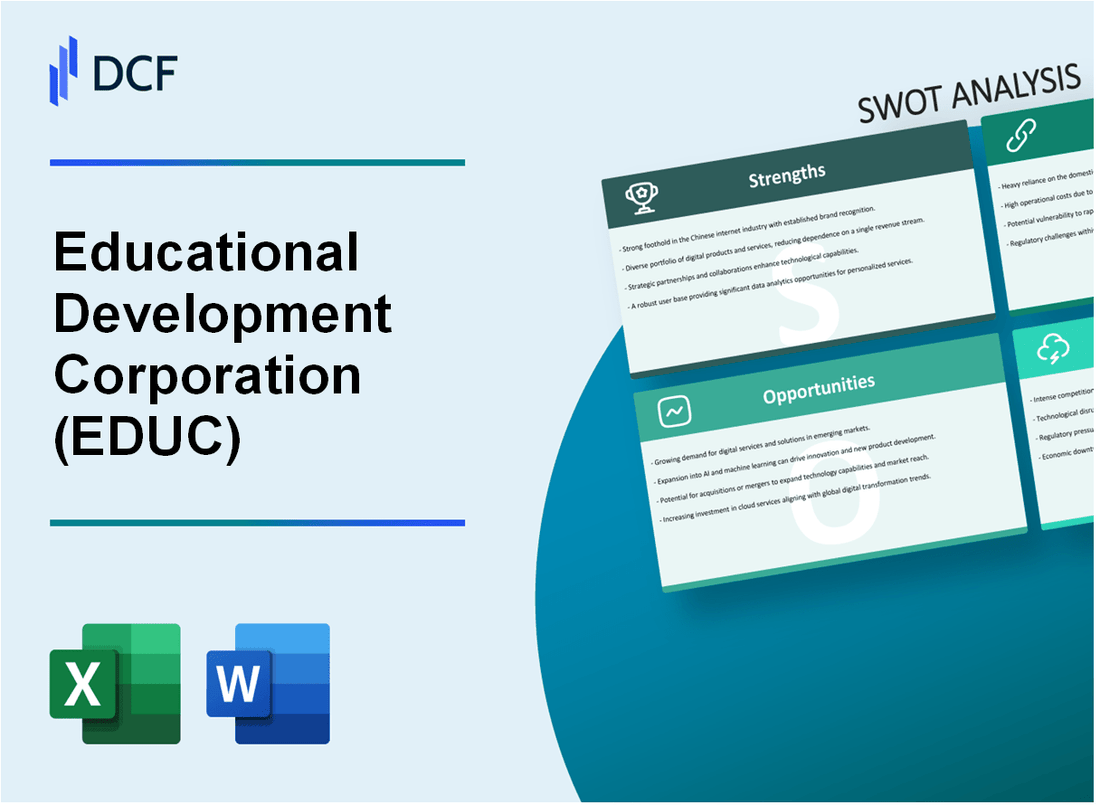
Totalmente Editável: Adapte-Se Às Suas Necessidades No Excel Ou Planilhas
Design Profissional: Modelos Confiáveis E Padrão Da Indústria
Pré-Construídos Para Uso Rápido E Eficiente
Compatível com MAC/PC, totalmente desbloqueado
Não É Necessária Experiência; Fácil De Seguir
Educational Development Corporation (EDUC) Bundle
No mundo dinâmico da publicação educacional, a Educational Development Corporation (EDUC) está em uma encruzilhada crítica, navegando em desafios e oportunidades complexas de mercado. Essa análise SWOT abrangente revela o posicionamento estratégico da empresa em 2024, oferecendo um mergulho profundo em seu cenário competitivo, revelando como um editor de livros especializado pode prosperar em meio a transformação digital, mudando os paradigmas educacionais e as preferências em evolução do consumidor. Descubra o intrincado equilíbrio de pontos fortes, fraquezas, oportunidades e ameaças que moldarão a futura trajetória da Educ no mercado de conteúdo educacional.
Educational Development Corporation (EDUC) - Análise SWOT: Pontos fortes
Especializado em publicação e distribuição de livros educacionais
A Educational Development Corporation opera como uma editora especializada com foco exclusivamente em livros infantis de alta qualidade. No ano fiscal de 2023, a empresa gerou US $ 48,3 milhões em receita total da publicação e distribuição de livros.
| Segmento de receita | Receita anual |
|---|---|
| Vendas de livros de Usborne | US $ 37,2 milhões |
| Vendas de livros Kane Miller | US $ 11,1 milhões |
Foco no mercado de nicho com as linhas de livros Usborne e Kane Miller
A empresa mantém uma posição única de mercado através de duas marcas de livros distintas:
- Usborne Books: Linha do Livro Infantil Internacional com mais de 2.000 títulos ativos
- Kane Miller Book Publishing: especializada em traduções internacionais de literatura infantil
Pagamentos de dividendos consistentes aos acionistas
A Educational Development Corporation demonstra estabilidade financeira por meio de distribuições regulares de dividendos:
| Ano | Dividendo anual por ação |
|---|---|
| 2022 | $0.40 |
| 2023 | $0.45 |
Estrutura financeira sem dívida com fortes reservas de caixa
A empresa mantém uma posição financeira robusta, com zero dívida de longo prazo e reservas de caixa significativas.
| Métrica financeira | Quantia |
|---|---|
| Caixa e equivalentes em dinheiro (Q4 2023) | US $ 12,5 milhões |
| Equidade total do acionista | US $ 35,6 milhões |
Educational Development Corporation (EDUC) - Análise SWOT: Fraquezas
Pequena capitalização de mercado limitando o potencial de crescimento
Em janeiro de 2024, a Educational Development Corporation (EDUC) possui uma capitalização de mercado de aproximadamente US $ 44,7 milhões, o que restringe significativamente sua capacidade de competir com entidades de publicação maiores.
| Métrica financeira | Valor |
|---|---|
| Capitalização de mercado | US $ 44,7 milhões |
| Receita anual (2023) | US $ 62,3 milhões |
| Lucro líquido (2023) | US $ 3,1 milhões |
Concentração estreita de mercado geográfico
A EDUC opera principalmente nos Estados Unidos, com presença internacional limitada.
- A receita doméstica é responsável por 98,5% da receita total da empresa
- Canais de distribuição internacional limitados
- Penetração mínima de mercado fora dos mercados norte -americanos
Volume de negociação relativamente baixo nos mercados de ações
A empresa experimenta liquidez mínima no mercado de ações.
| Métrica de negociação | Valor médio |
|---|---|
| Volume médio de negociação diária | 12.500 ações |
| Faixa de preço das ações (2023) | $10.25 - $16.75 |
Transformação digital limitada
A EDUC demonstra adaptação digital mais lenta em comparação com os maiores concorrentes de publicação.
- A receita digital representa apenas 15,6% da receita total
- Plataformas limitadas de livro eletrônico e de conteúdo digital
- Investimento mínimo em infraestrutura digital
Os principais indicadores de desempenho destacando as fraquezas:
| Métrica de transformação digital | Porcentagem/valor |
|---|---|
| Porcentagem de receita digital | 15.6% |
| Investimento de plataforma digital | US $ 1,2 milhão (2023) |
| TECNOLOGIA P&D Gastos | 2,3% da receita total |
Educational Development Corporation (EDUC) - Análise SWOT: Oportunidades
Expandindo o conteúdo educacional em plataformas de aprendizado digital e on -line
O mercado global de aprendizado digital foi avaliado em US $ 247,96 bilhões em 2022 e deve atingir US $ 535,15 bilhões até 2030, com um CAGR de 10,3%.
| Segmento de mercado de aprendizado digital | Valor de mercado 2022 | Valor de mercado projetado 2030 |
|---|---|---|
| K-12 Educação Online | US $ 85,4 bilhões | US $ 193,6 bilhões |
| Plataformas de conteúdo educacional | US $ 62,3 bilhões | US $ 147,2 bilhões |
Crescente demanda por livros educacionais para crianças e materiais de aprendizagem
O mercado global de livros infantis foi avaliado em US $ 15,2 bilhões em 2022 e deve atingir US $ 22,6 bilhões até 2030.
- Taxa de crescimento do mercado de livros educacionais infantis: 5,2% CAGR
- Participação de mercado norte -americana: 38,5%
- Crescimento do segmento de livros infantis digitais: 12,7% anualmente
Potencial expansão do mercado internacional
Potencial do mercado internacional de conteúdo educacional por região:
| Região | Tamanho do mercado educacional 2022 | Taxa de crescimento projetada |
|---|---|---|
| Ásia-Pacífico | US $ 98,3 bilhões | 14,5% CAGR |
| Médio Oriente | US $ 22,7 bilhões | 11,2% CAGR |
| América latina | US $ 15,6 bilhões | 9,8% CAGR |
Desenvolvimento de recursos educacionais suplementares para escolas e educação em casa
Estatísticas do mercado de educação em casa e educação suplementar:
- Tamanho do mercado de educação em casa em 2022: US $ 27,4 bilhões
- Tamanho do mercado projetado até 2027: US $ 42,6 bilhões
- Taxa de crescimento anual: 9,3%
- Número de estudantes em casa nos EUA: 3,7 milhões em 2022
Indicadores -chave de oportunidade: O mercado de conteúdo educacional demonstra potencial de crescimento robusto em plataformas digitais, mercados internacionais e recursos de aprendizagem suplementares.
Educational Development Corporation (EDUC) - Análise SWOT: Ameaças
Aumentando a concorrência de mídia digital em conteúdo educacional
O mercado de conteúdo educacional digital projetado para atingir US $ 404 bilhões até 2025, representando uma taxa de crescimento anual de 16,3%. Plataformas de aprendizado on -line como Coursera e Khan Academy têm mais de 100 milhões de usuários em todo o mundo.
| Plataforma de aprendizado digital | Usuários globais (2023) | Quota de mercado |
|---|---|---|
| Coursera | 77 milhões | 22.5% |
| Udemy | 62 milhões | 18.3% |
| Academia Khan | 18 milhões | 5.4% |
Potenciais interrupções da cadeia de suprimentos na indústria de publicação
Publicando o setor com 12,4% de volatilidade da cadeia de suprimentos, com custos de papel aumentando 17,6% desde 2022.
Custos de impressão e distribuição crescentes
Os custos de impressão aumentaram 22,3% entre 2022-2023. Os preços do papel subiram de US $ 680 para US $ 832 por tonelada.
| Categoria de custo | 2022 Preço | 2023 Preço | Aumento percentual |
|---|---|---|---|
| Papel (por tonelada) | $680 | $832 | 22.4% |
| Despesas de impressão | US $ 1,2 milhão | US $ 1,47 milhão | 22.5% |
Mudança de currículo educacional e preferências de aprendizado
O mercado de currículo digital K-12, espera-se que cresça para US $ 43,5 bilhões até 2026, com 35,7% de preferência por modelos de aprendizado híbrido.
- Adoção de aprendizagem remota: 42,3% das instituições educacionais
- Preferência de aprendizado híbrido: 35,7%
- Aprendizado tradicional em sala de aula: 22%
Potenciais crises econômicas que afetam as decisões de compra de livros
Sensibilidade ao mercado de livros educacionais às flutuações econômicas: 7,6% diminuem nos gastos discricionários durante as contrações econômicas.
| Indicador econômico | Impacto na publicação educacional |
|---|---|
| Probabilidade de recessão | 37.5% |
| Redução de compra de livro | 7.6% |
| Cortes no orçamento educacional | 5.3% |
Educational Development Corporation (EDUC) - SWOT Analysis: Opportunities
You're looking at Educational Development Corporation (EDUC) in a challenging period, with fiscal year 2025 net revenues down to $34.2 million and a net loss of $(5.3) million. But honestly, this financial stress creates a pivot point, not a dead end. The biggest opportunities lie in strategically shifting away from the declining direct sales model and monetizing the physical assets they are currently shedding.
The core strategy is simple: reduce reliance on the PaperPie Direct Sales Division, which accounted for 87% of FY2025 net revenues, and aggressively pursue the higher-margin, more stable institutional and digital markets. This is how you stabilize the top line and build a more resilient business model.
Expand digital offerings and e-books to diversify revenue streams and lower inventory risk.
The shift from physical inventory to digital is a clear path to reducing the massive inventory risk that has plagued EDUC. The company ended FY2025 with net inventories of $44.7 million, and management noted that excess inventory still approximates $30 million. Moving to e-books and digital content immediately lowers carrying costs, obsolescence risk, and the need for discounted promotions that erode gross margin, which fell to $21.0 million in FY2025 from $33.0 million the prior year.
The market is there. The Global Digital Education Publishing Market is projected to reach $20.32 billion in 2025, growing at a Compound Annual Growth Rate (CAGR) of 16.89%. Your move here is to convert the most popular Usborne and Kane Miller titles into interactive, subscription-based digital formats. This is a capital-light way to unlock value from existing intellectual property (IP).
- Reduce inventory carrying costs.
- Capture a share of the $20.32 billion digital market.
- Create a recurring revenue stream (subscription).
Increase penetration in the K-12 institutional and library markets, moving beyond home sales.
The Publishing Division, which handles trade and institutional sales, accounted for only 13% of FY2025 net revenues, or approximately $4.45 million of the total $34.2 million. This is a tiny footprint in a massive, stable market. The K-12 Textbook Market alone is valued at $166.3 billion in 2025, with the broader K-12 Education Technology market projected to grow at a 20.6% CAGR to reach $55.4 billion by 2030.
The institutional market offers predictable, large-volume purchase orders that contrast sharply with the volatile, high-turnover nature of the direct sales channel. You need a dedicated, professional sales team focused on curriculum alignment and state adoption processes, not just relying on the PaperPie network. This is where you find sustained, profitable growth.
| Market Opportunity Metric | FY2025 EDUC Performance (Approx.) | 2025 Market Size/Growth Rate |
|---|---|---|
| Institutional/Trade Revenue | $4.45 million (13% of Net Revenue) | K-12 Textbook Market: $166.3 billion |
| Digital Publishing Market | Not separately disclosed from Publishing segment. | Global Digital Ed. Publishing: $20.32 billion (16.89% CAGR) |
| Excess Warehouse Capacity | Approx. 50% leased; $30 million excess inventory | US 3PL Market Growth: $132.3 billion increase (8.2% CAGR) |
Geographic expansion into new international markets outside of the US and Canada.
Right now, EDUC's primary distribution agreement focuses on the US and Canada. The company needs to diversify its geographic revenue base to mitigate market-specific economic risks, like the domestic inflation and reduced consumer discretionary spending that impacted FY2025 sales.
A simple exporting strategy (introducing existing products with minimal adaptation) into high-growth, English-friendly markets, particularly in Southeast Asia or parts of the Middle East, could be a low-investment entry point. These regions have a strong demand for quality K-12 English-language educational content. You don't need a massive physical presence to start; use a licensing or direct-export model to test the waters first. Revenue diversification is a key pillar of business resilience.
Use excess warehouse capacity to offer third-party logistics (3PL) services.
The company has already taken the right step by consolidating warehouse operations and leasing approximately 50% of its office and warehouse space in the Hilti Complex to a new tenant, which is a great sign of cost-cutting. The remaining capacity, coupled with the ongoing effort to reduce the $30 million in excess inventory, presents a clear opportunity to generate non-core revenue by becoming a third-party logistics (3PL) provider.
The global 3PL market is projected to reach $1.32 trillion in 2025, with the US market alone forecast to increase by $132.3 billion between 2024 and 2029. You already have the infrastructure, a Warehouse Management System (WMS), and a trained staff from your own distribution needs. Offering fulfillment and warehousing services to small-to-midsize e-commerce companies-especially those selling non-competing children's products-is a smart way to turn a fixed cost (warehouse overhead) into a variable profit center. This is defintely a quick-win revenue stream.
Finance: Draft a 13-week cash view by Friday that models the revenue potential from leasing the remaining excess warehouse capacity at a $0.50/sq ft/month rate, using the current cost savings as the baseline for the profit margin.
Educational Development Corporation (EDUC) - SWOT Analysis: Threats
Intense Competition from Amazon and Large Retail Chains that Offer Lower Pricing
The primary threat to Educational Development Corporation's (EDUC) sales model is the sheer scale and pricing power of mass-market e-commerce and retail giants, particularly Amazon and Walmart. These competitors dominate the children's book market, especially during high-volume periods like the back-to-school season. For the fiscal year 2025, EDUC's net revenues plummeted from $51.0 million to just $34.2 million, a clear sign of market share erosion driven by this intense competition.
To compete and manage its massive inventory, EDUC was forced to run promotions with discounted pricing throughout fiscal 2025, a tactic that prioritizes cash flow over profitability. This necessity to discount erodes the potential profitability of its high-margin direct sales channel. Amazon, in contrast, reported a Q3 2025 net sales increase of 13% to $180.2 billion, showcasing its continued market dominance and ability to absorb price competition.
Here is the quick math on the revenue decline:
- FY 2024 Net Revenue: $51.0 million
- FY 2025 Net Revenue: $34.2 million
- Year-over-Year Decline: 33%
Increasing Regulatory Scrutiny on Multi-Level Marketing (MLM) and Direct Sales Practices
The company's core sales engine, the PaperPie Brand Partners, operates under a multi-level marketing (MLM) model, which is under increasing regulatory and public scrutiny. This scrutiny directly impacts the company's ability to recruit and retain its sales force, which is the lifeblood of the business. The Federal Trade Commission (FTC) intensified its oversight, releasing a comprehensive staff report in September 2024 that highlighted concerning statistics across the MLM industry. [cite: 8 in previous search]
The real-world impact on EDUC is stark: the average active PaperPie Brand Partners decreased dramatically from 18,300 to just 12,300 in fiscal 2025. This 33% contraction in the sales force is a direct threat to future revenue generation. The FTC's findings that 'most participants made $1,000 or less per year' in the broader MLM space create a massive hurdle for recruiting new partners, as the business opportunity is perceived as less viable. [cite: 8 in previous search]
Economic Downturns that Reduce Consumer Discretionary Spending on Non-Essential Items
Children's books, especially premium educational titles, are highly sensitive to economic shifts, as they are often viewed as discretionary purchases. The 'difficult economic period of high inflation' cited by management directly contributed to EDUC's challenging fiscal 2025 performance. [cite: 2 in previous search]
The substantial decline in consumer spending translated directly into a significant bottom-line loss. The company posted a net loss of $(5.3) million for the year, a severe reversal from the $546,400 gain reported in the previous fiscal year. Consumers are becoming more price-conscious, with mass merchants capturing 83% of back-to-school shopping plans in 2025, up from 77% the prior year, indicating a strong shift toward value over niche products. [cite: 16 in previous search]
The net loss is a clear signal that cost-cutting efforts could not offset the revenue drop.
Rising Freight and Supply Chain Costs that Erode Already Thin Gross Margins
Despite a relatively high gross profit margin of 64.67% as of the first quarter of fiscal 2025, the company's net profitability is vulnerable to rising costs in its supply chain, particularly for inbound freight from international publishers and outbound shipping to customers. Global supply chain costs are projected to rise up to 7% above inflation by the end of 2025, creating intensifying margin pressure for all retailers. [cite: 13 in previous search]
Management recognized this threat and took clear action in fiscal 2025 to mitigate the impact, but the underlying cost pressure remains a factor. They switched their outbound freight carrier in August 2024, which reduced the average cost per shipment by approximately 20%. [cite: 6 in previous search] While this is a positive operational move, the necessity of such a drastic change highlights the severity of the logistics cost environment. The ongoing liquidation of approximately $30 million in excess inventory at current revenue levels will continue to pressure margins as the company is forced to sell these products at lower prices. [cite: 2 in previous search]
The table below summarizes the financial impact of these threats in fiscal 2025:
| Financial Metric | FY 2025 Value | Comparison (vs. FY 2024) | Threat Implication |
|---|---|---|---|
| Net Revenues | $34.2 million | Down from $51.0 million | Intense Competition / Economic Downturn |
| Net Loss | $(5.3) million | Reversal from $546,400 Gain | Economic Downturn / Pricing Pressure |
| Active Brand Partners | 12,300 | Down from 18,300 | MLM Regulatory Scrutiny / Competition |
| Inventory Reduction Cash Flow | $10.9 million | Generated from inventory sale | Forced Liquidation / Margin Pressure |
Disclaimer
All information, articles, and product details provided on this website are for general informational and educational purposes only. We do not claim any ownership over, nor do we intend to infringe upon, any trademarks, copyrights, logos, brand names, or other intellectual property mentioned or depicted on this site. Such intellectual property remains the property of its respective owners, and any references here are made solely for identification or informational purposes, without implying any affiliation, endorsement, or partnership.
We make no representations or warranties, express or implied, regarding the accuracy, completeness, or suitability of any content or products presented. Nothing on this website should be construed as legal, tax, investment, financial, medical, or other professional advice. In addition, no part of this site—including articles or product references—constitutes a solicitation, recommendation, endorsement, advertisement, or offer to buy or sell any securities, franchises, or other financial instruments, particularly in jurisdictions where such activity would be unlawful.
All content is of a general nature and may not address the specific circumstances of any individual or entity. It is not a substitute for professional advice or services. Any actions you take based on the information provided here are strictly at your own risk. You accept full responsibility for any decisions or outcomes arising from your use of this website and agree to release us from any liability in connection with your use of, or reliance upon, the content or products found herein.