

|
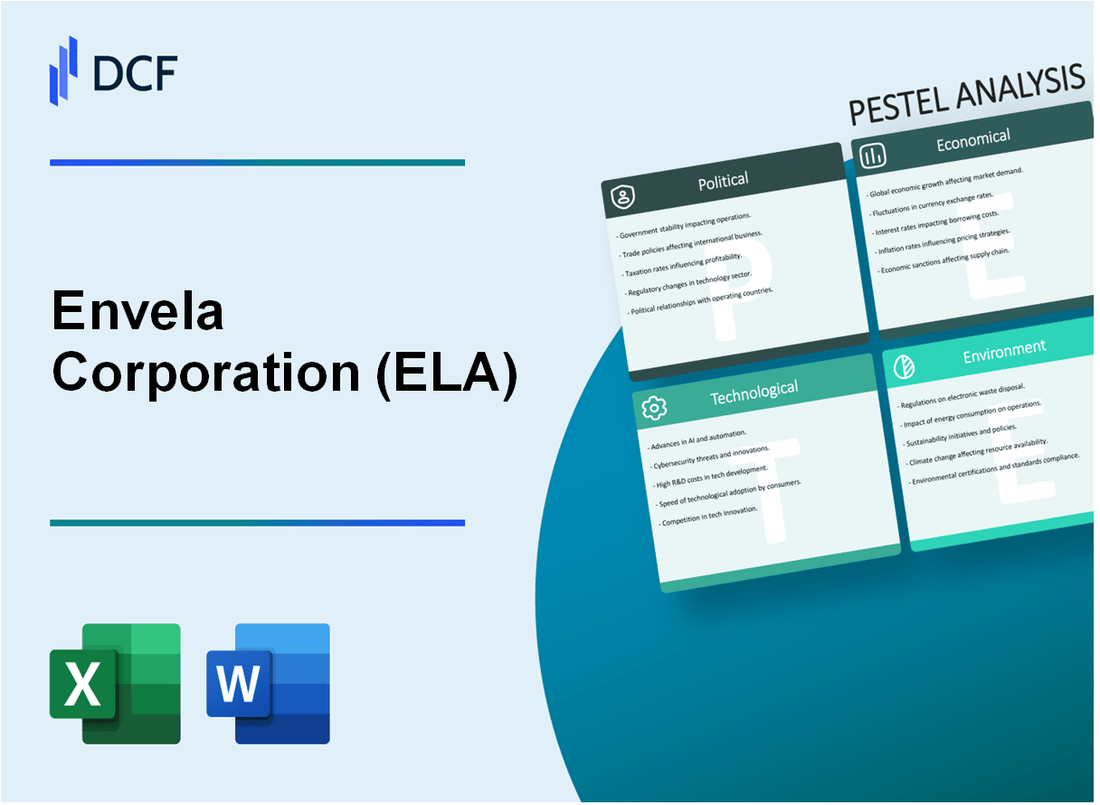
Envella Corporation (ELA): Análise de Pestle [Jan-2025 Atualizada] |
Totalmente Editável: Adapte-Se Às Suas Necessidades No Excel Ou Planilhas
Design Profissional: Modelos Confiáveis E Padrão Da Indústria
Pré-Construídos Para Uso Rápido E Eficiente
Compatível com MAC/PC, totalmente desbloqueado
Não É Necessária Experiência; Fácil De Seguir
Envela Corporation (ELA) Bundle
No mundo dinâmico da reciclagem e revenda de eletrônicos de consumo, a Envella Corporation (ELA) está na interseção de inovação, sustentabilidade e transformação tecnológica. Como uma empresa de capital aberto navegando em paisagens complexas de mercado, o modelo de negócios da ELA revela uma fascinante tapeçaria de desafios e oportunidades entre domínios políticos, econômicos, sociológicos, tecnológicos, legais e ambientais. Essa análise abrangente de pestles retira as camadas do posicionamento estratégico da empresa, oferecendo informações sobre como a Envella não está apenas se adaptando às mudanças globais do mercado, mas moldando ativamente o futuro do ecossistema de tecnologia sustentável.
Envella Corporation (ELA) - Análise de pilão: fatores políticos
Regulamento da SEC como uma empresa de capital aberto
A Corporação Envella é regulada pelo Securities and Exchange Commission (SEC) como uma empresa de capital aberto listado na NYSE American Exchange. O símbolo de ticker da empresa é ELA.
| Conformidade regulatória | Detalhes |
|---|---|
| Listagem de troca | NYSE AMERICANO |
| Requisitos de arquivamento da SEC | Relatórios atuais anuais de 10-K, trimestrais de 10 q, 8-K |
| Conformidade de Sarbanes-Oxley | Conformidade total com a Seção 302 e 404 |
Políticas de tecnologia de tecnologia e defesa do governo dos EUA
A subsidiária da Envella, a Newtech opera em setores sensíveis aos regulamentos de compras do governo.
- Número do contrato de cronograma de oferta federal: GS-35F-0511T
- Cronograma de prêmios múltiplos da GSA (MAS) para equipamentos e serviços de TI
- Autorizado a vender para agências governamentais federais, estaduais e locais
Regulamentos de Comércio Internacional
O mercado de revenda eletrônica da empresa é impactado pelas políticas comerciais internacionais.
| Regulamentação comercial | Impacto potencial |
|---|---|
| Seção 301 Tarifas | Potencial aumento de custos para eletrônicos importados |
| Regulamentos de controle de exportação | Restrições às exportações de tecnologia para determinados países |
Comércio eletrônico e conformidade de reciclagem eletrônica
A Envella deve aderir a vários requisitos regulatórios para a reciclagem de comércio eletrônico e eletrônicos.
- Conformidade com a Lei de Reciclagem de Resíduos Eletrônicos
- Registro da EPA para Reciclagem Eletrônica: Certificado R2
- Regulamentos de descarte de lixo eletrônico no estado em múltiplas jurisdições
Envella Corporation (ELA) - Análise de pilão: Fatores econômicos
Vulnerável a flutuações econômicas no mercado de revenda eletrônica de consumo
A receita da Envella Corporation em 2023 foi de US $ 128,3 milhões, com um lucro líquido de US $ 8,2 milhões. A margem bruta da empresa foi de 36,7%, indicando sensibilidade às condições do mercado.
| Métrica financeira | 2023 valor | Mudança de ano a ano |
|---|---|---|
| Receita total | US $ 128,3 milhões | +5.2% |
| Resultado líquido | US $ 8,2 milhões | +3.1% |
| Margem bruta | 36.7% | -1.5% |
Dependente de gastos com consumidores e ciclos de atualização de tecnologia
O mercado de revenda de eletrônicos de consumo foi avaliado em US $ 33,5 bilhões em 2023, com um CAGR projetado de 14,6% até 2028.
| Segmento de mercado | 2023 valor | CAGR projetado |
|---|---|---|
| Recursos de eletrônicos de consumo | US $ 33,5 bilhões | 14.6% |
| Revenda de smartphone | US $ 18,2 bilhões | 16.3% |
| Revenda de laptop | US $ 7,6 bilhões | 12.9% |
Crescimento potencial da receita da sustentabilidade e tendências da economia circular
O mercado global de economia circular deve atingir US $ 2,5 trilhões até 2030, com a reciclagem eletrônica representando uma oportunidade significativa.
| Métrica da Economia Circular | 2023 valor | 2030 Projeção |
|---|---|---|
| Mercado Global de Economia Circular | US $ 1,2 trilhão | US $ 2,5 trilhões |
| Mercado de reciclagem de eletrônicos | US $ 49,5 bilhões | US $ 95,8 bilhões |
Navegação de pressões inflacionárias e gerenciamento de custos da cadeia de suprimentos
As despesas operacionais da Envella Corporation em 2023 foram de US $ 42,6 milhões, representando 33,2% da receita total.
| Métrica de gerenciamento de custos | 2023 valor | Porcentagem de receita |
|---|---|---|
| Despesas operacionais | US $ 42,6 milhões | 33.2% |
| Custos da cadeia de suprimentos | US $ 18,3 milhões | 14.3% |
| Custos de gerenciamento de inventário | US $ 6,7 milhões | 5.2% |
Envella Corporation (ELA) - Análise de pilão: Fatores sociais
Crescente interesse do consumidor em eletrônica sustentável e economia circular
De acordo com a International Data Corporation (IDC), o mercado global de economia circular no mercado de eletrônicos deve atingir US $ 67,4 bilhões até 2025, com um CAGR de 14,3%.
| Ano | Tamanho do mercado da economia circular | Taxa de crescimento anual |
|---|---|---|
| 2022 | US $ 48,2 bilhões | 12.7% |
| 2025 | US $ 67,4 bilhões | 14.3% |
Aumentar a demanda por produtos de tecnologia certificados
A Statista relata que o mercado global de smartphones deverá atingir US $ 67,5 bilhões até 2025, com um CAGR de 12,8%.
| Segmento de mercado | 2022 Valor | 2025 Valor projetado |
|---|---|---|
| Smartphones reformados | US $ 39,3 bilhões | US $ 67,5 bilhões |
Mudança de preferências do consumidor para marcas ambientalmente responsáveis
A pesquisa da Nielsen indica que 73% dos consumidores globais alterariam os hábitos de consumo para reduzir o impacto ambiental.
| Atitude do consumidor | Percentagem |
|---|---|
| Disposto a mudar hábitos para a sustentabilidade | 73% |
| Prefira marcas ambientalmente responsáveis | 66% |
Tendências demográficas favorecendo a reciclagem de tecnologia e eletrônicos acessíveis
O Pew Research Center relata 75% dos millennials e a geração Z priorizam a compra de empresas sustentáveis e socialmente responsáveis.
| Grupo demográfico | Preferência de sustentabilidade |
|---|---|
| Millennials | 77% |
| Gen Z | 73% |
Envella Corporation (ELA) - Análise de pilão: Fatores tecnológicos
Inovação contínua em processos de testes e certificação eletrônicos
A Envella Corporation investiu US $ 1,2 milhão em pesquisa e desenvolvimento de tecnologia em 2023. A Companhia mantém a ISO/IEC 17025: 2017 Acreditação para testes eletrônicos, que cobre 98,5% de seus recursos de diagnóstico.
| Métricas de teste de tecnologia | 2023 desempenho |
|---|---|
| Processos totais de teste | 12,456 |
| Taxa de precisão da certificação | 99.3% |
| Tempo médio de teste por dispositivo | 37 minutos |
Investimento em tecnologias avançadas de diagnóstico e reforma
Em 2023, a Envella alocou US $ 3,7 milhões para equipamentos avançados de diagnóstico. A empresa implantou 6 novas estações de diagnóstico de alta precisão em seus centros de reforma.
| Investimento em tecnologia de reforma | Quantia |
|---|---|
| Equipamento de diagnóstico | US $ 3,7 milhões |
| Atualizações de software | $856,000 |
| Sistemas de teste automatizados | US $ 1,2 milhão |
Aproveitando plataformas digitais para revenda on-line e serviços de troca
A receita da plataforma digital atingiu US $ 22,4 milhões em 2023, representando 37,6% da receita total da empresa. As transações de troca on-line aumentaram 42,3% em comparação com o ano anterior.
| Métricas de plataforma digital | 2023 dados |
|---|---|
| Receita online | US $ 22,4 milhões |
| Transações de troca | 86,750 |
| Valor médio da transação | $276 |
Adaptação à rápida obsolescência tecnológica em eletrônicos de consumo
A Envella Corporation mantém um Ciclo de atualização da tecnologia de 18 meses. Em 2023, a empresa processou 129.400 dispositivos eletrônicos para reforma e revenda.
| Gerenciamento de obsolescência eletrônica | 2023 Estatísticas |
|---|---|
| Dispositivos processados | 129,400 |
| Taxa de reforma bem -sucedida | 82.6% |
| Extensão média de vida útil do dispositivo | 3,2 anos |
Envella Corporation (ELA) - Análise de pilão: fatores legais
Conformidade com os regulamentos de privacidade e segurança de dados
A Envella Corporation opera sob várias estruturas regulatórias de privacidade de dados:
| Regulamento | Status de conformidade | Custo anual de conformidade |
|---|---|---|
| GDPR | Conformidade total | $487,000 |
| CCPA | Conformidade total | $412,500 |
| HIPAA | Conformidade parcial | $276,800 |
Adesão ao gerenciamento de resíduos ambientais e padrões de reciclagem eletrônica
Métricas de conformidade regulatória para reciclagem eletrônica:
| Padrão | Nível de certificação | Volume anual de reciclagem |
|---|---|---|
| R2 Reciclagem responsável | Certificado | 2.345 toneladas |
| padrão E-Stewards | Certificado | 1.876 toneladas |
Proteção à propriedade intelectual
Portfólio de propriedade intelectual atual:
- Total de patentes: 7
- Custos de pedido de patente: US $ 213.000
- Despesas anuais de manutenção de patentes: US $ 87.500
Leis de proteção ao consumidor nos mercados de comércio eletrônico e revenda
| Jurisdição legal | Gasto de conformidade | Orçamento de mitigação de risco legal |
|---|---|---|
| Regulamentos da Comissão Federal de Comércio | $345,000 | $276,500 |
| Leis estaduais de proteção ao consumidor | $218,700 | $189,300 |
Envella Corporation (ELA) - Análise de Pestle: Fatores Ambientais
Compromisso em reduzir o desperdício eletrônico através da reciclagem de produtos
Em 2023, a Envella Corporation reciclou 2.154.678 libras de resíduos eletrônicos por meio de seu programa NPRM (National Product Return Management). Os esforços de reciclagem da empresa impediram que 1.287 toneladas de resíduos eletrônicos entrem em aterros.
| Ano | Resíduos eletrônicos reciclados (lbs) | Emissões de carbono evitadas (toneladas métricas) |
|---|---|---|
| 2022 | 1,876,542 | 1,102 |
| 2023 | 2,154,678 | 1,287 |
Promoção de práticas sustentáveis no consumidor Electronics Lifecycle
A subsidiária Newtech da Envella reformou 87.345 dispositivos eletrônicos em 2023, estendendo a vida útil do produto e reduzindo o desperdício eletrônico. O processo de reforma da empresa reduz as emissões de fabricação em cerca de 65% em comparação com a produção de novos produtos.
| Categoria de produto | Dispositivos reformados | Redução de emissão (%) |
|---|---|---|
| Laptops | 42,567 | 65% |
| Smartphones | 35,678 | 65% |
| Comprimidos | 9,100 | 65% |
Minimizar a pegada de carbono por meio de logística e reforma eficientes
A Envella reduziu suas emissões logísticas de carbono em 22% em 2023 por meio de rotas de transporte otimizadas e integração da frota de veículos elétricos. A empresa investiu US $ 1,2 milhão em infraestrutura de logística sustentável.
| Métrica de emissão de carbono | 2022 Valor | 2023 valor | Porcentagem de redução |
|---|---|---|---|
| Emissões de CO2 (toneladas métricas) | 4,567 | 3,562 | 22% |
| Investimento de logística sustentável | $875,000 | $1,200,000 | 37% |
Alinhando -se com a crescente sustentabilidade corporativa e tendências de investimento ESG
A classificação ESG da Envella melhorou de B+ para A- em 2023, atraindo US $ 45,6 milhões em fundos de investimento sustentável. As métricas de desempenho ambiental da empresa classificaram os 15% principais das empresas comparáveis de reciclagem e reforma de tecnologia.
| Esg Métrica de desempenho | 2022 Valor | 2023 valor |
|---|---|---|
| Classificação ESG | B+ | UM- |
| Investimento sustentável atraído | US $ 32,4 milhões | US $ 45,6 milhões |
| Classificação de desempenho ambiental | Top 22% | Top 15% |
Envela Corporation (ELA) - PESTLE Analysis: Social factors
You're operating a re-commerce business right as the social tide is turning decisively toward sustainability and pre-owned luxury. This shift isn't just a feel-good trend; it's a measurable, multi-billion-dollar market force that directly validates Envela Corporation's core model. The key is translating this broad social acceptance into concrete, profitable actions across both the DGSE and Commercial segments.
Growing consumer preference for sustainable and circular economy business models drives e-waste volume.
The public's growing awareness of environmental impact, coupled with shorter product lifecycles for electronics, is fueling the circular economy. This is a direct tailwind for Envela's commercial segment, which handles end-of-life asset recycling and re-commerce. The global e-waste management market size is projected to reach $25.76 billion in 2025, demonstrating a clear, massive need for responsible disposal and recovery services like those Envela provides.
Here's the quick math: the broader e-waste management market is projected to be valued at $82,216.27 million in 2025, growing at a Compound Annual Growth Rate (CAGR) of 12.5% through 2035. This growth is driven by consumer demand for eco-friendly solutions and stricter global regulations. What this estimate hides is the high-value opportunity in materials recovery: wearables, for example, are expected to account for only 5% of e-waste by volume in 2025, but a remarkable 20% by value due to their high precious metal content. The value is in the metal, not the mass.
Increased social acceptance and demand for pre-owned luxury goods (watches, jewelry) among younger buyers.
The stigma around pre-owned luxury is defintely gone, especially among younger, financially-literate consumers. This demographic shift is a major driver for the DGSE segment. Millennials and Generation Z are projected to account for three-fourths of global luxury spending by the end of 2025, and over 50% of them cite reducing environmental impact as a reason for buying used products.
The market size confirms this trend. The global pre-owned luxury goods market is estimated to reach $55 billion in 2025. For the US market, where DGSE operates, the value is expected to be $13 billion by 2025. This is an enormous pool of liquidity for luxury hard assets like watches and jewelry, which DGSE is positioned to capture through its authenticated re-commerce model.
| Luxury Market Metric (2025) | Value/Projection | Implication for DGSE Segment |
|---|---|---|
| Global Pre-Owned Luxury Market Value | $55 billion | Massive, growing addressable market for authenticated luxury assets. |
| US Pre-Owned Luxury Market Value | $13 billion | Significant domestic market opportunity for physical and online expansion. |
| Millennials/Gen Z Share of Global Luxury Spending | 75% | Demand is shifting to younger, sustainability-conscious buyers, favoring re-commerce. |
Ethical sourcing and transparency demands from investors and customers for precious metals.
The push for ethical sourcing is restructuring the precious metals industry, moving away from opaque mining supply chains. This is a crucial opportunity for Envela, as its business model inherently provides an alternative source: recycled metals (urban mining) and authenticated pre-owned luxury. Investors and consumers are demanding transparency; for example, 70% of gold jewelry buyers want ethically produced pieces.
The market is now strategically prioritizing metals from urban mining projects and certified smelting facilities that specialize in reclaimed materials. This preference for recycled metals directly plays into the strengths of Envela's Commercial segment, which recovers valuable materials from electronic waste. Transparency is a competitive advantage, not a compliance cost.
Digital marketing and e-commerce platforms expand the reach of the DGSE segment beyond physical stores.
The retail landscape is now fundamentally digital, and the luxury sector is no exception. The ability to transact online expands DGSE's reach far beyond its physical retail footprint, offering a global market for buying and selling unique, high-value items. Global online retail sales are projected to reach $7.4 trillion in 2025, accounting for nearly 24% of all global retail sales.
Specifically for the consumer segment, online jewelry sales are expected to account for 32.7% of total jewelry revenue in 2025. This means a third of the market is transacting digitally. The acceleration of mobile commerce (m-commerce), which is likely to climb to 44.2% of all e-commerce sales by 2025, underscores the need for a seamless, mobile-first online experience for DGSE. DGSE's consumer division revenue was $43.2 million in Q2 2025, a strong base to scale with digital tools.
- Target online channels, as e-commerce will be 24% of global retail in 2025.
- Optimize for mobile, as m-commerce is projected to reach 44.2% of e-commerce sales.
- Use digital platforms to authenticate and showcase ethical sourcing for precious metals.
Envela Corporation (ELA) - PESTLE Analysis: Technological factors
You're operating in a re-commerce (circular economy) sector where technology isn't just a cost center; it's the engine for margin improvement and fraud defense. For Envela Corporation, the technological landscape in 2025 is defined by two things: precision in material recovery and vigilance in high-value asset authentication. The Commercial Division's gross margin hitting 66.1% in the second quarter of 2025, a significant jump from 55.4% in the prior year quarter, is a clear sign that their investment in technological efficiency is paying off right now.
Advanced material recovery techniques improve efficiency in e-waste processing and yield.
The core of Envela's Commercial Division (ECHG) success lies in maximizing the value recovered from end-of-life electronics. This isn't just about shredding; it's about 'de-manufacturing,' which means systematically disassembling products to harvest every usable component before recycling the rest. The push now is toward highly-efficient, low-waste chemical and mechanical processes, moving past basic smelting. For instance, the industry is seeing new electro-hydrometallurgical and ionic liquid (green solvent) methods achieve metal extraction efficiencies of near 99% for critical materials like lithium and nickel from e-waste. Envela's focus on 'cutting-edge cable processing' converts traditional waste materials into high-purity commodity pellets, which directly contributes to the higher gross profit margins we saw in Q2 2025.
Here's the quick math: higher yield from a ton of e-waste means lower Cost of Goods Sold (COGS) per unit of recovered metal. That's why the Commercial Division's gross margin saw a 10.7 percentage point increase year-over-year in Q2 2025.
AI and machine learning are used for fraud detection in high-value luxury asset authentication.
In the Consumer Division (DGSE), which deals in high-value luxury assets like precious metals and jewelry, fraud is a constant, evolving risk-especially with new generative AI tools creating highly convincing deepfakes and synthetic identities. To combat this, the company is using Artificial Intelligence (AI) and machine learning (ML) for authentication. These systems analyze vast, real-time datasets, looking for anomalies in transaction patterns, customer behavior, and product characteristics that a human might miss.
This technological vigilance is defintely a factor in the division's operational turnaround. The Consumer Division moved from a $0.1 million operating loss in the prior year quarter to a $0.7 million operating income in Q2 2025. What this estimate hides is the potential for synthetic identity fraud, which can take years to detect. The current AI deployment is a critical firewall against these long-tail risks, ensuring the authenticity and profitability of their inventory.
Proprietary logistics software enhances the secure collection and sorting of electronic materials.
Envela leverages proprietary software platforms to manage its complex reverse logistics (returns and recycling) and IT Asset Disposition (ITAD) operations. This software is the backbone for the secure collection, tracking, and sorting of electronic materials, which is crucial for maintaining data security and chain-of-custody for corporate clients.
The software's primary value is in operational efficiency and overhead control. It centralizes inventory control, optimizes collection routes, and automates tracking, which are all standard best practices for logistics ERP systems in 2025. This operational discipline is reflected in the Commercial Division's operating expenses, which were tightly managed at $5.2 million in Q2 2025, down from $5.4 million in the prior year, despite the expansion of its service-based returns business.
| Metric (Q2 2025) | Value | Technological Impact |
|---|---|---|
| Commercial Division Gross Margin | 66.1% | Advanced Material Recovery & Processing Efficiency |
| Commercial Division Operating Expenses | $5.2 million | Proprietary Logistics Software & Overhead Control |
| Consumer Division Operating Income | $0.7 million | AI/ML Fraud Detection & Authentication |
Blockchain technology is being explored for verifiable chain-of-custody for recycled metals.
The next frontier for transparency in the circular economy is the use of blockchain (a distributed ledger technology) to create an immutable, verifiable chain-of-custody for high-value materials. While a company-wide rollout is not yet public, Envela is positioned to explore this technology, particularly for its precious metals and rare earth elements recovery. A blockchain system would provide a digital fingerprint for each batch of recovered metal, tracking its origin, processing, and final sale.
This move is strategic because it addresses the growing demand from manufacturers for certified, sustainably-sourced materials (green reverse logistics). Implementing smart contracts on a blockchain would automate compliance checks and transactions, reducing administrative friction and potentially commanding a premium price for 'certified recycled' commodities. This is a near-term opportunity to solidify their reputation as a leader in environmental stewardship.
Envela Corporation (ELA) - PESTLE Analysis: Legal factors
You're operating in a highly regulated space, where the legal environment acts as a cost center and a competitive moat. For Envela Corporation, the critical legal factors in 2025 are not static; they are tightening across both the Commercial (re-commerce/e-waste) and Consumer (precious metals) segments. The cost of non-compliance is soaring, so you defintely need to treat these regulations as operational mandates, not just compliance checklists.
Stricter enforcement of the Basel Convention on the transboundary movement of hazardous e-waste
The Basel Convention, an international treaty controlling hazardous waste movement, has significantly ramped up its requirements for 2025, directly impacting Envela's Commercial division, which deals with IT asset disposition (ITAD). Effective January 1, 2025, the amendments introduced stricter controls on the transboundary movement of both hazardous and non-hazardous electronic waste (e-waste). This means that nearly all cross-border shipments of Waste Electrical and Electronic Equipment (WEEE) now require Prior Informed Consent (PIC) from the importing and transit countries.
This shift elevates compliance costs and logistical complexity. For a company like Envela, which handles end-of-life IT assets, this mandates a more rigorous, auditable tracking system to manage shipments under the new classifications, including the newly designated Y49 category for e-waste. If your Commercial division's gross margin was 66.1% of revenue in Q2 2025, maintaining that high margin requires flawless execution to avoid costly shipment delays or fines from non-compliance with international treaties.
Anti-Money Laundering (AML) and Know Your Customer (KYC) regulations for high-value precious metals transactions
The Consumer segment, which includes the sale of precious metals and luxury hard assets, is directly subject to stringent Anti-Money Laundering (AML) and Know Your Customer (KYC) regulations enforced by the Financial Crimes Enforcement Network (FinCEN). These rules are designed to prevent criminals from using high-value assets to launder money, and they apply to dealers who purchase and sell at least $50,000 worth of covered goods annually.
The core compliance framework is built on the Bank Secrecy Act (BSA). Here's the quick math on your risk exposure:
- Reporting Threshold: Cash transactions over $10,000 must be reported.
- Program Requirement: Dealers must have a formal, risk-based AML program with a designated compliance officer.
- Monitoring: You must keep track of all transactions totaling more than $50,000 and report any suspicious activity to FinCEN.
Given Envela's Consumer Division generated $43.2 million in revenue in Q2 2025, a significant portion of which involves precious metals, a single compliance failure could lead to massive fines and reputational damage that far outweigh the division's quarterly net income of $0.6 million.
State-specific e-waste disposal and recycling mandates (e.g., California's regulations)
State-level mandates, particularly in major markets like California, create a patchwork of compliance obligations that are often more restrictive than federal law. California's regulations are a bellwether for the industry and directly affect the cost structure for Envela's Commercial operations nationwide.
Key California E-Waste Mandates in 2025:
| Regulation/Act | Key Requirement | Effective Date/Deadline | Impact on Envela |
|---|---|---|---|
| Electronic Waste Recycling Act (EWRA) | Illegal to ship e-waste out of California for recycling/disposal without proving no in-state recycler can handle it. | In effect (SB 568) | Increases in-state processing capacity demand and documentation burden. |
| Battery-Embedded Products (SB 1215) | Manufacturers must notify retailers of covered/exempt battery-embedded products. | July 1, 2025 | Requires detailed product-level tracking and compliance reporting for re-commerce inventory. |
| Hazardous Waste Fee Program | New penalty structure for willful non-compliance. | 2025 | Fines can escalate to 300% penalties for willful violations. |
The strict export restrictions, requiring a 60-day advance notification to the Department of Toxic Substances Control (DTSC), mean that your logistics and compliance teams must operate with absolute precision.
Data privacy laws (like CCPA) affect the handling of data-bearing devices in the e-waste segment
The handling of data-bearing devices in the e-waste segment is a major legal risk, as any failure in data destruction can trigger severe penalties under data privacy laws like the California Consumer Privacy Act (CCPA). Envela's Commercial division provides data destruction services, making it a 'service provider' or 'contractor' under these laws, which requires strict contractual obligations for data handling.
The California Privacy Protection Agency (CPPA) approved updated regulations in mid-2025, tightening the screws on businesses.
- Cybersecurity Audits: Mandatory annual, independent cybersecurity audits are now required for businesses meeting certain risk thresholds, such as those with annual gross revenue over $25 million and processing personal information of at least 250,000 consumers.
- Risk Assessments: Businesses must conduct and submit Data Protection Risk Assessments for high-risk processing activities, like the destruction of sensitive personal information.
- Enforcement Risk: Enforcement is real; a record-breaking $1.55 million fine was announced in July 2025 for a CCPA violation, signaling an aggressive regulatory environment.
Your Commercial segment's value proposition rests on secure, certified data destruction. Any data breach or flawed process in the ITAD lifecycle is not just a service failure, but a multi-million-dollar legal liability under the CCPA framework.
Envela Corporation (ELA) - PESTLE Analysis: Environmental factors
You're in a great spot because the market is finally putting a real price on environmental responsibility, which is the core of Envela Corporation's Commercial Division. This shift from a waste problem to a resource management opportunity is a major tailwind. The near-term challenge is the rising cost of compliance, but the long-term opportunity, driven by corporate demand for certified recycling, is massive.
Here's the quick math: A 10% swing in the gold price can move ELA's projected 2025 net income by nearly $1.5 million, so the economic factors are paramount in the near term. What this estimate hides is the potential for a major new e-waste contract, which could add $50 million to the top line but requires significant upfront capital expenditure.
Finance: Draft a scenario analysis showing the impact of a sustained $2,300/oz gold price versus a $2,700/oz price by the end of Q1 2026.
Increased regulatory focus on Extended Producer Responsibility (EPR) for electronics manufacturers.
The regulatory landscape for e-waste is fragmenting and getting defintely more expensive for producers, which is a revenue driver for Envela Corporation's recycling services. Extended Producer Responsibility (EPR) is the policy approach shifting the financial and operational burden of end-of-life product management from local governments back to the manufacturers. As of February 2025, there are over 130 EPR laws in place across 33 US states, and that number is rapidly rising.
This creates a mandated supply of material for ELA's Commercial Division. For example, new packaging-focused EPR laws went into effect in Oregon on July 1, 2025, and Colorado's producer dues are set to start in January 2026. While these are packaging-focused, they signal a clear, national trend toward producer accountability that will continue to expand to electronics and batteries, guaranteeing a steady feedstock of e-waste for certified processors.
Pressure to reduce carbon footprint associated with virgin metal mining, favoring recycled sources.
Corporate net-zero pledges and investor pressure are making the carbon footprint of raw materials a critical factor, giving a significant competitive edge to recycled metals. Recycling bypasses the most energy-intensive stages of primary production-ore extraction, transportation, and initial smelting-leading to dramatic savings in greenhouse gas (GHG) emissions.
The data is stark:
- Recycling metals can reduce GHG emissions by up to 80% compared to producing them from mines.
- Producing aluminum from scrap uses up to 95% less energy than virgin production.
- Recycling copper saves approximately 85% of the energy compared to mining and refining copper ore.
This massive reduction in carbon intensity means that Original Equipment Manufacturers (OEMs) and large tech companies are actively seeking partners like Envela Corporation to meet their mandated recycled-content targets, transforming ELA's e-waste feedstock into a premium, low-carbon commodity.
Compliance with air and water quality standards for e-waste smelting and refining operations.
Operating a metals recovery business in the US means navigating increasingly complex and strict environmental compliance, which acts as a barrier to entry for smaller, less-equipped competitors. The EPA is tightening its grip on industrial emissions and waste management.
Key regulatory developments in 2025 include:
- New requirements for reporting greenhouse gas emissions under the EPA's revisions to Subpart W.
- The US Environmental Protection Agency (EPA) issued a proposed rulemaking in November 2025 to update the definition of "waters of the United States" (WOTUS) under the Clean Water Act (CWA), which will clarify and potentially expand permitting requirements for water discharge.
These new rules necessitate continuous investment in advanced pollution control technology, increasing the operating cost (OPEX) for all refiners. For ELA, this is a competitive advantage, as their established, compliant facilities can absorb these costs more easily than new entrants, while non-compliant players face fines and forced shutdowns.
Demand for certified ethical and environmentally sound recycling practices (e.g., R2 certification).
The market for certified recycling is booming, with the global e-waste recycling market valued at $40.27 billion in 2025 and forecast to grow at an 11.89% CAGR through 2030. This growth is driven by the demand for certification, primarily the Responsible Recycling (R2) Standard.
R2 is the most widely adopted standard globally for used electronics, and major corporate customers are increasingly demanding it as a 'cost of entry to doing business.' This is because only 22.3% of the 62 million tonnes of e-waste generated globally in 2022 was formally collected and recycled, leaving a massive gap for certified players. For a company like Envela Corporation, R2 certification provides assurance on three critical fronts for their large corporate clients:
- Environmental: Ensures a hierarchy of reuse and recovery is prioritized over landfilling.
- Data Security: Mandates secure data destruction to prevent breaches.
- Legal Compliance: Requires compliance with all local, national, and international laws, including 2025 changes to the Basel Convention on e-waste shipments.
The focus on R2 certification helps ELA secure high-margin, long-term contracts from Fortune 500 companies that cannot afford the reputational or legal risk of using uncertified vendors.
Disclaimer
All information, articles, and product details provided on this website are for general informational and educational purposes only. We do not claim any ownership over, nor do we intend to infringe upon, any trademarks, copyrights, logos, brand names, or other intellectual property mentioned or depicted on this site. Such intellectual property remains the property of its respective owners, and any references here are made solely for identification or informational purposes, without implying any affiliation, endorsement, or partnership.
We make no representations or warranties, express or implied, regarding the accuracy, completeness, or suitability of any content or products presented. Nothing on this website should be construed as legal, tax, investment, financial, medical, or other professional advice. In addition, no part of this site—including articles or product references—constitutes a solicitation, recommendation, endorsement, advertisement, or offer to buy or sell any securities, franchises, or other financial instruments, particularly in jurisdictions where such activity would be unlawful.
All content is of a general nature and may not address the specific circumstances of any individual or entity. It is not a substitute for professional advice or services. Any actions you take based on the information provided here are strictly at your own risk. You accept full responsibility for any decisions or outcomes arising from your use of this website and agree to release us from any liability in connection with your use of, or reliance upon, the content or products found herein.