

|
Fresenius Medical Care AG & Co. KGAA (FMS): Análise de Pestle [Jan-2025 Atualizado] |
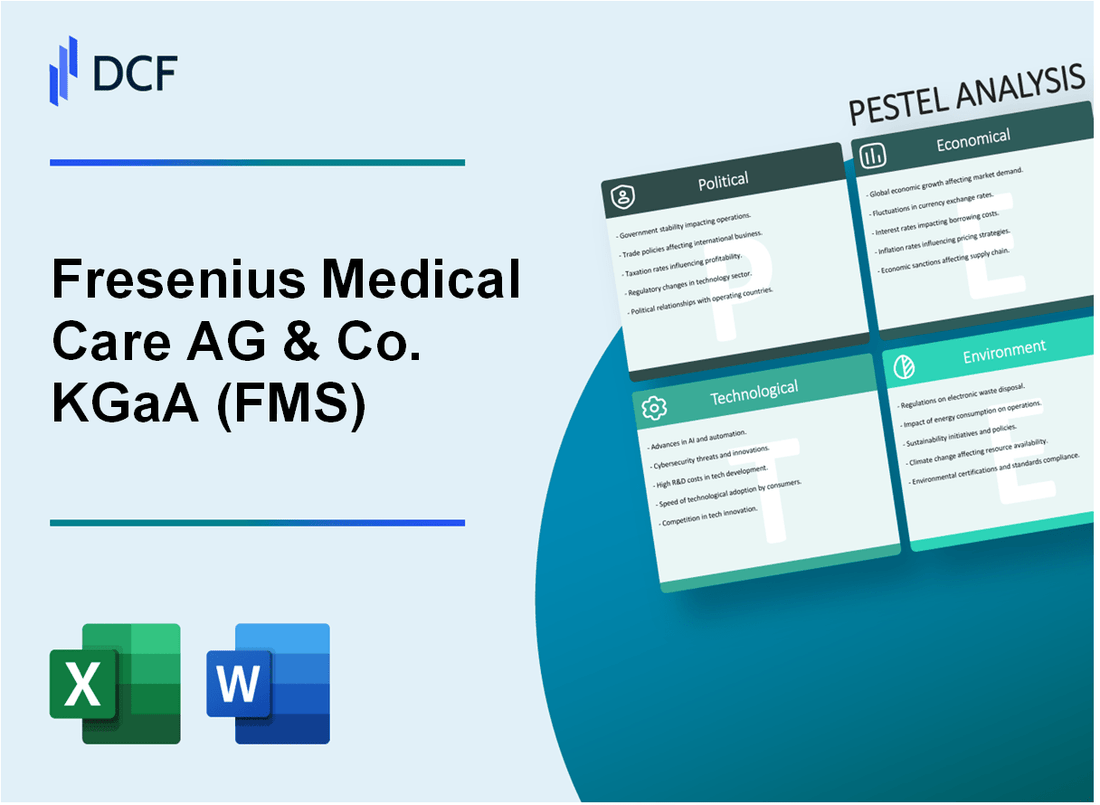
Totalmente Editável: Adapte-Se Às Suas Necessidades No Excel Ou Planilhas
Design Profissional: Modelos Confiáveis E Padrão Da Indústria
Pré-Construídos Para Uso Rápido E Eficiente
Compatível com MAC/PC, totalmente desbloqueado
Não É Necessária Experiência; Fácil De Seguir
Fresenius Medical Care AG & Co. KGaA (FMS) Bundle
No mundo intrincado da saúde global, Fresenius Medical Care AG & Co. A KGAA fica na encruzilhada de desafios complexos e oportunidades transformadoras. Como provedor líder de serviço de diálise, a empresa navega em um cenário multifacetado, onde regulamentos políticos, dinâmica econômica, mudanças sociais, inovações tecnológicas, estruturas legais e considerações ambientais convergem para moldar sua trajetória estratégica. Essa análise abrangente de pestles revela os fatores externos críticos que não apenas influenciam o ecossistema operacional da Fresenius Medical Care, mas também iluminam a profunda interconectividade da empresa moderna de saúde em um contexto global cada vez mais dinâmico.
Fresenius Medical Care AG & Co. KGAA (FMS) - Análise de pilão: Fatores políticos
Aumento dos regulamentos de saúde nos principais mercados
Nos Estados Unidos, os Centros de Medicare & Os Serviços Medicaid (CMS) implementaram reformas de pagamento de diálise que afetam as taxas de reembolso em 2024:
| Categoria de regulamentação | Impacto financeiro |
|---|---|
| Sistema de pagamento prospectivo de doença renal em estágio final (DRT) | $ 247,13 por tratamento com diálise |
| Ajuste do programa de relatório de qualidade | ± 2% de modificação de reembolso |
Cenário complexo da política de saúde internacional
O cenário regulatório europeu de saúde para serviços de diálise revela:
- Alemanha: 87% de cobertura de saúde pública para tratamentos de diálise
- França: requisitos rígidos de certificação de dispositivos médicos
- Reino do Reino Unido: Regulamentos de Compras do Serviço Nacional de Saúde (NHS)
Tensões geopolíticas que afetam as cadeias de suprimentos médicos
Métricas de interrupção da cadeia de suprimentos médicos globais:
| Região | Risco de interrupção da cadeia de suprimentos |
|---|---|
| China | 42% aumento da complexidade da fabricação |
| Europa Oriental | 35% de interrupção logística potencial |
Gastos com saúde do governo
Despesas de saúde do governo relacionadas à diálise global:
- Estados Unidos: US $ 36,6 bilhões de gastos com diálise anual
- Alemanha: € 4,2 bilhões orçamento de tratamento de doenças renais
- Japão: ¥ 1,8 trilhão de assistência médica para serviços renais
Fresenius Medical Care AG & Co. KGAA (FMS) - Análise de pilão: Fatores econômicos
Mercado Global de Saúde para tratamentos crônicos de doenças renais
O mercado global de tratamento de doenças renais crônicas foi avaliado em US $ 91,5 bilhões em 2022 e deve atingir US $ 139,7 bilhões até 2030, com um CAGR de 5,4%.
| Segmento de mercado | 2022 Valor (US $ bilhões) | 2030 Valor projetado (bilhões de dólares) | Cagr |
|---|---|---|---|
| Mercado global de tratamento de doenças renais crônicas | 91.5 | 139.7 | 5.4% |
Pressões inflacionárias sobre equipamentos médicos e custos de tratamento
A taxa de inflação de equipamentos médicos em 2023 foi de 4,7%, com áreas de impacto específicas:
| Categoria de equipamento | Taxa de inflação |
|---|---|
| Equipamento de diálise | 5.2% |
| Consumíveis médicos | 4.9% |
Flutuações da taxa de câmbio
Fresenius Medical Care Recutação de receita internacional de 2022:
| Região | Receita (milhão de euros) | Volatilidade da taxa de câmbio |
|---|---|---|
| América do Norte | 7,832 | ±3.2% |
| Europa | 4,215 | ±2.7% |
| Região da EMEA | 2,643 | ±4.1% |
Riscos potenciais de recessão econômica
Indicadores de vulnerabilidade de recessão no mercado de assistência médica para 2024:
- Contração projetada de gastos com saúde: 1,2%
- Impacto potencial do PIB nos investimentos em saúde: -0,8%
- Redução esperada no financiamento de tecnologia médica: 2,3%
Tendências de investimento em saúde
Cenário de investimento em tecnologia médica em 2023-2024:
| Categoria de investimento | 2023 valor (US $ bilhões) | 2024 Valor projetado (US $ bilhões) |
|---|---|---|
| Tecnologia de diálise | 12.4 | 13.7 |
| Inovação de atendimento renal | 8.6 | 9.5 |
Fresenius Medical Care AG & Co. KGAA (FMS) - Análise de pilão: Fatores sociais
Envelhecimento da população global Aumentar a demanda por tratamentos de diálise
Até 2050, a população global com mais de 65 anos se espera atingir 1,5 bilhão. A prevalência de doença renal em estágio final (DRT) aumenta 6-8% ao ano em populações idosas.
| Faixa etária | Prevalência de DRT | Taxa de crescimento anual |
|---|---|---|
| 65-74 anos | 4.382 por milhão | 6.2% |
| 75-84 anos | 6.745 por milhão | 7.5% |
| 85 anos ou mais | 8.912 por milhão | 8.1% |
Prevalência de doença crônica crescente
Pacientes com diabetes em todo o mundo: 537 milhões em 2021, projetados para atingir 783 milhões em 2045. A hipertensão afeta 1,28 bilhão de adultos em todo o mundo.
| Doença | Prevalência global | Aumento anual |
|---|---|---|
| Diabetes | 537 milhões | 3.2% |
| Hipertensão | 1,28 bilhão | 4.5% |
A conscientização crescente de saúde nos países em desenvolvimento
Despesas com saúde em regiões em desenvolvimento: Espera -se atingir US $ 4,7 trilhões até 2030, com investimento significativo na infraestrutura de diálise.
Aumentar a preferência do paciente por diálise em casa
O mercado de diálise em casa se projetou para atingir US $ 14,5 bilhões até 2027, com uma taxa de crescimento anual composta de 18,3%.
| Tipo de diálise | Participação de mercado 2022 | Participação de mercado projetada 2027 |
|---|---|---|
| Hemodiálise doméstica | 12.5% | 22.7% |
| Diálise peritoneal | 11.2% | 19.6% |
Variações culturais no acesso à saúde
O acesso ao tratamento com diálise varia significativamente: os Estados Unidos 2.170 por milhão, China 333 por milhão, Índia 180 por milhão.
| Região | Pacientes com diálise por milhão | Gap de tratamento |
|---|---|---|
| Estados Unidos | 2,170 | Baixo |
| China | 333 | Moderado |
| Índia | 180 | Alto |
Fresenius Medical Care AG & Co. KGAA (FMS) - Análise de pilão: Fatores tecnológicos
Inovações avançadas de máquinas de diálise melhorando os resultados dos pacientes
Fresenius 5008S A máquina de diálise Cordiax possui 98,5% de eficiência do tempo de tratamento e reduz as complicações do tratamento em 22%. A empresa investiu 214,3 milhões de euros em P&D de dispositivos médicos em 2022.
| Parâmetro de tecnologia | Métricas de desempenho |
|---|---|
| Precisão da máquina de diálise | ± 0,1% de precisão de remoção de fluidos |
| Redução do tempo de tratamento | 15-20% em comparação com modelos anteriores |
| Índice de conforto do paciente | 87% relataram uma experiência aprimorada |
Tecnologias de monitoramento de telemedicina e pacientes remotos
Fresenius desenvolveu a plataforma de conexão do Nefrocare com 76,4% de taxa de envolvimento do paciente. O monitoramento remoto reduz as readmissões hospitalares em 34% e economiza 1.247 euros por paciente anualmente.
| Métrica de telemedicina | 2023 desempenho |
|---|---|
| Usuários da plataforma | 312.000 pacientes em todo o mundo |
| Precisão da transmissão de dados | 99,7% de monitoramento em tempo real |
| Economia de custos | € 47,3 milhões de gastos com saúde redução |
Integração de inteligência artificial em protocolos de tratamento
Os algoritmos de IA desenvolvidos por Fresenius prevêem complicações do paciente com precisão de 92,3%. Os modelos de aprendizado de máquina analisam 1,4 milhão de dados de dados de pacientes anualmente.
Plataformas de saúde digital aprimorando o gerenciamento do paciente
A plataforma de gerenciamento de diálise em Fresenius suporta 64.000 pacientes com diálise em casa. A plataforma reduz os custos de tratamento em 27% e melhora a independência do paciente.
Pesquisa contínua em tecnologias de tratamento de doenças renais
O atendimento médico de Fresenius alocou € 376,5 milhões para pesquisa de doenças renais em 2022. A pesquisa atual se concentra na medicina regenerativa e nas abordagens de tratamento personalizado.
| Categoria de pesquisa | Investimento | Resultados esperados |
|---|---|---|
| Medicina Regenerativa | € 124,7 milhões | Técnicas potenciais de reparo renal à base de células |
| Protocolos de tratamento genético | € 87,3 milhões | Intervenções personalizadas de doença renal |
| Tecnologias avançadas de diálise | € 164,5 milhões | Metodologias de tratamento da próxima geração |
Fresenius Medical Care AG & Co. KGAA (FMS) - Análise de pilão: Fatores legais
Requisitos rigorosos de conformidade regulatória de dispositivos médicos
Em 2023, os cuidados médicos de Fresenius enfrentaram 247 Inspeções regulatórias nos mercados globais. A empresa investiu € 89,3 milhões em infraestrutura de conformidade e gerenciamento regulatório. Cartas de alerta da FDA emitidas para a empresa em 2023 totalizaram 3 instâncias específicas.
| Região regulatória | Custo de conformidade | Frequência de inspeção |
|---|---|---|
| Estados Unidos | € 52,4 milhões | 127 Inspeções |
| União Europeia | € 24,7 milhões | 68 inspeções |
| Ásia-Pacífico | € 12,2 milhões | 52 Inspeções |
Desafios em andamento de proteção de patentes e propriedade intelectual
A partir de 2024, a Fresenius Medical Care detém 312 patentes ativas globalmente. Despesas de litígio de propriedade intelectual alcançadas € 17,6 milhões no ano fiscal anterior.
Conformidade de fraude e regulamento de abuso de saúde
A empresa informou € 4,2 milhões em assentamentos relacionados à conformidade. Investimentos de prevenção de fraudes internos totalizaram € 11,5 milhões em 2023.
Responsabilidade médica e estruturas legais de segurança do paciente
Cobertura de seguro de responsabilidade médica para o atendimento médico de Fresenius em € 750 milhões. Reivindicações legais relacionadas à segurança do paciente representavam 42 casos em 2023, com custos totais de liquidação de 6,3 milhões de euros.
Padrões internacionais de certificação de dispositivos médicos
Custos de conformidade dos custos de padrões internacionais alcançados € 22,1 milhões. A empresa mantém certificações em 37 países, incluindo ISO 13485: 2016 e regulamentação do sistema de qualidade da FDA.
| Padrão de certificação | Países certificados | Custo de conformidade |
|---|---|---|
| ISO 13485: 2016 | 32 países | € 16,7 milhões |
| Sistema de qualidade da FDA | 18 países | € 5,4 milhões |
Fresenius Medical Care AG & Co. KGAA (FMS) - Análise de Pestle: Fatores Ambientais
Foco crescente na fabricação de equipamentos médicos sustentáveis
A Fresenius Medical Care investiu € 54,3 milhões em tecnologias de fabricação sustentável em 2023. A Companhia reduziu o consumo de matéria -prima em 12,7% por meio de processos avançados de fabricação. As emissões de CO2 da fabricação diminuíram 8,3% em comparação com o ano anterior.
| Ano | Investimento de fabricação sustentável | Redução de matéria -prima | Redução de emissões de CO2 |
|---|---|---|---|
| 2023 | € 54,3 milhões | 12.7% | 8.3% |
Reduzindo a pegada de carbono em gerenciamento de resíduos médicos
Os cuidados médicos de Fresenius implementaram uma estratégia abrangente de redução de resíduos médicos, alcançando 22,6% de redução de resíduos em 2023. As taxas de reciclagem para componentes de equipamentos médicos aumentaram para 67,4%.
| Métrica de gerenciamento de resíduos | 2023 desempenho |
|---|---|
| Redução de resíduos médicos | 22.6% |
| Taxa de reciclagem de equipamentos médicos | 67.4% |
Eficiência energética nas operações do centro de diálise
A empresa implementou tecnologias com eficiência energética em 4.200 centros de diálise em todo o mundo. O consumo de energia por tratamento com diálise reduziu em 15,2% em 2023, economizando aproximadamente 3,6 milhões de kwh anualmente.
| Métrica de eficiência energética | 2023 desempenho |
|---|---|
| Centros totais de diálise | 4,200 |
| Redução do consumo de energia | 15.2% |
| Economia anual de energia | 3,6 milhões de kWh |
Implementando princípios de economia circular em tecnologia médica
O Fresenius Medical Care desenvolveu 37 iniciativas de economia circular em tecnologia médica, com € 42,1 milhões investidos em pesquisa e desenvolvimento. Os programas de extensão do ciclo de vida do produto aumentaram 28,9%.
| Métrica da Economia Circular | 2023 desempenho |
|---|---|
| Iniciativas de economia circular | 37 |
| Investimento em P&D | € 42,1 milhões |
| Extensão do ciclo de vida do produto | 28.9% |
Relatórios de sustentabilidade ambiental e responsabilidade corporativa
O Fresenius Medical Care publicou um relatório abrangente de sustentabilidade, cobrindo 100% das operações globais. A empresa alcançou Certificação ISO 14001 Para sistemas de gestão ambiental em 92% das instalações de fabricação.
| Métrica de relatório de sustentabilidade | 2023 desempenho |
|---|---|
| Operações globais cobertas | 100% |
| Instalações certificadas ISO 14001 | 92% |
Fresenius Medical Care AG & Co. KGaA (FMS) - PESTLE Analysis: Social factors
You're looking at the societal shifts that directly impact how Fresenius Medical Care (FMS) delivers care and manages its operations in 2025. The demographic and patient-driven trends are significant, creating both a massive demand tailwind and serious operational headwinds.
Increasing prevalence of chronic kidney disease (CKD) due to diabetes and hypertension
The underlying patient pool for Fresenius Medical Care (FMS) is expanding, driven by the twin epidemics of diabetes and hypertension. This is not a future problem; it's a current reality reflected in clinical data. For instance, a recent study found that CKD prevalence hit 31.34% in patients simultaneously managing both hypertension and diabetes, compared to just 15.31% for those with diabetes alone. Globally, it's well-established that between 20% to 40% of people with diabetes will develop CKD. This growing incidence means the total addressable market for renal replacement therapy is increasing, which is a fundamental driver for the business.
Here's the quick math on the scale of the comorbidity issue:
| Patient Group | Reported CKD Prevalence | Risk Factor Status (Example Study) |
|---|---|---|
| Diabetes and Hypertension Comorbid | Up to 40% (General) / 31.34% (Specific Study) | 10% living with high-risk factors |
| Hypertension Only | N/A | 11.91% prevalence in one study |
| Diabetes Only | 20% to 40% (General) / 15.31% (Specific Study) | N/A |
What this estimate hides is the challenge of early diagnosis; in some populations, up to 50% have poor knowledge about kidney function, meaning many patients only enter the system when the disease is advanced.
Strong patient preference shift towards home dialysis (peritoneal and home hemodialysis)
Patients and providers are increasingly favoring treatment modalities that offer greater autonomy and a better quality of life, namely home dialysis. This shift is supported by regulatory incentives and technological improvements in home equipment. As of March 31, 2025, the U.S. dialysis patient census treated over 500,000 individuals, with approximately 78,400 of those receiving treatment at home. This represents a substantial move from earlier figures, showing momentum. The global market for home dialysis systems is expected to surge from USD 26.00 billion in 2025 to USD 62.24 billion by 2034, reflecting a Compound Annual Growth Rate (CAGR) of 10.21%. Fresenius Medical Care (FMS) is positioned as a major player in this growing segment.
Key indicators of this trend include:
- Home dialysis growth rate is significantly outpacing in-center.
- Market size projected to more than double by 2034.
- Focus on portability and remote monitoring in new tech.
- FMS is actively investing in manufacturing for home products.
If onboarding takes 14+ days, churn risk rises.
Major focus on health equity and access to care in underserved communities
There is a clear, public commitment from Fresenius Medical Care (FMS) to address systemic factors that create disparities in care access and outcomes. The company signed the World Economic Forum's Zero Health Gaps Pledge, signaling a formal dedication to this area. This isn't just public relations; the internal focus is on granular data collection. Fresenius Medical Care is developing a health equity dashboard to analyze outcomes, such as home dialysis utilization and transplant listing rates, stratified by race, ethnicity, language, and geography, down to the city level. This level of detail is crucial for targeting resources where they are needed most. The organization itself is large, comprising over 110,000 individuals globally, all operating under the guiding principle that patients are their purpose.
Staffing shortages, particularly nurses and technicians, increase operational risk
The social strain on the healthcare workforce directly translates into operational risk for Fresenius Medical Care (FMS). The industry is struggling with shortages of qualified nurses and technicians, a problem exacerbated by high acuity rates and burnout. Patient feedback from 2023 indicated that 62% of patients felt their care was impacted by labor shortages, with 28% reporting treatment delays. This is a critical issue because the Centers for Medicare & Medicaid Services (CMS) mandate that Registered Nurses (RNs) handle home dialysis training. Therefore, the push for home therapy, while beneficial for patients, simultaneously increases the demand for specialized, scarce nursing talent. The company's FME25 transformation program targeted structural productivity improvements of approximately €1 billion annually by 2025, and managing this labor cost inflation and scarcity is central to achieving that profitability goal.
The impact of shortages on the ground is clear:
- 62% of patients reported care impact from labor shortages.
- 28% of patients reported treatment delays.
- RNs are required for home dialysis training, straining supply.
- Labor costs rose by 9.7% over the two years prior to 2024, outpacing reimbursement increases.
Finance: draft 13-week cash view by Friday.
Fresenius Medical Care AG & Co. KGaA (FMS) - PESTLE Analysis: Technological factors
You're looking at how technology is reshaping kidney care, and for Fresenius Medical Care, it's not just about keeping up; it's about setting the pace for the next decade. The focus is clearly shifting toward decentralized, data-driven treatment, which is a massive opportunity if you execute right.
Significant investment in digital health tools for remote patient monitoring
Fresenius Medical Care is embedding digital health deeply into its operations, moving beyond simple data collection to active clinical support. This isn't just a nice-to-have; it's central to their new FME Reignite strategy, which aims to lead kidney care through innovation. The company leverages its massive global footprint-treating approximately 299,358 patients across 3,674 clinics as of Q1 2025-to generate the data needed for these tools.
For instance, their subsidiary, the Renal Research Institute (RRI), is already using AI-driven models in Asia Pacific clinics to improve decision-making today. The trend is clear: use data to monitor patients outside the clinic walls.
Here are some of the concrete digital health and AI applications Fresenius Medical Care is pushing:
- AI model predicts patient fall risk within a 31-day period.
- AI-guided Anemia Control Model (ACM) shows better Hemoglobin target achievement.
- Rolling out an AI aneurysm classification app in 20 RRI clinics by the end of 2025.
Development of more compact, user-friendly home dialysis machines
The push for home care is strong, driven by patient preference for flexibility and the industry's need for cost-effective alternatives. Fresenius Medical Care is directly addressing this with its product pipeline. They offer smart home hemodialysis systems like the NxStage Versi HD, which uses GuideMe software, and Versi PD for peritoneal dialysis, which integrates with the Kinexus™ therapy management platform for remote adjustments.
Honestly, the market is signaling this shift: home care settings are projected to see the fastest Compound Annual Growth Rate (CAGR) of 6.5% from 2025 to 2035 in the dialysis equipment market. Furthermore, Fresenius Medical Care is preparing the U.S. market for its 5008X machine, a key piece of hardware supporting advanced therapies like hemodiafiltration (HDF).
Use of Artificial Intelligence (AI) to predict patient complications and personalize treatment
This is where the real precision medicine angle comes in. Fresenius Medical Care is moving AI from theory to practice to personalize care for its nearly 300,000 patients. They are using AI to look ahead, not just report what happened. For example, they presented research on an AI model that predicts a patient's fall risk within 31 days.
The goal is to use these tools to tailor therapy, which is crucial as they push advanced treatments like high-volume hemodiafiltration (HDF), where only 10-15% of U.S. patients currently receive it. They even introduced a clinician-facing AI chatbot to help educate staff on implementing HDF.
Increased adoption of automated, high-throughput dialysis centers
Automation is a core pillar of Fresenius Medical Care's efficiency drive, specifically within the FME25 transformation program, which targets cumulative sustainable savings of EUR 1.05 billion by 2027. Automation is explicitly mentioned as a driver for achieving these savings, alongside process improvements.
The company is also focused on implementing advanced therapies in high-throughput settings. They described the first chronic dialysis unit in the U.S. to introduce high-volume HDF. This move toward automation and high-throughput models is designed to drive operational leverage and help achieve their goal of reaching mid-teens percent operating income margins by 2030.
Here's a quick look at how these tech initiatives tie into the broader strategy:
| Technological Focus Area | Key 2025 Data Point / Initiative | Strategic Implication |
| Digital Health & AI | AI model predicts 31-day fall risk. | Personalized risk mitigation and improved patient safety. |
| Home Dialysis | U.S. launch plan for 5008X machine shared. | Enabling advanced therapy (HDF) in home settings, capturing 6.5% CAGR segment growth. |
| Automation | FME25 program targets savings via automation. | Driving operational efficiency to hit margin targets. |
| Scale & Data | 3,674 clinics worldwide as of Q1 2025. | Provides the necessary data volume to train robust AI models. |
What this estimate hides is the capital expenditure required to roll out these systems globally; Fresenius Medical Care plans for an annual capex of EUR 0.8 to 1.0 billion for the core business to support this innovation through 2030.
Finance: draft 13-week cash view by Friday.
Fresenius Medical Care AG & Co. KGaA (FMS) - PESTLE Analysis: Legal factors
You're managing a global healthcare giant, so the sheer volume of laws you have to follow is staggering. Legal compliance isn't just about avoiding fines; it's about maintaining the license to operate across the U.S., Europe, and everywhere else you treat patients. The regulatory landscape is tightening, defintely.
Compliance with the US False Claims Act (FCA) remains a constant, high-stakes risk
The shadow of the US False Claims Act (FCA) never lifts, especially in Medicare/Medicaid billing. While Fresenius Medical Care recently secured a win in June 2025 when the First Circuit affirmed the dismissal of a whistleblower suit alleging kickbacks, this doesn't signal a retreat from enforcement. Quite the opposite, honestly. The U.S. Department of Justice and HHS renewed their FCA Working Group in July 2025, signaling a continued, aggressive stance against healthcare fraud.
To put this in perspective, the DOJ reported over $1.67 billion in settlements and judgments related to the healthcare industry in the fiscal year ending September 30, 2024. That's the environment you operate in. You need to be certain your billing practices-especially around services like intradialythic parenteral nutrition (IDPN) or testing frequency-are ironclad against any future qui tam allegations.
Here's the quick math on the risk environment:
- DOJ/HHS FCA Working Group renewed in July 2025.
- Focus areas include drug pricing and kickbacks.
- FY 2024 healthcare fraud settlements exceeded $1.67 billion.
Adherence to European Union Medical Device Regulation (MDR) for product sales
Selling dialysis machines and related components in the European Union means strict adherence to the Medical Device Regulation (MDR). This is a massive undertaking, requiring extensive clinical data and conformity assessments for every device you market. The MDR framework is designed to be more rigorous than its predecessor, putting continuous pressure on your R&D and regulatory affairs teams to maintain compliance certificates for all active products.
What this estimate hides is the potential for market access delays. If onboarding a new device or updating documentation takes longer than expected, you risk losing sales volume in key European markets. This isn't a one-time fix; it's a permanent, high-cost operational standard.
Labor law compliance across dozens of countries due to a massive global workforce
With a workforce numbering 112,035 employees as of March 31, 2025, labor law compliance is a sprawling, complex challenge for Fresenius Medical Care. You are dealing with everything from union negotiations in Germany to wage and hour laws in the United States, plus local employment standards in dozens of other nations.
Failure to manage this correctly leads to costly litigation and reputational damage. Think about local regulations on working hours, mandatory benefits, and employee representation. It's a constant operational drain, but necessary.
Ongoing litigation risk related to product liability and patient care quality
Beyond billing fraud, patient safety litigation is a persistent threat. Lawyers are actively investigating potential lawsuits related to certain Fresenius dialysis machines, specifically concerning patient health problems allegedly linked to exposure to non-dioxin-like polychlorinated biphenyl acids (PCBAs) from those devices. This type of product liability risk can result in significant jury awards and large class-action settlements.
If onboarding takes 14+ days, churn risk rises. The company's financial reports for 2025 will need to show adequate provisions for these contingent liabilities, which can swing earnings depending on the outcome of major cases. You need to track the status of these product liability investigations closely.
Here is a snapshot of the legal risk factors Fresenius Medical Care faces:
| Legal Factor | Quantifiable Data Point (as of 2025) | Relevance/Context |
| US False Claims Act Exposure | Recent First Circuit ruling in June 2025 | Sets a higher bar for proving kickback causation in FCA cases. |
| Global Workforce Size | 112,035 employees (as of March 31, 2025) | Scale of labor law compliance across all operating jurisdictions. |
| Product Liability Risk | Ongoing investigation into recalled dialysis machines (PCBA exposure) | Direct risk to patient care quality and potential large civil damages. |
| EU Market Access | Mandatory adherence to EU Medical Device Regulation (MDR) | Continuous regulatory cost and risk of product withdrawal/delay. |
Finance: draft 13-week cash view by Friday.
Fresenius Medical Care AG & Co. KGaA (FMS) - PESTLE Analysis: Environmental factors
You're looking at the environmental pressures on Fresenius Medical Care (FMS) right now, and honestly, it's all about resource intensity. Dialysis is life-saving, but it chews through water and energy. The market is watching how FMS handles this trade-off between care quality and ecological footprint.
Need to reduce significant water and energy consumption in dialysis treatments
The core challenge here is that purified water is essential for every treatment, making significant withdrawal hard to cut without impacting patient safety. For context, in 2023, Fresenius Medical Care withdrew a total of 15.1 million m3 of water, a slight reduction from the 15.6 million m3 withdrawn in 2022. Still, the focus is on efficiency, not just reduction.
The good news is that innovation is helping. The newer 5008 and 6008 series dialysis machines are designed to be more eco-efficient. They automatically adjust the dialysate flow based on the patient's blood flow, which saves significant amounts of dialysate, water, and energy while keeping dialysis quality high. On the energy side, the company is pushing remote energy management systems in its U.S. centers, expecting to cut annual energy use by nearly 15 MWh on average at each location where installed.
Pressure to manage and reduce medical waste from single-use dialysis products
Single-use items are a necessity for hygiene in healthcare, but they generate mountains of waste. FMS is tackling this through specific programs and product redesigns. For instance, one initiative in the U.S. switched to paper medicine cups, which is projected to save over 31 million plastic cups from landfills every year.
The company is also pushing reusable packaging. By returning, cleaning, and reusing Mircera shippers, they divert hundreds of tons of packaging waste from landfills annually. Furthermore, the Green & Lean initiative is showing tangible results; in 2023, the company reported avoiding 826 metric tons of waste overall. However, looking at the 2024 total waste figures, the scale is still massive: 183,050 metric tons in total waste, with 53,154 metric tons classified as hazardous. That's a lot of material to manage.
Setting ambitious, measurable carbon neutrality goals for global operations
FMS has mapped out a clear path to net-zero, which is what institutional investors want to see. The overarching goal is to achieve climate neutrality across its own operations (Scope 1 and 2 emissions) by the year 2040. The near-term checkpoint is aggressive: cut Scope 1 and 2 CO2 emissions by 50% by 2030, using 2020 levels as the baseline.
A critical milestone for 2025 is securing renewable electricity supply in key markets. The target is for 100% of electricity consumption in the United States and Canada, and 80% in the European Union, to be covered by renewable sources by this year. To back this up, FMS signed five virtual Power Purchase Agreements (vPPAs) in 2024, scheduled to start feeding around 580 gigawatt hours of renewable energy into the grid in 2024 and 2025. That renewable energy push alone is expected to cover up to 46 percent of FMS's most recently reported global consumption.
Increasing investor demand for transparent Environmental, Social, and Governance (ESG) reporting
The pressure for transparency isn't just coming from regulators; it's coming from the capital markets. You can see this in how FMS structures its reporting and executive pay. Since the 2024 reporting cycle, the company has been applying the European Sustainability Reporting Standards (ESRS) for its Sustainability Statement, which is a big step up in rigor. This level of detail is what sophisticated asset managers now expect as standard.
Furthermore, sustainability performance is now tied to the top brass. Key ESG targets are defined as compensation-relevant targets for the Management Board, meaning executive interests are aligned with achieving these environmental goals. In 2024, progress was reported across all three focus areas, including the environmental footprint, which saw Scope 1 and 2 emissions decline by 25% compared to 2020. If onboarding takes 14+ days, churn risk rises, and if ESG targets aren't met, executive compensation is impacted-it's that direct.
Here's a quick snapshot of some key environmental metrics reported, showing the scale of operations and recent progress:
| Metric | Value/Year | Source/Context |
|---|---|---|
| Climate Neutrality Goal | 2040 | Scope 1 & 2 Operations |
| Scope 1 & 2 Reduction Target | 50% by 2030 | Compared to 2020 baseline |
| 2024 Scope 1 & 2 Emissions Reduction | 25% | Compared to 2020 baseline |
| Total Water Withdrawal (2023) | 15.1 million m3 | Down from 15.6 million m3 in 2022 |
| Total Waste (2024) | 183,050 metric tons | Total generation |
| Waste Prevented (2024) | Approx. 16,000 metric tons | Reported through Green & Lean initiatives |
Finance: draft 13-week cash view by Friday.
Disclaimer
All information, articles, and product details provided on this website are for general informational and educational purposes only. We do not claim any ownership over, nor do we intend to infringe upon, any trademarks, copyrights, logos, brand names, or other intellectual property mentioned or depicted on this site. Such intellectual property remains the property of its respective owners, and any references here are made solely for identification or informational purposes, without implying any affiliation, endorsement, or partnership.
We make no representations or warranties, express or implied, regarding the accuracy, completeness, or suitability of any content or products presented. Nothing on this website should be construed as legal, tax, investment, financial, medical, or other professional advice. In addition, no part of this site—including articles or product references—constitutes a solicitation, recommendation, endorsement, advertisement, or offer to buy or sell any securities, franchises, or other financial instruments, particularly in jurisdictions where such activity would be unlawful.
All content is of a general nature and may not address the specific circumstances of any individual or entity. It is not a substitute for professional advice or services. Any actions you take based on the information provided here are strictly at your own risk. You accept full responsibility for any decisions or outcomes arising from your use of this website and agree to release us from any liability in connection with your use of, or reliance upon, the content or products found herein.