

|
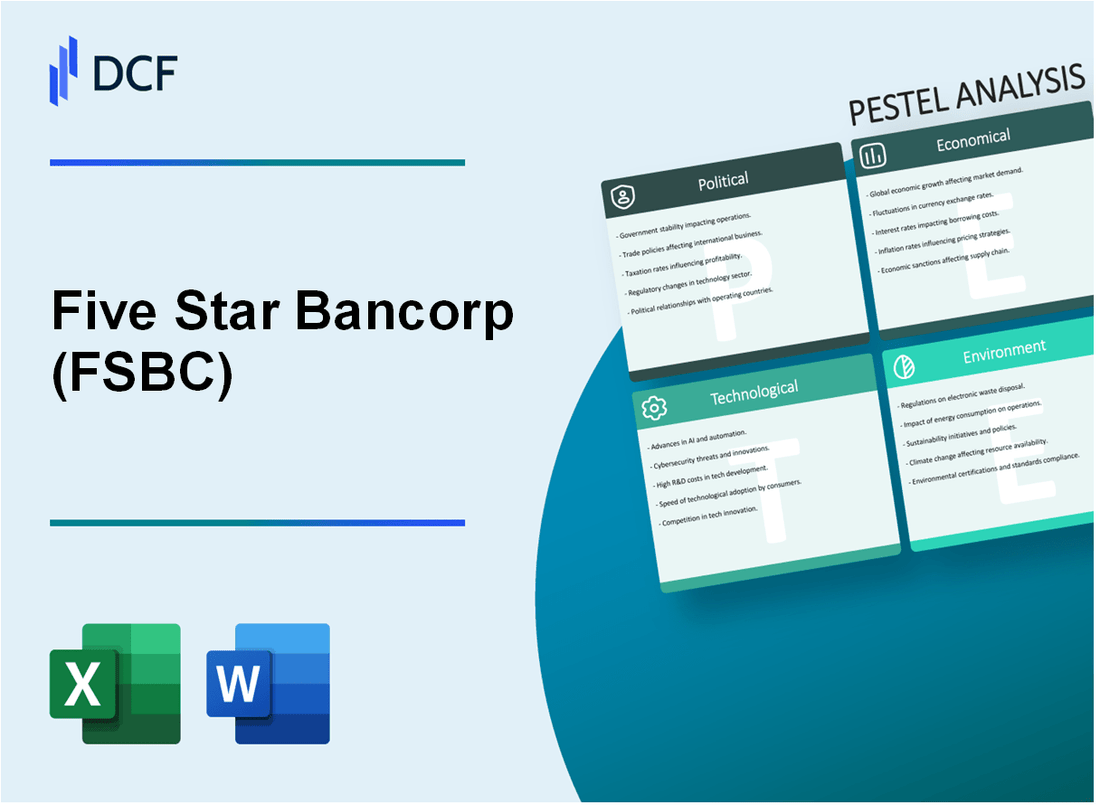
Five Star Bancorp (FSBC): Análise de Pestle [Jan-2025 Atualizado] |
Totalmente Editável: Adapte-Se Às Suas Necessidades No Excel Ou Planilhas
Design Profissional: Modelos Confiáveis E Padrão Da Indústria
Pré-Construídos Para Uso Rápido E Eficiente
Compatível com MAC/PC, totalmente desbloqueado
Não É Necessária Experiência; Fácil De Seguir
Five Star Bancorp (FSBC) Bundle
No cenário dinâmico do setor bancário regional, o Five Star Bancorp (FSBC) fica na interseção de ambientes regulatórios complexos, inovação tecnológica e evolução das expectativas dos clientes. Essa análise abrangente de pestles revela os desafios e oportunidades multifacetados que as instituições financeiras do norte da Califórnia enfrentam, explorando como os fatores políticos, econômicos, sociológicos, tecnológicos, legais e ambientais moldam sua trajetória estratégica. Desde a navegação de regulamentos bancários intrincados até a adoção da transformação digital, o Five Star Bancorp demonstra uma adaptabilidade notável em um ecossistema financeiro em rápida mudança.
Five Star Bancorp (FSBC) - Análise de Pestle: Fatores Políticos
Supervisão regulatória
Cinco estrelas bancorp é regulamentada pelo Federal Reserve System e Departamento de Proteção Financeira da Califórnia e Inovação. Métricas de conformidade regulatória a partir de 2024:
| Órgão regulatório | Métricas de conformidade |
|---|---|
| Federal Reserve | 100% de conformidade com os requisitos de capital Basileia III |
| Reguladores do Estado da Califórnia | Passou 2023 Exame Financeiro Anual com zero descobertas críticas |
Impacto da política monetária
Potenciais mudanças de política monetária federal que afetam cinco estrelas bancorp:
- Taxa de fundos federais em janeiro de 2024: 5,33%
- Ajustes de taxa de juros projetados: +/- 0,25-0,50 pontos percentuais
- Impacto estimado na margem de juros líquidos do Banco: variação de 2-3%
Conformidade da Lei de Reinvestimento Comunitário
Desempenho da Lei de Reinvestimento da Comunidade (CRA) da Five Star Bancorp:
| CLA CLATA | Investimento comunitário |
|---|---|
| Satisfatório | US $ 42,6 milhões investidos em comunidades de renda baixa a moderada em 2023 |
| Métricas de empréstimos | 67% dos empréstimos para pequenas empresas abaixo de US $ 250.000 |
Sensibilidade legislativa
Principais áreas legislativas de impacto potencial:
- Dodd-Frank Lei de conformidade Custo: US $ 1,2 milhão anualmente
- Potencial mudança de mudança regulatória impacto: 3-5% de ajuste operacional
- Orçamento de rastreamento legislativo: US $ 350.000 por ano
Five Star Bancorp (FSBC) - Análise de Pestle: Fatores Econômicos
Exposto a flutuações de taxa de juros no ambiente econômico da Califórnia
A partir do quarto trimestre de 2023, a Five Star Bancorp registrou receita de juros líquidos de US $ 35,4 milhões, com uma margem de juros líquidos de 3,52%. A sensibilidade da taxa de juros do banco é demonstrada por seu US $ 1,47 bilhão portfólio de empréstimos totais.
| Indicador econômico | Valor | Período |
|---|---|---|
| Receita de juros líquidos | US $ 35,4 milhões | Q4 2023 |
| Margem de juros líquidos | 3.52% | Q4 2023 |
| Portfólio total de empréstimos | US $ 1,47 bilhão | Q4 2023 |
Dependente da saúde econômica regional do mercado do norte da Califórnia
A composição da carteira de empréstimos da Five Star Bancorp reflete sua exposição econômica regional:
| Categoria de empréstimo | Montante total | Percentagem |
|---|---|---|
| Imóveis comerciais | US $ 712 milhões | 48.4% |
| Comercial & Industrial | US $ 356 milhões | 24.2% |
| Imóveis residenciais | US $ 402 milhões | 27.4% |
Desafios potenciais da incerteza econômica e inflação em andamento
O desempenho financeiro do banco reflete os desafios econômicos:
- Total de ativos: US $ 2,03 bilhões (Q4 2023)
- Empréstimos não-desempenho: US $ 8,2 milhões
- Provisão de perda de empréstimo: US $ 4,5 milhões
Sensibilidade às condições locais de mercado imobiliário e de empréstimos comerciais
| Indicador do mercado imobiliário | Valor | Ano |
|---|---|---|
| Empréstimos imobiliários comerciais | US $ 712 milhões | 2023 |
| Tamanho médio de empréstimo comercial | US $ 1,2 milhão | 2023 |
| Volume de originação de empréstimos comerciais | US $ 245 milhões | 2023 |
Five Star Bancorp (FSBC) - Análise de Pestle: Fatores sociais
Servindo clientes bancários predominantemente comerciais e pessoais no norte da Califórnia
O Five Star Bancorp atende a 7 condados do norte da Califórnia, incluindo os condados de Placer, Nevada, El Dorado, Sacramento, Yolo, Solano e Contra Costa. A partir do quarto trimestre 2023, o banco registrou 14 localizações de filiais de serviço completo.
| Condado | Número de ramificações | Penetração de mercado |
|---|---|---|
| Condado de Placer | 4 | 32.5% |
| Condado de Sacramento | 5 | 27.3% |
| Condado de El Dorado | 2 | 15.7% |
| Outros condados | 3 | 24.5% |
Mudanças demográficas nas preferências bancárias de clientes em relação aos serviços digitais
Taxa de adoção bancária digital para clientes de cinco estrelas do Bancorp: 68,4% em dezembro de 2023. O uso bancário móvel aumentou 22,3% ano a ano.
| Métrica bancária digital | 2022 Valor | 2023 valor | Porcentagem de crescimento |
|---|---|---|---|
| Usuários bancários móveis | 42,500 | 52,000 | 22.3% |
| Volume de transações online | 1,240,000 | 1,580,000 | 27.4% |
Crescente demanda por experiências bancárias personalizadas e focadas na comunidade
Métricas de engajamento da comunidade para o Five Star Bancorp em 2023:
- Empréstimos comerciais locais: US $ 187,6 milhões
- Patrocínios de eventos comunitários: 42 eventos
- Doações de caridade locais: US $ 475.000
Adaptando -se a mudanças geracionais nas expectativas de tecnologia financeira
Remutação demográfica da idade do cliente para serviços bancários digitais:
| Faixa etária | Adoção bancária digital | Canal bancário primário |
|---|---|---|
| 18-34 anos | 89.7% | Celular/online |
| 35-49 anos | 72.5% | Misturado |
| 50-64 anos | 45.3% | Ramificação/online |
| 65 anos ou mais | 23.6% | Filial |
Five Star Bancorp (FSBC) - Análise de Pestle: Fatores tecnológicos
Investir em plataformas bancárias digitais e soluções bancárias móveis
A Five Star Bancorp investiu US $ 2,3 milhões em tecnologia bancária digital em 2023. Downloads de aplicativos de bancos móveis aumentaram 37% no quarto trimestre 2023. O banco registrou 68.500 usuários de bancos móveis ativos em 31 de dezembro de 2023.
| Métrica bancária digital | 2023 dados |
|---|---|
| Investimento de plataforma digital | US $ 2,3 milhões |
| Mobile App Downloads Growth | 37% |
| Usuários bancários móveis ativos | 68,500 |
Implementando medidas de segurança cibernética para proteger os dados financeiros do cliente
A Bancorp Cinco Star alocou US $ 1,7 milhão à infraestrutura de segurança cibernética em 2023. O banco sofreu zero zero violações de dados no ano fiscal. A equipe de segurança cibernética consiste em 12 profissionais de segurança da informação em tempo integral.
| Métrica de segurança cibernética | 2023 dados |
|---|---|
| Investimento de segurança cibernética | US $ 1,7 milhão |
| Principais violações de dados | 0 |
| Equipe de segurança da informação | 12 profissionais |
Explorando a inteligência artificial e o aprendizado de máquina para avaliação de riscos
A Bancorp Five Star implementou modelos de avaliação de risco orientados por IA, cobrindo 92% da carteira de empréstimos. Os algoritmos de aprendizado de máquina reduziram o tempo de avaliação de risco de crédito em 44%. O investimento em tecnologia da IA atingiu US $ 1,1 milhão em 2023.
| Métrica de avaliação de risco de IA | 2023 dados |
|---|---|
| Cobertura de portfólio por modelos de IA | 92% |
| Redução do tempo de avaliação de risco | 44% |
| Investimento em tecnologia da IA | US $ 1,1 milhão |
Desenvolvendo recursos de bancos online e móveis aprimorados
O volume de transações bancárias on -line aumentou 52% em 2023. O uso de depósito de cheque móvel cresceu para 45% do total de transações de depósito. A plataforma bancária digital suporta 23 recursos de serviço financeiro diferentes.
| Métrica de capacidade bancária digital | 2023 dados |
|---|---|
| Crescimento do volume de transações online | 52% |
| Uso de depósito de cheque móvel | 45% |
| Recursos de serviço financeiro da plataforma | 23 recursos |
Five Star Bancorp (FSBC) - Análise de Pestle: Fatores Legais
Conformidade estrita com regulamentos bancários e padrões de relatórios financeiros
A Five Star Bancorp relatou uma taxa total de capital regulatório de 15,97% a partir do terceiro trimestre de 2023, significativamente acima do limite mínimo de 10% exigido. O índice de capital de nível 1 do Banco foi de 14,62%.
| Métrica regulatória | Percentagem | Status de conformidade |
|---|---|---|
| Índice de capital regulatório total | 15.97% | Compatível |
| Índice de capital de camada 1 | 14.62% | Compatível |
| Proporção de nível de patrimônio comum 1 | 14.62% | Compatível |
Riscos legais potenciais associados às práticas de empréstimo
A Five Star Bancorp registrou US $ 1,57 bilhão em empréstimos totais a partir do terceiro trimestre de 2023, com empréstimos sem desempenho representando 0,17% da carteira total de empréstimos.
| Métrica de empréstimo | Quantia |
|---|---|
| Empréstimos totais | US $ 1,57 bilhão |
| Empréstimos não-desempenho | 0.17% |
Lavagem anti-dinheiro (AML) e Conheça seus regulamentos de clientes (KYC)
Investimentos de conformidade: O Bancorp Five Star alocou US $ 2,3 milhões em 2023 para o treinamento em tecnologia e pessoal da AML e KYC.
Divulgações financeiras e governança corporativa
O banco mantém 100% de conformidade com os requisitos de relatório da SEC. Diretores independentes constituem 75% do Conselho de Administração.
| Métrica de Governança | Percentagem |
|---|---|
| Diretores independentes do conselho | 75% |
| SEC Relatórios conformidade | 100% |
Five Star Bancorp (FSBC) - Análise de Pestle: Fatores Ambientais
Implementando práticas bancárias sustentáveis e iniciativas de empréstimos verdes
Em 2024, a Bancorp Five Star alocou US $ 42,3 milhões em iniciativas de empréstimos verdes, representando 7,8% de sua carteira total de empréstimos comerciais. A quebra de empréstimo sustentável do banco inclui:
| Categoria de empréstimo | Investimento total | Porcentagem de portfólio |
|---|---|---|
| Projetos de energia renovável | US $ 18,7 milhões | 3.4% |
| Empréstimos de eficiência energética | US $ 15,6 milhões | 2.9% |
| Agricultura sustentável | US $ 8 milhões | 1.5% |
Reduzindo a pegada de carbono através de soluções bancárias digitais
Five Star Bancorp relatou um 37,2% de redução no consumo de papel Através de plataformas bancárias digitais em 2024. As métricas de transação digital incluem:
- Transações bancárias móveis: 2,4 milhões por trimestre
- Usuários bancários online: 68.500 contas ativas
- Adoção de declaração digital: 82,3% da base de clientes
Apoiando empréstimos de negócios ambientalmente responsáveis
Critérios de empréstimos ambientais para empréstimos comerciais em 2024:
| Critérios de desempenho ambiental | Requisito mínimo | Impacto da qualificação do empréstimo |
|---|---|---|
| Redução de emissões de carbono | 15% redução de ano a ano | Redução da taxa de juros de 0,25% |
| Práticas de gerenciamento de resíduos | Programa de reciclagem certificado | Redução da taxa de juros de 0,15% |
| Integração de energia renovável | Uso de energia renovável mínima de 20% | Redução da taxa de juros de 0,35% |
Desenvolvimento de estratégias de sustentabilidade corporativa e relatórios
Métricas de relatórios de sustentabilidade 2024 da Five Star Bancorp:
- Emissões de gases de efeito estufa: 1.850 toneladas métricas equivalentes
- Redução do consumo de energia: 22,6% em comparação com 2023
- Conformidade do Relatório de Sustentabilidade: Padrão da Iniciativa Global de Relatórios (GRI)
- Pontuação de auditoria ambiental de terceiros: 8.7/10
Five Star Bancorp (FSBC) - PESTLE Analysis: Social factors
Growing customer demand for seamless digital banking and mobile services
You are defintely seeing a massive shift in how clients interact with their money, and Five Star Bancorp is not immune to this social trend. The expectation for seamless, instant service-what used to be a luxury-is now the baseline, even for a business-focused regional bank.
The sheer scale of the US market's digital adoption in 2025 shows the pressure: the total value of transactions in the digital payments market is anticipated to hit US$20.09 trillion this year. That's a huge number, and it means commercial clients expect that speed and efficiency in their banking, too. By late 2024, about 63% of US bank account holders were already handling their banking via smartphone or tablet. For Five Star Bancorp, expanding digital capabilities is a core strategy, especially after the decision to phase out their smaller Banking-as-a-Service (BaaS) program in 2025 to focus on their core retail, commercial, and wealth management lines.
This refocus means the bank must deliver a top-tier digital experience to its core clientele, or they will lose them to larger, tech-heavy competitors. It's a simple equation: better digital tools equal sticky clients.
Increased financial literacy driving demand for personalized advisory services
As financial literacy improves across the US, clients are moving past simple transactions and demanding more sophisticated, personalized guidance. They want a partner, not just a vault. This demand is fueling significant growth in the advisory sector.
The global financial advisory services market is poised to grow from $92.52 billion in 2024 to an estimated $148.58 billion by 2032, showing the long-term opportunity here. The US Bureau of Labor Statistics projects the financial advisor industry to grow by 17% through 2033. For Five Star Bancorp, this is a major opportunity, especially given their historical focus on personalized service for local entrepreneurs and high-net-worth individuals.
Clients today expect advisors to blend human expertise with technology, demanding a seamless digital experience alongside personalized, holistic advice. The bank's wealth management and advisory services must be ready to incorporate AI-powered tools for portfolio analysis and risk assessment to free up human advisors for high-value strategic planning.
Workforce talent competition, especially for specialized cybersecurity and AI roles
The biggest near-term human capital risk for any bank, including Five Star Bancorp, is the acute shortage of specialized tech talent. You can't run a digital bank without top-tier cybersecurity and AI expertise, and the competition is brutal.
The US faces a significant cybersecurity workforce gap, with estimates ranging from a shortage of nearly 265,000 to over 500,000 professionals. Organizations can only fill about 83% of available cybersecurity jobs. The situation is especially dire in the financial sector: a 2023 World Economic Forum report found that only 14% of banking and capital market leaders felt they had the necessary cybersecurity talent onboard.
This intense competition forces regional banks to pay a premium and compete directly with major tech companies for talent, often facing a disadvantage due to the preference among tech professionals for remote or hybrid work, which many traditional banks are still slow to fully embrace.
| Talent Area | 2025 US Market Reality | Implication for Five Star Bancorp |
|---|---|---|
| Cybersecurity | US shortage of 265,000 to 500,000+ professionals. | Higher salaries and benefits required to fill critical roles; increased risk exposure if positions remain vacant. |
| AI/Data Science | Increasing number of job postings require AI skills. | Need to upskill existing staff or face high costs to hire external experts for AI-driven personalization and fraud detection. |
| Banking Sector Confidence | Only 14% of banking leaders have the cybersecurity talent they need. | A clear, industry-wide competitive disadvantage that Five Star Bancorp must address with aggressive recruitment or internal training programs. |
Strong emphasis on Environmental, Social, and Governance (ESG) factors by institutional investors
ESG is no longer a niche topic; it's a mainstream driver of institutional investment decisions and a core social expectation. Five Star Bancorp, as a publicly traded entity, faces increasing scrutiny from shareholders on its non-financial performance.
Institutional investors are actively looking for evidence of social impact and sound governance. The bank has publicly committed to ESG objectives, including building an inclusive culture, mirroring the communities they serve with a diverse workforce, and supporting women entrepreneurs.
The bank's community reinvestment efforts focus on key areas that align with the 'S' in ESG:
- Community Services.
- Economic Development.
- Education & Workforce Development.
- Affordable Housing.
This focus is critical because financially literate consumers are more likely to engage in sound financial management, which ultimately builds trust and increases the likelihood they will use a company's products. Honestly, a strong ESG profile is now a cost of capital issue; it directly impacts investor sentiment and access to funds.
Five Star Bancorp (FSBC) - PESTLE Analysis: Technological factors
You need to know where Five Star Bancorp's (FSBC) technology investments are going because they directly impact the efficiency ratio and future credit risk. The bank's strategy is a 'high-tech and high-touch' approach, but in 2025, this means mandatory, non-negotiable spend on security and a strategic pivot away from high-risk, high-tech ventures like Banking-as-a-Service (BaaS).
Mandatory investment in advanced cybersecurity to counter rising threat sophistication.
The first priority for any financial institution in 2025 is defense. The threat landscape is defintely more complex, especially with generative AI (GenAI) enabling more sophisticated phishing and deepfake fraud. For FSBC, while the exact dollar figure for the cybersecurity budget isn't broken out, the pressure to increase spending is immense; nationally, 89% of banking executives are increasing their budget to address cyber risk this year.
The cost of failure is too high to ignore. Here's the quick math: the average cost of a data breach in the U.S. hit a record high of $10.2 million in 2025. This is why FSBC must align with the industry trend of boosting cybersecurity efforts, which 70% of bank executives report doing due to new technologies like GenAI. This investment is a cost of doing business, not a competitive advantage, but it's crucial for maintaining the trust that underpins the bank's core community and commercial relationships.
Adoption of Artificial Intelligence (AI) and Machine Learning (ML) for credit risk modeling and fraud detection.
AI is moving beyond internal-only pilot projects and into customer-facing and risk-management functions. For FSBC, a bank focused on commercial and business clients, the most immediate and valuable application of AI/ML is in managing its loan portfolio, where nonperforming loans were only 5 basis points of total loans held for investment as of September 30, 2025. Maintaining that exceptional credit quality requires better tools.
The industry is already there: 78% of banking executives are using GenAI or AI pilots for security and fraud prevention. FSBC is likely deploying AI/ML in its back-office operations to:
- Automate fraud detection in commercial payments.
- Enhance credit risk modeling for new loan production.
- Streamline compliance and regulatory reporting processes.
This focus on AI for risk and efficiency is a clear driver behind the bank's improved efficiency ratio, which tightened to 40.13% in the third quarter of 2025, down from 41.03% in Q2 2025.
Continuous pressure to modernize core banking systems to reduce technical debt.
The push for core banking modernization is less about flashy features and more about operational efficiency and data quality. Banks are being forced toward database modernization to create a robust data foundation, which is the only way to truly harness AI's full potential. For FSBC, this modernization is driven by two key factors:
- Regulatory Requirements: Cited by 83% of banking executives as a key driver for modernizing payment platforms and systems.
- Operational Efficiency: Cited by 80% of executives for the same reason.
While FSBC's non-interest expense growth of $900,000 in Q3 2025 was largely tied to increased headcount, a portion of this expense is inevitably dedicated to maintaining and upgrading the core systems that support new employees and the Bay Area expansion. This is a critical investment to avoid technical debt (outdated systems that slow down innovation) and keep the bank's efficiency ratio moving in the right direction.
Fintech partnerships are defintely a necessity for enhancing customer experience and efficiency.
The bank's approach to Fintech partnerships is a clear example of a trend-aware realist mapping risk to opportunity. FSBC's strategic decision to wind down its modest Banking-as-a-Service (BaaS) program entirely in 2025 is a major technological and strategic pivot.
This move was driven by evolving regulatory expectations and the future investments in talent and technology necessary to achieve scale in BaaS. Instead of competing in the high-risk BaaS space, FSBC is focusing on its core business banking franchise and its 'high-tech' approach to serving its existing clients. This means a shift from deep integration (like BaaS) to selective partnerships for specific tools.
The bank's focus is now on enhancing its differentiated client experience and treasury management tools, which is why non-wholesale deposits increased by $359 million in Q3 2025. The table below summarizes the strategic shift in technology focus:
| Technology Focus Area | 2025 Strategic Action | FSBC 2025 Metric/Context |
|---|---|---|
| Cybersecurity Investment | Mandatory budget increase for advanced defenses. | Average U.S. breach cost hit $10.2 million. |
| AI/ML Adoption | Deployment for fraud prevention and credit risk modeling. | 78% of banks use AI for security/fraud. FSBC Q3 NPL ratio is 5 basis points. |
| Core System Modernization | Continuous small-scale upgrades to support new services. | Efficiency Ratio improved to 40.13% in Q3 2025. |
| Fintech Partnerships | Wind-down of BaaS; focus on core business tools. | BaaS program phased out in 2025 to focus on core community banking. |
The next concrete step is for the Technology Steering Committee to formally reallocate the capital and personnel freed up from the BaaS wind-down into the core system modernization budget by the end of Q4 2025.
Five Star Bancorp (FSBC) - PESTLE Analysis: Legal factors
Stricter enforcement of Bank Secrecy Act (BSA) and Anti-Money Laundering (AML) regulations
You need to see the Bank Secrecy Act (BSA) and Anti-Money Laundering (AML) compliance not just as a cost center, but as a critical operational risk. Honestly, the regulatory environment in 2025 is a mix of deregulation and targeted, high-stakes enforcement. While the overall number of federal enforcement actions is down, the consequences of the few that hit are much more severe, often involving third-party monitorships and growth restrictions.
The Financial Crimes Enforcement Network (FinCEN) is acting more like an aggressive enforcement authority, not just an intelligence unit. Their focus is shifting toward illicit finance connected to national security and narcotics trafficking, which means your transaction monitoring systems must be defintely more sophisticated. For example, FinCEN's April 2025 Financial Trend Analysis documented over $1 billion in suspicious activity reports (SARs) tied to US correspondent accounts routing to Mexican financial institutions. This shows the intense scrutiny on cross-border transactions. The good news is that enforcement of the Corporate Transparency Act's Beneficial Ownership Information (BOI) requirements is currently suspended, but that's a temporary pause, not a long-term solution.
New state-level consumer data privacy laws (like CCPA) increasing compliance costs
Operating in California means you are directly exposed to the evolving California Consumer Privacy Act (CCPA) and its amendments, the California Privacy Rights Act (CPRA). This isn't just about a privacy policy anymore; it's a full-scale governance issue. The financial thresholds and penalties have increased for 2025, forcing more mid-sized businesses like Five Star Bancorp to comply. The annual gross revenue threshold for applicability rose to $26,625,000.
The financial risk is concrete. Beginning in 2025, the maximum penalty for an intentional violation involving consumers under 16 years of age increased to $7,988 per violation. New regulations, finalized in September 2025, also mandate new compliance activities starting in 2026, including:
- Mandatory risk assessments for high-risk processing activities.
- Annual cybersecurity audits for businesses meeting specific thresholds.
- New obligations for using automated decision-making technology (ADMT) for significant consumer decisions.
This is a clear action item: Map your data processing against the new ADMT and risk assessment rules now.
Litigation risk tied to commercial real estate (CRE) loan portfolio performance
The commercial real estate market remains a significant legal risk, especially with higher interest rates pressuring property valuations and debt service coverage. Five Star Bancorp's exposure is substantial, with Commercial Real Estate (CRE) loans totaling approximately $2,941.2 million as of March 31, 2025. This concentration demands constant vigilance.
We saw a small, but notable, uptick in non-performing assets in 2025, which is a leading indicator of potential litigation risk. Here's the quick math: the ratio of nonperforming loans to loans held for investment for Five Star Bancorp increased from 0.05% at March 31, 2025, to 0.06% at June 30, 2025. This increase was explicitly attributed to just one commercial real estate loan being placed on nonaccrual status during the second quarter. One loan can move the needle, so the legal cost of workout, foreclosure, and potential borrower lawsuits is a real threat to watch.
| CRE Loan Portfolio Risk Metric | Value (as of Q2/Q3 2025) | Implication |
|---|---|---|
| Commercial Real Estate Loans (Mar 31, 2025) | $2,941.2 million | Significant portfolio concentration and systemic risk exposure. |
| Nonperforming Loan Ratio (Jun 30, 2025) | 0.06% (up from 0.05%) | Indicates rising credit quality stress, driven by a single CRE loan nonaccrual. |
| Maximum CCPA Intentional Fine (2025) | $7,988 per violation | Direct financial penalty for non-compliance with state data laws. |
Evolving rules on digital asset custody and blockchain technology in banking
Regulatory clarity around digital assets is finally improving, which is an opportunity for banks to modernize their infrastructure. The Office of the Comptroller of the Currency (OCC) has been busy in 2025. In May 2025, the OCC issued Interpretive Letter 1184, which affirmed that national banks can provide crypto-asset custody and execution services, including outsourcing these functions, provided they follow appropriate third-party risk management.
More recently, in November 2025, the OCC issued new guidance (Interpretive Letter 1186) allowing national banks to hold and spend cryptocurrency on their balance sheets, but only when necessary for permissible banking activities. This means you can hold small amounts of crypto to pay blockchain network fees (often called gas fees) or to test tokenized deposit platforms. This is a huge shift from conceptual exploration to infrastructure enablement. The key here is that this is for operational crypto, not speculative trading desks.
The regulatory path is now clear for Five Star Bancorp to start experimenting with blockchain-based settlement pilots and tokenized deposits without wading through old regulatory ambiguity. That's a competitive edge if you move fast.
Five Star Bancorp (FSBC) - PESTLE Analysis: Environmental factors
The environmental factor for Five Star Bancorp, operating exclusively in California, is not an abstract ESG concept; it is a clear, quantifiable physical risk to the bank's core collateral base. Your primary challenge is managing the escalating risk of catastrophic wildfires against a loan portfolio heavily concentrated in commercial real estate.
Increasing pressure to assess and report on climate-related financial risks (CRFR) in loan portfolios.
You are caught between a global push for transparency and a domestic regulatory pullback. The Financial Stability Board (FSB) updated its roadmap on addressing Climate-Related Financial Risks (CRFR) in July 2025, continuing the international focus on how climate shocks impact the financial system. Still, the US regulatory environment remains fragmented.
Honestly, the immediate pressure is coming from the market, not the federal government. While the Basel Committee's guidance on climate risk disclosures became voluntary in 2025 due to US pushback, sophisticated investors still demand this data to price risk. Your management team must internally model the impact of physical climate risk on your collateral, especially since your Commercial Real Estate (CRE) loans represented a massive 80.75% of total loans as of December 31, 2024. That concentration is your single biggest environmental risk factor.
Need for internal policies to manage physical risks (e.g., California wildfires) affecting branch operations and collateral.
The physical risk from California wildfires is no longer a tail event; it's an annual operational reality that directly threatens your loan quality. The 2025 wildfire season has already demonstrated this severity, with insured property losses estimated by Moody's RMS to reach up to $30 billion from early 2025 fires alone.
Here's the quick math: a significant portion of your CRE collateral in Northern California is located in areas facing heightened fire risk, and the insurance market is buckling. The California FAIR Plan, the state's insurer of last resort, is strained, facing claims that may exceed its resources, which forces a financial assessment on all private insurers in the state. This creates a dual threat: collateral value erosion from physical damage, and increased default risk from borrowers facing soaring commercial property insurance premiums or non-renewal. Your provision for credit losses was $2.5 million in Q3 2025, a figure that is defintely sensitive to any spike in collateral damage or insurance gaps.
| Risk Vector | 2025 Impact on FSBC's Market (California) | FSBC's Core Exposure |
|---|---|---|
| Physical Damage Loss (Wildfires) | Insured losses estimated up to $30 billion in early 2025. | Collateral for 80.75% of total loans (CRE). |
| Insurance Gap Risk | California FAIR Plan may face claims exceeding its resources. | Increased probability of unrecoverable loss on defaulted CRE loans. |
| Regulatory Clarity (State) | California's SB261 climate disclosure law temporarily enjoined (Nov 2025). | Temporary relief from mandatory state disclosure, but investor scrutiny remains. |
Investor and public demand for transparency on sustainable lending practices.
Even without mandatory federal rules, investors are using ESG reports to differentiate risk and opportunity. Your Q3 2025 net income of $16.3 million is strong, but sustaining that requires a credible long-term strategy, which includes climate resilience. Investors want to see how you are actively mitigating the physical risk in your existing portfolio and, crucially, how you are financing the transition.
You need to move beyond general statements on energy efficiency. The market is demanding specific metrics on two things: the percentage of your CRE loans in high-risk zones, and the size of your green lending portfolio.
Opportunity to finance green infrastructure projects in their local market.
This is where your California focus becomes an advantage. The global Green Loan market saw issuance of $162 billion in 2024, a 31% year-over-year increase, showing clear momentum. In California, the need for green infrastructure-from energy-efficient building retrofits to microgrid development-is massive, driven by state mandates.
Your opportunity is to actively market Green CRE loans that incentivize fire-resistant construction and energy efficiency upgrades for your existing client base. This both mitigates collateral risk and taps into a high-growth sector. You already support clients focused on sustainable energy and environmental impact, so formalizing a dedicated green finance product line is a clear next step to capture this market share.
- Develop a Green Loan product for CRE retrofits.
- Incentivize fire-resistant building materials in new loan underwriting.
- Target 5% of new loan growth in 2026 toward certified green projects.
Finance: Draft a detailed 13-week cash view by Friday, focusing on deposit retention cost scenarios.
Disclaimer
All information, articles, and product details provided on this website are for general informational and educational purposes only. We do not claim any ownership over, nor do we intend to infringe upon, any trademarks, copyrights, logos, brand names, or other intellectual property mentioned or depicted on this site. Such intellectual property remains the property of its respective owners, and any references here are made solely for identification or informational purposes, without implying any affiliation, endorsement, or partnership.
We make no representations or warranties, express or implied, regarding the accuracy, completeness, or suitability of any content or products presented. Nothing on this website should be construed as legal, tax, investment, financial, medical, or other professional advice. In addition, no part of this site—including articles or product references—constitutes a solicitation, recommendation, endorsement, advertisement, or offer to buy or sell any securities, franchises, or other financial instruments, particularly in jurisdictions where such activity would be unlawful.
All content is of a general nature and may not address the specific circumstances of any individual or entity. It is not a substitute for professional advice or services. Any actions you take based on the information provided here are strictly at your own risk. You accept full responsibility for any decisions or outcomes arising from your use of this website and agree to release us from any liability in connection with your use of, or reliance upon, the content or products found herein.