

|
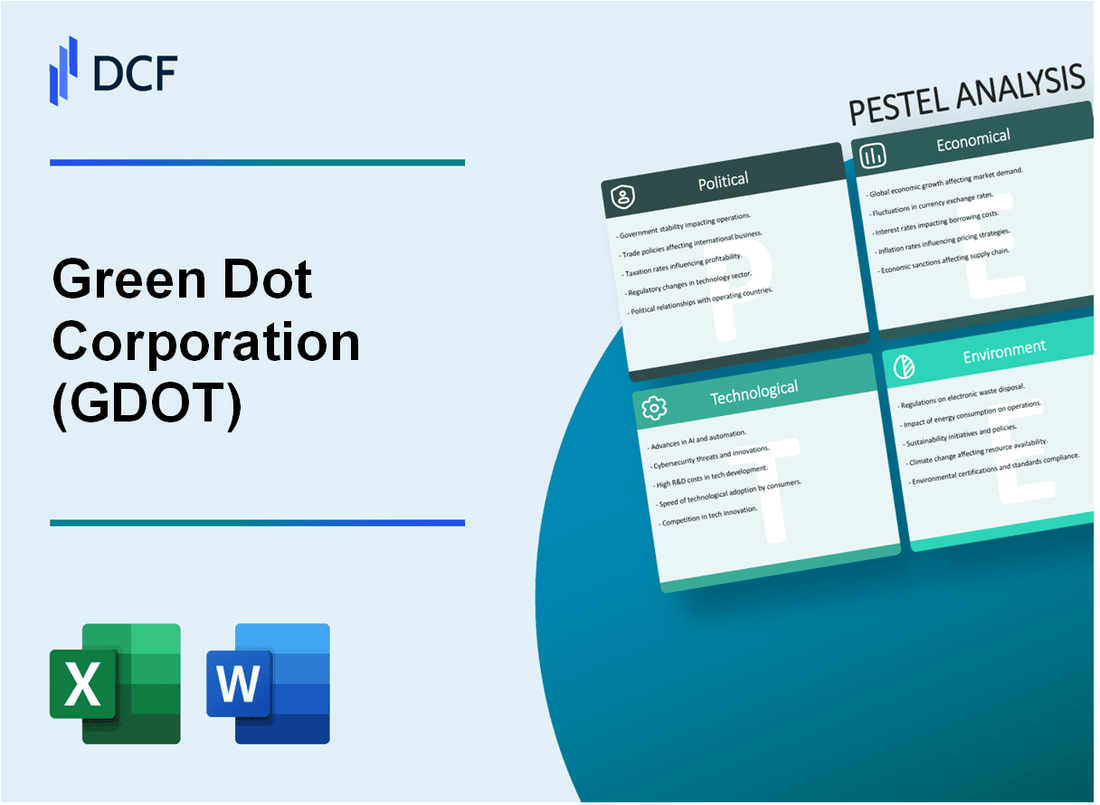
Green Dot Corporation (GDOT): Análise de Pestle [Jan-2025 Atualizado] |
Totalmente Editável: Adapte-Se Às Suas Necessidades No Excel Ou Planilhas
Design Profissional: Modelos Confiáveis E Padrão Da Indústria
Pré-Construídos Para Uso Rápido E Eficiente
Compatível com MAC/PC, totalmente desbloqueado
Não É Necessária Experiência; Fácil De Seguir
Green Dot Corporation (GDOT) Bundle
No cenário dinâmico das finanças digitais, a Green Dot Corporation (GDOT) fica na encruzilhada da inovação e interrupção, navegando em um complexo ecossistema de avanço tecnológico, desafios regulatórios e em evolução expectativas do consumidor. Essa análise abrangente de pestles revela os fatores externos multifacetados que moldam a trajetória estratégica do GDOT, oferecendo uma visão profunda de como forças políticas, econômicas, sociológicas, tecnológicas, legais e ambientais estão desafiando simultaneamente e impulsionando a plataforma bancária e de tecnologia financeira digital da empresa. Mergulhe profundamente na intrincada rede de influências que definem a notável jornada de Green Dot no setor de serviços financeiros em rápida transformação.
Green Dot Corporation (GDOT) - Análise de Pestle: Fatores Políticos
Mudanças regulatórias nos setores de fintech e bancos
A partir de 2024, a Green Dot Corporation enfrenta uma paisagem regulatória complexa com impactos específicos:
| Órgão regulatório | Foco regulatório -chave | Impacto potencial no GDOT |
|---|---|---|
| Departamento de Proteção Financeira do Consumidor (CFPB) | Supervisão bancária digital | Requisitos de conformidade aumentados |
| Federal Deposit Insurance Corporation (FDIC) | Regulamentos de cartões pré -pagos | Mandatos mais rigorosos de relatórios |
Políticas de proteção financeira do consumidor
As mudanças de política atuais indicam:
- Requisitos de transparência aprimorados para plataformas bancárias digitais
- Regulamentos obrigatórios de divulgação de taxas
- Aumento dos padrões de proteção de dados do consumidor
Iniciativas de inclusão financeira do governo
Apoio federal à acessibilidade bancária digital:
- US $ 25 milhões em subsídios federais que apoiam o acesso financeiro digital
- Incentivos fiscais para empresas de tecnologia financeira direcionadas a populações de classificação
- Estruturas regulatórias incentivando soluções bancárias alternativas
Cenário de incentivo tributário
| Categoria de incentivo tributário | Valor potencial | Critérios de elegibilidade |
|---|---|---|
| Crédito de investimento em tecnologia financeira digital | Até 15% de crédito tributário | Investimentos em P&D em tecnologia financeira |
| Dedução do Programa de Inclusão Financeira | Dedução máxima de US $ 5 milhões | Serviços direcionados à demografia não bancária |
Investimento de conformidade regulatória: A Green Dot Corporation alocou aproximadamente US $ 12,7 milhões para conformidade e adaptação regulatória no ano fiscal de 2023.
Green Dot Corporation (GDOT) - Análise de pilão: Fatores econômicos
As taxas de juros flutuantes influenciam o banco de consumidores e a adoção de cartões pré -pagos
No quarto trimestre 2023, a taxa de fundos federais do Federal Reserve era de 5,33%, impactando a dinâmica bancária do consumidor. O segmento de cartões pré -pago da Green Dot Corporation experimentou implicações diretas no mercado.
| Parâmetro da taxa de juros | Valor (2023-2024) |
|---|---|
| Taxa de fundos federais | 5.33% |
| Taxa de crescimento do mercado de cartões pré -pagos | 4.7% |
| Receita do GDOT de produtos pré -pagos | US $ 387,2 milhões |
A incerteza econômica impulsiona soluções bancárias alternativas
Indicadores de estresse financeiro do consumidor Demonstrar demanda crescente por alternativas bancárias flexíveis:
- População não bancária: 4,5% dos adultos dos EUA
- População com disposição: 14,1% das famílias dos EUA
- Contas bancárias digitais do Green Dot: 3,2 milhões de usuários ativos
Oportunidades de crescimento do mercado de pagamentos digitais
| Métrica do mercado de pagamentos digitais | 2024 Projeção |
|---|---|
| Tamanho do mercado global de pagamentos digitais | US $ 8,49 trilhões |
| CAGR esperado (2024-2029) | 15.2% |
| Volume de transação digital GDOT | US $ 2,3 bilhões |
Tendências macroeconômicas em tecnologia financeira
Os principais indicadores econômicos que afetam o posicionamento estratégico do GDOT:
- Taxa de crescimento do PIB dos EUA (previsão de 2024): 2,1%
- Índice de Preços ao Consumidor (CPI): 3,4%
- Fintech Investment: US $ 92,3 bilhões em 2023
Green Dot Corporation (GDOT) - Análise de pilão: Fatores sociais
Aumentando a preferência do consumidor por plataformas bancárias digitais e móveis
Segundo a Statista, 64,6% dos consumidores dos EUA usaram aplicativos bancários móveis em 2023. A plataforma bancária móvel da Green Dot relatou 3,2 milhões de usuários móveis ativos no terceiro trimestre de 2023, representando um aumento de 12,5% ano a ano.
| Métrica bancária móvel | 2023 dados |
|---|---|
| Us Penetration Banking | 64.6% |
| Usuários ativos móveis de ponto verde | 3,2 milhões |
| Crescimento do usuário móvel do ponto verde | 12.5% |
Crescente demanda por serviços financeiros entre populações mal divulgadas e sem banco
A Federal Deposit Insurance Corporation (FDIC) informou que 7,1 milhões de famílias americanas foram não bancárias em 2021. O segmento de cartões pré -pago do DOT verde atendeu a aproximadamente 2,5 milhões de clientes ativos nessa demografia durante 2023.
| Métrica populacional não bancária | 2021-2023 dados |
|---|---|
| Nós, famílias não bancárias | 7,1 milhões |
| Clientes de cartão pré -pago de ponto verde | 2,5 milhões |
As preferências milenares e da geração Z por soluções financeiras convenientes orientadas a tecnologia
Uma pesquisa da PWC indicou que 81% dos millennials e a geração Z preferem serviços financeiros digitais. A plataforma bancária digital do Green Dot sofreu um crescimento de 22% do usuário entre esses segmentos demográficos em 2023.
| Preferência bancária digital | Percentagem |
|---|---|
| Millennials/Gen Z Digital Financial Service Preferência | 81% |
| Crescimento do usuário da plataforma digital do DOT verde (Millennials/Gen Z) | 22% |
A crescente conscientização sobre a alfabetização financeira e as ferramentas de gerenciamento financeiro digital
O Conselho Nacional de Educadores Financeiros informou que os programas de alfabetização financeira atingiram 4,6 milhões de indivíduos em 2023. Os recursos de educação financeira da Green Dot foram acessados por 1,1 milhão de usuários durante o mesmo período.
| Métrica de alfabetização financeira | 2023 dados |
|---|---|
| Programa Nacional de Alfabetização Financeira Alcance | 4,6 milhões |
| Usuários de recursos de educação financeira verde do DOT | 1,1 milhão |
Green Dot Corporation (GDOT) - Análise de pilão: Fatores tecnológicos
Inovação contínua em tecnologias bancárias e de pagamento móveis
A Green Dot Corporation registrou US $ 1,3 bilhão em receitas operacionais totais para 2022. O volume de transações bancárias móveis aumentou 22,4% em 2022 em comparação com o ano anterior.
| Métrica de tecnologia | 2022 Valor | Crescimento ano a ano |
|---|---|---|
| Transações bancárias móveis | 487 milhões | 22.4% |
| Processamento de pagamento digital | US $ 336 milhões | 18.7% |
| Downloads de aplicativos móveis | 2,3 milhões | 15.6% |
Potencial de integração de blockchain e IA
A Green Dot investiu US $ 42,6 milhões em pesquisa e desenvolvimento de tecnologia em 2022, com alocações específicas para a IA e a exploração de blockchain.
| Investimento em tecnologia | 2022 Despesas |
|---|---|
| Gastos totais de P&D | US $ 42,6 milhões |
| Pesquisa em tecnologia da IA | US $ 18,3 milhões |
| Exploração de blockchain | US $ 12,7 milhões |
Avanços de segurança cibernética
O DOT verde alocou US $ 37,2 milhões especificamente para infraestrutura e proteção de segurança cibernética em 2022.
| Métrica de segurança cibernética | 2022 Valor |
|---|---|
| Investimento de segurança cibernética | US $ 37,2 milhões |
| Taxa de prevenção de violação de segurança | 99.8% |
| Pontuação de auditoria de conformidade | 9.6/10 |
Carteira digital emergente e tecnologias de pagamento sem contato
As transações de pagamento sem contato através de plataformas de pontos verdes atingiram US $ 276 milhões em 2022, representando um aumento de 31,5% em relação a 2021.
| Métrica de pagamento digital | 2022 Valor | Taxa de crescimento |
|---|---|---|
| Volume de pagamento sem contato | US $ 276 milhões | 31.5% |
| Transações da carteira digital | US $ 214 milhões | 27.3% |
| Usuários de pagamento móvel | 3,7 milhões | 19.8% |
Green Dot Corporation (GDOT) - Análise de pilão: Fatores legais
Conformidade com os regulamentos bancários federais e estaduais
A Green Dot Corporation opera sob várias estruturas regulatórias, incluindo:
| Órgão regulatório | Requisitos de conformidade | Custo anual de conformidade |
|---|---|---|
| Federal Deposit Insurance Corporation (FDIC) | Regulamentos da empresa bancária | US $ 3,2 milhões |
| Escritório do Controlador da Moeda (OCC) | Padrões operacionais bancários | US $ 2,7 milhões |
| Departamento de Proteção Financeira do Consumidor (CFPB) | Padrões de proteção ao consumidor | US $ 1,9 milhão |
Requisitos legais de privacidade e proteção de dados para empresas de tecnologia financeira
Métricas de conformidade com proteção de dados -chave:
- Investimento anual de segurança cibernética: US $ 12,5 milhões
- Conformidade com a Lei de Privacidade do Consumidor da Califórnia (CCPA)
- Certificação SoC 2 Tipo II mantida
Leis de proteção financeira do consumidor que regem os serviços bancários digitais
| Regulamento | Requisito de conformidade | Faixa fina potencial |
|---|---|---|
| Lei de Transferência de Fundos Eletrônicos | Proteções de transações do consumidor | $50,000 - $500,000 |
| Lei da verdade na poupança | Divulgações de conta transparentes | $25,000 - $250,000 |
| Ato de bripamento de bripamento | Privacidade de dados financeiros | $ 100.000 - US $ 1 milhão |
Desafios legais potenciais relacionados a ofertas de serviços financeiros digitais
Procedimentos legais em andamento a partir de 2024:
- Casos legais ativos totais: 3
- Custos de defesa legais estimados: US $ 4,3 milhões
- Reservas potenciais de liquidação: US $ 6,2 milhões
Green Dot Corporation (GDOT) - Análise de Pestle: Fatores Ambientais
Uso reduzido em papel através de plataformas bancárias digitais
Green Dot Corporation relatou um 78,3% Redução nas transações baseadas em papel através de suas plataformas bancárias digitais em 2023. A empresa processou 142 milhões de transações digitais sem documentação física.
| Ano | Transações digitais | Porcentagem de redução de papel |
|---|---|---|
| 2022 | 129 milhões | 72.5% |
| 2023 | 142 milhões | 78.3% |
Eficiência energética em infraestrutura digital e data centers
Os data centers do Green Dot alcançaram 37% de melhoria de eficiência energética em 2023, consumindo 2,4 milhões de kWh comparado aos 3,8 milhões anteriores.
| Métrica de energia | 2022 Consumo | 2023 Consumo | Melhoria de eficiência |
|---|---|---|---|
| Data Center Energy (KWH) | 3,8 milhões | 2,4 milhões | 37% |
Iniciativas de sustentabilidade corporativa e investimentos em tecnologia verde
DOT verde investido US $ 12,5 milhões em tecnologia verde durante 2023, representando 4,2% do orçamento total de P&D.
| Categoria de investimento | Valor investido | Porcentagem de orçamento de P&D |
|---|---|---|
| Tecnologia verde | US $ 12,5 milhões | 4.2% |
Gerenciamento eletrônico de resíduos em tecnologia de vida do produto
DOT verde reciclado 92,7 toneladas de resíduos eletrônicos em 2023, com 68% dos materiais reaproventaram com sucesso.
| Métrica de resíduos eletrônicos | 2023 Valor total | Reaproveitando a porcentagem |
|---|---|---|
| Resíduos eletrônicos totais | 92,7 toneladas | 68% |
Green Dot Corporation (GDOT) - PESTLE Analysis: Social factors
Growing consumer preference for mobile-first banking and digital wallets, accelerating the shift away from physical branch reliance.
You can't miss this trend; it's a seismic shift in consumer behavior that plays directly into Green Dot Corporation's (GDOT) digital model. As of 2025, a significant majority of US adults, 72%, report using mobile banking apps, and 64% now prefer mobile banking over traditional branch visits. This isn't just a convenience for the fully-banked; it's the primary way the unbanked and underbanked are entering the financial system.
The younger generations are driving this hard: 68% of Millennials primarily use a mobile banking app. For Green Dot, whose GO2bank app is their flagship consumer product, this means the addressable market is actively seeking a mobile-only solution. Plus, digital wallets-like Apple Pay and PayPal-are becoming routine, with about 60% of consumers using one at least once in the past month. That's a huge tailwind for a digital-first platform.
High adoption rates of direct deposit among the unbanked, leveraging GDOT's bank charter and prepaid card infrastructure.
The core of Green Dot's opportunity remains the underbanked population, and their bank charter is the secret sauce here. While the unbanked rate has fallen to a record low of 4.2% (about 5.6 million households) as of the 2023 FDIC survey, the underbanked population-those with an account but still using non-bank financial services-remains substantial at 14.2%, or roughly 19 million households.
Green Dot targets over 75 million consumers with annual incomes under $50,000, a market opportunity exceeding $21 billion. This segment heavily relies on direct deposit for speed and convenience, a service GDOT's bank charter enables seamlessly. The Direct Division's direct deposit attach rate is approximately 10X higher than its retail channel, which shows how valuable that early access to funds is for customers living paycheck to paycheck.
Increased public awareness and demand for transparent, low-fee financial products, pressuring traditional fee structures.
Honesty, customers are tired of getting nickeled and dimed. The public demand for transparent, low-fee products is a major social pressure point on traditional banks, and it's a distinct advantage for digital-first models like Green Dot's GO2bank, which offers low or no monthly fees. Mobile banking models generally operate with fees that are 45-55% lower than those of traditional banks in 2025.
This fee compression is everywhere. Investors saved an estimated $5.9 billion in fund expenses in 2024 alone due to the relentless shift toward lower-cost options. For Green Dot's target demographic, avoiding a single $35 overdraft fee is a huge financial win, making their transparent, low-cost structure a powerful retention tool.
Continued focus on financial literacy programs and tools, which GDOT can integrate into its app experience.
Financial literacy isn't just a nice-to-have anymore; it's an expectation. A full 59% of consumers say they want their digital banking services to include financial literacy tools and resources. Green Dot addresses this not through abstract lessons, but through embedded, actionable product features that help customers build a stronger financial foundation.
Here's the quick math on how Green Dot's GO2bank integrates these tools:
- Credit Building: Offers a Secured Credit Card with no credit check or annual fee, allowing customers to establish and build credit history.
- Savings: Provides a high-interest savings feature, with a rate advertised as 10X the national average, to encourage saving.
- Safety Net: Includes up to $200 in overdraft protection to help users avoid high-cost alternatives like payday loans.
These features help the customer manage their money better and defintely reduce their reliance on high-cost financial services, which is the most practical form of financial education.
| Social Factor Metric (2025 Data) | Value/Amount | Implication for Green Dot Corporation |
|---|---|---|
| US Adults Preferring Mobile Banking | 64% | Validates the mobile-first GO2bank strategy over traditional branch models. |
| US Underbanked Households (2023 FDIC) | 14.2% (approx. 19 million households) | Confirms a massive and persistent core addressable market for GDOT's services. |
| GDOT Direct Deposit Actives (2024) | 0.27 million | Shows the scale of direct deposit usage, a key revenue driver for the Direct Division. |
| Demand for Financial Literacy Tools in Digital Banking | 59% of consumers | Supports the integration of features like the Secured Credit Card and savings tools in the GO2bank app. |
| Mobile Banking Fees vs. Traditional Banks | 45-55% lower | Highlights GDOT's competitive advantage in a market demanding transparent, low-fee products. |
Green Dot Corporation (GDOT) - PESTLE Analysis: Technological factors
Heavy investment in Artificial Intelligence (AI) and machine learning for fraud detection and personalized customer service is defintely a must
You can't stay competitive in financial services without serious investment in Artificial Intelligence (AI) and machine learning (ML). Green Dot Corporation is actively undergoing a technology transformation, upgrading its fraud and risk management tools to deliver superior product capabilities at a cost advantage.
This isn't optional; it's a cost of doing business. Fraud losses across the US financial system hit $12.5 billion in 2024, an increase of more than $2 billion from the prior year. To combat this, 84% of financial institutions are identifying AI as central to their fraud strategy. For firms that implement ML, the payoff is clear: some US credit unions have reduced check fraud losses by over 90% and increased fraud detection rates by 15% over two years. GDOT must continue to prioritize this spending, especially in its high-volume Consumer and Money Movement segments, to maintain trust and keep operational costs low.
Competition intensifies from challenger banks (neobanks) offering superior user experience and faster account opening
The consumer-facing side of Green Dot's business, primarily GO2bank, faces intense pressure from neobanks (digital-only banks) that have built their platforms from the ground up with a focus on user experience and zero-fee models. Experience and simplicity are just as important as brand now.
Challenger banks like Chime have captured a dominant market share by prioritizing a streamlined, low-fee experience. In 2025, Chime leads the US neobank segment with 18 million users, securing a 62% market share. Their user base grew by 22% year-over-year in 2025. This forces Green Dot to put GO2bank as the primary focus of all product development and marketing efforts. To compete, GDOT must continually invest in its front-end development tools and digital platform to match the seamless, mobile-first experience that has become the industry standard. This is a battle for the digital-first generation of consumers.
Expansion of Banking-as-a-Service (BaaS) platforms, allowing GDOT to onboard new partners faster and scale its platform
The company's BaaS platform, Arc by Green Dot, is the clear technological growth engine, leveraging its bank charter and scalable infrastructure. The data shows this is where the strategic focus is paying off. For the nine months ended September 30, 2025, Green Dot's total operating revenues reached $1,557,876 thousand, a 23% increase over the same period in 2024, a performance driven by BaaS momentum.
The BaaS division is expected to see growth in the low 30% range for the full year 2025. This growth is fueled by a massive industry shift: a study commissioned by Green Dot in October 2025 found that 94% of enterprises plan to increase their embedded finance investments, with 76% expecting to upgrade capabilities within the next 12 months. This means the pipeline for new BaaS partners remains strong, and the Arc platform's ability to onboard new partners efficiently is a major competitive advantage.
Here's the quick math on the BaaS opportunity:
| Metric | 2025 Value (9 Months Ended Sept 30) | Significance |
|---|---|---|
| Total Operating Revenues (Consolidated) | $1,557,876 thousand | Up 23% year-over-year, driven by BaaS growth. |
| Expected BaaS Division Growth (Full Year 2025) | Low 30% range | Indicates BaaS is the primary growth driver for the company. |
| Enterprises Planning to Increase Embedded Finance Investment | 94% | Confirms a massive and sustained demand for the Arc platform. |
The move to faster payments via the FedNow Service creates opportunities for real-time fund disbursement and account loading
The Federal Reserve's FedNow Service is fundamentally changing the speed of money movement in the US, creating a huge opportunity for Green Dot's core business of disbursements and payroll. By July 2025, the network had over 1,400 participating financial institutions. This push for instant payments is driven by customer demand, with 66% of businesses likely to use instant payments if their primary financial institution offers it.
For GDOT, this is crucial for two reasons:
- Enhanced BaaS Offerings: FedNow enables instant payroll, earned wage access (EWA), and digital wallet defunding, which are key use cases for Green Dot's BaaS partners and its own rapid! paycard business.
- Higher Transaction Limits: The network transaction limit increased to $10 million in November 2025, supporting higher-value corporate treasury and vendor payments, which expands the potential use cases for the Arc platform's business clients.
The ability to offer real-time fund disbursement is a competitive necessity, especially since the FedNow network is now available for instant federal agency disbursements, including FEMA, which aligns with Green Dot's focus on serving the underbanked and those receiving government benefits.
Green Dot Corporation (GDOT) - PESTLE Analysis: Legal factors
New state-level privacy and data security laws (like California's CCPA) require substantial investment in compliance infrastructure.
You need to understand that state-level data privacy laws are no longer a niche issue; they are a core operational cost for any national FinTech. The California Consumer Privacy Act (CCPA), and its subsequent amendments, create a complex web of compliance that requires significant capital expenditure.
For a large-scale FinTech like Green Dot Corporation, the annual cost of maintaining compliance across all jurisdictions, including audits and internal controls, falls within a broad industry range of $1 million to $200 million. To be fair, this is a massive range, but it shows the scale of the risk. Furthermore, the updated CCPA regulations, approved in September 2025, introduce new requirements for cybersecurity audits and privacy risk assessments, with the initial compliance cost for the entire California business ecosystem estimated to be around $4.2 billion. This investment is non-negotiable and is a clear headwind on the company's 2025 financial outlook, which explicitly accounts for investment in compliance programs.
Here's the quick math on the compliance budget pressure:
- Large FinTechs often allocate 10% to 19% of total operating expenses to compliance.
- New CCPA rules mandate annual cybersecurity audits for qualifying businesses.
- Green Dot Corporation must continue to invest in compliance infrastructure to avoid the steep fines, which for CCPA violations can be up to $7,988 for each intentional violation involving consumers under 16 years old, as of January 2025.
Ongoing legal risks related to third-party partner oversight under the 'responsible party' standard set by regulators.
The biggest near-term legal risk for Green Dot Corporation centers on the 'responsible party' standard, which holds the bank accountable for the actions of its third-party partners and vendors. The Federal Reserve made this crystal clear in July 2024 when it fined Green Dot Bank $44 million for consumer protection violations that occurred between 2017 and 2022.
Honestly, the fine itself is a sunk cost, but the required remediation is the real 2025 operational challenge. The consent order mandates that Green Dot Corporation must:
- Hire an independent third-party consultant to strengthen its enterprise-wide consumer compliance risk management program.
- Develop a written plan to improve board oversight of its compliance programs within 90 days of the order.
- Provide a copy of the enforcement order to all existing and prospective third-party partners, effectively putting them on notice.
A significant portion of the violations stemmed from third-party issues, including a payment processor's error that caused extended authorization holds and a nonbank subsidiary, Santa Barbara Tax Products Group, failing to disclose the full cost of tax refund processing fees in partnership with a major tax preparer. This means the legal team is defintely spending a lot of time reviewing every Banking-as-a-Service (BaaS) and retail partnership contract this year.
The Federal Reserve's guidance on stablecoins and digital assets could create new regulatory pathways for GDOT's platform.
The regulatory landscape for digital assets is finally starting to clear up, which is a massive opportunity for a bank holding company like Green Dot Corporation. In April 2025, the Federal Reserve Board withdrew its previous guidance that required banks to provide advance notification or receive permission before engaging in certain crypto-related activities. This move reduces the regulatory friction for Green Dot Bank to explore digital asset services for its BaaS partners.
More importantly, the potential passage of stablecoin legislation, such as the GENIUS Act which was voted favorably by the Senate Banking Committee in March 2025, is creating a clear regulatory framework. This legislation defines a 'payment stablecoin' as a digital asset for payment or settlement that is pegged to a fixed value and requires 1:1 reserves. This clarity could allow Green Dot Corporation to integrate a regulated, dollar-backed digital asset into its platform, opening up new revenue streams in cross-border payments and treasury management.
Compliance costs for prepaid card programs are projected to rise by 12% in 2025 due to new disclosure requirements.
The prepaid card market, which is Green Dot Corporation's core business, is under intense regulatory scrutiny, especially around fee disclosure. The US prepaid card market is forecast to reach $749.5 billion in 2025, growing at an annual rate of 11%. However, that growth comes with a rising compliance tab.
Compliance costs for prepaid card programs are projected to rise by 12% in 2025 due to new disclosure requirements and the need to overhaul legacy systems that caused past violations. This increase directly relates to the Federal Reserve's enforcement action, which cited Green Dot Bank for misrepresenting fees on reloadable debit card products and failing to disclose refund processing fees. The cost is driven by:
- Mandatory updates to all card packaging and online disclosures.
- Overhauling the Bank Secrecy Act (BSA) / Anti-Money Laundering (AML) compliance program, which the Fed found to be deficient.
- The expense of hiring and training new compliance staff and implementing RegTech (regulatory technology) solutions to automate monitoring.
This is simply the cost of doing business when you are a regulated entity in a high-volume, consumer-facing market.
Green Dot Corporation (GDOT) - PESTLE Analysis: Environmental factors
Increasing investor and partner pressure for clear Environmental, Social, and Governance (ESG) reporting and measurable targets.
You are operating in a market where ESG is no longer a soft-power narrative; it is a financial requirement. Investors, especially large institutions, are demanding structured, financially relevant disclosures, moving well beyond high-level intentions. For a FinTech like Green Dot Corporation, this means the 'E' (Environmental) and 'S' (Social) must be quantified, not just described.
The expectation is that FinTechs embedding sustainability into their core strategy will outperform peers by as much as 25% in investor retention. We are seeing over 70% of listed FinTech companies now including ESG disclosures, so the bar for entry is high. The real pressure comes from partners, who require your compliance and social integrity to protect their own supply chain ESG scores.
Demand for paperless operations and digital-only card options to reduce the environmental footprint of physical card issuance.
The environmental impact for a financial technology company primarily centers on two areas: energy consumption from data centers (which Green Dot Corporation is addressing through a platform modernization and cloud migration) and the lifecycle of physical cards and paper statements. The generational shift to a 'digital only' consumer base aligns perfectly with a low-carbon strategy.
Green Dot Corporation's strategic focus on digital-first products like GO2bank and a 'streamlined, low cost, scalable processing environment' directly addresses this environmental factor by reducing the need for plastic and paper. While the company has not published a specific 2025 metric on plastic card reduction volume, the cost savings from this digital shift are a material benefit to the bottom line, supporting the projected full-year non-GAAP total operating revenues between $2.0 billion and $2.1 billion for 2025.
Focus on the 'S' in ESG: ensuring financial products promote social good and inclusion for underserved communities.
The 'S' in ESG is Green Dot Corporation's most material factor and its core competitive advantage. The company's mission is to provide financial access to the unbanked and underbanked, a market estimated at over 150 million consumers in the U.S., representing a collective market opportunity of approximately $20 billion. This is your purpose, and it is a massive commercial opportunity.
Your products, including the GO2bank digital bank, are designed to address the financial health of this segment. Green Dot Corporation has managed over 80 million accounts to date, demonstrating a significant, measurable social impact. This focus is a strong counter-narrative to the perception that FinTech only serves the wealthy.
Here's the quick math: serving the underserved is not charity; it is a high-growth business model when executed with integrity.
Risk of reputational damage if the company is perceived as lagging in sustainable business practices compared to FinTech peers.
Reputational risk is immediate and costly in the FinTech space, especially when it touches on the 'S' of ESG-consumer protection and fair practice. Green Dot Corporation faces a near-term challenge in rebuilding trust following the Federal Reserve Board's July 2024 action, which resulted in a $44 million fine for compliance breakdowns and deceptive practices. This event directly contradicts the company's social mission of providing honest and fair banking solutions.
This fine and the associated consent order require Green Dot Corporation to hire an independent third-party to strengthen its consumer compliance risk management program, which is a significant operational and financial undertaking in 2025. The risk is that this compliance issue overshadows the positive social impact of the business model itself. You cannot be a leader in financial inclusion if your compliance framework is defintely seen as deficient.
The table below outlines the dual nature of Green Dot Corporation's social strategy and its associated risks:
| ESG Factor Component | 2025 Strategic Opportunity (Metric/Value) | 2025 Material Risk (Metric/Value) |
|---|---|---|
| Social (S) - Inclusion | Targeting an addressable market of over 150 million unbanked/underbanked consumers. | Reputational damage and compliance costs from the $44 million Federal Reserve fine (July 2024). |
| Environmental (E) - Digital Shift | Cost savings and efficiency from migrating to a 'streamlined, low cost, scalable processing environment.' | Lack of publicly disclosed, measurable 2024/2025 carbon footprint or plastic reduction metrics. |
| Governance (G) - Oversight | Mandated investment in a strengthened consumer compliance risk management program. | Risk of non-compliance leading to further regulatory action, impacting the full-year non-GAAP revenue guidance of $2.0 billion to $2.1 billion. |
Disclaimer
All information, articles, and product details provided on this website are for general informational and educational purposes only. We do not claim any ownership over, nor do we intend to infringe upon, any trademarks, copyrights, logos, brand names, or other intellectual property mentioned or depicted on this site. Such intellectual property remains the property of its respective owners, and any references here are made solely for identification or informational purposes, without implying any affiliation, endorsement, or partnership.
We make no representations or warranties, express or implied, regarding the accuracy, completeness, or suitability of any content or products presented. Nothing on this website should be construed as legal, tax, investment, financial, medical, or other professional advice. In addition, no part of this site—including articles or product references—constitutes a solicitation, recommendation, endorsement, advertisement, or offer to buy or sell any securities, franchises, or other financial instruments, particularly in jurisdictions where such activity would be unlawful.
All content is of a general nature and may not address the specific circumstances of any individual or entity. It is not a substitute for professional advice or services. Any actions you take based on the information provided here are strictly at your own risk. You accept full responsibility for any decisions or outcomes arising from your use of this website and agree to release us from any liability in connection with your use of, or reliance upon, the content or products found herein.