

|
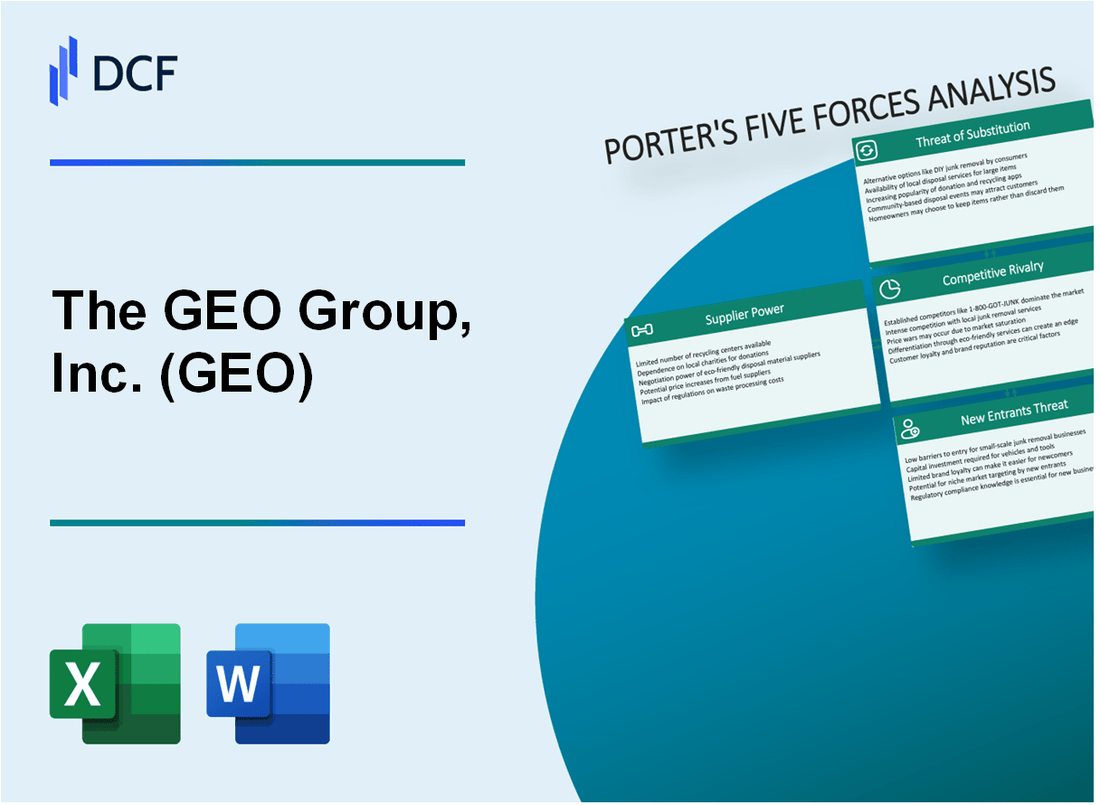
The Geo Group, Inc. (Geo): 5 forças Análise [Jan-2025 Atualizada] |
Totalmente Editável: Adapte-Se Às Suas Necessidades No Excel Ou Planilhas
Design Profissional: Modelos Confiáveis E Padrão Da Indústria
Pré-Construídos Para Uso Rápido E Eficiente
Compatível com MAC/PC, totalmente desbloqueado
Não É Necessária Experiência; Fácil De Seguir
The GEO Group, Inc. (GEO) Bundle
No complexo mundo do gerenciamento de instalações correcionais privadas, o Geo Group, Inc. navega em uma paisagem desafiadora moldada pelas forças estratégicas do mercado. Como um participante importante no setor de correções, o Geo enfrenta a intrincada dinâmica do poder do fornecedor, relacionamentos com clientes, pressões competitivas, potenciais substitutos e barreiras à entrada de mercado. A compreensão dessas forças revela os desafios e oportunidades estratégicas que definem o ecossistema operacional da empresa, oferecendo uma lente crítica sobre como os serviços correcionais privados sobrevivem e prosperam em um ambiente cada vez mais examinado e regulamentado.
The Geo Group, Inc. (Geo) - Five Forces de Porter: poder de barganha dos fornecedores
Número limitado de provedores de instalações correcionais especializadas
A partir de 2024, o mercado de construção e gerenciamento de instalações correcionais possui aproximadamente 5-7 grandes fornecedores especializados, incluindo o grupo Geo, corecíco e empreiteiros regionais menores.
Barreiras de entrada de mercado
| Barreira de entrada | Custo/requisito estimado |
|---|---|
| Investimento inicial de capital | $ 50- $ 150 milhões |
| Qualificação do contrato governamental | Experiência operacional mínima de 5 anos |
| Custos de conformidade regulatória | US $ 3 a US $ 7 milhões anualmente |
Paisagem de tecnologia e equipamento de fornecedores
- Valor de mercado de equipamentos de segurança especializado: US $ 2,3 bilhões em 2023
- Investimento de tecnologia média por instalação: US $ 4,5 a US $ 6,2 milhões
- Fornecedores de tecnologia -chave: G4S, Motorola Solutions, Honeywell
Impacto de conformidade regulatória
Os requisitos de conformidade aumentam significativamente a energia do fornecedor, com cerca de 35-40% dos custos operacionais totais dedicados à atendimento aos regulamentos federais e estaduais.
Fatores de alavancagem do fornecedor
| Categoria de fornecedores | Porcentagem de alavancagem |
|---|---|
| Provedores de tecnologia de segurança | 42% |
| Contratados de construção | 38% |
| Sistemas de gerenciamento de instalações | 35% |
The Geo Group, Inc. (Geo) - Five Forces de Porter: poder de barganha dos clientes
Agências governamentais como clientes primários
A base de clientes do GEO Group consiste principalmente nos departamentos correcionais federais e estaduais. A partir de 2024, a Companhia tem contratos com 29 estados e o Federal Bureau of Prisons.
Características do contrato
| Tipo de contrato | Duração média | Estrutura de preços |
|---|---|---|
| Contratos federais | 5-10 anos | Taxas fixas por diem |
| Contratos estaduais | 3-7 anos | Preços baseados em desempenho |
Análise de concentração de mercado
O mercado de gerenciamento de instalações correcionais está altamente concentrado, com apenas três principais fornecedores privados:
- O Grupo Geo: 38% de participação de mercado
- CoreCivic: 35% de participação de mercado
- Corporação de gestão e treinamento: 12% de participação de mercado
Trocar custos e complexidade de compras
A troca de custos para entidades governamentais é substancial, estimada em US $ 15-25 milhões por transição da instalação.
| Barreira de compras | Custo/complexidade estimada |
|---|---|
| Custos de transição da instalação | US $ 15-25 milhões |
| RECERTIFICAÇÃO DO CONSELHA | 12-18 meses |
| Duração do processo RFP | 6-9 meses |
Métricas de dependência do governo
Em 2023, 92% da receita de US $ 2,1 bilhões do Geo Group derivada de contratos governamentais.
- Contratos federais: 56% da receita total
- Contratos estaduais: 36% da receita total
- Contratos do governo local: 6% da receita total
The Geo Group, Inc. (Geo) - Five Forces de Porter: Rivalidade Competitiva
Concentração de mercado e concorrentes
A partir de 2024, o mercado de gerenciamento de correções privadas está concentrado com duas empresas principais:
- The Geo Group, Inc. (Geo)
- CoreCivic (CXW)
| Empresa | Quota de mercado | Receita anual (2023) |
|---|---|---|
| O grupo geográfico | 45% | US $ 2,12 bilhões |
| CoreCivic | 40% | US $ 1,87 bilhão |
Dinâmica competitiva
Cenário de licitação do contrato governamental
| Tipo de contrato | Valor total | Duração média do contrato |
|---|---|---|
| Contratos federais | US $ 1,5 bilhão | 3-5 anos |
| Contratos estaduais | US $ 870 milhões | 2-4 anos |
Margens de lucro
Margens de lucro de gerenciamento de instalações correcionais:
- Margem bruta: 12-15%
- Margem de lucro líquido: 4-6%
Barreiras de entrada de mercado
Principais requisitos regulatórios para entrada no mercado:
- Investimento de capital inicial: US $ 50-100 milhões
- Certificações de conformidade: 3-5 anos para obter
- Autorizações de segurança do governo: verificações extensas de antecedentes
The Geo Group, Inc. (Geo) - Five Forces de Porter: ameaça de substitutos
Substitutos diretos limitados para gerenciamento de instalações correcionais privadas
A partir de 2024, as instalações correcionais privadas gerenciadas pelo grupo GEO representam 8,4% do total de instalações correcionais dos EUA. A concentração de mercado indica substitutos diretos mínimos.
| Tipo de instalação | Quota de mercado | Número de instalações |
|---|---|---|
| Instalações correcionais privadas | 8.4% | 130 |
| Instalações correcionais federais | 51.2% | 122 |
| Instalações correcionais do estado | 40.4% | 1,566 |
Instalações correcionais administradas pelo governo como potencial alternativa
As instalações administradas pelo governo apresentam um substituto em potencial, com custos operacionais anuais com média de US $ 33.274 por preso, em comparação com os US $ 28.650 do Geo Group.
Tendências emergentes na reforma da justiça criminal
- 24 estados implementaram programas de sentença alternativos
- Redução nas taxas de encarceramento em 12,3% entre 2019-2023
- US $ 15,2 bilhões alocados para programas de reabilitação em todo o país
Abordagens alternativas de reabilitação e encarceramento
| Abordagem alternativa | Taxa de adoção | Economia anual de custos |
|---|---|---|
| Monitoramento eletrônico | 37% | US $ 5.600 por agressor |
| Serviço comunitário | 29% | US $ 4.200 por agressor |
| Programas de reabilitação | 22% | US $ 6.800 por agressor |
Potenciais inovações tecnológicas no gerenciamento de correções
Os investimentos em tecnologia em gerenciamento de correções atingiram US $ 1,3 bilhão em 2023, com Rastreamento de reabilitação orientado a IA e Sistemas de monitoramento remoto Emergente como ameaças -chave de substituição.
- Sistemas de rastreamento de reabilitação de IA implantados em 18% das instalações
- Tecnologia de monitoramento remoto Crescimento do mercado: 14,7% anualmente
- Investimento de tecnologia estimada em correções: US $ 1,3 bilhão
The Geo Group, Inc. (GEO) - As cinco forças de Porter: ameaça de novos participantes
Investimento de capital substancial necessário
O Grupo Geo exige um investimento de capital de aproximadamente US $ 2,3 bilhões em ativos totais a partir de 2023. Os custos iniciais da infraestrutura para uma nova instalação de correções variam entre US $ 75 milhões e US $ 250 milhões por instalação.
| Categoria de investimento | Faixa de custo estimada |
|---|---|
| Construção da instalação | US $ 75M - US $ 250M |
| Sistemas de segurança | US $ 15m - US $ 45M |
| Configuração operacional | US $ 25 milhões - US $ 50m |
Ambiente regulatório complexo
O setor de correções envolve a conformidade com vários regulamentos federais e estaduais, incluindo:
- Padrões do Bureau of Prisons
- Requisitos de Segurança Interna de Departamento
- Diretrizes de instalações correcionais específicas do estado
Extensos processos de liberação de segurança do governo
Processos de liberação de segurança do governo para instalações de correções envolvem:
- Verificações de antecedentes: Aproximadamente 6 a 12 meses de tempo de processamento
- Vetting abrangente do fornecedor
- Monitoramento contínuo de conformidade
Experiência significativa em gerenciamento de correções
O grupo Geo emprega 23.000 profissionais com experiência em gerenciamento de correções especializadas. Custos de treinamento estimados por funcionário: US $ 15.000 - US $ 25.000.
Altos custos iniciais de infraestrutura e operacional
| Categoria de custo | Despesas anuais |
|---|---|
| Pessoal | US $ 450M |
| Manutenção da instalação | US $ 180m |
| Infraestrutura de tecnologia | US $ 75M |
The GEO Group, Inc. (GEO) - Porter's Five Forces: Competitive rivalry
You're looking at the competitive landscape for The GEO Group, Inc. (GEO) right now, and the rivalry is definitely the most pressing force here. Honestly, the competition is a tight, two-horse race, primarily a duopoly between The GEO Group and CoreCivic (CXW). These two companies are constantly vying for the same finite pool of government contracts, meaning the fight is fierce over both the price you bid and the quality of the facility you offer. It's a direct, head-to-head contest for government business, whether it's for Immigration and Customs Enforcement (ICE) processing centers, U.S. Marshals Service capacity, or Federal Bureau of Prisons needs.
The scale of the market The GEO Group operates in is substantial, highlighted by its projected annual revenue for fiscal year 2025, which management guides to be approximately $2.6 billion. To give you a clearer picture of how this rivalry plays out in real-time, look at their recent top-line performance:
| Metric | The GEO Group, Inc. (GEO) | CoreCivic, Inc. (CXW) |
| Q3 2025 Revenue | $682.3 million | $580.4 million |
| FY 2025 Projected Revenue (Low End) | $2.575 billion | N/A (Not directly comparable) |
| Total Beds Operated (Approximate) | Approximately 81,000 across 100 facilities | Largest private owner of correctional/detention facilities |
Competition centers on securing and expanding these government relationships. When The GEO Group wins new business, it directly takes capacity away from the potential pool for CoreCivic, and vice-versa. This dynamic forces both players to be aggressive on contract terms. For instance, The GEO Group has been busy locking down capacity, which is a direct competitive move.
Here's a look at the recent competitive wins that define the current battleground:
- New or expanded contracts since early 2025 represent over $460 million in new annualized revenues for The GEO Group.
- The activation of the North Lake Facility is expected to generate in excess of $85 million in annualized revenues.
- The Delaney Hall 15-year ICE contract is expected to generate in excess of $60 million in annualized revenues at full occupancy.
- A contract modification at the D. Ray James Facility is anticipated to generate approximately $66 million in additional annual revenue in the first complete year.
- The GEO Group's occupancy in Owned and Leased Secure Services facilities rose to 88% in Q3 2025, up from 84% in Q3 2024.
The market size itself is not infinitely elastic; it is fundamentally capped by government policy and the prevailing overall incarceration and detention rates across the jurisdictions The GEO Group serves. This inelasticity intensifies the rivalry because growth for one competitor often means a direct loss of market share or stagnation for the other, especially when federal immigration enforcement priorities shift. The ability to maintain high facility utilization, like The GEO Group's Q3 2025 occupancy rate, becomes a critical lever in contract negotiations, as idle beds represent lost revenue potential that neither company can easily absorb.
The GEO Group, Inc. (GEO) - Porter's Five Forces: Threat of substitutes
The primary substitute for services provided by The GEO Group, Inc. is the government's own capacity to house and supervise individuals. This threat is substantial because the government controls the demand and can choose to internalize the service. For context, the Federal Bureau of Prisons (BOP) operates with an annual budget of approximately $8.3 billion for the 2025 fiscal year, which represents the largest allocation within the Department of Justice. You should note that the BOP ended the use of privately-owned prisons on November 30, 2022, meaning as of 2025, there are zero federal inmates in private institutions under the BOP's direct purview.
Alternative sentencing models and non-custodial programs are definitely gaining traction, which directly pressures the need for physical detention beds. Electronic monitoring (EM) is a key component of this shift. Estimates suggest that by 2025, there will be 282,000 people under EM supervision in North America on any given day. The overall number of adults under EM in the U.S. grew nearly fivefold from 2005 to 2021, reaching 254,700 adults under some form of EM that year. The cost differential highlights the appeal of these substitutes; the estimated average daily cost of EM equipment is around $5 per offender, a tiny fraction of the estimated $30,000 per year for a prison or jail cell.
The GEO Group mitigates this threat by actively participating in and expanding these alternative models, effectively turning a substitute into a revenue stream. The company's subsidiary, BI Incorporated, secured a contract renewal from U.S. Immigration and Customs Enforcement (ICE) for the Intensive Supervision Appearance Program (ISAP), effective October 1, 2025. This two-year agreement, which includes a one-year option period, has an estimated value to The GEO Group, Inc. of over $1 billion. This program is a concrete example of The GEO Group, Inc. providing the very alternative supervision methods that might otherwise reduce their core detention revenue. BI Incorporated supports this through a nationwide network of approximately 100 offices and close to 1,000 employees dedicated to the ISAP contract.
Political movements, especially at the state level, can rapidly increase the viability of public-sector substitutes, though The GEO Group, Inc. has also seen success in transitioning facilities back to state control. For instance, in the third quarter of 2025, The GEO Group, Inc. completed the sale of its company-owned, 2,388-bed Lawton Correctional Facility to the State of Oklahoma for $312 million. This divestiture directly shifts capacity back to the public sector. Still, state reliance on private providers varies significantly, which means the threat level is not uniform across the country.
Here's a quick look at the scale differences between public and private operations based on recent historical data, which informs the potential scale of the government-run substitute:
| Metric | Public Sector (State/Federal) | Private Sector (State/Federal) |
|---|---|---|
| Incarcerated Population (2022) | Approximately 92% of 1.2 million | 90,873 people (8%) in 2022 |
| Capacity Utilization (Older Data) | Operated at 113% capacity on average | Operated at 82% capacity on average |
| Federal Inmates (As of 2025) | All federal inmates housed in BOP facilities | Zero federal inmates housed in private institutions |
The continued growth in EM, even if provided by The GEO Group, Inc. via contracts like ISAP (which saw an estimated federal value of over $1 billion for two years starting late 2025), shows that the form of the service is changing, but the function of supervision remains a government responsibility. The company's Q3 2025 revenue was $682.3 million, with full-year 2025 revenue guidance around $2.53 billion to $2.56 billion.
The GEO Group, Inc. (GEO) - Porter's Five Forces: Threat of new entrants
The threat of new entrants for The GEO Group, Inc. (GEO) is exceptionally low. This industry is not one you just decide to enter on a whim; the barriers to entry are structural and immense, effectively locking out most potential competitors before they can even draft a business plan.
Barriers are extremely high due to massive upfront capital and specialized real estate investment. Building a modern, compliant correctional facility requires capital expenditure figures that scare off all but the most well-capitalized, established players. For instance, while The GEO Group, Inc. (GEO) guided for total Capital Expenditures between $200 million and $210 million for the full year 2025, this often includes upgrades or acquisitions, not ground-up construction. New, state-level construction projects illustrate the true scale: a new men's correctional facility in Alabama is costing over $1.08 billion, and a major jail replacement in New York is estimated at $3.8 billion for four facilities. Furthermore, The GEO Group, Inc. (GEO) held approximately $260.6 million in net book value across its idle Secure Services facilities as of December 31, 2024, representing sunk, specialized real estate costs that a newcomer lacks. The annual carrying cost for just these idle assets was estimated at $33.0 million for 2025.
| Project/Metric | Associated Cost/Value | Year/Date Reference |
|---|---|---|
| Alabama New Prison Construction | $1.08 billion | 2024/2025 Project |
| The GEO Group, Inc. (GEO) Full Year 2025 CAPEX Guidance (Q2 Update) | $200 million to $210 million | 2025 Fiscal Year Estimate |
| The GEO Group, Inc. (GEO) Idle Secure Services Asset Net Book Value | $260.6 million | As of December 31, 2024 |
| The GEO Group, Inc. (GEO) San Diego Facility Acquisition Cost | $60 million | Planned for July 2025 |
| The GEO Group, Inc. (GEO) Investment for ICE Capacity (Total) | $70 million | Announced December 2024 |
Securing initial, long-term government contracts requires a proven, complex track record. Government agencies, particularly federal ones like ICE and the U.S. Marshals Service, are not awarding multi-year, high-value service agreements to unproven entities. You need years of audited performance data demonstrating operational stability, security compliance, and cost-effectiveness. The GEO Group, Inc. (GEO) recently announced contract wins that highlight this reliance on existing relationships and scale:
- Announced two contract awards in Q1 2025 totaling 2,800 beds.
- These Q1 2025 awards represent in excess of $130 million in annualized revenues.
- Secured a $147 million contract with the U.S. Marshals Service.
- The U.S. Marshals Service contract is projected to generate about $29 million annually.
- The company announced a 15-year contract with ICE in February 2025 for Delaney Hall Facility.
Regulatory compliance and navigating local opposition create significant hurdles. The industry operates under intense federal, state, and local scrutiny. A new entrant would need to immediately master complex, often changing, mandates regarding inmate care, safety protocols, and reporting standards-a process that takes years for incumbents to perfect. Furthermore, any proposal for a new facility immediately triggers local political and community review processes. The sheer scale of public investment, like the $1.08 billion Alabama prison, means any new entrant faces an uphill battle securing zoning and public buy-in against established entities that already possess the necessary governmental relationships and regulatory navigation expertise.
Reputational risk and public backlash deter most new corporate entrants. The private correctional sector carries a significant, persistent reputational overhang. New entrants would inherit this negative perception, making it difficult to attract necessary financing, secure local government support, and recruit high-quality operational staff. The GEO Group, Inc. (GEO), despite reporting first nine months 2025 revenues of $1.92 billion, still has to manage this perception, which acts as a major non-financial barrier to entry for any company not already insulated by decades of operation in this specific, high-visibility niche.
Disclaimer
All information, articles, and product details provided on this website are for general informational and educational purposes only. We do not claim any ownership over, nor do we intend to infringe upon, any trademarks, copyrights, logos, brand names, or other intellectual property mentioned or depicted on this site. Such intellectual property remains the property of its respective owners, and any references here are made solely for identification or informational purposes, without implying any affiliation, endorsement, or partnership.
We make no representations or warranties, express or implied, regarding the accuracy, completeness, or suitability of any content or products presented. Nothing on this website should be construed as legal, tax, investment, financial, medical, or other professional advice. In addition, no part of this site—including articles or product references—constitutes a solicitation, recommendation, endorsement, advertisement, or offer to buy or sell any securities, franchises, or other financial instruments, particularly in jurisdictions where such activity would be unlawful.
All content is of a general nature and may not address the specific circumstances of any individual or entity. It is not a substitute for professional advice or services. Any actions you take based on the information provided here are strictly at your own risk. You accept full responsibility for any decisions or outcomes arising from your use of this website and agree to release us from any liability in connection with your use of, or reliance upon, the content or products found herein.