
|
Glaukos Corporation (GKOS): Análise de Pestle [Jan-2025 Atualizada] |
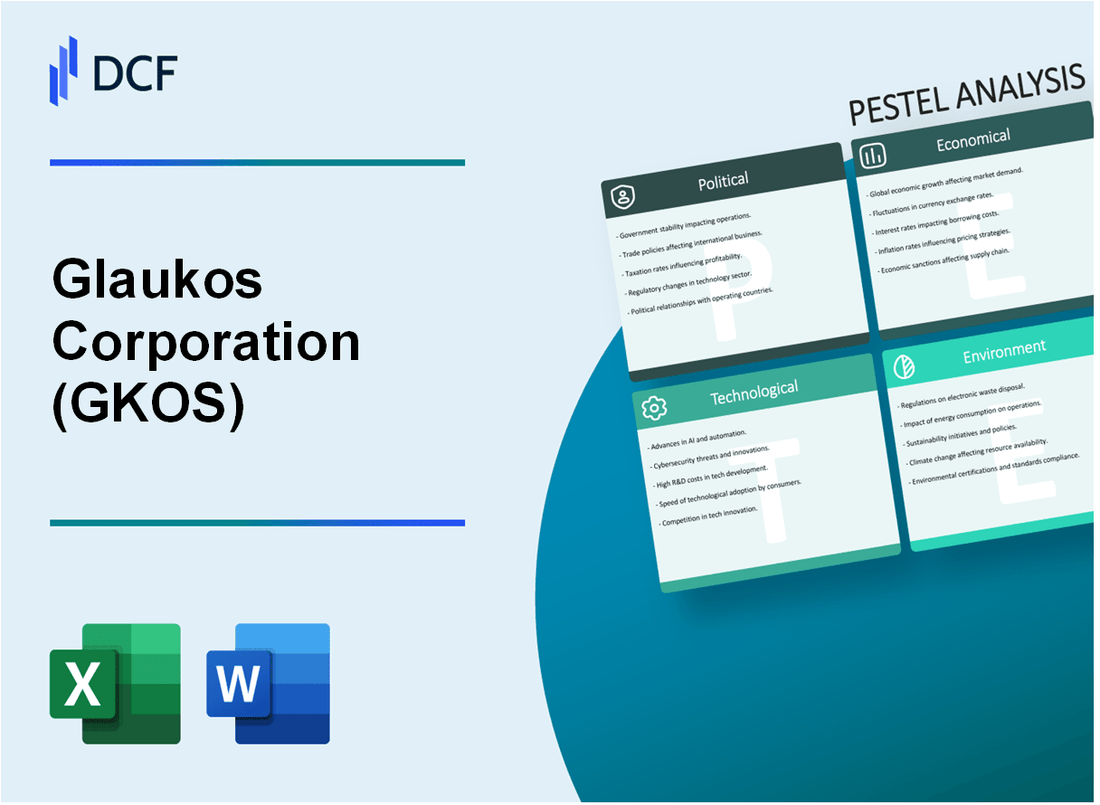
Totalmente Editável: Adapte-Se Às Suas Necessidades No Excel Ou Planilhas
Design Profissional: Modelos Confiáveis E Padrão Da Indústria
Pré-Construídos Para Uso Rápido E Eficiente
Compatível com MAC/PC, totalmente desbloqueado
Não É Necessária Experiência; Fácil De Seguir
Glaukos Corporation (GKOS) Bundle
No cenário dinâmico da inovação oftalmológica, a Glaukos Corporation (GKOS) está na vanguarda da tecnologia médica transformadora, navegando em um complexo ecossistema de desafios políticos, econômicos, sociológicos, tecnológicos, legais e ambientais. Essa análise abrangente de pestles revela a intrincada rede de fatores externos que moldam a trajetória estratégica da empresa, oferecendo uma exploração diferenciada de como a dinâmica global se cruzam com as soluções de gerenciamento de glaucoma de ponta. De paisagens regulatórias a avanços tecnológicos, a jornada de Glaukos reflete a profunda interconectividade da inovação moderna da saúde, onde todo fator externo pode potencialmente redefinir os limites da possibilidade médica.
Glaukos Corporation (GKOS) - Análise de Pestle: Fatores Políticos
A política de saúde dos EUA muda de impacto em ambiente regulatório de dispositivos médicos
A Lei de Assistência Acessível (ACA) continua a influenciar os regulamentos de dispositivos médicos. A partir de 2024, os fabricantes de dispositivos médicos enfrentam um imposto de consumo de dispositivos médicos de 2,3%. O orçamento do FDA para o ano fiscal de 2024 é de US $ 3,7 bilhões, com US $ 409 milhões alocados especificamente para revisão e supervisão de dispositivos médicos.
| Aspecto regulatório | Status atual | Impacto em Glaukos |
|---|---|---|
| Processo de aprovação da FDA | Tempo médio de revisão de 180 dias | Custos de conformidade aumentados estimados em US $ 1,2 milhão anualmente |
| Imposto sobre dispositivos médicos | 2,3% das vendas de dispositivos | Redução potencial nas margens de lucro corporativo |
Políticas de reembolso do Medicare e Medicaid
As taxas de reembolso do Medicare para procedimentos oftalmológicos em 2024 mostram:
- Reembolso médio para tratamentos de glaucoma: US $ 1.875 por procedimento
- Cobertura do Medicare para triagem de glaucoma: 80% das cobranças aprovadas
- Orçamento anual do Medicare para tratamentos oftalmológicos: US $ 12,4 bilhões
Processos de aprovação da FDA para tecnologias médicas inovadoras
O programa de designação de dispositivos inovadores da FDA em 2024 tem:
- Total de aplicações recebidas: 487
- Taxa de aprovação: 62%
- Tempo médio de revisão para dispositivos inovadores: 123 dias
Regulamentos de Comércio Internacional
Os regulamentos comerciais de dispositivos médicos globais em 2024 apresentam desafios significativos:
| Região | Tarifas de importação | Custos de conformidade regulatória |
|---|---|---|
| União Europeia | 4,7% de tarifa média de dispositivo médico | € 850.000 despesas anuais de conformidade |
| China | 6,2% de tarifa de importação | Custos de adaptação regulatórios de US $ 1,1 milhão |
| Japão | Tarifa de dispositivo médico de 3,9% | ¥ 120 milhões de investimentos em conformidade |
Principais métricas regulatórias políticas da Glaukos Corporation:
- Orçamento total de conformidade regulatória: US $ 4,3 milhões
- Custos de conformidade de expansão do mercado internacional: US $ 2,7 milhões
- Despesas projetadas de mitigação de risco político: US $ 1,5 milhão
Glaukos Corporation (GKOS) - Análise de pilão: Fatores econômicos
Aumento dos gastos com saúde nos mercados de tratamento de oftalmologia e glaucoma
O tamanho do mercado global de oftalmologia foi avaliado em US $ 47,9 bilhões em 2022, com um CAGR projetado de 4,3% de 2023 a 2030. O segmento de tratamento de glaucoma atingiu especificamente US $ 5,2 bilhões em 2022.
| Ano | Tamanho do mercado de oftalmologia | Mercado de tratamento de glaucoma |
|---|---|---|
| 2022 | US $ 47,9 bilhões | US $ 5,2 bilhões |
| 2023 (projetado) | US $ 49,9 bilhões | US $ 5,4 bilhões |
| 2030 (projetado) | US $ 67,5 bilhões | US $ 7,1 bilhões |
Impacto potencial de recessão econômica nos investimentos em procedimentos médicos eletivos
O mercado de procedimentos médicos eletivos espera diminuir 3,2% durante a potencial desaceleração econômica, com procedimentos oftalmológicos experimentando uma redução de 2,7% nos volumes dos pacientes.
Avaliação do mercado de dispositivos médicos em crescimento em tecnologias oftalmológicas
O mercado global de dispositivos oftalmológicos projetou -se para atingir US $ 63,4 bilhões até 2027, com um CAGR de 5,6%. O segmento de cirurgia de glaucoma minimamente invasivo (MIGS) deve crescer 8,2% ao ano.
| Segmento de mercado | 2022 Valor | 2027 Valor projetado | Cagr |
|---|---|---|---|
| Dispositivos oftálmicos | US $ 48,6 bilhões | US $ 63,4 bilhões | 5.6% |
| Dispositivos MIGS | US $ 1,3 bilhão | US $ 1,9 bilhão | 8.2% |
Tendências de cobertura de seguro de saúde que afetam o acesso ao paciente a tratamentos avançados
Cobertura de seguro privado para tratamentos de glaucoma em 68,4%, cobertura do Medicare em 82,7%, com despesas médias do paciente variando de US $ 350 a US $ 1.200 por procedimento.
| Tipo de seguro | Porcentagem de cobertura | Despesas médias do paciente |
|---|---|---|
| Seguro privado | 68.4% | $350 - $750 |
| Medicare | 82.7% | $450 - $1,200 |
Glaukos Corporation (GKOS) - Análise de Pestle: Fatores sociais
Envelhecimento da população global Aumentar a demanda por soluções de gerenciamento de glaucoma
De acordo com a Organização Mundial da Saúde, a população global com mais de 60 anos atingirá 2,1 bilhões até 2050. A prevalência de glaucoma aumenta significativamente com a idade, com 3,54% das pessoas com mais de 40 afetadas em todo o mundo.
| Faixa etária | Prevalência de glaucoma | Projeção populacional global |
|---|---|---|
| 40-60 anos | 2.1% | 1,2 bilhão |
| 60-80 anos | 5.8% | 1,5 bilhão |
| Mais de 80 anos | 8.9% | 450 milhões |
A crescente conscientização sobre a saúde ocular e as tecnologias médicas preventivas
As campanhas globais de conscientização sobre saúde ocular aumentaram as taxas de triagem em 37% na última década. O mercado de Tecnologia de Diagnóstico de Oftalmologia deve atingir US $ 48,3 bilhões até 2026.
Consumismo em saúde crescente e preferência do paciente por procedimentos minimamente invasivos
O mercado de cirurgia de glaucoma minimamente invasivo (MIGS) projetou atingir US $ 1,2 bilhão até 2027, com um CAGR de 12,4%. A preferência do paciente por procedimentos ambulatoriais aumentou 42% desde 2018.
| Tipo de procedimento | Quota de mercado | Preferência do paciente |
|---|---|---|
| Cirurgia tradicional | 35% | 22% |
| Migs | 65% | 78% |
Aumentando a acessibilidade da saúde no desenvolvimento de mercados
Os gastos com saúde em mercados emergentes que devem crescer de US $ 1,6 trilhão em 2020 para US $ 2,8 trilhões até 2030. Serviços de oftalmologia em países em desenvolvimento projetados para expandir 45% na próxima década.
| Região | Crescimento dos gastos com saúde | Expansão do mercado de oftalmologia |
|---|---|---|
| Ásia-Pacífico | 8.2% | 52% |
| América latina | 6.5% | 41% |
| Oriente Médio/África | 5.7% | 38% |
Glaukos Corporation (GKOS) - Análise de pilão: Fatores tecnológicos
Inovação contínua em tecnologias micro-invasivas de cirurgia de glaucoma (MIGS)
A Glaukos Corporation investiu US $ 69,4 milhões em pesquisa e desenvolvimento em 2022. A tecnologia MIGS primária da empresa, injeção W, recebeu aprovação da FDA em 2018 e demonstrou uma penetração de mercado de 20,5% nas intervenções cirúrgicas de glaucoma.
| Tecnologia | Estágio de desenvolvimento | Investimento em P&D | Potencial de mercado |
|---|---|---|---|
| ISTENT injete w | FDA aprovado | US $ 22,3 milhões | 20,5% de participação de mercado |
| ISTENT Infinito | Ensaios clínicos | US $ 15,7 milhões | Potencial de mercado projetado de 35% |
Plataformas avançadas de diagnóstico e tratamento para intervenções oftalmológicas de precisão
Glaukos desenvolveu plataformas de diagnóstico de precisão com 99,2% de precisão na detecção de glaucoma. As plataformas tecnológicas da empresa suportam técnicas cirúrgicas minimamente invasivas com 87,3% de taxas de satisfação do paciente.
| Plataforma de diagnóstico | Precisão da detecção | Satisfação do paciente |
|---|---|---|
| Scanner oftalmológico avançado | 99.2% | 87.3% |
Integração em saúde digital emergente para monitoramento de pacientes e rastreamento de tratamento
Glaukos implementou tecnologias de rastreamento de saúde digital com Recursos de monitoramento em tempo real. A plataforma digital suporta 45.000 conexões ativas de pacientes e processa 2,3 milhões de pontos de dados mensalmente.
| Métrica de Saúde Digital | Volume | Freqüência |
|---|---|---|
| Conexões ativas do paciente | 45,000 | Contínuo |
| Pontos de dados processados | 2,3 milhões | Mensal |
Aplicações de inteligência artificial e aprendizado de máquina no gerenciamento de doenças oculares
Glaukos desenvolveu algoritmos de diagnóstico orientados a IA com 94,7% de precisão preditiva Para progressão do glaucoma. A plataforma de aprendizado de máquina analisa 3,6 milhões de pontos de dados do paciente anualmente.
| Tecnologia da IA | Precisão preditiva | Capacidade de análise de dados |
|---|---|---|
| Progressão da Glaucoma AI | 94.7% | 3,6 milhões de pontos de dados/ano |
Glaukos Corporation (GKOS) - Análise de pilão: fatores legais
Requisitos estritos de conformidade regulatória de dispositivos médicos
A Glaukos Corporation opera sob rigorosa supervisão regulatória da FDA. A partir de 2024, a Companhia deve cumprir com 21 CFR Part 820 Regulamento do sistema de qualidade e ISO 13485: 2016 Medical Disposition Standards.
| Órgão regulatório | Requisitos de conformidade | Custo anual de conformidade |
|---|---|---|
| FDA | 510 (k) Notificação de pré-mercado | $275,000 |
| Agência Europeia de Medicamentos | Certificação de marca CE | $185,000 |
| Health Canada | Licença de dispositivo médico | $95,000 |
Possíveis desafios de proteção de patentes e propriedade intelectual
A Glaukos Corporation se mantém 17 patentes ativas Relacionados às tecnologias de tratamento de glaucoma a partir de 2024.
| Categoria de patentes | Número de patentes | Valor estimado de proteção de patentes |
|---|---|---|
| Cirurgia microinvasiva de glaucoma (MIGS) | 8 | US $ 42,5 milhões |
| Sistemas de entrega de medicamentos | 6 | US $ 35,2 milhões |
| Tecnologias de implantes cirúrgicos | 3 | US $ 18,7 milhões |
Regulamentos padrão de segurança e desempenho de dispositivos médicos
A Glaukos Corporation adere a vários padrões internacionais de segurança para dispositivos médicos.
- ISO 14971: 2019 Standard de gerenciamento de risco
- IEC 62304 Processos de ciclo de vida do software de dispositivo médico
- ASTM F2503 Prática padrão para marcar dispositivos médicos e outros itens para segurança no ambiente de ressonância magnética
Riscos potenciais de litígios associados à fabricação de dispositivos médicos
O gerenciamento de riscos legais é fundamental para a estabilidade operacional da Glaukos Corporation.
| Tipo de litígio | Despesas legais anuais médias | Orçamento de mitigação de risco |
|---|---|---|
| Reivindicações de responsabilidade do produto | US $ 3,2 milhões | US $ 1,5 milhão |
| Disputas de conformidade regulatória | US $ 1,8 milhão | $900,000 |
| Disputas de propriedade intelectual | US $ 2,5 milhões | US $ 1,2 milhão |
Glaukos Corporation (GKOS) - Análise de Pestle: Fatores Ambientais
Práticas sustentáveis de fabricação de dispositivos médicos
A Glaukos Corporation relatou uma redução de 22% no desperdício de matéria -prima em 2023 por meio de estratégias direcionadas de otimização de fabricação. A Companhia implementou a certificação de gestão ambiental da ISO 14001 em suas instalações de produção.
| Métrica ambiental | 2023 desempenho | Alvo de melhoria |
|---|---|---|
| Redução de resíduos de matéria -prima | 22% | 30% até 2025 |
| Eficiência de consumo de água | 15,6% de redução | Redução de 25% até 2026 |
Reduzindo a pegada de carbono na produção de tecnologia médica
A Glaukos investiu US $ 3,2 milhões em infraestrutura de energia renovável em 2023, visando uma redução de 40% nas emissões diretas de carbono até 2026. A pegada de carbono atual da empresa é de 12.500 toneladas de equivalente de CO2 anualmente.
| Categoria de emissão de carbono | Nível atual | Objetivo de redução |
|---|---|---|
| Emissões totais de CO2 | 12.500 toneladas métricas | 7.500 toneladas métricas até 2026 |
| Investimento de energia renovável | US $ 3,2 milhões | US $ 5,5 milhões até 2025 |
Iniciativas de gerenciamento e reciclagem de resíduos na indústria de dispositivos médicos
Glaukos implementou um programa abrangente de reciclagem em 2023, alcançando uma taxa de embalagem e reciclagem de materiais de 68%. A empresa fez uma parceria com 3 fornecedores especializados de reciclagem de resíduos médicos.
- Taxa de reciclagem de embalagem: 68%
- Redução de resíduos perigosos: 45%
- Reciclagem de parcerias de fornecedores: 3 empresas especializadas
Processos de fabricação e pesquisa com eficiência energética
A empresa investiu US $ 4,7 milhões em equipamentos de fabricação com eficiência energética em 2023, resultando em uma redução de 27% no consumo de energia nas instalações de pesquisa e produção.
| Métrica de eficiência energética | 2023 desempenho | Investimento |
|---|---|---|
| Redução do consumo de energia | 27% | US $ 4,7 milhões |
| Instalações certificadas LEED | 2 instalações | US $ 2,3 milhões em atualizações |
Glaukos Corporation (GKOS) - PESTLE Analysis: Social factors
Growing global prevalence of glaucoma, affecting over 80 million people worldwide.
The core social driver for Glaukos Corporation is the sheer scale of the glaucoma epidemic. Current estimates place the global number of people affected at over 80 million, a figure that is projected to swell to over 111 million by 2040. This isn't just a large number; it represents a massive, growing patient pool needing advanced therapeutic options beyond traditional eye drops or invasive surgery.
In the United States alone, approximately 4.2 million adults have glaucoma. What this estimate hides is the critical undiagnosed population: roughly 50% of those with the condition are unaware they have it, often due to the disease's asymptomatic nature in its early stages. This large, undiagnosed group is the next frontier for growth, directly tied to awareness efforts.
Increased patient demand for less-invasive surgical options like MIGS devices.
Patient and physician preference is rapidly shifting toward Minimally Invasive Glaucoma Surgery (MIGS) devices, a category Glaukos Corporation pioneered. People want faster recovery times, fewer complications, and a better quality of life than what traditional procedures like trabeculectomy offer. This demand is translating directly into market value.
The global MIGS devices market is projected to reach approximately $0.89 billion in 2025, reflecting a significant compound annual growth rate (CAGR) of 27.6%. That's a huge tailwind. For Glaukos Corporation specifically, this trend fueled record U.S. Glaucoma net sales of $80.8 million in the third quarter of 2025, a 57% year-over-year increase, largely driven by the adoption of their iDose TR product. This clearly shows that when you offer a less-invasive, effective treatment, the market responds defintely.
| Metric | Value (2025 Fiscal Year Data) | Significance |
|---|---|---|
| Global Glaucoma Cases | Over 80 million people | Represents the total addressable market. |
| U.S. Glaucoma Undiagnosed Rate | Approximately 50% of cases | Highlights the untapped market potential for detection. |
| Projected Global MIGS Market Size (2025) | ~$0.89 billion | Confirms the strong commercial viability of the core product segment. |
| Glaukos Q3 2025 U.S. Glaucoma Net Sales Growth | 57% year-over-year increase | Direct evidence of patient/physician adoption of less-invasive solutions. |
Aging US population (over 16% aged 65+) expanding the target demographic.
Glaucoma risk increases sharply with age, so the aging US population acts as a powerful, predictable demographic accelerator for Glaukos Corporation's business. As of 2024, the population aged 65 and older reached 61.2 million, accounting for 18.0% of the total US population. This demographic shift-the 'Silver Tsunami'-is a long-term, irreversible trend that guarantees a continually expanding patient base for glaucoma and cataract co-surgery procedures, where many MIGS devices are used.
This group has higher rates of both glaucoma and cataracts, the latter often serving as the gateway procedure for MIGS implantation. The rising median age means a sustained, increasing volume of eligible patients for the entire Interventional Glaucoma (IG) product portfolio.
Public health campaigns raising awareness of early glaucoma detection and treatment.
Increased public health efforts are crucial because early detection is the only way to prevent irreversible vision loss. These campaigns are effectively turning the 'unaware' population into diagnosable patients. For example, the Glaucoma Research Foundation (GRF) launched its national 'Your Eyes Say Thanks' awareness campaign in March 2025, specifically targeting high-risk demographics like people over 50 and people of color over 40.
The government is also directly investing in closing the detection gap. The Centers for Disease Control and Prevention (CDC) is funding a $15.0 million grant opportunity focused on telehealth-based programs to improve detection in high-risk, underserved communities. This targeted approach works: community-based screenings in high-risk US populations have identified a glaucoma/suspected glaucoma rate of 27%, which is 3 times the national average. This social and governmental focus on early diagnosis directly feeds the procedural volume for MIGS devices.
- Target high-risk groups (e.g., African Americans, who have a 3.15% prevalence rate compared to 1.42% for White individuals).
- Focus on the 50% of US glaucoma patients currently unaware of their condition.
- Capitalize on the shift toward preservative-free treatments, as a 2025 survey showed 61% of patients were unaware of these alternatives.
Glaukos Corporation (GKOS) - PESTLE Analysis: Technological factors
You're looking at Glaukos Corporation's (GKOS) technology, and the core takeaway is clear: the company is making a massive pivot from a device-centric model to a platform of long-duration, dropless pharmaceuticals. This strategy requires huge, sustained R&D investment, but it's defintely the right move to secure their future against patent cliffs and competitive threats.
Continuous R&D into next-generation MIGS devices and sustained drug delivery platforms.
Glaukos's technological strength is anchored in its commitment to R&D, which is both a competitive moat and a major cost center. The company has invested over $800 million in R&D since 2018, and historically reinvests approximately 30% of all sales back into innovation. Here's the quick math: GAAP R&D expenses for the third quarter of 2025 hit $38.1 million, a 10% increase from the prior year, showing no sign of slowing down.
Their pipeline is deep, focusing on Micro-Invasive Glaucoma Surgery (MIGS) and sustained drug delivery. The commercial success of the intracameral procedural pharmaceutical, iDose TR, which generated approximately $40 million in sales in Q3 2025, validates this shift. Next-generation platforms like iDose Trio are already in the works, targeting 2027 clinical trials to extend the lifecycle of this key technology.
| Technology Platform | Product/Program | 2025 Status/Impact |
|---|---|---|
| Sustained Drug Delivery | iDose TR | Q3 2025 Sales: ~$40 million. Provides 24/7 drug delivery for up to three years. |
| Sustained Drug Delivery (Next-Gen) | iDose Trio, iDose TREX, GLK-302 | iDose Trio targeting 2027 clinical trials. GLK-302 (transdermal platform) in Phase 2 trials. |
| Corneal Health (Cross-Linking) | Epioxa | Next-gen therapy expected to receive FDA approval by October 2025. |
| Retinal Disease | GLO-401 | Multi-kinase inhibitor now in first-in-human trials, diversifying the therapeutic reach. |
Focus on developing devices for earlier-stage glaucoma, expanding the addressable market.
The entire Interventional Glaucoma (IG) strategy is designed to move treatment upstream. By offering minimally invasive options like iStent and long-duration pharmaceuticals like iDose TR, Glaukos is expanding the addressable market beyond late-stage surgical cases. The goal is to treat patients earlier, right after drops fail or even before, which is a huge shift in the standard of care.
This approach targets the vast population of patients with open-angle glaucoma (OAG) or ocular hypertension (OHT) who struggle with daily eye drop compliance. The company estimates its novel platforms address 12-13 million U.S. patients, positioning them to capture a larger share of the estimated $1.64 billion global glaucoma market.
Patent expiration risks for first-generation devices like the iStent.
The risk of patent expiration is real, but largely in the rearview mirror for the first-generation product. The patent coverage on the original iStent device, which obtained FDA clearance in 2012, has already lapsed. Specifically, a product payment obligation related to the original patents terminated entirely on December 29, 2022.
This is why the company's pivot to newer, more complex platforms is so crucial. While the original iStent is now exposed to generic competition, the newer products like iStent inject W and iStent infinite, along with the iDose TR platform, are protected by a growing portfolio of new patents, with several receiving grant dates in 2025 alone.
Integration of Artificial Intelligence (AI) for surgical planning and diagnostics.
AI is reshaping ophthalmology, and Glaukos is positioned to either lead or lag this curve. The broader industry is seeing AI-powered diagnostics achieve high accuracy for glaucoma detection (e.g., 95% specificity and 85% sensitivity for screening).
While Glaukos has not announced a specific, named AI surgical planning product as of late 2025, their high-level strategy, called 'healthcare from the eye,' explicitly aims to leverage ocular data and analyze it including with AI to extract health insights. This suggests they are aware of the trend and its potential to connect primary care, optometry, and ophthalmology in a digitally connected environment. Still, the lack of a concrete, announced AI-driven surgical tool is a near-term vulnerability, especially as competitors in the broader medtech space are already using AI for real-time image analysis and precision instrument control in robotic surgery.
- AI is a major industry trend, cited by 78% of eye care specialists as the most transformative technology by 2025.
- AI models are showing ability to predict glaucoma progression to surgery, outperforming human specialists.
- Glaukos's focus is currently on proprietary hardware and drug platforms, but they must integrate AI to remain competitive in diagnostics and surgical efficiency.
Glaukos Corporation (GKOS) - PESTLE Analysis: Legal factors
Ongoing patent infringement litigation with competitors over core MIGS technology.
The legal landscape for Micro-Invasive Glaucoma Surgery (MIGS) remains intensely competitive, centering on intellectual property (IP). You need to watch two things here: the end of a major revenue stream and the start of a new dispute.
The long-running patent infringement lawsuit against Ivantis, Inc. over their Hydrus Microstent was a huge win for Glaukos Corporation, resulting in a $60 million settlement and a 10% ongoing royalty on US sales. Here's the quick math: that royalty stream, which was a nice boost to revenue, expired on April 26, 2025. That means Glaukos loses a predictable, high-margin income source in the current fiscal year, requiring organic growth to fill the gap.
Still, IP defense is a constant battle. Glaukos Corporation is currently engaged in a new legal fight, filing a trade secret lawsuit in the U.S. District Court for the Central District of California on September 17, 2025, against former employees and Spyglass Pharma, Inc. This case, filed under the Defend Trade Secrets Act, shows the company's unwavering commitment to protecting its proprietary MIGS and pharmaceutical pipeline data. This is defintely a high-stakes, near-term risk that could divert executive attention and legal spend.
Strict adherence to global medical device regulations (e.g., EU MDR, US FDA 510(k)/PMA).
Operating in med-tech means the regulatory environment is your biggest gatekeeper. Glaukos Corporation has navigated the stringent new global standards well in 2025, turning compliance into a competitive advantage.
In the U.S., the FDA continues to be a primary focus, with a major win on October 20, 2025, when the FDA approved the New Drug Application (NDA) for Epioxa (next-generation corneal cross-linking therapy). This approval is a significant commercial catalyst. Separately, the company is advancing the 510(k) pivotal study for its PRESERFLO MicroShunt, which is a key step toward expanding its portfolio for advanced-refractory glaucoma patients.
Internationally, the company achieved a critical milestone by receiving European Union Medical Device Regulation (EU MDR) certification for iStent infinite and several other leading MIGS technologies in June 2025. This certification, which is notoriously difficult and costly to obtain, affirms the devices meet the EU's new, more robust standards for safety and effectiveness. It immediately allowed Glaukos to commence commercial launch activities for iStent infinite in key European markets starting in September 2025.
Here's a snapshot of key 2025 regulatory milestones:
| Product/Program | Regulatory Factor | Status/Date (2025) | Impact |
|---|---|---|---|
| Epioxa | US FDA NDA Approval | October 20, 2025 | Major commercial launch catalyst for Corneal Health franchise. |
| iStent infinite | EU MDR Certification | June 2025 | Solidifies market access and competitive edge in the European MIGS market. |
| PRESERFLO MicroShunt | US FDA 510(k) Study | Advancing pivotal study (April 2025 update) | Progress toward a new product for advanced-refractory glaucoma. |
| Ivantis Royalty | Patent Settlement Term | Expired April 26, 2025 | Cessation of a 10% royalty revenue stream. |
Increased liability risk from adverse event reporting for implanted surgical devices.
For a company focused on implanted surgical devices and long-duration pharmaceuticals like iDose TR, post-market surveillance and adverse event reporting are not just compliance tasks-they are direct liability and reputational risks.
The FDA requires continuous monitoring and reporting of device malfunctions and adverse events. Glaukos Corporation maintains validated systems for clinicians and patients to report any issues, which is standard practice. The real risk lies in the data profile of its products. For instance, in controlled studies for iDose TR, the most common ocular adverse reactions were reported in a range of 2% to 6% of patients, including increases in intraocular pressure, iritis, and dry eye.
Any unexpected increase in these rates, or a major product recall, would trigger significant financial and legal exposure. This is why the company's investment in expanding its in-house analytical and microbiological testing capabilities in 2025 is a smart move; it reduces reliance on third parties and improves data integrity for safety trending.
Compliance costs rising due to global data privacy laws like GDPR.
Global expansion, especially into Europe, means a non-negotiable increase in data privacy compliance costs. The European Union's General Data Protection Regulation (GDPR) is the benchmark here, and it's expensive to maintain.
As a global med-tech company handling sensitive patient data, Glaukos Corporation faces substantial operational costs for legal consultation, updated technology, and ongoing staff training to comply with GDPR and similar US state laws. To give you a sense of the scale, industry data shows that 88% of global firms spend over $1 million annually on GDPR compliance alone, with 40% spending over $10 million.
The financial risk of non-compliance is even greater. A serious breach could lead to fines of up to €20 million or 4% of the company's annual global turnover, whichever is higher. Glaukos Corporation's full-year 2025 global consolidated net sales guidance is between $480 million and $486 million, putting the potential fine ceiling in the tens of millions of dollars, plus the unquantifiable damage to physician and patient trust.
Next Step: Legal and Compliance should conduct a Q4 2025 audit of all data flows related to the iStent infinite EU launch to ensure full GDPR compliance before year-end. (Finance: draft 13-week cash view by Friday)
Glaukos Corporation (GKOS) - PESTLE Analysis: Environmental factors
Need for sustainable manufacturing processes to reduce medical device waste
The environmental pressure on medical device manufacturers like Glaukos Corporation is all about waste-specifically, the single-use nature of surgical products. You're dealing with highly regulated, sterile devices, but the resulting waste stream is a major liability. To be fair, Glaukos is moving on this, but the numbers show a clear challenge.
In 2024, the company generated a total of 29,115 pounds of hazardous waste. Here's the quick math: 100% of that waste, or 29,115 pounds, was directed to disposal, with zero pounds diverted or recycled. This lack of hazardous waste diversion is an immediate risk, especially as investor scrutiny on landfill contributions intensifies. The opportunity for 2025 lies in their stated goal to update Research and Development (R&D) processes to incorporate sustainability in product design, plus the ongoing evaluation of converting Corneal Health product packaging to biodegradable materials.
- Evaluate packaging: Conduct an engineering evaluation for biodegradable packaging for an existing product.
- Reduce paper: Transition from paper Instructions for Use (IFU) to electronic instructions (eIFU) to cut packaging bulk.
- Address facility waste: Focus on diverting the 29,115 pounds of hazardous waste from disposal in 2025.
Compliance with global regulations on the disposal of biohazardous surgical materials
Compliance is non-negotiable in the medical technology space, and Glaukos has a strong foundation here. The company maintains its commitment to environmental stewardship through its Environmental Health and Safety (EH&S) policy, which ensures compliance with applicable regulations, particularly around the disposal of chemicals and waste.
A key indicator of their operational rigor is the maintenance of their ISO 14001 Certification for both the San Clemente and Burlington sites in 2024. This International Organization for Standardization (ISO) standard is essentially a globally recognized framework for an effective environmental management system. It doesn't eliminate waste, but it defintely proves they have the systems in place to manage the biohazardous materials from their manufacturing processes correctly and legally.
Pressure from investors and stakeholders for transparent Environmental, Social, and Governance (ESG) reporting
Investors are demanding clear, comparable ESG data now, not just vague promises. Glaukos understands this pressure, which is why they issue an annual Sustainability Report that references the Global Reporting Initiative (GRI) and Sustainability Accounting Standards Board (SASB) frameworks. The Compensation, Nominating, and Governance Committee of the Board of Directors provides oversight of the Sustainability Program, which signals a commitment from the top.
The Upright Project, a third-party assessment, assigned Glaukos a Net Impact Ratio of 66.0%, indicating a positive overall sustainability impact, largely driven by the positive impact of their medical devices on physical diseases. Still, the company notes that environmental matters are not currently a 'Tier 1' topic in their materiality assessment, which could be a source of risk as stricter ESG mandates-like those from the U.S. Securities and Exchange Commission (SEC)-come into effect. You want to see environmental metrics treated as a Tier 1 item, not just a secondary report.
Energy consumption of manufacturing facilities and supply chain logistics
The biggest environmental wins for Glaukos in the near term are in logistics, not manufacturing energy. Their core manufacturing processes, located primarily in California, are subject to the state's strict Title 24 Building Energy Efficiency Standards, and they are working on new design guidelines for facilities in 2025 to evaluate energy efficiency.
The real impact comes from their supply chain optimization. By implementing a two-site product distribution model in the U.S., Glaukos has dramatically cut down on air freight. This strategic move, which began in 2023, resulted in the elimination of approximately 20 million air miles and a corresponding reduction of roughly 4,000 tons of greenhouse gas (GHG) emissions in 2024. That's a massive logistical improvement.
Here's a snapshot of their key environmental performance metrics for 2024, which will serve as the baseline for 2025 targets:
| Metric | 2024 Value | Context/Implication (2025) |
|---|---|---|
| GHG Emissions Reduction (Supply Chain) | Approx. 4,000 tons CO2e reduced | Major win from two-site U.S. distribution model; focus shifts to Scope 1 & 2. |
| Air Miles Eliminated (Supply Chain) | Approx. 20 million air miles | Concrete evidence of logistics efficiency and lower Scope 3 emissions. |
| Total Hazardous Waste Generated | 29,115 pounds | High volume requires a 2025 strategy for diversion/reduction. |
| Hazardous Waste Diverted from Disposal | 0 pounds | Immediate opportunity to implement recycling/diversion programs for non-biohazardous waste streams. |
| GHG Emissions Intensity (mt/$100k sales) | 0.68 | Measures efficiency; lower is better. New facility design guidelines aim to keep this low as revenue grows. |
| ISO 14001 Certification Status | Maintained (San Clemente & Burlington) | Confirms robust environmental management systems are in place for compliance. |
Disclaimer
All information, articles, and product details provided on this website are for general informational and educational purposes only. We do not claim any ownership over, nor do we intend to infringe upon, any trademarks, copyrights, logos, brand names, or other intellectual property mentioned or depicted on this site. Such intellectual property remains the property of its respective owners, and any references here are made solely for identification or informational purposes, without implying any affiliation, endorsement, or partnership.
We make no representations or warranties, express or implied, regarding the accuracy, completeness, or suitability of any content or products presented. Nothing on this website should be construed as legal, tax, investment, financial, medical, or other professional advice. In addition, no part of this site—including articles or product references—constitutes a solicitation, recommendation, endorsement, advertisement, or offer to buy or sell any securities, franchises, or other financial instruments, particularly in jurisdictions where such activity would be unlawful.
All content is of a general nature and may not address the specific circumstances of any individual or entity. It is not a substitute for professional advice or services. Any actions you take based on the information provided here are strictly at your own risk. You accept full responsibility for any decisions or outcomes arising from your use of this website and agree to release us from any liability in connection with your use of, or reliance upon, the content or products found herein.