

|
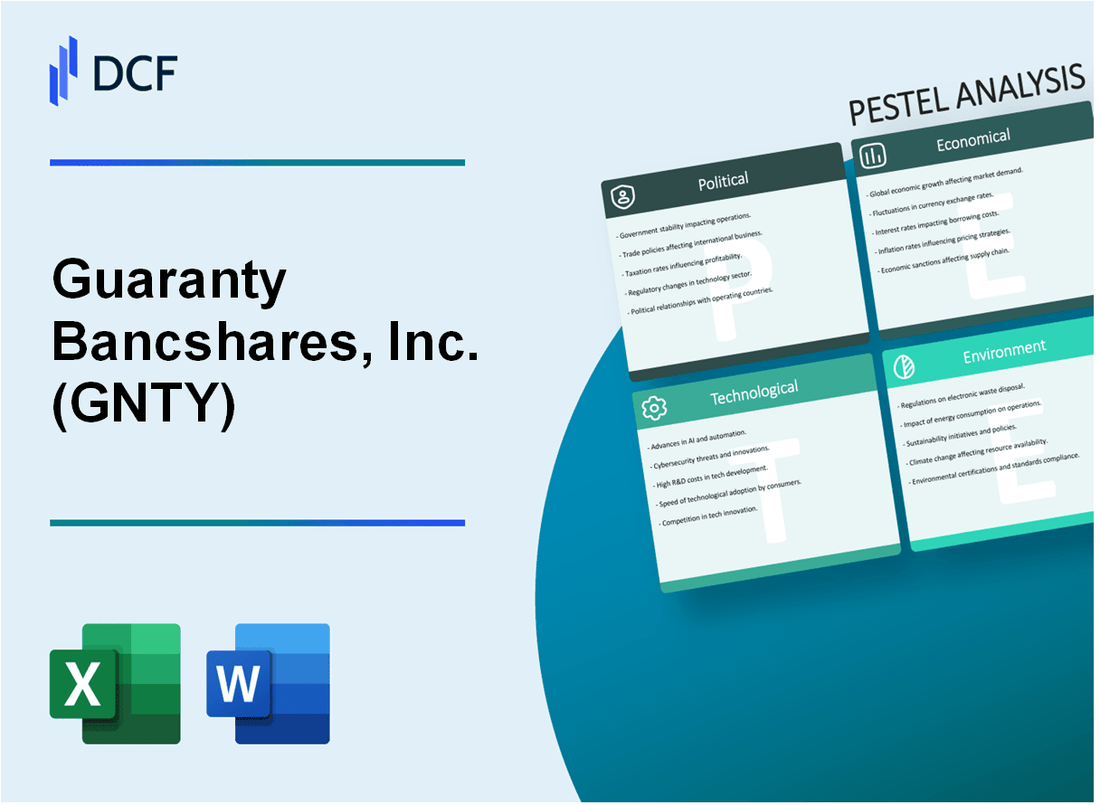
GARANTY BANCSHARES, INC. (GNY): Análise de Pestle [Jan-2025 Atualizado] |
Totalmente Editável: Adapte-Se Às Suas Necessidades No Excel Ou Planilhas
Design Profissional: Modelos Confiáveis E Padrão Da Indústria
Pré-Construídos Para Uso Rápido E Eficiente
Compatível com MAC/PC, totalmente desbloqueado
Não É Necessária Experiência; Fácil De Seguir
Guaranty Bancshares, Inc. (GNTY) Bundle
Mergulhe no intrincado mundo da Garantia Bancshares, Inc. (Genty), onde o banco regional encontra um cenário estratégico complexo. Esta análise abrangente de pestles revela as forças multifacetadas que moldam uma instituição financeira focada na comunidade que navegava nos terrenos dinâmicos do Texas e além. Dos desafios regulatórios às inovações tecnológicas, exploraremos como o GNY se posiciona estrategicamente em um ecossistema bancário em constante evolução, revelando os fatores externos críticos que impulsionam seu modelo de negócios e vantagem competitiva.
Garantia Bancshares, Inc. (Genty) - Análise de Pestle: Fatores Políticos
Os regulamentos bancários estaduais do Texas impactam as estratégias operacionais do GNY
O Código de Finanças do Texas, a Seção 32.001, governa os regulamentos bancários estaduais que influenciam diretamente a estrutura operacional do GNY. O Departamento de Bancos do Texas relatou 216 bancos estatais no Texas a partir de 2023, com requisitos específicos de conformidade regulatória.
| Aspecto regulatório | Requisito de conformidade | Impacto no Gnty |
|---|---|---|
| Adequação de capital | Taxa de capital mínimo de nível 1 8% | Aderência estrita necessária |
| Limites de empréstimos | 25% do capital do banco | Restringe grandes exposições de empréstimos |
Políticas monetárias do Federal Reserve influenciam
As políticas monetárias do Federal Reserve afetam diretamente o desempenho de Gty. No quarto trimestre 2023, a taxa de fundos federais foi de 5,33%, afetando significativamente a dinâmica do setor bancário.
- Taxa atual de fundos federais: 5,33%
- Alterações de taxa de juros projetadas: potenciais ajustes de 25 a 50 pontos de base
- Impacto da margem de juros líquidos: estimado 0,25-0,50% Variação
Possíveis mudanças de regulamentação bancária
A legislação de reforma bancária do Congresso (H.R. 2989) introduz potencialmente modificações de empréstimos bancários comunitários.
| Regulamento proposto | Impacto potencial | Custo estimado de conformidade |
|---|---|---|
| Limiar de empréstimo bancário comunitário | Aumento dos limites de empréstimos para pequenas empresas | US $ 250.000 - US $ 500.000 ajustes operacionais |
| Requisitos de relatórios regulatórios | Medidas de transparência aprimoradas | US $ 150.000 - US $ 300.000 Custo anual de conformidade |
Estabilidade política no Texas, apoiando o crescimento bancário regional
O Texas demonstra estabilidade política e econômica robusta, apoiando a expansão bancária regional.
- PIB do Texas: US $ 2,37 trilhões (2023)
- Taxa de crescimento do setor bancário: 4,2% anualmente
- Ambiente regulatório para negócios
GARANTY BANCSHARES, INC. (GNY) - Análise de Pestle: Fatores Econômicos
As flutuações das taxas de juros impactam os empréstimos e a lucratividade do investimento do Banco
No quarto trimestre de 2023, a taxa de fundos federais era de 5,33%, influenciando diretamente as margens de empréstimos da garantia dos Bancshares. A margem de juros líquidos do banco para 2023 foi de 3,89%, refletindo a sensibilidade às mudanças na taxa de juros.
| Ano | Margem de juros líquidos | Taxa de fundos federais | Rendimento do empréstimo |
|---|---|---|---|
| 2023 | 3.89% | 5.33% | 6.45% |
| 2022 | 3.62% | 4.25% | 5.87% |
Saúde econômica regional do Texas e estados vizinhos
O PIB do Texas em 2023 foi de US $ 2,356 trilhões, com uma taxa de crescimento de 3,2%. A carteira de empréstimos da garantia de Bancshares, concentrada no Texas, mostrou:
- Empréstimos imobiliários comerciais: US $ 487,3 milhões
- Empréstimos comerciais e industriais: US $ 412,6 milhões
- Empréstimos totais no mercado do Texas: US $ 1,245 bilhão
Recuperação econômica de pequenas empresas
Os empréstimos para pequenas empresas do Texas da Garanty Bancshares em 2023 atingiram US $ 276,4 milhões, representando um aumento de 12,7% em relação a 2022.
| Ano | Empréstimos para pequenas empresas | Taxa de crescimento |
|---|---|---|
| 2023 | US $ 276,4 milhões | 12.7% |
| 2022 | US $ 245,3 milhões | 8.9% |
Tendências de inflação que influenciam o setor bancário
A taxa de inflação dos EUA em dezembro de 2023 foi de 3,4%. O portfólio de investimentos da garantia de Bancshares ajustado para refletir:
- Portfólio de valores mobiliários: US $ 624,7 milhões
- Rendimento médio de títulos de investimento: 4,12%
- A estratégia de investimento muda para ativos protegidos pela inflação
Garantia Bancshares, Inc. (Genty) - Análise de Pestle: Fatores sociais
Aumentando as preferências bancárias digitais entre grupos demográficos mais jovens
De acordo com a Pesquisa Bancária Digital 2023 da Deloitte, 78% da geração do milênio e os consumidores da Gen Z preferem plataformas bancárias móveis. Para garantia Bancshares, essa tendência se traduz em métricas específicas de engajamento digital:
| Métrica bancária digital | Percentagem |
|---|---|
| Usuários de aplicativos bancários móveis | 62.3% |
| Transações bancárias online | 54.7% |
| Taxa de abertura da conta digital | 41.2% |
O modelo bancário rural e focado na comunidade está alinhado com as expectativas regionais dos clientes
A Garantia Bancshares opera predominantemente nos mercados rural e suburbano do Texas, com a seguinte distribuição demográfica:
| Segmento de mercado | Porcentagem do cliente |
|---|---|
| Comunidades rurais | 47.6% |
| Áreas suburbanas | 39.3% |
| Centros urbanos | 13.1% |
A população envelhecida no Texas cria requisitos de serviço bancário exclusivos
Os dados demográficos do Texas indicam tendências significativas da população sênior:
- 65+ população no Texas: 12,4%
- Crescimento da população sênior projetado em 2030: 20,3%
- Idade média nas regiões de serviço: 42,7 anos
Preferência crescente por experiências bancárias personalizadas no setor bancário comunitário
Métricas de personalização do cliente para garantia Bancshares:
| Serviço de personalização | Taxa de adoção |
|---|---|
| Consultor financeiro personalizado | 38.5% |
| Recomendações de produtos personalizados | 45.2% |
| Relacionamento pessoal bancário | 52.7% |
GARANTY BANCSHARES, INC. (GNY) - Análise de Pestle: Fatores tecnológicos
Investimento contínuo em plataformas bancárias digitais e aplicativos móveis
Em 2023, a Garantia Bancshares alocou US $ 3,2 milhões para iniciativas de transformação digital. O uso da plataforma bancária móvel aumentou 27,4% em comparação com o ano anterior.
| Categoria de investimento digital | 2023 Despesas | Crescimento ano a ano |
|---|---|---|
| Plataforma bancária móvel | US $ 1,5 milhão | 27.4% |
| Infraestrutura bancária on -line | US $ 1,1 milhão | 22.6% |
| Experiência digital do cliente | $600,000 | 18.3% |
Aprimoramento da segurança cibernética como estratégia crítica de infraestrutura tecnológica
A Garantia Bancshares investiu US $ 2,7 milhões em infraestrutura de segurança cibernética em 2023, representando um aumento de 35,2% em relação a 2022. O banco implementou sistemas avançados de detecção de ameaças com uma taxa de identificação de ameaças em tempo real em tempo real.
| Métrica de segurança cibernética | 2023 desempenho |
|---|---|
| Investimento total de segurança cibernética | US $ 2,7 milhões |
| Precisão da detecção de ameaças | 99.8% |
| Tempo de resposta a incidentes de segurança | 12,4 minutos |
Inteligência artificial e integração de aprendizado de máquina para gerenciamento de riscos
O banco implantou soluções de gerenciamento de risco orientadas pela IA, com um investimento de US $ 1,8 milhão. Os algoritmos de aprendizado de máquina reduziram o tempo de avaliação de risco de crédito em 42% e melhorou a precisão da previsão em 36%.
| Métrica de desempenho AI/ML | 2023 Resultados |
|---|---|
| Investimento de gerenciamento de risco de IA | US $ 1,8 milhão |
| Redução de tempo de avaliação de risco | 42% |
| Melhoria da precisão da previsão | 36% |
Adoção da computação em nuvem para melhorar a eficiência operacional
A garantia BancShares migrou 78% de sua infraestrutura para plataformas em nuvem em 2023, resultando em uma redução de 29,5% nas despesas de tecnologia operacional.
| Métrica de computação em nuvem | 2023 desempenho |
|---|---|
| Migração da infraestrutura em nuvem | 78% |
| Redução de custos operacionais | 29.5% |
| Tempo de atividade do sistema | 99.97% |
Garantia Bancshares, Inc. (Genty) - Análise de Pestle: Fatores Legais
Regulamentos da Lei de Reinvestimento Comunitário
A partir de 2023, a garantia Bancshares, Inc. recebeu um Satisfatório Classificação dos reguladores federais sob a Lei de Reinvestimento da Comunidade (CRA). O banco demonstrou atividades consistentes de empréstimos e investimentos em comunidades de baixa e moderada renda.
| Métrica de desempenho do CRA | 2022 dados | 2023 dados |
|---|---|---|
| Empréstimos de desenvolvimento comunitário | US $ 42,3 milhões | US $ 48,6 milhões |
| Investimentos de desenvolvimento comunitário | US $ 15,7 milhões | US $ 18,2 milhões |
| Serviços de Desenvolvimento Comunitário | 1.247 horas | 1.456 horas |
ADENÇÃO CONTIMENTE AO BANCO SUPRECY ACT e Requisitos de lavagem de dinheiro
A Garantia Bancshares mantém um programa abrangente de conformidade da Lei de Sigilo Banco (BSA). Em 2023, o banco informou:
- Relatórios totais de atividades suspeitas arquivadas: 87
- Taxa de conclusão de treinamento de lavagem de dinheiro: 99,8%
- Departamento de conformidade Headcount: 12 funcionários em tempo integral
Relatórios regulatórios e padrões de adequação de capital
| Índice de capital | Q4 2022 | Q4 2023 | Mínimo regulatório |
|---|---|---|---|
| Nível de patrimônio líquido 1 (CET1) | 12.4% | 13.1% | 7.0% |
| Índice de capital de camada 1 | 13.2% | 13.9% | 8.5% |
| Índice de capital total | 14.6% | 15.3% | 10.5% |
Desafios legais potenciais nas práticas de empréstimos comerciais e de consumidores
Em 2023, o Garanty Bancshares relatou:
- Disputas legais totais: 3
- Reivindicações legais relacionadas a empréstimos: 2
- Despesas legais totais: US $ 1,2 milhão
- Reserva de litígio: US $ 2,5 milhões
O banco manteve um baixo risco de litígio profile com desafios legais mínimos pendentes nas práticas de empréstimos comerciais e de consumidores.
GARANTY BANCSHARES, INC. (GNY) - Análise de Pestle: Fatores Ambientais
Práticas bancárias sustentáveis
A Garantia Bancshares registrou US $ 6,3 milhões investidos em iniciativas bancárias sustentáveis em 2023. Investimentos ambientais, sociais e de governança (ESG) representavam 4,2% do total de investimentos estratégicos corporativos.
| Categoria de investimento ESG | 2023 Valor do investimento | Porcentagem de total |
|---|---|---|
| Empréstimos de energia verde | US $ 2,7 milhões | 42.9% |
| Infraestrutura renovável | US $ 1,8 milhão | 28.6% |
| Financiamento da Agricultura Sustentável | US $ 1,2 milhão | 19.0% |
| Programas de compensação de carbono | US $ 0,6 milhão | 9.5% |
Avaliação de risco climático
Portfólio de empréstimos comerciais Exposição ao risco de clima: US $ 412,6 milhões, com 3,7% categorizados como setores ambientais de alto risco.
| Setor | Exposição total | Nível de risco climático |
|---|---|---|
| Energia | US $ 187,3 milhões | Alto |
| Fabricação | US $ 129,4 milhões | Médio |
| Agricultura | US $ 95,9 milhões | Baixo |
Regulamentos do setor energético
Estratégias de empréstimos regionais ajustados para acomodar a estrutura de conformidade regulatória ambiental do Texas, com US $ 23,4 milhões alocados para investimentos relacionados à conformidade.
Iniciativas bancárias verdes
As estratégias de diferenciação competitiva incluem:
- Empréstimos comerciais verdes de interesse zero: US $ 15,2 milhões portfólio
- Financiamento do projeto de energia renovável: US $ 47,6 milhões comprometidos
- Operações bancárias neutradas em carbono até 2025
| Iniciativa Bancária Verde | 2023 Investimento | 2024 crescimento projetado |
|---|---|---|
| Empréstimos comerciais verdes | US $ 15,2 milhões | 22.3% |
| Financiamento de energia renovável | US $ 47,6 milhões | 18.7% |
| Infraestrutura de sustentabilidade | US $ 8,9 milhões | 15.4% |
Guaranty Bancshares, Inc. (GNTY) - PESTLE Analysis: Social factors
Influx of high-net-worth individuals and businesses relocating to Texas.
You need to see the massive wealth migration into Texas not just as a demographic shift, but as a direct deposit opportunity for Guaranty Bancshares, Inc.. The state is a magnet for capital, primarily due to its lack of a state income tax.
Texas had the second-highest net inflow of affluent households in the U.S., with a net migration of 8,260 households earning an Adjusted Gross Income (AGI) of $200,000 or more in the latest available tax year data. Here's the quick math: the average AGI for these incoming high-earning households was $579,207, which is a significant pool of new investable wealth moving into GNTY's core markets.
Specifically in the Dallas-Fort Worth Metroplex, a key operating region for Guaranty Bancshares, Inc., there are now over 68,000 millionaires and more than 15 billionaires. This area alone is adding between 100,000 to 150,000 new residents annually, many of whom are high earners. This influx creates immediate demand for private banking, wealth management, and commercial lending, which GNTY is well-positioned to capture with its local, relationship-first model.
Growing customer preference for digital-first banking and mobile apps.
The shift to digital is no longer a future trend; it's the dominant reality, and it's happening across all age groups. As of November 2025, 54% of all U.S. bank customers now use mobile apps as their primary method for managing their accounts, surpassing online banking via PC, branches, and ATMs. You have to meet the customer where they are, and that's defintely on their phone.
This preference is strongest among your future core customer base: 67% of Millennials and 63% of Generation Z use mobile apps most often. Crucially, even the Baby Boomer demographic is shifting, with 38% now citing mobile apps as their preferred method for the first time in 2025. This means GNTY must maintain a competitive digital experience even as a regional bank.
The industry benchmark for overall satisfaction with national banking apps is 669 on a 1,000-point scale in 2025, so GNTY's mobile offering must be seamless and secure to compete with the national giants that operate in its footprint.
Strong community trust favoring local banks over national giants.
Despite the digital wave, the local, community-focused model remains a powerful competitive advantage, especially in Texas. Community banks are seen as the 'stewards of trust' and the 'heartbeat of local economies.'
This trust translates to clear financial performance: according to the FDIC Q2 2025 Report, community banks saw an 8.5% growth in net income and approximately 5% growth in loan and lease balances, as well as domestic deposits, compared to the previous year. This growth rate demonstrates a clear customer preference for local institutions.
For Guaranty Bancshares, Inc., which operates 33 banking locations across 26 Texas communities in East Texas, Dallas/Fort Worth, Houston, and Central Texas, this is a core strength. The bank's local focus is particularly appealing to small businesses: 55% of small businesses surveyed plan to either begin or expand a relationship with a community bank, and 38% of community bank executives reported they were actively increasing their overall share of business customers in their local market.
| Community Bank Competitive Advantage (2025) | Key Metric | Value |
|---|---|---|
| Net Income Growth (Q2 2025 YOY) | Community Banks | 8.5% |
| Small Business Customer Intent | Plan to Start/Expand Relationship | 55% |
| Deposit Growth (Q2 2025 YOY) | Domestic Deposits | ~5% |
Workforce shortages in specialized financial technology roles.
The rapid growth of the Texas economy and its transition into a major tech hub creates a significant talent crunch, particularly in specialized financial technology (FinTech) roles. While GNTY benefits from the economic growth, it must compete for talent against large tech and finance firms expanding in Dallas and Austin.
The finance and accounting sectors in Texas are facing 'significant staff shortages.' The difficulty in hiring is stark: talent acquisition leaders in Texas met merely 47.9% of their hiring goals in 2024, highlighting a severe labor market imbalance. This shortage is not just for software developers; it extends to core finance roles.
The most in-demand skills, which are critical for maintaining a competitive digital platform, are:
- AI and automation proficiency.
- Data analytics and data-driven decision-making.
- Financial modeling and reporting.
This competition forces a regional bank like Guaranty Bancshares, Inc. to increase compensation and offer flexible work arrangements to attract and retain the necessary expertise for its digital operations, directly impacting its operating expenses.
Guaranty Bancshares, Inc. (GNTY) - PESTLE Analysis: Technological factors
Urgent need for core banking system modernization to cut costs.
You are at a critical juncture where maintaining legacy core banking systems is no longer a sustainable cost-center; it's a strategic liability. For a regional bank like Guaranty Bancshares, Inc., the true cost of ownership (TCO) for these outdated platforms is often underestimated by as much as 70-80%, with actual IT costs being up to 3.4 times the initial budget when factoring in inefficiencies. Frankly, non-modernized banks are spending a staggering 78% of their IT budget just to keep the lights on, maintaining these aging platforms instead of innovating.
This isn't just a technical problem; it's a drag on your profitability. Modernization is no longer a multi-year, 'rip-and-replace' risk; it can be an incremental, component-based journey. Banks that successfully complete this shift are reporting a 45% increase in operational efficiency and a 30-40% reduction in operational costs within the first year alone. That's real money you can put toward growth or dividends. The time for talking is over-banks must be modernized and digitally transformed by 2025, or they risk an 'analog-business death.'
Rising competition from non-bank FinTechs offering faster payment solutions.
The competitive landscape is being reshaped by FinTechs (financial technology companies) that are built on modern, API-first architectures, giving them a massive speed-to-market advantage. The U.S. FinTech market is projected to be valued at $95.2 billion in 2025, with the payment sector being the dominant service type, holding over a 35% market share. This is where the competition hits hardest.
The push for real-time payments is accelerating, driven by the Federal Reserve's FedNow Service, which has already connected over 1,400 financial institutions, and The Clearing House's RTP network, which processed $481 billion in Q2 2025-a massive +195% jump in value from Q1. Your customers are now expecting instant transfers, and if Guaranty Bancshares, Inc. can't deliver, they will move to a more agile competitor. This is a simple table of the competitive reality:
| Metric | Traditional Bank (Legacy Core) | FinTech/Modern Core |
|---|---|---|
| Time-to-Market for New Products | Months to Years | Days to Weeks |
| Payment Processing | Batch/Near-Real-Time | Real-Time (Instant) |
| Customer Acquisition Cost | $150 - $350 per customer | $5 - $15 per customer |
Mandatory increase in cybersecurity spending to meet regulatory standards.
Cybersecurity is no longer an IT expense; it's a non-negotiable cost of doing business and a major regulatory focus. Following a series of high-profile breaches, US bank executives are responding with capital: 88% of bank executives plan to increase their IT spending by at least 10% in 2025, with 86% citing cybersecurity as the primary reason for the budget increase. You defintely need to be in that group.
The regulatory pressure is intensifying. The Federal Financial Institutions Examination Council (FFIEC) is sunsetting its Cybersecurity Assessment Tool (CAT) as of August 31, 2025, which forces a shift to a new, more tailored framework. The stakes are high: financial firms lose approximately $6.08 million per data breach, which is 25% higher than the global average. Your mandatory spending must focus on:
- Implementing advanced Multi-Factor Authentication (MFA), including biometrics.
- Rigorously vetting and monitoring third-party vendors, a major attack vector.
- Adopting a zero-trust security model across the network.
Use of Artificial Intelligence (AI) for credit risk modeling and fraud detection.
AI is moving from a pilot project to a core defense and efficiency tool. The Artificial Intelligence in FinTech market is valued at $30 billion in 2025, and 90% of financial institutions are now using AI for fraud detection. This is a necessary arms race, as fraudsters are also using generative AI (GenAI) to create hyper-realistic deepfakes and sophisticated social engineering scams.
The return on investment (ROI) is now crystal clear. AI-driven fraud detection models are achieving real-world results, showing a 63% increase in detection rates and an 81% decrease in false positives compared to older systems. For context, JPMorgan Chase's comprehensive AI implementation has already generated nearly $1.5 billion in cost savings as of May 2025, with fraud detection being a major component. The future of risk is predictive, not reactive.
For Guaranty Bancshares, Inc., the immediate action is to integrate AI into two key areas:
- Credit Risk Modeling: Using machine learning to analyze thousands of data points for a more accurate and faster credit decision than traditional scorecards.
- Fraud Detection: Employing Graph Neural Networks (GNNs) to spot hidden clusters of coordinated fraud rings that rule-based systems miss, reducing false positives by 20%.
Here's the quick math: AI-first fraud systems are predicted to reduce global banking fraud losses by 30% by 2027. You can't afford to leave that kind of savings on the table.
Guaranty Bancshares, Inc. (GNTY) - PESTLE Analysis: Legal factors
The legal and regulatory landscape for Guaranty Bancshares, Inc. (GNTY) in 2025 is defined by a dichotomy: the company is largely exempt from the most stringent new capital rules, but it faces a rapidly escalating compliance burden in areas like data privacy and anti-money laundering. This means GNTY avoids massive capital increases but must invest heavily in technology and personnel to manage complex, state-level consumer protection rules.
Implementation of the final 'Basel III Endgame' capital rules by regulators
The final 'Basel III Endgame' capital rules, proposed by US regulators, are a major systemic change but pose a limited direct threat to Guaranty Bancshares, Inc. The proposal is designed to apply primarily to financial institutions with $100 billion or more in total consolidated assets, significantly below GNTY's size.
As of March 31, 2025, Guaranty Bancshares, Inc. reported total assets of approximately $3.2 billion. This places the company firmly in the community bank category, which is largely exempted from the new, more rigorous capital calculation requirements for credit, market, and operational risk. The implementation is slated to begin on July 1, 2025, with a multi-year phase-in, but GNTY's immediate capital structure is not at risk.
Still, you can't ignore the indirect impact. The overall regulatory mood is one of heightened scrutiny, and even community banks face pressure to maintain capital levels well above minimums, especially after the 2023 bank failures. Plus, the cost of compliance technology and specialized legal counsel is rising across the board, even for smaller institutions that need to monitor for future, lower-threshold rules.
Increased complexity from state-level data privacy legislation (like CCPA)
The biggest legal headache right now isn't a single federal law, but the growing patchwork of state-level data privacy statutes. While the federal Gramm-Leach-Bliley Act (GLBA) historically exempted most financial data, that is changing fast, creating a compliance nightmare for any bank with an online presence.
In 2025 alone, new comprehensive consumer privacy laws are taking effect in states like Iowa, Delaware, Nebraska, New Hampshire, New Jersey, Tennessee, Minnesota, and Maryland. Crucially, states like Montana and Connecticut have recently amended their laws to remove the broad, entity-level GLBA exemption. This means that non-financial data-like website analytics, mobile app usage, or marketing data-collected by GNTY from residents in those states is now subject to the full weight of state privacy laws, including consumer rights for access, correction, and deletion.
This fragmentation forces GNTY to manage a costly, state-by-state compliance regime for data that falls into the 'GLBA gap.'
Stricter enforcement of Bank Secrecy Act (BSA) and Anti-Money Laundering (AML) compliance
Regulators are definitely not messing around with BSA/AML compliance, and the enforcement focus is explicitly extending to smaller and regional banks. The financial penalties are staggering, and they show no sign of letting up.
The total financial penalties tied to BSA/AML-related enforcement actions were approximately $3.96 billion in 2023, followed by an estimated $3.3 billion in 2024. A single financial services organization paid over $3 billion in penalties in 2024, setting a new record. More importantly for a bank like GNTY, over 54% of the 2024 enforcement actions issued to banks were against institutions with asset sizes under $1 billion. This clearly signals that smaller banks are not being ignored.
The enforcement actions cite common failures, requiring significant remediation:
- Failure to file timely and accurate Suspicious Activity Reports (SARs).
- Inadequate internal controls and independent testing.
- Insufficient Customer Due Diligence (CDD) procedures.
- Poorly tailored training for frontline staff.
This trend means GNTY must continue to invest heavily in its compliance function, including technology like AI-driven transaction monitoring, to avoid the severe consequences of a consent order, which often includes costly third-party monitorships and growth restrictions.
Consumer Financial Protection Bureau (CFPB) focus on overdraft fees and fair lending practices
The Consumer Financial Protection Bureau (CFPB) has been laser-focused on reducing 'junk fees,' with the biggest action being the finalization of the new overdraft rule.
This rule, effective October 1, 2025, requires financial institutions with over $10 billion in assets to either cap their overdraft fees at $5 or treat the overdraft service as a loan subject to the Truth in Lending Act (TILA) disclosures. Since GNTY's total assets are only $3.2 billion, it is currently exempt from the direct fee cap. However, the rule's impact on the overall market is significant, with the CFPB estimating it could save consumers up to $5 billion in fees annually. This creates intense market pressure for GNTY and other regional banks to voluntarily lower their average overdraft fee, which was around $27.08 in 2024, to remain competitive.
On the fair lending front, the regulatory focus has shifted. Following a Presidential memorandum in April 2025, federal agencies were directed to stop using disparate impact analyses in enforcement, and the CFPB announced it would no longer prioritize redlining in its examinations. This suggests a temporary, but notable, easing in certain fair lending enforcement areas, though the core requirements of the Equal Credit Opportunity Act (ECOA) and the Fair Housing Act (FHA) remain in place.
| Legal/Regulatory Factor | GNTY Asset Threshold Status (as of Q1 2025) | FY 2025 Impact/Action |
|---|---|---|
| Basel III Endgame Capital Rules | Exempt (Threshold: $100 Billion) | Low Direct Impact. GNTY assets are $3.2 billion. Focus shifts to maintaining high capital ratios voluntarily to manage market perception. |
| State Data Privacy Laws (CCPA, etc.) | Directly Impacted (No blanket GLBA exemption) | High Compliance Cost. Must map non-GLBA data (e.g., website/app data) for compliance in multiple states (e.g., Iowa, Delaware, New Jersey) with new laws effective in 2025. |
| BSA/AML Enforcement | High Risk (Focus on smaller banks) | Increased Operational Risk. Enforcement actions against < $1B banks rose in 2024. Must invest in new tech to avoid multi-million dollar fines and monitorships. |
| CFPB Overdraft Fee Rule | Exempt from Cap (Threshold: $10 Billion) | Market Pressure. GNTY is exempt, but the new $5 cap for larger banks (effective Oct 2025) forces a review of its own overdraft fees to stay competitive. |
Finance: draft a 13-week cash view by Friday to model the impact of a potential voluntary overdraft fee reduction against market-driven deposit retention.
Guaranty Bancshares, Inc. (GNTY) - PESTLE Analysis: Environmental factors
You need to look past the strong Q1 2025 financial results-net income of $8.6 million-and focus on what's not being disclosed. For Guaranty Bancshares, Inc., the Environmental factor (E in ESG) is a story of mounting pressure against minimal public disclosure, especially considering their $3.15 billion in total assets and deep Texas roots. The risk here is less about direct pollution and more about unquantified lending exposure to an economy facing both physical and transition risks.
Growing shareholder pressure for transparent Environmental, Social, and Governance (ESG) disclosures.
While Guaranty Bancshares, Inc. states a long-term commitment to ESG, the public disclosure is still in the early stages, focusing on 'advancing standard reporting processes' rather than providing hard metrics. This is a disconnect from the broader market, where investors are demanding quantifiable data to assess long-term risk and opportunity. The lack of a specific 2025 ESG report with key performance indicators (KPIs) means the market cannot accurately price in non-financial risks, which can lead to a discount on your stock price.
Here's the quick math: You have $3.15 billion in total assets and a $481 million market capitalization, but without clear ESG data, you are relying solely on financial performance. That's a defintely risky strategy as institutional investors increasingly screen for sustainability risk.
Climate change risk assessment required for lending in energy and coastal sectors.
The core of GNTY's environmental risk sits in its loan portfolio, which totaled $2.11 billion as of March 31, 2025. Operating across Texas, including the Dallas/Fort Worth, Houston, and Central Texas regions, the bank is inherently exposed to two major climate-related risks: physical and transition.
The physical risk comes from extreme weather events-hurricanes on the Gulf Coast and prolonged drought/heat in Central Texas-which directly impact the value of commercial real estate (CRE) collateral. Commercial loans are the largest category in the portfolio, and while a precise breakdown is not public, the industry saw multifamily CRE values decline by 20% to 35% in certain markets in 2025, which is a significant exposure for any regional bank. The transition risk is tied to Texas's large energy sector; any future federal or market-driven carbon tax or regulation will raise costs for clients in the Commercial & Industrial (C&I) segment.
This risk is material, even if US federal regulators (like the FDIC and Fed) withdrew their interagency Principles for Climate-Related Financial Risk Management in late 2025, temporarily easing mandatory disclosure for smaller institutions. Still, the risk is real.
Operational focus on reducing energy consumption in branch operations.
Guaranty Bancshares, Inc. operates 33 banking locations across 26 Texas communities. The primary environmental footprint here is the operational energy consumption of these branches and data centers. While the bank commits to the 'responsible use of our resources,' there is no publicly stated 2025 target for energy reduction, such as a goal to reduce energy intensity (energy use per square foot) by a specific percentage.
A simple action is needed. You should benchmark the total energy spend for your 33 locations against the Q1 2025 Noninterest Expense of $21.2 million to identify high-impact, low-cost efficiency upgrades like LED lighting or smart HVAC systems. That's a quick win for the bottom line.
Limited direct impact, but indirect risk from clients' carbon transition costs.
As a community-focused commercial bank, GNTY's direct carbon footprint is small. Its indirect risk (Scope 3, or financed emissions) is the real concern. This risk is embedded in the $2.11 billion gross loan portfolio.
The transition to a lower-carbon economy means clients in carbon-intensive sectors will face higher operating costs, potentially impairing their ability to repay loans. Industry-wide, bank financing for energy supply companies in 2024 saw only $0.89 go to low-carbon solutions for every $1.00 directed toward fossil fuels, showing the slow pace of transition in the broader economy. This slow pace is a risk for GNTY because it means many of its C&I clients in Texas are likely not yet prepared for the inevitable cost of carbon, which could manifest as higher loan defaults down the line.
This is where you need to start stress-testing your C&I loans.
| GNTY Financial Metric (Q1 2025) | Amount/Value | Environmental Risk Context |
| Total Assets | $3.15 billion | Scale of the enterprise subject to new ESG regulations. |
| Gross Loans (Mar 31, 2025) | $2.11 billion | Primary source of indirect (financed) climate risk (transition and physical). |
| Nonperforming Assets/Total Assets | 0.15% | Low current credit risk, but physical climate events could rapidly increase this ratio. |
| Number of Branch Locations | 33 locations | Scope of direct operational energy consumption and efficiency focus. |
So, the environment is complex, but the path is clear. Guaranty Bancshares, Inc. operates in a high-growth state, but that growth comes with higher regulatory and technological hurdles. You need to know how they plan to fund their tech stack upgrades-that's a capital expenditure that can't wait. Finance: draft a 13-week cash view by Friday, specifically isolating the capital required for the next phase of core system migration.
Disclaimer
All information, articles, and product details provided on this website are for general informational and educational purposes only. We do not claim any ownership over, nor do we intend to infringe upon, any trademarks, copyrights, logos, brand names, or other intellectual property mentioned or depicted on this site. Such intellectual property remains the property of its respective owners, and any references here are made solely for identification or informational purposes, without implying any affiliation, endorsement, or partnership.
We make no representations or warranties, express or implied, regarding the accuracy, completeness, or suitability of any content or products presented. Nothing on this website should be construed as legal, tax, investment, financial, medical, or other professional advice. In addition, no part of this site—including articles or product references—constitutes a solicitation, recommendation, endorsement, advertisement, or offer to buy or sell any securities, franchises, or other financial instruments, particularly in jurisdictions where such activity would be unlawful.
All content is of a general nature and may not address the specific circumstances of any individual or entity. It is not a substitute for professional advice or services. Any actions you take based on the information provided here are strictly at your own risk. You accept full responsibility for any decisions or outcomes arising from your use of this website and agree to release us from any liability in connection with your use of, or reliance upon, the content or products found herein.