

|
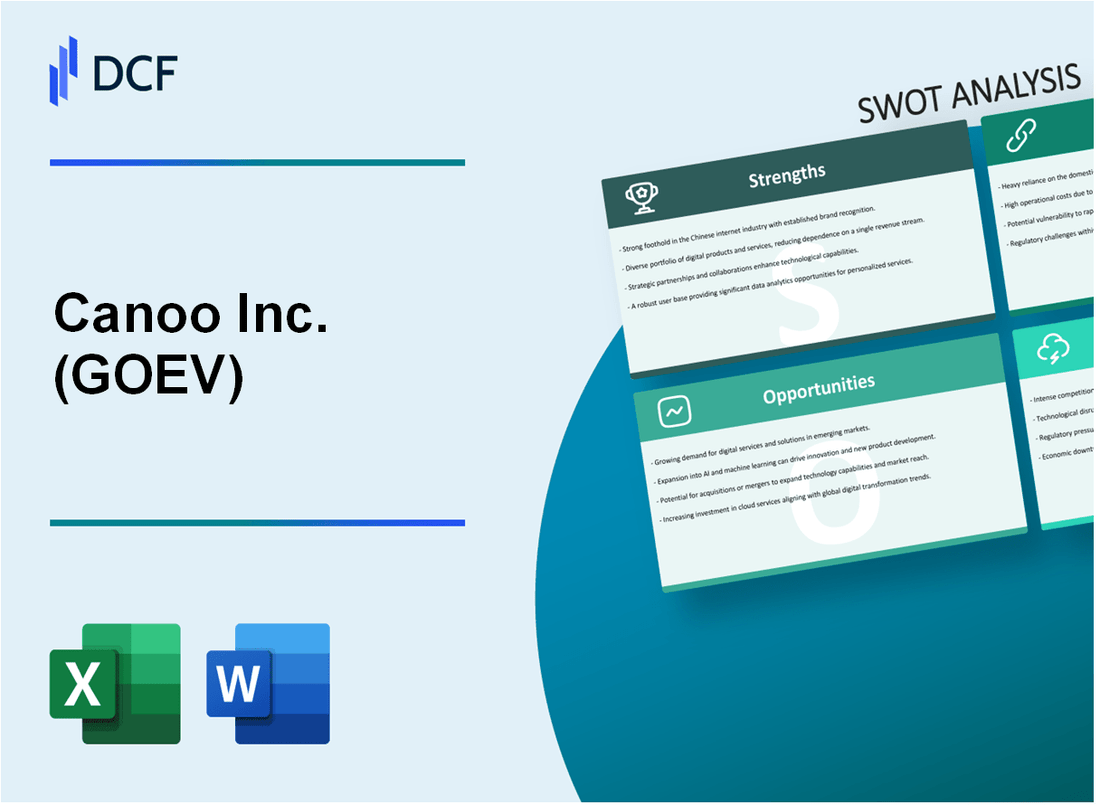
CANOO INC. (GOEV): Análise SWOT [Jan-2025 Atualizada] |
Totalmente Editável: Adapte-Se Às Suas Necessidades No Excel Ou Planilhas
Design Profissional: Modelos Confiáveis E Padrão Da Indústria
Pré-Construídos Para Uso Rápido E Eficiente
Compatível com MAC/PC, totalmente desbloqueado
Não É Necessária Experiência; Fácil De Seguir
Canoo Inc. (GOEV) Bundle
Na paisagem de veículos elétricos em rápida evolução, a CANOO Inc. (Goev) surge como um inovador ousado, desafiando os paradigmas automotivos tradicionais com sua revolucionária plataforma EV modular EV e abordagem exclusiva do design de veículos. À medida que a empresa navega pelo complexo terreno de soluções emergentes de mobilidade, essa análise abrangente do SWOT revela o posicionamento estratégico, os possíveis desafios e as oportunidades transformadoras que definem a ambiciosa jornada de Canoo na jornada no 2024 ecossistema automotivo.
CANOO INC. (GOEV) - Análise SWOT: Pontos fortes
Design de plataforma de veículo elétrico inovador (EV)
A plataforma de skate modular proprietária da Canoo permite configurações flexíveis de veículos com as seguintes especificações principais:
| Especificação da plataforma | Detalhes técnicos |
|---|---|
| Faixa de bateria | 250-350 milhas por carga |
| Adaptabilidade da plataforma | Pode suportar vários tipos de veículos e classes de peso |
| Flexibilidade de fabricação | Permite iterações rápidas de design e produção |
Foco de veículo elétrico comercial e de estilo de vida
O portfólio de veículos exclusivo do CANOO tem como alvo segmentos de mercado específicos:
- Van de estilo de vida: projetado para mobilidade urbana e uso pessoal
- Caminhão de coleta: veículo utilitário elétrico com Faixa estimada de 200 milhas
- Veículo de entrega multiuso (MPDV): direcionado a serviços de entrega de última milha
Tecnologia avançada de plataforma de skateboard
Os recursos da plataforma incluem:
| Recurso de tecnologia | Métrica de desempenho |
|---|---|
| Integração do trem de força elétrica | Até 600 cavalos de potência |
| Velocidade de carregamento | Capacidade de carregamento rápido de 350 kW DC |
| Peso da plataforma | Aproximadamente 400-500 libras |
Parcerias estratégicas
Colaborações significativas a partir de 2024:
- Walmart: Contrato para 4.500 veículos de entrega elétrica
- Hyundai Motor Group: Colaboração de Tecnologia e Design
- ZEEKR: Parceria de fabricação para produção global de EV
Abordagem de fabricação flexível
Estratégia de fabricação Destaques:
| Parâmetro de fabricação | Detalhe |
|---|---|
| Modelo de produção | Manufatura contratada com vários parceiros globais |
| Capacidade anual estimada | Até 30.000 veículos por ano |
| Locais de fabricação | Estados Unidos e Ásia |
CANOO INC. (GOEV) - Análise SWOT: Fraquezas
Histórico de produção limitado e números baixos de entrega de veículos
A partir do quarto trimestre 2023, o CANOO relatou entregas totais de veículos de apenas 53 unidades. Os volumes de produção da empresa permanecem extremamente baixos em comparação com os fabricantes estabelecidos de EV.
| Métrica | Valor |
|---|---|
| Total de entregas de veículos (Q4 2023) | 53 unidades |
| Capacidade de produção anual projetada | 3.000 unidades |
Desafios financeiros significativos e restrições contínuas de fluxo de caixa
A situação financeira do CANOO permanece precária, com queima de caixa em andamento substancial e geração de receita limitada.
| Métrica financeira | Quantia |
|---|---|
| Perda líquida (2023 ano inteiro) | US $ 228,4 milhões |
| Caixa e equivalentes em dinheiro (Q4 2023) | US $ 96,4 milhões |
| Taxa de queima de caixa operacional | Aproximadamente US $ 60 milhões por trimestre |
Presença de mercado relativamente pequena
O CANOO enfrenta desafios significativos no estabelecimento de participação de mercado dentro do cenário competitivo de EV.
- Capitalização de mercado de aproximadamente US $ 171 milhões (em fevereiro de 2024)
- Penetração mínima de mercado em comparação com Tesla, Ford e outros fabricantes de EV
- Distribuição geográfica limitada de veículos
Falta de reconhecimento generalizado da marca
A empresa luta com a conscientização da marca extremamente baixa no mercado automotivo.
- Orçamento de marketing limitado de aproximadamente US $ 5,2 milhões em 2023
- Reconhecimento mínimo do consumidor em comparação com marcas automotivas estabelecidas
- Nenhuma fidelidade de marca significativa estabelecida
Perdas líquidas contínuas e dependência de financiamento externo
O CANOO permanece fortemente dependente de fontes de financiamento externas para sustentar operações.
| Métrica de financiamento | Valor |
|---|---|
| Perdas líquidas cumulativas (2020-2023) | US $ 689,6 milhões |
| Financiamento externo levantado | Mais de US $ 500 milhões através de várias ofertas de ações |
| Financiamento da dívida | Instalação de dívida conversível de US $ 50 milhões |
CANOO Inc. (Goev) - Análise SWOT: Oportunidades
Demanda crescente por veículos comerciais elétricos e soluções de entrega de última milha
O mercado global de veículos comerciais elétricos deve atingir US $ 678,2 bilhões até 2027, com um CAGR de 24,7%. A plataforma modular do CANOO o posiciona para capturar um segmento desse mercado em expansão.
| Segmento de mercado | Tamanho do mercado projetado até 2027 | Cagr |
|---|---|---|
| Veículos comerciais elétricos | US $ 678,2 bilhões | 24.7% |
| Veículos de entrega de última milha | US $ 108,3 bilhões | 19.5% |
Expandindo o mercado para veículos de estilo de vida elétrico e modelos de mobilidade baseados em assinatura
O mercado de assinaturas de veículos elétricos deve crescer para US $ 16,7 bilhões até 2026, com um CAGR de 31,2%.
- Taxa de crescimento de mercado de mobilidade baseada em assinatura: 31,2%
- Tamanho do mercado projetado até 2026: US $ 16,7 bilhões
- Demografia-alvo: Millennials urbanos e consumidores com experiência em tecnologia
Potenciais incentivos governamentais para fabricação de veículos elétricos
A Lei de Redução de Inflação fornece incentivos significativos para os fabricantes de veículos elétricos:
| Tipo de incentivo | Valor | Condições |
|---|---|---|
| Crédito tributário de fabricação | Até US $ 7.500 por veículo | Requisitos de produção doméstica |
| Crédito de produção de bateria | US $ 35 por kWh | Fabricação de baterias domésticas |
Aumento do interesse corporativo em soluções de transporte sustentável
A eletrificação da frota corporativa está se acelerando, com 54% das empresas planejando fazer a transição para veículos elétricos até 2025.
- Intenção de eletrificação da frota corporativa: 54%
- Adoção esperada de veículos elétricos até 2025
- Mercado potencial para veículos elétricos comerciais
Mercados emergentes para plataformas especializadas de veículos elétricos
Os mercados especializados de veículos elétricos mostram potencial de crescimento significativo:
| Mercado especializado | Tamanho do mercado projetado até 2030 | Cagr |
|---|---|---|
| Veículos de entrega autônomos | US $ 212,5 bilhões | 33.8% |
| Veículos utilitários especializados | US $ 87,4 bilhões | 22.6% |
CANOO INC. (GOEV) - Análise SWOT: Ameaças
Concorrência intensa no mercado de veículos elétricos
A partir de 2024, o CANOO enfrenta uma pressão competitiva significativa dos principais fabricantes automotivos:
| Concorrente | Participação no mercado de EV 2023 | Produção anual de EV |
|---|---|---|
| Tesla | 20.1% | 1,8 milhão de unidades |
| Byd | 17.6% | 3,0 milhões de unidades |
| Grupo Volkswagen | 11.3% | 1,2 milhão de unidades |
| Ford | 5.7% | 270.000 unidades |
Desafios da paisagem tecnológica
Principais indicadores de interrupção tecnológica:
- Investimento global de tecnologia de bateria EV: US $ 62,4 bilhões em 2023
- Gastos médios de P&D por EV Fabricante: US $ 1,3 bilhão anualmente
- Crescimento do mercado de baterias de estado sólido projetado: 37,4% CAGR até 2030
Interrupções da cadeia de suprimentos
Impacto de escassez de semicondutores:
| Ano | Impacto global de escassez de semicondutores | Perda de receita estimada |
|---|---|---|
| 2022 | US $ 510 bilhões | US $ 210 bilhões |
| 2023 | US $ 380 bilhões | US $ 150 bilhões |
Riscos de desaceleração econômica
Indicadores econômicos que afetam investimentos automotivos:
- Declínio global de investimento automotivo: 12,6% em 2023
- Volatilidade do investimento de mercado EV: 15-20% de flutuações trimestrais
- Redução de financiamento de capital de risco EV: US $ 22,3 bilhões em 2023
Desafios de conformidade regulatória
Custos e requisitos de conformidade regulatórios:
| Região | Custo de conformidade | Padrões de emissão |
|---|---|---|
| Estados Unidos | US $ 1,2 milhão por modelo | 50 g CO2/km até 2030 |
| União Europeia | US $ 1,5 milhão por modelo | 0 g CO2/km até 2035 |
| China | US $ 900.000 por modelo | 40 g CO2/km até 2027 |
Canoo Inc. (GOEV) - SWOT Analysis: Opportunities
You're looking at the potential upside for Canoo Inc. right now, and honestly, the biggest wins are tied to converting existing interest into massive, repeatable revenue streams. The opportunity set centers on scaling production to meet the demand already signaled by major partners and leveraging that proven platform across new sectors.
Fulfilling the large-scale Walmart order (up to 10,000 units) would validate production and revenue
That definitive agreement with Walmart Inc. for 4,500 all-electric Lifestyle Delivery Vehicles (LDV), with the option for up to 10,000 units, remains the single most important validation point for Canoo Inc. If you can successfully deliver and integrate that full potential order, it proves you can handle the volume and quality required by a top-tier logistics operator. Remember, initial advanced deliveries to refine configuration began in the Dallas-Fort Worth metroplex back in 2022. The opportunity now is translating that pilot phase into consistent, high-volume deliveries throughout fiscal 2025. This isn't just about the revenue from those vehicles; it's about de-risking the entire business model in the eyes of future large-scale fleet buyers.
Securing further government/military contracts beyond the initial U.S. Army phase
The government sector shows real promise because they value the adaptability of your technology. You've already delivered a Light Tactical Vehicle (LTV) to the U.S. Army for demonstration, fulfilling a contract initially valued at $67,500. Plus, you secured a contract with the Defense Innovation Unit (DIU) for battery module analysis, following selection by NASA for Artemis crew transport vehicles. The opportunity here is moving from small demonstration contracts to multi-year procurement agreements. The military needs scalable, adaptable power solutions, and your modular platform is designed for that exact flexibility.
Here's a quick look at the concrete government/fleet interest:
| Customer/Agency | Known Engagement Type | Potential Scale Implication |
| Walmart Inc. | Definitive Purchase Agreement (Option up to 10,000 units) | Last-mile delivery volume validation |
| U.S. Army | LTV Delivery & Initial Contract ($67,500 value noted) | Tactical vehicle adaptation potential |
| Defense Innovation Unit (DIU) | Battery Module Contract | Proprietary component validation |
| NASA | Crew Transportation Vehicles | High-reliability, specialized application |
Expanding the B2B fleet market with the MPDV, capitalizing on EV transition mandates
Canoo Inc. has smartly pivoted to focus on fleet vehicles, which aligns perfectly with global and domestic mandates pushing for fleet electrification. Your Multi-Purpose Delivery Vehicle (MPDV) and the LDV are ideal for high-frequency, last-mile use cases where efficiency and cargo volume matter most. You've already built a backlog with key players like the U.S. Postal Service and international customers in the UK and Middle East. The opportunity in 2025 is capitalizing on the sheer size of the commercial EV market, which is hungry for purpose-built, right-sized vehicles that offer better total cost of ownership than retrofitted vans. If onboarding takes 14+ days, churn risk rises, so speed to market with reliable units is key here.
Potential for licensing the modular skateboard platform to other manufacturers
This is the long-term leverage play. The core strength of Canoo Inc. is its proprietary, flat, steer-by-wire skateboard platform, which houses the most critical components. This modularity allows for rapid development of diverse vehicle bodies with reduced R&D costs because the core engineering is done once. While a past collaboration with Hyundai Motor Group was noted for platform development, the current opportunity is proving the platform's flexibility across different applications-from delivery vans to potential autonomous delivery vehicles, as hinted at in past developments. The broader EV skateboard market is projected to reach $150 billion by 2035, and licensing a proven, functional platform is a high-margin way to tap into that growth without bearing all the manufacturing risk.
Finance: draft 13-week cash view by Friday.
Canoo Inc. (GOEV) - SWOT Analysis: Threats
You're looking at the landscape that ultimately proved too rough for Canoo Inc. to navigate. The biggest threat wasn't a single event; it was the convergence of intense market pressure and a critical lack of capital, which culminated in the company filing for Chapter 7 bankruptcy in January 2025. Let's break down the specific dangers that materialized.
Intense competition from established EV players and well-funded startups in the commercial space
The commercial EV segment is not a friendly place for newcomers, and Canoo Inc. faced giants. While you were focusing on your modular platform, established automakers like Ford Motor and General Motors, along with Tesla, were scaling up their own electric vans and trucks. The EV delivery van space, which was Canoo Inc.'s primary target, showed signs of cooling off, leaving fewer open spots for smaller players to capture significant market share. To be fair, the competition wasn't just about volume; it was about the deep pockets required to sustain the long, expensive road to mass production.
The challenge was clear:
- Facing legacy automakers with existing dealer networks.
- Competing against Tesla's charging infrastructure advantage.
- Navigating a market where smaller startups were already failing.
Risk of contract cancellation or reduction if production milestones are missed
Big fleet orders, like the ones with Walmart and NASA, are a lifeline, but they come with strings attached regarding delivery schedules. Canoo Inc. struggled to translate those initial orders into consistent, high-volume output. For the full year 2023, the company only completed 22 vehicles. This slow ramp-up meant that customers could easily look elsewhere, especially when facing their own operational deadlines. Missing production targets directly fed the cash burn problem because revenue wasn't coming in fast enough to cover the fixed costs of those large facilities in Texas and Oklahoma.
Ongoing 'going concern' risk, potentially leading to further stock dilution or bankruptcy
This was the specter hanging over every investor call. As of the third quarter of 2024, management explicitly stated that substantial doubt existed about the company's ability to continue as a going concern for the next twelve months. The math was brutal: the quarterly cash outflow in Q3 2024 was $31.3 million, yet cash and cash equivalents stood at only $1.5 million as of September 30, 2024. To bridge that gap, the company had to keep seeking capital, which almost always means issuing more shares-that's the dilution risk you wanted to avoid. When the attempts to secure new capital from foreign sources failed in late 2024/early 2025, this threat became reality with the Chapter 7 filing.
Supply chain volatility, especially for battery cells, impacting production costs and schedules
Even with the strategic shift to source over 90% of parts from the U.S. or allied nations by the end of 2022, supply chain issues remained a headache. In the Q3 2024 reports, management noted that supply chain disruptions could impede production capabilities. For an EV maker, battery cells are the single most critical, expensive, and often constrained component. Any hiccup here doesn't just delay a vehicle; it stops the entire assembly line, turning a planned production run into an unplanned cash drain. The need to harmonize the supply chain was a stated focus, but it was a race against the clock and the dwindling bank balance.
Here's a snapshot of the financial pressure leading into the final quarter of 2024:
| Metric (As of Q3 2024 End) | Value | Context |
| Cash & Equivalents | $1.5 million | Critically low cash position |
| Quarterly Cash Outflow (Q3 2024) | $31.3 million | Burn rate far exceeding available cash |
| Projected Q4 2024 Cash Outflow | $30 million to $40 million | Expected continued high burn |
| Annualized Savings from Consolidation | $12 million - $14 million | Cost-cutting efforts were significant but insufficient |
Finance: draft a memo detailing the cash runway based on the Q3 burn rate and the projected Q4 burn rate, assuming zero new financing, due by Friday.
Disclaimer
All information, articles, and product details provided on this website are for general informational and educational purposes only. We do not claim any ownership over, nor do we intend to infringe upon, any trademarks, copyrights, logos, brand names, or other intellectual property mentioned or depicted on this site. Such intellectual property remains the property of its respective owners, and any references here are made solely for identification or informational purposes, without implying any affiliation, endorsement, or partnership.
We make no representations or warranties, express or implied, regarding the accuracy, completeness, or suitability of any content or products presented. Nothing on this website should be construed as legal, tax, investment, financial, medical, or other professional advice. In addition, no part of this site—including articles or product references—constitutes a solicitation, recommendation, endorsement, advertisement, or offer to buy or sell any securities, franchises, or other financial instruments, particularly in jurisdictions where such activity would be unlawful.
All content is of a general nature and may not address the specific circumstances of any individual or entity. It is not a substitute for professional advice or services. Any actions you take based on the information provided here are strictly at your own risk. You accept full responsibility for any decisions or outcomes arising from your use of this website and agree to release us from any liability in connection with your use of, or reliance upon, the content or products found herein.