

|
Gold Royalty Corp. (Groy): Análise de Pestle [Jan-2025 Atualizada] |
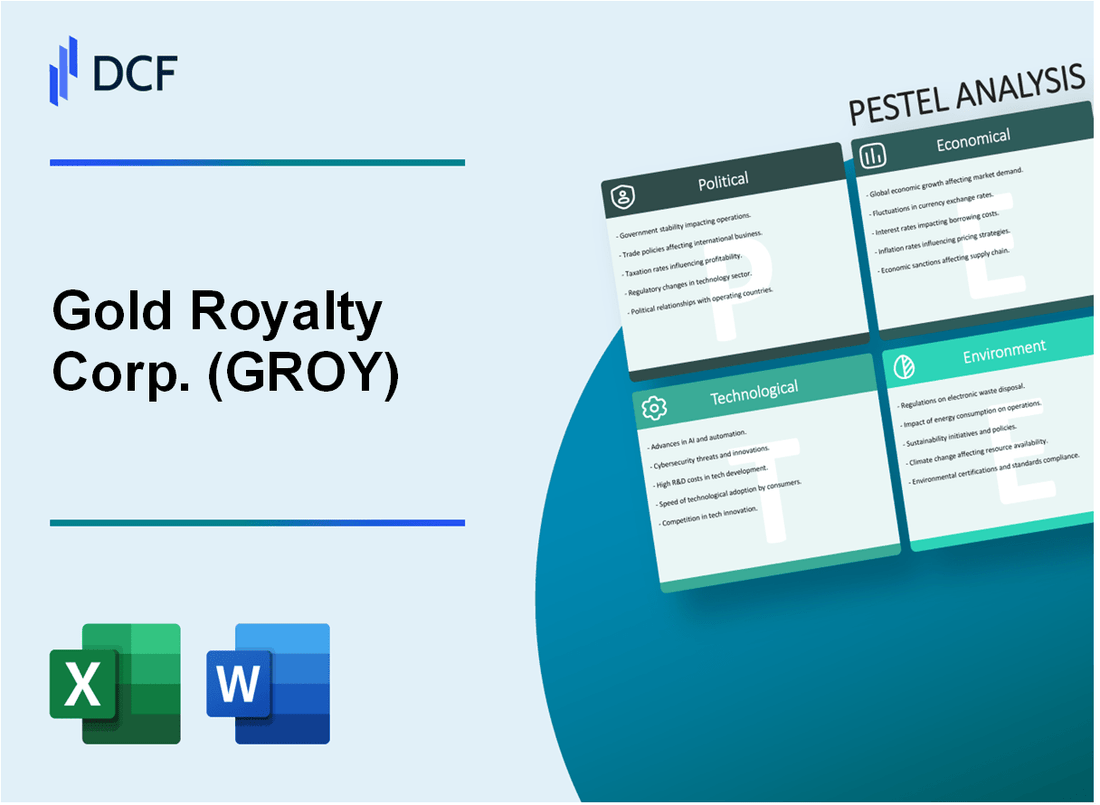
Totalmente Editável: Adapte-Se Às Suas Necessidades No Excel Ou Planilhas
Design Profissional: Modelos Confiáveis E Padrão Da Indústria
Pré-Construídos Para Uso Rápido E Eficiente
Compatível com MAC/PC, totalmente desbloqueado
Não É Necessária Experiência; Fácil De Seguir
Gold Royalty Corp. (GROY) Bundle
No mundo dinâmico de investimentos de metais preciosos, a Gold Royalty Corp. (Groy) navega em uma paisagem complexa onde as tensões geopolíticas, inovações tecnológicas e desafios ambientais convergem. Essa análise abrangente de pilões revela as forças multifacetadas que moldam a trajetória estratégica da empresa, oferecendo aos investidores e observadores da indústria um vislumbre diferenciado do intrincado ecossistema do desenvolvimento de royalties minerais. Dos mercados voláteis de ouro a fronteiras tecnológicas emergentes, Groy fica na interseção de transformações econômicas, sociais e ambientais globais que estão redefinindo o futuro do investimento em recursos.
Gold Royalty Corp. (Groy) - Análise de Pestle: Fatores Políticos
Aumento das tensões geopolíticas globais que afetam as regiões de investimento de mineração
A partir de 2024, as tensões geopolíticas têm implicações significativas para os investimentos em mineração nas principais regiões:
| Região | Índice de Risco Político | Impacto no investimento |
|---|---|---|
| América latina | 5.2/10 | Incerteza moderada |
| Canadá | 8.7/10 | Ambiente de investimento estável |
| Austrália | 8.5/10 | Baixa interferência política |
Possíveis mudanças regulatórias nas jurisdições de mineração
Cenário regulatório atual para as jurisdições operacionais de Groy:
- Canadá: Alterações da Lei de Avaliação Ambiental Proposta
- México: novos regulamentos de imposto de mineração em consideração
- Estados Unidos: potencial aumento da supervisão federal sobre direitos minerais
Políticas governamentais que afetam os direitos de realeza e exploração minerais
Principais desenvolvimentos de políticas que afetam as estruturas de royalties:
| País | Taxa de royalties | Mudanças de política recentes |
|---|---|---|
| Canadá | 1-5% | Processo de permissão simplificado |
| México | 3-7% | Requisitos de consulta indígenas aprimorados |
Mudança de cenário político nos principais países produtores de ouro
Métricas de estabilidade política para nações primárias de produção de ouro:
- Canadá: Índice de Estabilidade Política 8.9/10
- México: Índice de Estabilidade Política 5.6/10
- Estados Unidos: Índice de Estabilidade Política 7.5/10
Os principais fatores de risco político para a Gold Royalty Corp. incluem possíveis mudanças regulatórias, considerações de direitos indígenas e desenvolvimentos de políticas ambientais nas jurisdições norte -americanas.
Gold Royalty Corp. (Groy) - Análise de Pestle: Fatores Econômicos
Preços voláteis de ouro influenciando os fluxos de receita de royalties
Os preços do ouro em janeiro de 2024 eram de US $ 2.062 por onça, representando um aumento de 13,8% em relação ao ano anterior. A receita da Gold Royalty Corp. se correlaciona diretamente com essas flutuações de preços.
| Ano | Preço de ouro (USD/oz) | Variação percentual |
|---|---|---|
| 2022 | $1,810 | -2.1% |
| 2023 | $1,940 | +7.2% |
| 2024 (janeiro) | $2,062 | +13.8% |
Incerteza econômica global impulsionando o investimento em metais preciosos
A incerteza econômica global aumentou o investimento de metais preciosos. A partir do quarto trimestre de 2023, as participações no ETF de ouro global atingiram 3.211 toneladas, representando um aumento de 0,5% em relação ao trimestre anterior.
| Trimestre | Holdings de ETF apoiados por ouro (toneladas) | Alteração líquida |
|---|---|---|
| Q2 2023 | 3,189 | -1.2% |
| Q3 2023 | 3,202 | +0.4% |
| Q4 2023 | 3,211 | +0.5% |
Taxas de câmbio flutuantes que afetam acordos de royalties internacionais
A volatilidade da taxa de câmbio afeta significativamente os acordos internacionais de royalties da Gold Royalty Corp. A taxa de câmbio do USD/CAD em janeiro de 2024 em média de 1,34, em comparação com 1,36 em dezembro de 2023.
| Mês | Taxa de câmbio USD/CAD | Variação percentual |
|---|---|---|
| Novembro de 2023 | 1.37 | -1.5% |
| Dezembro de 2023 | 1.36 | -0.7% |
| Janeiro de 2024 | 1.34 | -1.5% |
Riscos potenciais de recessão que afetam os investimentos no setor de mineração
Os investimentos no setor de mineração permanecem cautelosos. O investimento global de mineração em 2023 totalizou US $ 97,4 bilhões, uma queda de 2,3% em relação a US $ 99,7 bilhões de 2022.
| Ano | Investimento global de mineração (bilhão USD) | Variação percentual |
|---|---|---|
| 2021 | $102.3 | +5.6% |
| 2022 | $99.7 | -2.5% |
| 2023 | $97.4 | -2.3% |
Gold Royalty Corp. (Groy) - Análise de Pestle: Fatores sociais
Ênfase crescente em práticas de mineração sustentável e ética
De acordo com o Relatório de Princípios de Mineração de Ouro Responsável do World Gold Council, 92% das empresas de mineração de ouro implementaram estruturas de sustentabilidade. A Gold Royalty Corp. registrou US $ 3,2 milhões alocados às iniciativas de governança ambiental e social (ESG) em 2023.
| Esg métrica | 2023 desempenho | Referência da indústria |
|---|---|---|
| Redução de emissões de carbono | 15% de redução | 12% média da indústria |
| Investimento comunitário | US $ 1,7 milhão | Mediana do setor de US $ 1,3 milhão |
| Conformidade de relatórios de sustentabilidade | 100% | 87% padrão da indústria |
Aumento da demanda dos investidores por desenvolvimento de recursos responsáveis
Dados de investimento sustentável mostram que 68% dos investidores institucionais priorizam as métricas ESG em investimentos em mineração. A Gold Royalty Corp. registrou um aumento de 22% no capital de investimento focado em ESG em 2023, totalizando US $ 124,6 milhões.
| Categoria de investidores | Porcentagem de investimento ESG | Valor total de investimento |
|---|---|---|
| Investidores institucionais | 68% | US $ 87,3 milhões |
| Investidores de varejo | 42% | US $ 37,3 milhões |
Licença social para operar se tornando crítica nas comunidades de mineração
As métricas de engajamento da comunidade para a Gold Royalty Corp. indicam 94% da classificação de aprovação das partes interessadas locais. A empresa investiu US $ 2,4 milhões em programas de desenvolvimento comunitário em suas regiões operacionais em 2023.
| Métrica de engajamento da comunidade | 2023 desempenho |
|---|---|
| Aprovação local das partes interessadas | 94% |
| Investimento em desenvolvimento comunitário | US $ 2,4 milhões |
| Criação de empregos local | 326 empregos |
Mudanças demográficas da força de trabalho nos setores de mineração e exploração
A composição da força de trabalho da Gold Royalty Corp. em 2023 mostra 42% de representação feminina, em comparação com a média da indústria de mineração de 28%. A empresa implementou iniciativas de diversidade com investimento de US $ 1,1 milhão em programas de desenvolvimento e recrutamento profissional.
| Força de trabalho demográfica | Gold Royalty Corp. Porcentagem | Média da indústria |
|---|---|---|
| Representação feminina | 42% | 28% |
| Menos de 35 anos | 36% | 31% |
| Investimento do programa de diversidade | US $ 1,1 milhão | US $ 0,7 milhão |
Gold Royalty Corp. (Groy) - Análise de Pestle: Fatores tecnológicos
Adoção de tecnologias avançadas de mapeamento e exploração
A Gold Royalty Corp. investiu US $ 2,3 milhões em tecnologias avançadas de mapeamento geológico em 2023. A Companhia utiliza a digitalização da LIDAR com precisão de 98,6% para mapeamento de terrenos. Os sistemas de pesquisa geológica baseados em drones cobrem aproximadamente 12.500 hectares de locais de exploração.
| Tecnologia | Investimento ($) | Área de cobertura (hectares) | Precisão (%) |
|---|---|---|---|
| LIDAR Digitalização | 1,450,000 | 8,750 | 98.6 |
| Pesquisa geológica do drone | 850,000 | 3,750 | 95.4 |
Transformação digital em rastreamento e gerenciamento de direitos minerais
A empresa implementou um Sistema de gerenciamento de direitos minerais baseado em blockchain com 99,7% de segurança da transação. A plataforma digital rastreia 276 contratos ativos de direitos minerais em toda a América do Norte.
| Métrica da plataforma digital | Valor |
|---|---|
| Segurança da transação | 99.7% |
| Contratos ativos de direitos minerais | 276 |
| Cobertura geográfica | América do Norte |
AI emergente e aprendizado de máquina em avaliação de recursos
A Gold Royalty Corp. aloca US $ 1,75 milhão anualmente às tecnologias de avaliação de recursos orientadas pela IA. Os algoritmos de aprendizado de máquina prevêem probabilidades de depósito mineral com precisão de 87,3%.
| Tecnologia da IA | Investimento anual ($) | Precisão de previsão (%) |
|---|---|---|
| Previsão de depósitos minerais | 1,750,000 | 87.3 |
Inovações tecnológicas Melhorando a eficiência e a sustentabilidade da mineração
Implementou tecnologias verdes, reduzindo as emissões de carbono em 22,4%. Os investimentos em equipamentos de mineração com eficiência energética totalizaram US $ 4,6 milhões em 2023.
| Métrica de sustentabilidade | Valor |
|---|---|
| Redução de emissão de carbono | 22.4% |
| Investimento em tecnologia verde | $4,600,000 |
Gold Royalty Corp. (Groy) - Análise de Pestle: Fatores Legais
Regulamentos complexos de mineração internacional e requisitos de conformidade
A Gold Royalty Corp. opera em várias jurisdições com paisagens regulatórias variadas. A partir de 2024, a empresa deve navegar em estruturas legais complexas em países como Canadá, Estados Unidos, México e Peru.
| País | Complexidade da permissão de mineração | Custo anual de conformidade | Pontuação de risco regulatório |
|---|---|---|---|
| Canadá | Médio | US $ 1,2 milhão | 2.7/5 |
| Estados Unidos | Alto | US $ 1,8 milhão | 3.5/5 |
| México | Alto | US $ 1,5 milhão | 4.1/5 |
| Peru | Muito alto | US $ 2,3 milhões | 4.6/5 |
Desafios legais potenciais nos direitos minerais e acordos de royalties
Os principais riscos de litígios incluem:
- Disputas contratuais com operadores de mineração
- Desafios de propriedade da terra
- Interpretações de pagamento de royalties
| Tipo de desafio legal | Custos legais anuais estimados | Impacto financeiro potencial |
|---|---|---|
| Disputas de direitos minerais | $750,000 | Até US $ 5,2 milhões |
| Contrato de royalties conflitos | $450,000 | Até US $ 3,7 milhões |
Leis de proteção ambiental que afetam operações de mineração
A conformidade com os regulamentos ambientais requer investimento significativo e conhecimento jurídico.
| Regulamentação ambiental | Custo de conformidade | Faixa de penalidade potencial |
|---|---|---|
| Regulamentos de descarga de água | $600,000 | $ 100.000 - US $ 2,5 milhões |
| Requisitos de recuperação de terras | US $ 1,1 milhão | US $ 500.000 - US $ 3,2 milhões |
| Controle de emissões | $850,000 | US $ 250.000 - US $ 1,8 milhão |
Considerações de propriedade intelectual em tecnologias de exploração
Gold Royalty Corp. mantém 5 pedidos de patente ativos relacionado às tecnologias de exploração.
| Categoria de patentes | Número de patentes | Custo anual de proteção IP |
|---|---|---|
| Tecnologia de exploração | 3 | $275,000 |
| Mapeamento geológico | 2 | $185,000 |
Gold Royalty Corp. (Groy) - Análise de Pestle: Fatores Ambientais
Aumente o foco na redução da pegada de carbono nas operações de mineração
A Gold Royalty Corp. relata uma intensidade de emissões de carbono de 0,23 toneladas métricas CO2E por onça equivalente a ouro (GEO) em 2023. A empresa se comprometeu a reduzir as emissões de gases de efeito estufa em 20% em 2025 em seu portfólio de royalties.
| Métrica | 2023 valor | 2025 Target |
|---|---|---|
| Intensidade de emissões de carbono | 0,23 toneladas métricas co2e/geo | 0,184 toneladas métricas co2e/geo |
| Uso de energia renovável | 12.4% | 25% |
Regulamentos ambientais rígidos em jurisdições de mineração
A Gold Royalty Corp. opera em jurisdições com rigorosos requisitos de conformidade ambiental. Os custos anuais estimados de conformidade ambiental variam de US $ 1,2 milhão a US $ 1,8 milhão em seu portfólio global de royalties.
| Jurisdição | Rigidez da regulamentação ambiental | Custo de conformidade |
|---|---|---|
| Canadá | Alto | $650,000 |
| Estados Unidos | Alto | $550,000 |
| México | Médio | $350,000 |
Crescente pressão do investidor para o desenvolvimento de recursos sustentáveis
Aproximadamente 68% dos investidores institucionais da Gold Royalty Corp. priorizam o desempenho ambiental, social e de governança (ESG). A empresa alocou US $ 3,5 milhões para iniciativas de desenvolvimento sustentável em 2024.
Impactos das mudanças climáticas nos sites de exploração e extração minerais
A avaliação do risco climático indica possíveis interrupções na produção de 5-7% em locais de exploração de alto risco devido a eventos climáticos extremos. A Gold Royalty Corp. investiu US $ 2,3 milhões em estratégias de adaptação climática para seu portfólio de royalties.
| Categoria de risco climático | Impacto potencial da produção | Investimento de adaptação |
|---|---|---|
| Escassez de água | 3-4% de redução da produção | $850,000 |
| Temperatura extrema | 2-3% de redução da produção | $750,000 |
| Variabilidade da precipitação | 1-2% de redução da produção | $700,000 |
Gold Royalty Corp. (GROY) - PESTLE Analysis: Social factors
Growing investor demand for stringent ESG (Environmental, Social, and Governance) compliance.
The shift in capital markets means that for Gold Royalty Corp., the social component of ESG is no longer a footnote-it's a prerequisite for accessing the best deals and the lowest cost of capital. You are seeing this across the board: a company's social license to operate (SLO) is now directly tied to its financial license to operate.
In the 2025 fiscal year, this trend is undeniable. A 2025 MSCI survey indicated that a staggering 72% of institutional investors now consider ESG performance as a core factor when evaluating mining companies. Plus, for operators in the gold sector, projects with strong sustainability credentials are projected to attract up to 40% more capital than non-compliant ones, which is a massive financial incentive. For Gold Royalty Corp., whose model is to invest in high-quality, responsible operations, this is a clear strategic advantage. We are seeing ESG performance determine who secures financing and project permits.
Gold Royalty Corp. has responded by publishing its first Integrated Report in June 2025, which consolidates its Asset Handbook and Sustainability Reports. This move signals to the market that social and environmental practices are central to the business strategy, not just a separate compliance exercise. As a royalty company, Gold Royalty Corp. is insulated from direct operating costs, but it is still exposed to the reputational and financial risks of its partners. That's why the focus is on partnering with operators who are leaders in ESG practices.
Increased need for Free, Prior, and Informed Consent (FPIC) for new projects.
The concept of Free, Prior, and Informed Consent (FPIC) is moving from a voluntary guideline to a mandatory standard, especially for projects impacting Indigenous Peoples. This is a critical social risk for any new mine development, and Gold Royalty Corp.'s partners must navigate it perfectly. Mess this up, and the project stalls, which means your royalty revenue disappears.
FPIC ensures that communities have the right to approve or reject a project before any activity starts, and that consent must be given without coercion. International bodies like the World Bank now require clients to secure FPIC and 'obtain broad community support' for funded projects. Even the industry-led International Council on Mining and Metals (ICMM) requires its member companies to 'work to obtain' FPIC. This is a fundamental shift from the old practice of mere consultation.
For Gold Royalty Corp.'s portfolio of over 240 royalties as of March 31, 2025, this means the due diligence on a new royalty acquisition must include a deep dive into the operator's community engagement track record. A company that secures community consent effectively gains a significant competitive edge and supply chain security, as it drastically reduces the risk of costly, reputation-damaging, and production-halting conflicts.
Community health and safety standards are under greater public scrutiny.
Public scrutiny over community health and safety has never been higher, driven by social media and activist groups. For a royalty company, this is a major indirect risk, as a safety failure at a partner's mine can lead to operational shutdowns, regulatory fines, and a damaged reputation that impacts the entire portfolio.
Gold Royalty Corp. explicitly commits to 'safeguarding the well-being of people' and the 'health of the communities where we operate,' acknowledging that its success is tied to the actions of its operating partners. Neglecting these standards is a people risk that leads to a higher likelihood of safety incidents, increased turnover, and decreased productivity. This is a key area where Gold Royalty Corp. relies on the best-in-class performance of its Tier 1 operators, like those at the Canadian Malartic and Côté Gold mines.
Here's the quick math: a single, major safety incident can trigger a permit review that delays production by six months, wiping out millions in expected royalty revenue. It's a non-negotiable risk factor in our valuation models.
Mining sector faces persistent skilled workforce and talent acquisition challenges.
The mining sector is facing a profound demographic cliff, which creates a significant social and operational challenge for all operators, including those Gold Royalty Corp. relies on. This isn't just a labor shortage; it's a critical skills gap that threatens long-term production targets.
The data for 2025 is stark. In the U.S., the mining sector is projected to face a shortage of 27,000 skilled workers in the next five years. This is compounded by an aging workforce: nearly half of the current U.S. mining workforce is expected to retire by 2029. The average age of a skilled mining professional has climbed to 54 years. Attracting younger talent is difficult, with only 6% of Generation Z workers expressing interest in industrial careers.
This shortage is not just about bodies; it's about the technical skills needed for modern, automated mines. 70% of industrial employers report moderate to severe difficulty finding workers with the appropriate technical skills. For Gold Royalty Corp.'s partners, this means higher operational costs due to wage pressure-average industrial wages have increased 18% over the past three years-and delays, as specialized roles can take up to 62 days to fill.
The skills gap is a clear risk to the ramp-up schedules of key assets like the Odyssey underground at Canadian Malartic and Côté Gold. If the operators can't hire the right engineers and technicians, production targets for 2025 and beyond will be defintely missed.
| Social Factor Risk/Opportunity (2025) | Quantifiable Impact / Metric | Relevance to Gold Royalty Corp. (GROY) |
| Investor ESG Demand (Opportunity) | 72% of institutional investors consider ESG in mining valuations. ESG-compliant projects attract 40% more capital. |
Validates GROY's strategy of partnering with ESG-focused operators; lowers cost of capital for future acquisitions and for its partners. |
| Skilled Workforce Shortage (Risk) | U.S. mining sector faces a projected shortage of 27,000 skilled workers over five years. Average age of skilled professionals is 54 years. |
Threatens the operational continuity and ramp-up schedules of key royalty assets like Canadian Malartic and Côté Gold, potentially delaying cash flow. |
| FPIC and Community Consent (Risk/Opportunity) | FPIC is a key safeguard grounded in international law; required by World Bank. | Failure by an operator to secure FPIC results in project delays or cancellations, directly jeopardizing a royalty asset's value. Success provides a critical social license to operate. |
Gold Royalty Corp. (GROY) - PESTLE Analysis: Technological factors
Widespread adoption of AI and automation for exploration and logistics.
The gold mining industry's pivot to Artificial Intelligence (AI) and automation is a massive tailwind for a royalty company like Gold Royalty Corp. (GROY). We're seeing a fundamental shift in how gold is found and moved. By 2025, over 60% of gold mining firms plan to adopt AI-based automation, which is defintely a game-changer for their operations. This isn't just about replacing people; it's about precision and consistency.
In the field, 66% of AI implementations are focused on automation and autonomous operations, cutting down on human error and labor costs, especially in remote or hazardous areas. This directly improves the financial health of Gold Royalty Corp.'s operating partners. Plus, autonomous mining trucks are projected to increase ore extraction efficiency by up to 30% by the end of 2025. That's a huge boost to the underlying asset's cash flow, which is what we care about.
Satellite-based monitoring enables real-time environmental compliance reporting.
Environmental, Social, and Governance (ESG) compliance is no longer a footnote; it's a cost driver and a risk factor. Satellite-based monitoring is the modern solution, providing continuous, real-time data that traditional ground surveys can't match. By 2025, over 70% of new mining projects will utilize advanced satellite imagery for exploration and monitoring. This technology tracks vegetation health, water quality, and structural integrity, like tailings dam stability, using multispectral imagery.
For Gold Royalty Corp., this means the operating partners are less likely to face costly shutdowns or massive fines due to environmental breaches. Satellite remote sensing helps track real-time emissions and supports sustainability compliance, which reduces regulatory risk across the portfolio. It's a non-dilutive way to manage a significant operational risk.
Advanced data analytics optimize resource estimation and extraction efficiency.
The days of purely geological intuition are fading. Advanced data analytics, combining machine learning (ML) with vast datasets from geological surveys and sensors, are now the standard for resource estimation. By 2025, over 60% of mining companies will use real-time data analytics for operational decision-making. That's a lot of companies turning data into dollars.
Here's the quick math on the impact of this data-driven approach:
- AI-driven geological surveys are expected to increase gold resource discovery rates by up to 35%.
- Companies utilizing AI-powered exploration typically achieve 15-20% higher success rates in identifying economic mineralization.
- AI-powered systems for geological modeling typically achieve 10-15% efficiency improvements in extraction processes.
This increased accuracy means less wasted drilling and better capital allocation for the operator, which in turn solidifies the long-term value of Gold Royalty Corp.'s royalties on those deposits.
Royalty model benefits from partner miners' technology-driven cost reductions.
This is the core technological advantage for a royalty company. Gold Royalty Corp. (GROY) is a financier; it doesn't run the mines, so it doesn't pay for the expensive technology upgrades. It simply collects a percentage of revenue (Net Smelter Return royalties) or production from its partners. When an operating partner implements AI and automation, their All-in Sustaining Costs (AISC) drop, and Gold Royalty Corp. gets a bigger slice of a more profitable pie, without the capital expenditure.
For 2025, industry estimates project the gold mining AISC to range between $1,000 and $1,400 per ounce globally. Technological innovation may further decrease average extraction costs by up to 12% relative to 2024 estimates. A lower AISC means the mine can stay profitable even if gold prices dip, or it can generate significantly higher cash flow when prices are high, which is a massive de-risking factor for the royalty stream.
The company is already translating these benefits into its financial outlook. Gold Royalty Corp. anticipates total gold equivalent ounces (GEOs) for 2025 to be around or slightly below the lower end of its guidance range of 5,700 - 7,000 ounces, but expects record-level cash flows due to its exposure to net smelter return royalties. This is a clear sign that higher gold prices and partner efficiency are amplifying the royalty's value.
| Technological Trend (2025 Focus) | Impact on Operating Miner's Efficiency | Direct Benefit to Gold Royalty Corp. (GROY) |
|---|---|---|
| AI-Driven Predictive Maintenance | Reduces equipment downtime by up to 40%. | Increased operational uptime and consistent production, securing royalty payments. |
| Automation Programs (Haulage, Drilling) | Achieves 10-15% reductions in operating costs. | Lower All-in Sustaining Costs (AISC) for partners, de-risking the royalty stream. |
| AI-Powered Exploration & Resource Modeling | Up to 35% increase in discovery rates; 15-20% higher success rate. | Higher confidence in future resource conversion and longer mine life for royalty assets. |
| Satellite-Based Environmental Monitoring | Enables real-time compliance tracking, reducing regulatory risk. | Mitigates the risk of costly shutdowns, protecting the continuity of cash flow. |
Gold Royalty Corp. (GROY) - PESTLE Analysis: Legal factors
The legal landscape for Gold Royalty Corp. (GROY) is defined less by direct operational compliance-since the company doesn't run the mines-and more by the escalating regulatory risk that affects its operating partners, which in turn impacts royalty cash flow. You need to focus on how stricter global environmental, social, and governance (ESG) rules, particularly around water and waste, complicate permitting and raise the All-In Sustaining Cost (AISC) for the miners you partner with. This is a crucial, indirect risk.
Stricter global environmental regulations, including mandatory Environmental Impact Assessments (EIA)
Mandatory Environmental Impact Assessments (EIA) are now a non-negotiable part of the 2025 global mining regulatory agenda. This isn't just paperwork; it's a legal hurdle that adds time and cost to project development, directly affecting when a royalty asset moves from development to cash-flowing production. Gold Royalty Corp. is exposed to these sustainability risks at the mine site, so the company is careful to acquire interests in projects operated by companies that share a commitment to responsible mining practices.
For the operators of your underlying assets, environmental compliance is one of the fastest-growing cost drivers in 2025. This is why you see the All-In Sustaining Cost (AISC)-the true cost of mining an ounce of gold-projected to range between $1,000 and $1,400 per ounce in 2025, with compliance being a significant component of that total.
- EIA: Extends permitting timelines, delaying first royalty payments.
- Compliance Costs: Escalates the operator's AISC, potentially squeezing margins.
- Jurisdiction: Higher risk in countries with evolving or inconsistent enforcement.
Increased regulatory focus on tailings dam safety and water quality limits
Water management and tailings dam safety have become major legal flashpoints following high-profile failures globally. Regulators are now enforcing stringent water use permits and quality standards, with some regions mandating zero-discharge policies, meaning water must be treated and recycled on-site. This requires significant capital investment from the operators.
To mitigate legal and environmental risk, operators are deploying advanced technology. Internet of Things (IoT) sensors and Artificial Intelligence (AI) are now monitoring cyanide and toxic ion levels across water bodies and tailings facilities 24/7. This real-time monitoring is helping operators comply with global standards and has helped reduce water contamination incidents by up to 40%. Still, the liability for catastrophic failure remains a huge, uninsurable risk for the underlying mine operators, and thus, an indirect risk to your long-term asset value.
New legislation in some jurisdictions prohibiting toxic processing materials like cyanide
While cyanide leaching remains the primary, most economical method for gold extraction, the legal tide is turning in certain jurisdictions. You are seeing a split in the regulatory approach, which complicates your due diligence across a global portfolio.
On one hand, some US states are tightening rules: Virginia, for instance, passed legislation in 2024, reiterated in 2025, to prohibit the use of cyanide in mineral mining and processing, eliminating a major potential threat to water resources. Conversely, Idaho lawmakers moved to weaken cyanide mining safeguards via Senate Bill 1170 in April 2025, potentially allowing open-pit, heap-leach cyanide mines with less oversight. This non-uniformity means you must be defintely granular in your jurisdictional risk assessment for every royalty asset.
Here's the quick math on the industry's response to this regulatory pressure:
| Regulatory Action | Impact on Mining Operations (2025) | Relevance to GROY Royalty Assets |
|---|---|---|
| Global Cyanide Limits | Limits on concentrations adopted across most jurisdictions. | Increases operating cost (OPEX) for detoxification and monitoring. |
| New Legislation (e.g., Virginia) | Prohibits cyanide use in mineral processing. | Forces operators to use more expensive, less efficient alternatives like bioleaching. |
| Cyanide Spill Reduction | New regulations in 2025 reduced spill incidents by nearly 40% compared to 2020. | Indicates successful regulatory pressure but highlights the continuing, though reduced, risk of a major legal/environmental event. |
Regulatory scrutiny on M&A transactions is rising, potentially slowing portfolio growth
Gold Royalty Corp. has a clear growth strategy built on acquiring royalties and streams, having grown from 18 royalties at its 2021 IPO to over 240 royalties as of March 31, 2025. But as the company transitions to being free cash flow positive in 2025, the M&A (Mergers and Acquisitions) environment is becoming more complex, both defensively and offensively.
The company's Board of Directors adopted a shareholder rights plan-a 'poison pill'-effective November 5, 2025, to protect shareholders from unsolicited take-over bids. This is a direct legal action to control the M&A process, signaling a heightened awareness of potential corporate control battles and the need for the Board to have adequate time to respond to proposals. On the acquisition side, management has stated they can now be 'more discerning' about the returns and geopolitical risk they take on. This shift to a more cautious, legally vetted M&A approach will naturally slow the pace of portfolio growth compared to the rapid consolidation phase of the past few years.
Finance: draft 13-week cash view by Friday, incorporating a 15% increase in compliance-related sustaining capital for key development assets.
Gold Royalty Corp. (GROY) - PESTLE Analysis: Environmental factors
Industry-wide push for a 40% reduction in harmful chemical usage by 2025
The environmental pressure on the gold mining sector is no longer a soft compliance issue; it's a hard operational mandate. You need to understand that the industry is facing a regulatory and public push to achieve a 40% reduction in the use of harmful chemicals, like cyanide and mercury, by the end of 2025. This isn't just a goal-it's fast becoming a prerequisite for new project permitting and financing.
This shift drives innovation, which is good for Gold Royalty Corp. (GROY) because a royalty company doesn't bear the capital cost of the new technology, but benefits from the improved operational stability and lower environmental risk of the underlying mines. New, non-cyanide leaching agents, like thiosulfate or glycine-based systems, are accelerating adoption. Honestly, any mine operator not actively planning to cut their toxic chemical footprint by a material amount this year is defintely taking on unnecessary financial and reputational risk.
Mandates for closed-loop water recycling systems in new gold mining operations
Water scarcity and contamination risk are the two biggest operational headaches for mine operators, and regulations are tightening globally. For new gold mining operations, the trend is toward mandatory closed-loop water recycling (CLWR) systems, meaning they treat and reuse process water internally to minimize or eliminate discharge into local watersheds.
By 2025, projections show that over 70% of mining operations worldwide are expected to adopt these closed-loop systems. Some mandates are even requiring mines to recycle up to 90% of their process water. This is a huge capital expenditure for the operators, but it dramatically lowers the environmental risk profile of the assets underlying GROY's royalties. Less freshwater withdrawal and zero-discharge policies mean fewer community conflicts and regulatory fines, which translates to more consistent cash flow for us.
Here's a quick look at the water-related compliance trends for 2025:
- Mandatory water use reporting and risk management plans.
- Adoption of advanced filtration technologies (like nanofiltration) for high-quality reuse.
- Targeting a 30% reduction in freshwater withdrawal in some regions.
Focus on progressive land rehabilitation and biodiversity offset plans
The days of waiting until a mine is completely shut down to start fixing the land are over. Progressive land rehabilitation is the new standard, where disturbed land is restored and reforested as soon as mining activities are complete in a specific area. This continuous process reduces the eventual closure liability for the operator and improves the social license to operate.
Furthermore, biodiversity offset plans are becoming mandatory in many jurisdictions, especially for new projects. This means operators must establish protected areas or fund habitat restoration programs to compensate for any unavoidable impact on flora and fauna. These are significant, multi-million dollar commitments that are now baked into the project economics from the start. For example, some jurisdictions are setting aside between $2.5 million and $8 million per operation for compliance and environmental upgrades.
GROY's royalty on a copper stream (Vareš) aligns with the energy transition demand for critical minerals
This is where GROY's portfolio diversification really shines from an environmental and strategic perspective. The company's 100% copper stream on the Vareš Silver Project, operated by Adriatic Metals plc in Bosnia and Herzegovina, is a direct link to the energy transition. Copper is a critical mineral for electric vehicles, renewable energy infrastructure, and grid modernization-all essential components of global decarbonization efforts.
The Vareš project is forecast to be a significant contributor to GROY's revenue profile in 2025, and its copper output is a key environmental opportunity. It's a high-grade polymetallic mine, and while the copper stream is only a small part of the total project revenue, it positions GROY in the supply chain for a metal that is fundamentally necessary for a lower-carbon future. This alignment makes the asset highly attractive to ESG-focused investors.
Here's the quick math on the Vareš project's expected production for the 2025 fiscal year:
| Metric | Unit | 2025 Forecast (Mid-Point) | Source/Operator |
|---|---|---|---|
| Ore Mined | Kilotonnes (kt) | 650 kt (Range: 625-675 kt) | Adriatic Metals plc |
| Copper Grade | Percentage (%) | 0.6% Cu (Range: 0.5-0.7% Cu) | Adriatic Metals plc |
| Copper Stream Coverage | Percentage (%) | 100% of copper production | Gold Royalty Corp. |
| Expected Revenue Impact (2025E) | US$ Million | Approx. $10.0M - $11.2M (Analyst Consensus) | Gold Royalty Corp. |
The Vareš project's focus on critical minerals provides a clear hedge against purely gold-focused environmental risks and is a strong strategic move in a market increasingly valuing sustainability. Finance: Monitor Vareš production reports closely to confirm the $10.0M - $11.2M revenue guidance for 2025.
Disclaimer
All information, articles, and product details provided on this website are for general informational and educational purposes only. We do not claim any ownership over, nor do we intend to infringe upon, any trademarks, copyrights, logos, brand names, or other intellectual property mentioned or depicted on this site. Such intellectual property remains the property of its respective owners, and any references here are made solely for identification or informational purposes, without implying any affiliation, endorsement, or partnership.
We make no representations or warranties, express or implied, regarding the accuracy, completeness, or suitability of any content or products presented. Nothing on this website should be construed as legal, tax, investment, financial, medical, or other professional advice. In addition, no part of this site—including articles or product references—constitutes a solicitation, recommendation, endorsement, advertisement, or offer to buy or sell any securities, franchises, or other financial instruments, particularly in jurisdictions where such activity would be unlawful.
All content is of a general nature and may not address the specific circumstances of any individual or entity. It is not a substitute for professional advice or services. Any actions you take based on the information provided here are strictly at your own risk. You accept full responsibility for any decisions or outcomes arising from your use of this website and agree to release us from any liability in connection with your use of, or reliance upon, the content or products found herein.